Underwater Adventure: Color the Aquatic Animals Worksheet
Coloring a scene full of aquatic animals gives children a low-pressure way to practice fine motor control and color choice while also building familiarity with ocean creature vocabulary as they look at and name each animal before coloring it. For ages three to five, an open coloring page like this also supports creativity, since there's no single 'correct' color for a fantasy-bright fish or coral.
Part of the pack
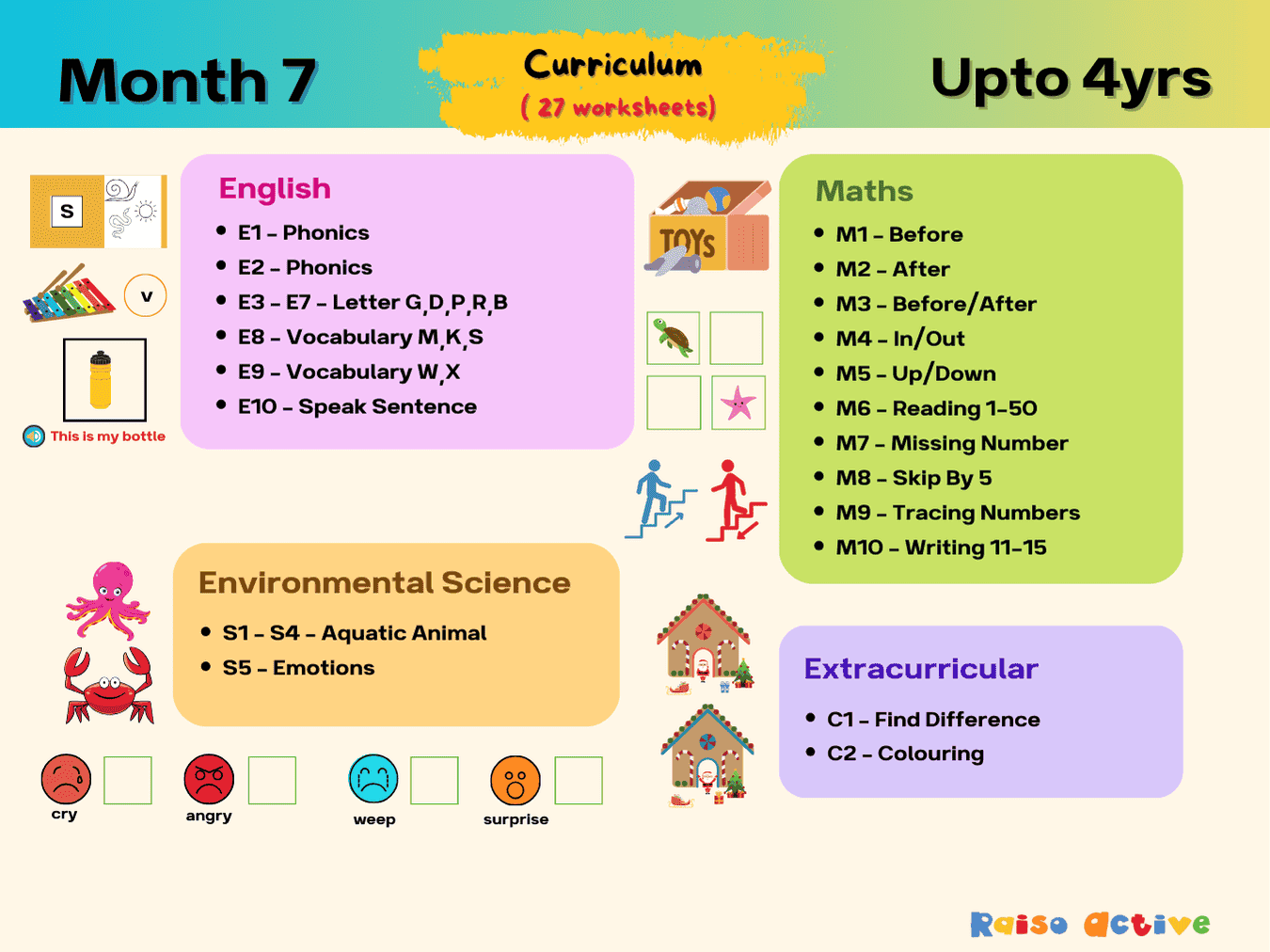
Month 7: Comprehensive preschool learning | Ages Up to 4
This is page 30 of the pack. Ages 2-4 · PreschoolAges 2-4 · NurseryAges 2-4
Made for your child
A whole activity pack made with their name
60 pages to spot, build, trace and write their own name, plus pages about their favourites, feelings and family. See a free preview with their name.
Make an All About Me packFree preview · free for members
Or start free: a name tracing sheet with their nameCurriculum
- Living Things - Animals > Aquatic Animals
How to use this worksheet
Look at the underwater scene together first and name each aquatic animal your child can identify, like a fish, octopus, or starfish. Hand your child crayons or colored pencils and let them choose colors for each creature, encouraging them to stay within the lines as they color. Talk about each animal as they color it, asking questions like 'What do you think this fish eats?' Once finished, have your child point out their favorite animal in the finished picture and say why they picked it.
Materials needed
- Crayons
- Colored Pencils
- Pencil
Extension activities
- 1Research one animal from the page together, learning a fun fact about where it lives or what it eats.
- 2Draw your own ocean scene, adding new sea creatures your child imagines.
- 3Visit an aquarium in person or watch an ocean documentary clip to see the real animals in motion.
- 4Create an ocean-themed sensory bin with blue rice or water beads and small sea-animal toys.

Written by
Hemsweta Jain · Teacher Cheena
MBA and Early Childhood Educator, teaching since 2014 · Founder of RaisoActive, Mumbai
Every RaisoActive worksheet is designed and checked by the founder before publishing.
Published · Last reviewed
More from Month 7: Comprehensive preschool learning | Ages Up to 4
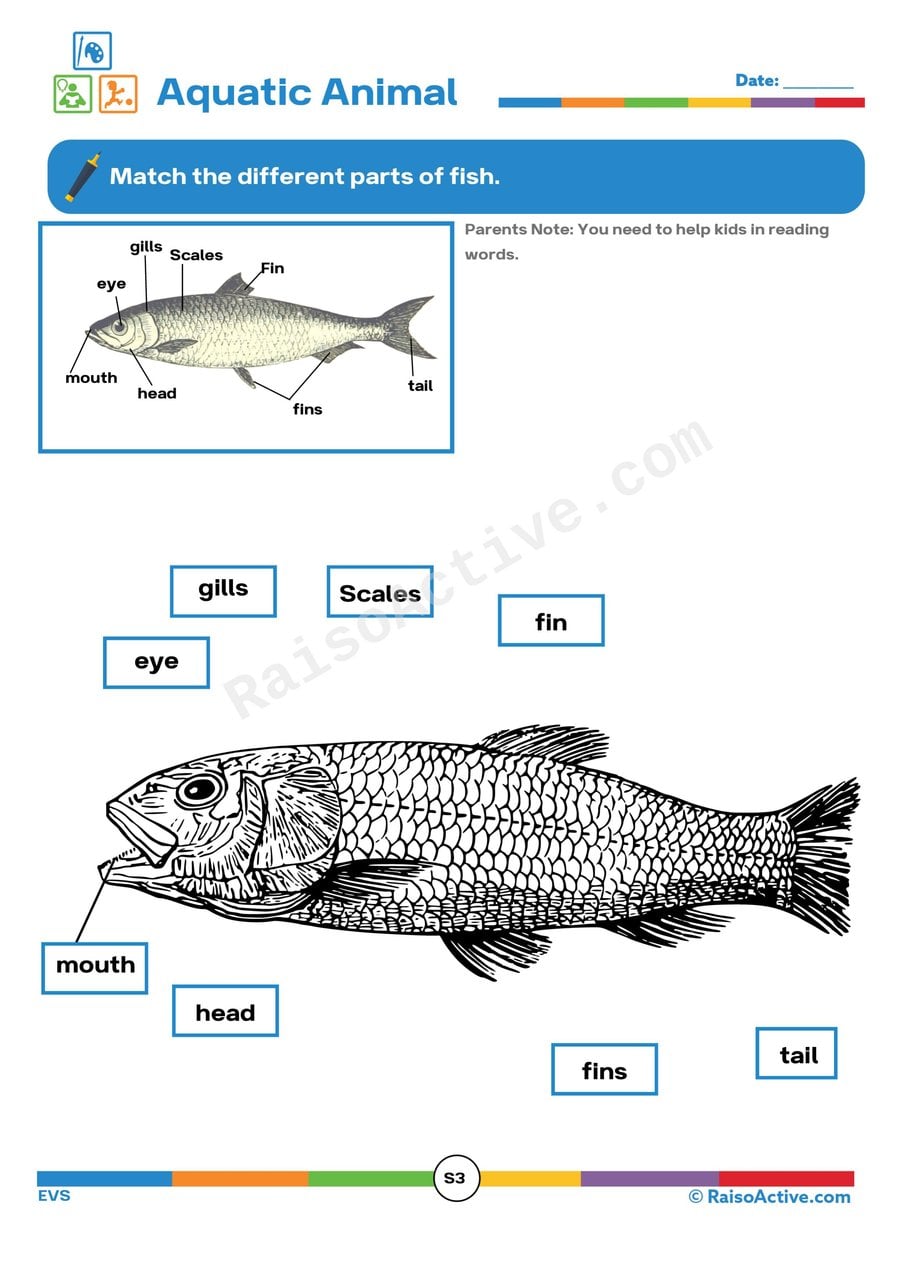
Fish Parts Matching Worksheet for Preschoolers
Ages 3-5 · Preschool–Pre-KAges 3-5 · Nursery–ReceptionAges 3-5 · Nursery–LKGAges 3-5
Preschoolers ages 3-5 learn the specific parts of a fish — like fins, gills, tail, and scales — by drawing lines connecting each written word to the correct location on a fish illustration. This vocabulary-focused matching task builds observational science skills, teaching children to see an animal's individual features rather than one general shape. It also reinforces early word recognition as children connect written labels to visual meaning.

Writing Numbers 11-16 Worksheet: Trace, Write & Count!
Ages 4-6 · Pre-K–KindergartenAges 4-6 · Reception–Year 1Ages 4-6 · LKG–UKGAges 4-6
This worksheet moves children ages 4-6 beyond single-digit numbers, giving them structured practice tracing, writing, and counting the numbers 11 through 16. Working with two-digit numbers for the first time helps children understand place value informally, seeing that these numbers are built from a 'ten' plus more. The paired counting section connects each written number to a matching quantity of objects, reinforcing number meaning rather than just symbol recognition.

Letter R Tracing Worksheet for Preschoolers: Learn to Write & Identify Words
Ages 3-5 · Preschool–Pre-KAges 3-5 · Nursery–ReceptionAges 3-5 · Nursery–LKGAges 3-5
This worksheet has children trace the letter R in multiple formats, a large model, dotted guides, and practice lines, while also identifying words that begin with the 'R' sound, building both handwriting muscle memory and phonics recognition together. For ages three to five, repeated tracing practice across several formats on one page reinforces correct stroke direction far more effectively than a single trace attempt.
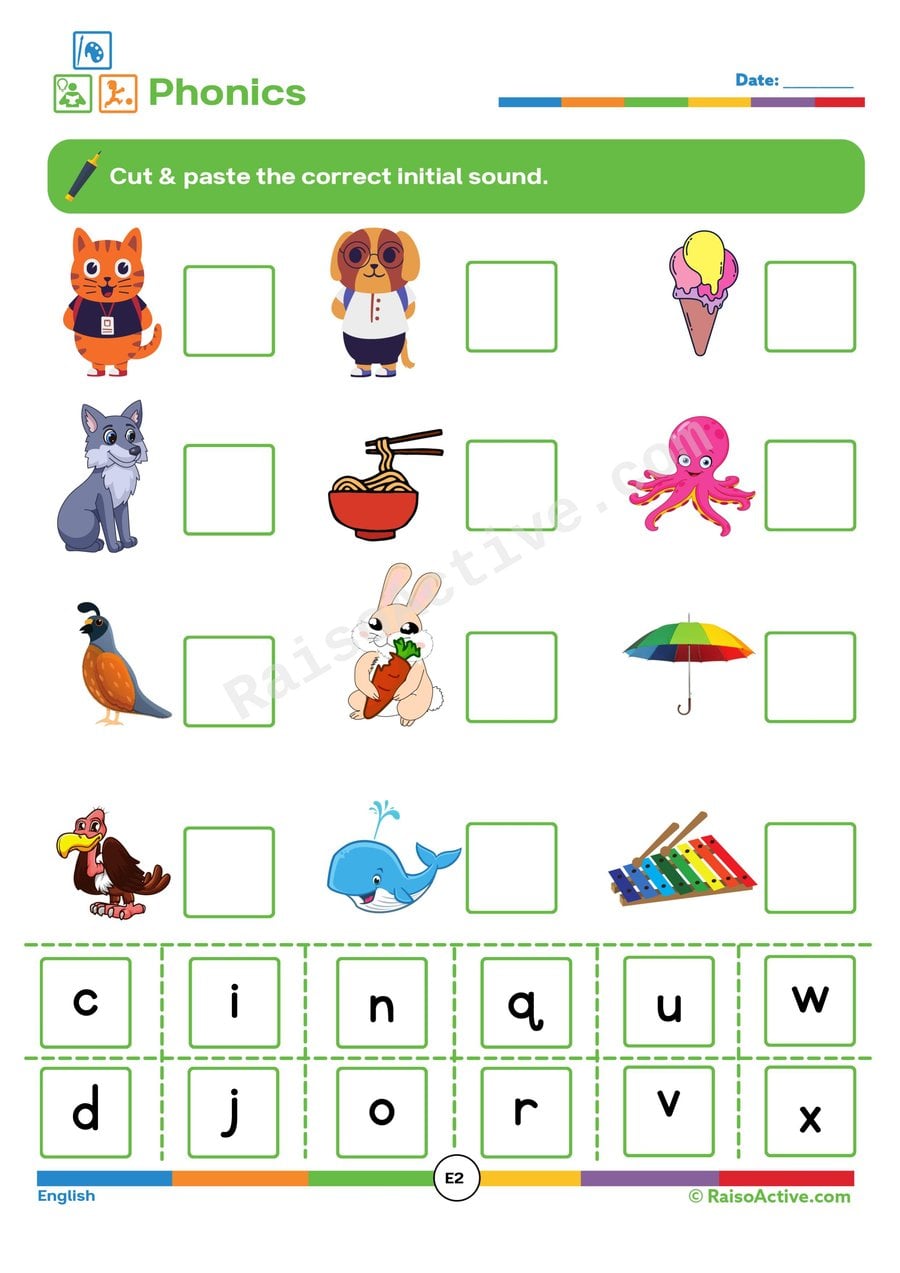
Initial Sound Match: Cut and Paste Worksheet
Ages 4-5 · Pre-KAges 4-5 · ReceptionAges 4-5 · LKGAges 4-5
Children ages 4-5 develop phonemic awareness by identifying the beginning sound of each pictured object and matching it to the correct letter, a critical pre-reading skill for connecting sounds to symbols. This cut-and-paste format adds fine motor practice with scissors and glue alongside the phonics work. Recognizing initial sounds is one of the strongest early predictors of later reading success.
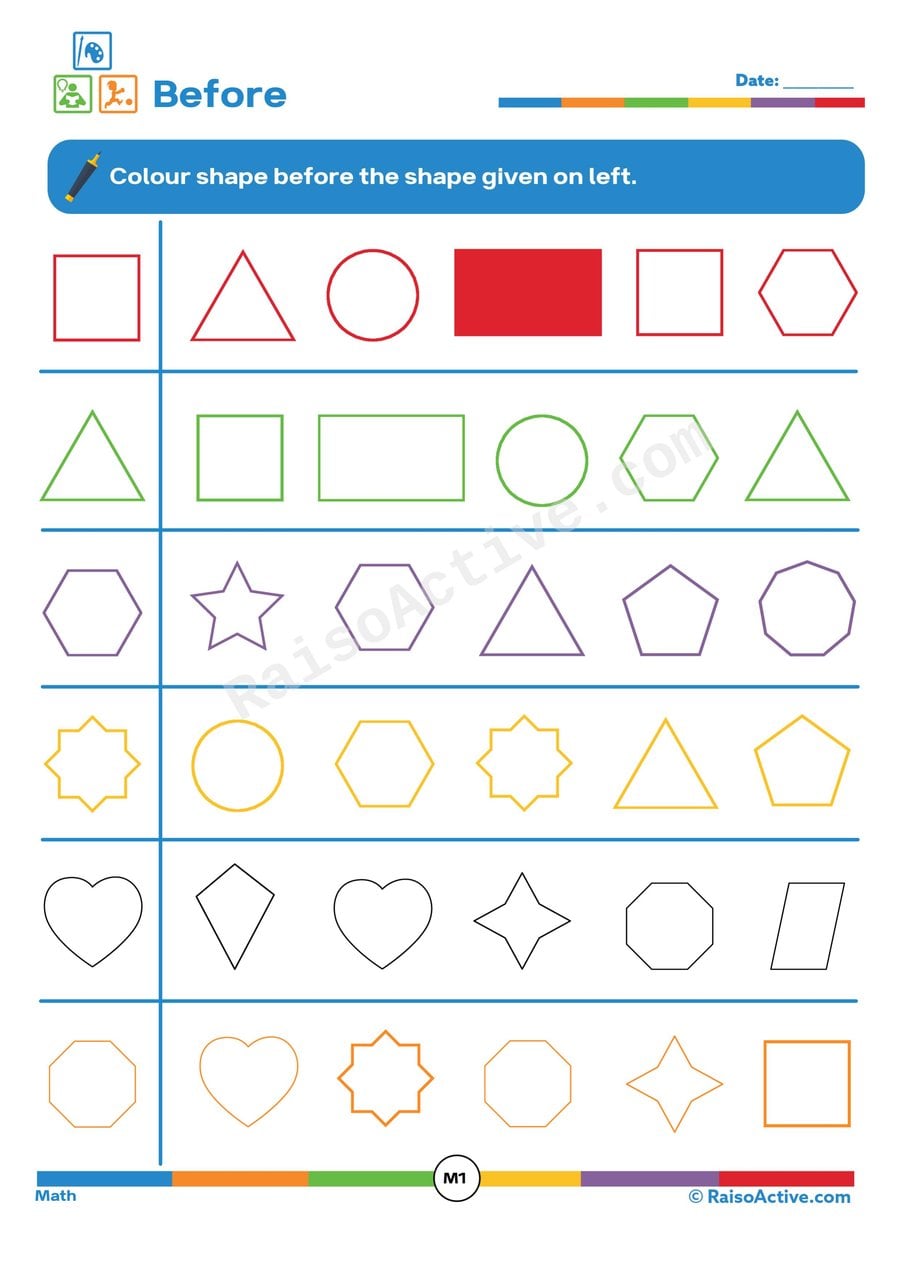
Shape Coloring Worksheet: Before the Shape!
Ages 3-5 · Preschool–Pre-KAges 3-5 · Nursery–ReceptionAges 3-5 · Nursery–LKGAges 3-5
This worksheet combines shape recognition with sequencing by asking children to identify which shape comes before a given shape in a row, requiring them to understand order as well as shape names. For ages three to five, thinking about what comes 'before' something visually is a gentle introduction to ordinal reasoning that will later apply to numbers and letters as well as shapes.
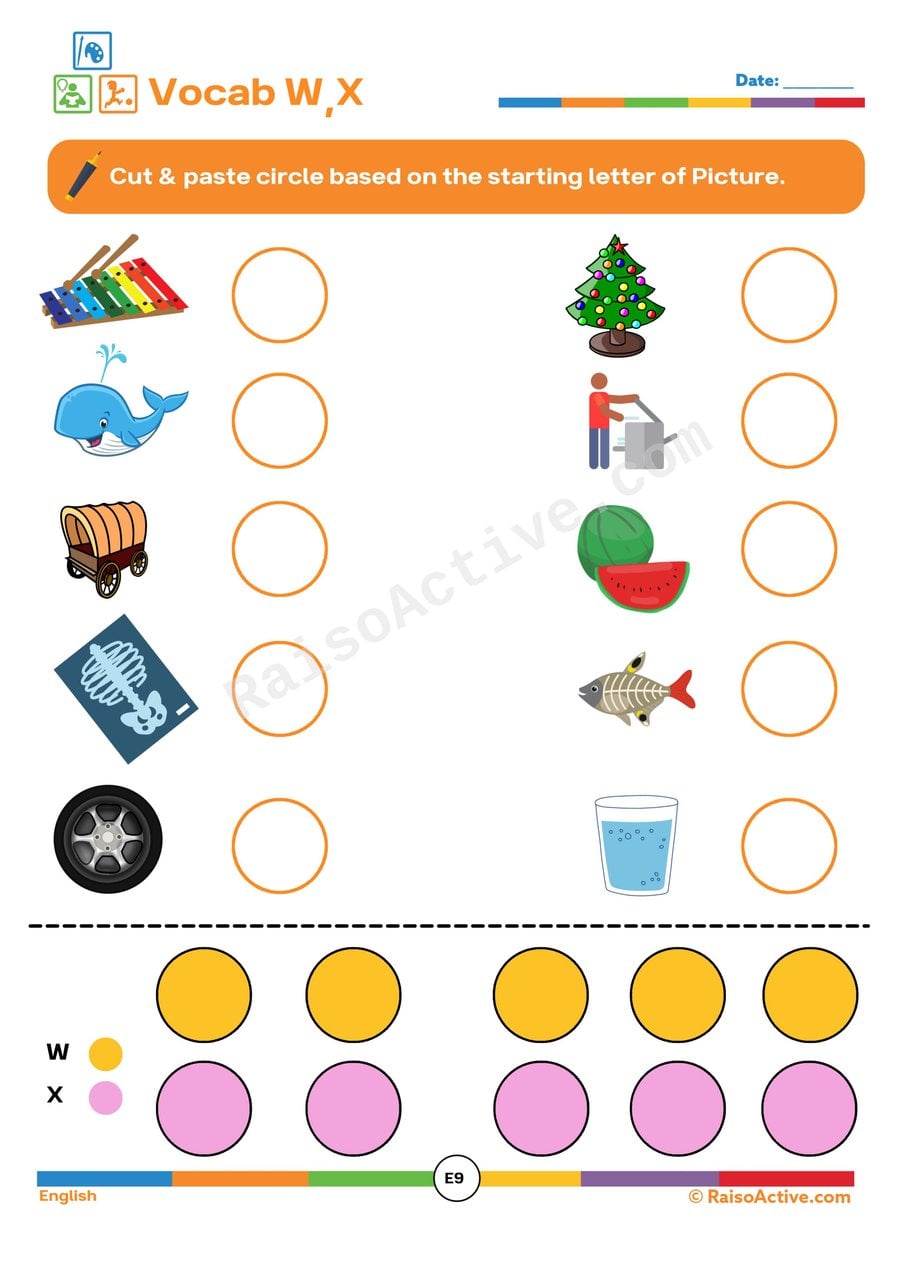
W and X Words Worksheet: Cut and Paste Fun!
Ages 4-5 · Pre-KAges 4-5 · ReceptionAges 4-5 · LKGAges 4-5
Identifying words that start with W and the much rarer letter X gives children practice distinguishing beginning sounds across a wider range of vocabulary, since X-words are less common and require extra attention to hear correctly. For ages four to five, the cut-and-paste format adds a deliberate pause before each answer, helping avoid the rushed guessing that can happen with a quicker matching task.

Before and After: Sequencing Worksheet for Early Learners
Ages 3-5 · Preschool–Pre-KAges 3-5 · Nursery–ReceptionAges 3-5 · Nursery–LKGAges 3-5
Sequencing 'before' and 'after' events trains children to think about time and cause-and-effect in order, a reasoning skill that underlies reading comprehension, like following a story's plot, and everyday routines alike. This cut-and-paste format adds a physical, hands-on layer, requiring children to manipulate and place pictures correctly rather than just pointing, which reinforces the sequencing concept through action.
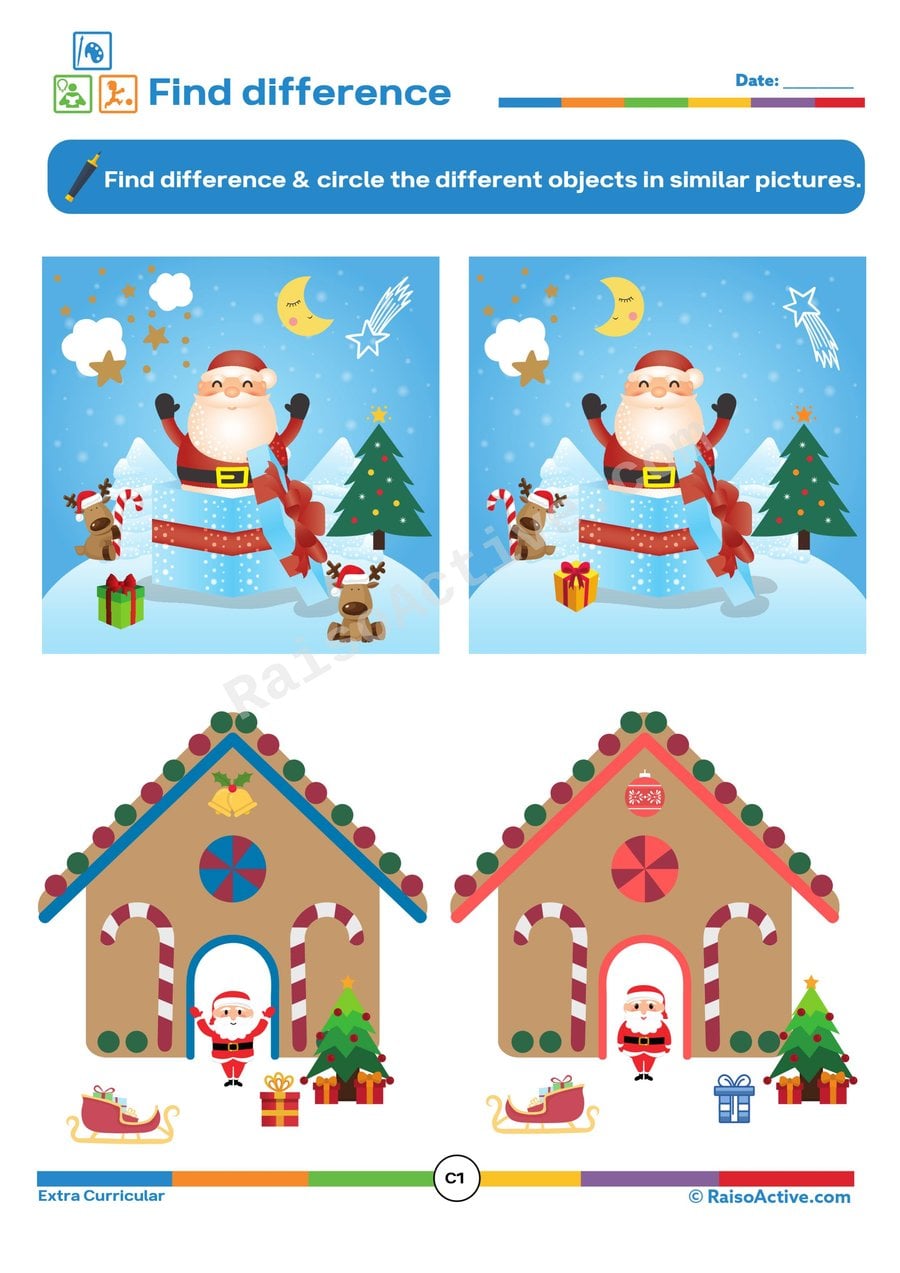
Find the Differences: Christmas Worksheet
Ages 3-5 · Preschool–Pre-KAges 3-5 · Nursery–ReceptionAges 3-5 · Nursery–LKGAges 3-5
Spotting the differences between two nearly identical holiday pictures trains visual discrimination, the ability to notice small details and compare them carefully, a skill that also supports early reading, since distinguishing similar-looking letters (like 'b' and 'd') relies on the same careful visual comparison. The festive Christmas theme adds motivation for ages three to five to stay engaged through a task that requires real sustained attention.
Related worksheets

Easter Egg Color Code Worksheet for Preschoolers
Ages 3-5 · Preschool–Pre-KAges 3-5 · Nursery–ReceptionAges 3-5 · Nursery–LKGAges 3-5
Matching numbers on each Easter egg section to a color key builds number recognition and color-word association in children ages 3-5, since they must hold both a numeral and its assigned color in mind while coloring. This kind of coded coloring activity also strengthens visual scanning, as children need to locate the small numbers printed inside each egg section before choosing the right crayon. Completing the code correctly gives an immediate, visible reward when a colorful, patterned egg emerges from the numbered outline.

Easter Egg Color by Hints Worksheet for Preschoolers
Ages 3-5 · Preschool–Pre-KAges 3-5 · Nursery–ReceptionAges 3-5 · Nursery–LKGAges 3-5
This worksheet has children ages 3-5 listen to or read simple written hints describing shapes and colors, then apply that information correctly while coloring each Easter egg, building early reading comprehension and the ability to follow multi-step verbal instructions. Because the hints must be followed precisely rather than colored freely, children also practice patience and careful attention to detail.

Diwali Night Seek-and-Find: Colour the Street and Spot 8 Things
Ages 4-6 · Pre-K–KindergartenAges 4-6 · Reception–Year 1Ages 4-6 · LKG–UKGAges 4-6
Children colour a big line-art Diwali street with lanterns, garlands, diyas and rangoli, then find eight pictured things in the scene: a cat, sweets, a rangoli, a garland, a lantern, a star, a plant pot and diyas. They tick each one and count the paper lanterns hanging over the street.

Navratri Rangoli Colour by Number and Symmetry Diya
Ages 4-6 · Pre-K–KindergartenAges 4-6 · Reception–Year 1Ages 4-6 · LKG–UKGAges 4-6
Children match numbers to colours using a key, colour a rangoli pattern carefully and draw the other half of a shape so both sides match.
Colour the औ Words – Hindi Letter औ (au) Colouring Worksheet | औ वाली चीज़ों में रंग भरो
Ages 3-7 · Preschool–Grade 1Ages 3-7 · Nursery–Year 2Ages 3-7 · Nursery–Class 1Ages 3-7
Children say each picture name aloud, decide whether it starts with औ, colour the matching pictures (औंधा घड़ा, औज़ार, औरत and औषधि) and the big outline letter, and put a cross on the rest. Sorting by first sound trains the ear and colouring builds hand control.
Colour the उ Things: Hindi Letter उ Colouring Page | रंग भरो · उ
Ages 3-7 · Preschool–Grade 1Ages 3-7 · Nursery–Year 2Ages 3-7 · Nursery–Class 1Ages 3-7
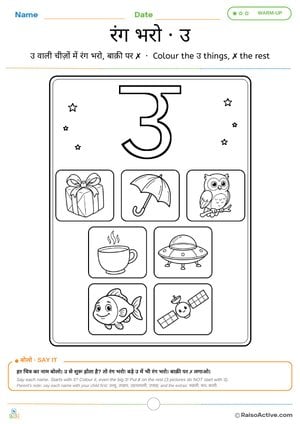
Children listen for the first sound of each picture name and decide whether it starts with उ. They colour the उ pictures, cross out the others and colour the big letter.

Color the Reindeer! Christmas Coloring Worksheet for Kids
Ages 3-5 · Preschool–Pre-KAges 3-5 · Nursery–ReceptionAges 3-5 · Nursery–LKGAges 3-5
Coloring the reindeer and gift bag illustrations gives children ages 3-5 focused practice with crayon control and color selection, helping them build the hand strength and precision needed for later handwriting tasks. Choosing colors for a familiar character like a reindeer also encourages imaginative decision-making, since there's no single 'correct' color for a fictional animal's coat or a wrapped gift. The festive subject matter keeps a repetitive fine motor task feeling like a treat rather than a chore.

Happy Easter Coloring Card Worksheet for Preschoolers
Ages 3-5 · Preschool–Pre-KAges 3-5 · Nursery–ReceptionAges 3-5 · Nursery–LKGAges 3-5
Coloring the Easter egg and bunny images on this fold-into-a-card worksheet gives children ages 3-5 practice with controlled crayon strokes and color choice, while the act of turning their artwork into a card for someone else introduces an early sense of purpose and gift-giving. Because the finished piece becomes a keepsake rather than just a worksheet, children also build pride and motivation to complete their coloring carefully. This blends fine motor practice with a first taste of creating something meaningful for another person.
Guides for this topic

Best Worksheets for 3-Year-Olds: What Works and What to Avoid
What works on worksheets for 3-year-olds: short sessions, crayons, tracing lines, matching, cutting, a free weekly plan, and signs one is too advanced.
Fostering Creativity in Structured Learning: The Perfect Balance for Young Minds
Learn how to blend creativity with structured learning for children ages 1-8. Practical strategies, activities, and printable worksheets for parents and teachers.
Celebrating Diversity: How to Incorporate Cultural Awareness in Learning Activities for Young Children
Practical cultural awareness activities for young children aged 2-8. Explore Indian festivals, world cultures, food, music, and crafts to teach diversity and inclusion.
Reviews
Every worksheet for ages 3–5, no watermark
Members download the full library of 1,000+ worksheets and every activity pack without watermarks or daily limits. One year costs ₹999 in India or $20 elsewhere.
See membership plansOr download any worksheet free with a watermark (5 a day).