Find the Differences: Christmas Worksheet
Spotting the differences between two nearly identical holiday pictures trains visual discrimination, the ability to notice small details and compare them carefully, a skill that also supports early reading, since distinguishing similar-looking letters (like 'b' and 'd') relies on the same careful visual comparison. The festive Christmas theme adds motivation for ages three to five to stay engaged through a task that requires real sustained attention.
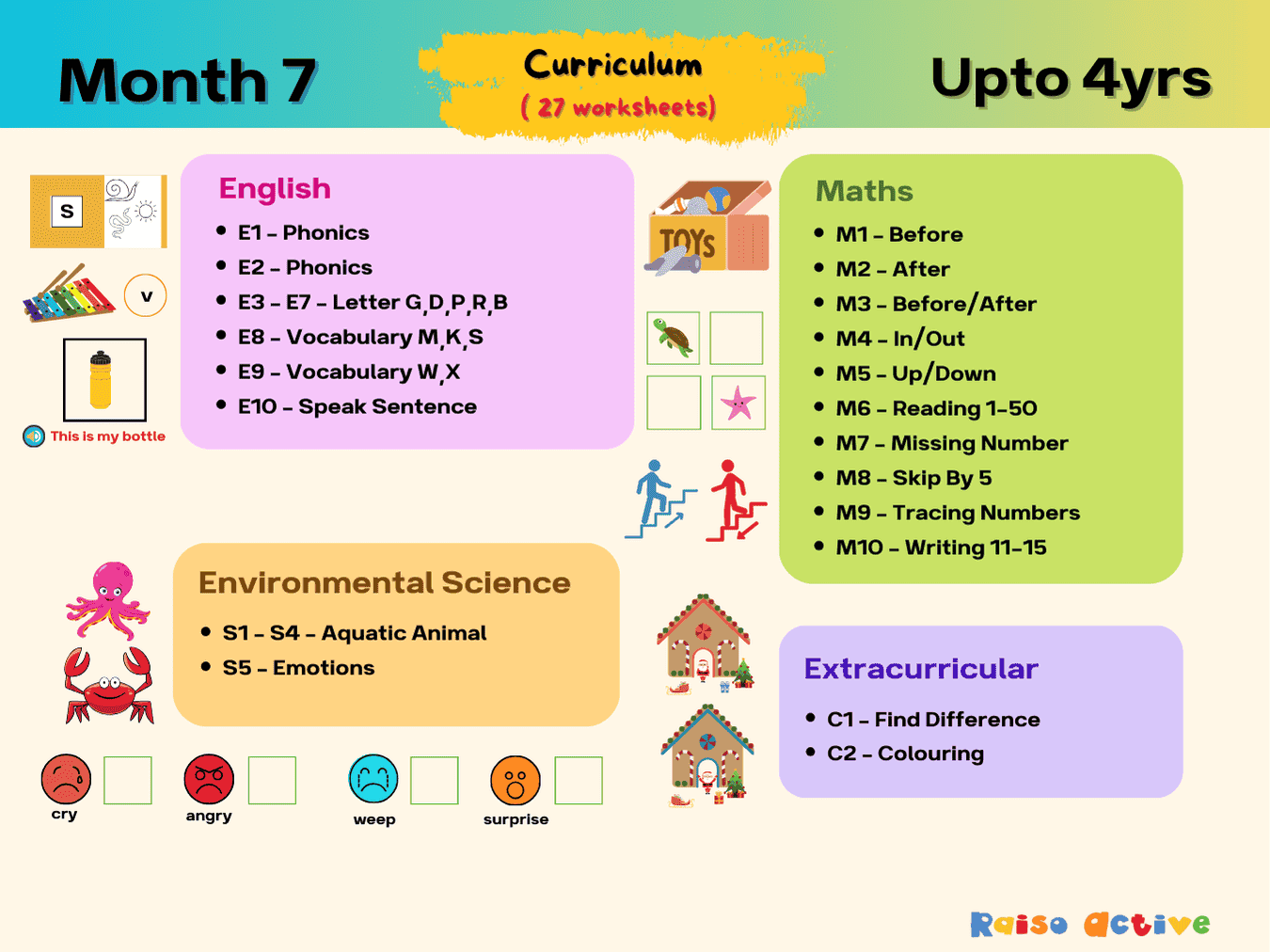
Part of the pack
Month 7: Comprehensive preschool learning | Ages Up to 4
This is page 29 of the pack. Ages 2-4 · PreschoolAges 2-4 · NurseryAges 2-4
Curriculum
- Culture & Festivals > Christmas Activities
How to use this worksheet
Look at both pictures side by side first and ask your child what they notice about the overall scene before hunting for differences. Have them scan one section of the picture at a time, top-left, then top-right, and so on, comparing the two images closely rather than glancing back and forth randomly. When they spot a difference, have them circle it on the picture where it appears. Continue until all the differences have been found, and count together how many they identified.
Materials needed
- Pencil
- Crayons
Extension activities
- 1Have the child describe the differences they found out loud, explaining what changed between the two pictures.
- 2Encourage the child to create their own simple 'find the difference' picture by drawing two similar scenes with a few changes.
- 3Play a memory-based version: look at one picture for ten seconds, cover it, then describe as many details as possible.
- 4Search for real-life 'differences' around the house, like spotting what changed after tidying up a room.

Written by
Hemsweta Jain · Teacher Cheena
MBA and Early Childhood Educator, teaching since 2014 · Founder of RaisoActive, Mumbai
Every RaisoActive worksheet is designed and checked by the founder before publishing.
Published · Last reviewed
More from Month 7: Comprehensive preschool learning | Ages Up to 4

Fun Phonics Activities: Letter S Worksheet for Preschoolers
Ages 3-5 · Preschool–Pre-KAges 3-5 · Nursery–ReceptionAges 3-5 · Nursery–LKGAges 3-5
This multi-part activity page immerses preschoolers in the sound and shape of the letter 'S' through drawing, speaking, and playful games rather than a single worksheet task, which research on early phonics shows helps the sound-letter connection stick faster than tracing alone. Ages three to five benefit especially from this variety, since moving between drawing, talking, and active games matches their short attention spans while reinforcing the same target sound from multiple directions.
Fish Parts Matching Worksheet for Preschoolers
Ages 3-5 · Preschool–Pre-KAges 3-5 · Nursery–ReceptionAges 3-5 · Nursery–LKGAges 3-5
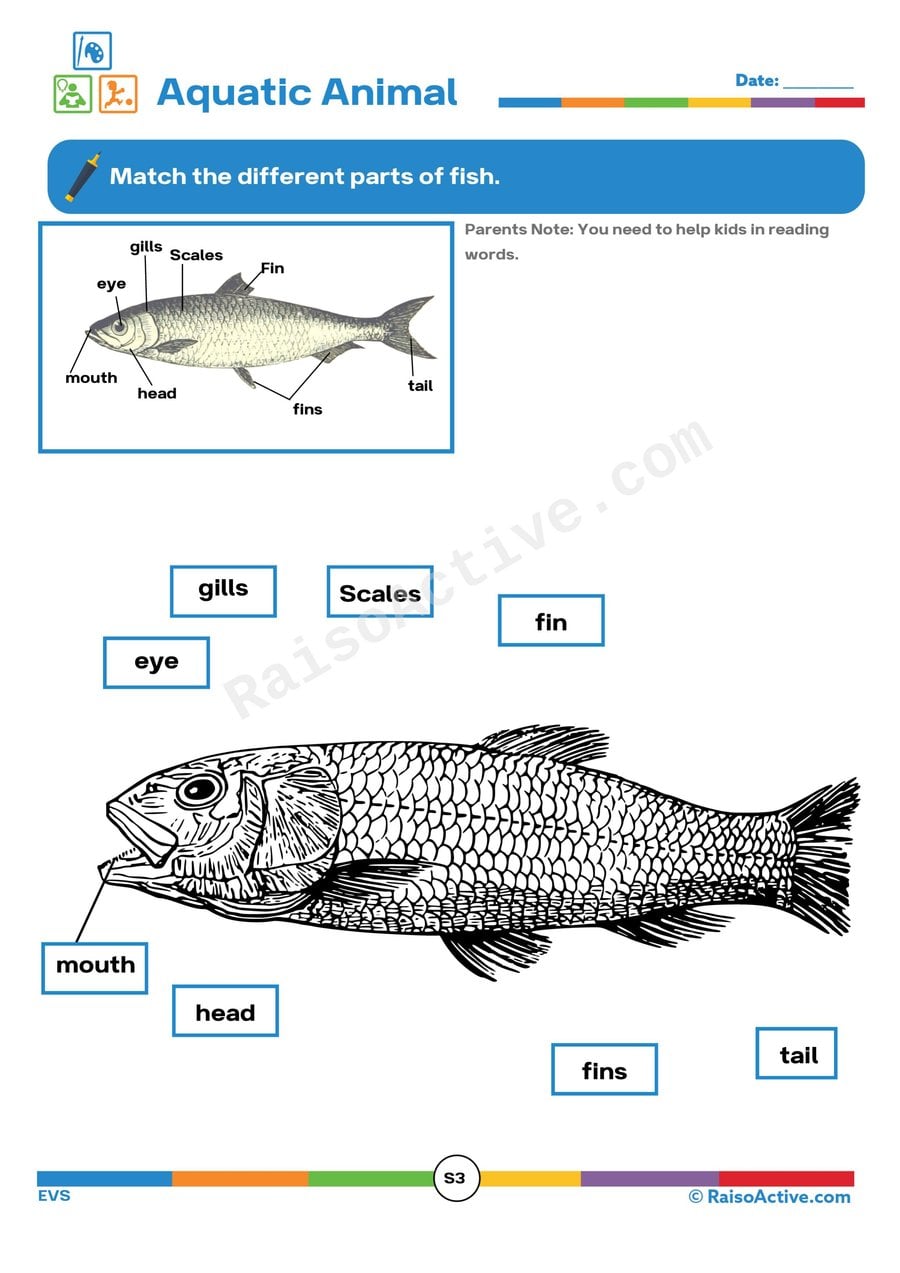
Preschoolers ages 3-5 learn the specific parts of a fish — like fins, gills, tail, and scales — by drawing lines connecting each written word to the correct location on a fish illustration. This vocabulary-focused matching task builds observational science skills, teaching children to see an animal's individual features rather than one general shape. It also reinforces early word recognition as children connect written labels to visual meaning.

Writing Numbers 11-16 Worksheet: Trace, Write & Count!
Ages 4-6 · Pre-K–KindergartenAges 4-6 · Reception–Year 1Ages 4-6 · LKG–UKGAges 4-6
This worksheet moves children ages 4-6 beyond single-digit numbers, giving them structured practice tracing, writing, and counting the numbers 11 through 16. Working with two-digit numbers for the first time helps children understand place value informally, seeing that these numbers are built from a 'ten' plus more. The paired counting section connects each written number to a matching quantity of objects, reinforcing number meaning rather than just symbol recognition.

Match the Parts of a Crab Worksheet for Preschoolers
Ages 3-5 · Preschool–Pre-KAges 3-5 · Nursery–ReceptionAges 3-5 · Nursery–LKGAges 3-5
Learning to label the parts of a crab, claws, shell, legs, eyes, introduces preschoolers to basic animal anatomy vocabulary and the idea that living things are made of distinct, named parts, an early step toward more formal science observation later on. Matching labels to a diagram also strengthens visual scanning, since children must locate the correct part on the picture before connecting it to its name.

Cut and Paste Initial Sounds Worksheet for Preschoolers
Ages 4-5 · Pre-KAges 4-5 · ReceptionAges 4-5 · LKGAges 4-5
This worksheet asks children to identify the very first sound of a picture's name and then physically select and paste the matching letter, combining phoneme isolation with a hands-on confirmation step that a simple matching line doesn't provide. For ages four to five, the cutting and choosing process slows the task down just enough to make sure the sound-letter connection is deliberate rather than a quick guess.

Color the Animals! M, K, S Beginning Sounds Worksheet for Preschool
Ages 3-5 · Preschool–Pre-KAges 3-5 · Nursery–ReceptionAges 3-5 · Nursery–LKGAges 3-5
By coloring circles according to a color key tied to the beginning sound of each animal's name, this worksheet trains children to isolate the very first sound in a word, a skill called phoneme isolation that is one of the strongest early predictors of reading success. Working with the letters M, K, and S specifically gives practice distinguishing sounds that can be tricky to tell apart when spoken quickly.
Skip Counting by 5: Maze Worksheet for Kids
Ages 4-6 · Pre-K–KindergartenAges 4-6 · Reception–Year 1Ages 4-6 · LKG–UKGAges 4-6
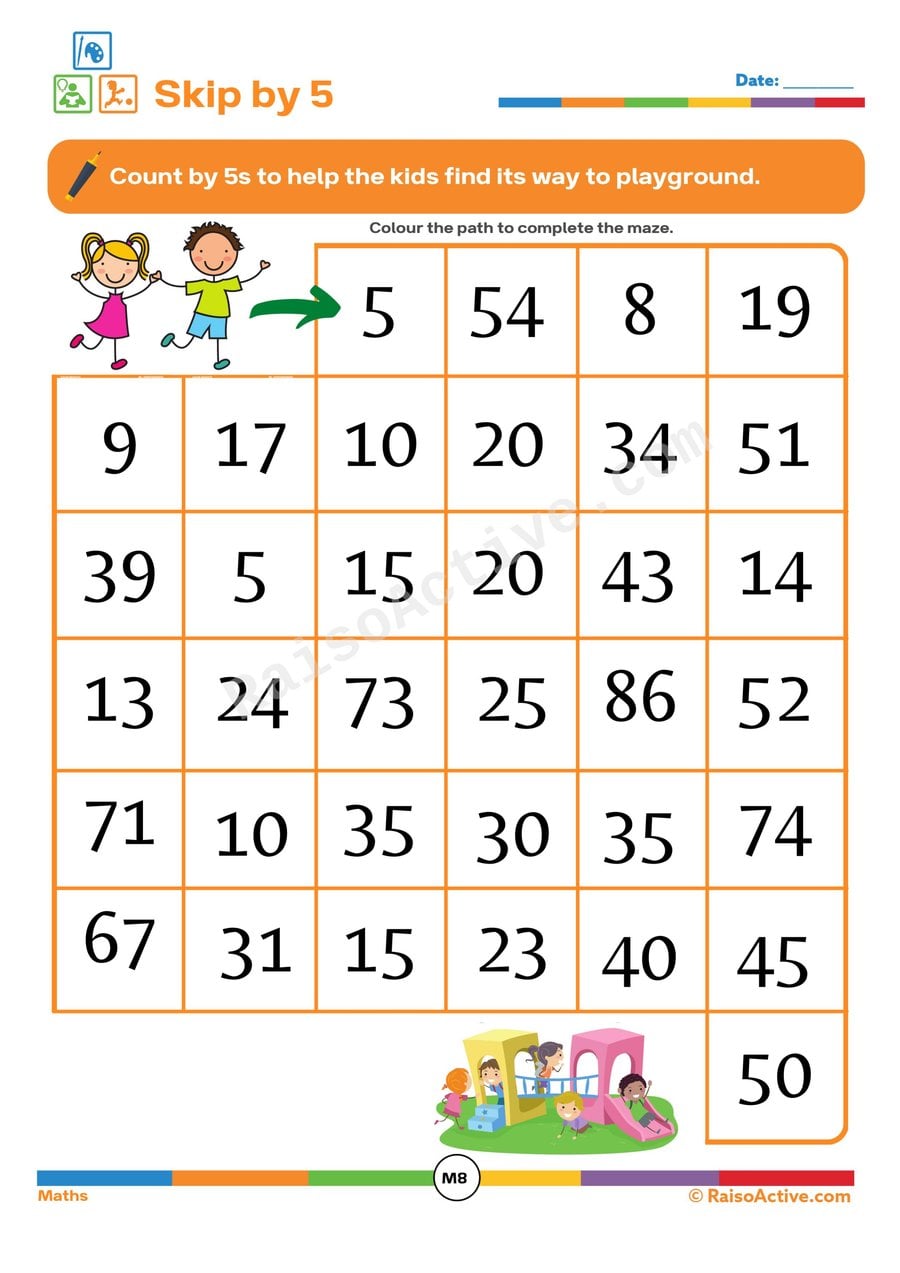
Skip counting by fives is a stepping stone toward multiplication and telling time on a clock face, and this maze format turns that abstract number pattern into a concrete navigation task. Ages four to six benefit from the built-in feedback a maze provides: choosing the wrong number sends the path to a dead end, so children learn to self-correct their counting in real time.
Speak Sentences Worksheet: Cut, Paste, and Match!
Ages 3-5 · Preschool–Pre-KAges 3-5 · Nursery–ReceptionAges 3-5 · Nursery–LKGAges 3-5
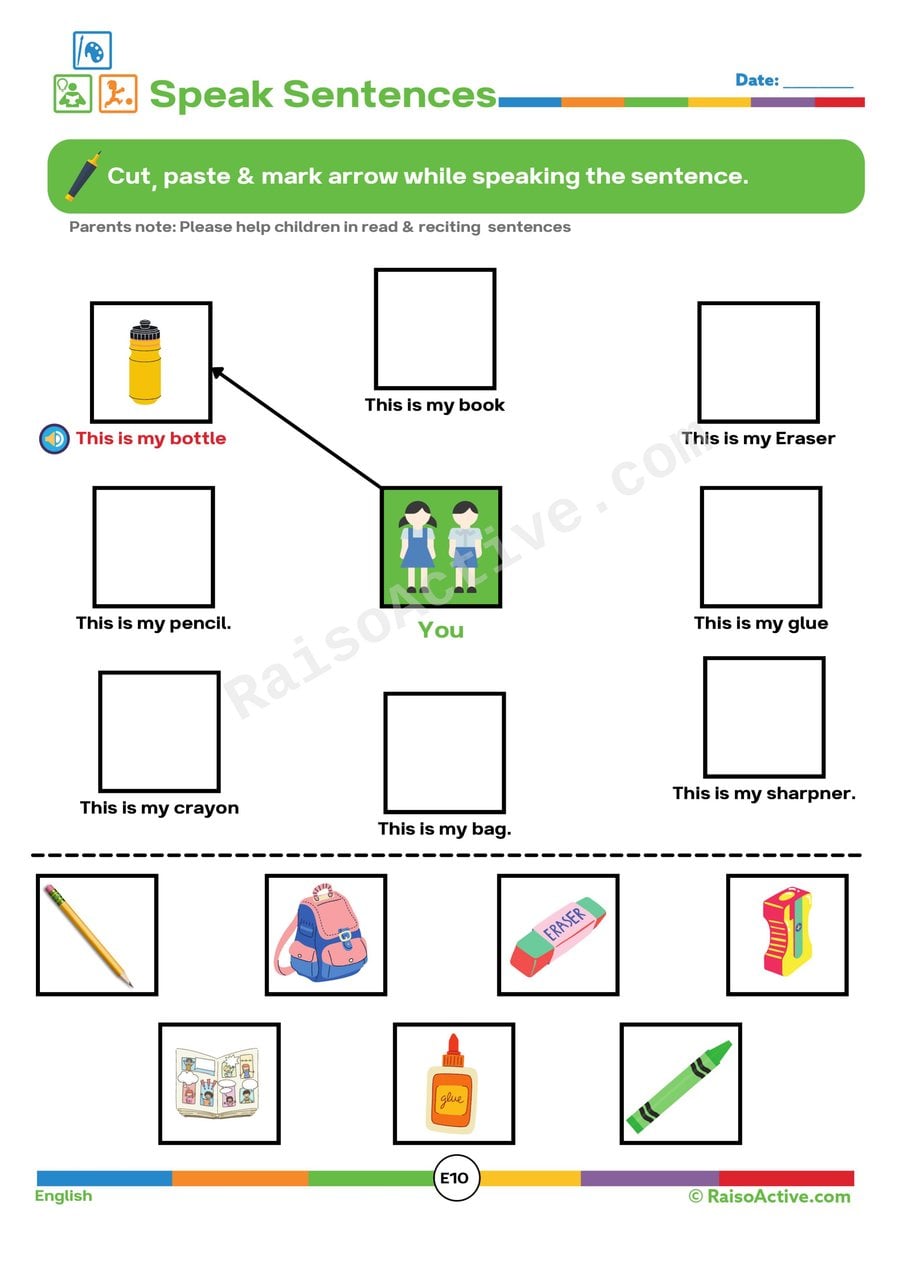
Children ages 3-5 practice matching spoken sentence meaning to pictures by cutting out images and pasting them next to the correct simple sentence, building early reading comprehension. This task requires connecting written or read-aloud words to real-world meaning, a critical step before children can read independently for understanding. The cutting and pasting also continues building the fine motor precision needed for handwriting and other classroom tasks.
Related worksheets
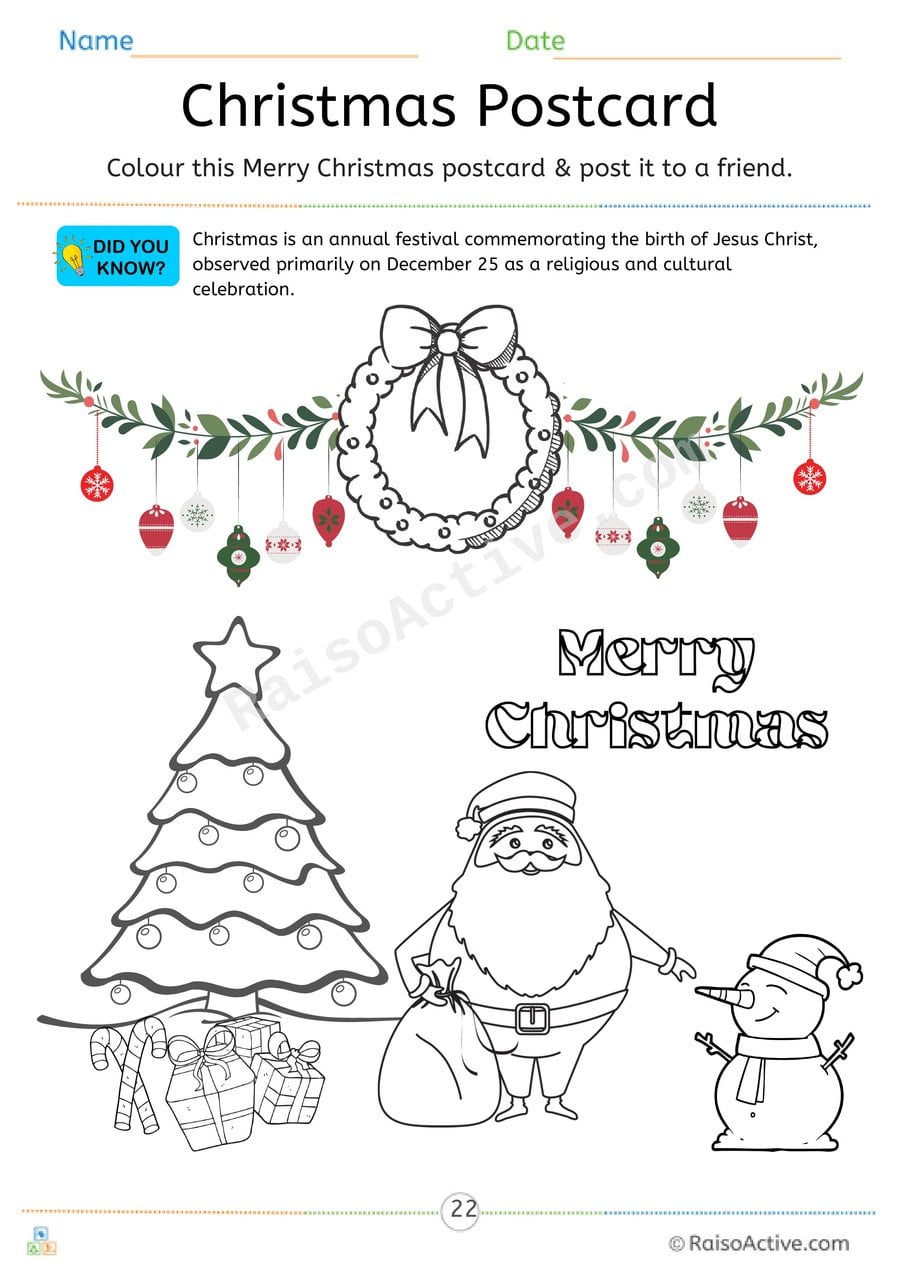
Merry Christmas Coloring Worksheet for Kids
Ages 4-8 · Pre-K–Grade 2Ages 4-8 · Reception–Year 3Ages 4-8 · LKG–Class 2Ages 4-8
Children learn that Christmas is celebrated on 25 December around the world and colour a postcard with Santa, a tree, a snowman and a wreath.
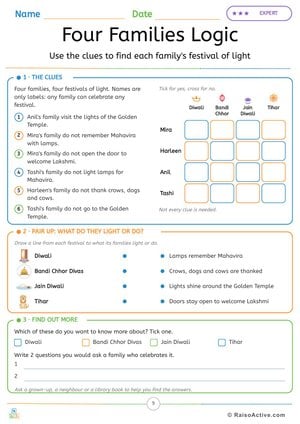
Four Families Logic: Diwali Festivals Logic Grid Puzzle
Ages 7-10 · Grade 2–Grade 3Ages 7-10 · Year 3–Year 4Ages 7-10 · Class 2–Class 3Ages 7-10
Children use six clues to solve a logic grid with four families and four festivals of light, then draw lines to match each festival to what its families light or do and write two questions to ask.
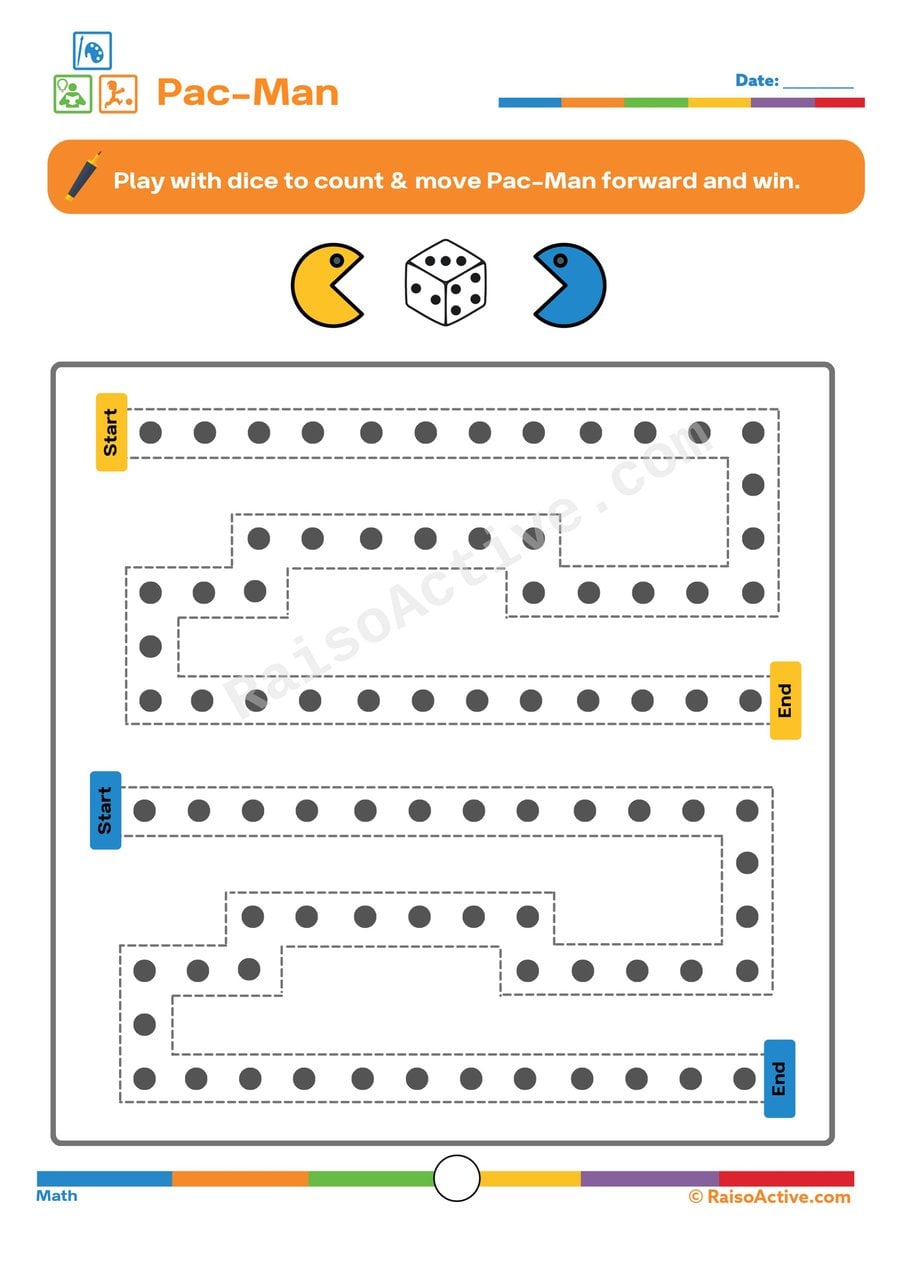
Pac-Man Maze Worksheet: Count and Move!
Ages 3-5 · Preschool–Pre-KAges 3-5 · Nursery–ReceptionAges 3-5 · Nursery–LKGAges 3-5
This dice-counting maze gives children ages 3-5 repeated practice matching a rolled number to the correct number of moves, reinforcing accurate counting under a bit of playful pressure. Tracking Pac-Man's current position after each roll also builds short-term spatial memory, since children must remember where they left off before moving again.

Parts of a Leaf Worksheet for Preschoolers: Learn and Play!
Ages 3-5 · Preschool–Pre-KAges 3-5 · Nursery–ReceptionAges 3-5 · Nursery–LKGAges 3-5
This hands-on activity teaches children ages 3-5 the parts of a leaf — tip, blade, veins, midrib, petiole, and stem — by having them shape a leaf from playdough while comparing it to a real leaf. Building a physical model alongside a real specimen helps children connect abstract vocabulary to tangible features they can see and touch, which is especially effective for this age group.

Navratri Picture Sudoku and Story Sequencing: Think It Through
Ages 4-6 · Pre-K–KindergartenAges 4-6 · Reception–Year 1Ages 4-6 · LKG–UKGAges 4-6
Children use logic to complete a 4x4 picture sudoku where each row and column has each picture once, and put four story pictures in order.

Merry Christmas Coloring Worksheet for Preschoolers
Ages 3-5 · Preschool–Pre-KAges 3-5 · Nursery–ReceptionAges 3-5 · Nursery–LKGAges 3-5
Filling in Christmas-themed pictures with crayons or colored pencils helps children ages 3-5 refine their pencil grip and hand control while practicing the concept of staying within a defined boundary. Because the pictures include multiple familiar holiday objects, this worksheet also gives children a chance to build vocabulary by naming each item as they color it. Repeated coloring practice at this age steadily improves the wrist and finger strength needed for later writing tasks.

States of Matter Worksheet: Exploring Solids, Liquids, and Gases!
Ages 4-6 · Pre-K–KindergartenAges 4-6 · Reception–Year 1Ages 4-6 · LKG–UKGAges 4-6
This worksheet introduces children ages 4-6 to the three states of matter — solid, liquid, and gas — by having them examine images and sort each one into its correct category. Learning to classify familiar objects (like ice, water, and steam) by their physical state builds early scientific reasoning, since children must look past an object's identity and focus on its underlying properties.

Color Santa Claus for Christmas! A Fun Coloring Worksheet
Ages 3-5 · Preschool–Pre-KAges 3-5 · Nursery–ReceptionAges 3-5 · Nursery–LKGAges 3-5
This Santa Claus coloring page lets children ages 3-5 practice crayon control and color selection on a large, familiar holiday figure, building confidence with fine motor coloring skills before moving to smaller or more detailed pictures. Choosing colors for Santa's suit, hat, and beard also opens up conversation about the holiday season and familiar seasonal symbols.
Guides for this topic

Age-Appropriate Problem-Solving Activities: Building Critical Thinkers from the Ground Up
Discover fun, age-appropriate problem-solving activities for children ages 1-8. Build critical thinking, logic, and reasoning skills through play-based learning.
Critical Thinking Activities That Actually Work for Young Children: Building Tomorrow's Thinkers Today
Discover proven critical thinking activities for young children. Age-wise logic games, questioning techniques, and hands-on ideas to build thinking skills at home.

Preparing Your Child for a Rapidly Changing World: Essential Skills for Future Success
Discover the essential 21st century skills your child needs for future success. Practical tips on creativity, critical thinking, digital literacy & emotional intelligence for ages 1-8.
Reviews
Every worksheet for ages 3–5, no watermark
Members download the full library of 1,000+ worksheets and every activity pack without watermarks or daily limits. One year costs ₹999 in India or $20 elsewhere.
See membership plansOr download any worksheet free with a watermark (5 a day).