Looking for a structured learning path?
Explore our age-wise monthly curriculum with 4 subjects per month
Free Printable Worksheets
Browse Worksheets
Download free educational worksheets for children ages 1-8. Perfect for preschool, kindergarten, and early elementary learning activities.
Filters
Age Range
Curriculum
Tags

Tenses Worksheet: Identifying Past, Present, and Future Verbs
Identifying whether an underlined verb describes something that already happened, is happening now, or will happen later introduces children ages 4-6 to verb tense, an important step toward constructing grammatically correct sentences of their own.

Tense Time! A Worksheet on Past, Present, and Future Verbs
This worksheet has 4-6 year olds take a given verb and write it correctly in past, present, and future tense boxes, which is a more demanding task than simply identifying tense since it requires actually producing the correct verb form each time — including the common '-ed' ending pattern for regular verbs. Practicing this transformation across multiple verbs builds the flexible understanding that the same action word changes shape depending on when it happens.
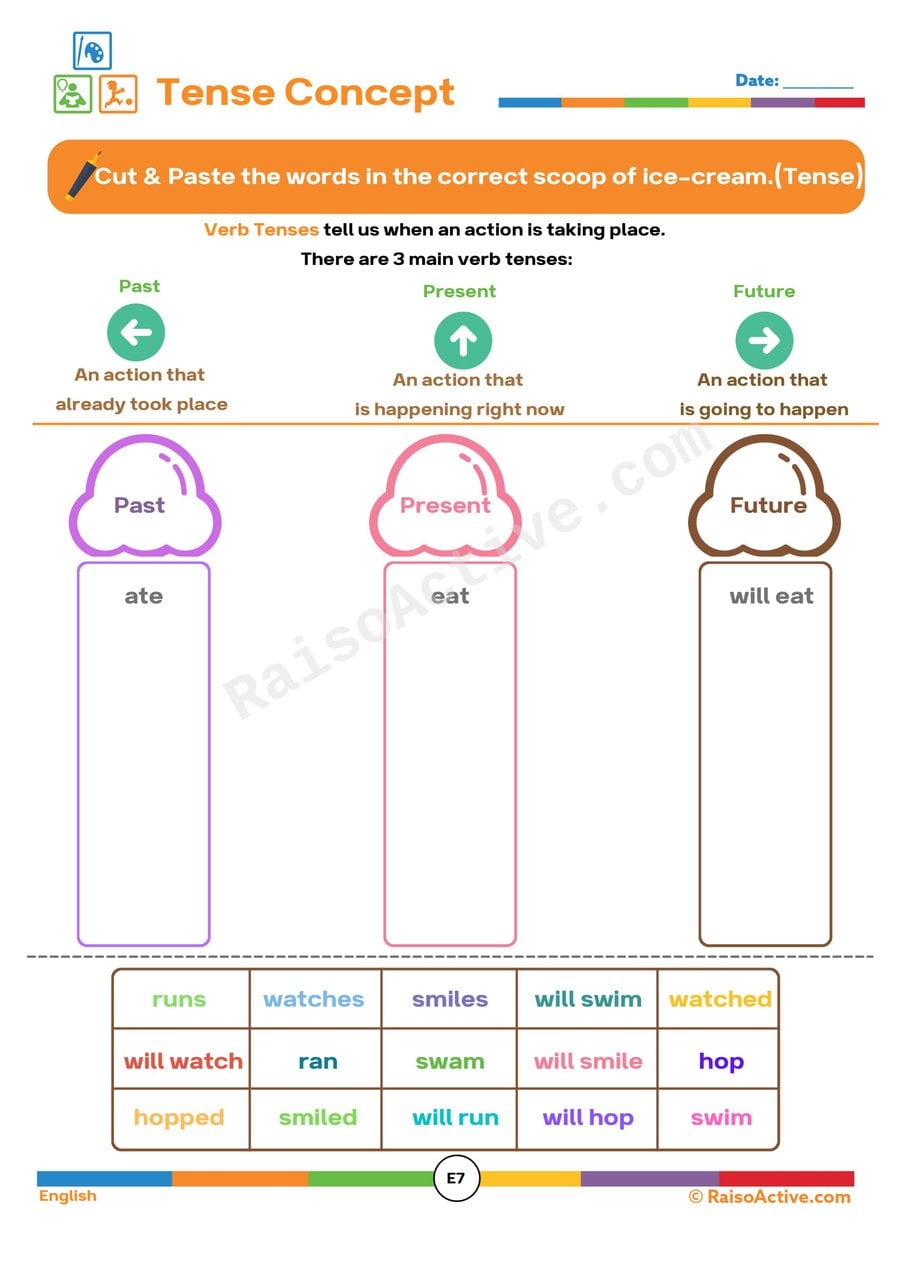
Tense Time! Cut and Paste the Verbs Worksheet
Sorting verbs into past, present, and future ice cream scoops teaches 4-6 year olds that verbs physically change form to show when something happens — a foundational grammar concept that often trips kids up because English tense endings are inconsistent (walked, but went, not goed). Because your child has to read each word, decide its tense, and then correctly cut and place it, the worksheet demands genuine comprehension rather than pattern-matching by ending alone, especially where irregular verbs are involved.

Tense Time! Identifying Past, Present, and Future Tense Worksheet
This worksheet asks 5-7 year olds to read a full sentence and identify which tense it's written in — past, present, or future — based on the verb form and clue words used, which is a meaningfully harder skill than simply writing verbs in different tenses since it requires recognizing the grammar pattern rather than producing it. This kind of tense-identification practice is exactly what supports stronger reading comprehension and writing later, since understanding when something happens is core to following any story.
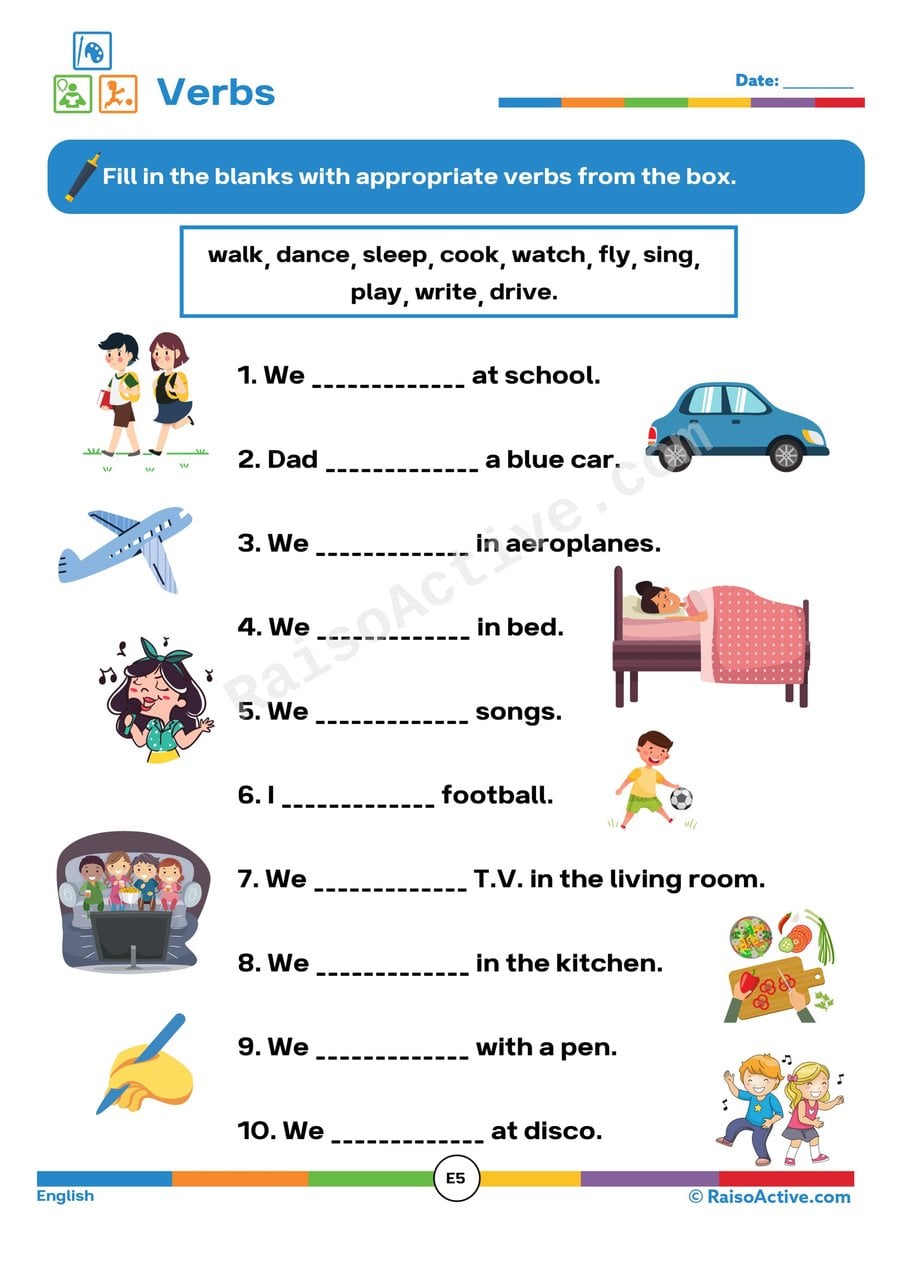
Action Verbs Worksheet: Fill in the Blanks!
This worksheet moves 4-6 year olds a step beyond matching verbs to pictures — now they have to read a full sentence, understand its meaning, choose the correct verb from a word box, and write it into the blank themselves. That combination of reading comprehension, vocabulary selection, and handwriting makes this noticeably more demanding than earlier action-word worksheets, and it's exactly the kind of sentence-completion task children will meet again in early elementary grammar lessons.

Action Verbs Worksheet: Cut and Paste the Correct Verb!
This cut-and-paste worksheet asks young children to look at a picture of an action, choose the matching verb from a set of cutouts at the bottom of the page, and glue it into the blank — practicing verb-to-image matching alongside genuine scissor and glue control. Because the verbs aren't pre-placed, your child has to actively decide which word fits each picture rather than simply confirming an existing pairing, which makes the vocabulary work more demanding than a standard matching worksheet.
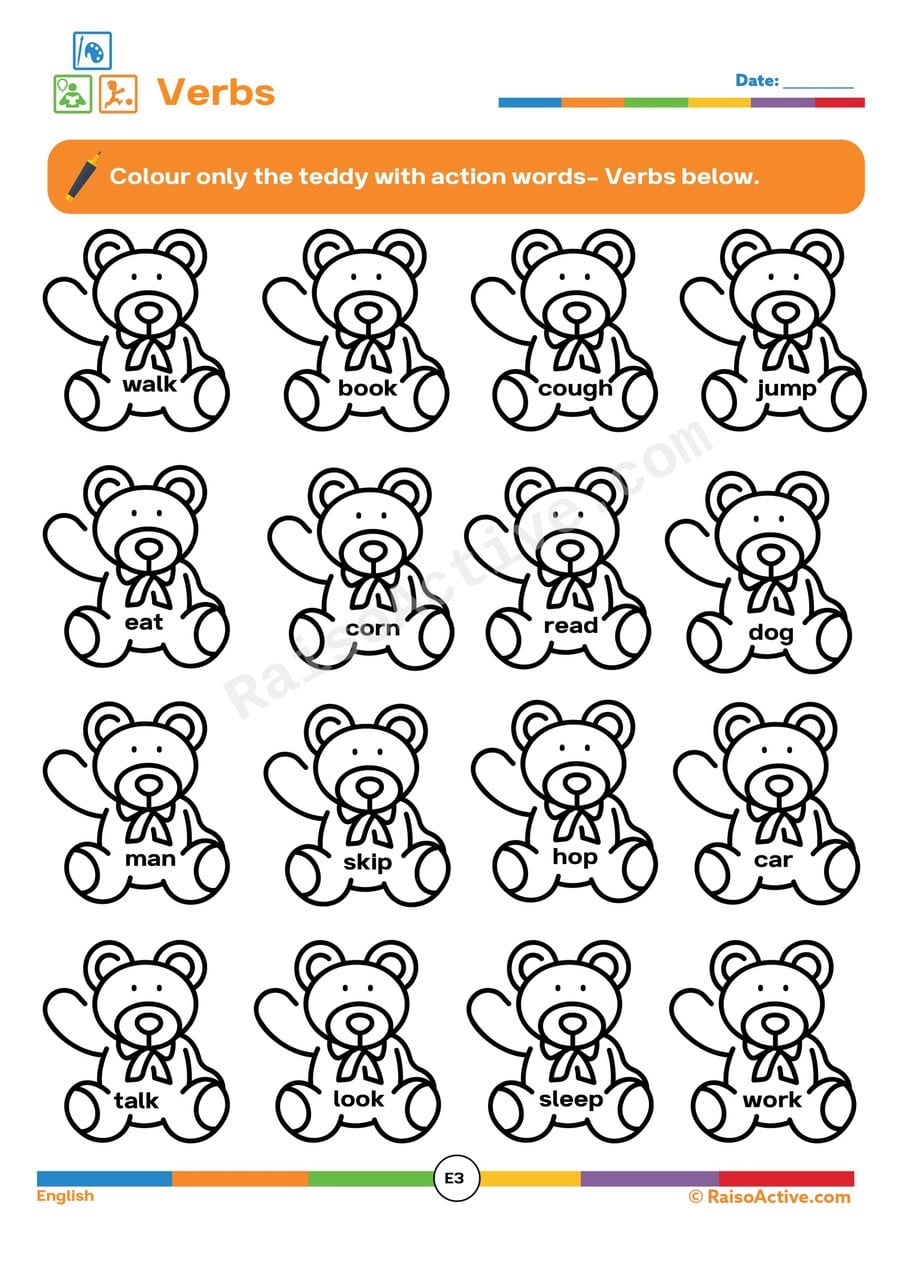
Action Word Coloring Worksheet for Preschoolers
This worksheet trains 3-5 year olds to follow a written instruction precisely — color only the teddy bears paired with specific action words, and leave the rest blank. That precision is the real skill being built: your child has to read or recognize each action word before deciding whether to color, rather than coloring everything in sight. It's an early, low-stakes way to connect written verbs to their meaning while also practicing careful, purposeful coloring instead of open-ended scribbling.

Action Verbs Worksheet: Identify and Color Verbs in the Picture
This worksheet asks 3-5 year olds to look closely at a busy picture and decide which action verbs are actually happening in it versus which ones aren't shown at all, using a color code (green for present, red for absent) to record their answer. That distinction — is this action really happening in the picture, or just a word I know? — pushes your child to observe carefully rather than simply recognize verb vocabulary in isolation.
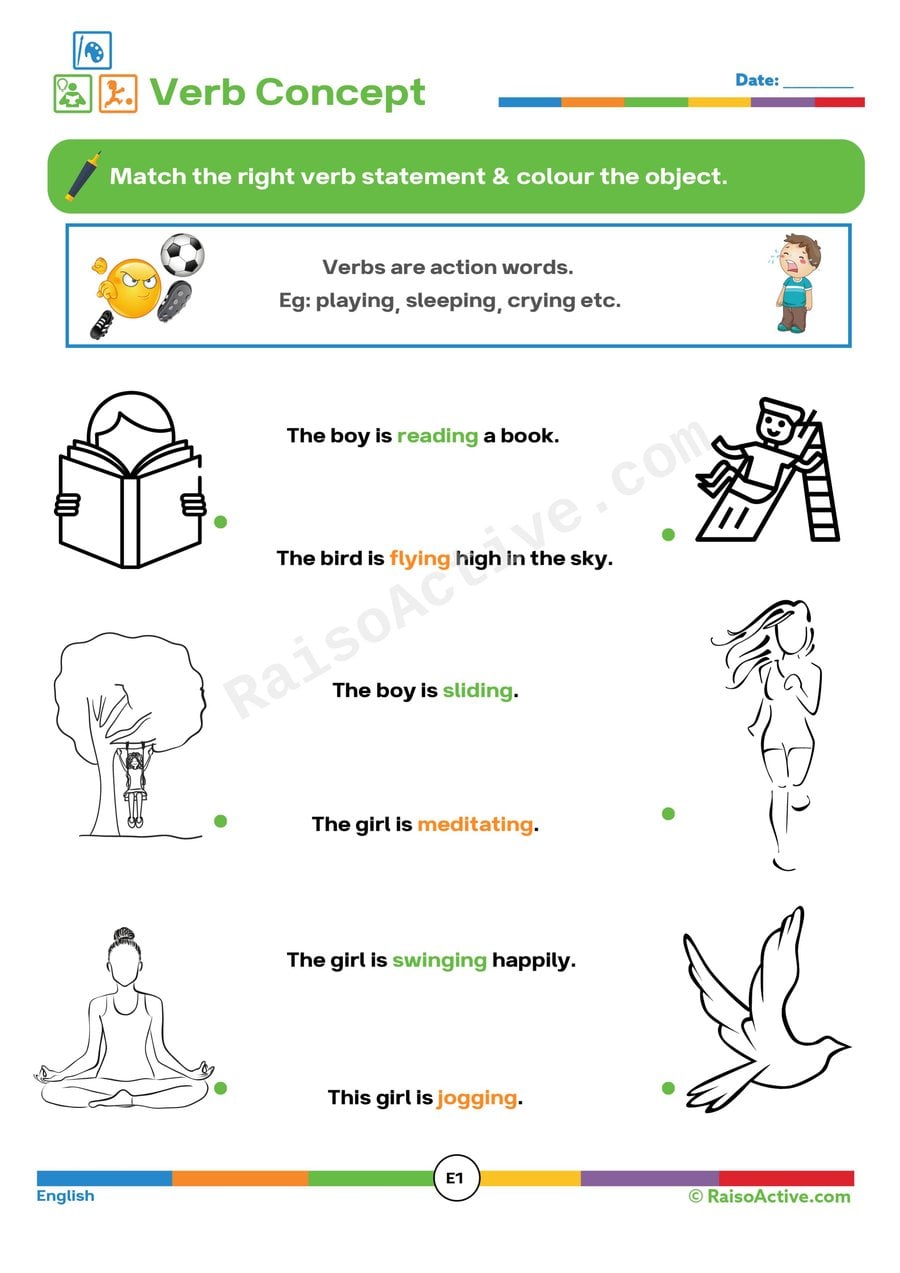
Action Verbs Worksheet: Match and Color!
This worksheet has 4-6 year olds read a short sentence, pick out the action word inside it, and match that sentence to the picture showing the action happening — a skill that bridges early reading with grammar. Identifying the verb specifically (rather than just understanding the sentence generally) is a more advanced task than simple picture-word matching, since children have to isolate one word's job within a whole sentence. Coloring the matched picture afterward gives an easy, low-pressure way to confirm the match was correct.

Parent's Guide: Fun Activities for Verbs, Subtraction, and More!
This parent guide pulls together several early-learning threads — verbs, subtraction, plant life cycles, and 2D shapes — into a single set of hands-on activity suggestions designed for 3-5 year olds, giving you ready-made ways to reinforce classroom or worksheet learning at home without needing to plan lessons yourself. Rather than a single skill, this guide's value is in showing how the same everyday objects (flashcards, fruit, seeds, toys) can support several different concepts across a week of casual, low-pressure practice.

Match the Verb: Action Verbs Worksheet for Preschoolers
Action verbs are some of the first 'doing words' children learn to recognize in print, and this worksheet asks children ages 3-5 to spot the verb within a simple sentence and connect it to a picture showing that action. Circling the verb first trains children to identify the part of a sentence that describes an action, an early grammar skill, while matching it to a picture reinforces comprehension of the word's meaning. This combination builds both reading and vocabulary skills using content — running, jumping, eating — that's naturally engaging to young children.

Tenses in Verbs Worksheet: Tick & Write the Correct Option!
This worksheet has children ages 4-6 practice identifying whether a sentence describes a past, present, or future action, ticking the correct verb tense option and then writing it into the sentence. Distinguishing between tenses is a core grammar skill that helps children eventually narrate their own experiences accurately, whether describing something that already happened or something they plan to do.
Want Unlimited Downloads?
Subscribe to get unlimited access to all worksheets without watermarks
View Subscription Plans