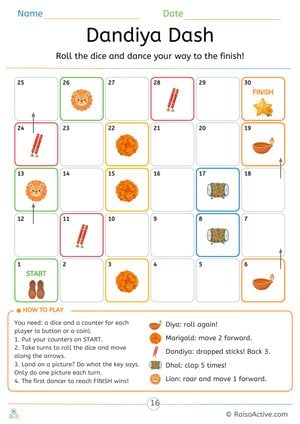
Dandiya Dash: Navratri Board Game for Kids
Ages 4-6 · Pre-K–KindergartenAges 4-6 · Reception–Year 1Ages 4-6 · LKG–UKGAges 4-6
Children count dots on a dice, count on along a number track to 30, take turns and follow simple game rules.
Free printable worksheets
Download free educational worksheets for children ages 2–8. Perfect for preschool, kindergarten, and early elementary learning activities.
Subscribe to get unlimited access to all worksheets without watermarks
View Subscription Plans289 topics match
18 worksheetsof 1,994
Ages 4-6 · Pre-K–KindergartenAges 4-6 · Reception–Year 1Ages 4-6 · LKG–UKGAges 4-6
Children count dots on a dice, count on along a number track to 30, take turns and follow simple game rules.
Ages 4-6 · Pre-K–KindergartenAges 4-6 · Reception–Year 1Ages 4-6 · LKG–UKGAges 4-6
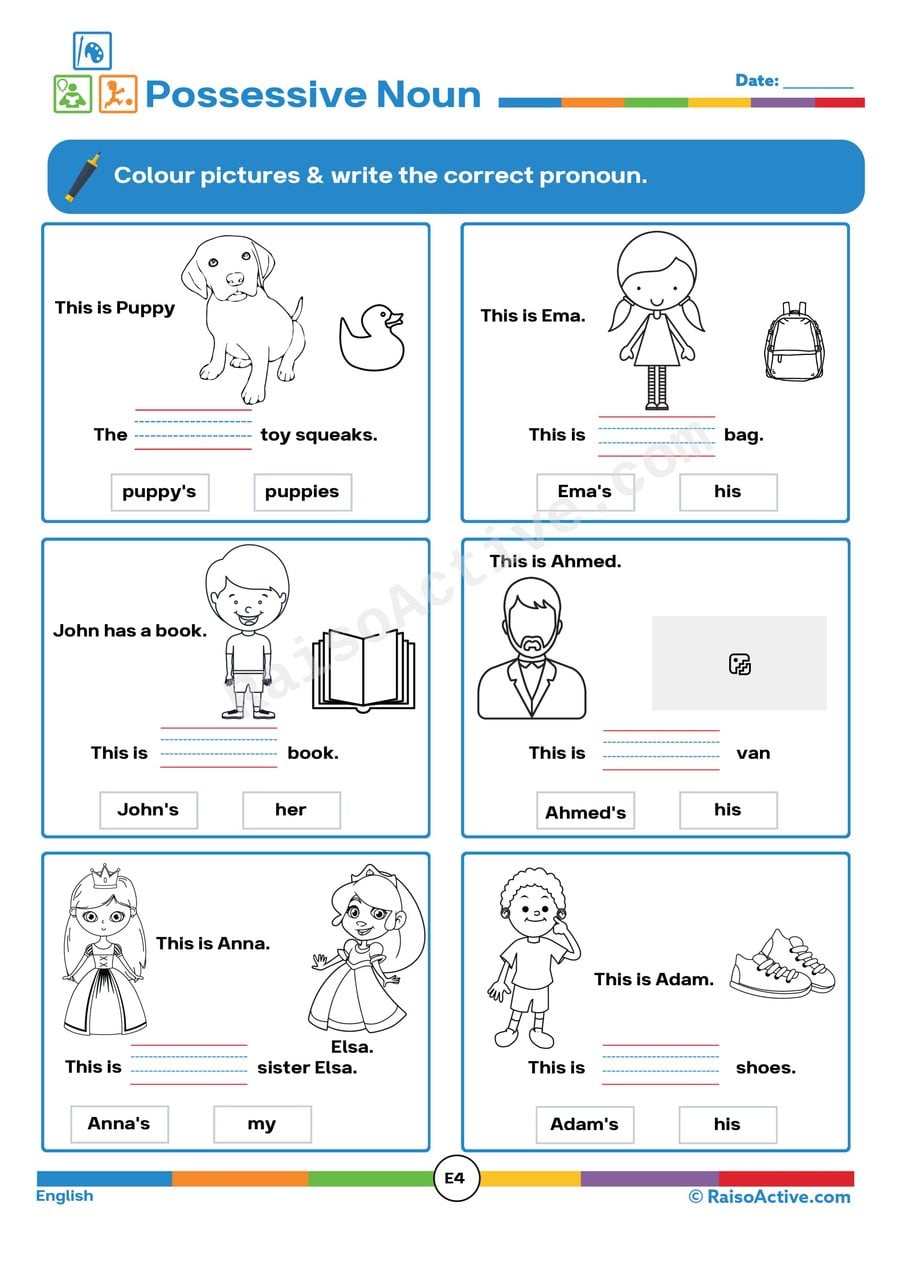
Children ages 4-6 practice forming possessive nouns, learning to add an apostrophe and 's' to show that something belongs to someone, like 'the dog's bone.' This is a specific grammar rule that children will use constantly once they start writing about ownership in their own sentences.
Ages 4-6 · Pre-K–KindergartenAges 4-6 · Reception–Year 1Ages 4-6 · LKG–UKGAges 4-6
This worksheet introduces children ages 4-6 to the concept of proper nouns — specific names for people, places, or things — by having them choose or write the correct proper noun to complete each sentence. Understanding the difference between a general word like 'city' and a specific name like 'Mumbai' is an early grammar concept that also supports capitalization rules children will need once they start writing independently.
Ages 4-6 · Pre-K–KindergartenAges 4-6 · Reception–Year 1Ages 4-6 · LKG–UKGAges 4-6
This worksheet introduces children ages 4-6 to three foundational parts of speech — nouns, pronouns, and adjectives — by asking them to sort individual words into the correct grammatical category. Learning to tell these word types apart early gives children a vocabulary for talking about language itself, which supports both reading comprehension and their own sentence writing later on. Matching words to pictures also keeps an abstract grammar concept grounded in something concrete and visual.
Ages 3-5 · Preschool–Pre-KAges 3-5 · Nursery–ReceptionAges 3-5 · Nursery–LKGAges 3-5
This worksheet builds early reading comprehension for children ages 3-5 by having them read or listen to a short passage about a pet dog and then answer simple questions about what they understood. Moving beyond decoding individual words, this task requires children to hold information from the text in mind and use it to answer questions, an essential skill for comprehension that develops alongside basic reading fluency.
Ages 4-5 · Pre-KAges 4-5 · ReceptionAges 4-5 · LKGAges 4-5
Children ages 4-5 build on singular demonstrative pronouns by learning 'these' and 'those,' the plural forms used to describe groups of objects that are near or far. Understanding this distinction strengthens both grammar and the ability to judge distance and quantity together in a single sentence.
Ages 3-5 · Preschool–Pre-KAges 3-5 · Nursery–ReceptionAges 3-5 · Nursery–LKGAges 3-5
Choosing between the articles 'a' and 'the' before a noun builds early grammar awareness for children ages 3-5, helping them notice a small but important word choice that changes how a sentence sounds and reads.
Ages 5-7 · Kindergarten–Grade 1Ages 5-7 · Year 1–Year 2Ages 5-7 · UKG–Class 1Ages 5-7
This worksheet teaches the grammar rule for possessive nouns — adding an apostrophe-s to show ownership, like 'the dog's bone' — by having children choose the correctly formed possessive in each sentence. For five- to seven-year-olds who are already reading simple sentences, this is often their first formal introduction to how punctuation changes a word's meaning rather than just its sound.
Ages 4-6 · Pre-K–KindergartenAges 4-6 · Reception–Year 1Ages 4-6 · LKG–UKGAges 4-6
Children ages 4-6 practice forming possessive nouns by choosing the correct apostrophe-s form to complete a sentence, building an understanding that an apostrophe signals ownership ('the dog's bone' rather than 'the dogs bone'). This is an early but important punctuation skill that sets the foundation for more advanced grammar and writing clarity later on.
Ages 4-6 · Pre-K–KindergartenAges 4-6 · Reception–Year 1Ages 4-6 · LKG–UKGAges 4-6
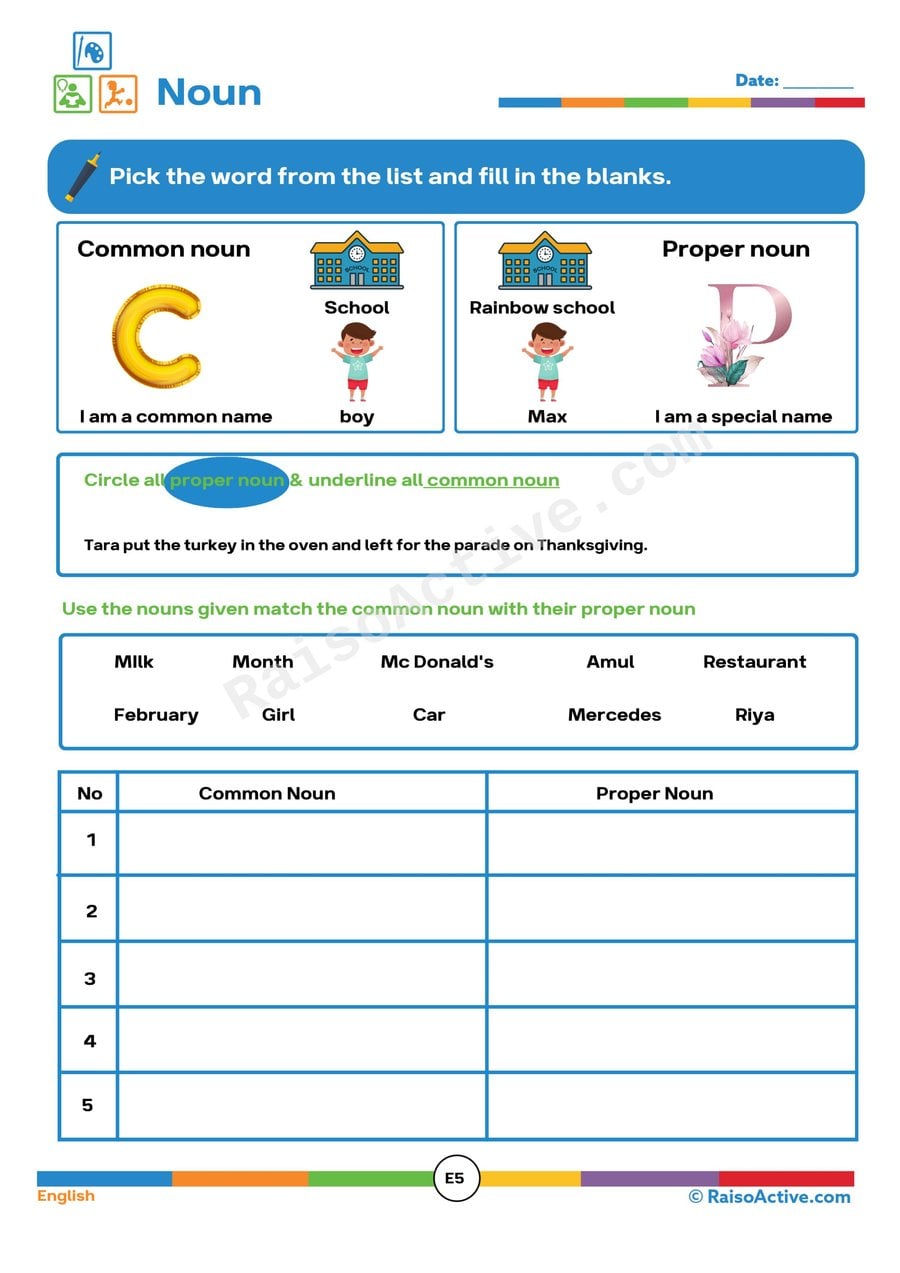
This worksheet introduces children ages 4-6 to the distinction between proper nouns (specific names, like 'London' or 'Max') and common nouns (general words, like 'city' or 'dog'), asking them to color a pencil to show which category each word belongs to. Recognizing that proper nouns are specific and usually capitalized is an early step toward correct capitalization in their own writing.
Ages 4-6 · Pre-K–KindergartenAges 4-6 · Reception–Year 1Ages 4-6 · LKG–UKGAges 4-6
This worksheet introduces children ages 4-6 to the grammar concept of common nouns (general words like city or dog) versus proper nouns (specific names like Mumbai or Rex), building an early foundation for capitalization rules and sentence structure. Learning to tell the two apart also sharpens attention to detail, since proper nouns are marked by capital letters that common nouns don't use.
Ages 4-6 · Pre-K–KindergartenAges 4-6 · Reception–Year 1Ages 4-6 · LKG–UKGAges 4-6
This hands-on flower craft teaches children ages 4-6 to identify nouns — people, places, and things — by opening petal flaps to reveal example words, then building a simple sentence using each noun they find. Turning grammar into a physical, foldable object makes an abstract concept like 'noun' concrete and memorable for early learners.