Alphabet Worksheet: Fill in the Missing Letters!
Filling in missing letters within the printed alphabet sequence builds letter recognition and sequencing for children ages 4-5, reinforcing both the order of the alphabet and the shape of each individual letter through handwriting practice.
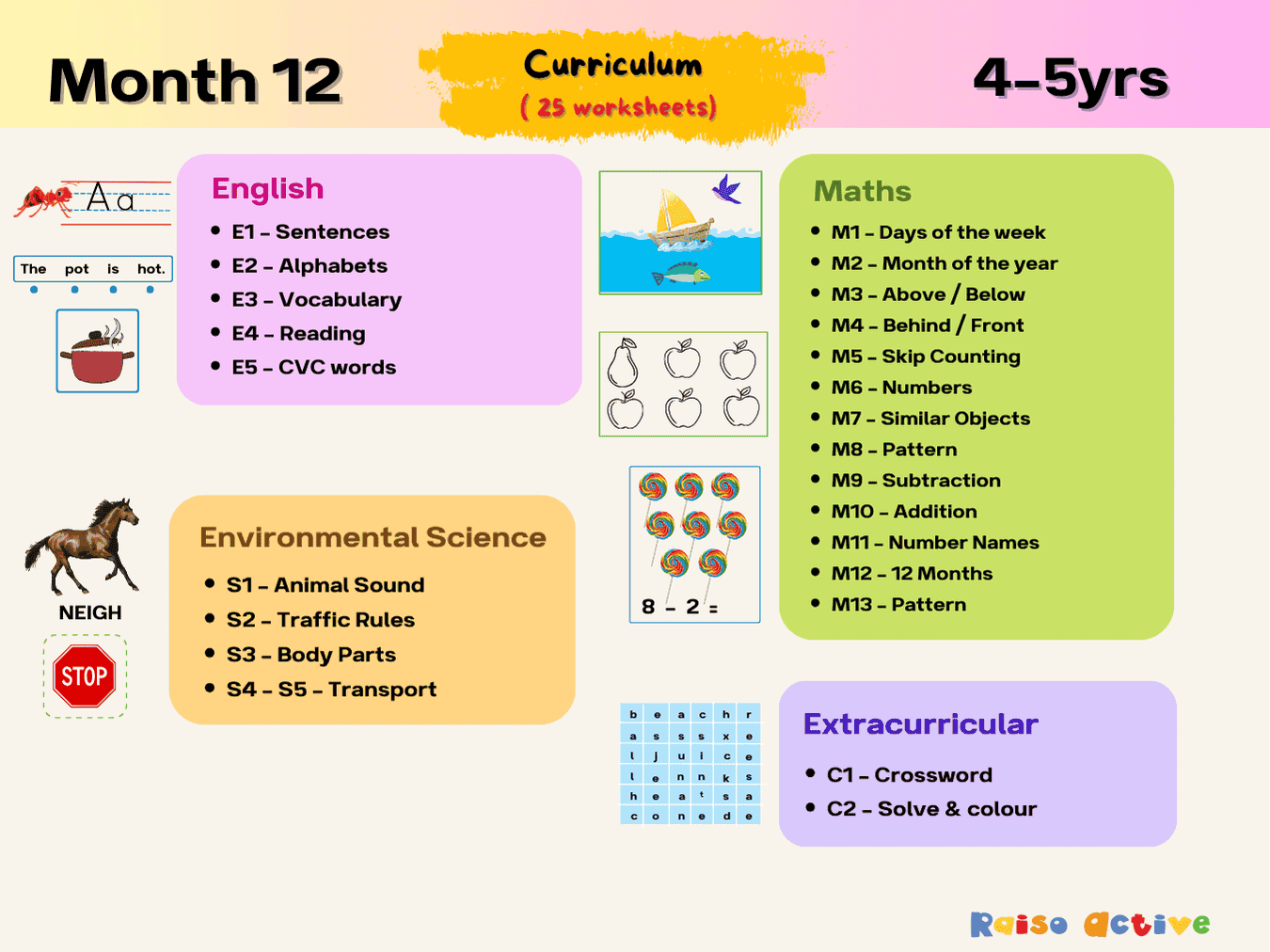
Part of the pack
Month 12: Learning & Development | Ages 4-5
This is page 5 of the pack. Ages 4-5 · Pre-KAges 4-5 · ReceptionAges 4-5 · LKGAges 4-5
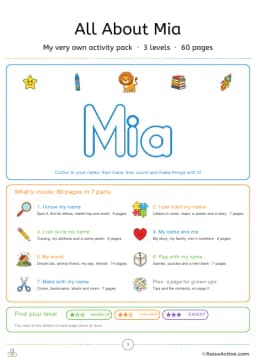
Made for your child
A whole activity pack made with their name
60 pages to spot, build, trace and write their own name, plus pages about their favourites, feelings and family. See a free preview with their name.
Make an All About Me packFree preview · free for members
Or start free: a name tracing sheet with their nameCurriculum
- Alphabet > Alphabet Sequence
How to use this worksheet
Look at the row of letters together and identify which ones are missing from the sequence. Use the picture clues provided to help figure out or confirm each missing letter. Have your child write the missing letters on the lines, continuing through the alphabet until every gap has been filled in.
Materials needed
- Pencil
- Eraser
Extension activities
- 1Have the child draw a picture of something that starts with each missing letter.
- 2Practice writing the letters in sand, shaving cream, or with playdough for a multisensory approach.
- 3Sing the alphabet song while pointing to each letter on the page.
- 4Play an alphabet puzzle or magnetic letter game to reinforce sequence.

Written by
Hemsweta Jain · Teacher Cheena
MBA and Early Childhood Educator, teaching since 2014 · Founder of RaisoActive, Mumbai
Every RaisoActive worksheet is designed and checked by the founder before publishing.
Published · Last reviewed
More from Month 12: Learning & Development | Ages 4-5

Penguin Addition Worksheet for Preschoolers: Counting and Circling
Ages 3-5 · Preschool–Pre-KAges 3-5 · Nursery–ReceptionAges 3-5 · Nursery–LKGAges 3-5
Counting groups of penguins, combining them, and circling the correct sum from several options builds early addition fluency for children ages 3-5, using a fun animal theme to keep counting practice engaging.
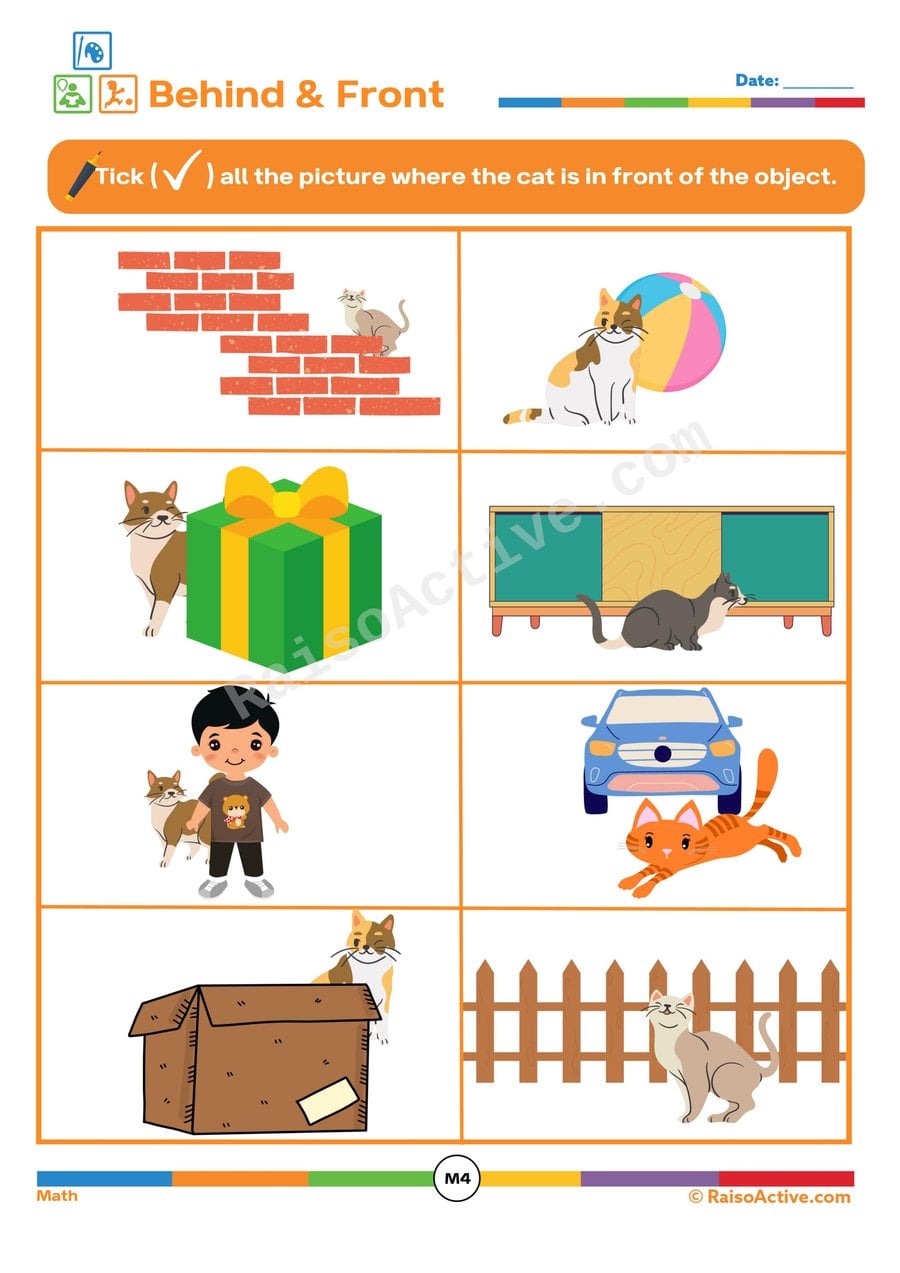
Front and Behind Worksheet: Where is the Cat?
Ages 3-5 · Preschool–Pre-KAges 3-5 · Nursery–ReceptionAges 3-5 · Nursery–LKGAges 3-5
Judging whether the cat sits 'in front of' or 'behind' an object in each picture develops relative-position reasoning for children ages 3-5, an early spatial skill that also builds the vocabulary needed for giving and following directions.

Solve & Color: Fun Addition and Subtraction Worksheet for Kids!
Ages 4-6 · Pre-K–KindergartenAges 4-6 · Reception–Year 1Ages 4-6 · LKG–UKGAges 4-6
This worksheet combines early arithmetic practice with a color-by-number format, as children ages 4-6 solve simple addition and subtraction problems and then use a color key to fill in each shape based on their answer. Because getting the coloring 'right' depends on solving the math correctly, children get built-in, self-checking feedback on their arithmetic while also practicing shape recognition and staying within lines.

Traffic Rules Worksheet: Cut and Glue the Traffic Signs!
Ages 3-5 · Preschool–Pre-KAges 3-5 · Nursery–ReceptionAges 3-5 · Nursery–LKGAges 3-5
Cutting out traffic sign pictures and matching them to their correct labels builds early sign recognition and vocabulary for children ages 3-5, connecting a familiar shape and color to its real-world safety meaning.
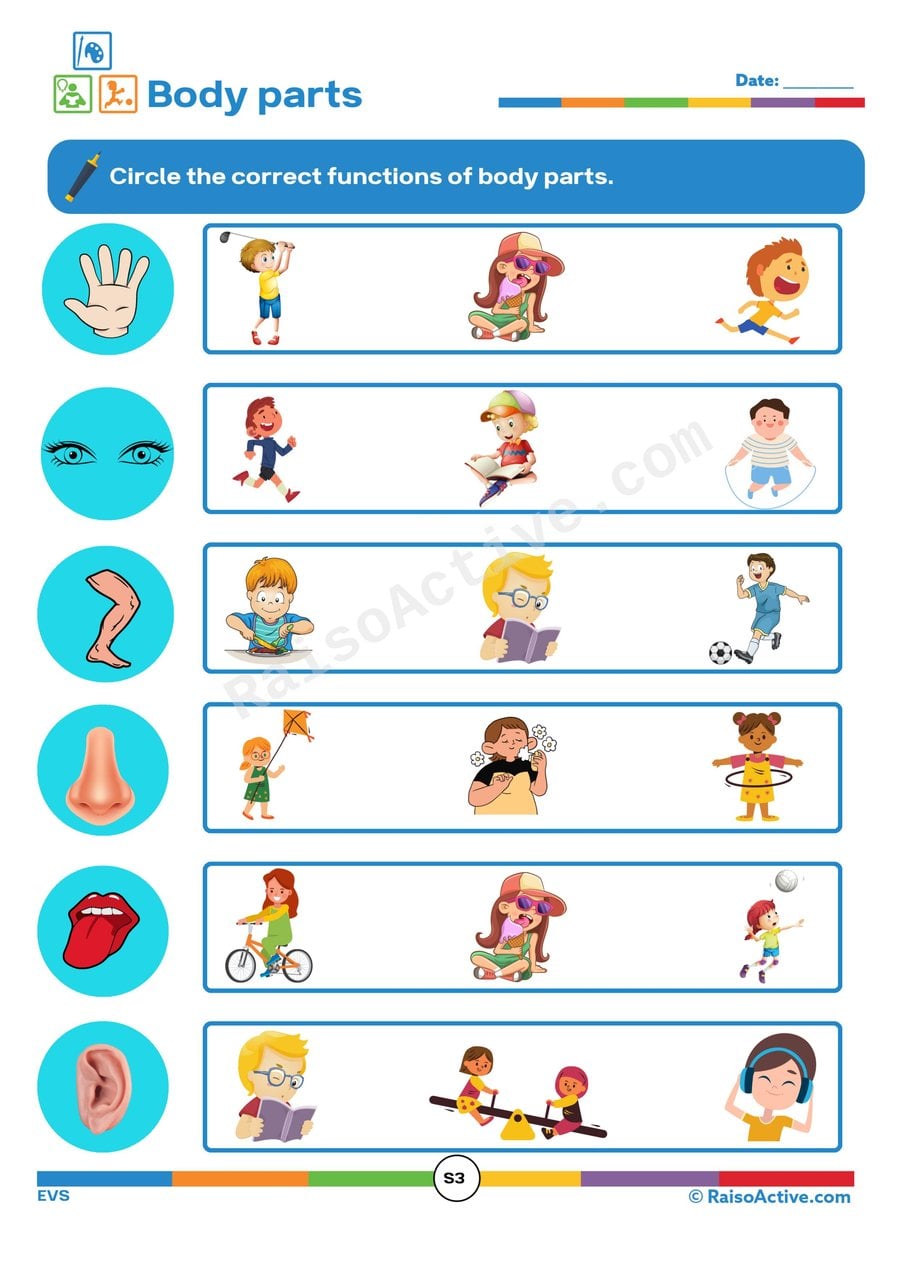
Body Parts Functions Worksheet for Kids
Ages 3-5 · Preschool–Pre-KAges 3-5 · Nursery–ReceptionAges 3-5 · Nursery–LKGAges 3-5
Children ages 3-5 practice connecting specific body parts to their real-world function, like eyes for seeing or ears for hearing, by circling the picture that shows what each body part is used for. This reinforces body awareness and vocabulary while building the reasoning skill of linking a body part to its purpose.
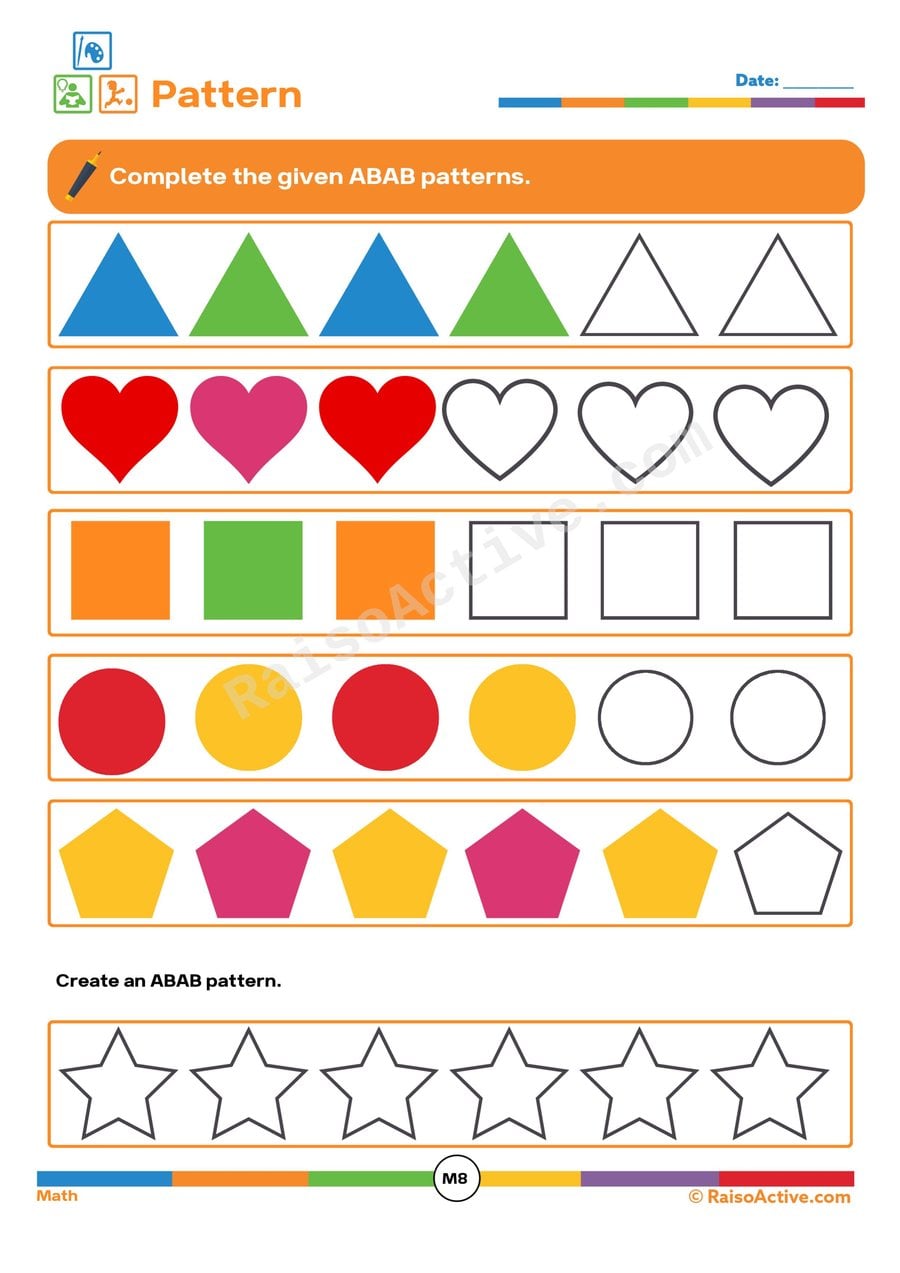
ABAB Pattern Fun: Complete the Shapes Worksheet!
Ages 3-5 · Preschool–Pre-KAges 3-5 · Nursery–ReceptionAges 3-5 · Nursery–LKGAges 3-5
This worksheet builds early algebraic thinking as children ages 3-5 identify and continue ABAB patterns using shapes and colors, then create a pattern of their own using stars. Recognizing that a pattern repeats in a predictable unit is a foundational math skill that later supports understanding sequences, multiplication, and logical prediction, making this simple shape activity more mathematically important than it might first appear.

Transportation Worksheet: Match the Vehicles! (Ages 3-5)
Ages 3-5 · Preschool–Pre-KAges 3-5 · Nursery–ReceptionAges 3-5 · Nursery–LKGAges 3-5
This worksheet asks children ages 3-5 to sort vehicles into four transportation categories — road, track, air, and water — which builds classification skills beyond simple pairs. Because kids must decide which of four groups a vehicle belongs to instead of just two, it stretches their reasoning a level further than basic matching. It also grows vocabulary around trains and tracks, a category many transportation worksheets skip.
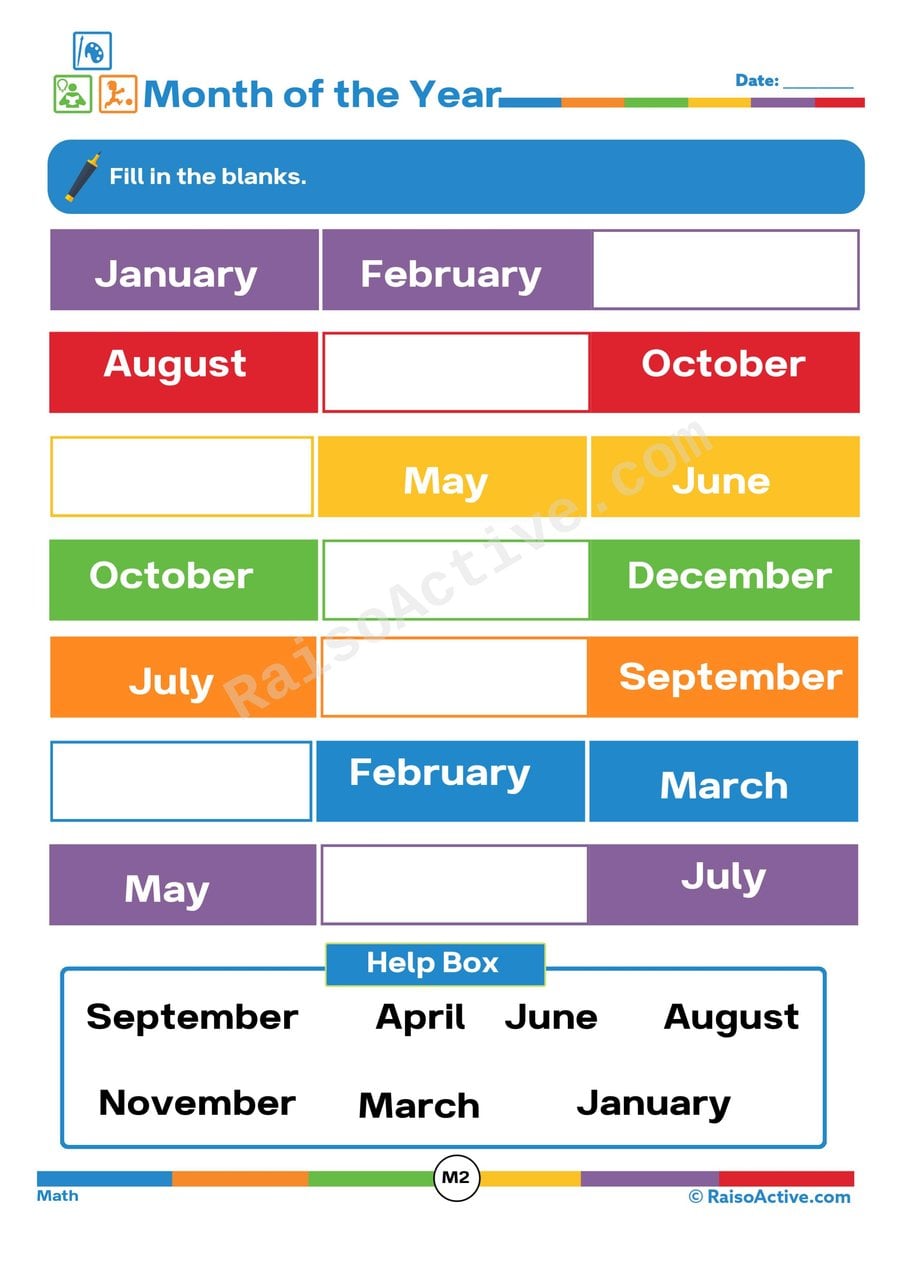
Months of the Year Fill-in-the-Blanks Worksheet
Ages 3-5 · Preschool–Pre-KAges 3-5 · Nursery–ReceptionAges 3-5 · Nursery–LKGAges 3-5
This worksheet introduces children ages 3-5 to the twelve months of the year in order, asking them to fill in missing month names using a reference list. Practicing this longer, less familiar sequence builds memory and early calendar literacy, skills that support understanding birthdays, holidays, and seasons as the year unfolds.
Related worksheets

Treasure Hunt: Alphabetical Order Worksheet for Preschoolers
Ages 3-5 · Preschool–Pre-KAges 3-5 · Nursery–ReceptionAges 3-5 · Nursery–LKGAges 3-5
This connect-the-letters worksheet has children ages 3-5 trace a path from A to Z in strict alphabetical order to help a character find hidden treasure, combining full alphabet sequencing practice with sustained fine motor control as they draw one long connected line. Successfully sequencing the entire alphabet in order, rather than just naming letters individually, is a meaningful milestone in early literacy.

N-Z Alphabet Worksheet: Missing Letters and Picture Matching
Ages 4-6 · Pre-K–KindergartenAges 4-6 · Reception–Year 1Ages 4-6 · LKG–UKGAges 4-6
This worksheet continues alphabet mastery for children ages 4-6 by having them fill in missing letters from N to Z and match each one to a corresponding picture, extending the sequencing and picture-matching skills used in the first half of the alphabet into the second half. Completing both halves of the alphabet across companion worksheets like this builds full, confident recall of all 26 letters in order.

A-M Alphabet Worksheet: Write and Paste the Correct Picture!
Ages 4-5 · Pre-KAges 4-5 · ReceptionAges 4-5 · LKGAges 4-5
This worksheet has children ages 4-5 identify and write the missing letters from A to M, then match each letter to a corresponding picture, combining alphabet sequencing with beginning-sound picture matching in one activity. Filling in missing letters, rather than tracing a complete alphabet, requires children to actively recall what comes next rather than simply copying a model.

Plant Parts Worksheet: Identify and Label the Parts of a Plant!
Ages 4-6 · Pre-K–KindergartenAges 4-6 · Reception–Year 1Ages 4-6 · LKG–UKGAges 4-6
This worksheet teaches children ages 4-6 to identify and independently label the flower, stem, leaf, and roots of a plant, moving a step beyond simple matching toward recalling vocabulary from memory. Optionally adding pulses or grains to the diagram introduces a tactile, sensory layer that helps reinforce which part is which through touch as well as sight.
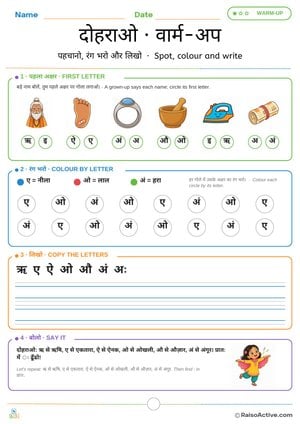
Hindi Vowels Part 2 Revision: Spot, Colour and Write | दोहराओ – वार्म-अप
Ages 3-7 · Preschool–Grade 1Ages 3-7 · Nursery–Year 2Ages 3-7 · Nursery–Class 1Ages 3-7
A warm-up revision: circle the first letter of each picture word, colour circles by letter (ए blue, ओ red, अं green), copy the seven letters and repeat the words ऋषि, एकतारा, ऐनक, ओखली, औज़ार and अंगूर.
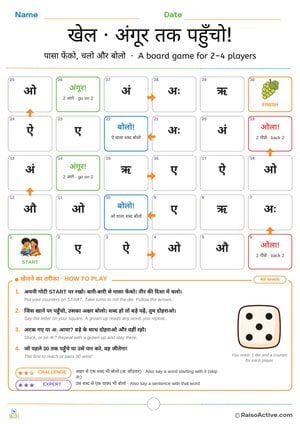
Hindi Vowels Board Game: Reach the Grapes (Part 2) | खेल – अंगूर तक पहुँचो
Ages 3-7 · Preschool–Grade 1Ages 3-7 · Nursery–Year 2Ages 3-7 · Nursery–Class 1Ages 3-7
A 30-square board game from START to the grapes (अंगूर). Players roll a die, move along the arrows and say the letter on their square, then a word that starts with it. Special squares send players forward or back, and the sign अः has its own stuck-or-अः rule.

Say It Kindly: Build I-Messages, Blame or Kind and Fix-It Cards
Ages 7-10 · Grade 2–Grade 3Ages 7-10 · Year 3–Year 4Ages 7-10 · Class 2–Class 3Ages 7-10
Children learn the I-message pattern 'I feel... when... I need...', sort blaming and kind sentences with B or K, match oops moments to repairs and think how a classmate might feel.
Hindi Letter ऊ Practice Part 1: Write, Fix and Find | ऊ का अभ्यास · भाग 1
Ages 3-7 · Preschool–Grade 1Ages 3-7 · Nursery–Year 2Ages 3-7 · Nursery–Class 1Ages 3-7
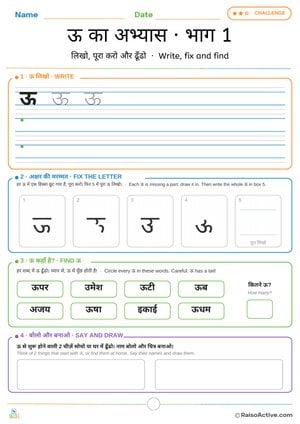
Children write ऊ on guide lines, complete four partly drawn letters, circle ऊ in eight words (while avoiding its look-alike उ), count how many they found, then think of two more words at home that start with ऊ and draw them.
Guides for this topic

Kindergarten Readiness Checklist: 25 Skills to Practice Before the First Day
A kindergarten readiness checklist of 25 literacy, math, motor, self-regulation and self-help skills, with an 8-week summer plan and notes on when not to worry.

Phase 2 Phonics at Home: Sound Order, Blending Games, Worksheets
Phase 2 phonics at home: the five sound sets in order, oral blending, tricky words, a two-week routine, common mistakes, and free worksheets.
Reception Year Explained: EYFS Learning and How to Help at Home
A teacher's plain-English guide to the Reception Year: the seven areas of learning, Early Learning Goals, Phase 2/3 phonics, the RBA and home routines.
Reviews
Every worksheet for ages 4–5, no watermark
Members download the full library of 1,000+ worksheets and every activity pack without watermarks or daily limits. One year costs ₹999 in India or $20 elsewhere.
See membership plansOr download any worksheet free with a watermark (5 a day).