Front and Behind Worksheet: Where is the Cat?
Judging whether the cat sits 'in front of' or 'behind' an object in each picture develops relative-position reasoning for children ages 3-5, an early spatial skill that also builds the vocabulary needed for giving and following directions.
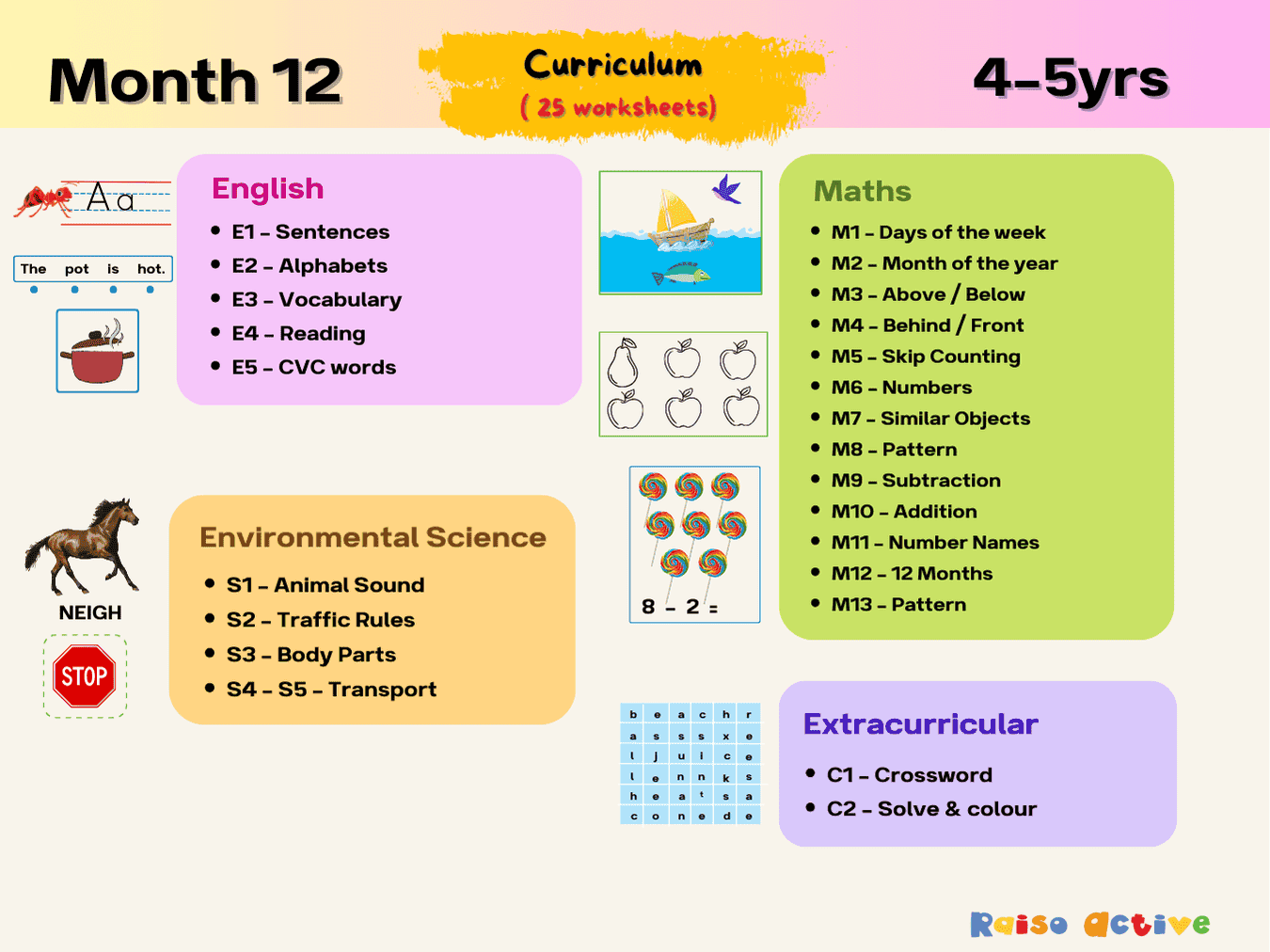
Part of the pack
Month 12: Learning & Development | Ages 4-5
This is page 12 of the pack. Ages 4-5 · Pre-KAges 4-5 · ReceptionAges 4-5 · LKGAges 4-5
Made for your child
Counting to 10, made for your child
A maths pack with your child's name in it: pictures that explain, practice at three levels, puzzles and story sums about them. Print a new set whenever they finish.
Make a maths packFree preview · free for members
Curriculum
- Spatial Sense > Spatial Concepts
How to use this worksheet
Look at the first picture with your child and ask where the cat is positioned relative to the nearby object. If the cat is in front, have your child mark a tick (✔) in the box beside that picture; if it's behind, move on to the next. Continue through all the pictures, encouraging your child to say 'in front of' or 'behind' out loud before marking their answer.
Materials needed
- Pencil
- Crayons
Extension activities
- 1Place a toy cat in front of and behind household objects and have your child name its position each time.
- 2Play hide-and-seek games where your child hides behind furniture and describes their position.
- 3Draw a picture together showing an animal in front of a tree, then behind it.
- 4Take turns giving instructions using 'in front of' and 'behind' to place objects on a table.

Written by
Hemsweta Jain · Teacher Cheena
MBA and Early Childhood Educator, teaching since 2014 · Founder of RaisoActive, Mumbai
Every RaisoActive worksheet is designed and checked by the founder before publishing.
Published · Last reviewed
More from Month 12: Learning & Development | Ages 4-5
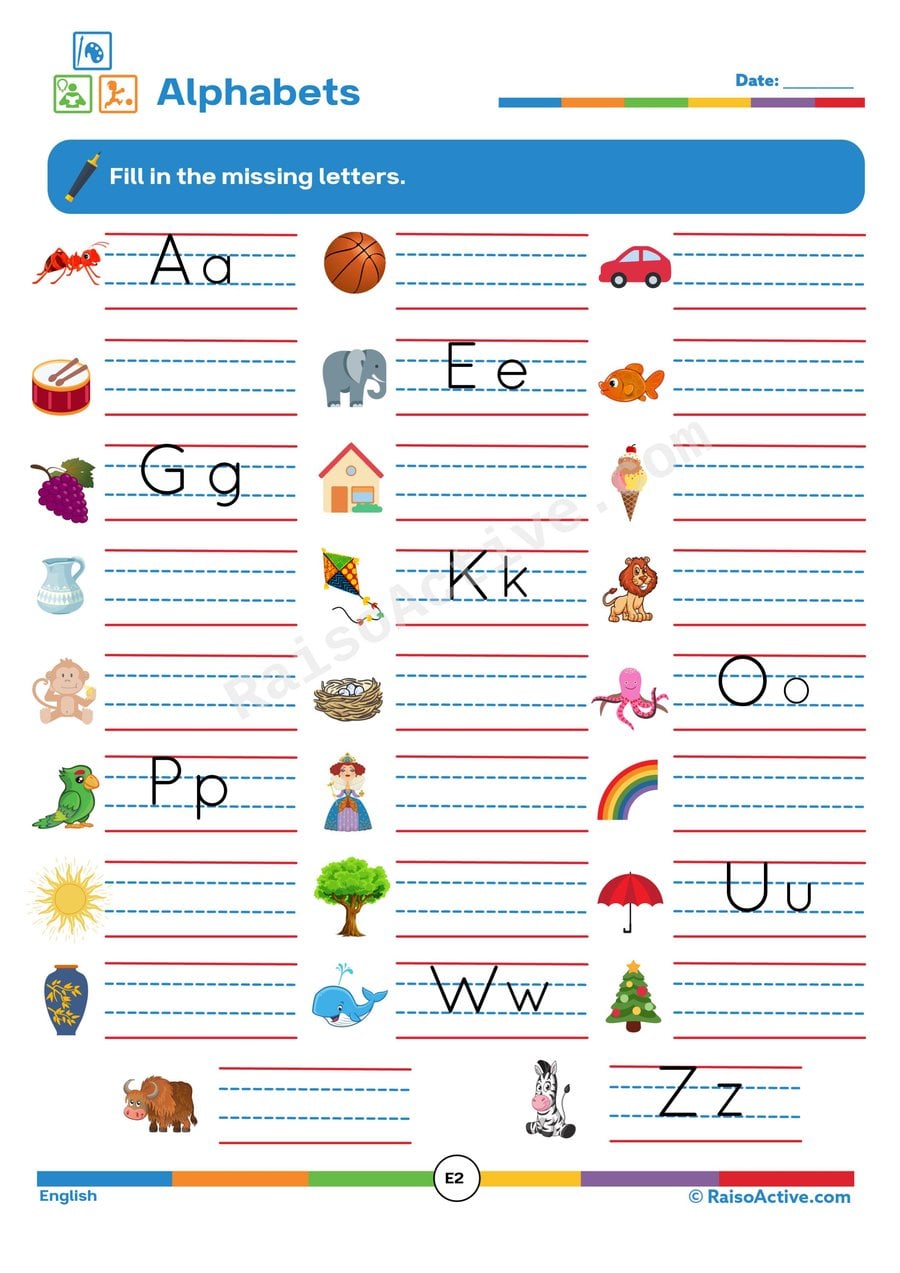
Alphabet Worksheet: Fill in the Missing Letters!
Ages 4-5 · Pre-KAges 4-5 · ReceptionAges 4-5 · LKGAges 4-5
Filling in missing letters within the printed alphabet sequence builds letter recognition and sequencing for children ages 4-5, reinforcing both the order of the alphabet and the shape of each individual letter through handwriting practice.

Vocabulary Worksheet: Circle the Objects That Start with the Letter!
Ages 4-6 · Pre-K–KindergartenAges 4-6 · Reception–Year 1Ages 4-6 · LKG–UKGAges 4-6
This worksheet reinforces letter-sound recognition for children ages 4-6 by presenting a target letter and asking them to identify which pictures in a row begin with that sound. Unlike single-picture beginning sound tasks, scanning an entire row of images and filtering for matches builds sustained visual attention alongside phonics, since children must reject several near-matches before finding the correct ones.

Traffic Rules Worksheet: Cut and Glue the Traffic Signs!
Ages 3-5 · Preschool–Pre-KAges 3-5 · Nursery–ReceptionAges 3-5 · Nursery–LKGAges 3-5
Cutting out traffic sign pictures and matching them to their correct labels builds early sign recognition and vocabulary for children ages 3-5, connecting a familiar shape and color to its real-world safety meaning.
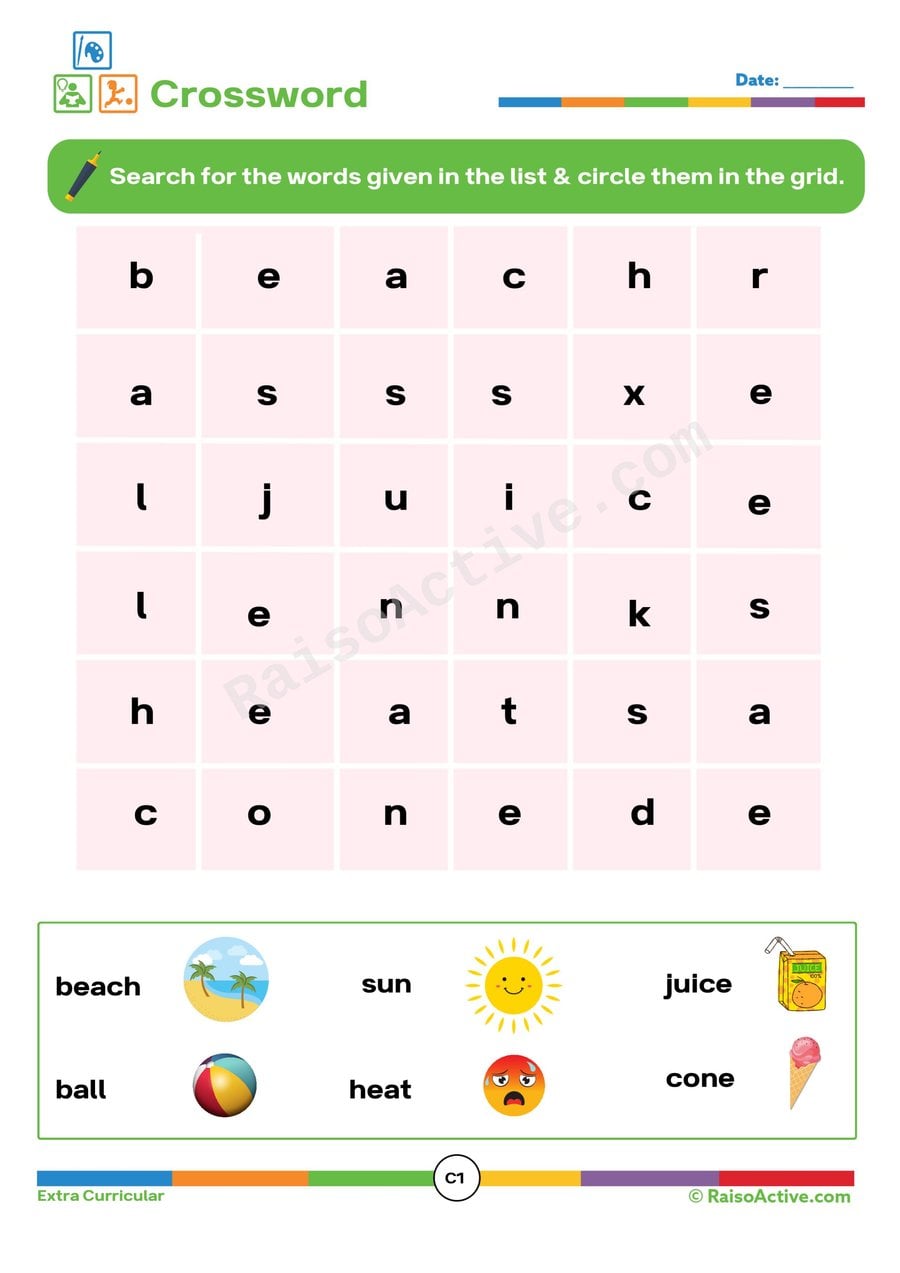
Summer Fun Crossword Puzzle Worksheet for Kids
Ages 3-5 · Preschool–Pre-KAges 3-5 · Nursery–ReceptionAges 3-5 · Nursery–LKGAges 3-5
Children ages 3-5 practice recognizing and reading summer-themed vocabulary words, like sun, pool, or ice cream, by finding them hidden within a grid, building early word-recognition and visual scanning skills. Searching for a whole word letter by letter also reinforces left-to-right reading direction, an important pre-reading habit.

Parent's Guide: Sight Words and CVC Words Activities
Ages 3-5 · Preschool–Pre-KAges 3-5 · Nursery–ReceptionAges 3-5 · Nursery–LKGAges 3-5
This parent's guide offers a set of hands-on activities for children ages 3-5 that build early reading skills through sight word and CVC (consonant-vowel-consonant) word practice, using letter blocks, storytelling, and even a color-mixing experiment to keep learning varied and engaging. Practicing sight words and simple three-letter words together builds the foundation for sounding out and recognizing whole words while reading.

Above and Below Worksheet: Following Instructions for Preschoolers
Ages 3-5 · Preschool–Pre-KAges 3-5 · Nursery–ReceptionAges 3-5 · Nursery–LKGAges 3-5
Interpreting instructions like 'circle what is above the tree' builds spatial vocabulary and listening comprehension for children ages 3-5, a foundation that later supports map reading, following multi-step directions, and even number-line concepts in math.

Read and Match: Sight Word Sentences Worksheet for Early Readers
Ages 4-5 · Pre-KAges 4-5 · ReceptionAges 4-5 · LKGAges 4-5
Children ages 4-5 practice reading simple sight-word sentences and matching them to the picture that shows their meaning, building early reading comprehension by connecting printed words directly to what they represent. This bridges the gap between recognizing individual sight words and understanding a full sentence's meaning.

Animal Sounds Worksheet: Circle the Correct Sound!
Ages 3-5 · Preschool–Pre-KAges 3-5 · Nursery–ReceptionAges 3-5 · Nursery–LKGAges 3-5
This worksheet strengthens vocabulary and reading readiness for children ages 3-5 by asking them to match each animal picture to the word describing the sound it makes, such as 'moo' for a cow or 'quack' for a duck. Connecting a familiar sound to its written word form is an early step toward reading, since it links spoken vocabulary your child already knows to print they are just beginning to recognize.
Related worksheets
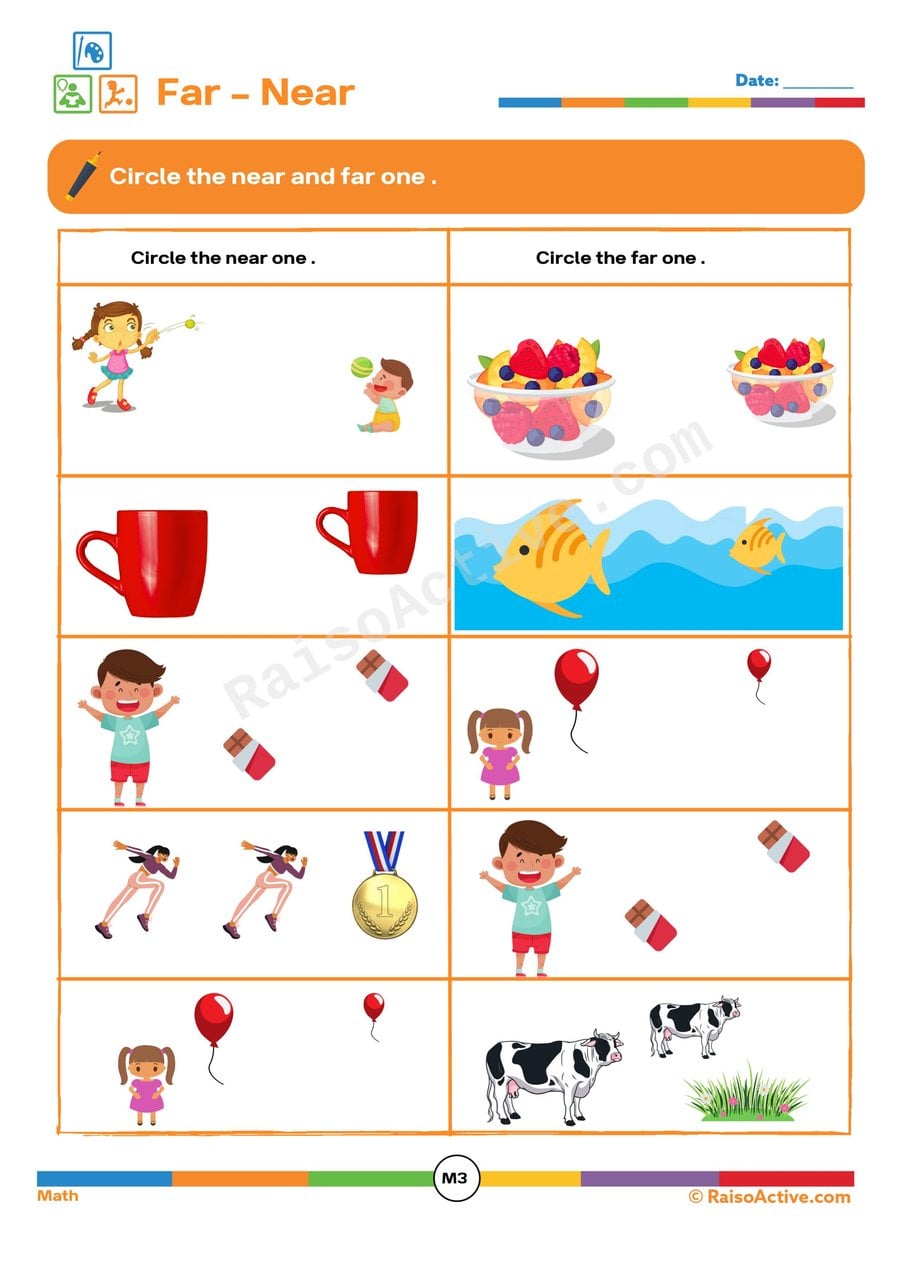
Far and Near Worksheet: Circle the Objects!
Ages 3-5 · Preschool–Pre-KAges 3-5 · Nursery–ReceptionAges 3-5 · Nursery–LKGAges 3-5
Children ages 3-5 build early spatial reasoning by comparing the relative distance of paired objects and deciding which is 'near' and which is 'far,' a foundational concept for understanding position and distance in the world around them. This kind of comparative thinking also supports later math concepts like measurement and estimation.

Inside or Outside Sorting Worksheet for Preschoolers
Ages 3-5 · Preschool–Pre-KAges 3-5 · Nursery–ReceptionAges 3-5 · Nursery–LKGAges 3-5
This worksheet teaches children ages 3-5 to apply the spatial concepts of 'inside' and 'outside' by sorting pictures of objects into the location where they typically belong. Deciding where an object usually belongs requires children to draw on their own real-world experience and apply it to a new sorting task, strengthening both spatial vocabulary and everyday reasoning. This kind of applied sorting is more demanding than simply naming inside or outside items when shown a single picture.

Front and Back Matching Worksheet for Preschoolers
Ages 3-5 · Preschool–Pre-KAges 3-5 · Nursery–ReceptionAges 3-5 · Nursery–LKGAges 3-5
This cut-and-paste worksheet builds spatial reasoning by asking children to recognize that many objects and animals look different from the front versus the back, and to match each front view to its correct back view. For ages 3-5, this kind of visual matching strengthens observational skills and the beginning of perspective-taking, understanding that the same object can look different depending on which side you're viewing.

Over and Under Worksheet: Identifying Object Positions
Ages 3-5 · Preschool–Pre-KAges 3-5 · Nursery–ReceptionAges 3-5 · Nursery–LKGAges 3-5
This worksheet helps children ages 3-5 learn and identify the spatial concepts of 'over' and 'under' by examining pictures and deciding which positional word correctly describes what they see. Practicing this distinction builds the vocabulary foundation children need to follow multi-step directions involving location.

Front or Behind Sorting Worksheet for Preschoolers
Ages 3-5 · Preschool–Pre-KAges 3-5 · Nursery–ReceptionAges 3-5 · Nursery–LKGAges 3-5
Positional words like 'front' and 'behind' describe relationships between objects rather than the objects themselves, which makes them a genuinely trickier concept for a 3-5 year old than sorting by color or size. Deciding where each picture belongs and sorting it into the right box builds early spatial reasoning that later supports following multi-step directions and understanding maps or diagrams.
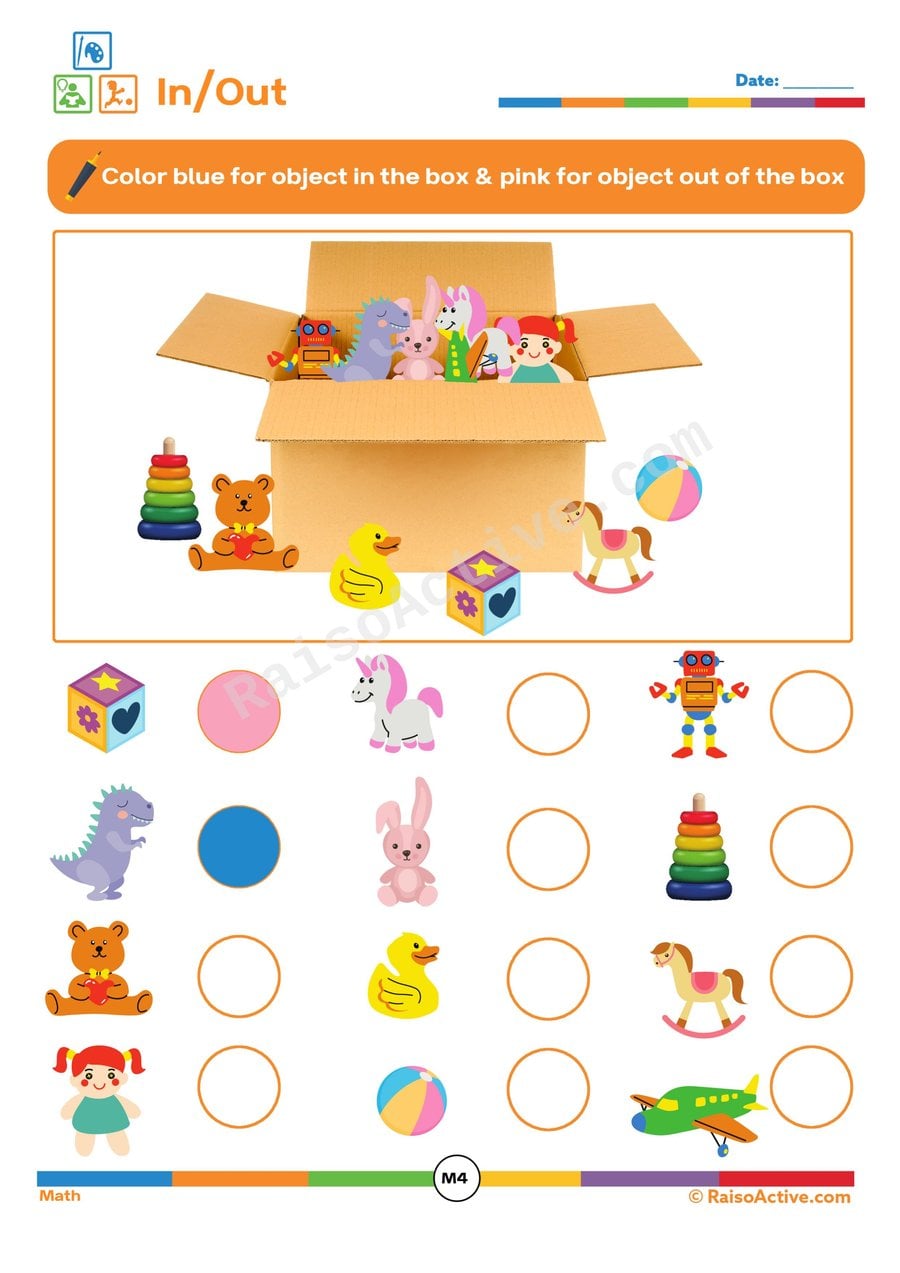
In/Out Sorting Worksheet: Color the Objects!
Ages 3-5 · Preschool–Pre-KAges 3-5 · Nursery–ReceptionAges 3-5 · Nursery–LKGAges 3-5
Sorting objects as 'in' or 'out' of a box builds on the positional vocabulary preschoolers need before they can follow multi-step directions or understand simple math concepts like sets and groups. Using color as the sorting tool here, blue for inside and pink for outside, also strengthens the ability to hold two rules in mind simultaneously and apply the correct one to each object in turn.
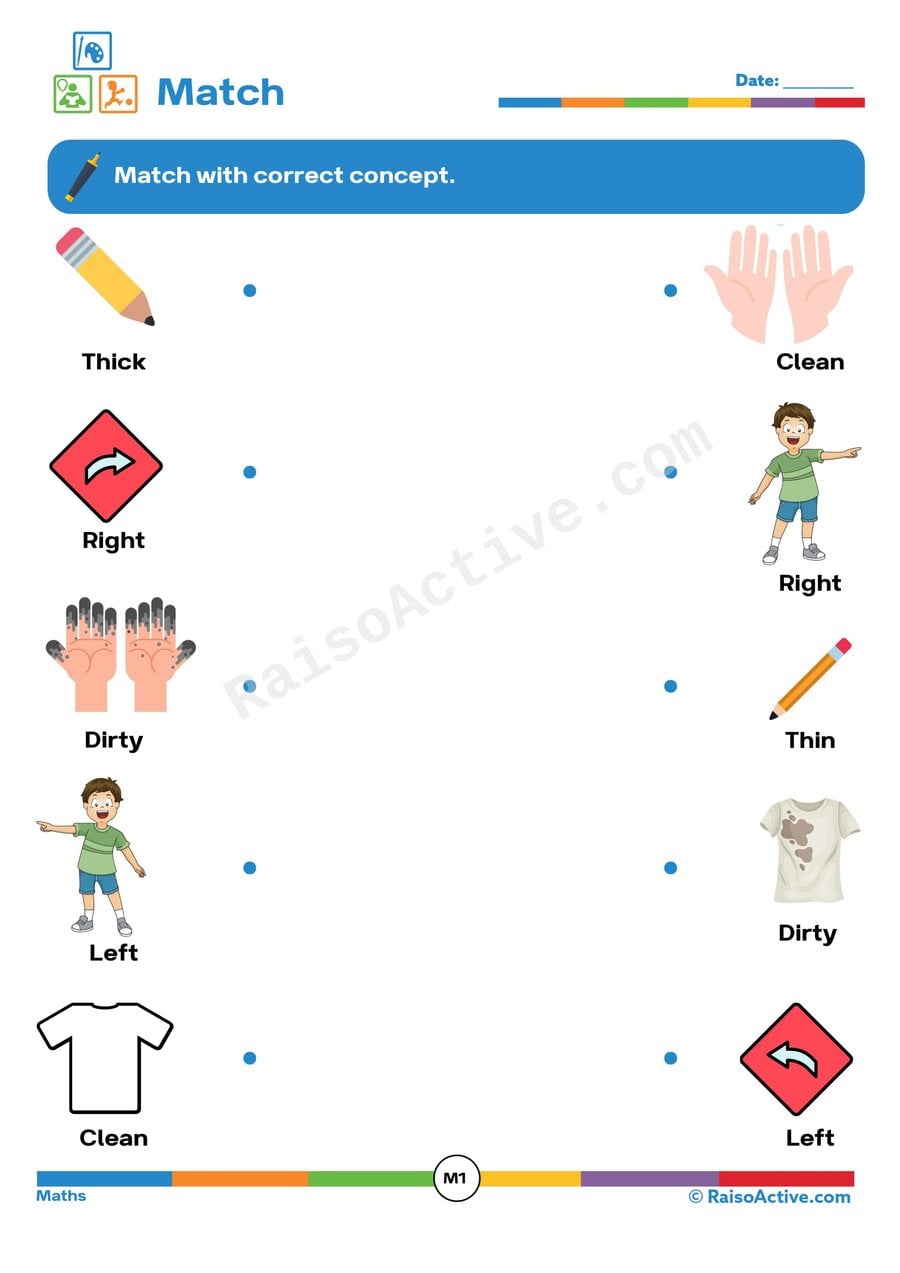
Match the Concepts! A Fun Worksheet for Kids
Ages 3-5 · Preschool–Pre-KAges 3-5 · Nursery–ReceptionAges 3-5 · Nursery–LKGAges 3-5
Children ages 3-5 practice matching pairs of opposite or related concepts, like thick and thin or clean and dirty, building early vocabulary and critical thinking around comparison words. Understanding these paired concepts helps children describe the world around them with more precise, descriptive language.

Above and Below Worksheet: Identifying Objects' Positions
Ages 3-5 · Preschool–Pre-KAges 3-5 · Nursery–ReceptionAges 3-5 · Nursery–LKGAges 3-5
Understanding positional words like 'above' and 'below' helps children ages 3-5 build the spatial vocabulary that later supports following multi-step directions, reading maps, and even understanding math concepts like number lines. This worksheet asks children to look closely at a scene and judge the position of different objects relative to one another, which sharpens visual observation alongside language development. Marking each object with a tick or a cross also introduces early symbol-based recording, a small step toward more formal worksheet conventions used in later grades.
Guides for this topic

Best Worksheets for 3-Year-Olds: What Works and What to Avoid
What works on worksheets for 3-year-olds: short sessions, crayons, tracing lines, matching, cutting, a free weekly plan, and signs one is too advanced.

Age-Appropriate Problem-Solving Activities: Building Critical Thinkers from the Ground Up
Discover fun, age-appropriate problem-solving activities for children ages 1-8. Build critical thinking, logic, and reasoning skills through play-based learning.
Critical Thinking Activities That Actually Work for Young Children: Building Tomorrow's Thinkers Today
Discover proven critical thinking activities for young children. Age-wise logic games, questioning techniques, and hands-on ideas to build thinking skills at home.
Reviews
Every worksheet for ages 3–5, no watermark
Members download the full library of 1,000+ worksheets and every activity pack without watermarks or daily limits. One year costs ₹999 in India or $20 elsewhere.
See membership plansOr download any worksheet free with a watermark (5 a day).