Apple Dot-to-Dot Worksheet for Preschoolers
This dot-to-dot worksheet strengthens number sequencing and fine motor control for children ages 3-5 as they connect numbered dots in order to reveal the shape of an apple. Because each new line depends on finding the next correct number, this activity reinforces counting sequence while also training the pencil control and hand-eye coordination needed for careful, controlled drawing.
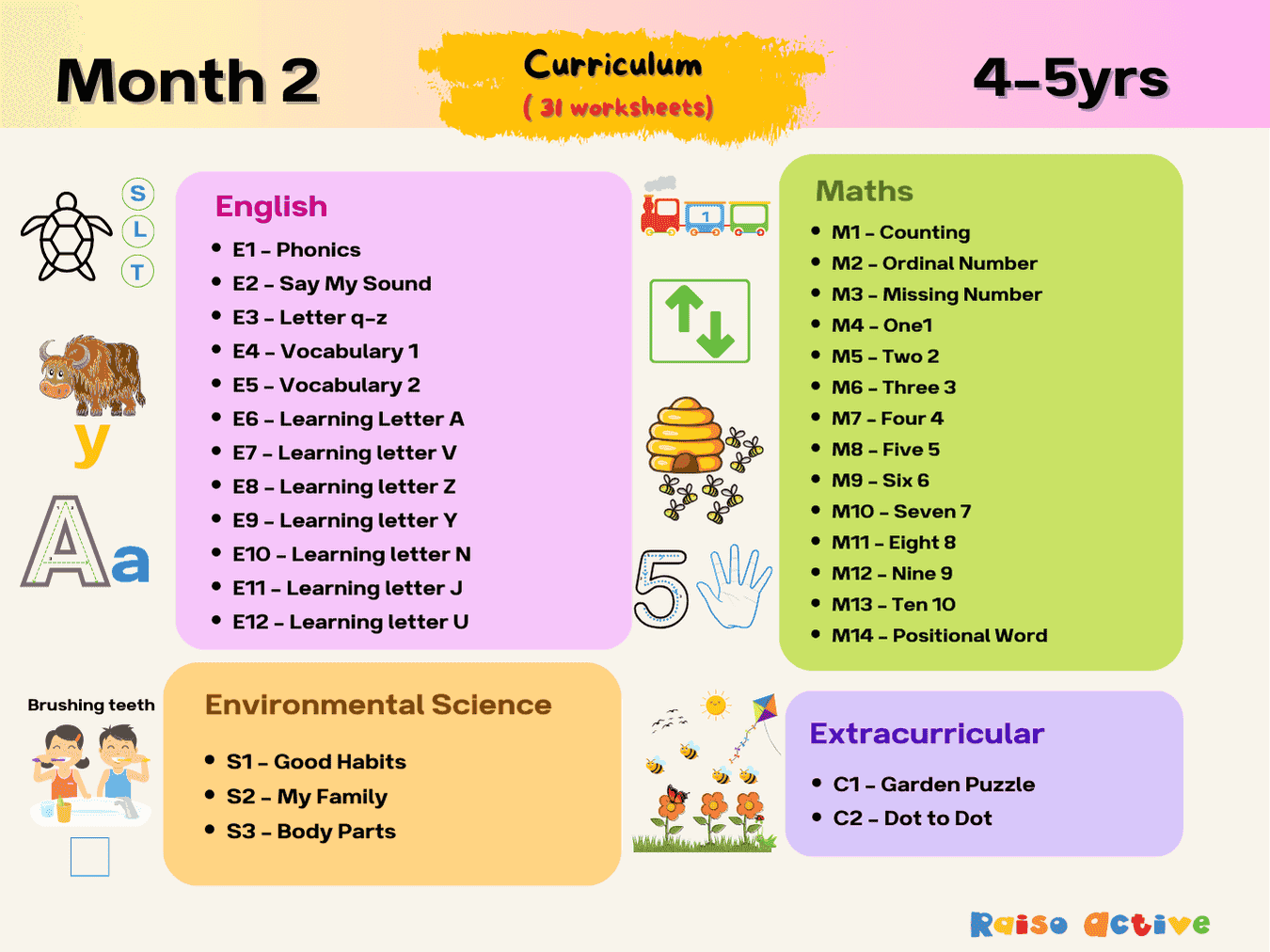
Part of the pack
Month 2: Learning & Development | Ages 4-5
This is page 34 of the pack. Ages 4-5 · Pre-KAges 4-5 · ReceptionAges 4-5 · LKGAges 4-5

Made for your child
Counting to 10, made for your child
A maths pack with your child's name in it: pictures that explain, practice at three levels, puzzles and story sums about them. Print a new set whenever they finish.
Make a maths packFree preview · free for members
Curriculum
- Number Sense > Counting 1-20
How to use this worksheet
Find dot number 1 together and place the pencil there to begin. Ask your child what number comes next, then have them draw a line to that dot, continuing the sequence numerically across the page. Keep going dot by dot, saying each number aloud as it's connected, until the full apple shape is complete. Once finished, let your child color the apple using red and green shades.
Materials needed
- Pencil
- Crayons
Extension activities
- 1Color the apple using different shades of red and green for a more detailed picture.
- 2Draw other fruit shapes and create your own simple dot-to-dot puzzles for your child to number and solve.
- 3Practice counting forward and backward from 1 to the highest number used in the puzzle.
- 4Use a number line to point out how each number is one more than the last, just like on the dot-to-dot.

Written by
Hemsweta Jain · Teacher Cheena
MBA and Early Childhood Educator, teaching since 2014 · Founder of RaisoActive, Mumbai
Every RaisoActive worksheet is designed and checked by the founder before publishing.
Published · Last reviewed
More from Month 2: Learning & Development | Ages 4-5
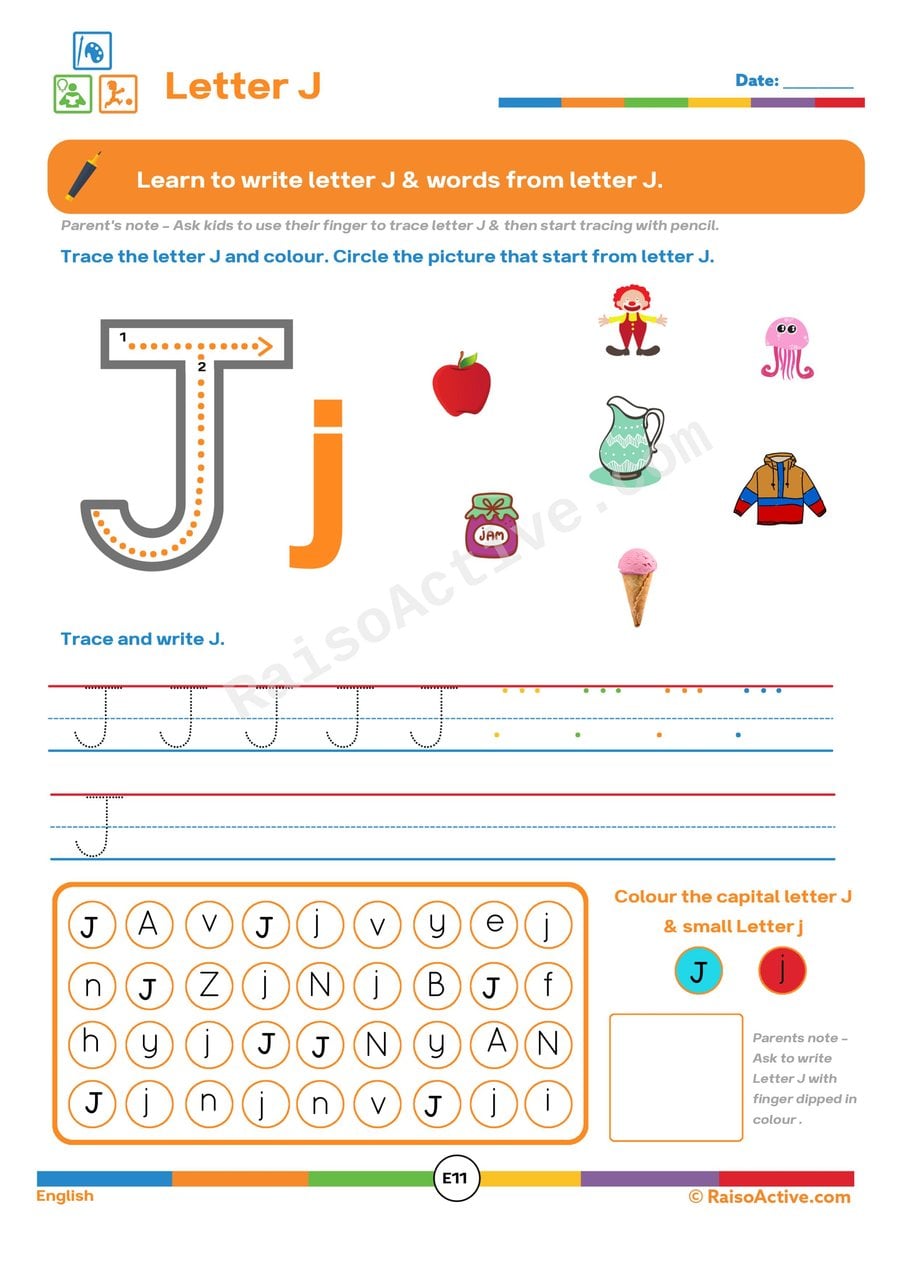
Letter J Worksheet: Trace, Write, and Color!
Ages 3-5 · Preschool–Pre-KAges 3-5 · Nursery–ReceptionAges 3-5 · Nursery–LKGAges 3-5
Children ages 3-5 practice forming the letter J, both uppercase and lowercase, through guided tracing, while also linking the letter to its sound by identifying pictures that begin with J. This combination of motor practice and phonics builds the foundation for both handwriting and early reading.
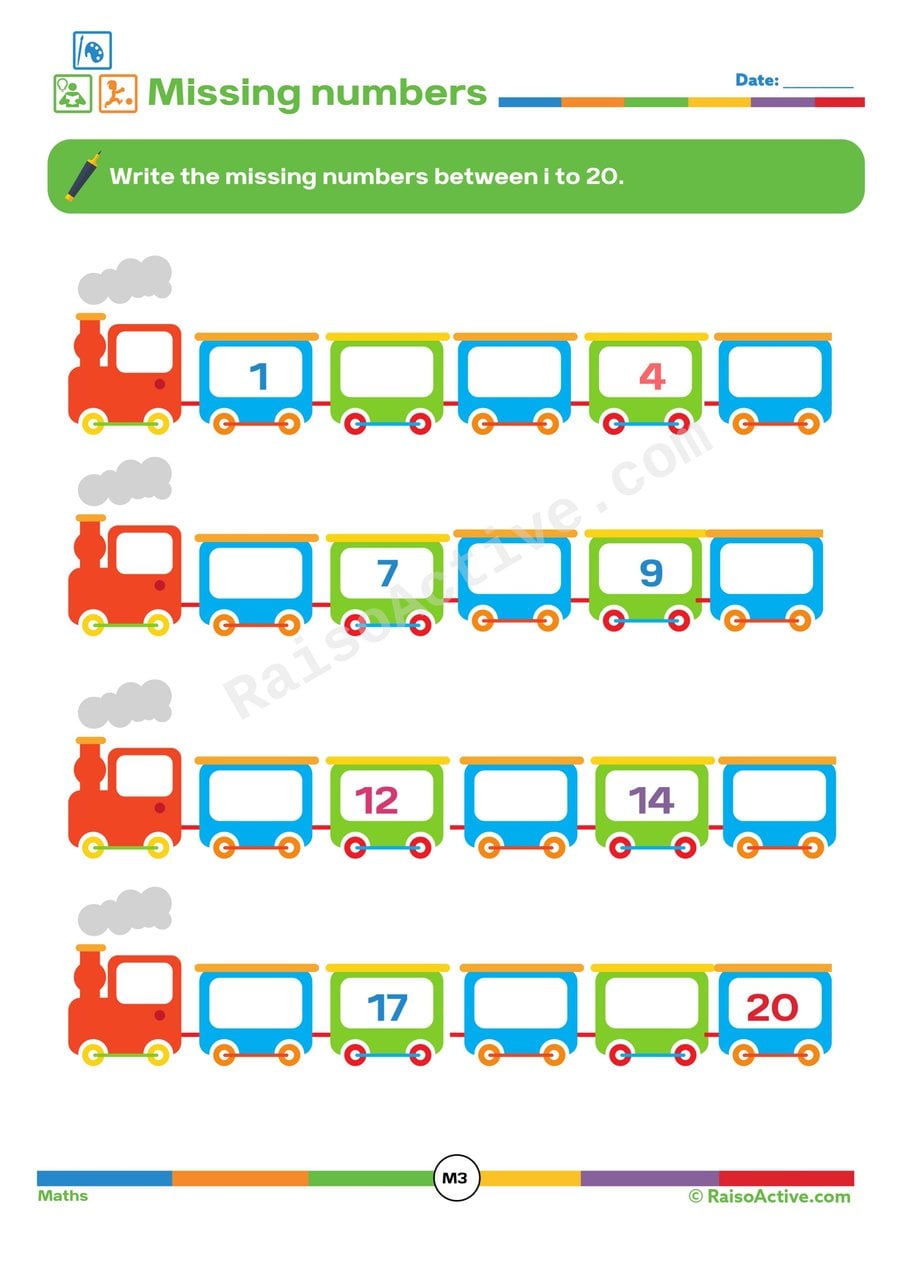
Missing Numbers Train Worksheet: Numbers 1-20
Ages 4-6 · Pre-K–KindergartenAges 4-6 · Reception–Year 1Ages 4-6 · LKG–UKGAges 4-6
This worksheet helps children ages 4-6 practice number recognition and sequencing by filling in missing numbers on a train of cars that counts from 1 to 20, reinforcing that numbers follow a fixed, predictable order. Working with a range this large also builds the stamina and sustained counting skill needed before children move on to skip-counting and simple addition.

Learn the Letter U! Tracing, Matching, and Coloring Worksheet
Ages 3-5 · Preschool–Pre-KAges 3-5 · Nursery–ReceptionAges 3-5 · Nursery–LKGAges 3-5
Children ages 3-5 practice forming the letter U in both its capital and lowercase shapes, while also learning to spot U words among other pictures, building both handwriting control and letter-sound recognition together. The matching component adds a layer of visual scanning practice, since children must compare each picture's beginning sound against the target letter.

Counting Fun: Circle the Correct Number Worksheet
Ages 4-5 · Pre-KAges 4-5 · ReceptionAges 4-5 · LKGAges 4-5
This worksheet builds one-to-one correspondence in children ages 4-5 as they count a group of objects and then match that count to the correct written numeral among several choices. Choosing from multiple numeral options, rather than just writing a number, also sharpens numeral recognition since similar-looking numbers can be easy to confuse.

Spot the Differences: Garden Puzzle Worksheet for Preschoolers
Ages 3-5 · Preschool–Pre-KAges 3-5 · Nursery–ReceptionAges 3-5 · Nursery–LKGAges 3-5
Carefully comparing two similar garden scenes to find five differences builds visual discrimination and sustained attention for children ages 3-5, skills that directly support later reading fluency, since spotting small differences between letters is a similar process.

Letter V Tracing and Coloring Worksheet for Preschoolers
Ages 3-5 · Preschool–Pre-KAges 3-5 · Nursery–ReceptionAges 3-5 · Nursery–LKGAges 3-5
This worksheet builds recognition and formation of the letter V, both uppercase and lowercase, while practicing fine motor skills through tracing and coloring pictures of V words like 'van' or 'volcano.' For three- to five-year-olds, practicing both letter cases together helps children see that uppercase and lowercase V share the same basic shape, which isn't true of every letter and makes V a good confidence-builder.

Circle the Correct Letter: Fun Phonics Worksheet for Kids
Ages 4-5 · Pre-KAges 4-5 · ReceptionAges 4-5 · LKGAges 4-5
This phonics worksheet helps children ages 4-5 connect a picture's beginning sound to its matching letter, a key decoding skill on the path to independent reading. Circling the correct letter from a small set of choices also builds visual discrimination, since children must tell similar-looking letters apart under a bit of time pressure.

Body Parts Matching Worksheet for Preschoolers
Ages 3-5 · Preschool–Pre-KAges 3-5 · Nursery–ReceptionAges 3-5 · Nursery–LKGAges 3-5
Children ages 3-5 practice matching each body part to its specific function, like eyes to seeing or legs to walking, building early awareness of how their own body works. This connects body-part vocabulary to real-world purpose rather than just naming parts in isolation.
Related worksheets

Dot-to-Dot Snail Worksheet: Counting Numbers 1-30!
Ages 3-5 · Preschool–Pre-KAges 3-5 · Nursery–ReceptionAges 3-5 · Nursery–LKGAges 3-5
This dot-to-dot worksheet challenges children ages 3-5 to count and connect numbers from 1 to 30 in sequence, extending their number-order knowledge well past the more common 1-10 range while also building fine motor control as they draw connecting lines. Successfully completing a longer sequence like this gives children a real sense of accomplishment tied directly to numeracy.

Spider Web Connect-the-Dots Worksheet for Preschoolers
Ages 3-5 · Preschool–Pre-KAges 3-5 · Nursery–ReceptionAges 3-5 · Nursery–LKGAges 3-5
This connect-the-dots worksheet has children ages 3-5 count in sequence from one number to the next while drawing curved lines, building both number-order recognition and the pencil control needed for pre-writing curves and loops. Revealing a spider web at the end gives the counting practice a satisfying, visual payoff that keeps young children motivated through the whole sequence.
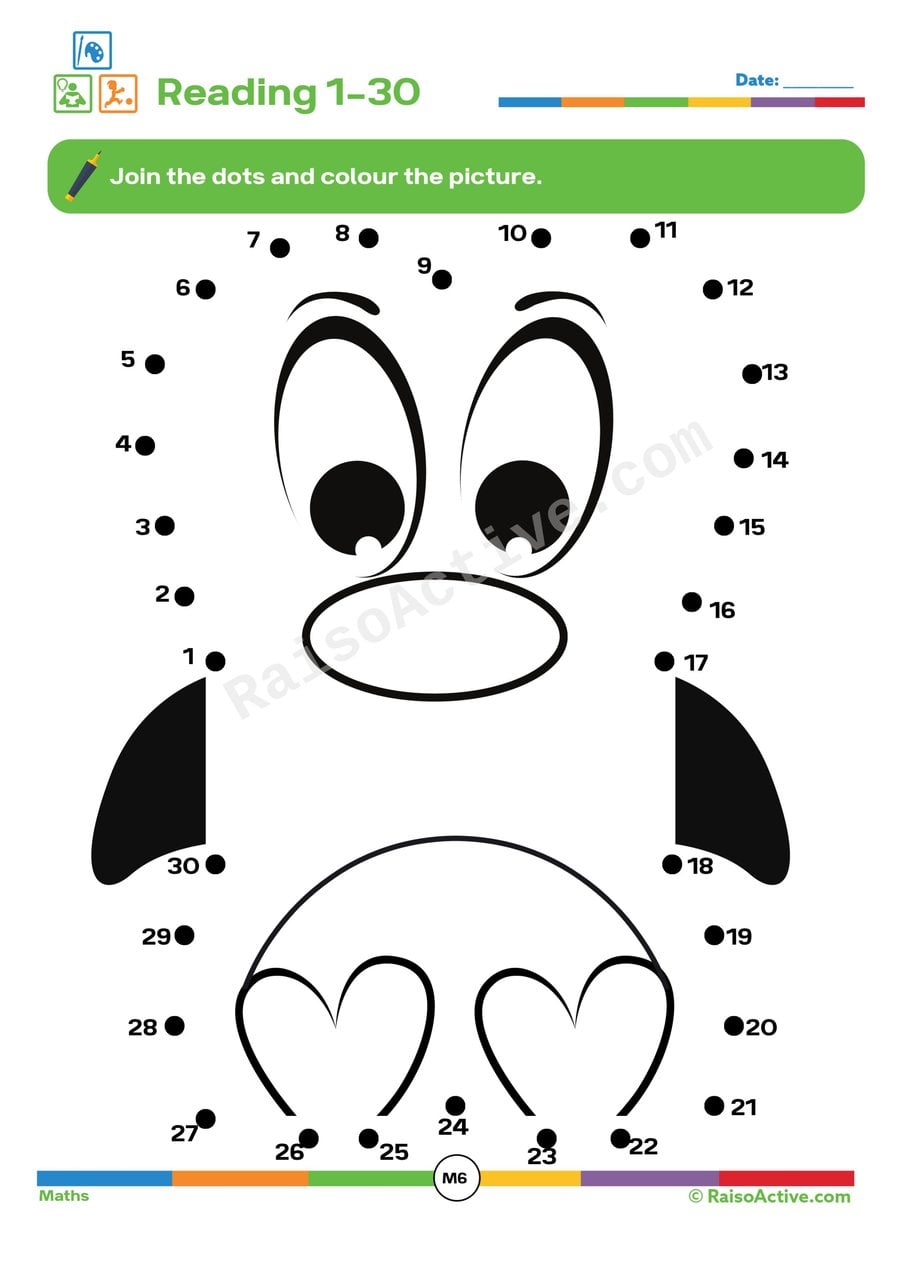
Connect the Dots Penguin Worksheet for Kids
Ages 3-5 · Preschool–Pre-KAges 3-5 · Nursery–ReceptionAges 3-5 · Nursery–LKGAges 3-5
Connecting numbered dots in order to reveal a penguin picture helps children ages 3-5 practice counting in sequence while building the fine motor control needed to draw a steady connecting line. The surprise of watching a recognizable picture emerge gives extra motivation to count carefully all the way to the end.

Connect the Dots: Mushroom House Worksheet for Kids (Numbers 26-50)
Ages 4-6 · Pre-K–KindergartenAges 4-6 · Reception–Year 1Ages 4-6 · LKG–UKGAges 4-6
Extending number sequencing into the 26-50 range pushes children ages 4-6 past the more familiar 1-20 span while reinforcing the fine motor control needed to draw controlled connecting lines that reveal a mushroom house picture.

Connect the Dots: Help the Prince Find the Princess! Numbers 1-25 Worksheet
Ages 3-5 · Preschool–Pre-KAges 3-5 · Nursery–ReceptionAges 3-5 · Nursery–LKGAges 3-5
Locating dots in order from 1 to 25 and drawing a steady connecting line combines number recognition and sequencing with the pencil control children ages 3-5 need for handwriting readiness.
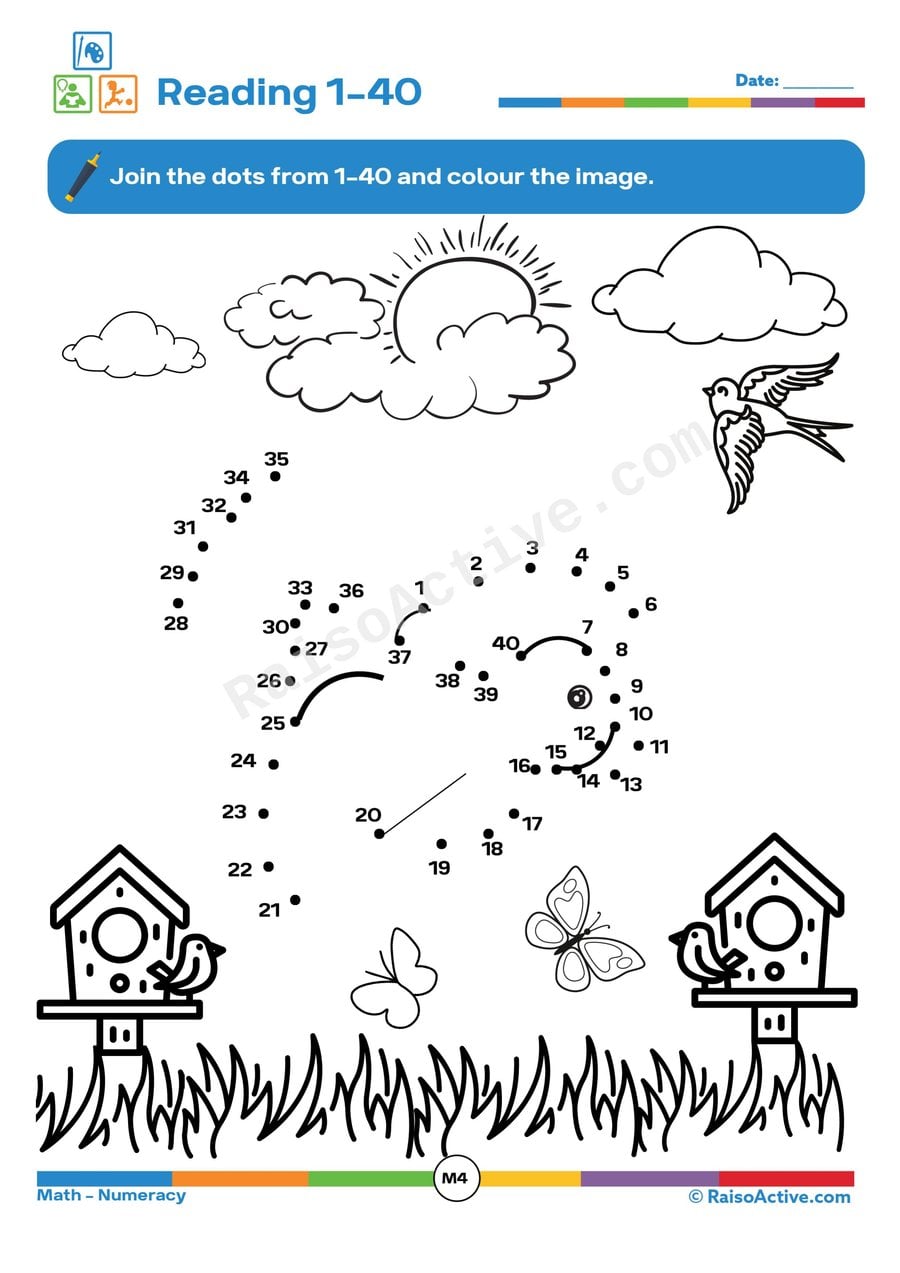
Connect the Dots: Sunny Day Picture Worksheet
Ages 3-5 · Preschool–Pre-KAges 3-5 · Nursery–ReceptionAges 3-5 · Nursery–LKGAges 3-5
Connecting the dots from 1 to 40 gives 3-5 year olds real practice with number sequencing well beyond the basic 1-10 range most preschool materials cover, while the physical act of drawing a line from dot to dot builds the same pencil control needed for handwriting. Because the picture only appears once every number has been found and connected in order, it also rewards sustained attention — your child has to keep track of where they are in the sequence across a fairly long worksheet, which is a real stretch at this age.

Balloon Pattern Matching Worksheet for Preschoolers
Ages 3-5 · Preschool–Pre-KAges 3-5 · Nursery–ReceptionAges 3-5 · Nursery–LKGAges 3-5
This worksheet strengthens pattern recognition in children ages 3-5 by having them study a repeating sequence of colored balloons and locate the matching arrangement elsewhere on the page. Recognizing and reproducing a pattern is an early pre-algebra skill, laying groundwork for later number patterns and logical sequencing.

Symmetry Fun Worksheet for Kids: Complete and Color!
Ages 3-5 · Preschool–Pre-KAges 3-5 · Nursery–ReceptionAges 3-5 · Nursery–LKGAges 3-5
This symmetry worksheet challenges children ages 3-5 to study a half-drawn Christmas picture and draw the missing mirror-image half, introducing the early geometry concept that two sides of a shape can match exactly. Completing and then coloring the picture also builds visual comparison skills, since children must check their drawn half against the original before filling it in with color.
Guides for this topic

Age-Appropriate Problem-Solving Activities: Building Critical Thinkers from the Ground Up
Discover fun, age-appropriate problem-solving activities for children ages 1-8. Build critical thinking, logic, and reasoning skills through play-based learning.
Critical Thinking Activities That Actually Work for Young Children: Building Tomorrow's Thinkers Today
Discover proven critical thinking activities for young children. Age-wise logic games, questioning techniques, and hands-on ideas to build thinking skills at home.

Preparing Your Child for a Rapidly Changing World: Essential Skills for Future Success
Discover the essential 21st century skills your child needs for future success. Practical tips on creativity, critical thinking, digital literacy & emotional intelligence for ages 1-8.
Reviews
Every worksheet for ages 3–5, no watermark
Members download the full library of 1,000+ worksheets and every activity pack without watermarks or daily limits. One year costs ₹999 in India or $20 elsewhere.
See membership plansOr download any worksheet free with a watermark (5 a day).