CVC 'ap' Word Family Read and Reveal Worksheet
Children read five 'ap' family words sound by sound, map, cap, lap, nap and tap, and see that changing the first sound makes a new word.
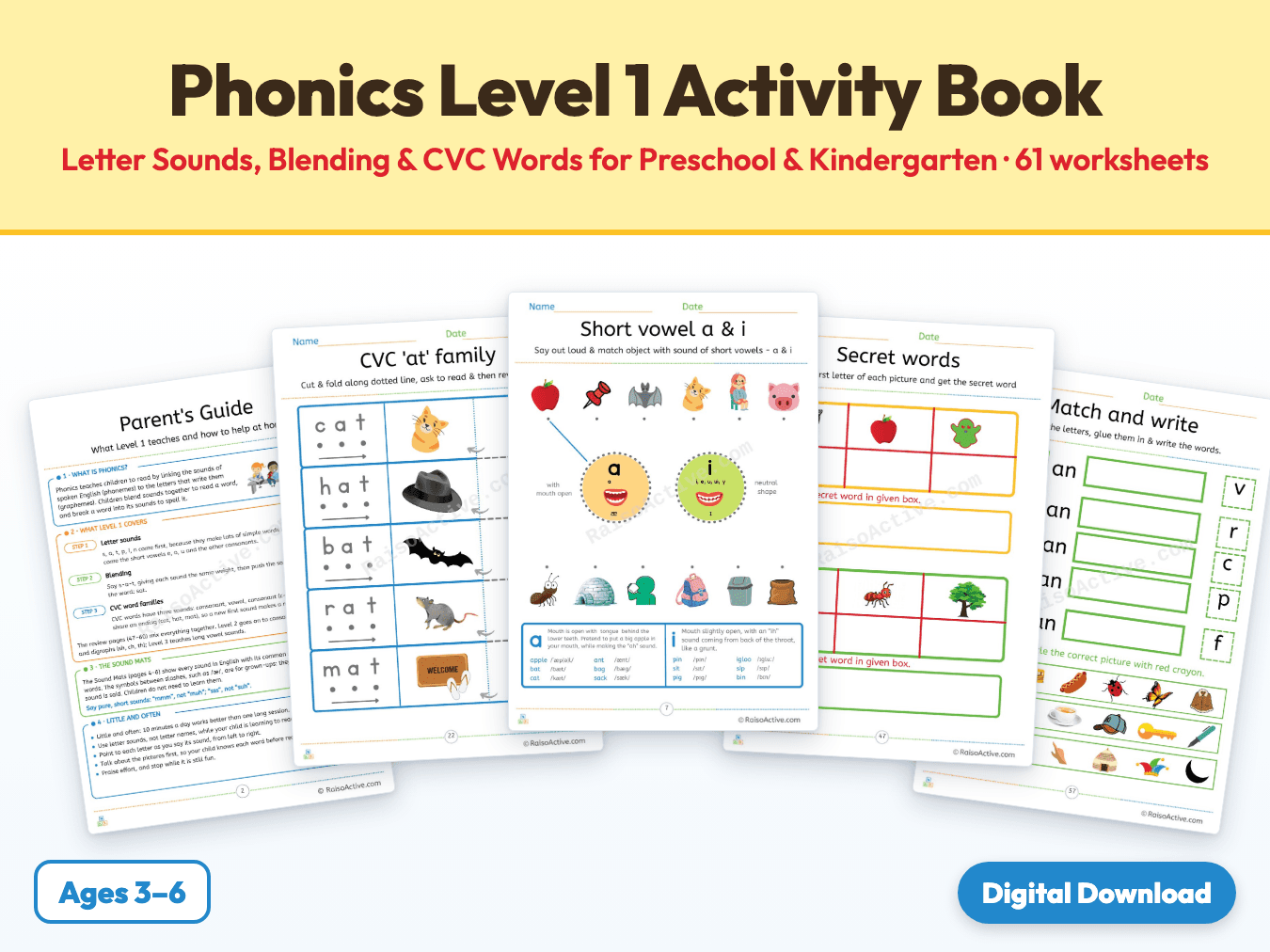
Part of the pack
Phonics Level 1 Activity Book: Letter Sounds, Blending & CVC Words for Preschool & Kindergarten
This is page 32 of the pack. Ages 3-6 · Preschool–KindergartenAges 3-6 · Nursery–Year 1Ages 3-6 · Nursery–UKGAges 3-6
Made for your child
Spelling practice, made for your child
Their own spelling words turned into a pack: trace or look-cover-write-check, roll and write, a secret picture code, a word search, a crossword and a test, with their name in it.
Make a spelling packFree preview · free for members
Or start free: a word search with sight wordsCurriculum
- Phonics - CVC Words > CVC Short A Families
How to use this worksheet
Cut along the dashed lines and fold the blank flap over the pictures. Your child touches the sound dots, blends along the arrow, reads the word, then lifts the flap to check.
Materials needed
- Scissors
- Pencil
Extension activities
- 1Think of another 'ap' word, real or silly
- 2Write the five 'ap' words on cards and read them in a new order

Written by
Hemsweta Jain · Teacher Cheena
MBA and Early Childhood Educator, teaching since 2014 · Founder of RaisoActive, Mumbai
Every RaisoActive worksheet is designed and checked by the founder before publishing.
Published · Last reviewed
More from Phonics Level 1 Activity Book: Letter Sounds, Blending & CVC Words for Preschool & Kindergarten

Letter Sounds f and h Say and Match Worksheet
Ages 3-6 · Preschool–KindergartenAges 3-6 · Nursery–Year 1Ages 3-6 · Nursery–UKGAges 3-6
Children hear and say the f and h sounds, see the mouth shape for each one and match pictures to the right sound. f: fish, fig, fan, phone, photo and cough. h: hut, hop, hat, hen, horse and heart.

CVC 'ag' Word Family Read, Colour and Match Worksheet
Ages 3-6 · Preschool–KindergartenAges 3-6 · Nursery–Year 1Ages 3-6 · Nursery–UKGAges 3-6
Children read the 'ag' words bag, tag, wag, rag and nag on their own and match each word to its picture, checking that they understood what they read.

Letter Sound: Circle the First Letter and Complete the Word
Ages 3-6 · Preschool–KindergartenAges 3-6 · Nursery–Year 1Ages 3-6 · Nursery–UKGAges 3-6
Children choose the first letter of frog, dog and cat from three letters, then hear the last sound and finish the CVC words pen, tap, hat, run, bug, pig, pin and rat.
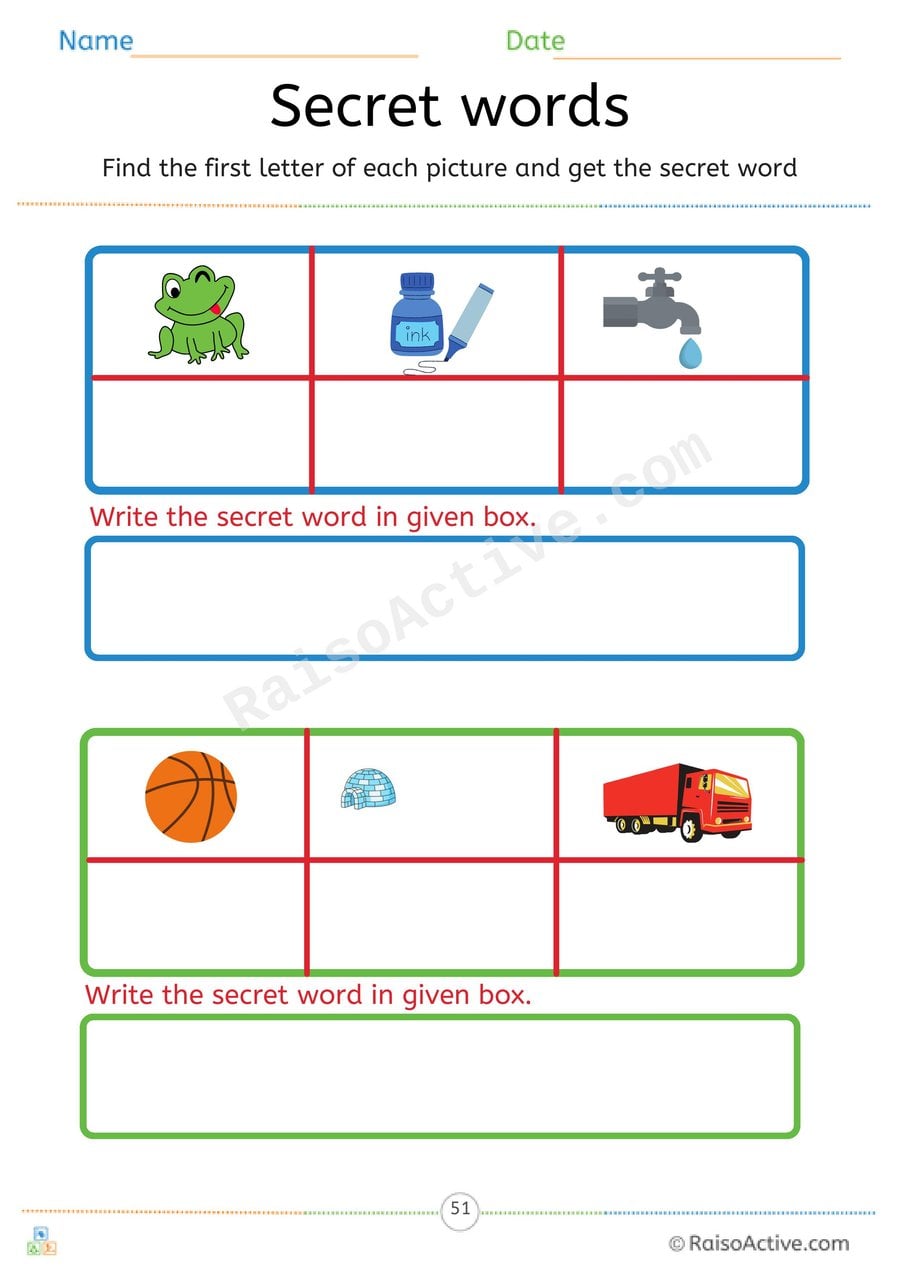
Secret Words: Spell 'it' Family Words from First Sounds
Ages 3-6 · Preschool–KindergartenAges 3-6 · Nursery–Year 1Ages 3-6 · Nursery–UKGAges 3-6
Children hear the first sound of each picture (for example frog, ink, tap), write that letter and blend the three letters to read a hidden 'it' family word.

CVC 'am' Word Family Read, Colour and Match Worksheet
Ages 3-6 · Preschool–KindergartenAges 3-6 · Nursery–Year 1Ages 3-6 · Nursery–UKGAges 3-6
Children read the 'am' words jam, dam, yam, ham and ram on their own and match each word to its picture, checking that they understood what they read.
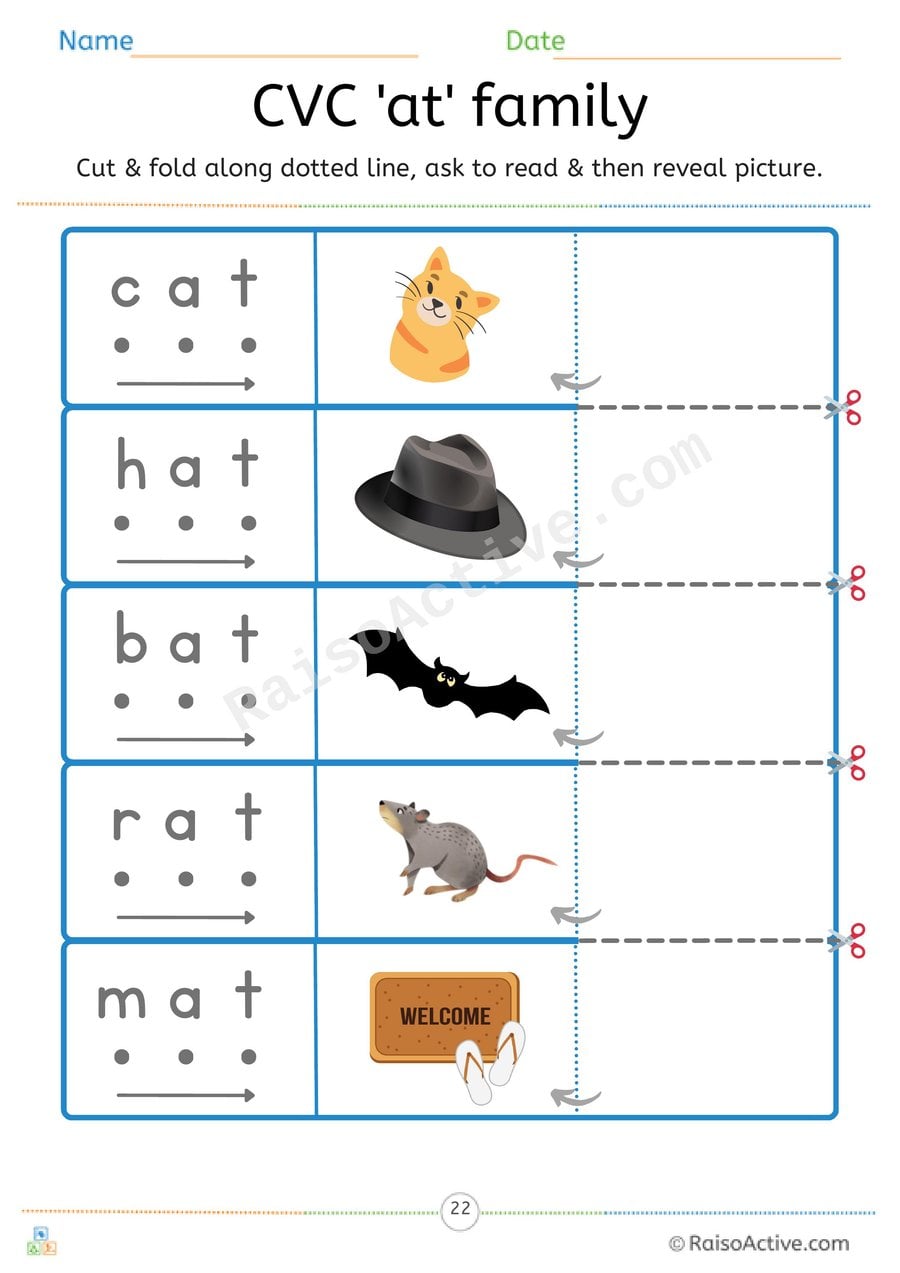
CVC 'at' Word Family Read and Reveal Worksheet
Ages 3-6 · Preschool–KindergartenAges 3-6 · Nursery–Year 1Ages 3-6 · Nursery–UKGAges 3-6
Children read five 'at' family words sound by sound, cat, hat, bat, rat and mat, and see that changing the first sound makes a new word.
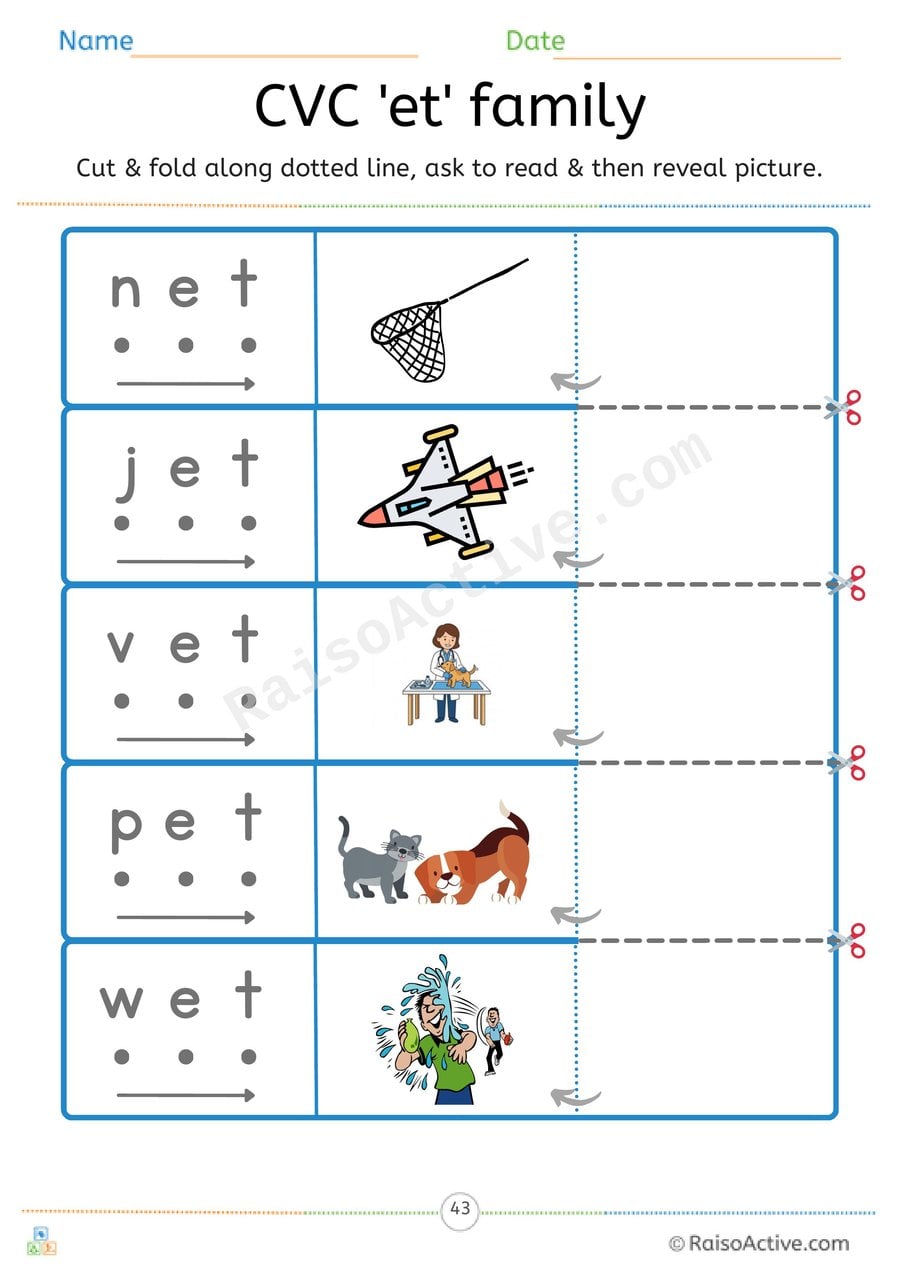
CVC 'et' Word Family Read and Reveal Worksheet
Ages 3-6 · Preschool–KindergartenAges 3-6 · Nursery–Year 1Ages 3-6 · Nursery–UKGAges 3-6
Children read five 'et' family words sound by sound, net, jet, vet, pet and wet, and see that changing the first sound makes a new word.

CVC 'an' Word Family Read, Colour and Match Worksheet
Ages 3-6 · Preschool–KindergartenAges 3-6 · Nursery–Year 1Ages 3-6 · Nursery–UKGAges 3-6
Children read the 'an' words man, pan, fan, ran and van on their own and match each word to its picture, checking that they understood what they read.
Related worksheets

Phonics Level 2 Sound Mat 2: Consonants and Consonant Digraphs
Ages 4-7 · Pre-K–Grade 1Ages 4-7 · Reception–Year 2Ages 4-7 · LKG–Class 1Ages 4-7
Children meet more consonant sounds and the digraphs th, sh, ch, zh and ng, with pictures, spellings and example words.
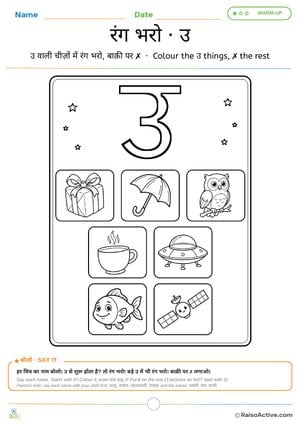
Colour the उ Things: Hindi Letter उ Colouring Page | रंग भरो · उ
Ages 3-7 · Preschool–Grade 1Ages 3-7 · Nursery–Year 2Ages 3-7 · Nursery–Class 1Ages 3-7
Children listen for the first sound of each picture name and decide whether it starts with उ. They colour the उ pictures, cross out the others and colour the big letter.
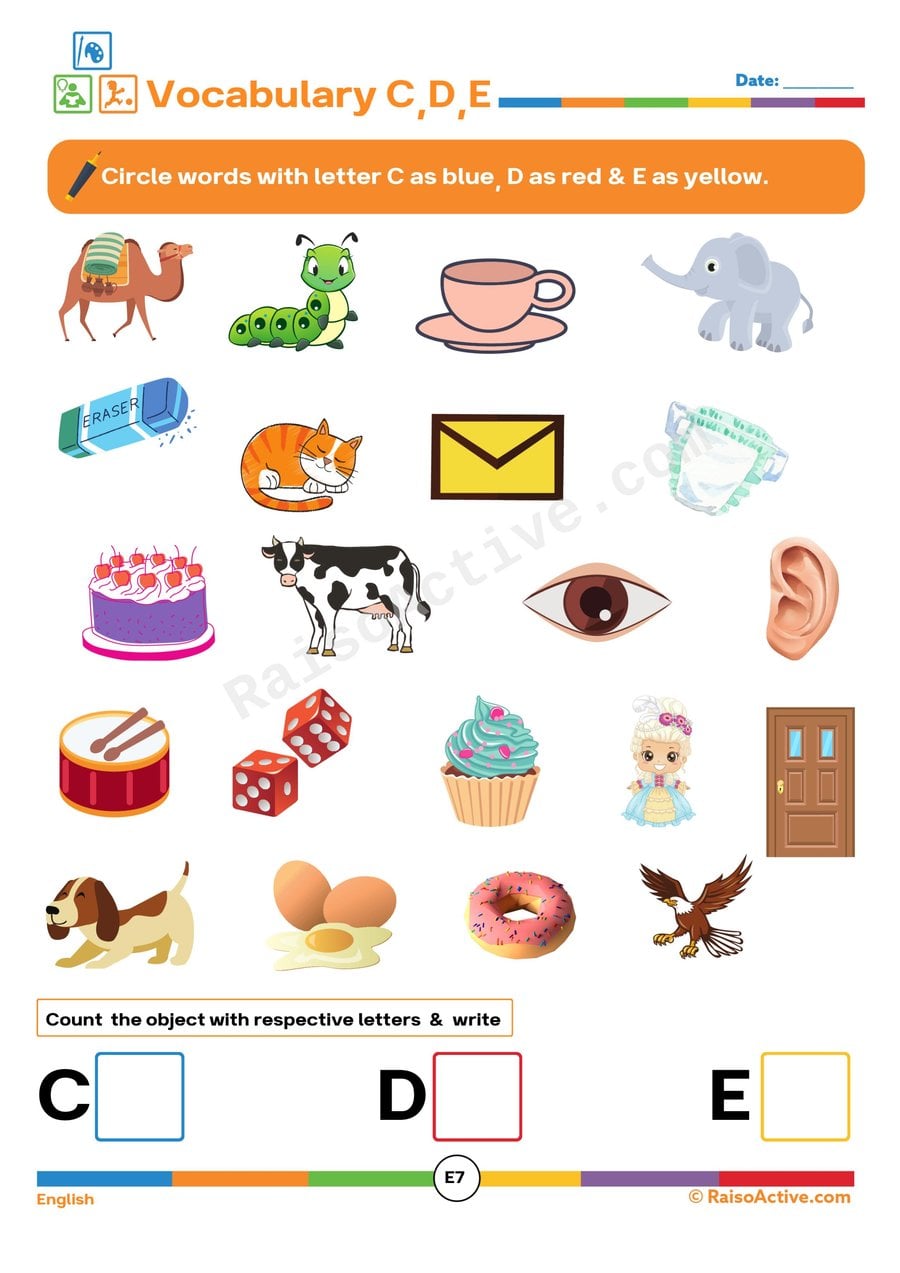
C, D, E Letter Sounds Worksheet: Circle and Count!
Ages 3-5 · Preschool–Pre-KAges 3-5 · Nursery–ReceptionAges 3-5 · Nursery–LKGAges 3-5
This activity gives children ages 3-5 focused practice recognizing the beginning sounds of the letters C, D, and E, asking them to circle matching pictures in different colors for each letter before counting the results. Combining phonics with counting means children practice two skills in one sitting: identifying initial letter sounds and recording a numeric total, both foundational for kindergarten readiness. Color-coding each letter also helps children visually organize the three sounds instead of mixing them together.

Vocabulary Worksheet: Circle the Objects That Start with the Letter!
Ages 4-6 · Pre-K–KindergartenAges 4-6 · Reception–Year 1Ages 4-6 · LKG–UKGAges 4-6
This worksheet reinforces letter-sound recognition for children ages 4-6 by presenting a target letter and asking them to identify which pictures in a row begin with that sound. Unlike single-picture beginning sound tasks, scanning an entire row of images and filtering for matches builds sustained visual attention alongside phonics, since children must reject several near-matches before finding the correct ones.
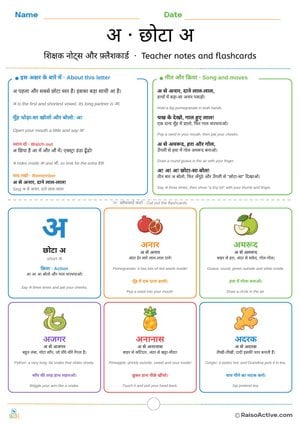
Hindi Letter अ (a) Teacher Notes and Flashcards | अ · छोटा अ
Ages 3-7 · Preschool–Grade 1Ages 3-7 · Nursery–Year 2Ages 3-7 · Nursery–Class 1Ages 3-7
Children meet the short vowel अ with a short note for adults, a song with actions and cut-out flashcards for अनार (pomegranate), अमरूद (guava), अजगर (python), अनानास (pineapple), अदरक (ginger). They hear the sound at the start of real words and link it to a hand action.
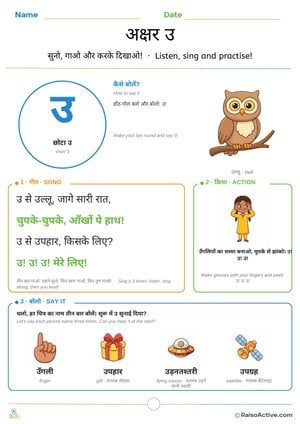
Hindi Letter उ (u) Song, Action and Say It | अक्षर उ
Ages 3-7 · Preschool–Grade 1Ages 3-7 · Nursery–Year 2Ages 3-7 · Nursery–Class 1Ages 3-7
Children hear and say the short vowel उ, learn a short rhyme with an action, and say the names of the picture words उल्लू (owl), उँगली (finger), उपहार (gift), उड़नतश्तरी (flying saucer), उपग्रह (satellite) to practise hearing उ at the start.
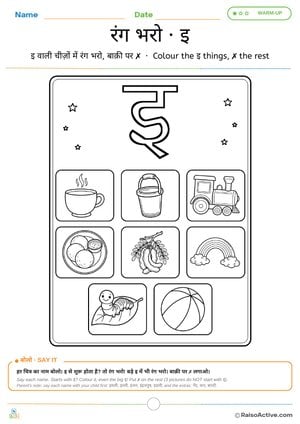
Colour the इ Things: Hindi Letter इ Colouring Page | रंग भरो · इ
Ages 3-7 · Preschool–Grade 1Ages 3-7 · Nursery–Year 2Ages 3-7 · Nursery–Class 1Ages 3-7
Children listen for the first sound of each picture name and decide whether it starts with इ. They colour the इ pictures, cross out the others and colour the big letter.

Phonics Level 3 Long Vowels Answer Key for Grown-ups
Ages 5-7 · Kindergarten–Grade 1Ages 5-7 · Year 1–Year 2Ages 5-7 · UKG–Class 1Ages 5-7
Grown-ups get every answer for the long a, e, i, o and u pages and the long-or-short sorting pages, including word search positions by row and column.
Guides for this topic

How to Teach CVC Blending: A Step-by-Step Method That Works in Two Weeks
A step-by-step method for teaching CVC blending, covering continuous sounds, word families, common errors, and a 14-day plan that most children finish reading CVC words.
Phase 2 Phonics at Home: Sound Order, Blending Games, Worksheets
Phase 2 phonics at home: the five sound sets in order, oral blending, tricky words, a two-week routine, common mistakes, and free worksheets.

Reception Year Explained: EYFS Learning and How to Help at Home
A teacher's plain-English guide to the Reception Year: the seven areas of learning, Early Learning Goals, Phase 2/3 phonics, the RBA and home routines.
Reviews
Every worksheet for ages 3–6, no watermark
Members download the full library of 1,000+ worksheets and every activity pack without watermarks or daily limits. One year costs ₹999 in India or $20 elsewhere.
See membership plansOr download any worksheet free with a watermark (5 a day).