Koala Life Cycle Worksheet: Cut and Paste Matching Activity
This worksheet introduces children ages 3-5 to the life cycle of a koala, from a tiny newborn called a joey that lives in its mother's pouch to a fully grown adult, while practicing scissor and gluing skills. Learning that koala joeys start out riding on their mother's back adds a memorable, specific detail that makes the science concept stick.
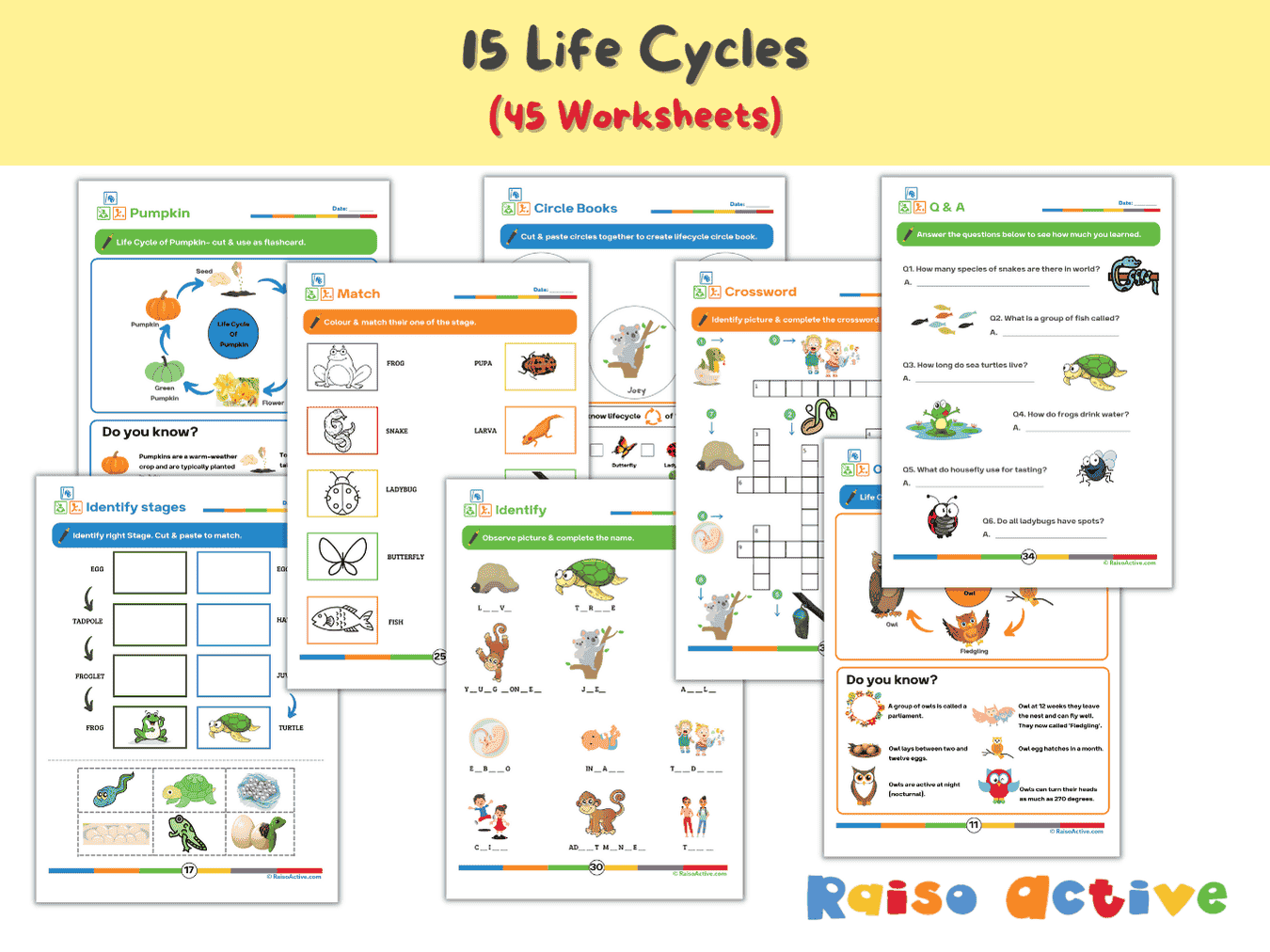
Part of the pack
Lifecycles Activity Book & Flashcards for Preschool & Early Elementary
This is page 21 of the pack. Ages 3-8 · Preschool–Grade 2Ages 3-8 · Nursery–Year 3Ages 3-8 · Nursery–Class 2Ages 3-8
Curriculum
- Living Things - Animals > Animal Life Cycles
How to use this worksheet
Cut out the picture cards at the bottom of the page, keeping them close by. Look at each stage box on the worksheet and talk about what a newborn koala joey, a growing joey, and an adult koala each look like. Have your child match each cut-out picture to its correct life-stage box and glue it into place. Once complete, review the whole sequence together from newborn to adult.
Materials needed
- Scissors
- Glue
- Pencil
Extension activities
- 1Draw your own koala life cycle from joey to adult.
- 2Research other animals that carry their young in a pouch, like kangaroos.
- 3Compare how koala joeys are cared for versus how human babies are cared for.
- 4Make a koala craft using gray paper and cotton balls for fur.
- 5Look up what koalas eat and act out munching on eucalyptus leaves.

Written by
Hemsweta Jain · Teacher Cheena
MBA and Early Childhood Educator, teaching since 2014 · Founder of RaisoActive, Mumbai
Every RaisoActive worksheet is designed and checked by the founder before publishing.
Published · Last reviewed
More from Lifecycles Activity Book & Flashcards for Preschool & Early Elementary

Word Search Worksheet: Find the Hidden Words!
Ages 4-6 · Pre-K–KindergartenAges 4-6 · Reception–Year 1Ages 4-6 · LKG–UKGAges 4-6
This life-cycle-themed word search has children ages 4-6 scan a grid of letters to locate vocabulary words related to growth and change, building visual tracking skills and reinforcing spelling patterns for words they've likely already encountered on other life-cycle worksheets. Searching row by row and diagonally also strengthens the kind of systematic visual scanning that supports later reading fluency.

Life Cycle Crossword Puzzle for Kids: Identify and Complete!
Ages 4-6 · Pre-K–KindergartenAges 4-6 · Reception–Year 1Ages 4-6 · LKG–UKGAges 4-6
This crossword challenges children ages 4-6 to connect a picture clue to its written word, strengthening both vocabulary recall and early spelling of life cycle terms like egg, caterpillar, or tadpole. Fitting letters into the numbered crossword boxes also builds letter-space awareness, helping children understand that each box holds exactly one letter. Together these skills bridge picture recognition and independent word writing, a key step for pre-readers moving toward reading fluency.

Identify Animal Life Cycles: Sequencing Worksheet for Kids
Ages 4-6 · Pre-K–KindergartenAges 4-6 · Reception–Year 1Ages 4-6 · LKG–UKGAges 4-6
This worksheet helps children ages 4-6 generalize the concept of a life cycle across multiple different animals, practicing sequencing by numbering each stage in the correct order. Working across several animals rather than just one strengthens the transferable skill of ordering events logically, regardless of the specific topic.

Fish Life Cycle Worksheet for Kids: Learn and Color!
Ages 3-5 · Preschool–Pre-KAges 3-5 · Nursery–ReceptionAges 3-5 · Nursery–LKGAges 3-5
Children ages 3-5 build early science vocabulary and sequencing skills as they learn the four stages of a fish's life — egg, hatchling, fry, and adult fish. Working with flashcards strengthens visual memory and the ability to place events in the correct order, a skill that supports later reading comprehension and storytelling.
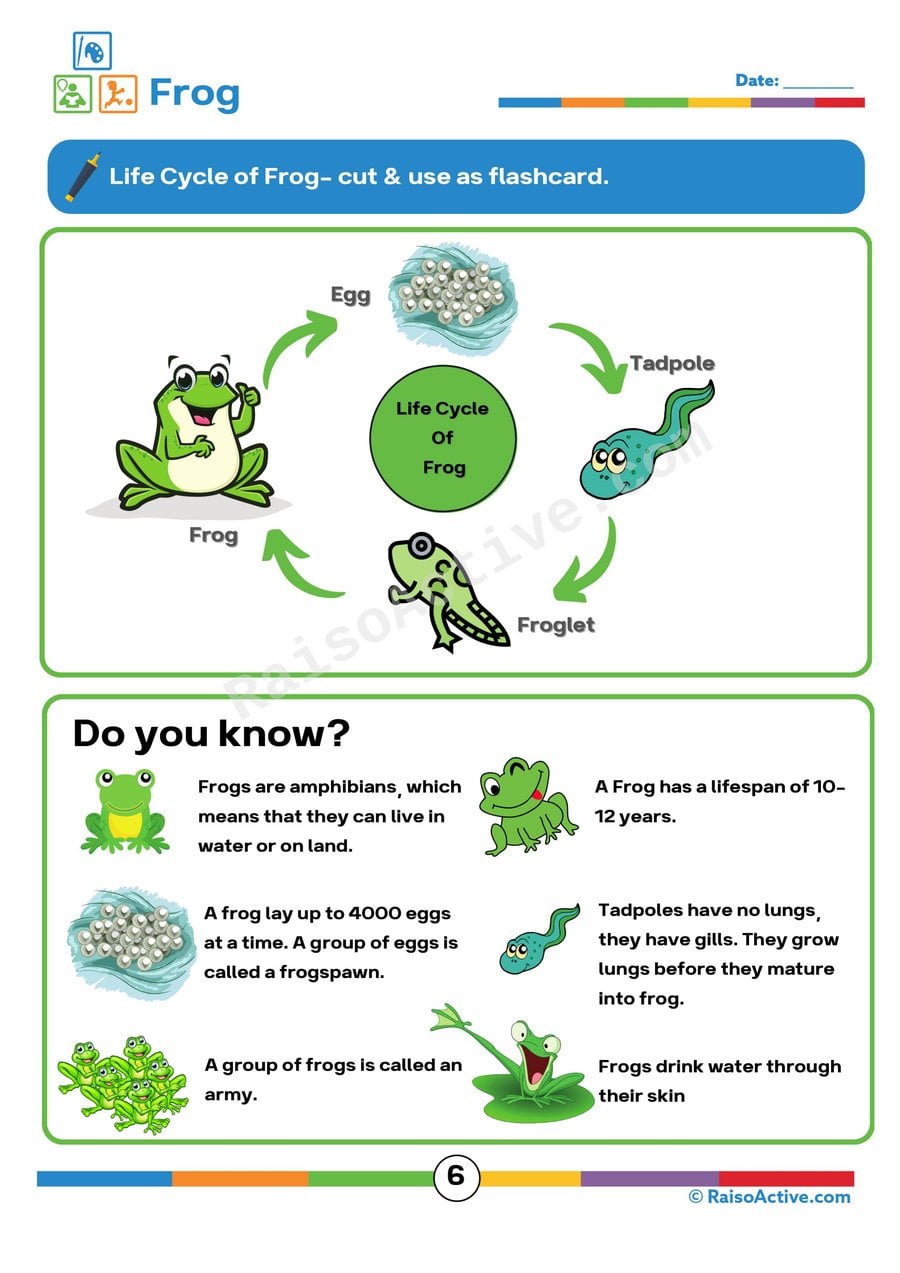
Frog Life Cycle Worksheet for Preschoolers
Ages 3-5 · Preschool–Pre-KAges 3-5 · Nursery–ReceptionAges 3-5 · Nursery–LKGAges 3-5
This worksheet walks children ages 3-5 through a frog's life cycle, egg, tadpole, tadpole with legs, and adult frog, introducing the concept of metamorphosis through a creature many children find fascinating. Recognizing that a tadpole and a frog are the same animal at different stages challenges early assumptions and builds flexible scientific thinking.

Chicken Life Cycle Flashcards: Learn About Chickens!
Ages 3-5 · Preschool–Pre-KAges 3-5 · Nursery–ReceptionAges 3-5 · Nursery–LKGAges 3-5
Working with flashcards that show a chicken's life stages, from egg to chick to adult chicken, teaches children ages 3-5 the concept of a life cycle using an animal that's familiar and easy to relate to through farms, storybooks, and everyday life. Cutting out and physically arranging the cards in order builds fine motor skills alongside sequencing and early scientific reasoning about growth and change. Because chickens are a common early-learning animal, this worksheet also reinforces vocabulary your child may already be building through other farm or animal-themed lessons.
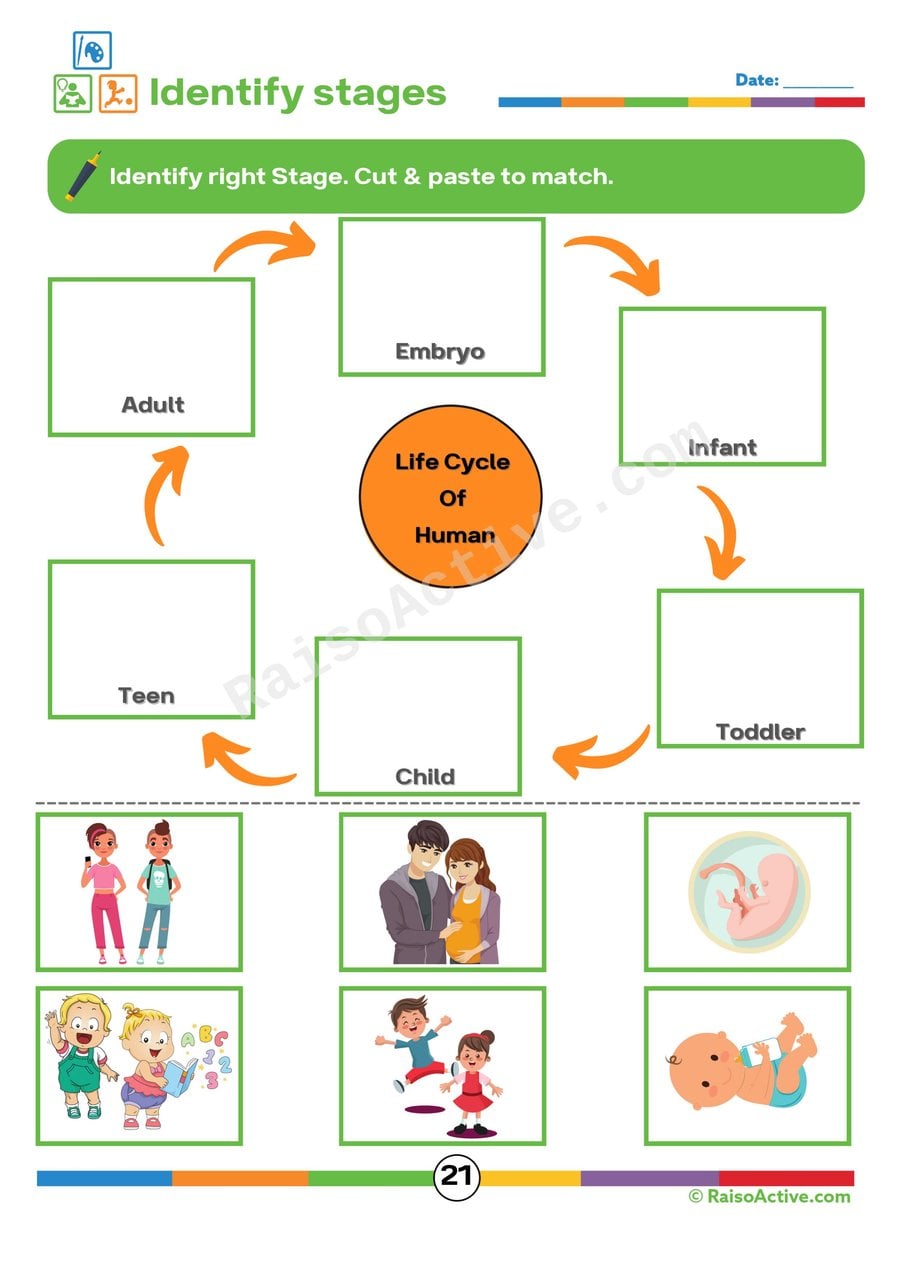
Human Life Cycle Stages Worksheet for Kids
Ages 4-6 · Pre-K–KindergartenAges 4-6 · Reception–Year 1Ages 4-6 · LKG–UKGAges 4-6
This worksheet helps children ages 4-6 understand that people, like animals, grow and change over time by matching pictures to the stages of human development — baby, child, teenager, and adult. It introduces early classification and comparison skills while giving children a concrete way to talk about growth they can observe in their own family.

Turtle Life Cycle Flashcard Worksheet for Preschoolers
Ages 3-5 · Preschool–Pre-KAges 3-5 · Nursery–ReceptionAges 3-5 · Nursery–LKGAges 3-5
This flashcard set introduces children ages 3-5 to the stages of a turtle's life, egg, hatchling, and adult, helping them understand that turtles start life very small and vulnerable before growing into their familiar shelled adult form. Discussing where turtles lay their eggs and how hatchlings behave also builds early awareness of animal habitats and instincts.
Related worksheets

Pinwheel Breathing Buddy: Make a Pinwheel and Spin It with Slow Breaths
Ages 4-6 · Pre-K–KindergartenAges 4-6 · Reception–Year 1Ages 4-6 · LKG–UKGAges 4-6
Children colour and build a pinwheel, then use it to feel the difference between fast and slow breaths. Three breath games ask which breath spins it smoothly and how they feel after.
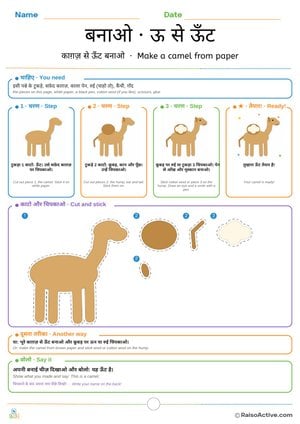
Make a Paper Camel: Hindi Letter ऊ Craft | बनाओ · ऊ से ऊँट
Ages 3-7 · Preschool–Grade 1Ages 3-7 · Nursery–Year 2Ages 3-7 · Nursery–Class 1Ages 3-7
Children cut out the pieces, put them together following three step pictures and make a paper camel. Saying the word ऊँट as they make it links the sound ऊ to something they built themselves.

Mix-a-Face Flip Book: Make Silly Faces and Find the Real Feelings
Ages 4-6 · Pre-K–KindergartenAges 4-6 · Reception–Year 1Ages 4-6 · LKG–UKGAges 4-6
Children see how eyebrows, eyes and mouths change a face. They mix faces, tick the ones they make, and decide which are real feelings and which are silly mixed-up faces.

Feelings Faces Worksheet: Match, Trace and Circle the Happy Faces
Ages 4-6 · Pre-K–KindergartenAges 4-6 · Reception–Year 1Ages 4-6 · LKG–UKGAges 4-6
Children link everyday moments (bubbles, ice cream, blocks, a storm, a gift) to the face that shows the feeling, trace four feelings words and count happy faces.

Peek-a-Boo Feelings Flaps: Cut-and-Glue Lift-the-Flap Craft
Ages 4-6 · Pre-K–KindergartenAges 4-6 · Reception–Year 1Ages 4-6 · LKG–UKGAges 4-6
Children guess how a child feels, lift a flap to check, and practise cutting, creasing and gluing. Six feelings are covered: happy, sad, angry, scared, surprised and excited.
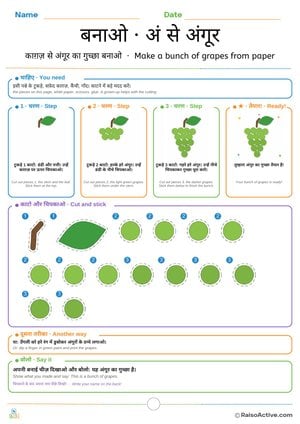
Make a Bunch of Paper Grapes: Hindi Letter अं (am) Cut and Stick Craft | बनाओ · अं से अंगूर
Ages 4-7 · Pre-K–Grade 1Ages 4-7 · Reception–Year 2Ages 4-7 · LKG–Class 1Ages 4-7
Children cut out the numbered pieces and stick them in order to make a bunch of grapes from light and dark green circles, then show it and say a full sentence about it. It links the letter अं with a real picture word, अंगूर, and practises scissor control and following steps.

Balloon Pattern Matching Worksheet for Preschoolers
Ages 3-5 · Preschool–Pre-KAges 3-5 · Nursery–ReceptionAges 3-5 · Nursery–LKGAges 3-5
This worksheet strengthens pattern recognition in children ages 3-5 by having them study a repeating sequence of colored balloons and locate the matching arrangement elsewhere on the page. Recognizing and reproducing a pattern is an early pre-algebra skill, laying groundwork for later number patterns and logical sequencing.

Calm Catcher Fortune Teller: Fold a Paper Fortune Teller of Calm Challenges
Ages 7-10 · Grade 2–Grade 3Ages 7-10 · Year 3–Year 4Ages 7-10 · Class 2–Class 3Ages 7-10
Children cut and fold a fortune teller (cootie catcher) whose eight flaps hold calm challenges: balloon breaths, name five things you see, stretch tall, squeeze and let go, say one kind thing and more.
Guides for this topic

Best Worksheets for 3-Year-Olds: What Works and What to Avoid
What works on worksheets for 3-year-olds: short sessions, crayons, tracing lines, matching, cutting, a free weekly plan, and signs one is too advanced.
Christmas and Winter Activities That Combine Fun and Learning: Creating Magical Educational Experiences
Discover Christmas and winter activities that combine festive fun with real learning. Crafts, counting, literacy, and printable worksheets for ages 2 to 8 — perfect for home and school.

Creating Engaging Themed Learning Units for Young Children: A Complete Guide to Integrated Learning
Discover how to create engaging themed learning units for young children that integrate literacy, maths, science, and art — with practical examples and free worksheets.
Reviews
Every worksheet for ages 3–5, no watermark
Members download the full library of 1,000+ worksheets and every activity pack without watermarks or daily limits. One year costs ₹999 in India or $20 elsewhere.
See membership plansOr download any worksheet free with a watermark (5 a day).