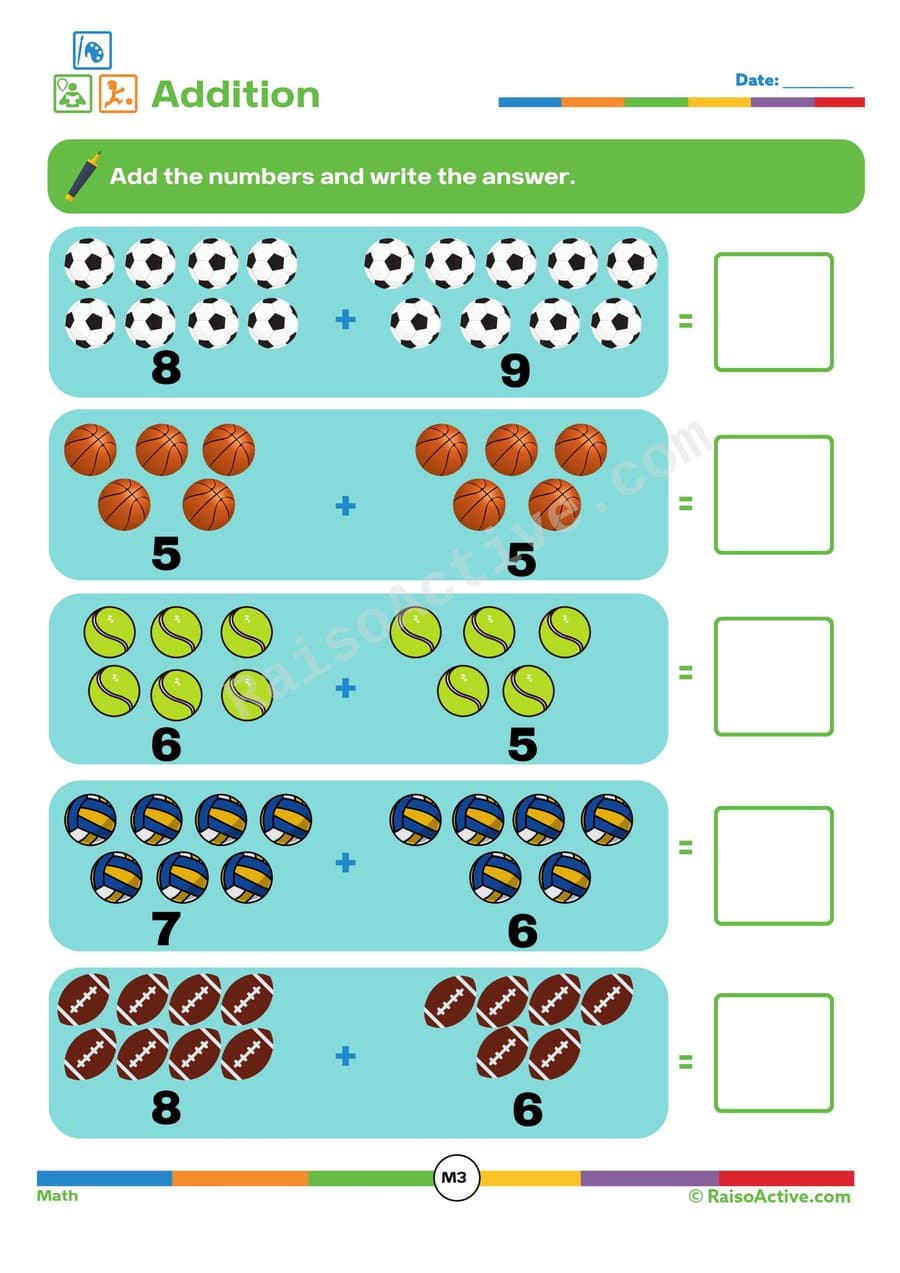
Sports Addition Worksheet for Kids
Featuring sports-themed pictures like balls, bats, and trophies, this worksheet gives children ages 4-6 engaging practice with simple addition, counting two separate sets of objects and combining them into a single total. Using a familiar, high-interest theme like sports can help maintain focus during repetitive counting practice, while still building the same foundational addition skills as any other worksheet.
Part of the pack
Month 9: Early Learning English Math Science | Ages 5-6Curriculum
How to use this worksheet
Look at the first set of sports-themed objects together, like a row of soccer balls, and count them aloud before moving to the second set. Ask your child to combine both counts to find the total number of objects and write that answer in the box provided. Work through each problem on the page the same way, encouraging your child to point to or touch each picture as they count to keep track accurately. Once complete, read each finished addition sentence aloud, connecting the sports pictures to the numbers they represent.
Materials needed
- Pencil
- Eraser
Extension activities
- •Gather real sports equipment, like balls or cones, and set up your own addition problem for your child to solve by counting.
- •Watch a short clip of a sports game and count how many points or goals are scored, adding them up together as the game plays.
- •Create a simple sports-themed board game where landing on a space means solving an addition problem to move forward.
- •Draw two teams of stick-figure players and ask your child to add up the total number of players on the page.
- •Practice counting equipment before and after a game of catch or a sports activity, adding the totals from both counts.
Tips for parents and teachers
If your child gets distracted by the exciting sports pictures rather than focusing on counting, gently redirect them by asking 'how many balls are in this group?' one group at a time. Encourage full recounting of the combined group rather than adding mentally, since this age typically needs the concrete counting step. Tie the math back to any sports your child actually plays or watches to make the numbers feel more meaningful and motivating.

Written by
Hemsweta Jain · Teacher Cheena
MBA and Early Childhood Educator, teaching since 2014 · Founder of RaisoActive, Mumbai
Every RaisoActive worksheet is designed and checked by the founder before publishing.
Published · Last reviewed
Related worksheets
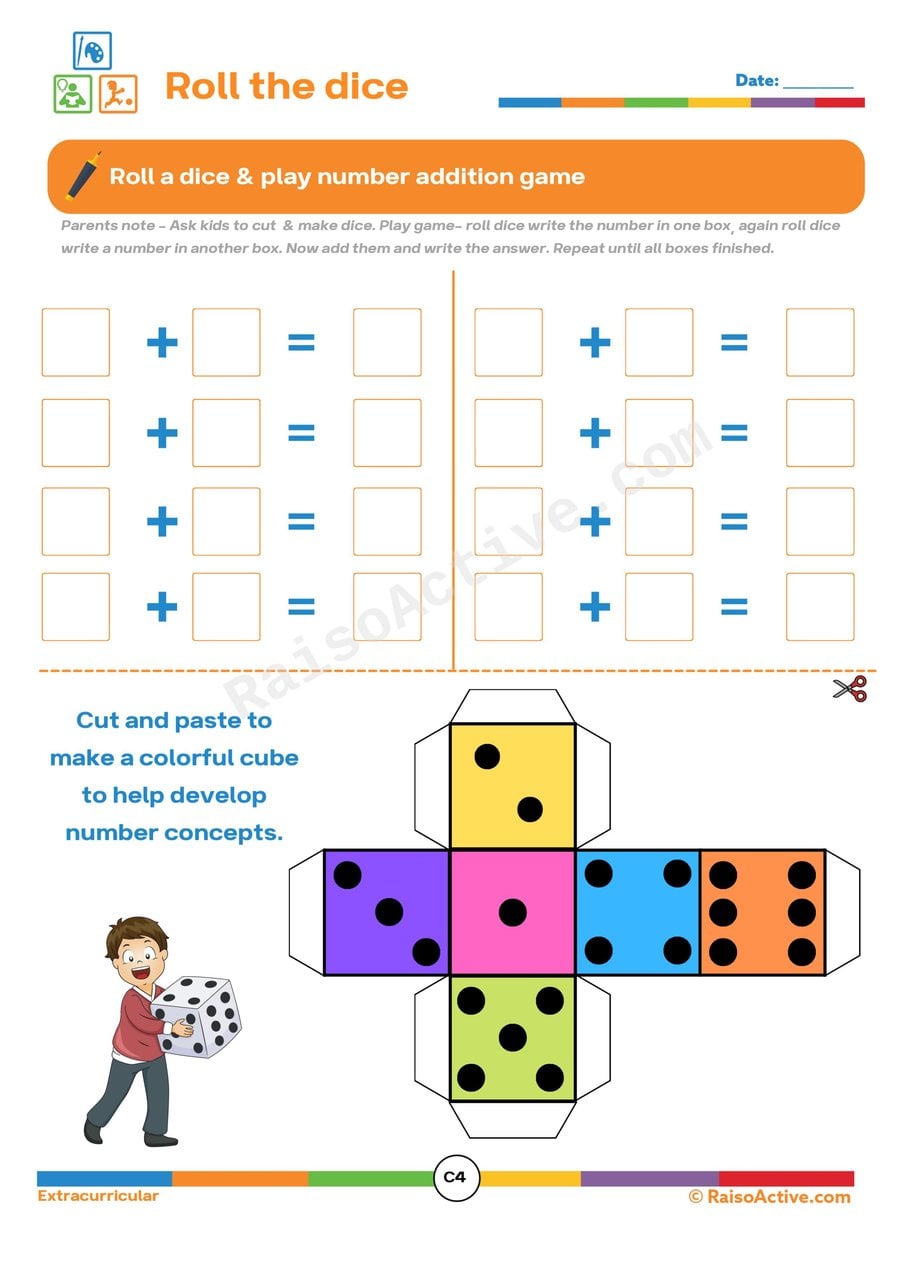
Roll the Dice Addition Worksheet for Kids
This dice-based addition worksheet gives children ages 4-6 hands-on practice combining two quantities into a sum, using a physical dice roll to make the abstract idea of addition concrete and random. Rolling, recording, and adding numbers repeatedly builds fluency with numbers 1-6 and reinforces that addition means 'putting together.' The repeated-roll format also builds working memory as children hold two numbers in mind to combine them.

Air Balloon Color by Sums Worksheet for Preschoolers
This color-by-sums worksheet combines basic addition practice with color-by-number skills, asking children ages 3-5 to solve simple addition problems within each section of an air balloon and then color that section according to a matching color key. Solving a math problem correctly before coloring turns each section into a small, self-checking task, since an incorrect sum would lead to the wrong color choice. This blend of math and art keeps repetitive addition practice feeling like a creative activity rather than a drill.
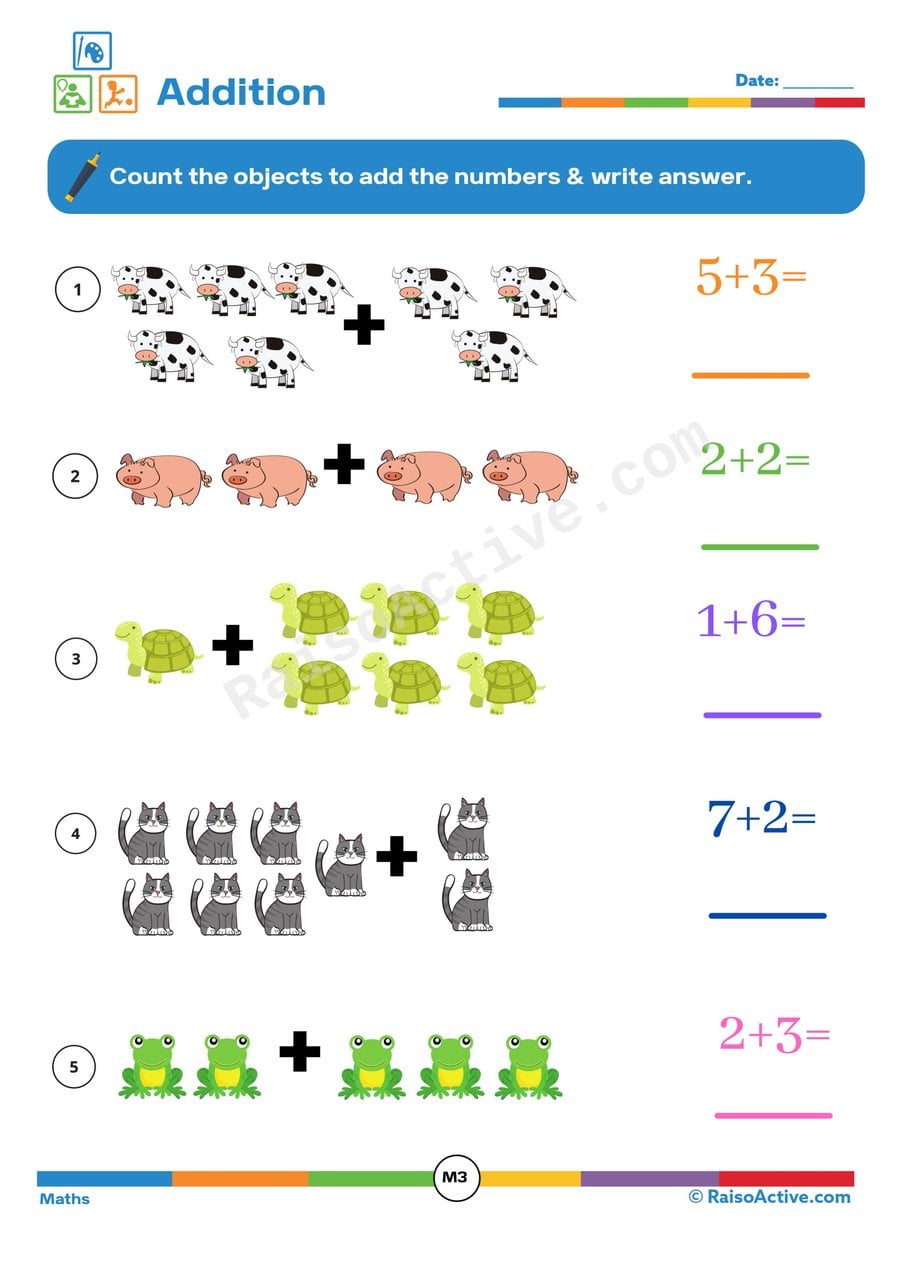
Addition Worksheet: Count and Add Objects!
Counting two groups of pictured objects and writing their combined total introduces children ages 4-6 to addition as a concrete, visual process before they work with numbers alone. Because the objects are drawn out rather than represented only by digits, children can physically point and count to verify their answer, building confidence in early math reasoning. Repeated practice with this picture-based format helps children internalize what a plus sign means before they're expected to solve equations without visual support.

Addition Fun: Count and Add the Pictures Worksheet!
Counting two separate groups of pictured objects and combining their totals introduces children ages 4-6 to the core concept of addition as joining quantities together, before they ever see an addition sign written out. Writing the final sum in the answer box connects this hands-on counting process to numeral writing, reinforcing that a math answer is a specific, countable quantity rather than an abstract symbol. This picture-based approach to addition builds a concrete foundation that supports later work with number-only equations.

Addition Fun: Add and Match the Numbers! (Worksheet)
Children ages 4-6 practice basic addition by counting two groups of pictured objects, finding their total, and then matching that sum to the correct number, combining counting, addition, and visual matching in a single activity. Drawing a line to connect an answer to its number reinforces that a math sentence and a numeral represent exactly the same quantity.

Penguin Addition Worksheet for Preschoolers: Counting and Circling
Counting groups of penguins, combining them, and circling the correct sum from several options builds early addition fluency for children ages 3-5, using a fun animal theme to keep counting practice engaging.

Coloring Fun: Addition Worksheet for Preschoolers
Solving each addition problem reinforces single-digit sums, while matching the answer to a color-by-number key trains children ages 4-6 to connect a symbol — the number — to a category — the color, an early bridge between arithmetic and following multi-step visual instructions.

Rolling Addition Worksheet for Preschoolers: Dice Game Fun!
Rolling two dice and adding the results teaches children ages 4-6 the core idea of addition as combining two quantities into one total, rather than just memorizing number facts. The physical act of rolling builds excitement around math while requiring them to recognize dice pips or numerals, transfer them to paper, and calculate a sum, connecting concrete play to abstract arithmetic.
Guides for this topic
Number Formation Rhymes 0–9 and How to Fix Reversals
Original number formation rhymes for 0–9, the correct stroke order for each digit, why 3, 5 and 7 get reversed most often, and multisensory fixes that work.
Christmas and Winter Activities That Combine Fun and Learning: Creating Magical Educational Experiences
Discover Christmas and winter activities that combine festive fun with real learning. Crafts, counting, literacy, and printable worksheets for ages 2 to 8 — perfect for home and school.
Age-Appropriate Halloween Learning Activities: Balancing Spooks and Skills for Young Learners
Discover fun, age-appropriate Halloween learning activities for young children. Spooky crafts, counting games, literacy ideas, and printable worksheets for ages 2 to 8.
Reviews
Every worksheet for ages 4–6, no watermark
Members download the full library of 1,000+ worksheets and every activity pack without watermarks or daily limits. One year costs ₹1,000 in India or $20 elsewhere.
See membership plansOr download any worksheet free with a watermark (5 a day).