Transportation Word Search Worksheet for Kids
This word search worksheet builds sight-word recognition and spelling awareness for children ages 4-6 as they scan a letter grid to find transportation-related vocabulary. Searching for a specific sequence of letters within a larger grid strengthens visual tracking and letter-pattern recognition, skills that support both reading fluency and spelling as children learn to recognize whole words at a glance.
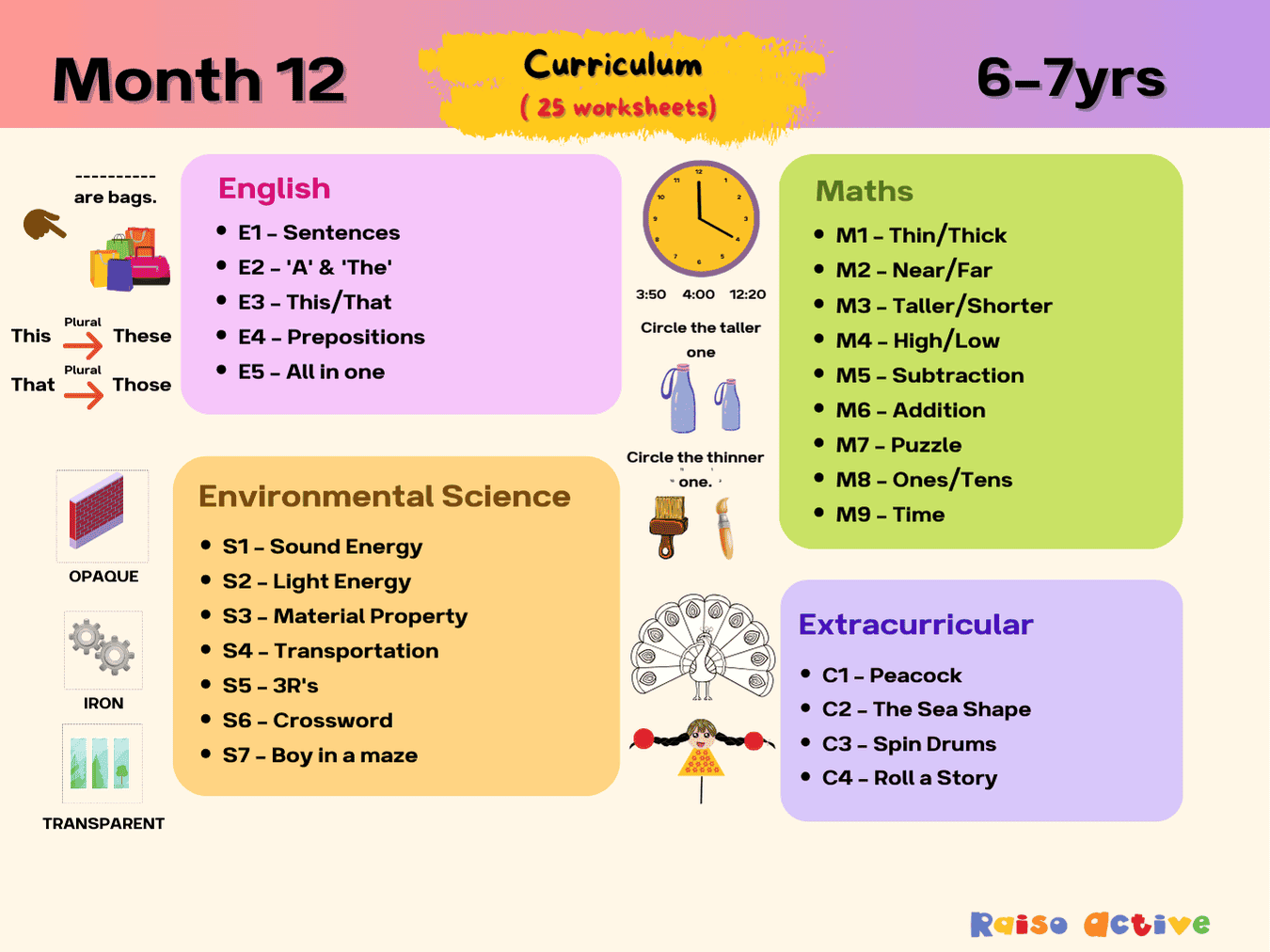
Part of the pack
Month 12: Learning & Development | Ages 6-7
This is page 21 of the pack. Ages 6-7 · Grade 1Ages 6-7 · Year 2Ages 6-7 · Class 1Ages 6-7
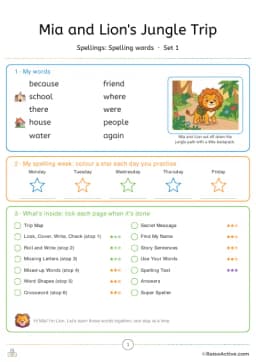
Made for your child
Spelling practice, made for your child
Their own spelling words turned into a pack: trace or look-cover-write-check, roll and write, a secret picture code, a word search, a crossword and a test, with their name in it.
Make a spelling packFree preview · free for members
Or start free: a word search with sight wordsCurriculum
- Vocabulary > Vocabulary Building
How to use this worksheet
Read through the list of transportation words below the grid together, sounding out any that are unfamiliar. Choose one word from the list and scan the grid row by row, looking for that same sequence of letters. Once found, have your child circle the word in the grid and cross it off the word list. Continue finding each word the same way, then have your child write the name of a transportation vehicle in the box provided once the search is complete.
Materials needed
- Pencil
- Crayons
Extension activities
- 1Draw your favorite mode of transportation and write a sentence about it.
- 2Write a sentence about each mode of transportation found in the word search.
- 3Create your own simple word search using three or four favorite vehicle names.
- 4Time how long it takes to find all the words, then try a fresh grid to beat that time.

Written by
Hemsweta Jain · Teacher Cheena
MBA and Early Childhood Educator, teaching since 2014 · Founder of RaisoActive, Mumbai
Every RaisoActive worksheet is designed and checked by the founder before publishing.
Published · Last reviewed
More from Month 12: Learning & Development | Ages 6-7
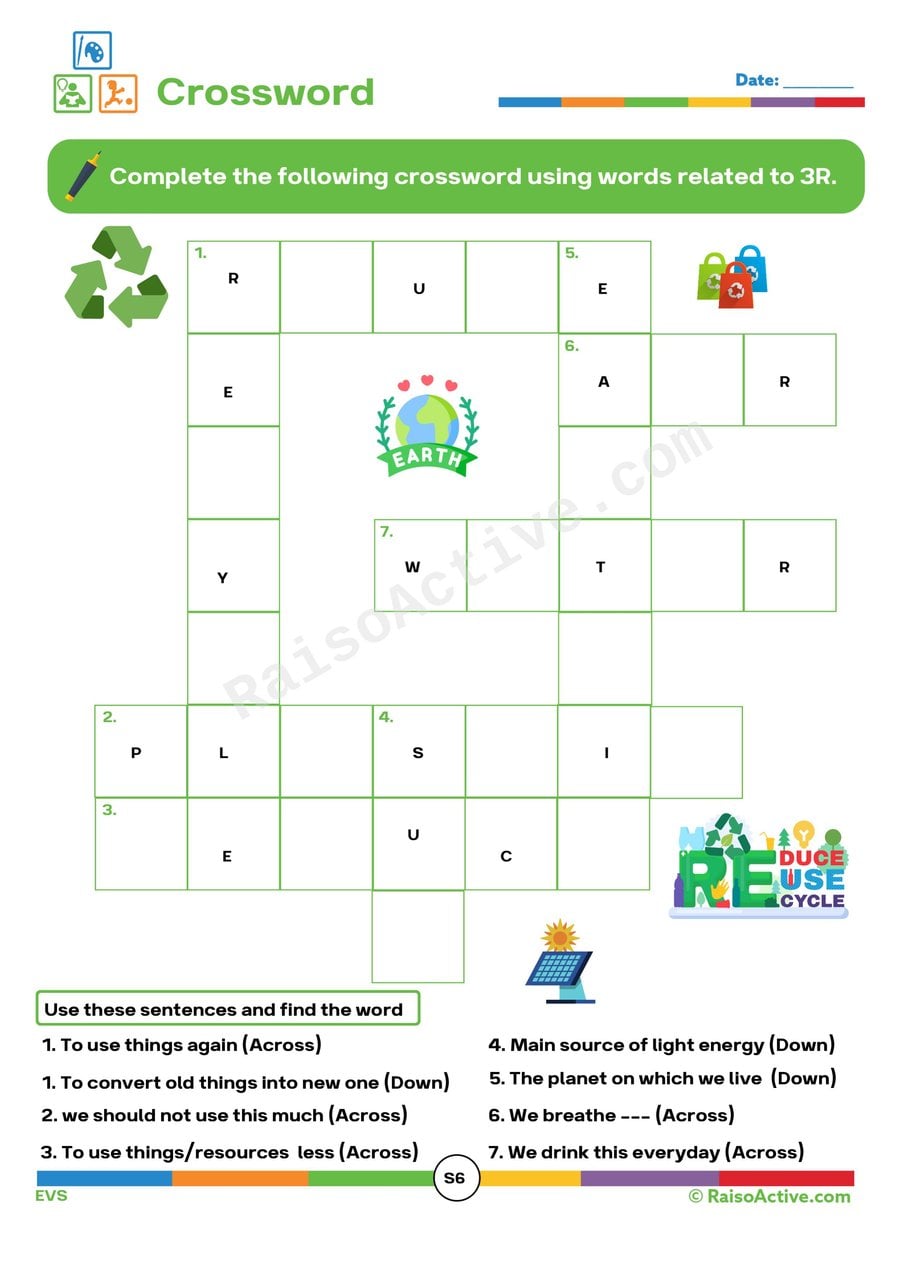
3R Crossword Puzzle Worksheet for Kids
Ages 4-6 · Pre-K–KindergartenAges 4-6 · Reception–Year 1Ages 4-6 · LKG–UKGAges 4-6
This crossword puzzle challenges children ages 4-6 to connect vocabulary about reducing, reusing, and recycling to its written spelling, reinforcing environmental concepts through reading and word-building rather than picture matching alone. Using clues to determine the correct word and then filling in letter boxes practices phonics, spelling, and logical deduction together, since letters that cross with other answers must match on both words.
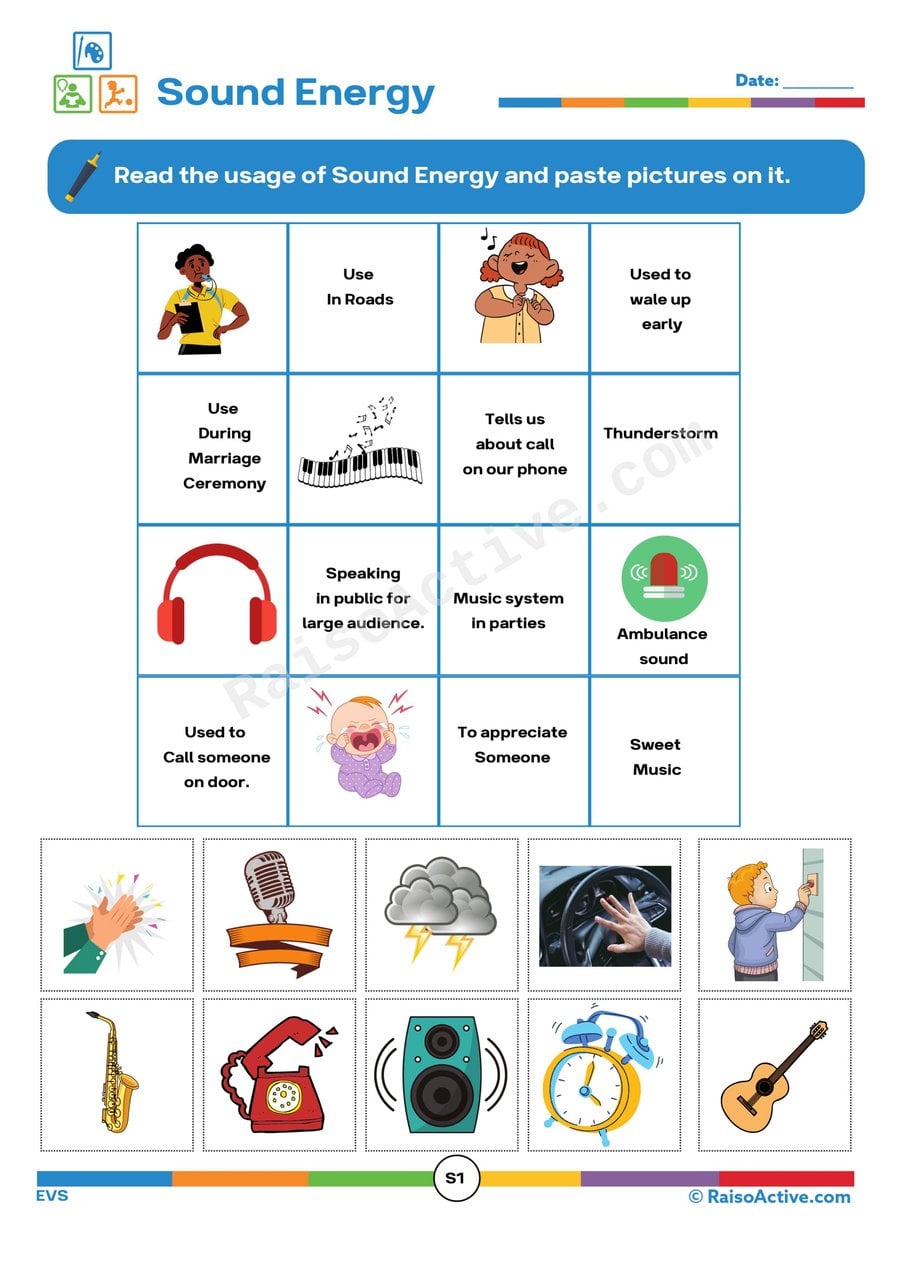
Sound Energy Matching Worksheet for Kids
Ages 4-6 · Pre-K–KindergartenAges 4-6 · Reception–Year 1Ages 4-6 · LKG–UKGAges 4-6
This worksheet introduces children ages 4-6 to the science concept of sound energy by having them match short descriptions of sound sources to the correct picture. Reading or listening to a description and then identifying the matching image builds comprehension alongside early science reasoning, helping children understand that sound is produced by different actions and objects in the world around them.

Roll a Story Worksheet: Create Fun Stories with Dice!
Ages 4-7 · Pre-K–Grade 1Ages 4-7 · Reception–Year 2Ages 4-7 · LKG–Class 1Ages 4-7
This dice-based storytelling worksheet helps children ages 4-7 practice narrative construction by rolling dice to randomly select a character, setting, and prop, then weaving those elements into an original story. Because the combination is different every time, children must think flexibly and creatively rather than relying on a memorized story, which builds oral language, sequencing, and imaginative reasoning skills that underpin later creative writing.

Material Properties Sorting Worksheet for Preschoolers
Ages 3-5 · Preschool–Pre-KAges 3-5 · Nursery–ReceptionAges 3-5 · Nursery–LKGAges 3-5
Children ages 3-5 practice identifying basic material properties, like hard, soft, rough, or smooth, and sorting everyday objects accordingly, an early science observation skill that builds the foundation for later lessons on states of matter and physical properties. Describing why an object belongs in a category also strengthens descriptive vocabulary.
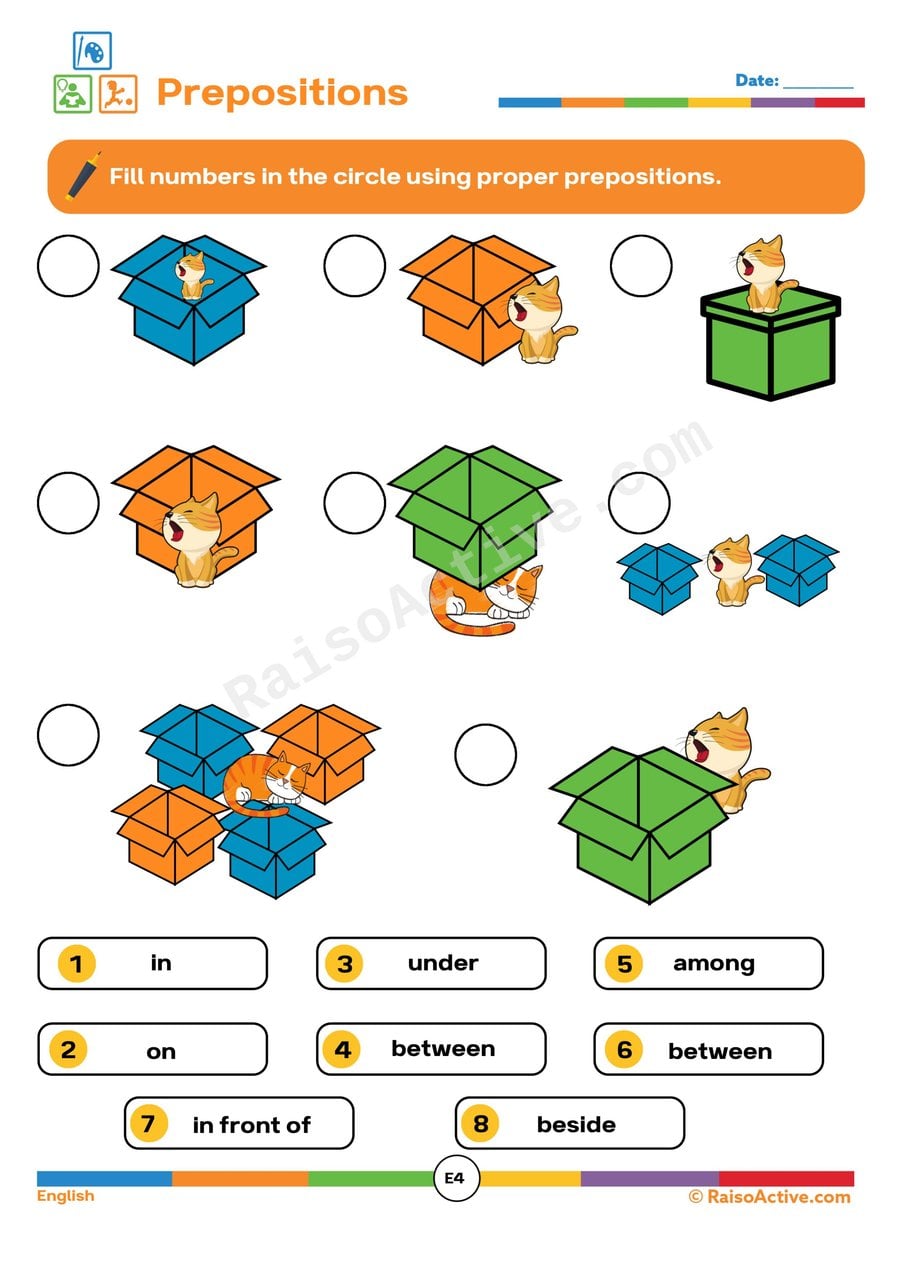
Prepositions Worksheet: Where Are the Cats?
Ages 3-5 · Preschool–Pre-KAges 3-5 · Nursery–ReceptionAges 3-5 · Nursery–LKGAges 3-5
This worksheet helps children ages 3-5 learn positional prepositions — words like 'under,' 'on,' 'behind,' and 'in' — by matching each word to a picture showing exactly where a cat is located. Understanding these small but essential words builds spatial vocabulary and comprehension skills that are used constantly in both everyday instructions and later reading comprehension.
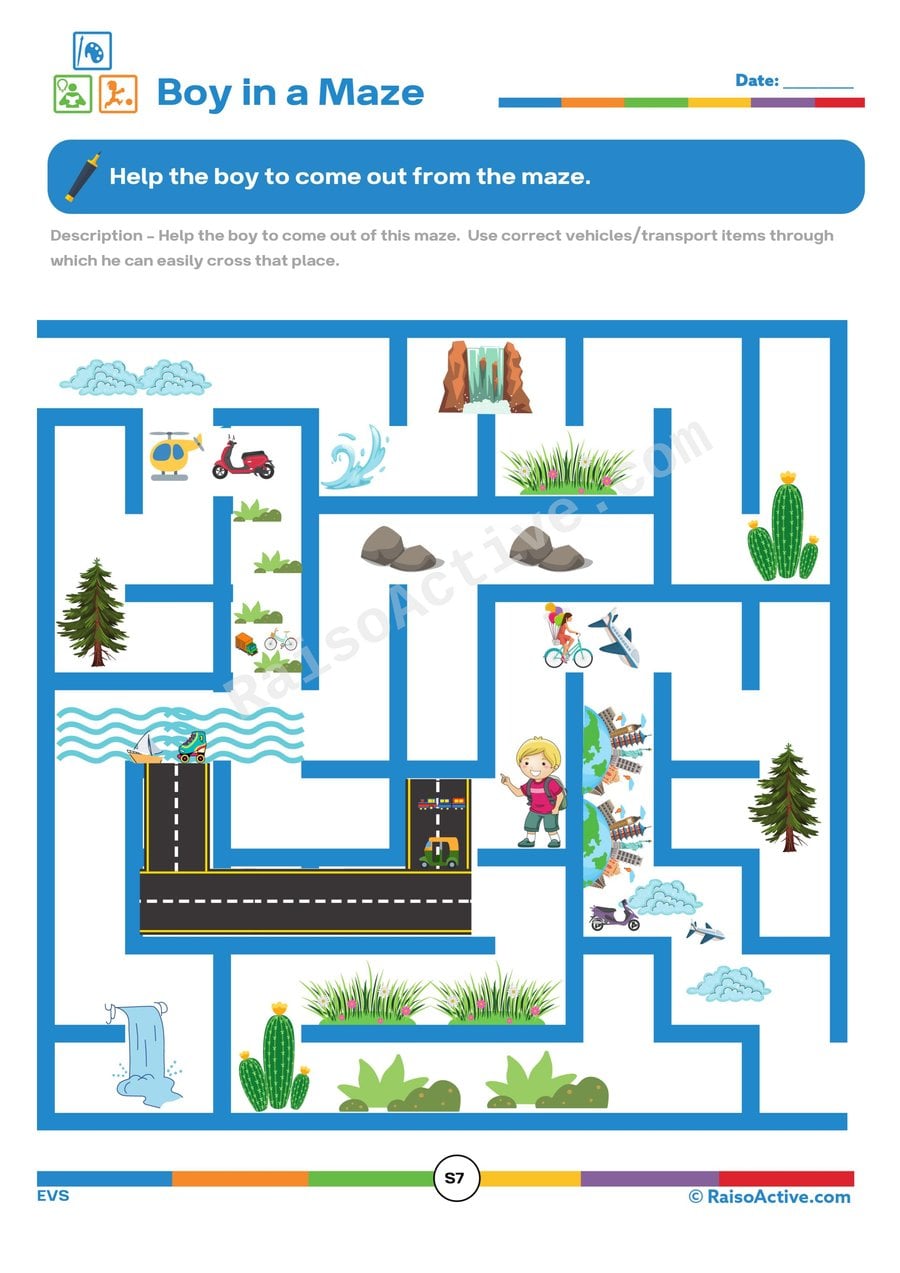
Help the Boy Escape the Maze Worksheet
Ages 3-5 · Preschool–Pre-KAges 3-5 · Nursery–ReceptionAges 3-5 · Nursery–LKGAges 3-5
This maze worksheet builds visual tracking, planning, and fine motor control as children ages 3-5 trace a path for a boy to escape, using different vehicles to get past obstacles along the way. Scanning ahead to choose a workable route before committing to a path develops early problem-solving and forward-planning skills, while the pencil control needed to stay within the maze lines strengthens hand strength for later handwriting.

Taller or Shorter? Comparing Heights Worksheet for Preschoolers
Ages 3-5 · Preschool–Pre-KAges 3-5 · Nursery–ReceptionAges 3-5 · Nursery–LKGAges 3-5
This worksheet builds early measurement vocabulary for children ages 3-5 as they compare the heights of pictured objects and people, circling the taller or shorter one as instructed. Beyond simple height comparison, the final section asks your child to identify both the tallest and smallest in a group, requiring them to compare more than two items at once, a step up in reasoning from simple pairwise comparison.

Under the Sea Shapes Cut and Paste Worksheet for Preschoolers
Ages 3-5 · Preschool–Pre-KAges 3-5 · Nursery–ReceptionAges 3-5 · Nursery–LKGAges 3-5
This worksheet combines shape recognition with fine motor practice as children ages 3-5 cut out geometric shapes and arrange them into an underwater scene. Identifying each shape before placing it, and cutting along the provided lines, builds both early geometry vocabulary and the scissor control needed for more advanced cutting tasks.
Related worksheets

Word Structure Worksheet: Choose the Correct Word!
Ages 4-6 · Pre-K–KindergartenAges 4-6 · Reception–Year 1Ages 4-6 · LKG–UKGAges 4-6
Reading a sentence with a missing word and selecting the correct option from a word bank builds vocabulary and context-clue reasoning for children ages 4-6, both essential for early reading fluency and comprehension.

What is Navratri? Nine Nights Worksheet for Kids
Ages 4-6 · Pre-K–KindergartenAges 4-6 · Reception–Year 1Ages 4-6 · LKG–UKGAges 4-6
Children learn that Navratri means "nine nights", that families pray to Maa Durga, light diyas, dance and share sweets, and that Dussehra comes on the tenth day. They name six things seen at the festival: diya, dandiya, dhol, marigold, kalash and rangoli.
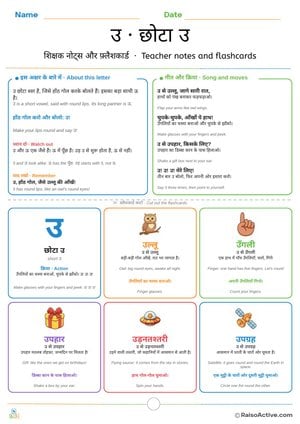
Hindi Letter उ (u) Teacher Notes and Flashcards | उ · छोटा उ
Ages 3-7 · Preschool–Grade 1Ages 3-7 · Nursery–Year 2Ages 3-7 · Nursery–Class 1Ages 3-7
Children meet the short vowel उ with a short note for adults, a song with actions and cut-out flashcards for उल्लू (owl), उँगली (finger), उपहार (gift), उड़नतश्तरी (flying saucer), उपग्रह (satellite). They hear the sound at the start of real words and link it to a hand action.

Navratri Picture Cards: Cut-Out Memory Match Game
Ages 4-6 · Pre-K–KindergartenAges 4-6 · Reception–Year 1Ages 4-6 · LKG–UKGAges 4-6
Children learn six Navratri words, match each picture to its word and clue, and practise memory and cutting skills.
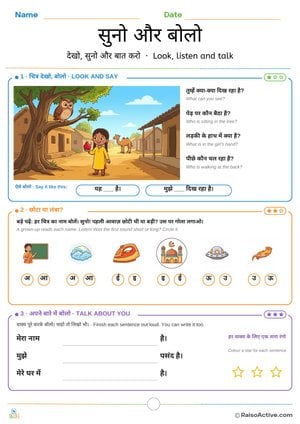
Look, Listen and Talk: Hindi Speaking Practice for Vowels Part 1 | सुनो और बोलो
Ages 3-7 · Preschool–Grade 1Ages 3-7 · Nursery–Year 2Ages 3-7 · Nursery–Class 1Ages 3-7
Children look at a village picture and answer questions, hear whether the first sound of each word is short or long, and say simple sentences about themselves such as मेरा नाम ___ है. It builds listening, spoken Hindi and sentence patterns with no reading needed.

Easter Egg Color by Hints Worksheet for Preschoolers
Ages 3-5 · Preschool–Pre-KAges 3-5 · Nursery–ReceptionAges 3-5 · Nursery–LKGAges 3-5
This worksheet has children ages 3-5 listen to or read simple written hints describing shapes and colors, then apply that information correctly while coloring each Easter egg, building early reading comprehension and the ability to follow multi-step verbal instructions. Because the hints must be followed precisely rather than colored freely, children also practice patience and careful attention to detail.
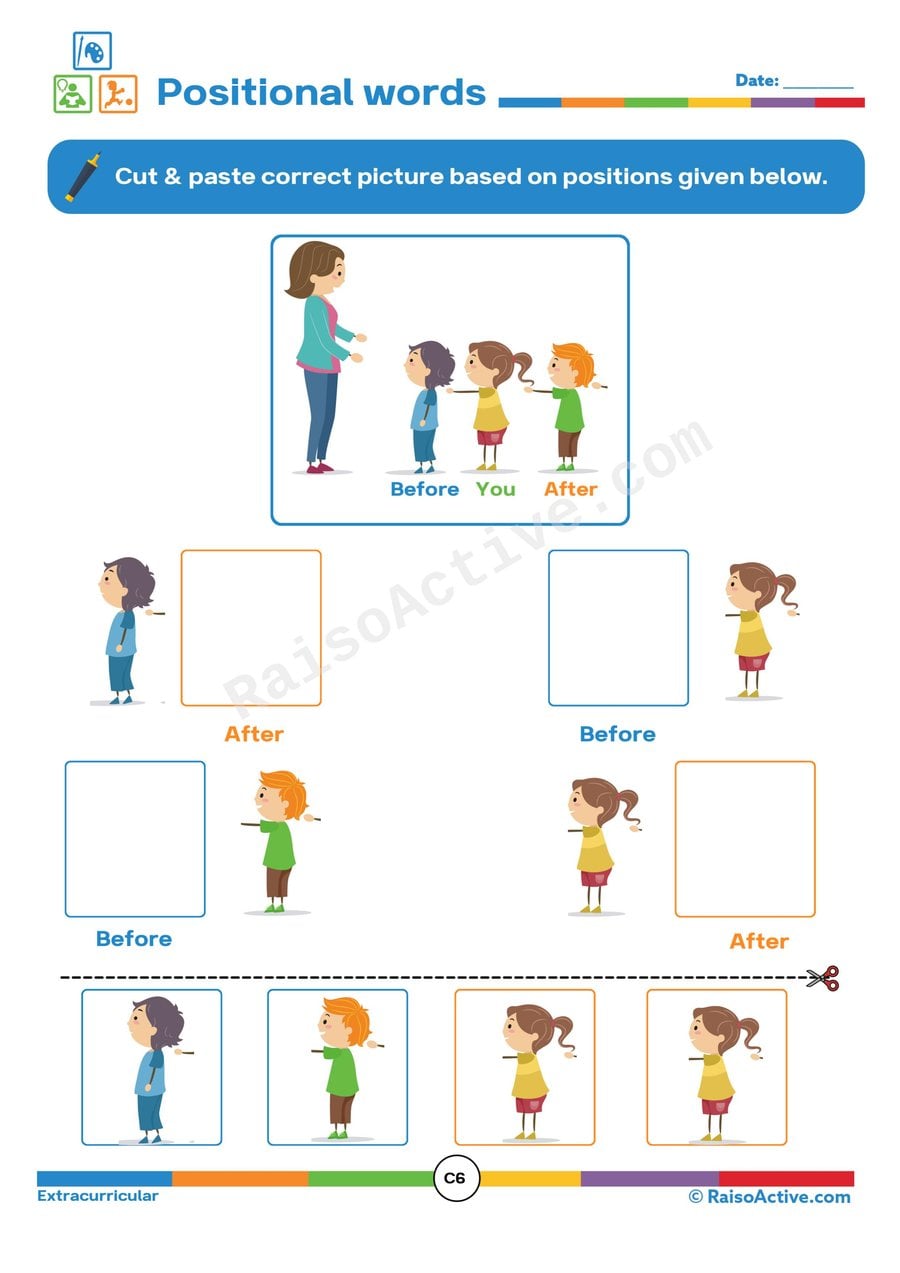
Positional Words Worksheet: Before, You, and After!
Ages 3-5 · Preschool–Pre-KAges 3-5 · Nursery–ReceptionAges 3-5 · Nursery–LKGAges 3-5
This cut-and-paste worksheet teaches children ages 3-5 to apply the positional words 'before' and 'after' to a sequence of objects or people, connecting an abstract language concept to a visual, hands-on task. Understanding order words like these is an important building block for later skills such as retelling stories in sequence and understanding time concepts like yesterday and tomorrow. Choosing and placing the correct picture also reinforces careful listening and following two-step directions.
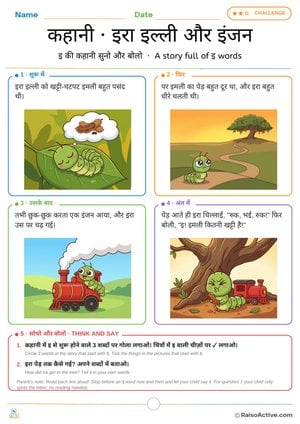
Letter इ Story: Ira Illi and the Engine | कहानी इरा इल्ली और इंजन
Ages 3-7 · Preschool–Grade 1Ages 3-7 · Nursery–Year 2Ages 3-7 · Nursery–Class 1Ages 3-7
Ira the caterpillar loves sour tamarind but the tree is far away, until a chugging engine carries her there. Children listen, look at the four pictures, spot the words that start with इ and retell what happened in their own words.
Guides for this topic

Sight Words by Age: The First 50 Words and How to Teach Them Without Flashcard Fatigue
Which sight words to teach first and why, the heart-word method, a read-trace-write-find routine, games, and a by-age table of typical sight-word progress.
How to Teach CVC Blending: A Step-by-Step Method That Works in Two Weeks
A step-by-step method for teaching CVC blending, covering continuous sounds, word families, common errors, and a 14-day plan that most children finish reading CVC words.

Documenting Learning Without Drowning in Data: A Practical Guide for Parents and Teachers
Learn practical ways to document your child's learning without overwhelm. Simple portfolios, observation tips, and printable trackers for ages 1-8.
Reviews
Every worksheet for ages 4–6, no watermark
Members download the full library of 1,000+ worksheets and every activity pack without watermarks or daily limits. One year costs ₹999 in India or $20 elsewhere.
See membership plansOr download any worksheet free with a watermark (5 a day).