Weather Word Search Worksheet for Kids
This word search strengthens children's visual scanning and spelling recognition for ages 4-6 by having them locate weather-related vocabulary — like rain, wind, or cloud — hidden horizontally and vertically within a letter grid. Searching for words in more than one direction adds an extra layer of challenge beyond a simple left-to-right search, training children's eyes to scan more flexibly across a grid. Pairing this puzzle-solving with familiar weather vocabulary also reinforces words children already use to describe daily conditions.
Part of the pack
Month 1: Learning & Development | Ages 6-7
This is page 22 of the pack. Ages 6-7 · Grade 1Ages 6-7 · Year 2Ages 6-7 · Class 1Ages 6-7
Made for your child
Spelling practice, made for your child
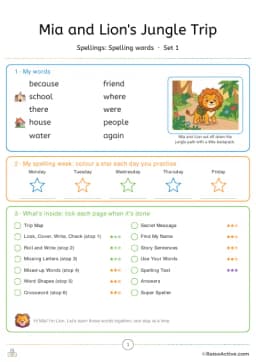
Their own spelling words turned into a pack: trace or look-cover-write-check, roll and write, a secret picture code, a word search, a crossword and a test, with their name in it.
Make a spelling packFree preview · free for members
Or start free: a word search with sight wordsCurriculum
- Earth & Environment > Seasons & Weather
How to use this worksheet
Read through the word list together first so your child knows exactly which weather words to look for. Have them scan the grid systematically, checking rows first and then columns, since the words can run either horizontally or vertically. When a word is found, circle it in the grid and cross it off the list below. Continue until every weather word has been located, then read the full list back together.
Materials needed
- Pencil
- Highlighters (optional)
Extension activities
- 1Draw a picture of your favorite weather from the word list.
- 2Write a sentence about the weather today using one of the found words.
- 3Create a simple weather journal, recording the day's conditions using the practiced vocabulary.
- 4Time how long the search takes and try to beat that time on a fresh copy of the puzzle.
- 5Make flashcards from the found words to review spelling later in the week.

Written by
Hemsweta Jain · Teacher Cheena
MBA and Early Childhood Educator, teaching since 2014 · Founder of RaisoActive, Mumbai
Every RaisoActive worksheet is designed and checked by the founder before publishing.
Published · Last reviewed
More from Month 1: Learning & Development | Ages 6-7

My Name is: Sentence Building Worksheet for Early Learners
Ages 3-5 · Preschool–Pre-KAges 3-5 · Nursery–ReceptionAges 3-5 · Nursery–LKGAges 3-5
This sentence-building activity asks children ages 3-5 to cut apart puzzle pieces of words and arrange them in the correct order to form a complete sentence, giving hands-on practice with sentence structure before they write full sentences independently. Physically manipulating word pieces lets children experiment with word order and self-correct by reading the sentence aloud, which is more forgiving than committing straight to writing. Copying the assembled sentence onto lines afterward then bridges the gap from arranging words to writing them from scratch.

Paper Bag Bunny Craft Worksheet for Preschoolers
Ages 3-5 · Preschool–Pre-KAges 3-5 · Nursery–ReceptionAges 3-5 · Nursery–LKGAges 3-5
This paper bag craft has children ages 3-5 follow a multi-step sequence of instructions — attaching a pom pom nose, spoon ears, googly eyes, and whisker details — while practicing the fine motor control needed to place and glue small materials precisely. Because the craft uses several different textures and materials in one project, children also get sensory-rich practice beyond typical paper-and-crayon activities. Successfully completing each step in order builds confidence in following sequential, multi-part directions.

Punctuation Practice Worksheet for Early Learners
Ages 4-6 · Pre-K–KindergartenAges 4-6 · Reception–Year 1Ages 4-6 · LKG–UKGAges 4-6
Children ages 4-6 learn to distinguish between statements and questions by deciding whether each sentence needs a period or a question mark, an early step in understanding how punctuation changes meaning and tone. Recognizing the difference between a question and a statement also supports reading fluency, since readers naturally use rising or falling intonation depending on the punctuation at the end of a sentence.
Shape Monster Craft Worksheet for Preschoolers
Ages 3-5 · Preschool–Pre-KAges 3-5 · Nursery–ReceptionAges 3-5 · Nursery–LKGAges 3-5
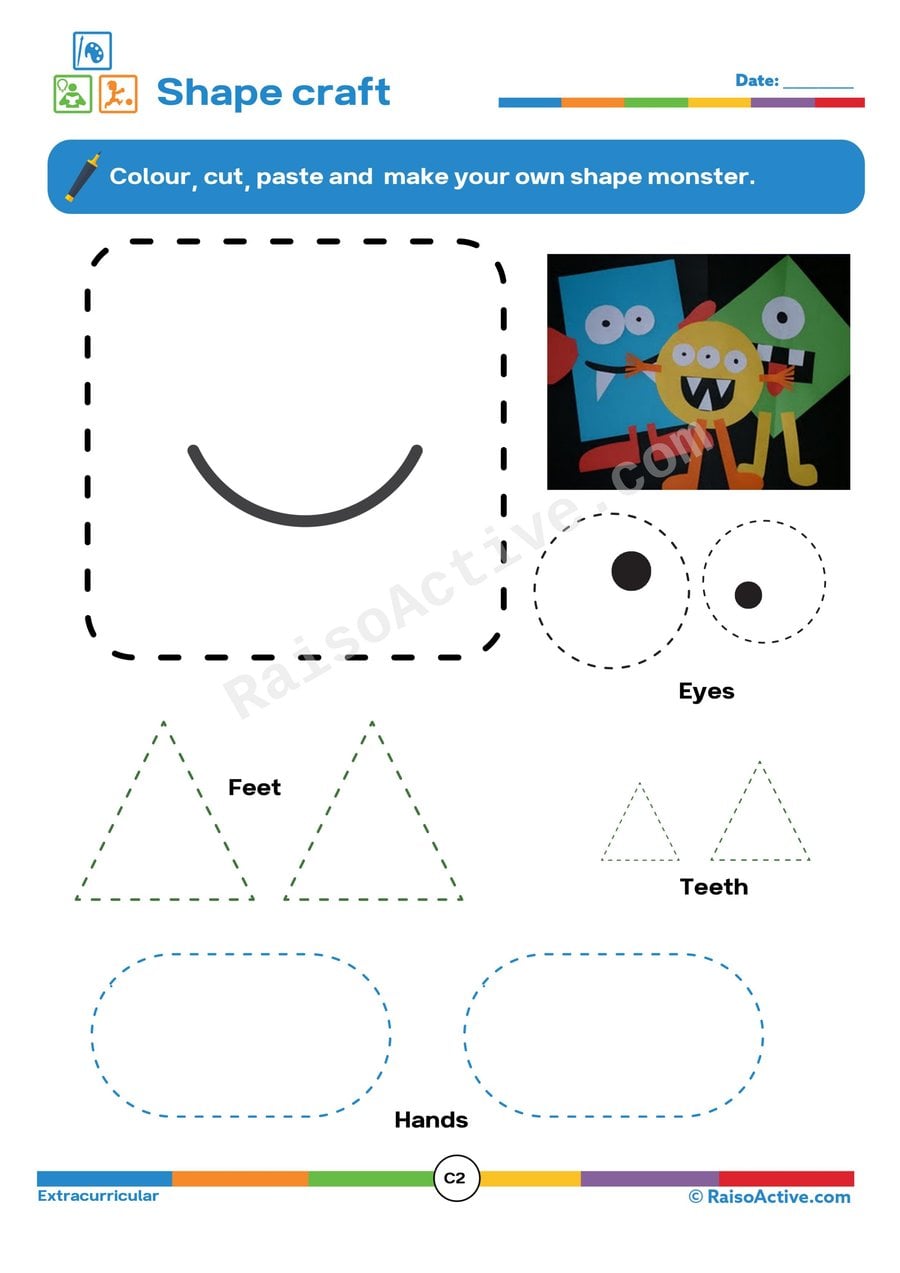
Coloring, cutting, and gluing shape pieces to build a monster teaches children ages 3-5 to recognize basic 2D shapes, like circles, triangles, and squares, while practicing scissor control along different edge types. Because the shapes need to be arranged in a specific way to form a recognizable monster face and body, this activity also builds spatial reasoning as children decide where each piece belongs. Turning geometry practice into a silly monster craft keeps repetitive shape work feeling like imaginative play rather than a math drill.

Weather Color by Number Worksheet for Preschoolers
Ages 3-5 · Preschool–Pre-KAges 3-5 · Nursery–ReceptionAges 3-5 · Nursery–LKGAges 3-5
This color-by-number activity has children ages 3-5 practice matching numerals to a color key while completing a weather-themed picture, combining number recognition with color recognition and the fine motor control needed for careful, contained coloring. Because each numbered section must be colored correctly for the picture to look right, children get immediate visual feedback on whether their number identification was accurate. The weather theme also gives a natural opportunity to talk about the picture's subject once it's revealed.

Keeping Our Environment Clean Worksheet for Kids
Ages 3-5 · Preschool–Pre-KAges 3-5 · Nursery–ReceptionAges 3-5 · Nursery–LKGAges 3-5
This worksheet builds early environmental awareness in children ages 3-5 by having them evaluate pictured actions — like throwing litter in a bin versus littering on the ground — and mark each one as good or bad for the environment. Making this judgment call requires children to connect a specific action to a broader consequence, an early form of cause-and-effect reasoning applied to environmental responsibility. Introducing this concept young helps normalize caring for shared spaces as a natural part of daily behavior rather than an abstract adult concern.
Month 1: Learning & Development | Ages 6-7 - Page 4
Ages 6-7 · Grade 1Ages 6-7 · Year 2Ages 6-7 · Class 1Ages 6-7
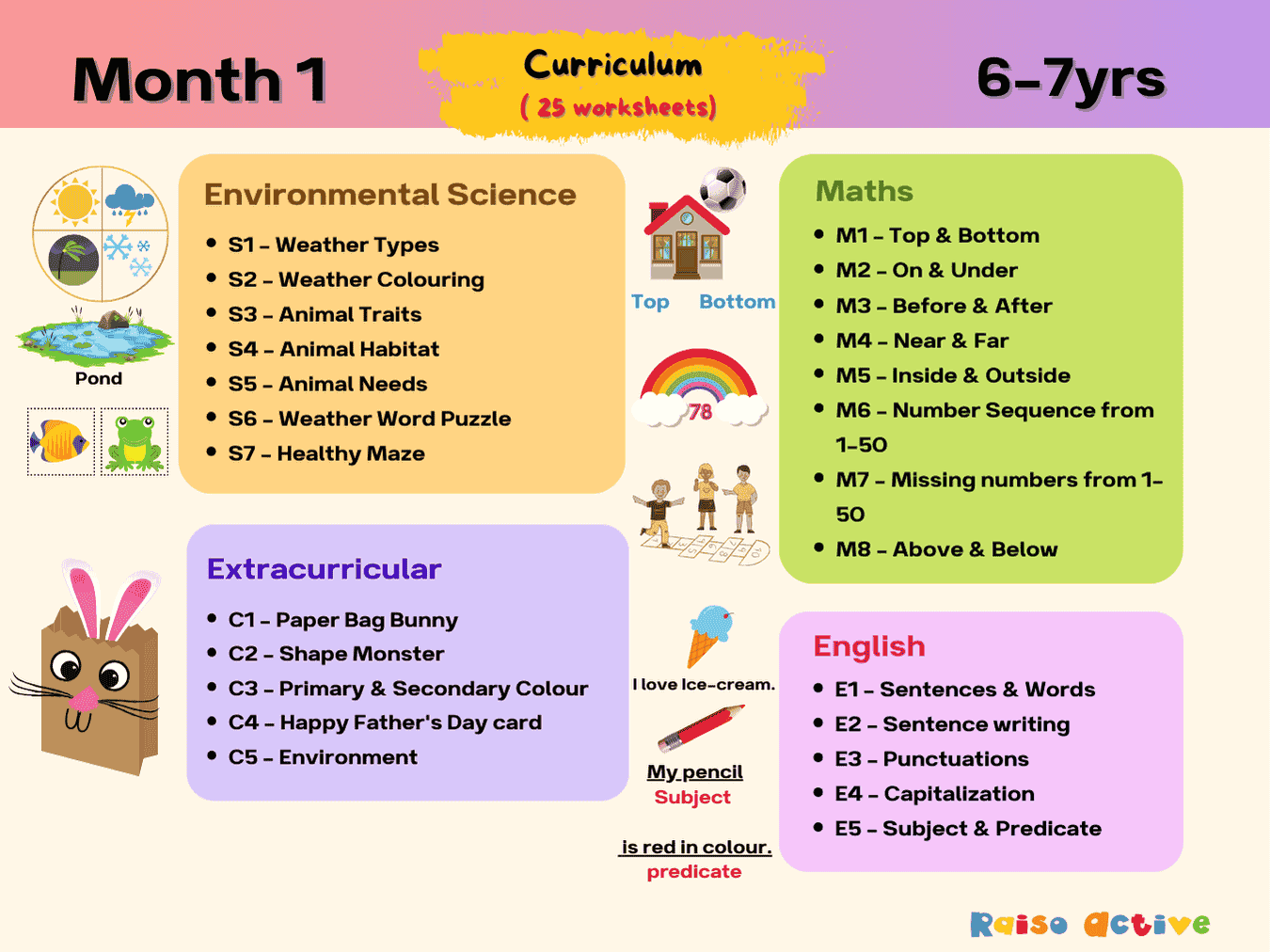
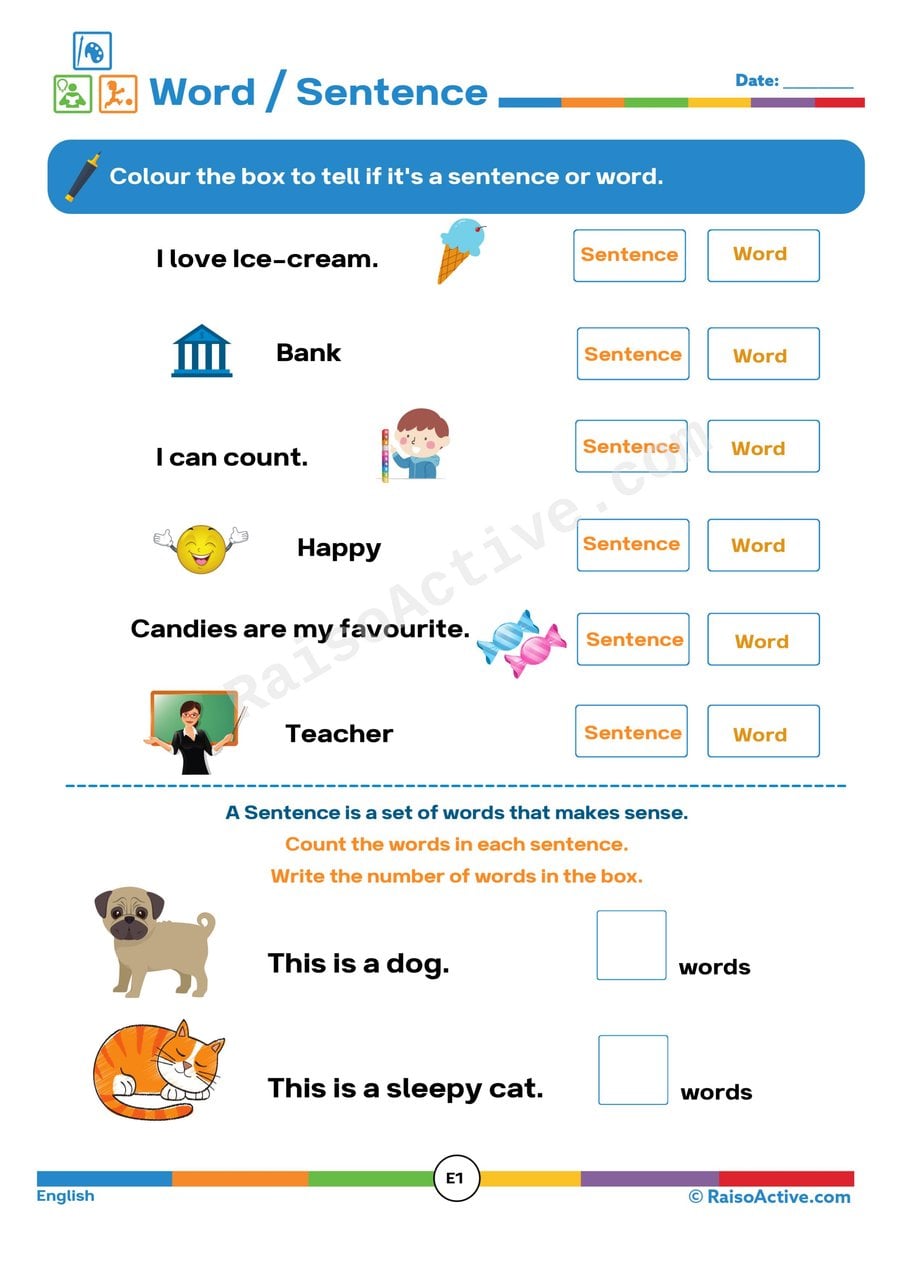
This overview page maps out everything covered in Month 1 of the ages 6-7 learning program, giving both children and parents a clear picture of what skills, from reading comprehension to number work to critical thinking, will be practiced across the month. Previewing a table of contents like this helps children ages 6-7 build early organizational awareness, understanding that learning happens in a structured sequence rather than as one-off, disconnected activities. Knowing what's coming also builds anticipation and motivation heading into each week's worksheets.

Handprint Father's Day Card Craft Worksheet for Kids
Ages 3-5 · Preschool–Pre-KAges 3-5 · Nursery–ReceptionAges 3-5 · Nursery–LKGAges 3-5
Painting a handprint and turning it into a Father's Day card gives children ages 3-5 a sensory, hands-on art experience while also creating a lasting keepsake that captures their current hand size. Writing or dictating a message for dad afterward adds an early writing or storytelling component, helping children practice expressing appreciation and affection in words. This project blends fine motor and sensory play with an emotional, relationship-building purpose that goes beyond typical coloring practice.
Related worksheets

Four Seasons Coloring Worksheet for Preschoolers
Ages 3-5 · Preschool–Pre-KAges 3-5 · Nursery–ReceptionAges 3-5 · Nursery–LKGAges 3-5
This worksheet introduces children ages 3-5 to the four seasons — spring, summer, fall, and winter — by having them color a tree differently to reflect each season's distinct features, like bare branches in winter or green leaves in summer. Choosing appropriate colors based on seasonal knowledge, rather than coloring freely, builds observational science thinking alongside creative expression and fine motor control.

Sun Safety Worksheet for Kids: Learn About Staying Safe in the Sun!
Ages 4-7 · Pre-K–Grade 1Ages 4-7 · Reception–Year 2Ages 4-7 · LKG–Class 1Ages 4-7
This worksheet has children ages 4-7 answer questions about sun safety, such as why sunscreen and hats matter, building early health literacy alongside writing practice as they put their understanding into their own words. Because the questions ask children to reason about why certain sun-safety habits matter rather than just label a picture, this worksheet develops early explanatory thinking, a step up from simple factual recall. Practicing writing full answers, even short ones, also builds sentence-forming skills appropriate for this age range.

Weather Worksheet: Match the Weather to the Number!
Ages 3-5 · Preschool–Pre-KAges 3-5 · Nursery–ReceptionAges 3-5 · Nursery–LKGAges 3-5
This matching activity asks children ages 3-5 to connect weather pictures — sun, rain, clouds, snow — to numbered labels, combining early reading of weather vocabulary with number-symbol association. Recognizing that a picture, a word, and a number can all represent the same idea builds the kind of flexible symbolic thinking children will later use in reading and math alike. Weather is also a topic children experience daily, which makes the vocabulary immediately meaningful rather than abstract.
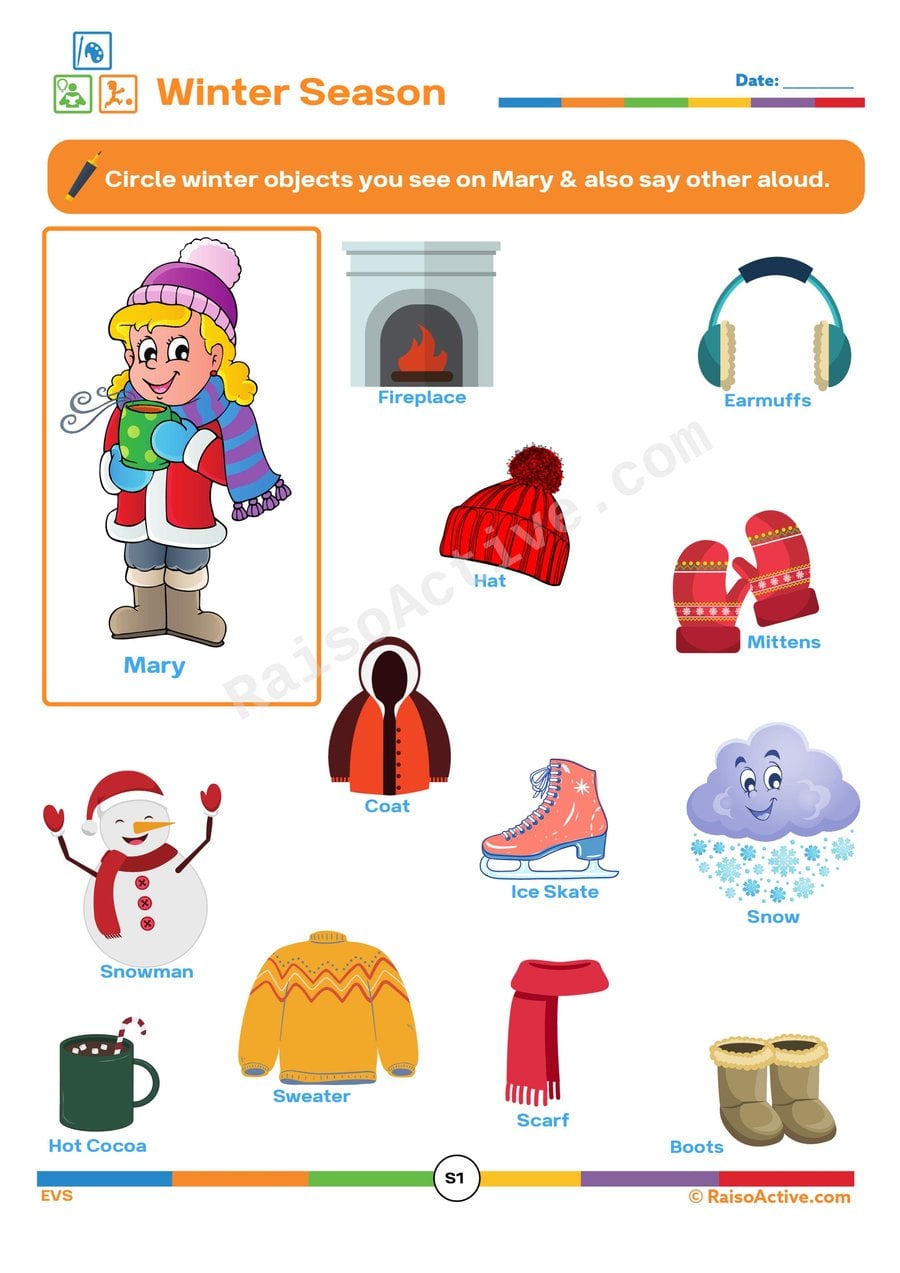
Winter Objects Worksheet: Circle and Say!
Ages 3-5 · Preschool–Pre-KAges 3-5 · Nursery–ReceptionAges 3-5 · Nursery–LKGAges 3-5
Identifying winter-related objects on this worksheet builds vocabulary and seasonal awareness for children ages 3-5, teaching them to associate specific items, like scarves, mittens, and snowflakes, with a particular time of year. Circling objects within a larger picture also sharpens visual scanning skills, requiring children to search carefully rather than glance at the whole image at once.
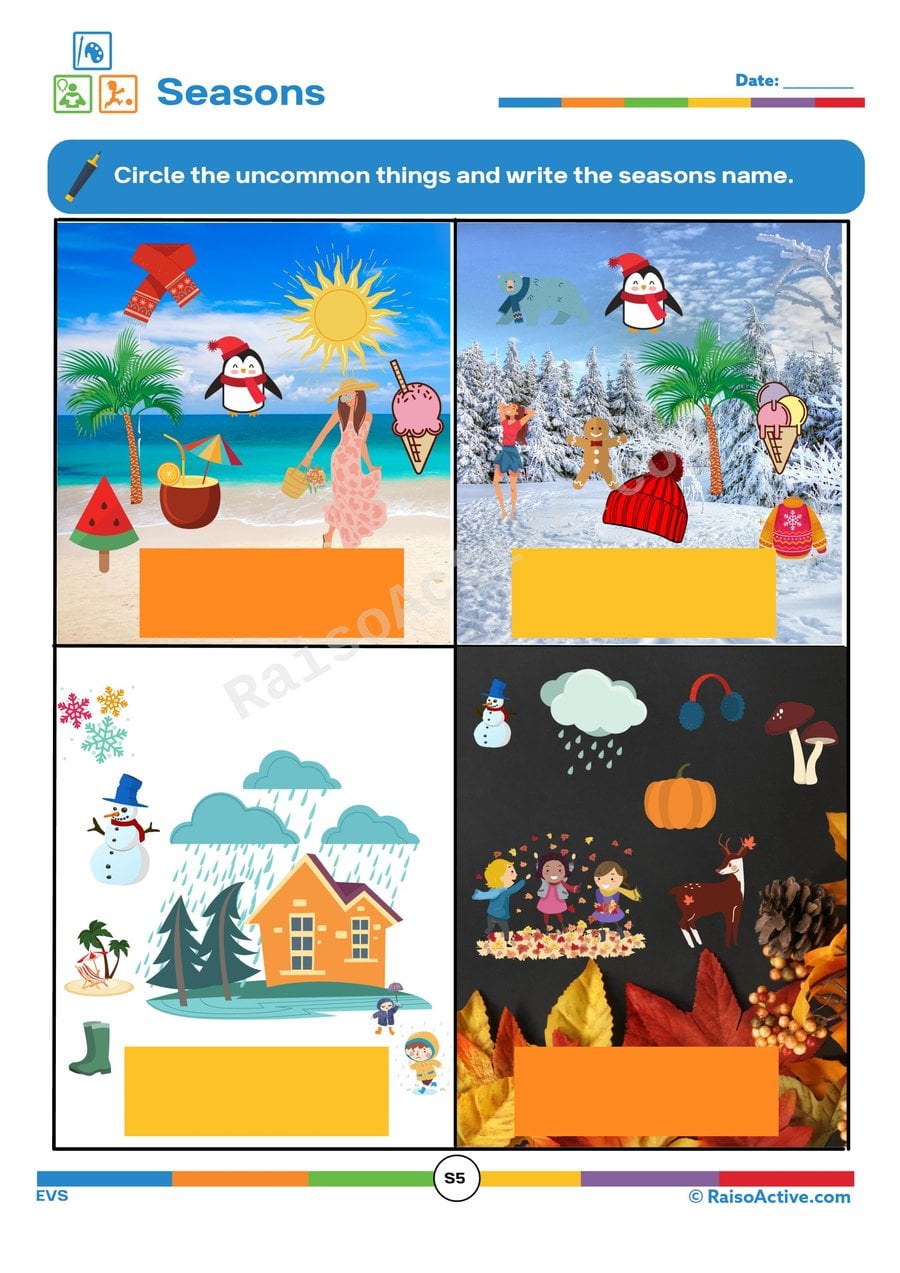
Seasons Worksheet: Circle the Uncommon Things!
Ages 3-5 · Preschool–Pre-KAges 3-5 · Nursery–ReceptionAges 3-5 · Nursery–LKGAges 3-5
This observation activity challenges children ages 3-5 to examine a seasonal scene and identify objects that don't belong, such as a snowman in a summer beach picture, sharpening their critical thinking and attention to seasonal detail. Naming the season afterward requires children to synthesize several visual clues into one overall conclusion rather than just spotting isolated errors. This kind of 'what doesn't fit' reasoning is an early form of the logical thinking used in later science observation and categorization skills.
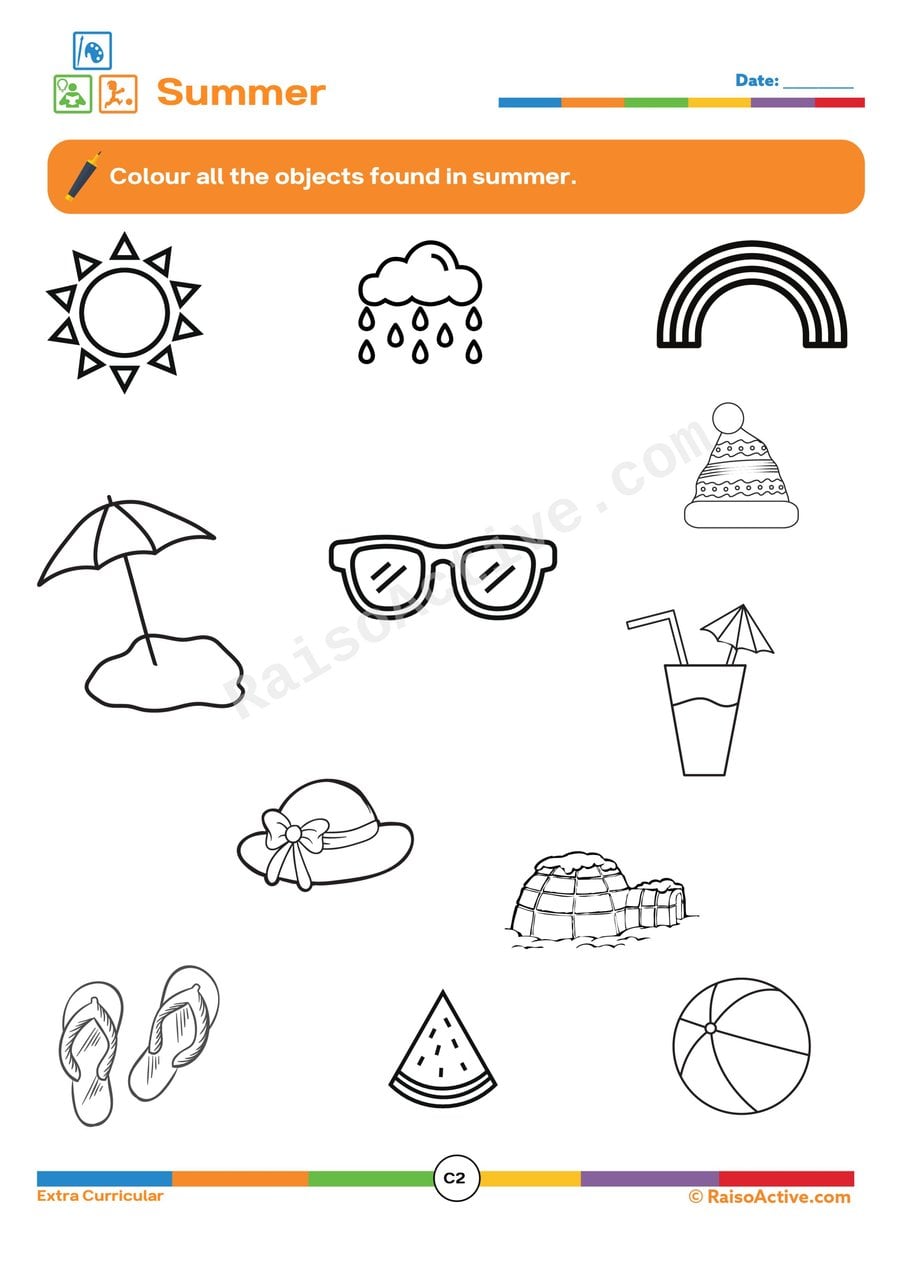
Summer Fun Coloring Worksheet for Preschoolers
Ages 3-5 · Preschool–Pre-KAges 3-5 · Nursery–ReceptionAges 3-5 · Nursery–LKGAges 3-5
Children ages 3-5 practice associating specific objects, like sunglasses, ice cream, or a swimsuit, with the summer season, building early seasonal awareness alongside fine motor coloring practice. Recognizing which objects belong to which season is a foundational step toward understanding weather, time, and the changing year.
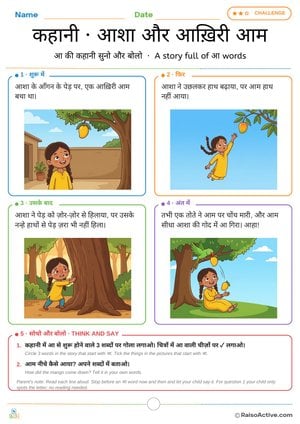
Letter आ Story: Asha and the Last Mango | कहानी आशा और आख़िरी आम
Ages 3-7 · Preschool–Grade 1Ages 3-7 · Nursery–Year 2Ages 3-7 · Nursery–Class 1Ages 3-7
Asha jumps for the last mango on the tree, her hands cannot reach, and a parrot knocks it down into her lap. Children listen, look at the four pictures, spot the words that start with आ and retell what happened in their own words.
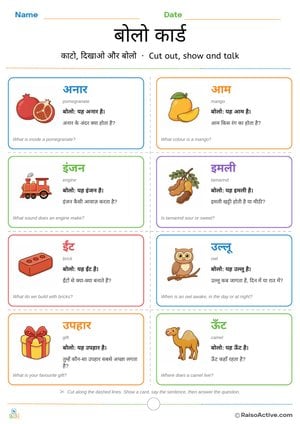
Hindi Bolo Cards: Cut-Out Speaking Cards for Vowels Part 1 | बोलो कार्ड
Ages 3-7 · Preschool–Grade 1Ages 3-7 · Nursery–Year 2Ages 3-7 · Nursery–Class 1Ages 3-7
Eight picture cards (अनार, आम, इंजन, इमली, ईंट, उल्लू, उपहार, ऊँट), each with the sentence बोलो: यह ___ है! and a question to talk about, for example what colour is a mango? Children practise speaking in full sentences.
Guides for this topic

Sight Words by Age: The First 50 Words and How to Teach Them Without Flashcard Fatigue
Which sight words to teach first and why, the heart-word method, a read-trace-write-find routine, games, and a by-age table of typical sight-word progress.
How to Teach CVC Blending: A Step-by-Step Method That Works in Two Weeks
A step-by-step method for teaching CVC blending, covering continuous sounds, word families, common errors, and a 14-day plan that most children finish reading CVC words.

Documenting Learning Without Drowning in Data: A Practical Guide for Parents and Teachers
Learn practical ways to document your child's learning without overwhelm. Simple portfolios, observation tips, and printable trackers for ages 1-8.
Reviews
Every worksheet for ages 4–6, no watermark
Members download the full library of 1,000+ worksheets and every activity pack without watermarks or daily limits. One year costs ₹999 in India or $20 elsewhere.
See membership plansOr download any worksheet free with a watermark (5 a day).