Navratri Festival Quest Certificate of Achievement
Ages 7-11 · Grade 2–Grade 3Ages 7-11 · Year 3–Year 4Ages 7-11 · Class 2–Class 3Ages 7-11
Children celebrate finishing the Navratri Festival Quest pack and record which levels they completed.
Free printable worksheets
Download free educational worksheets for children ages 2–8. Perfect for preschool, kindergarten, and early elementary learning activities.
Subscribe to get unlimited access to all worksheets without watermarks
View Subscription Plans289 topics match
48 worksheetsof 1,994
Ages 7-11 · Grade 2–Grade 3Ages 7-11 · Year 3–Year 4Ages 7-11 · Class 2–Class 3Ages 7-11
Children celebrate finishing the Navratri Festival Quest pack and record which levels they completed.
Ages 4-6 · Pre-K–KindergartenAges 4-6 · Reception–Year 1Ages 4-6 · LKG–UKGAges 4-6
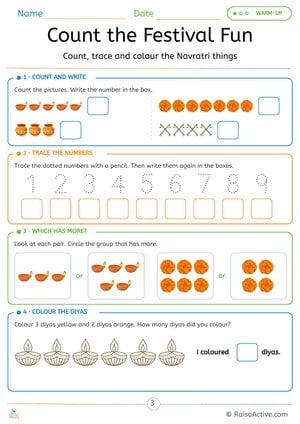
Children count small groups of festival pictures and write the number, trace and write the numbers 1 to 9, compare two groups to find the one with more, and colour a set number of diyas.
Ages 4-6 · Pre-K–KindergartenAges 4-6 · Reception–Year 1Ages 4-6 · LKG–UKGAges 4-6
Children celebrate finishing the Navratri Fun Time pages and see which levels they completed.
Ages 3-5 · Preschool–Pre-KAges 3-5 · Nursery–ReceptionAges 3-5 · Nursery–LKGAges 3-5
Connecting numbered dots to reveal each national symbol builds fine motor control and number-sequence recognition in children ages 3-5, since they must find and connect dots in the correct numerical order to form a recognizable picture. As each symbol emerges from the dots, children also gain early familiarity with important national imagery and its name.
Ages 3-5 · Preschool–Pre-KAges 3-5 · Nursery–ReceptionAges 3-5 · Nursery–LKGAges 3-5
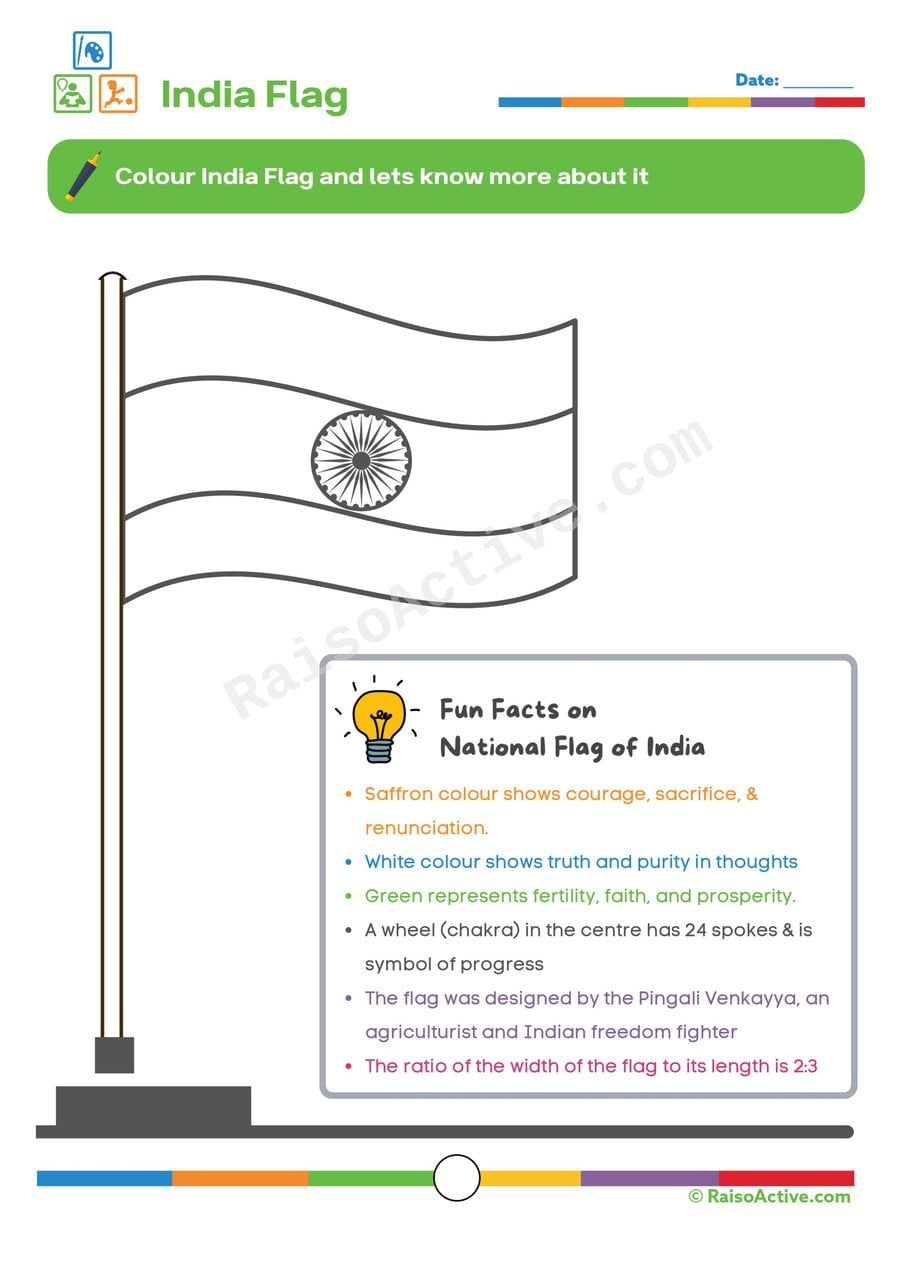
This worksheet teaches children ages 3-5 the three colors and layout of the Indian national flag, saffron, white, and green with the navy wheel, while practicing careful, section-by-section coloring. Reading a few simple facts about the flag alongside the coloring also introduces the idea that national symbols carry meaning, an early building block for civic and cultural awareness.
Ages 4-6 · Pre-K–KindergartenAges 4-6 · Reception–Year 1Ages 4-6 · LKG–UKGAges 4-6
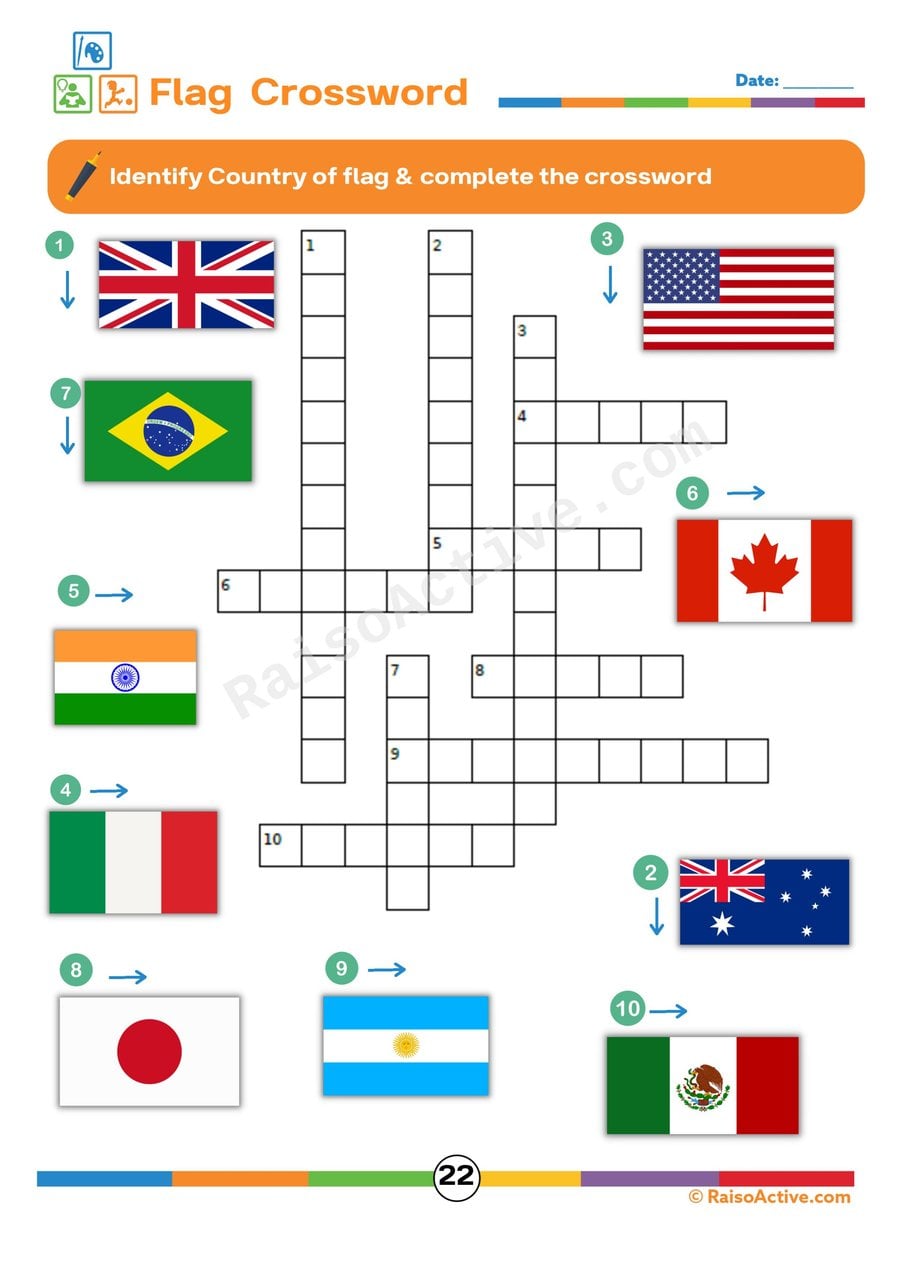
This flag crossword challenges children ages 4-6 to identify a country from its flag image and then spell out its name letter by letter in a crossword grid, linking visual recognition with early spelling and word-structure skills. Fitting each answer into the correct number of boxes also reinforces letter counting and attention to word length.
Ages 4-6 · Pre-K–KindergartenAges 4-6 · Reception–Year 1Ages 4-6 · LKG–UKGAges 4-6
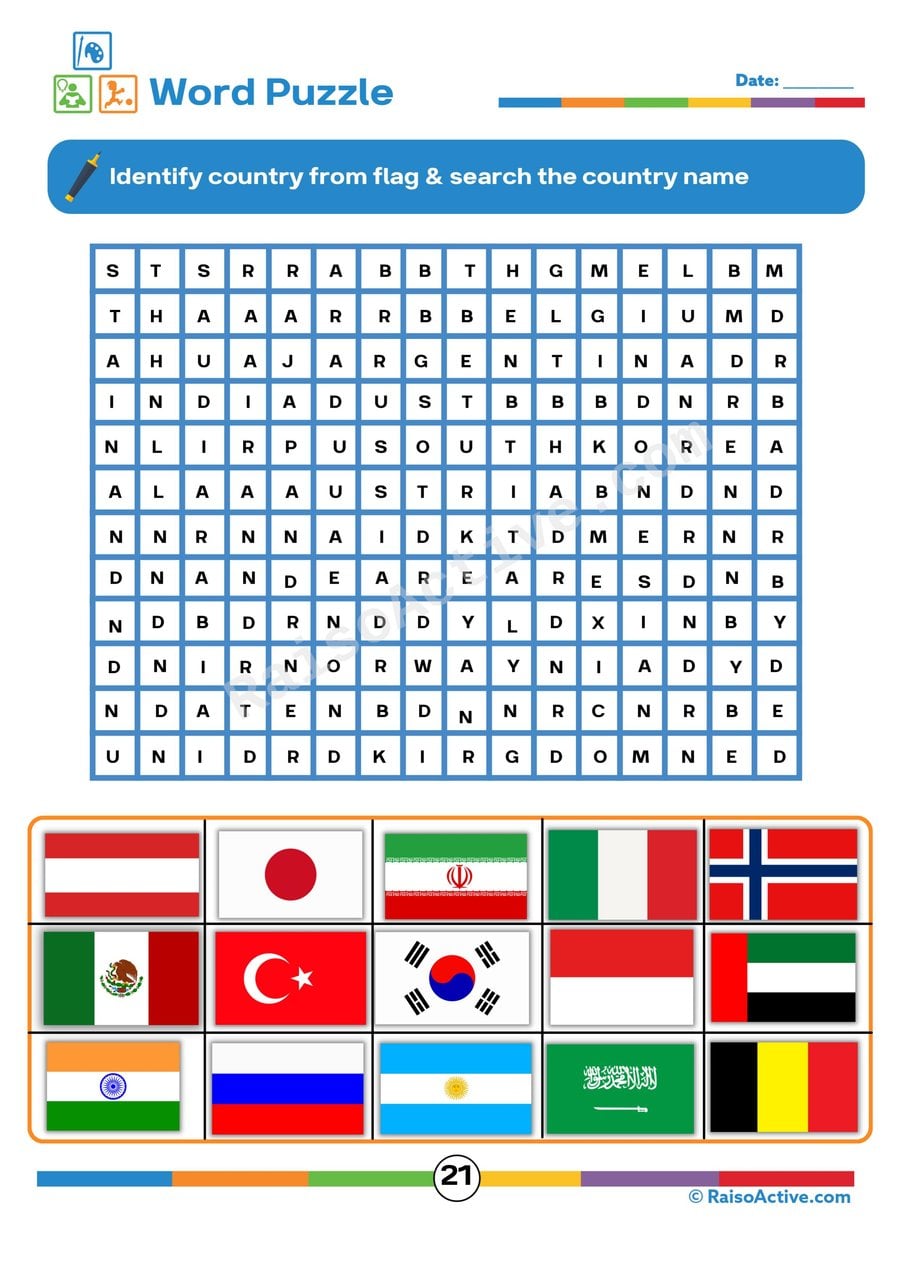
Searching a letter grid for country names tied to their flags builds visual scanning and letter-sequence recognition in children ages 4-6, skills that directly support early reading fluency. Because each word search target is anchored to a picture of a real flag, children also reinforce geography vocabulary while training their eyes to track left-to-right and top-to-bottom, a pre-reading habit. The combination of searching and circling develops sustained visual attention, which is still developing at this age.
Ages 4-6 · Pre-K–KindergartenAges 4-6 · Reception–Year 1Ages 4-6 · LKG–UKGAges 4-6
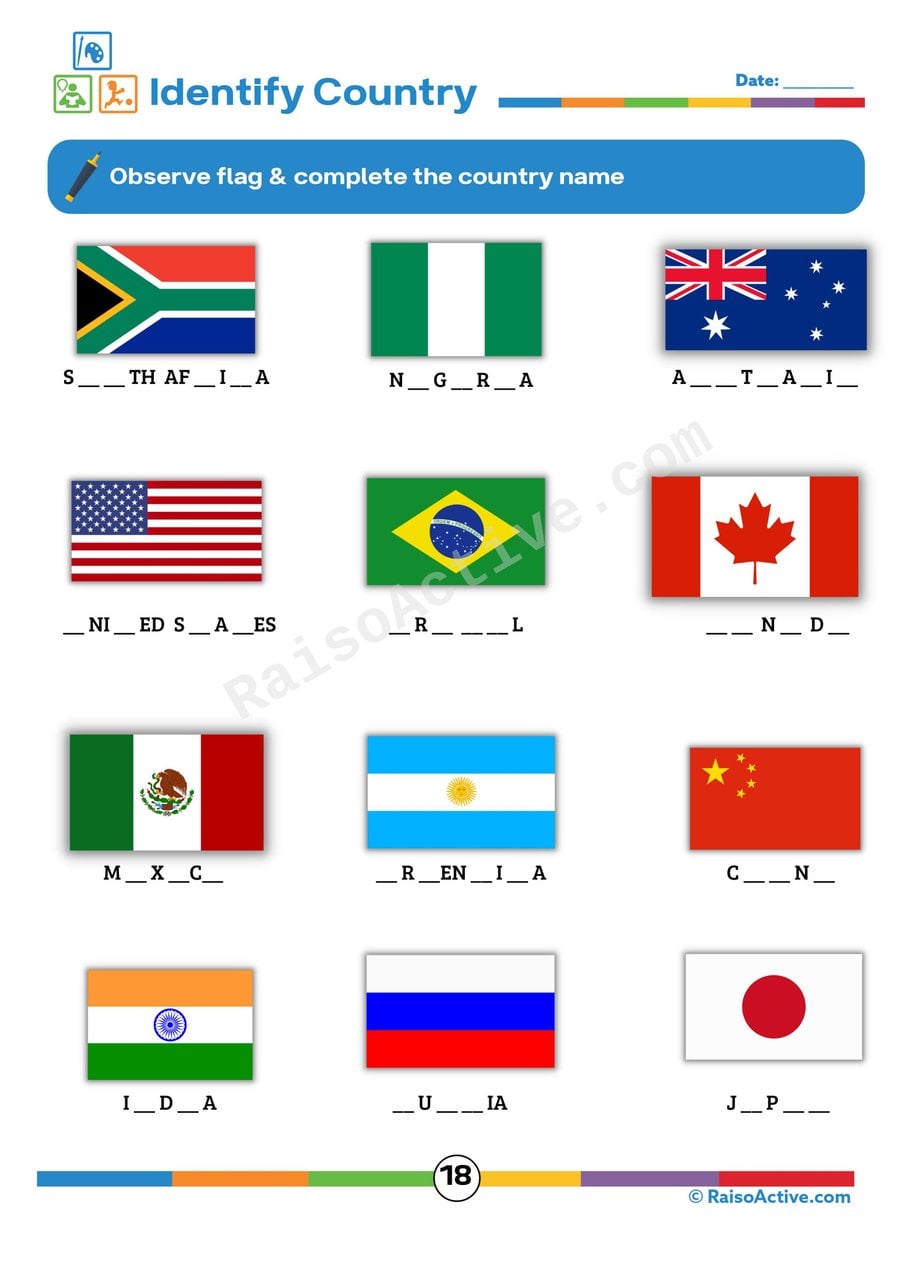
This worksheet combines flag recognition with spelling practice as children ages 4-6 study each flag and use provided letters to complete the missing parts of its country's name. Working from a partially filled word bank also teaches children to use context and available clues to solve a problem, rather than needing to know the full spelling from memory.
Ages 4-6 · Pre-K–KindergartenAges 4-6 · Reception–Year 1Ages 4-6 · LKG–UKGAges 4-6
Using hint letters to write out each country's name from its flag helps children ages 4-6 practice spelling unfamiliar words while building a mental map of world geography and cultural diversity. Because the clues scaffold the answer rather than giving it away entirely, children also strengthen problem-solving skills as they figure out which letters must go where. This worksheet is a gentle bridge between simple flag recognition and independent word writing.
Ages 4-7 · Pre-K–Grade 1Ages 4-7 · Reception–Year 2Ages 4-7 · LKG–Class 1Ages 4-7
Filling in the missing letters of each country's name while studying its flag gives children ages 4-7 practice with letter-sound correspondence and spelling patterns, since they must sound out the word and recall which letters are already provided as clues. It also builds early geography knowledge, helping children connect a visual symbol (the flag) to a country's name for the first time. This dual practice of decoding and world knowledge lays groundwork for both literacy and social studies skills.
Ages 3-5 · Preschool–Pre-KAges 3-5 · Nursery–ReceptionAges 3-5 · Nursery–LKGAges 3-5
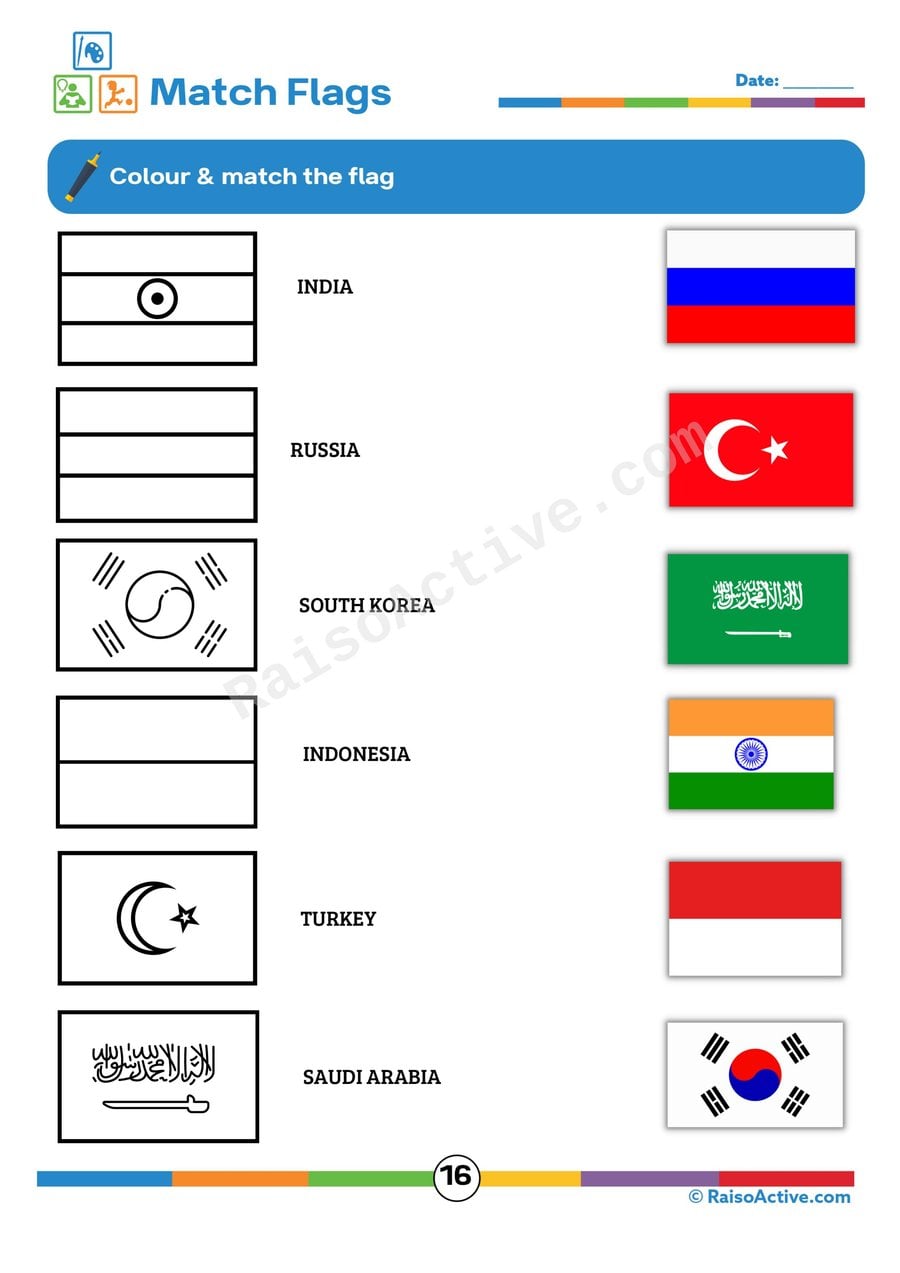
This flag-matching worksheet strengthens visual scanning and word recognition as children ages 3-5 compare printed country names on one side of the page to flag images on the other and connect the correct pairs. Because they must scan back and forth between two columns, it also builds the left-to-right tracking skills that support early reading.
Ages 4-6 · Pre-K–KindergartenAges 4-6 · Reception–Year 1Ages 4-6 · LKG–UKGAges 4-6
Children ages 4-6 build flag recognition by matching a set of country flags to their correct names, continuing to strengthen geography vocabulary and visual discrimination through this final flag-focused worksheet. Working with flags is an especially effective way to build visual memory in young children, since each one is a distinct, colorful pattern they can learn to recognize quickly.