Circle the Correct Blend Worksheet for Preschoolers
This worksheet trains 3-5 year olds to discriminate between two similar-sounding consonant blends by listening to a picture's name and deciding which of two printed blends matches its beginning sound — a genuinely tricky listening task since blends like 'bl' and 'br' or 'cl' and 'cr' sound close together. Getting this right requires careful auditory attention rather than guessing, making it a solid stepping stone toward full blend-word reading.
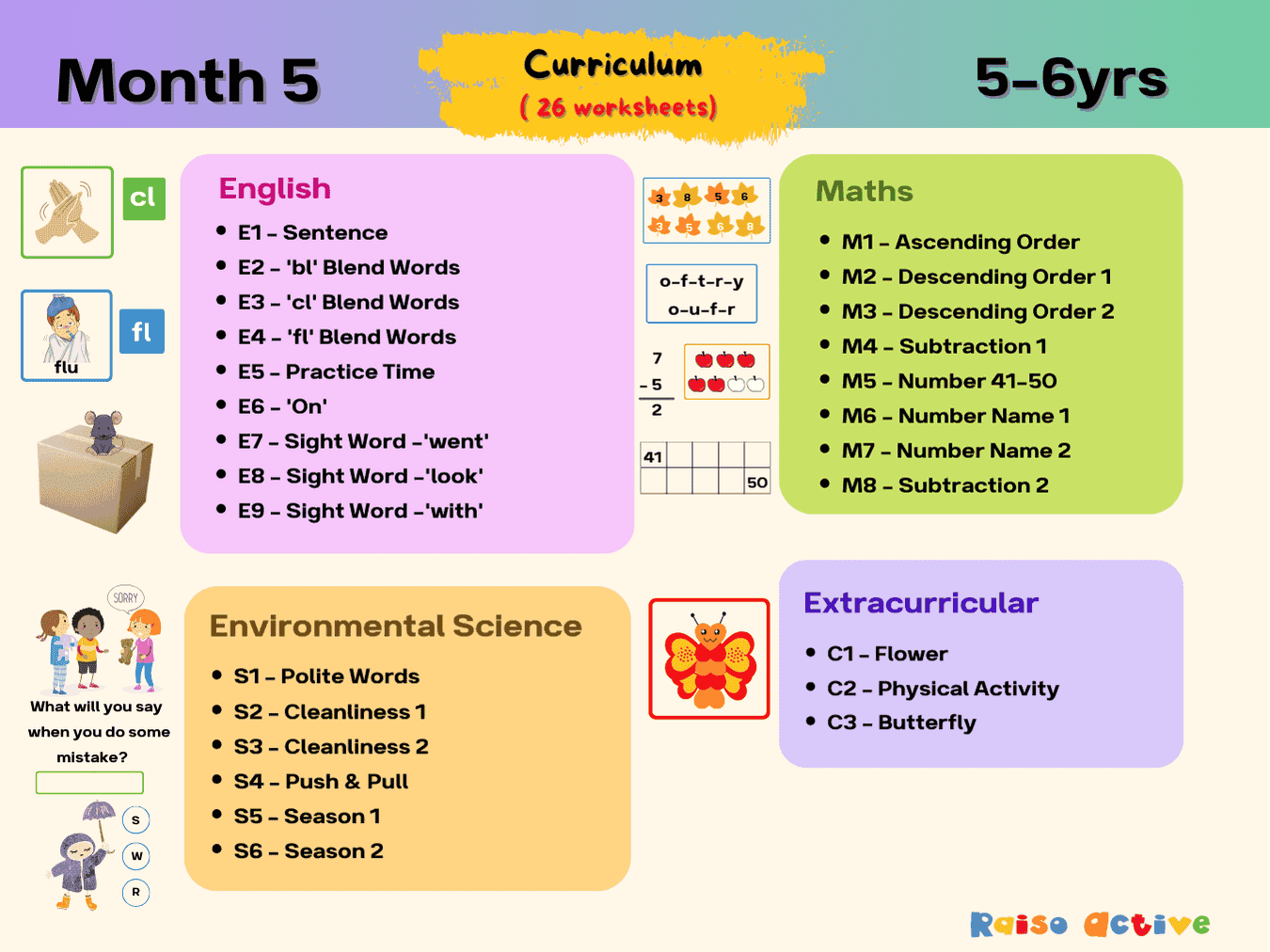
Part of the pack
Month 5: Play-based English Math Science | Ages 5-6
This is page 8 of the pack. Ages 5-6 · KindergartenAges 5-6 · Year 1Ages 5-6 · UKGAges 5-6
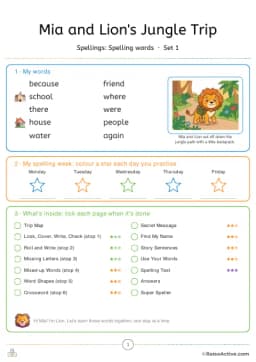
Made for your child
Spelling practice, made for your child
Their own spelling words turned into a pack: trace or look-cover-write-check, roll and write, a secret picture code, a word search, a crossword and a test, with their name in it.
Make a spelling packFree preview · free for members
Or start free: a word search with sight wordsCurriculum
- Phonics - Blends > Consonant Blends
How to use this worksheet
Look at the first picture together and say its name slowly and clearly. Read both blend options underneath out loud, emphasizing the sound of each. Ask your child which blend matches the beginning of the picture's name, then have them circle their choice. Move through each picture the same way, encouraging your child to repeat the word slowly if they're unsure before circling an answer.
Materials needed
- Pencil
- Crayons
Extension activities
- 1Once the blend is chosen, have your child try sounding out the whole word for extra reading practice.
- 2Ask your child to draw their own picture and write the blend that matches its name.
- 3Search the room together for objects whose names start with the same blends featured on the worksheet.
- 4Play a listening game where you say two similar words and your child has to spot which blend sound they share.
- 5Make a simple blend sorting chart and add new blend words to it throughout the week.

Written by
Hemsweta Jain · Teacher Cheena
MBA and Early Childhood Educator, teaching since 2014 · Founder of RaisoActive, Mumbai
Every RaisoActive worksheet is designed and checked by the founder before publishing.
Published · Last reviewed
More from Month 5: Play-based English Math Science | Ages 5-6

Ascending Order Fun: A Printable Worksheet for Numbers!
Ages 4-6 · Pre-K–KindergartenAges 4-6 · Reception–Year 1Ages 4-6 · LKG–UKGAges 4-6
Arranging numbers from smallest to largest teaches children ages 4-6 to compare quantities and understand relative magnitude, a skill that underlies later work with number lines, place value, and basic operations. It also reinforces number recognition, since children must correctly identify each numeral before they can decide where it belongs in the sequence.

Seasons Coloring Worksheet for Kids: Summer, Rainy, and Winter Fun!
Ages 3-5 · Preschool–Pre-KAges 3-5 · Nursery–ReceptionAges 3-5 · Nursery–LKGAges 3-5
This worksheet teaches 3-5 year olds to associate specific objects and weather patterns with the season they belong to — sunglasses and ice cream for summer, umbrellas for the rainy season, sweaters for winter — using a color-coding system to reinforce the sorting. Learning to categorize by season is an early science and observation skill, since it requires your child to notice recurring patterns in weather, clothing, and activities across the year.
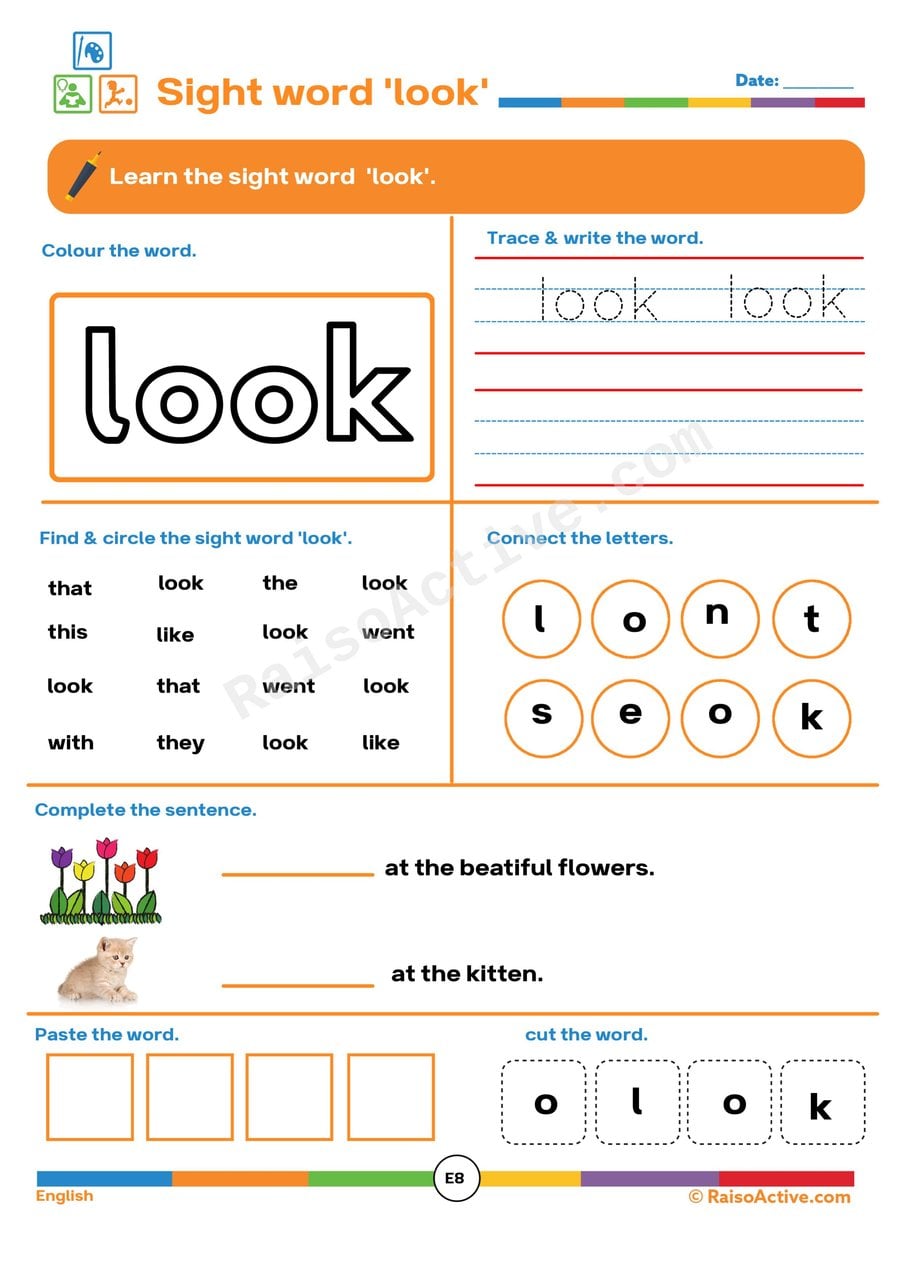
Look! Sight Word 'Look' Worksheet for Preschoolers
Ages 3-5 · Preschool–Pre-KAges 3-5 · Nursery–ReceptionAges 3-5 · Nursery–LKGAges 3-5
This worksheet builds automatic recognition of the sight word 'look' through six different activities — coloring, tracing, finding it in a list, spelling it by connecting letters, completing a sentence, and pasting it — which matters because sight words like 'look' don't sound out easily and have to be memorized by sight through repeated, varied exposure. Hitting the same word from six angles in one sitting is exactly the kind of repetition that turns a word from something your child sounds out slowly into one they recognize instantly.

Descending Order Snail Puzzle Worksheet for Preschoolers
Ages 3-5 · Preschool–Pre-KAges 3-5 · Nursery–ReceptionAges 3-5 · Nursery–LKGAges 3-5
Arranging cut-out puzzle pieces from the highest number down to the lowest asks children ages 3-5 to apply number order in the reverse direction from typical ascending counting, a genuinely different and more challenging skill than counting up. This descending-order practice deepens overall number sense, since children must compare values rather than just recite a memorized forward sequence. The reveal of a hidden picture once the pieces are correctly ordered adds a rewarding, motivating payoff to an otherwise abstract number task.
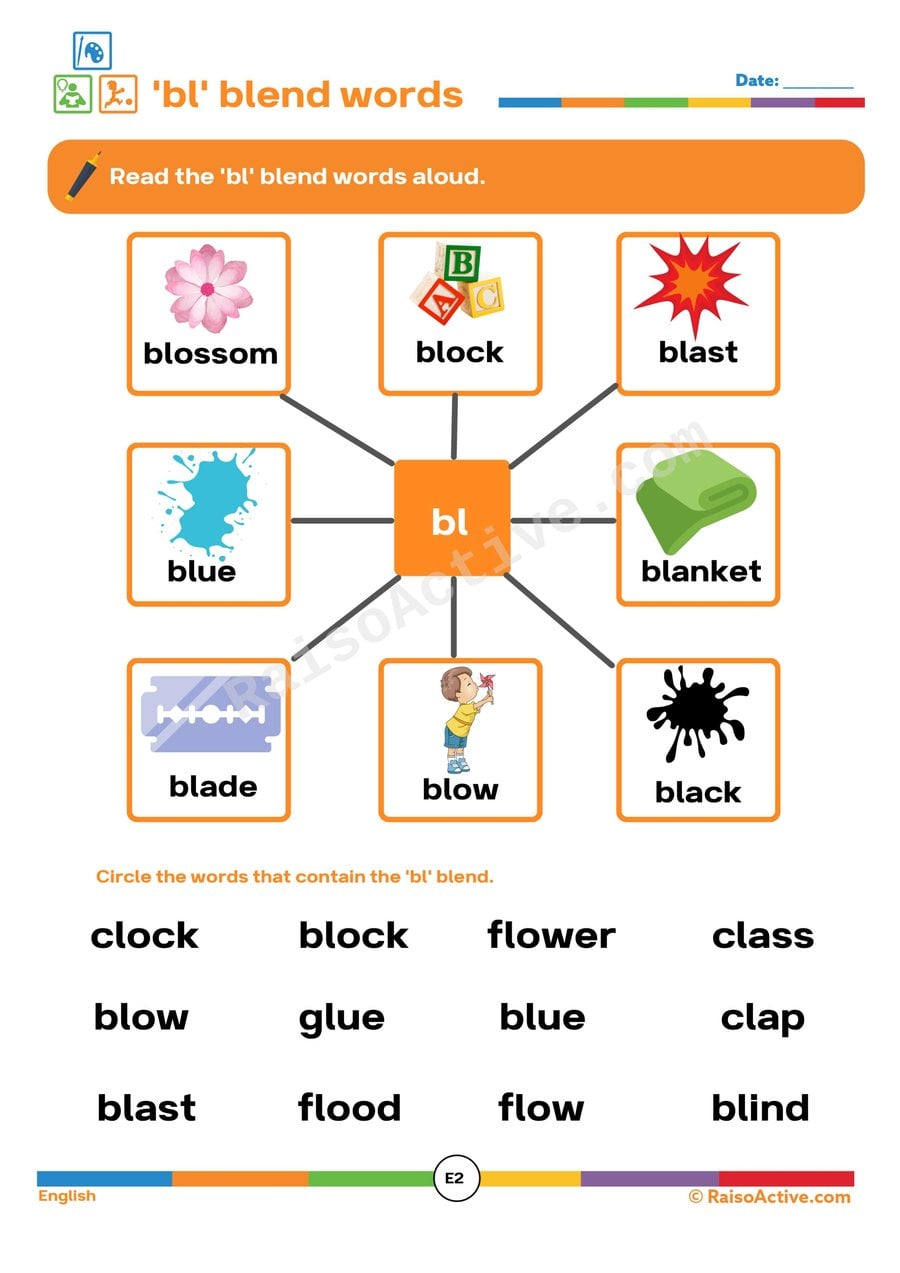
'bl' Blend Words Worksheet: Read, Circle, and Learn!
Ages 4-6 · Pre-K–KindergartenAges 4-6 · Reception–Year 1Ages 4-6 · LKG–UKGAges 4-6
Consonant blends like 'bl' require a child to smoothly join two sounds together (b + l) rather than saying them as separate beats, which is a distinct and harder phonics skill than single-letter sounds. This worksheet gives 4-6 year olds repeated practice reading words that start with 'bl' — like black, blue, or block — and then applying that recognition by circling the matching words, reinforcing the blend both by ear and by sight.

Subtraction Worksheet: Count and Subtract for Preschoolers
Ages 4-5 · Pre-KAges 4-5 · ReceptionAges 4-5 · LKGAges 4-5
Counting a group of pictured objects and then subtracting a stated number introduces children ages 4-5 to the concept that a quantity can decrease, building on their counting skills to form an early foundation for subtraction. Working from a visual group of objects, rather than abstract numbers alone, lets children physically cross out or count away items, which matches how young children naturally understand 'taking away.' This concrete, visual approach to subtraction sets up a much smoother transition to number-only subtraction problems later.

Seasons Worksheet: Identify and Color the Correct Season!
Ages 3-5 · Preschool–Pre-KAges 3-5 · Nursery–ReceptionAges 3-5 · Nursery–LKGAges 3-5
Identifying which season a picture represents and coloring the matching letter code builds children's ages 3-5 awareness of how weather, clothing, and activities change throughout the year, an early and very relatable science concept. This worksheet asks children to actively classify each picture rather than passively look at seasonal images, sharpening their observational and reasoning skills. Understanding seasons also gives children a framework for talking about holidays, weather, and the passage of time in daily conversation.

Sight Word 'Went' Worksheet for Preschoolers: Tracing, Matching, and Sentence Completion
Ages 3-5 · Preschool–Pre-KAges 3-5 · Nursery–ReceptionAges 3-5 · Nursery–LKGAges 3-5
The word 'went' doesn't sound out predictably using standard phonics rules, so children ages 3-5 need to memorize it by sight as a whole word — a key early reading strategy for common, frequently used words. This worksheet reinforces that sight-word memory through several different formats — tracing, word-hunting, letter connecting, and sentence completion — giving repeated exposure without it feeling like a single repetitive drill. Mastering high-frequency words like 'went' significantly speeds up reading fluency, since these words appear constantly in early books.
Related worksheets
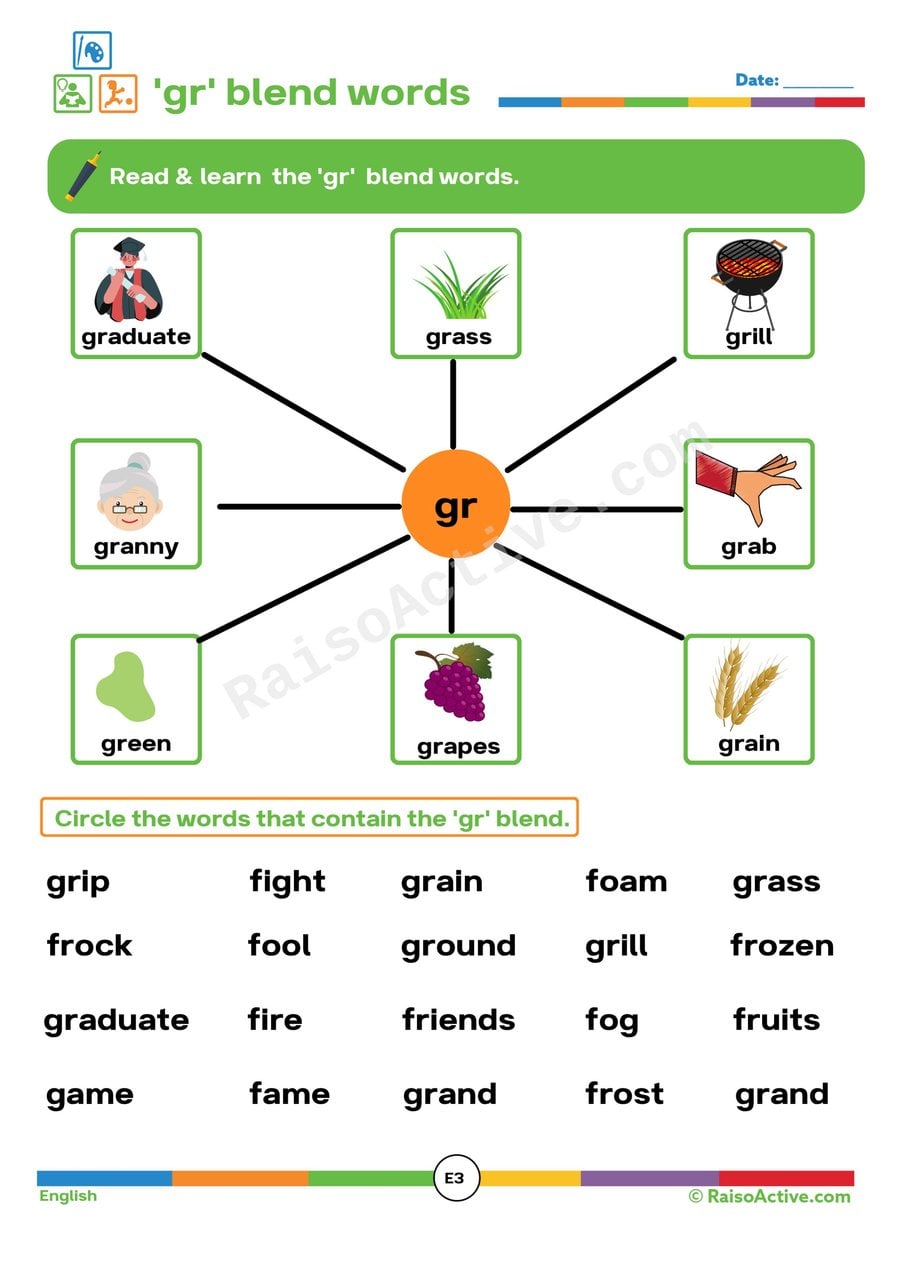
Gr Blend Words Worksheet: Circle the 'gr' Words!
Ages 4-6 · Pre-K–KindergartenAges 4-6 · Reception–Year 1Ages 4-6 · LKG–UKGAges 4-6
Learning to recognize the 'gr' consonant blend, as in 'grass,' 'green,' or 'grape,' trains children's ears to hear two consonant sounds pressed together at the start of a word, a more advanced phonics skill than single-letter sounds. For ages four to six, mastering common blends like 'gr' significantly expands the number of words they can decode independently when reading.
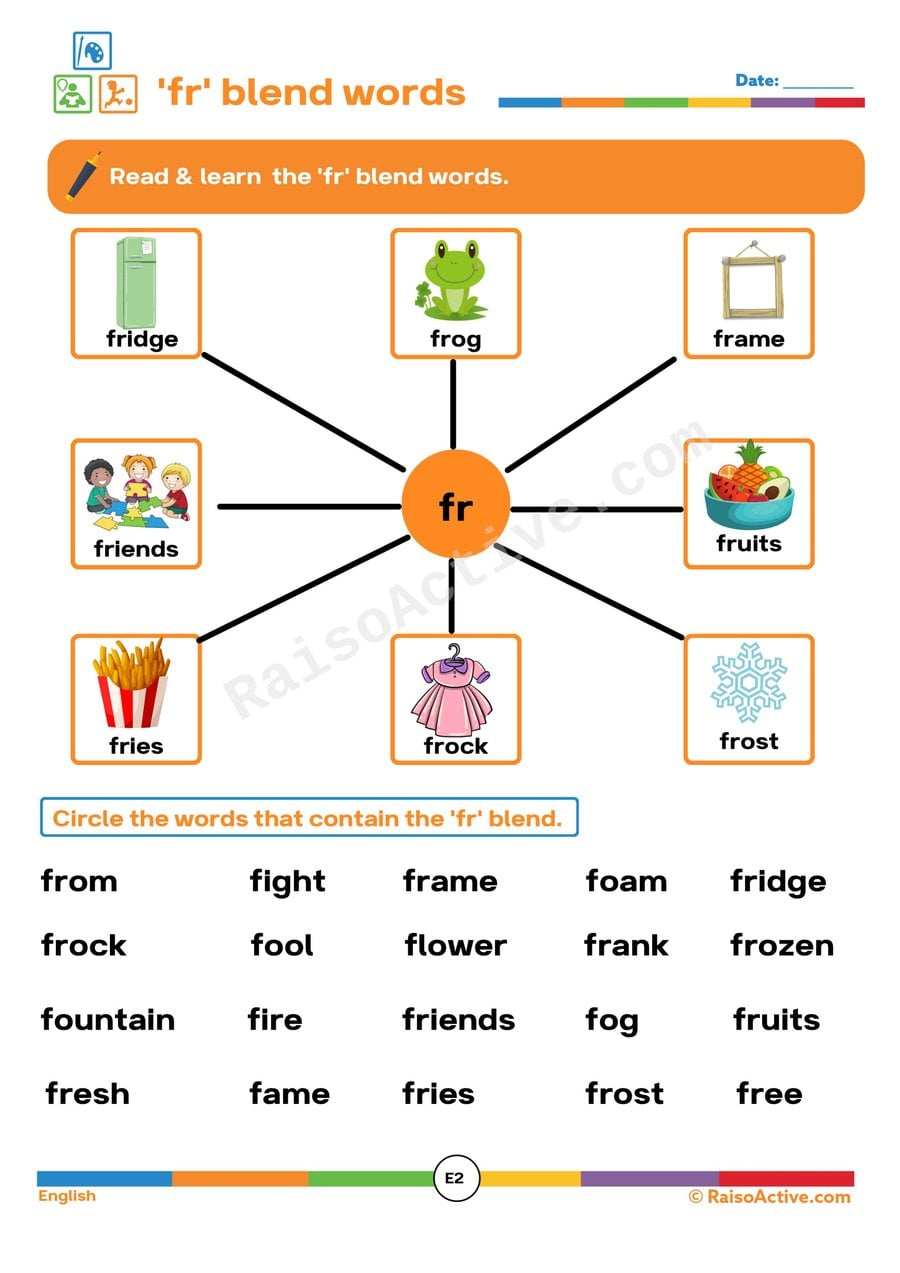
FR Blend Words Worksheet: Circle the Words!
Ages 4-6 · Pre-K–KindergartenAges 4-6 · Reception–Year 1Ages 4-6 · LKG–UKGAges 4-6
Children ages 4-6 practice recognizing the 'fr' consonant blend at the start of words, like 'frog' and 'friend', which requires blending two distinct sounds smoothly together rather than reading them as separate letters. Circling the correct words trains visual scanning alongside auditory sound recognition, both essential for fluent early reading. This kind of blend practice moves children beyond single-letter phonics into more complex word decoding.

Circle the 'pr' Blend Words Worksheet for Preschoolers
Ages 4-5 · Pre-KAges 4-5 · ReceptionAges 4-5 · LKGAges 4-5
Children ages 4-5 practice recognizing the 'pr' consonant blend at the beginning of words, like 'prize' and 'print', which requires blending two distinct sounds together fluently. Circling only the correct 'pr' words trains both auditory sound recognition and careful visual scanning of printed text. This kind of blend practice moves early readers beyond single-letter phonics into decoding more complex word beginnings.

Halloween Shadow Match Worksheet for Preschoolers
Ages 3-5 · Preschool–Pre-KAges 3-5 · Nursery–ReceptionAges 3-5 · Nursery–LKGAges 3-5
This shadow-matching worksheet sharpens visual discrimination in children ages 3-5 as they compare the outline of each Halloween object to its silhouette and identify the correct match. Because shadows strip away color and detail, children must focus purely on shape, which builds a skill that transfers directly to letter and shape recognition later on.
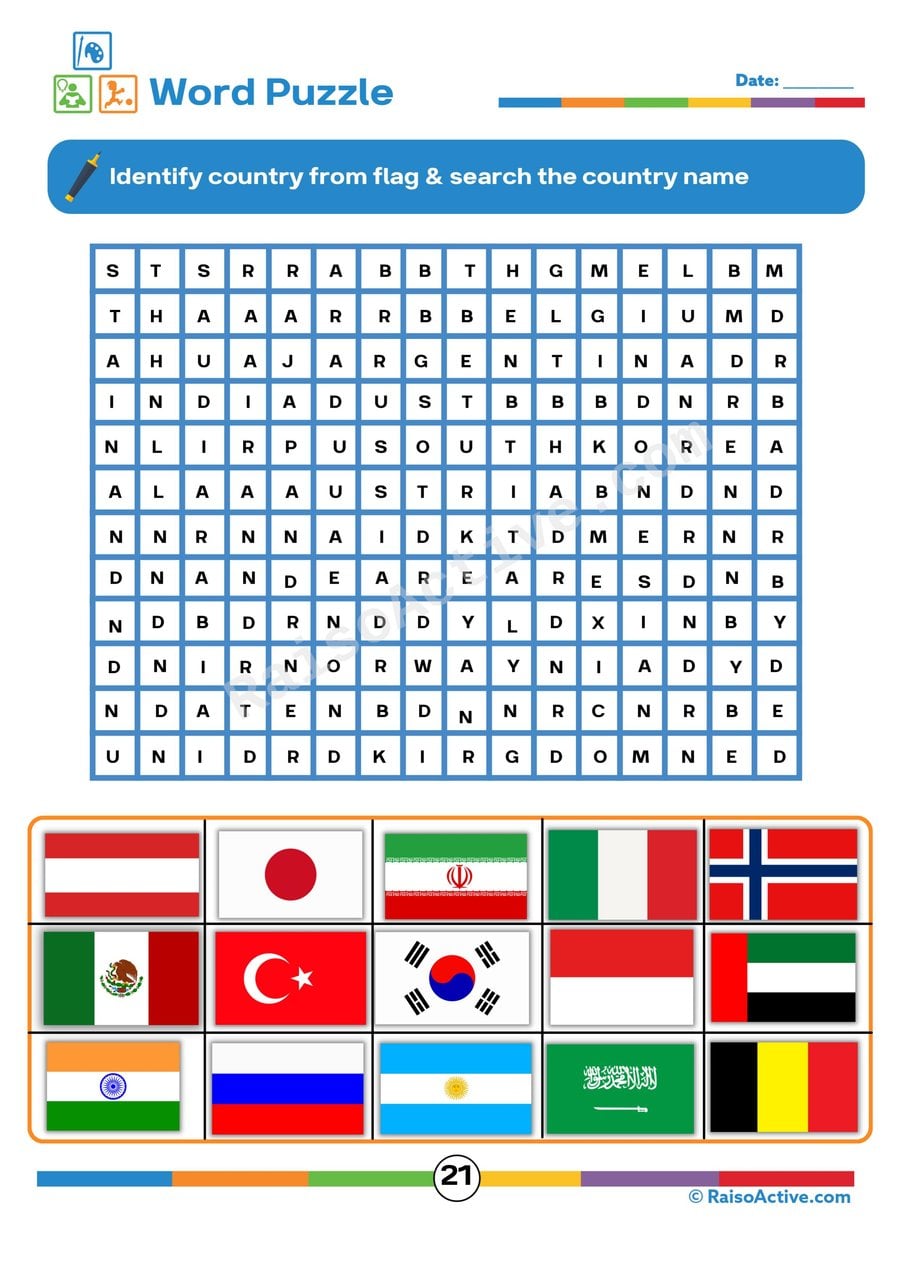
World Flags Word Search Worksheet for Kids
Ages 4-6 · Pre-K–KindergartenAges 4-6 · Reception–Year 1Ages 4-6 · LKG–UKGAges 4-6
Searching a letter grid for country names tied to their flags builds visual scanning and letter-sequence recognition in children ages 4-6, skills that directly support early reading fluency. Because each word search target is anchored to a picture of a real flag, children also reinforce geography vocabulary while training their eyes to track left-to-right and top-to-bottom, a pre-reading habit. The combination of searching and circling develops sustained visual attention, which is still developing at this age.

Indian Cities Crossword Puzzle Worksheet for Kids
Ages 4-6 · Pre-K–KindergartenAges 4-6 · Reception–Year 1Ages 4-6 · LKG–UKGAges 4-6
This crossword challenges children ages 4-6 to identify famous Indian cities from picture clues of their landmarks and then spell out each city's name in the puzzle grid, combining observation skills with early geography knowledge. Counting the crossword boxes to match each city's letter count also reinforces attention to word length before writing.

Logic Grid Puzzle for Kids: Sort by Two Rules
Ages 4-7 · Pre-K–Grade 1Ages 4-7 · Reception–Year 2Ages 4-7 · LKG–Class 1Ages 4-7
Children sort eight numbered objects by two rules at once (big or small, striped or plain) and then use clues in a simple logic grid to work out which child has which pet. This builds classification and deductive reasoning.
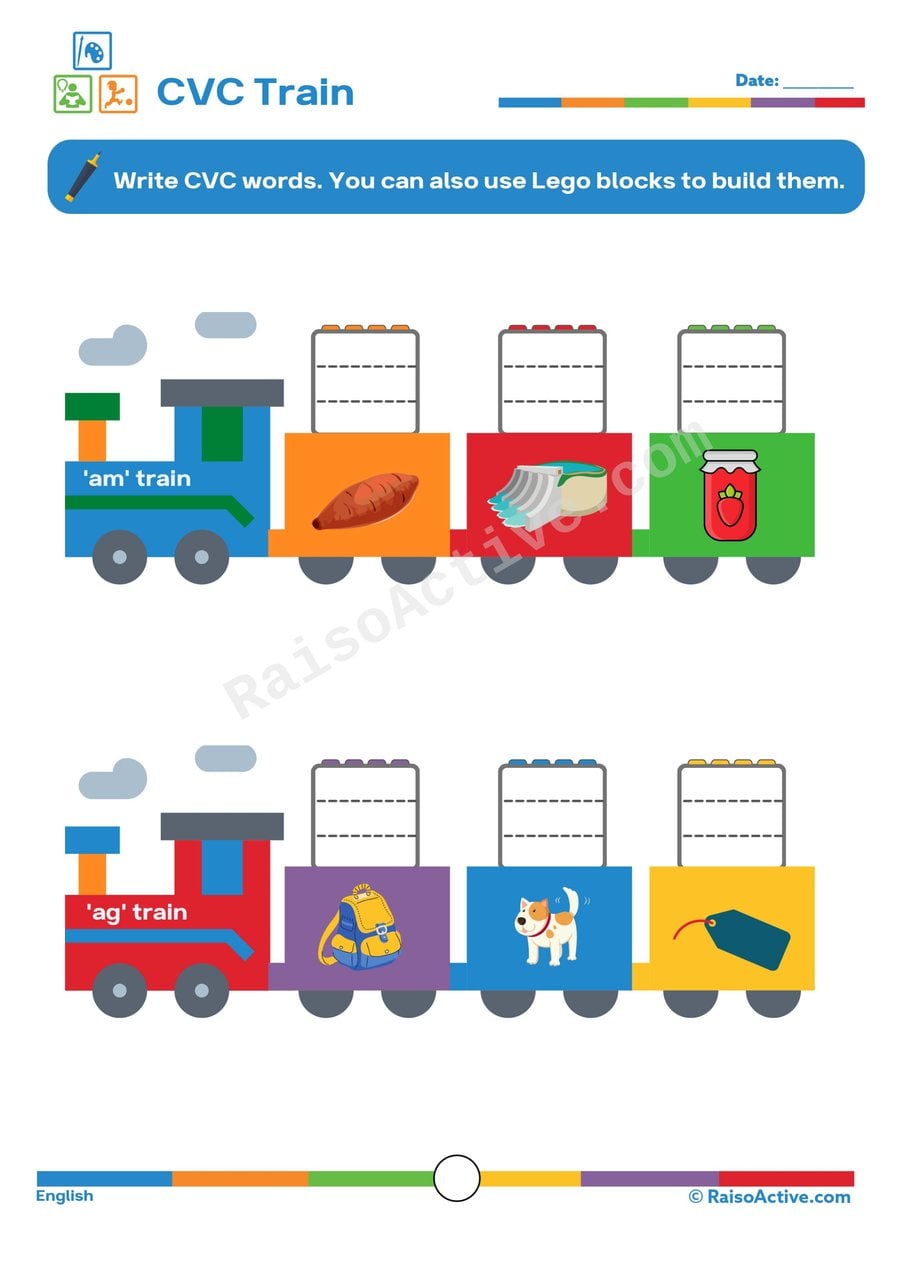
CVC Train Worksheet: Write and Build CVC Words!
Ages 4-6 · Pre-K–KindergartenAges 4-6 · Reception–Year 1Ages 4-6 · LKG–UKGAges 4-6
This worksheet gives children ages 4-6 focused practice blending letter sounds into consonant-vowel-consonant words, using train-car pictures as clues for words like 'dog,' 'hen,' or 'cup.' Because children both write the word and can optionally build it with Lego blocks, this worksheet reinforces the same phonics skill through two different physical actions — handwriting and hands-on construction — which helps the spelling patterns stick.
Guides for this topic

How to Teach CVC Blending: A Step-by-Step Method That Works in Two Weeks
A step-by-step method for teaching CVC blending, covering continuous sounds, word families, common errors, and a 14-day plan that most children finish reading CVC words.
Phase 2 Phonics at Home: Sound Order, Blending Games, Worksheets
Phase 2 phonics at home: the five sound sets in order, oral blending, tricky words, a two-week routine, common mistakes, and free worksheets.

Reception Year Explained: EYFS Learning and How to Help at Home
A teacher's plain-English guide to the Reception Year: the seven areas of learning, Early Learning Goals, Phase 2/3 phonics, the RBA and home routines.
Reviews
Every worksheet for ages 3–5, no watermark
Members download the full library of 1,000+ worksheets and every activity pack without watermarks or daily limits. One year costs ₹999 in India or $20 elsewhere.
See membership plansOr download any worksheet free with a watermark (5 a day).