Letter Sounds d and g Say and Match Worksheet
Children hear and say the d and g sounds, see the mouth shape for each one and match pictures to the right sound. d: doll, dice, duck, ladder, muddy boots and dolphin. g: goat, gate, gift, ghost, egg and bag.
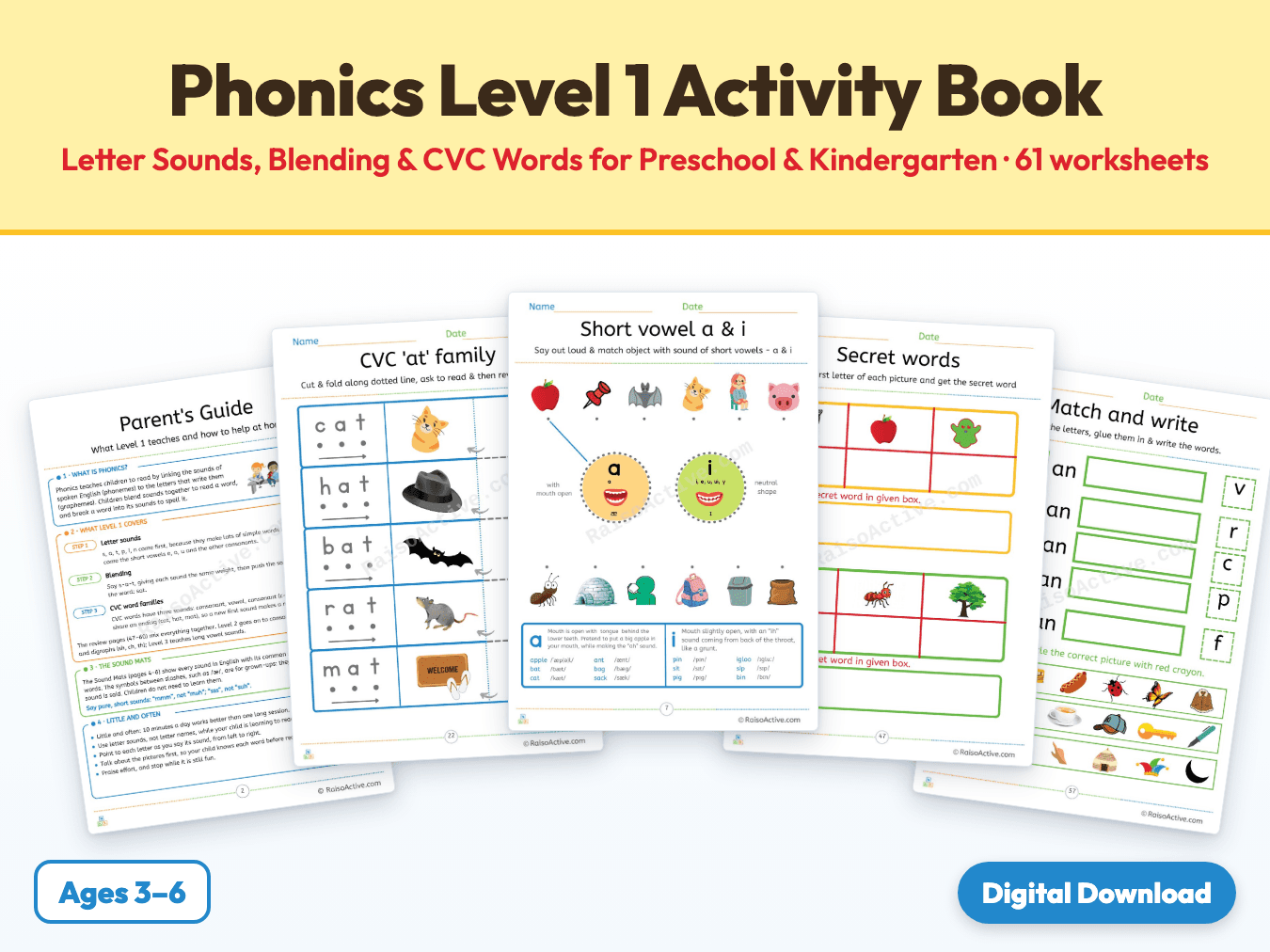
Part of the pack
Phonics Level 1 Activity Book: Letter Sounds, Blending & CVC Words for Preschool & Kindergarten
This is page 16 of the pack. Ages 3-6 · Preschool–KindergartenAges 3-6 · Nursery–Year 1Ages 3-6 · Nursery–UKGAges 3-6
Made for your child
Numbers to 20, made for your child
A maths pack with your child's name in it: pictures that explain, practice at three levels, puzzles and story sums about them. Print a new set whenever they finish.
Make a maths packFree preview · free for members
Curriculum
- Phonics - Letter Sounds > Consonant Sounds
How to use this worksheet
Say each picture name slowly and listen for the d or g sound. Draw a line from the dot under the picture to the right letter circle. Read the sound box at the bottom together.
Materials needed
- Pencil
- Crayons
Extension activities
- 1Find two things at home with the d sound and two with the g sound
- 2Say the words from the sound box and clap once for the target sound

Written by
Hemsweta Jain · Teacher Cheena
MBA and Early Childhood Educator, teaching since 2014 · Founder of RaisoActive, Mumbai
Every RaisoActive worksheet is designed and checked by the founder before publishing.
Published · Last reviewed
More from Phonics Level 1 Activity Book: Letter Sounds, Blending & CVC Words for Preschool & Kindergarten

CVC 'ot' Word Family Read and Reveal Worksheet
Ages 3-6 · Preschool–KindergartenAges 3-6 · Nursery–Year 1Ages 3-6 · Nursery–UKGAges 3-6
Children read five 'ot' family words sound by sound, dot, pot, hot, tot and cot, and see that changing the first sound makes a new word.
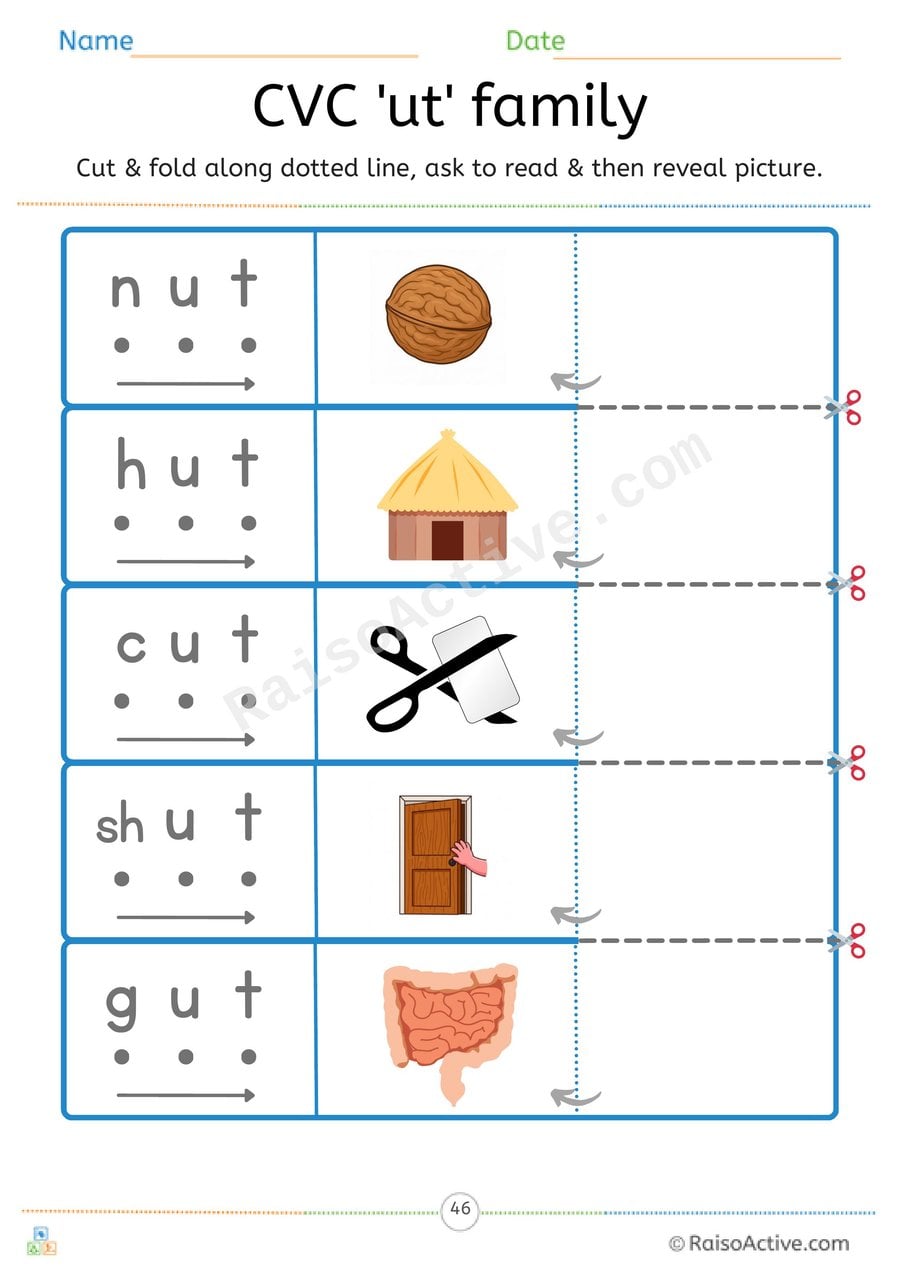
CVC 'ut' Word Family Read and Reveal Worksheet
Ages 3-6 · Preschool–KindergartenAges 3-6 · Nursery–Year 1Ages 3-6 · Nursery–UKGAges 3-6
Children read five 'ut' family words sound by sound, nut, hut, cut, shut and gut, and see that changing the first sound makes a new word. Shut starts with the digraph sh: say it as one sound.

Read and Reveal CVC Words: sit, pit, pat, tap, tip
Ages 3-6 · Preschool–KindergartenAges 3-6 · Nursery–Year 1Ages 3-6 · Nursery–UKGAges 3-6
Children blend their first CVC words using only s, a, t, i, p and n: sit, pit, pat, tap and tip.

Circle the Picture: Read CVC Words and Write First Letters
Ages 3-6 · Preschool–KindergartenAges 3-6 · Nursery–Year 1Ages 3-6 · Nursery–UKGAges 3-6
Children read the CVC words bag, sad and dad and find the right picture, then write the first letter of fish, grapes, kite, egg, bat, jug, duck, hat and leaf.

Letter Sounds v and w Say and Match Worksheet
Ages 3-6 · Preschool–KindergartenAges 3-6 · Nursery–Year 1Ages 3-6 · Nursery–UKGAges 3-6
Children hear and say the v and w sounds, see the mouth shape for each one and match pictures to the right sound. v: van, vine, vase, glove, cave and hive. w: well, web, worm, whale, watch and wheel.

First Letter Sound: Complete the Word and Make a New Word
Ages 3-6 · Preschool–KindergartenAges 3-6 · Nursery–Year 1Ages 3-6 · Nursery–UKGAges 3-6
Children write the first letter of six picture words, then put together the first sounds of three pictures to make new words: bat, mud, pin and cap.
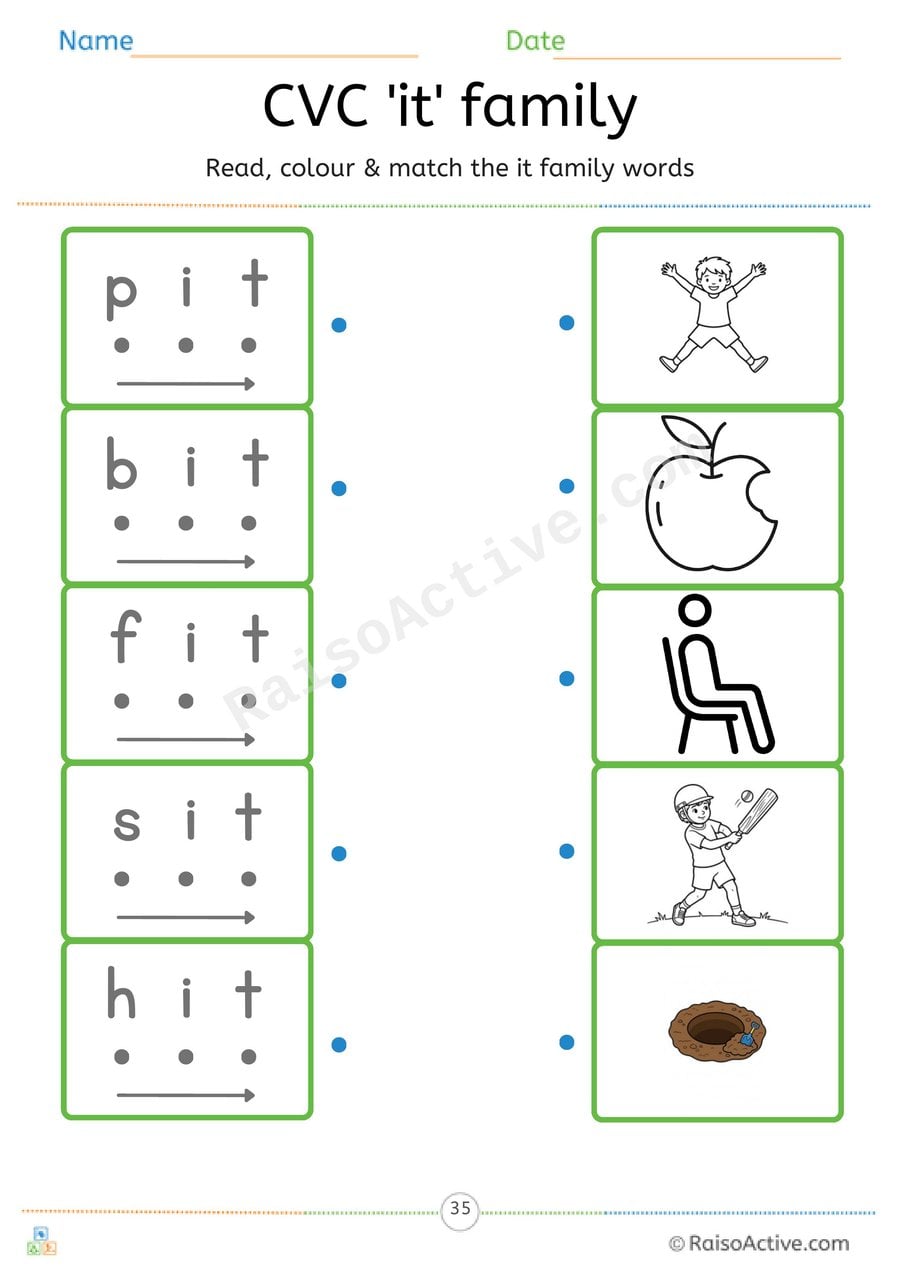
CVC 'it' Word Family Read, Colour and Match Worksheet
Ages 3-6 · Preschool–KindergartenAges 3-6 · Nursery–Year 1Ages 3-6 · Nursery–UKGAges 3-6
Children read the 'it' words pit, bit, fit, sit and hit on their own and match each word to its picture, checking that they understood what they read.

Secret Words: Spell 'en' Family Words from First Sounds
Ages 3-6 · Preschool–KindergartenAges 3-6 · Nursery–Year 1Ages 3-6 · Nursery–UKGAges 3-6
Children hear the first sound of each picture (for example dog, egg, net), write that letter and blend the three letters to read a hidden 'en' family word.
Related worksheets

Identify Vowels Worksheet: Circle the Correct Vowel!
Ages 4-6 · Pre-K–KindergartenAges 4-6 · Reception–Year 1Ages 4-6 · LKG–UKGAges 4-6
This worksheet sharpens phonemic awareness in children ages 4-6 by having them say a picture's name aloud and isolate which vowel sound — a, e, i, o, or u — appears in the middle. Vowels are the trickiest sounds for early readers to hear clearly since they blend into surrounding consonants, so focused practice like this builds a skill that pays off directly in future decoding and spelling.

Phonics Level 2 Sound Mat 3: Long Vowel and R-Influenced Vowel Sounds
Ages 4-7 · Pre-K–Grade 1Ages 4-7 · Reception–Year 2Ages 4-7 · LKG–Class 1Ages 4-7
Children see the long vowel sounds, the r-influenced vowels such as ar, er and or, and other vowel sounds such as ow, oy and oo, each with spellings and examples.

Fun Phonics Worksheet: Matching Uppercase and Lowercase Letters!
Ages 3-5 · Preschool–Pre-KAges 3-5 · Nursery–ReceptionAges 3-5 · Nursery–LKGAges 3-5
This matching worksheet teaches children ages 3-5 to recognize that uppercase and lowercase versions of the same letter — like S and s — represent one letter despite looking different, a concept that trips up many early readers. Drawing a line between the four matching pairs builds visual discrimination and letter-form memory, while the follow-up task of circling pictures that start with 'C' adds practice connecting a letter to its sound.

Phonics Fun: Write the First Letter and Draw! (Ages 3-5)
Ages 3-5 · Preschool–Pre-KAges 3-5 · Nursery–ReceptionAges 3-5 · Nursery–LKGAges 3-5
This worksheet asks children ages 3-5 to identify a picture's beginning sound and write the matching letter, then draw their own picture for extra practice, combining phonemic awareness with early letter formation. Writing the letter by hand, rather than just circling it, demands more fine motor control and reinforces the sound-symbol link more deeply than recognition alone. The open-ended drawing task also lets children apply the same beginning sound to a word of their own choosing.

Say My Sound: Beginning Letter Sounds Worksheet for Preschoolers
Ages 3-5 · Preschool–Pre-KAges 3-5 · Nursery–ReceptionAges 3-5 · Nursery–LKGAges 3-5
Saying a picture's name aloud and then circling the letter that matches its beginning sound builds phonemic awareness in children ages 3-5, teaching them to isolate the very first sound in a spoken word before connecting it to a printed letter. Because several letter options are given for each picture, this worksheet requires children to actively compare sounds rather than simply recognize a single correct letter by memory. This kind of applied letter-sound practice is one of the strongest early predictors of later reading success.

Alphabet Adventures: Circle the Objects! A Fun Letter Recognition Worksheet
Ages 3-5 · Preschool–Pre-KAges 3-5 · Nursery–ReceptionAges 3-5 · Nursery–LKGAges 3-5
This worksheet builds letter-sound correspondence by having children scan a group of pictures and circle only the ones that start with a specific letter. For three- to five-year-olds, this kind of visual search-and-sort task strengthens both phonics recognition and sustained visual attention, since children have to check each picture against the target sound rather than just glancing at the page.

Phonics Level 2 Certificate of Achievement: Super Reader
Ages 4-7 · Pre-K–Grade 1Ages 4-7 · Reception–Year 2Ages 4-7 · LKG–Class 1Ages 4-7
Children celebrate reading and spelling words with blends and digraphs, and tick what they can read: CVC words, blends and digraphs.

Phonics Level 2 Sound Mat 4: Consonant Blends and ck
Ages 4-7 · Pre-K–Grade 1Ages 4-7 · Reception–Year 2Ages 4-7 · LKG–Class 1Ages 4-7
Children see how two consonants keep both their sounds in a blend, at the start of words (bl, cl, fl, sl, br, cr, dr, tr, st, sw) and at the end (nd, nt, mp), and that ck makes one /k/ sound.
Guides for this topic

How to Teach CVC Blending: A Step-by-Step Method That Works in Two Weeks
A step-by-step method for teaching CVC blending, covering continuous sounds, word families, common errors, and a 14-day plan that most children finish reading CVC words.
Phase 2 Phonics at Home: Sound Order, Blending Games, Worksheets
Phase 2 phonics at home: the five sound sets in order, oral blending, tricky words, a two-week routine, common mistakes, and free worksheets.
Reception Year Explained: EYFS Learning and How to Help at Home
A teacher's plain-English guide to the Reception Year: the seven areas of learning, Early Learning Goals, Phase 2/3 phonics, the RBA and home routines.
Reviews
Every worksheet for ages 3–6, no watermark
Members download the full library of 1,000+ worksheets and every activity pack without watermarks or daily limits. One year costs ₹999 in India or $20 elsewhere.
See membership plansOr download any worksheet free with a watermark (5 a day).