'an' Word Family Cut and Paste and Read and Circle Worksheet
Children build the 'an' words ran, pan, van, fan and can by adding a first letter, write each word, then read bus, cup and hut and find the matching pictures.
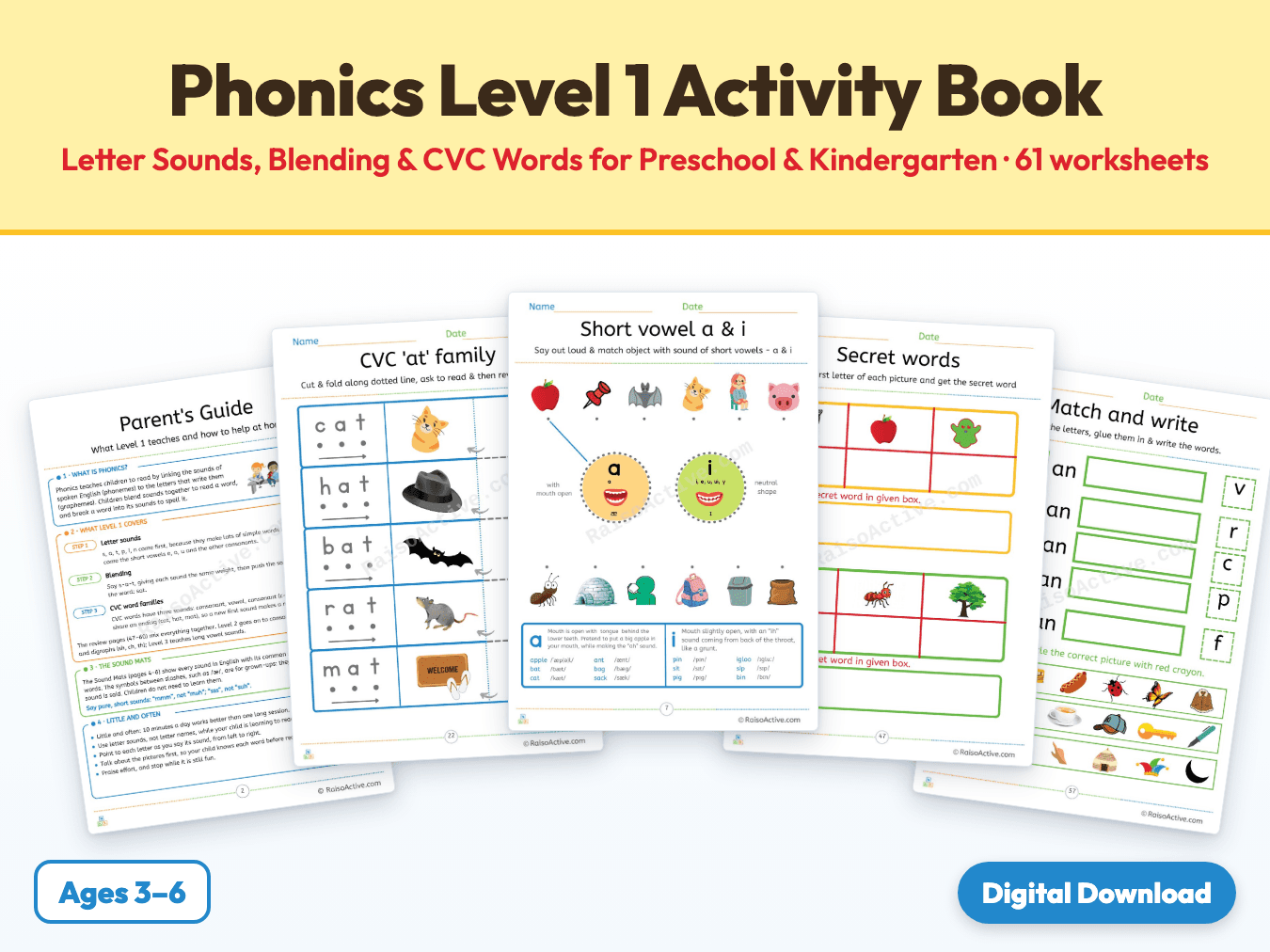
Part of the pack
Phonics Level 1 Activity Book: Letter Sounds, Blending & CVC Words for Preschool & Kindergarten
This is page 57 of the pack. Ages 3-6 · Preschool–KindergartenAges 3-6 · Nursery–Year 1Ages 3-6 · Nursery–UKGAges 3-6
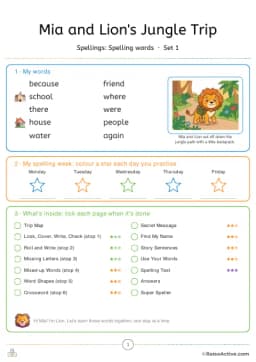
Made for your child
Spelling practice, made for your child
Their own spelling words turned into a pack: trace or look-cover-write-check, roll and write, a secret picture code, a word search, a crossword and a test, with their name in it.
Make a spelling packFree preview · free for members
Or start free: a word search with sight wordsCurriculum
- Phonics - CVC Words > CVC Short A Families
How to use this worksheet
Cut out the letters on the right, glue each one in front of 'an' to match the picture and write the whole word in the long box. Then read each word and circle its picture in red.
Materials needed
- Scissors
- Glue
- Pencil
- Red crayon
Extension activities
- 1Find another 'an' word, like man
- 2Read the circled words without the pictures

Written by
Hemsweta Jain · Teacher Cheena
MBA and Early Childhood Educator, teaching since 2014 · Founder of RaisoActive, Mumbai
Every RaisoActive worksheet is designed and checked by the founder before publishing.
Published · Last reviewed
More from Phonics Level 1 Activity Book: Letter Sounds, Blending & CVC Words for Preschool & Kindergarten

Read and Reveal CVC Words: sit, pit, pat, tap, tip
Ages 3-6 · Preschool–KindergartenAges 3-6 · Nursery–Year 1Ages 3-6 · Nursery–UKGAges 3-6
Children blend their first CVC words using only s, a, t, i, p and n: sit, pit, pat, tap and tip.
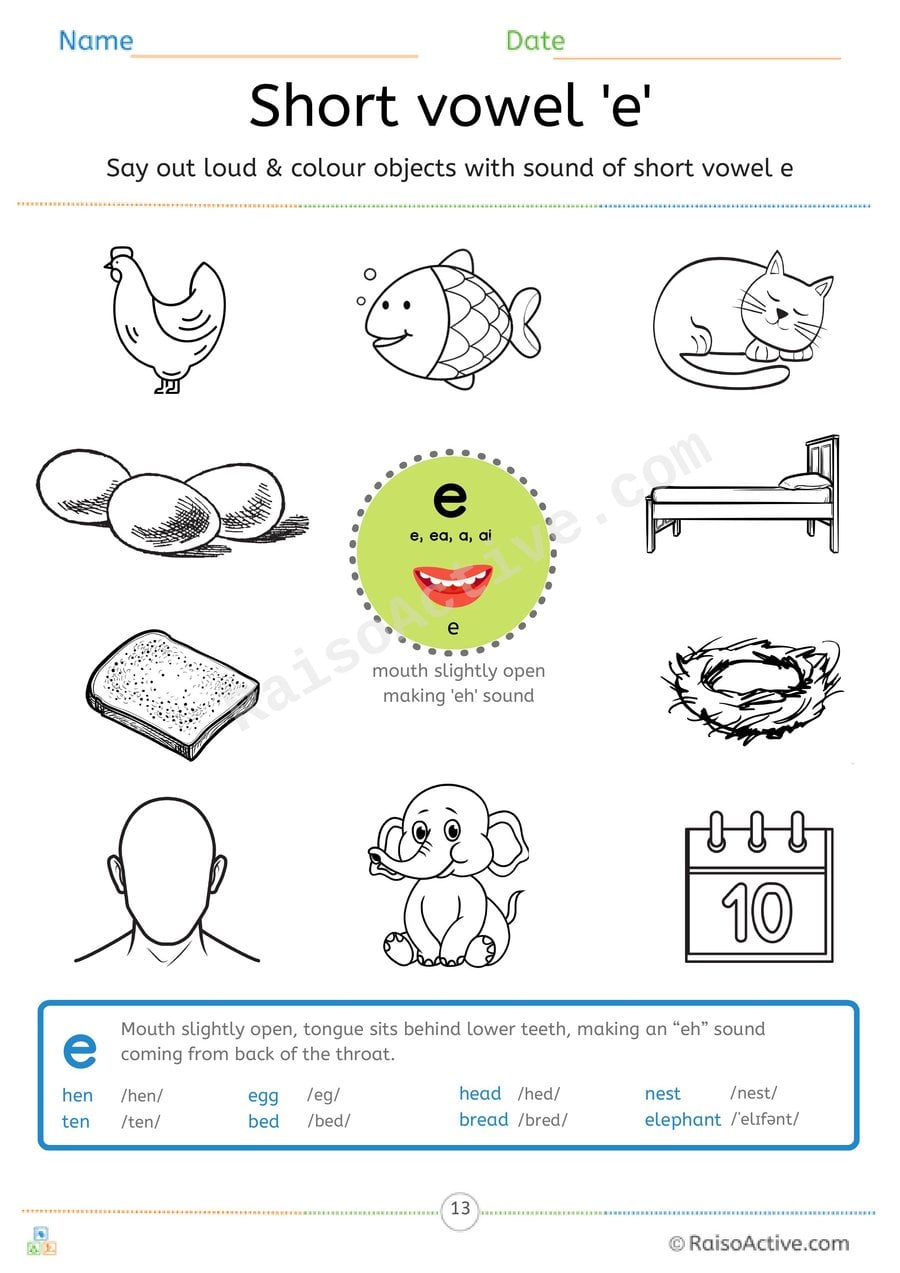
Short Vowel e Say and Colour Worksheet
Ages 3-6 · Preschool–KindergartenAges 3-6 · Nursery–Year 1Ages 3-6 · Nursery–UKGAges 3-6
Children hear the short e sound in the middle of words and pick it out: hen, eggs, bed, bread, nest, head, elephant and ten have it; fish and cat don't.

Read and Reveal CVC Words: pan, nap, tap, tin, pin
Ages 3-6 · Preschool–KindergartenAges 3-6 · Nursery–Year 1Ages 3-6 · Nursery–UKGAges 3-6
Children practise blending more s a t p i n words: pan, nap, tap, tin and pin.

CVC 'un' Word Family Read and Reveal Worksheet
Ages 3-6 · Preschool–KindergartenAges 3-6 · Nursery–Year 1Ages 3-6 · Nursery–UKGAges 3-6
Children read five 'un' family words sound by sound, sun, fun, bun, nun and run, and see that changing the first sound makes a new word.

CVC 'at' Word Family Read, Colour and Match Worksheet
Ages 3-6 · Preschool–KindergartenAges 3-6 · Nursery–Year 1Ages 3-6 · Nursery–UKGAges 3-6
Children read the 'at' words cat, hat, bat, rat and mat on their own and match each word to its picture, checking that they understood what they read.

Phonics Review: Circle the Word and Fill in the Missing Letter
Ages 3-6 · Preschool–KindergartenAges 3-6 · Nursery–Year 1Ages 3-6 · Nursery–UKGAges 3-6
Children read three similar words and choose the one that matches the picture, then hear the first sound of hat, bed, dog, bus, cow, car, cat and ant.

CVC 'ap' Word Family Read and Reveal Worksheet
Ages 3-6 · Preschool–KindergartenAges 3-6 · Nursery–Year 1Ages 3-6 · Nursery–UKGAges 3-6
Children read five 'ap' family words sound by sound, map, cap, lap, nap and tap, and see that changing the first sound makes a new word.

Secret Words: Spell 'an' Family Words from First Sounds
Ages 3-6 · Preschool–KindergartenAges 3-6 · Nursery–Year 1Ages 3-6 · Nursery–UKGAges 3-6
Children hear the first sound of each picture (for example mug, apple, nest), write that letter and blend the three letters to read a hidden 'an' family word.
Related worksheets
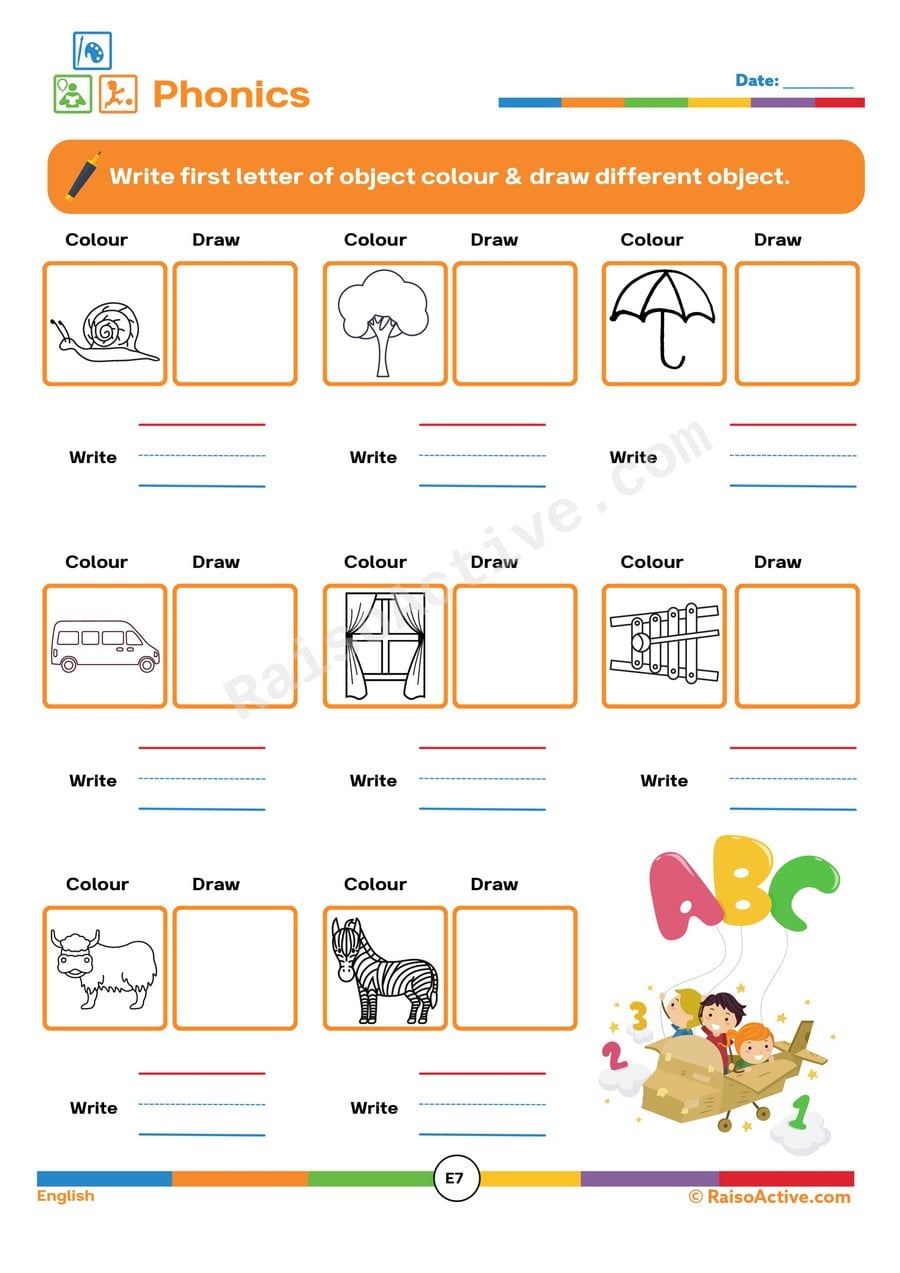
Phonics Fun: Color, Draw, and Write! (Ages 3-5)
Ages 3-5 · Preschool–Pre-KAges 3-5 · Nursery–ReceptionAges 3-5 · Nursery–LKGAges 3-5
Coloring a picture, drawing a related object, and writing its first letter combines three literacy-building tasks in one activity for children ages 3-5 — visual recognition, creative expression, and beginning-sound identification.

Phonics Fun: Write the First Letter and Draw! (Ages 3-5)
Ages 3-5 · Preschool–Pre-KAges 3-5 · Nursery–ReceptionAges 3-5 · Nursery–LKGAges 3-5
This worksheet asks children ages 3-5 to identify a picture's beginning sound and write the matching letter, then draw their own picture for extra practice, combining phonemic awareness with early letter formation. Writing the letter by hand, rather than just circling it, demands more fine motor control and reinforces the sound-symbol link more deeply than recognition alone. The open-ended drawing task also lets children apply the same beginning sound to a word of their own choosing.

Cut and Paste the First Letter: Fun Phonics Worksheet for Preschoolers
Ages 4-5 · Pre-KAges 4-5 · ReceptionAges 4-5 · LKGAges 4-5
Children ages 4-5 practice identifying the beginning sound of a word and matching it to the correct letter, a core early phonics skill, while also building fine motor control through cutting and pasting. Connecting a picture's name to its first letter sound is one of the clearest building blocks toward independent reading.
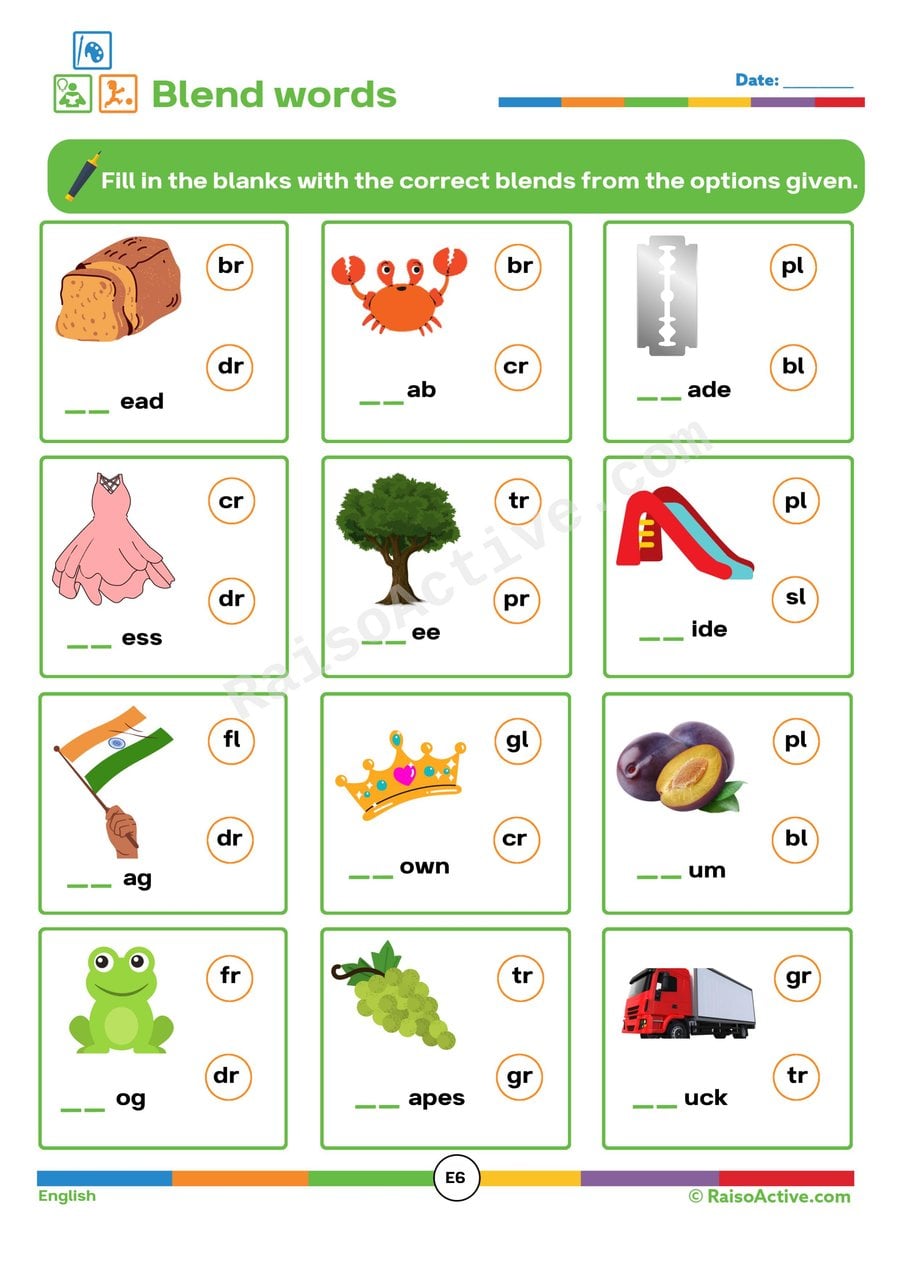
Blend Words Worksheet: Practice Blending Sounds!
Ages 4-6 · Pre-K–KindergartenAges 4-6 · Reception–Year 1Ages 4-6 · LKG–UKGAges 4-6
This worksheet gives children ages 4-6 focused practice blending initial consonant sounds, like 'cl' or 'fr,' with the rest of a word to complete a picture-labeled word. Unlike simple picture matching, writing the missing blend requires children to actively produce the correct letter combination from memory, which is a more demanding and valuable phonics skill than recognition alone.

Meera's Garba Night: Navratri Reading Comprehension Story
Ages 4-6 · Pre-K–KindergartenAges 4-6 · Reception–Year 1Ages 4-6 · LKG–UKGAges 4-6
Children listen to or read a short story, recall details by circling answers, write answers using a word bank and explain a simple idea in their own words.

Phonics Level 2 Sound Mat 3: Long Vowel and R-Influenced Vowel Sounds
Ages 4-7 · Pre-K–Grade 1Ages 4-7 · Reception–Year 2Ages 4-7 · LKG–Class 1Ages 4-7
Children see the long vowel sounds, the r-influenced vowels such as ar, er and or, and other vowel sounds such as ow, oy and oo, each with spellings and examples.

Phonics Level 3 Long Vowels Answer Key for Grown-ups
Ages 5-7 · Kindergarten–Grade 1Ages 5-7 · Year 1–Year 2Ages 5-7 · UKG–Class 1Ages 5-7
Grown-ups get every answer for the long a, e, i, o and u pages and the long-or-short sorting pages, including word search positions by row and column.

Vowel Sounds Worksheet: Identify and Circle the Correct Vowel!
Ages 4-6 · Pre-K–KindergartenAges 4-6 · Reception–Year 1Ages 4-6 · LKG–UKGAges 4-6
Children ages 4-6 practice identifying vowel sounds within words by looking at a picture, saying its name aloud, and figuring out which vowel they hear, a specific phonics skill that builds toward independent reading and spelling. Isolating the vowel sound in a word is often trickier for children than identifying beginning consonant sounds, making this a meaningful next step in phonics.
Guides for this topic

Sight Words by Age: The First 50 Words and How to Teach Them Without Flashcard Fatigue
Which sight words to teach first and why, the heart-word method, a read-trace-write-find routine, games, and a by-age table of typical sight-word progress.
How to Teach CVC Blending: A Step-by-Step Method That Works in Two Weeks
A step-by-step method for teaching CVC blending, covering continuous sounds, word families, common errors, and a 14-day plan that most children finish reading CVC words.
Phase 2 Phonics at Home: Sound Order, Blending Games, Worksheets
Phase 2 phonics at home: the five sound sets in order, oral blending, tricky words, a two-week routine, common mistakes, and free worksheets.
Reviews
Every worksheet for ages 3–6, no watermark
Members download the full library of 1,000+ worksheets and every activity pack without watermarks or daily limits. One year costs ₹999 in India or $20 elsewhere.
See membership plansOr download any worksheet free with a watermark (5 a day).