Number 1 Fun: Tracing, Coloring, and Counting Worksheet for Preschoolers
This worksheet helps children recognize, trace, and count the number 1 through a combination of tracing practice, coloring watermelon slices and number blocks, and identifying the numeral within a sequence. For three- to five-year-olds, this multi-activity approach reinforces the same number from several angles — written form, spoken word, and counted quantity — so the concept of '1' is reinforced from more than one direction.
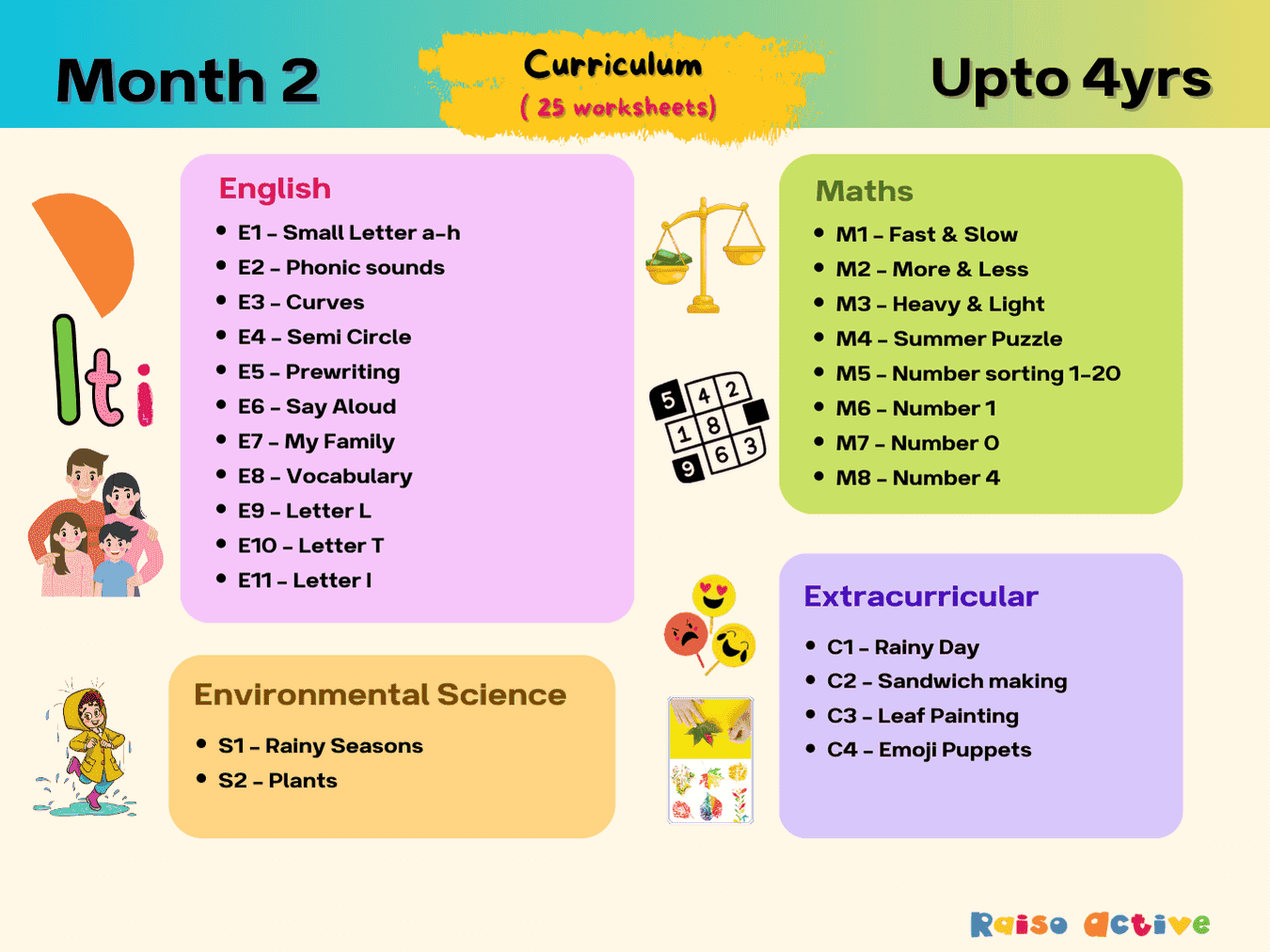
Part of the pack
Month 2: Learning & Development | Ages Up to 4
This is page 20 of the pack. Ages 3-4 · PreschoolAges 3-4 · NurseryAges 3-4

Made for your child
Counting to 10, made for your child
A maths pack with your child's name in it: pictures that explain, practice at three levels, puzzles and story sums about them. Print a new set whenever they finish.
Make a maths packFree preview · free for members
Curriculum
- Number Recognition > Number Tracing 1-10
How to use this worksheet
First, have your child trace the number 1 along the dotted lines. Then, have them color the watermelon slices and number blocks shown on the page. Next, ask them to circle every number 1 they can find within a printed number sequence. Finally, have them draw exactly one object in the box provided to represent the quantity.
Materials needed
- Pencil
- Crayons
Extension activities
- 1Have the child find objects around the house that represent the number 1, like one door or one nose.
- 2Practice writing the number 1 on a whiteboard or paper for extra repetition.
- 3Point out single objects throughout the day and count them together, saying 'one.'
- 4Build a tower using exactly one block, then compare it to a taller tower of many blocks.
- 5Play a simple game holding up one finger and naming something you can count 'one' of.

Written by
Hemsweta Jain · Teacher Cheena
MBA and Early Childhood Educator, teaching since 2014 · Founder of RaisoActive, Mumbai
Every RaisoActive worksheet is designed and checked by the founder before publishing.
Published · Last reviewed
More from Month 2: Learning & Development | Ages Up to 4

Small Letter a-h Matching Worksheet for Preschoolers
Ages 3-5 · Preschool–Pre-KAges 3-5 · Nursery–ReceptionAges 3-5 · Nursery–LKGAges 3-5
This worksheet builds lowercase letter recognition for a through h by having children match each letter to a picture whose name starts with that sound. For three- to five-year-olds, focusing on lowercase forms specifically matters because most of the text children encounter in books is written in lowercase, making this recognition more directly useful for early reading than uppercase alone.

Say Aloud and Match: Fun Worksheet for Young Learners
Ages 3-5 · Preschool–Pre-KAges 3-5 · Nursery–ReceptionAges 3-5 · Nursery–LKGAges 3-5
This worksheet builds sentence comprehension by having children listen to a full sentence and then find the picture that matches its meaning, rather than just recognizing individual words. For three- to five-year-olds, this task requires holding an entire sentence in mind and connecting it to a visual scene, an important early step toward reading comprehension beyond single-word recognition.

Pre-Writing Practice: Trace the Lines and Shapes Worksheet
Ages 3-5 · Preschool–Pre-KAges 3-5 · Nursery–ReceptionAges 3-5 · Nursery–LKGAges 3-5
This worksheet builds pre-writing skills by having children trace a variety of lines and shapes — following dinosaurs, marbles, skateboarders, and cars along their paths — which develops the hand-eye coordination and pencil control needed before formal letter writing begins. For three- to five-year-olds, tracing varied line types like straight, curved, and zigzag paths builds the specific motor patterns that later show up in letter strokes like the curves in 'c' and 'o' or the straight lines in 'l' and 't.'

Plant Life Cycle Worksheet: Cut and Paste the Stages!
Ages 3-5 · Preschool–Pre-KAges 3-5 · Nursery–ReceptionAges 3-5 · Nursery–LKGAges 3-5
This worksheet helps children ages 3-5 learn the different stages of a plant's life cycle, from seed to sprout to full-grown plant, by coloring each stage and then cutting and pasting the pictures in the correct sequential order. Sequencing the stages builds early scientific reasoning about growth and change over time, a concept children can also observe in themselves.

Parent's Guide: Fun Activities for Letter Recognition, Conversation & More!
Ages 3-5 · Preschool–Pre-KAges 3-5 · Nursery–ReceptionAges 3-5 · Nursery–LKGAges 3-5
This guide is a collection of hands-on activities parents can use to build letter recognition, phonics awareness, basic conversation skills, and spatial vocabulary in three- to five-year-olds through everyday play rather than worksheet drills. Because it's built around games like hiding letters or setting up a pretend shop, it teaches these early literacy and language skills through movement and imagination, which holds young children's attention far longer than seated tasks.

Summer Puzzle Worksheet: Cut and Arrange Numbers 11-20!
Ages 4-5 · Pre-KAges 4-5 · ReceptionAges 4-5 · LKGAges 4-5
This worksheet extends number sequencing practice into the teens and twenties by having children cut out numbered puzzle pieces and arrange them from 11 to 20 to reveal a hidden summer picture. For four- and five-year-olds, the puzzle format adds motivation to get the sequence right, since an incorrect order means the picture won't come together properly, giving children immediate, visual feedback on their own work.

Heavy or Light? Sorting Worksheet for Preschoolers
Ages 3-5 · Preschool–Pre-KAges 3-5 · Nursery–ReceptionAges 3-5 · Nursery–LKGAges 3-5
This worksheet helps children ages 3-5 understand the concept of weight by looking at balance scale pictures and identifying which object is heavier or lighter, then sorting objects into heavy and light categories through a cut-and-paste activity. Comparing weight this way introduces an early physics concept and builds the comparative reasoning skills used across many areas of math.

Letter L Tracing Worksheet for Preschoolers: Learn to Write!
Ages 3-5 · Preschool–Pre-KAges 3-5 · Nursery–ReceptionAges 3-5 · Nursery–LKGAges 3-5
This worksheet helps children ages 3-5 practice tracing the letter L's simple straight-line strokes while identifying words that start with the letter L, giving early success with one of the more approachable letters to write. Because L uses just two straight strokes, it's often a confidence-building letter for children still building fine motor control.
Related worksheets
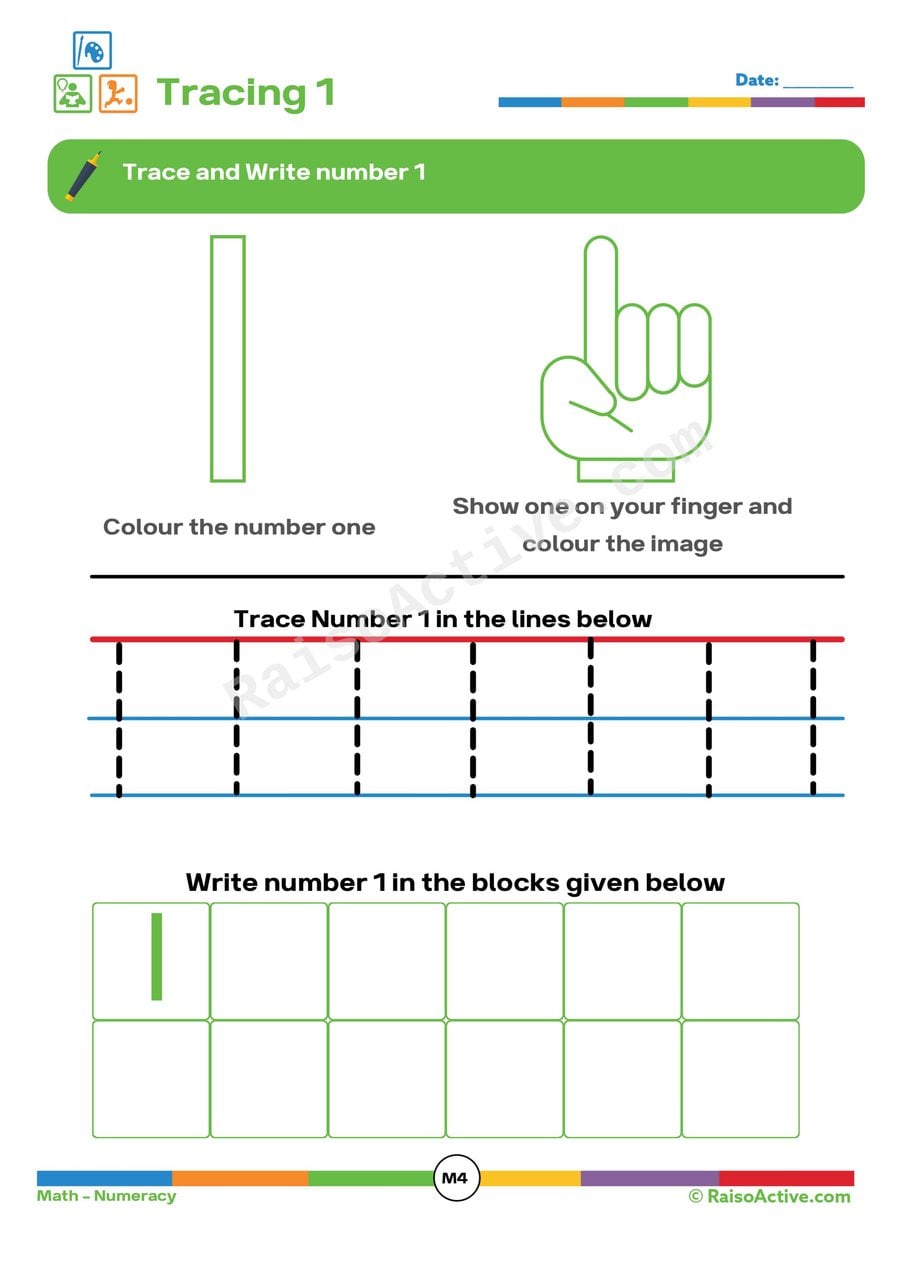
Tracing Number 1 Worksheet for Preschoolers
Ages 3-5 · Preschool–Pre-KAges 3-5 · Nursery–ReceptionAges 3-5 · Nursery–LKGAges 3-5
This tracing worksheet gives children ages 3-5 focused, repetitive practice forming the number 1 through tracing dotted lines, independent writing in provided boxes, and coloring an accompanying image, building the pencil control that precedes confident number writing. Because number 1 is typically the very first numeral children learn to write, getting the stroke direction and starting point correct here sets a strong foundation for writing higher numbers later. Repetition across multiple boxes on the page also builds the muscle memory needed for consistent, automatic number formation.
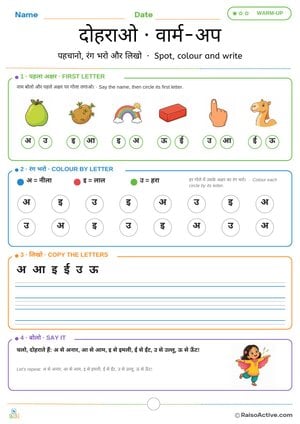
Hindi Vowels Part 1 Revision Warm-Up: First Letter, Colour by Letter and Copy | दोहराओ · वार्म-अप
Ages 3-7 · Preschool–Grade 1Ages 3-7 · Nursery–Year 2Ages 3-7 · Nursery–Class 1Ages 3-7
A mixed revision of the six vowels: circle the first letter of six pictured words, colour circles by letter code (अ blue, इ red, उ green), copy all six vowels on lines and say the revision rhyme.

Dussehra and First Letters: Vidyarambham Tracing and Letter Hunt
Ages 4-6 · Pre-K–KindergartenAges 4-6 · Reception–Year 1Ages 4-6 · LKG–UKGAges 4-6
Children learn about Vidyarambham, when little children write their first letters in rice on Vijayadashami, and about Dussehra, when Rama won against Ravana. They trace letters, sort things we use to learn, count to 10 and match letters to beginning sounds.
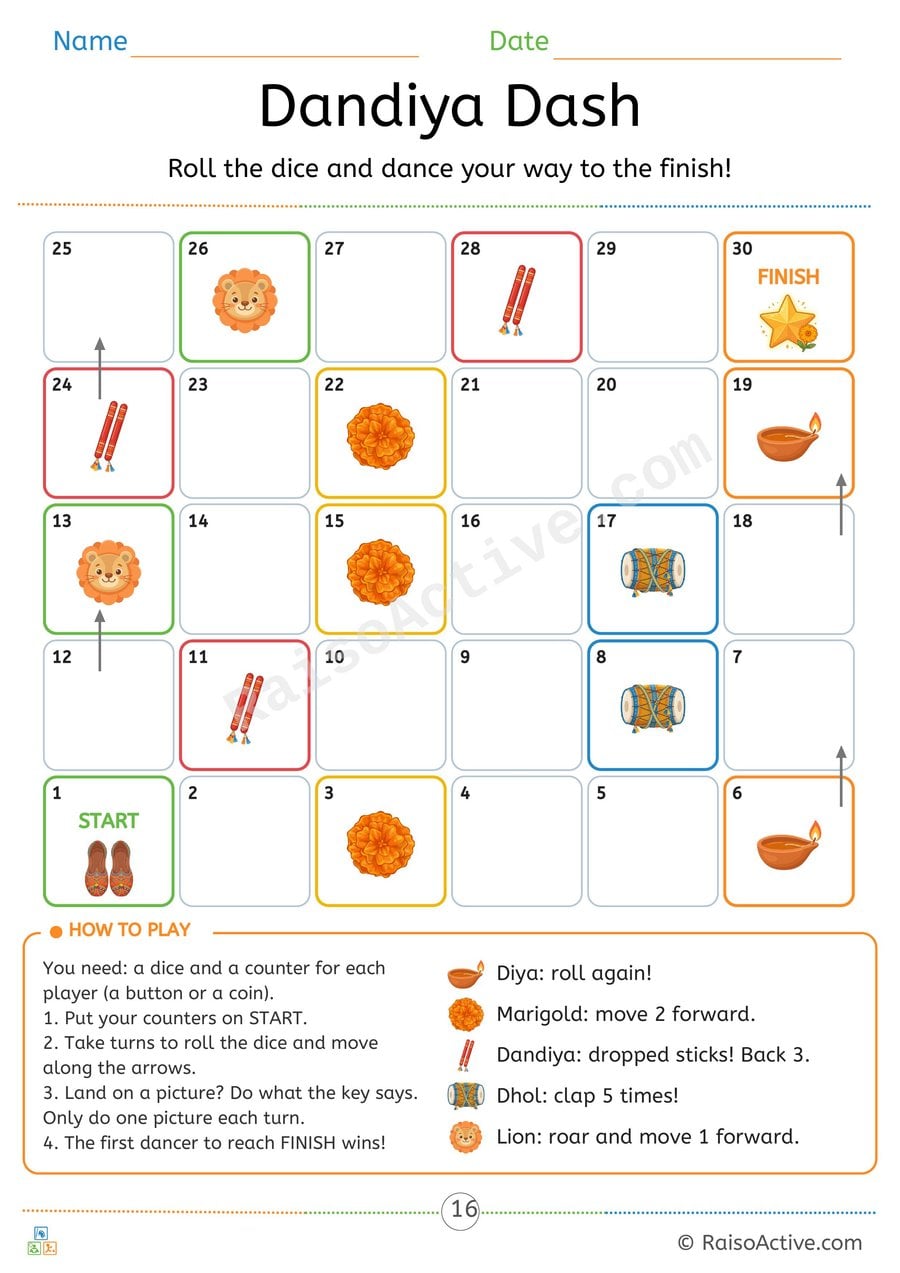
Dandiya Dash: Navratri Board Game for Kids
Ages 4-6 · Pre-K–KindergartenAges 4-6 · Reception–Year 1Ages 4-6 · LKG–UKGAges 4-6
Children count dots on a dice, count on along a number track to 30, take turns and follow simple game rules.

Golu Doll Fun: Navratri Golu Counting and Sharing Worksheet
Ages 4-6 · Pre-K–KindergartenAges 4-6 · Reception–Year 1Ages 4-6 · LKG–UKGAges 4-6
Children learn that a golu is a display of dolls on steps set up for Navratri. They count the dolls on each step and find the total, then share cups of sundal among friends and count what is left over.
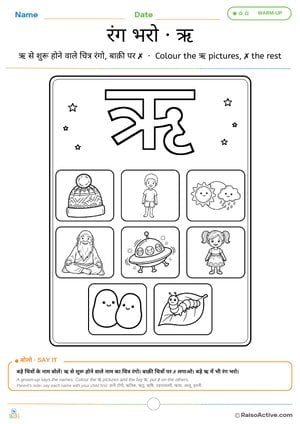
Colour the ऋ Words – Hindi Letter ऋ (ri) Colouring Worksheet | ऋ वाली चीज़ों में रंग भरो
Ages 3-7 · Preschool–Grade 1Ages 3-7 · Nursery–Year 2Ages 3-7 · Nursery–Class 1Ages 3-7
Children say each picture name aloud, decide whether it starts with ऋ, colour the matching pictures (ऋषि, ऋतु, ऋचा and ऋतिक) and the big outline letter, and put a cross on the rest. Sorting by first sound trains the ear and colouring builds hand control.
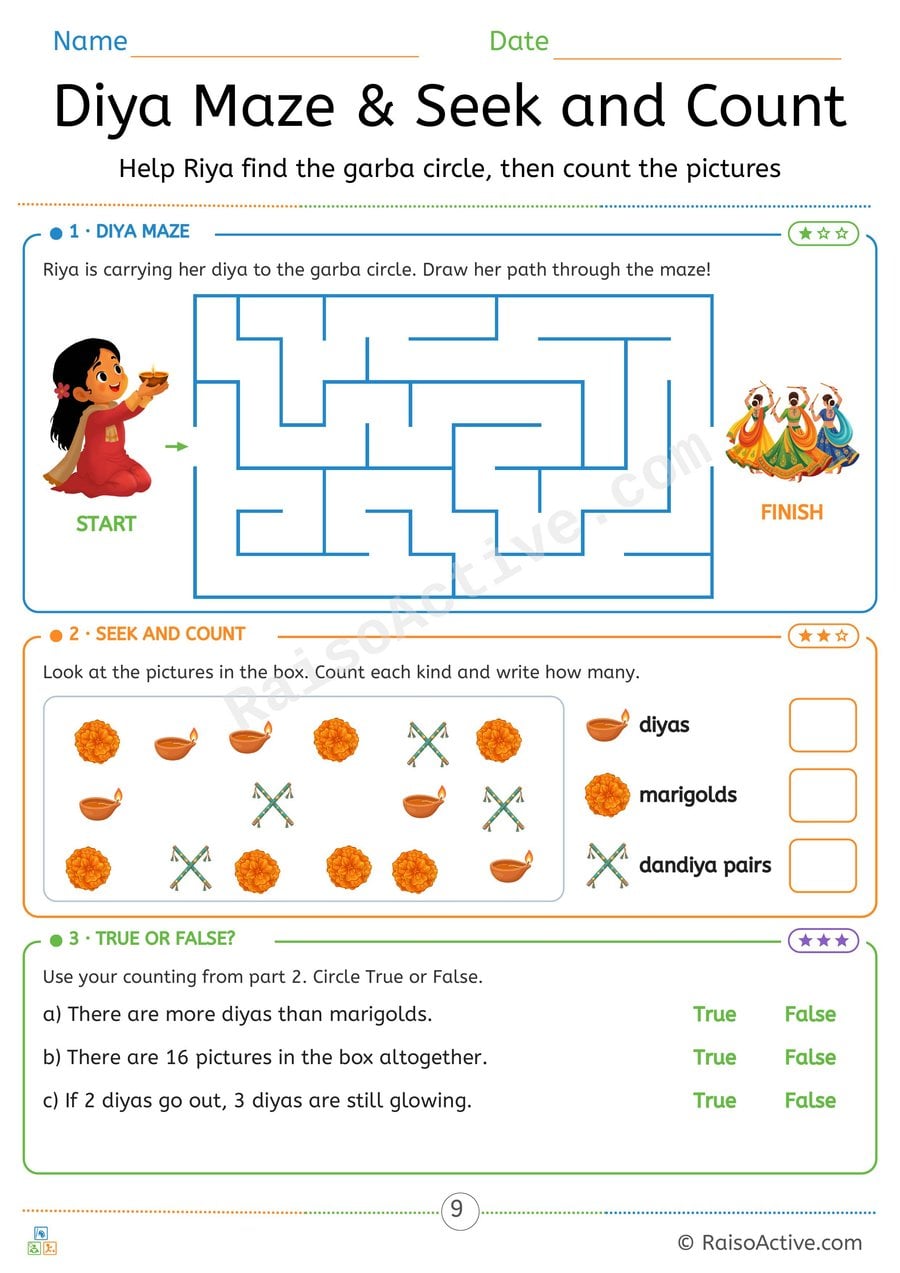
Navratri Diya Maze and Seek-and-Count Worksheet
Ages 4-6 · Pre-K–KindergartenAges 4-6 · Reception–Year 1Ages 4-6 · LKG–UKGAges 4-6
Children plan a path through a maze, count and sort mixed pictures by kind, and use their counts to decide if sentences are true or false.
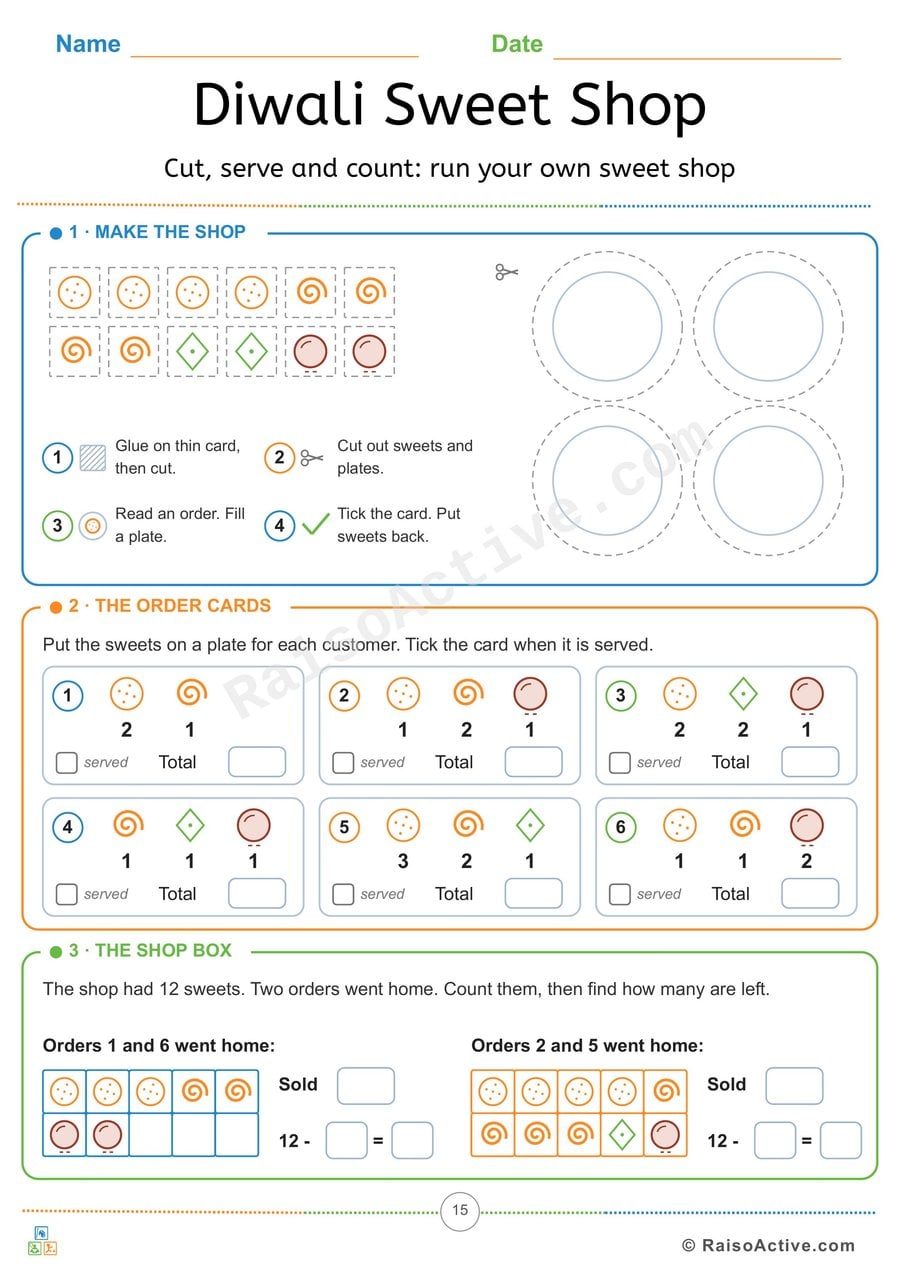
Diwali Sweet Shop Game: Cut, Serve and Count Orders
Ages 4-6 · Pre-K–KindergartenAges 4-6 · Reception–Year 1Ages 4-6 · LKG–UKGAges 4-6
Children cut out sweets and plates, then read six order cards and serve each customer the right number of sweets. They write the total, tick each served order and work out how many are left in the shop box.
Guides for this topic

Number Formation Rhymes 0–9 and How to Fix Reversals
Original number formation rhymes for 0–9, the correct stroke order for each digit, why 3, 5 and 7 get reversed most often, and multisensory fixes that work.

Best Worksheets for 3-Year-Olds: What Works and What to Avoid
What works on worksheets for 3-year-olds: short sessions, crayons, tracing lines, matching, cutting, a free weekly plan, and signs one is too advanced.
Fostering Creativity in Structured Learning: The Perfect Balance for Young Minds
Learn how to blend creativity with structured learning for children ages 1-8. Practical strategies, activities, and printable worksheets for parents and teachers.
Reviews
Every worksheet for ages 3–5, no watermark
Members download the full library of 1,000+ worksheets and every activity pack without watermarks or daily limits. One year costs ₹999 in India or $20 elsewhere.
See membership plansOr download any worksheet free with a watermark (5 a day).