Sentence Fun: Find the Subject and Predicate Worksheet for Kids!
This worksheet introduces basic sentence structure by teaching children to identify the subject (who or what the sentence is about) and the predicate (what the subject does or is) in simple sentences. For four- to six-year-olds, breaking a sentence into these two core parts is an early foundation for grammar and sentence-writing, helping them understand that every complete sentence needs both a 'who' and a 'what happens.'
Part of the pack
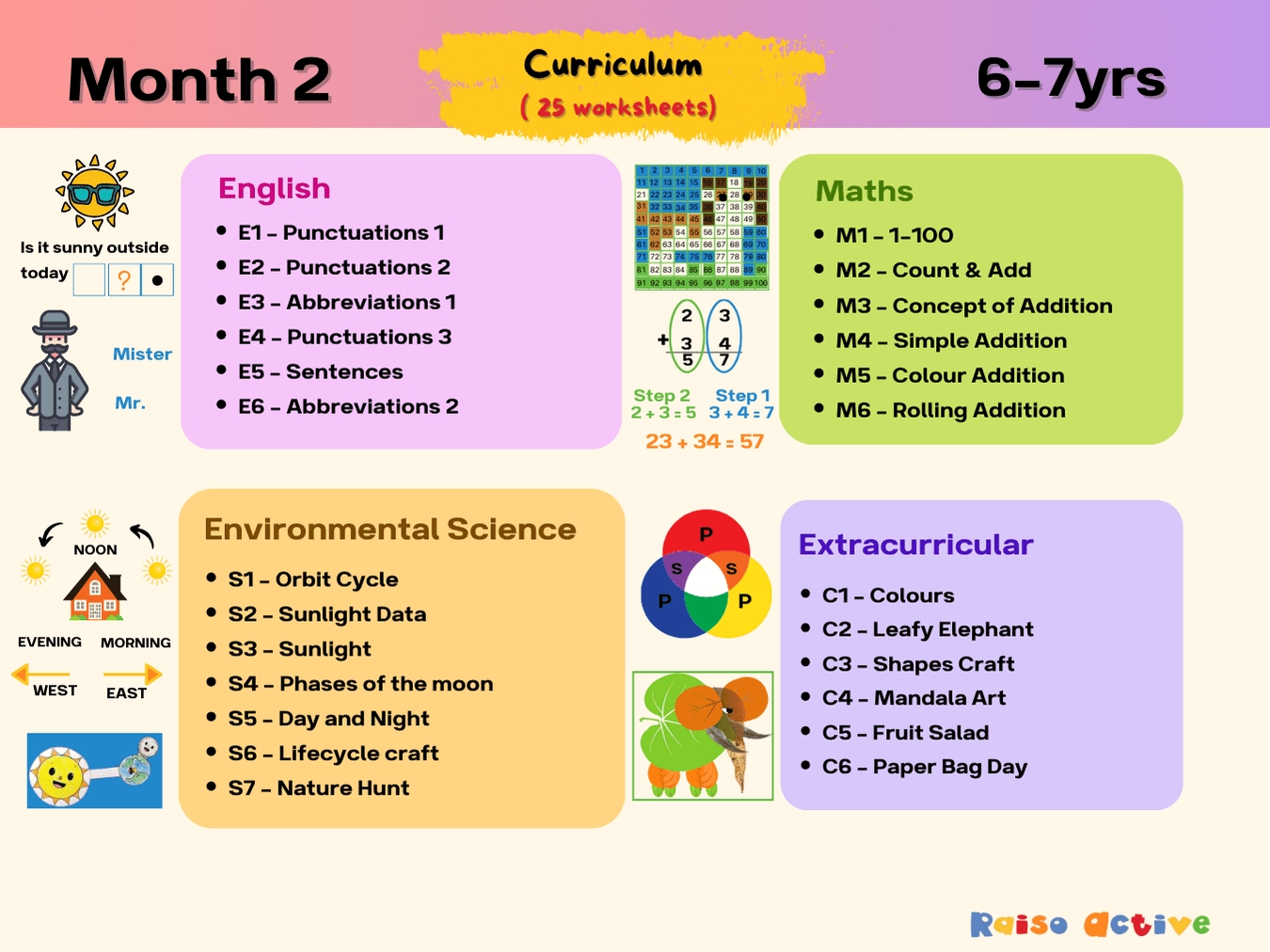
Month 2: Learning & Development | Ages 6-7
This is page 7 of the pack. Ages 6-7 · Grade 1Ages 6-7 · Year 2Ages 6-7 · Class 1Ages 6-7
Made for your child
A whole activity pack made with their name
60 pages to spot, build, trace and write their own name, plus pages about their favourites, feelings and family. See a free preview with their name.
Make an All About Me packFree preview · free for members
Or start free: a name tracing sheet with their nameCurriculum
- Fluency > Sentence Building
How to use this worksheet
Read the first sentence together aloud. Ask your child who or what the sentence is about, and have them circle that part in blue as the subject. Then ask what that subject is doing or being, and have them underline that part in orange as the predicate. Repeat for each sentence on the page, then have your child write two of their own simple sentences, marking the subject and predicate with the same two colors.
Materials needed
- Pencil
- Blue crayon or colored pencil
- Orange crayon or colored pencil
Extension activities
- 1Create more sentences together with a focus on identifying the subject and predicate.
- 2Draw pictures to illustrate a few of the sentences, labeling the subject and predicate parts.
- 3Play a sentence-building game where you supply a subject and your child supplies a matching predicate, or vice versa.
- 4Look through a book together and pick out one sentence per page to identify its subject and predicate.
- 5Mix and match subjects and predicates from different sentences to create silly new ones together.

Written by
Hemsweta Jain · Teacher Cheena
MBA and Early Childhood Educator, teaching since 2014 · Founder of RaisoActive, Mumbai
Every RaisoActive worksheet is designed and checked by the founder before publishing.
Published · Last reviewed
More from Month 2: Learning & Development | Ages 6-7
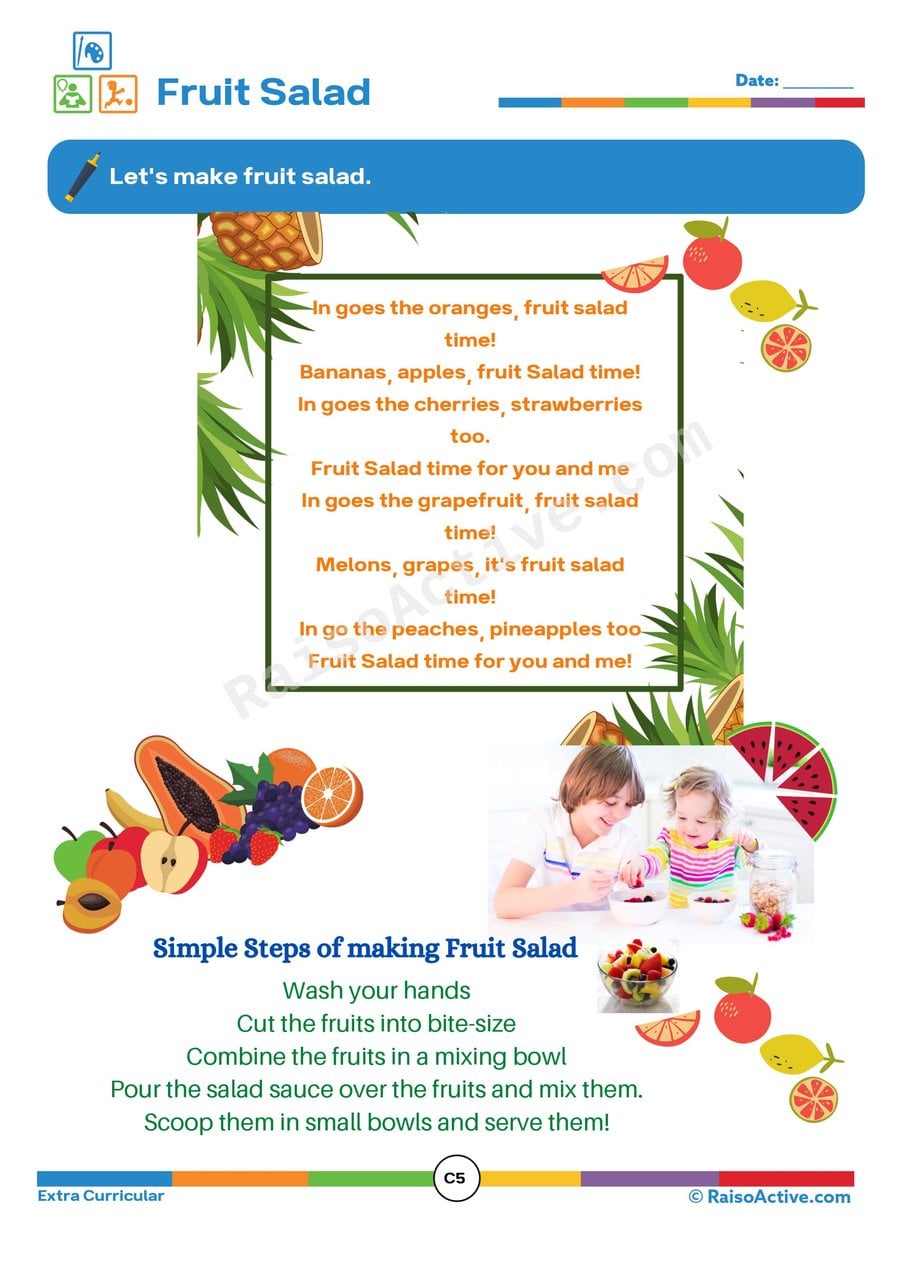
Fruit Salad Fun: A Recipe Worksheet for Kids
Ages 3-5 · Preschool–Pre-KAges 3-5 · Nursery–ReceptionAges 3-5 · Nursery–LKGAges 3-5
This worksheet uses a simple fruit salad recipe to teach children ages 3-5 how to follow a sequence of steps in order, a skill that underlies both reading comprehension and later procedural thinking in math and science. It also introduces healthy eating concepts as children name and draw the fruits that go into their salad.
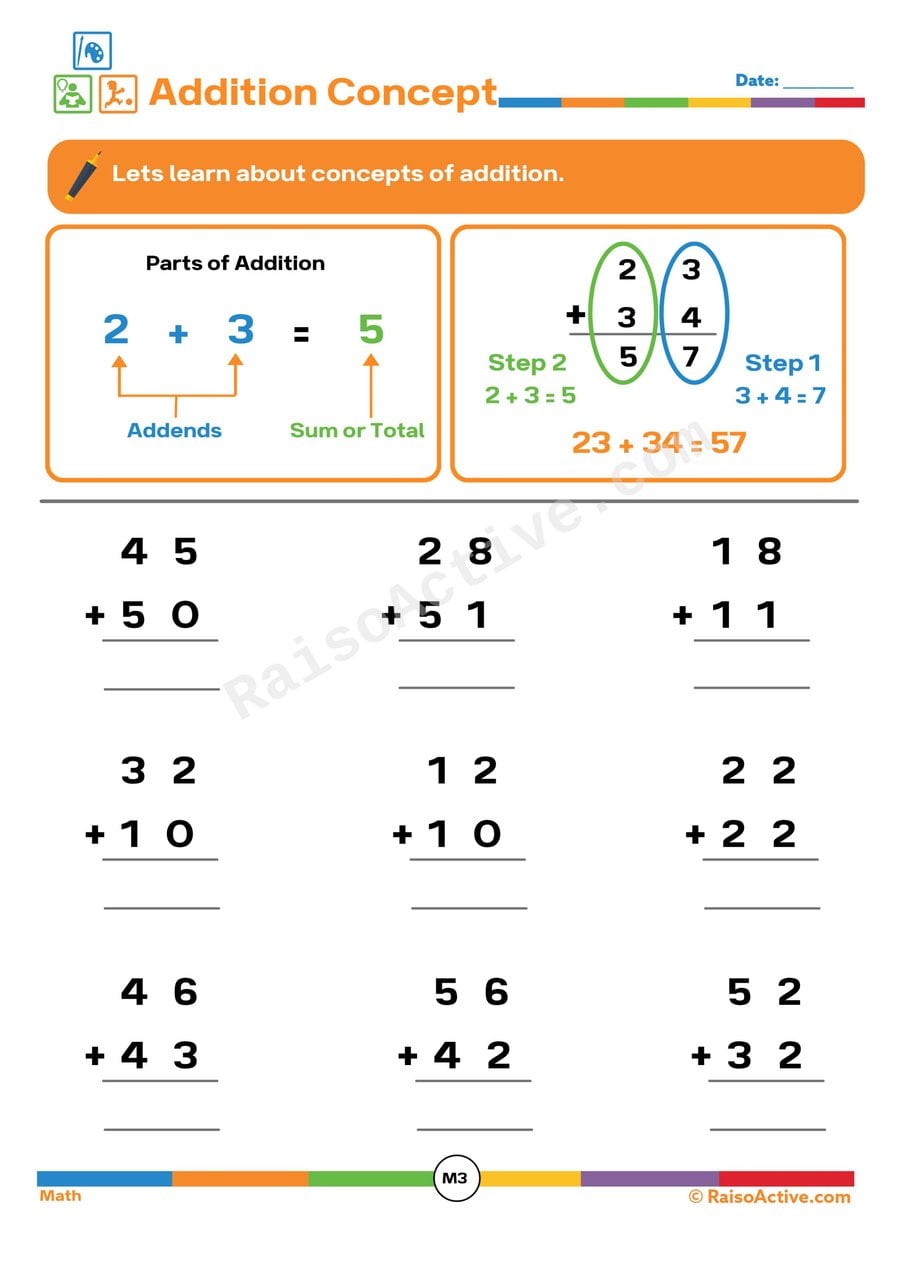
Addition Concepts Worksheet for Preschoolers
Ages 4-6 · Pre-K–KindergartenAges 4-6 · Reception–Year 1Ages 4-6 · LKG–UKGAges 4-6
Preschoolers ages 4-6 build early number sense by visually combining two small groups into one total, the concrete foundation every later addition fact depends on. Seeing objects physically joined together, rather than just numbers on a page, helps children grasp that addition means 'putting together' before they ever memorize a sum.

Orbit Cycle Worksheet: Learn About Earth, Sun, and Moon!
Ages 3-5 · Preschool–Pre-KAges 3-5 · Nursery–ReceptionAges 3-5 · Nursery–LKGAges 3-5
This hands-on craft worksheet introduces children ages 3-5 to the basic idea that the Earth orbits the Sun while the Moon orbits the Earth, an early astronomy concept made concrete through building a working model. Assembling the pieces themselves, rather than just looking at a picture, helps very young children grasp a concept that is otherwise entirely abstract.

Count and Add: Fruits, Vehicles, and Sweets Worksheet for Preschoolers
Ages 3-5 · Preschool–Pre-KAges 3-5 · Nursery–ReceptionAges 3-5 · Nursery–LKGAges 3-5
This worksheet practices counting and basic addition by having children count several different groups of everyday objects — fruits, vehicles, and sweets — and then add the totals together. For three- to five-year-olds, varying the objects being counted across different sections keeps the counting practice fresh while reinforcing that the process of counting and adding works the same way no matter what's being counted.

Abbreviations Worksheet: Matching Words and Abbreviations!
Ages 4-6 · Pre-K–KindergartenAges 4-6 · Reception–Year 1Ages 4-6 · LKG–UKGAges 4-6
This worksheet teaches children common abbreviations, like 'Dr.' for Doctor or 'St.' for Street, by having them match each full word to its shortened form. For four- to six-year-olds who are building early reading and writing fluency, recognizing abbreviations is a practical real-world skill, since these shortened forms appear regularly in addresses, titles, and everyday writing.

Rolling Addition Worksheet for Preschoolers: Dice Game Fun!
Ages 4-6 · Pre-K–KindergartenAges 4-6 · Reception–Year 1Ages 4-6 · LKG–UKGAges 4-6
Rolling two dice and adding the results teaches children ages 4-6 the core idea of addition as combining two quantities into one total, rather than just memorizing number facts. The physical act of rolling builds excitement around math while requiring them to recognize dice pips or numerals, transfer them to paper, and calculate a sum, connecting concrete play to abstract arithmetic.
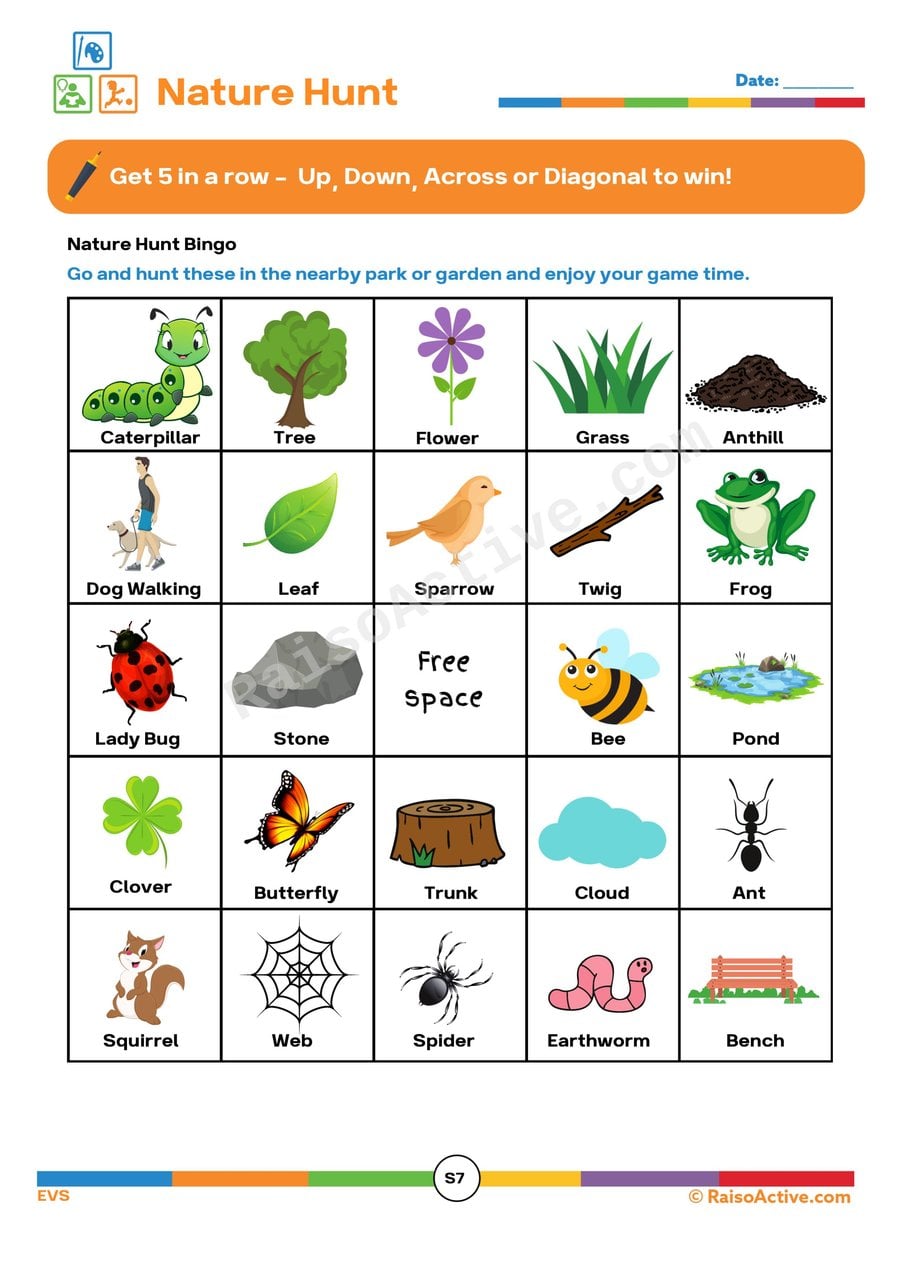
Nature Hunt Bingo Worksheet for Kids
Ages 3-5 · Preschool–Pre-KAges 3-5 · Nursery–ReceptionAges 3-5 · Nursery–LKGAges 3-5
This worksheet helps children ages 3-5 practice identifying and recognizing common items found in nature, like leaves, rocks, or flowers, by searching for them in a real outdoor space and marking them off a bingo card. Turning a nature walk into a bingo game builds observational focus, since children must actively scan their surroundings rather than passively walk through them.
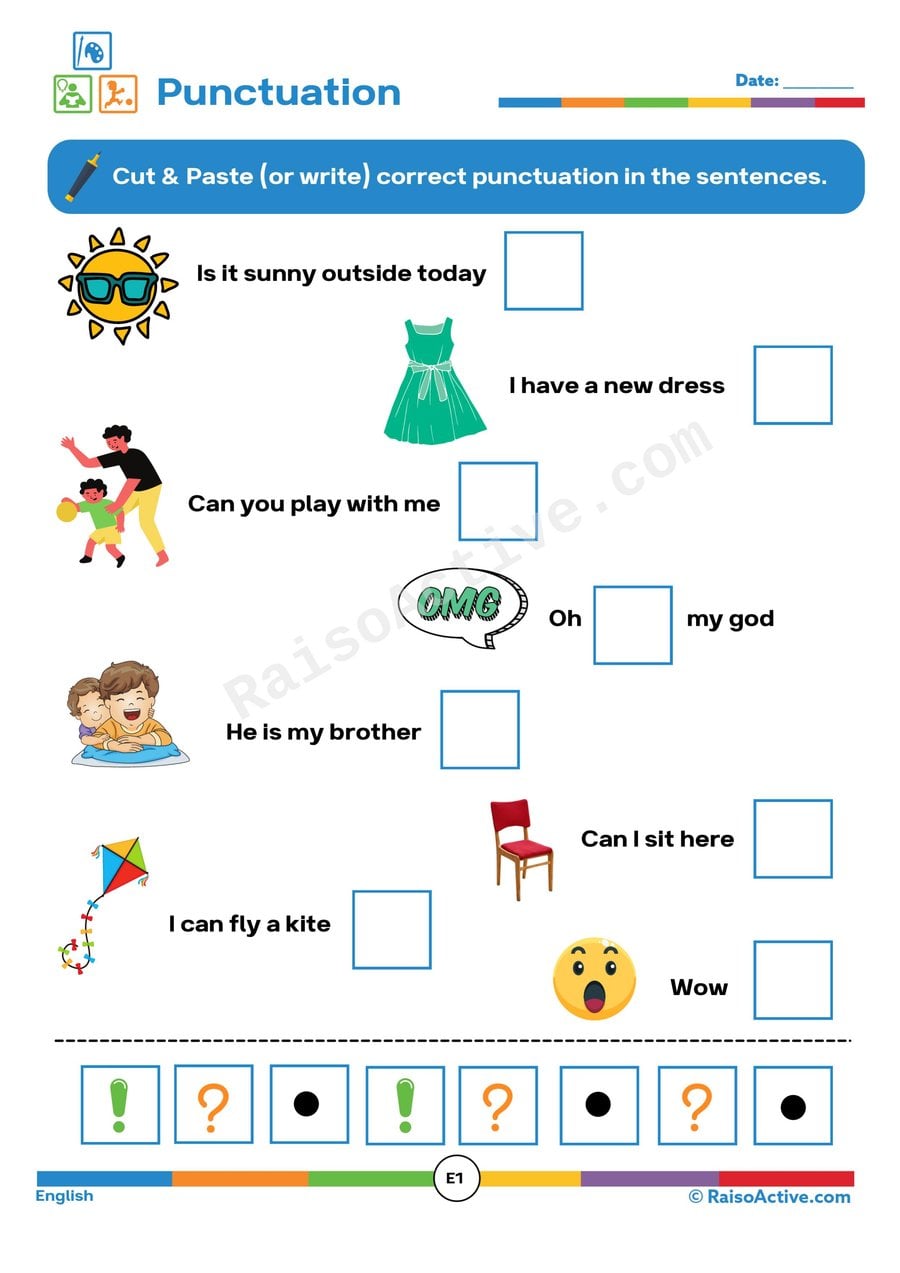
Punctuation Fun: Cut & Paste Punctuation Worksheet
Ages 4-6 · Pre-K–KindergartenAges 4-6 · Reception–Year 1Ages 4-6 · LKG–UKGAges 4-6
This worksheet teaches children to recognize and apply correct end punctuation — periods, question marks, and exclamation points — by reading simple sentences and choosing the punctuation mark that fits each one's tone. For four- to six-year-olds, connecting a sentence's meaning (a statement, a question, an exclamation) to its correct punctuation mark is an early step toward understanding that punctuation changes how a sentence should be read and understood.
Related worksheets

Indefinite Pronouns Worksheet: Fill-in-the-Blanks Fun!
Ages 4-6 · Pre-K–KindergartenAges 4-6 · Reception–Year 1Ages 4-6 · LKG–UKGAges 4-6
Filling in the blanks with indefinite pronouns like something, someone, and somewhere teaches children ages 4-6 how these flexible words stand in for people, places, or things without naming them specifically, an important step in building more natural, varied sentences. Using picture clues alongside the sentences also helps children connect abstract grammar terms to concrete, familiar scenes.

Noun Detective: A Fun Worksheet for Identifying Nouns!
Ages 4-6 · Pre-K–KindergartenAges 4-6 · Reception–Year 1Ages 4-6 · LKG–UKGAges 4-6
This detective-themed worksheet has children ages 4-6 practice identifying nouns within sentences and pictures, then writing them down, building on the basic concept of what a noun is with more active, applied identification tasks. Framing the task as detective work turns grammar analysis into an engaging search-and-find challenge rather than a dry drill.

Punctuation Fun: Practice Using Punctuation Marks!
Ages 4-6 · Pre-K–KindergartenAges 4-6 · Reception–Year 1Ages 4-6 · LKG–UKGAges 4-6
Choosing the correct punctuation mark to complete a sentence teaches children ages 4-6 that periods, question marks, and other marks change how a sentence should be read and understood, not just how it looks on paper. Matching sentences to their correct punctuation marks reinforces this by requiring children to recognize the tone or purpose of a sentence, whether it's a statement, a question, or an exclamation. This early grammar practice builds the foundation for reading with expression and writing complete, correctly punctuated sentences later on.
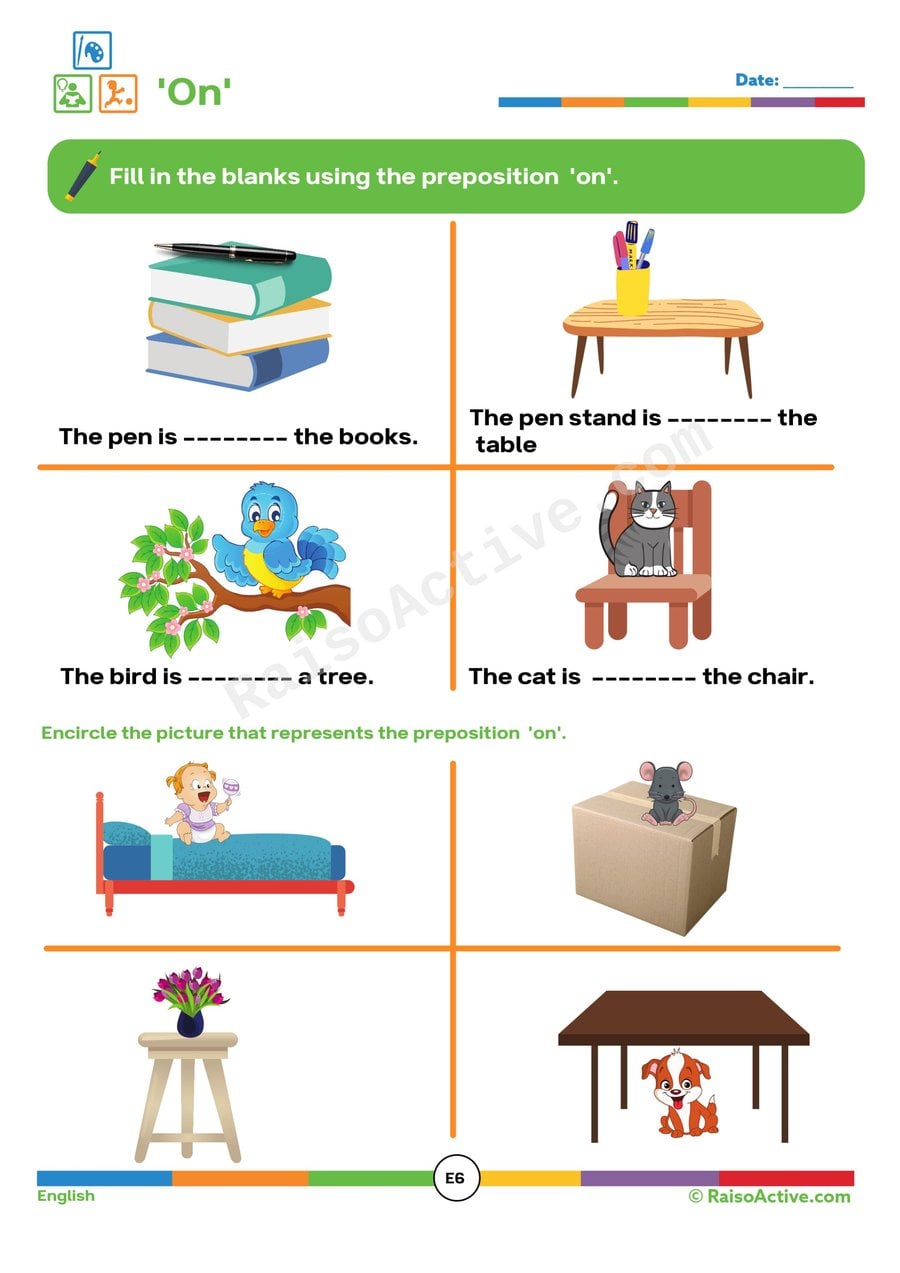
Preposition Fun: 'On' Worksheet for Early Learners
Ages 3-5 · Preschool–Pre-KAges 3-5 · Nursery–ReceptionAges 3-5 · Nursery–LKGAges 3-5
Practicing the preposition 'on' teaches children ages 3-5 how a small function word can precisely describe where one object sits in relation to another, an early and important step in building more complex, descriptive sentences. Filling in the blank with 'on' repeatedly across different sentences helps the word become automatic rather than something they have to think hard about each time. Circling the picture that correctly shows something 'on' another object also checks that your child truly understands the spatial meaning, not just the spelling of the word.

A or An Worksheet: Fill in the Blanks with Beginning Sounds!
Ages 4-6 · Pre-K–KindergartenAges 4-6 · Reception–Year 1Ages 4-6 · LKG–UKGAges 4-6
This worksheet teaches children ages 4-6 the grammar rule for choosing between the articles 'a' and 'an,' based on whether the following word starts with a consonant or vowel sound. Applying this rule correctly requires listening carefully to a word's beginning sound rather than just its spelling, which sharpens phonemic awareness alongside grammar knowledge.

These or Those Worksheet: Identifying Plural Nouns
Ages 4-5 · Pre-KAges 4-5 · ReceptionAges 4-5 · LKGAges 4-5
Children ages 4-5 build on singular demonstrative pronouns by learning 'these' and 'those,' the plural forms used to describe groups of objects that are near or far. Understanding this distinction strengthens both grammar and the ability to judge distance and quantity together in a single sentence.

Sentence Building Worksheet: Write Sentences with Given Words!
Ages 4-6 · Pre-K–KindergartenAges 4-6 · Reception–Year 1Ages 4-6 · LKG–UKGAges 4-6
Using given words to build a complete sentence teaches children ages 4-6 how word order creates meaning, an essential step toward reading fluency and independent writing. Practicing this skill also reinforces sentence mechanics like starting with a capital letter and ending with a period, which many children this age are just beginning to apply consistently.
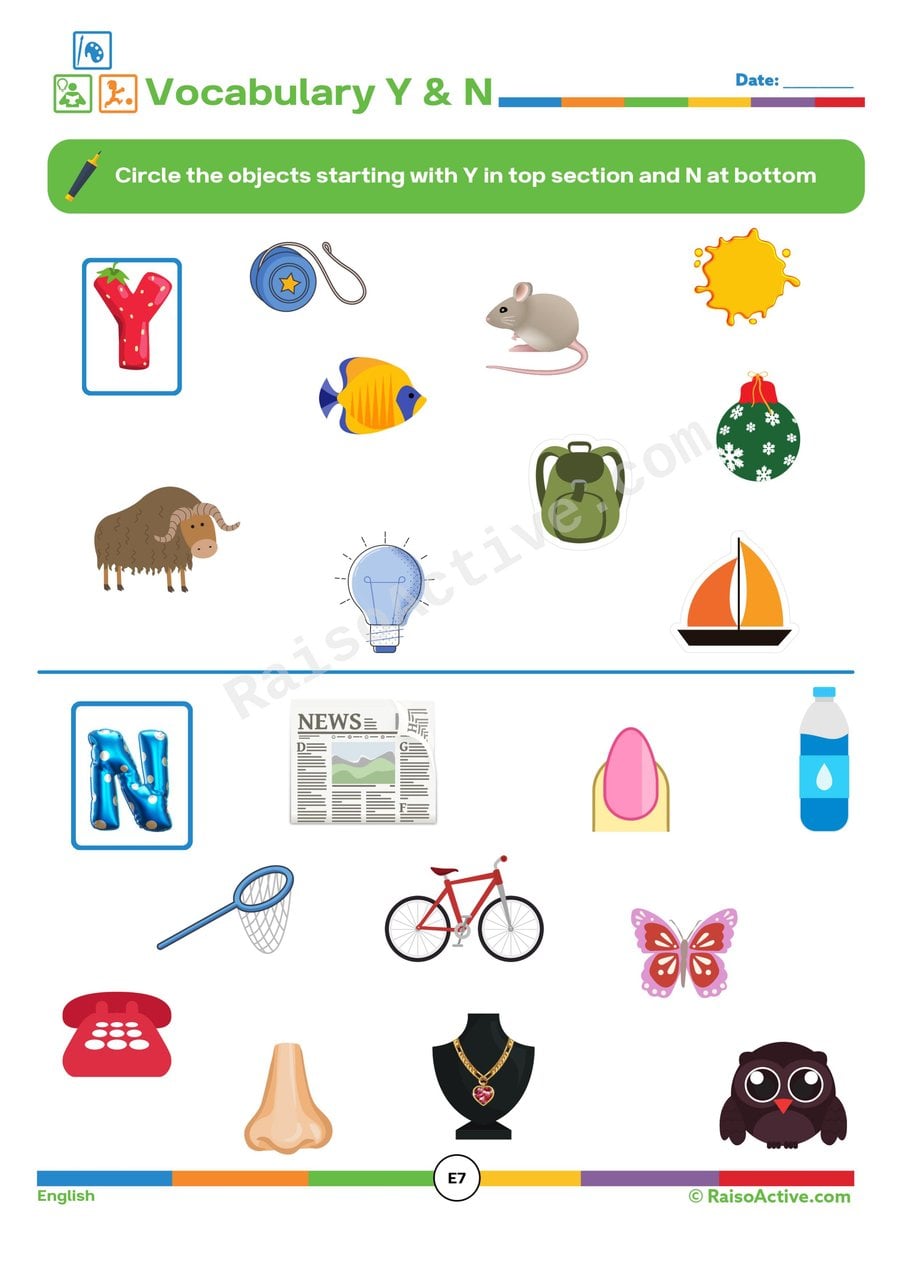
Y and N Vocabulary Worksheet: Circle the Objects!
Ages 3-5 · Preschool–Pre-KAges 3-5 · Nursery–ReceptionAges 3-5 · Nursery–LKGAges 3-5
Deciding whether a pictured object starts with Y or N helps children ages 3-5 practice initial sound discrimination between two distinct consonant sounds, building both vocabulary and listening skills. Circling in the correct top or bottom section adds a simple visual organization step that reinforces the category each object belongs to.
Reviews
Every worksheet for ages 4–6, no watermark
Members download the full library of 1,000+ worksheets and every activity pack without watermarks or daily limits. One year costs ₹999 in India or $20 elsewhere.
See membership plansOr download any worksheet free with a watermark (5 a day).