Addition Concepts Worksheet for Preschoolers
Preschoolers ages 4-6 build early number sense by visually combining two small groups into one total, the concrete foundation every later addition fact depends on. Seeing objects physically joined together, rather than just numbers on a page, helps children grasp that addition means 'putting together' before they ever memorize a sum.
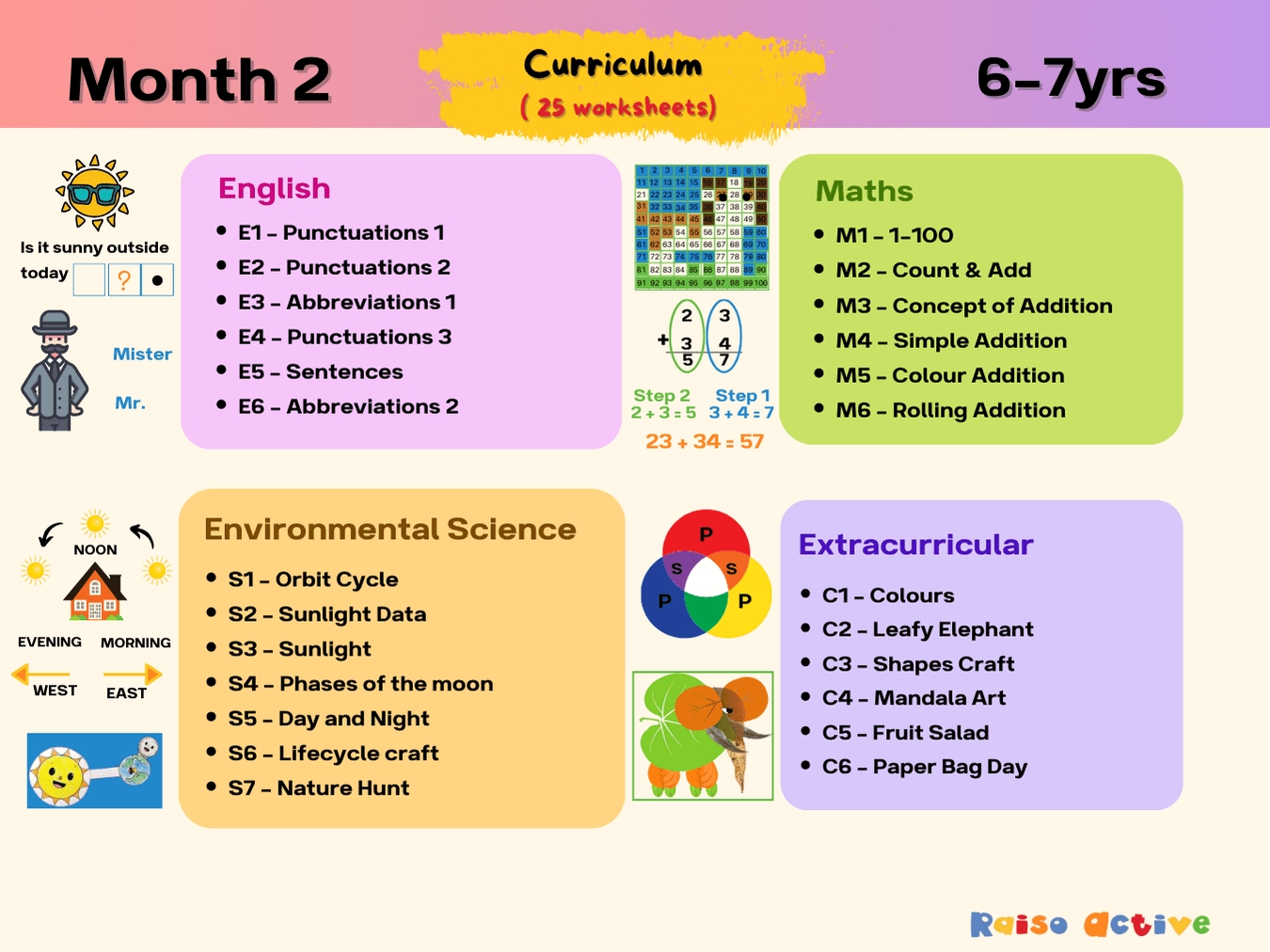
Part of the pack
Month 2: Learning & Development | Ages 6-7
This is page 12 of the pack. Ages 6-7 · Grade 1Ages 6-7 · Year 2Ages 6-7 · Class 1Ages 6-7
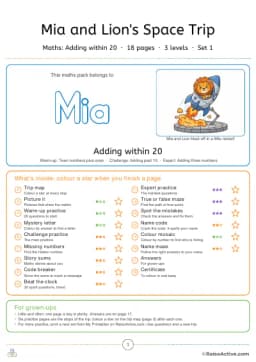
Made for your child
Adding within 10, made for your child
A maths pack with your child's name in it: pictures that explain, practice at three levels, puzzles and story sums about them. Print a new set whenever they finish.
Make a maths packFree preview · free for members
Curriculum
- Addition > Addition Basics
How to use this worksheet
Look at the first example together and count each group of pictures out loud, then count the combined total to show how addition works. Move through each problem the same way: count the first group, count the second group, then count everything together to find the answer. Write the total number in the box provided, saying the full addition sentence aloud, like 'two plus three equals five,' as you go.
Materials needed
- Pencil
- Eraser
Extension activities
- 1Use dried beans or buttons to physically build each addition problem before writing the answer.
- 2Create your own simple addition problems using two small piles of snacks, then eat the sum as a treat.
- 3Draw two groups of stars or hearts on paper and ask your child to count the total.
- 4Play a finger-addition game, holding up fingers on each hand and counting the total together.

Written by
Hemsweta Jain · Teacher Cheena
MBA and Early Childhood Educator, teaching since 2014 · Founder of RaisoActive, Mumbai
Every RaisoActive worksheet is designed and checked by the founder before publishing.
Published · Last reviewed
More from Month 2: Learning & Development | Ages 6-7

Sentence Fun: Find the Subject and Predicate Worksheet for Kids!
Ages 4-6 · Pre-K–KindergartenAges 4-6 · Reception–Year 1Ages 4-6 · LKG–UKGAges 4-6
This worksheet introduces basic sentence structure by teaching children to identify the subject (who or what the sentence is about) and the predicate (what the subject does or is) in simple sentences. For four- to six-year-olds, breaking a sentence into these two core parts is an early foundation for grammar and sentence-writing, helping them understand that every complete sentence needs both a 'who' and a 'what happens.'

Color Mixing Fun: A Primary and Secondary Colors Worksheet
Ages 3-5 · Preschool–Pre-KAges 3-5 · Nursery–ReceptionAges 3-5 · Nursery–LKGAges 3-5
This worksheet helps children ages 3-5 understand that the three primary colors, red, yellow, and blue, combine to create secondary colors like orange, green, and purple. Coloring circles and observing how colors combine introduces an early, hands-on science concept about mixing, which also supports color vocabulary used throughout art and everyday description.
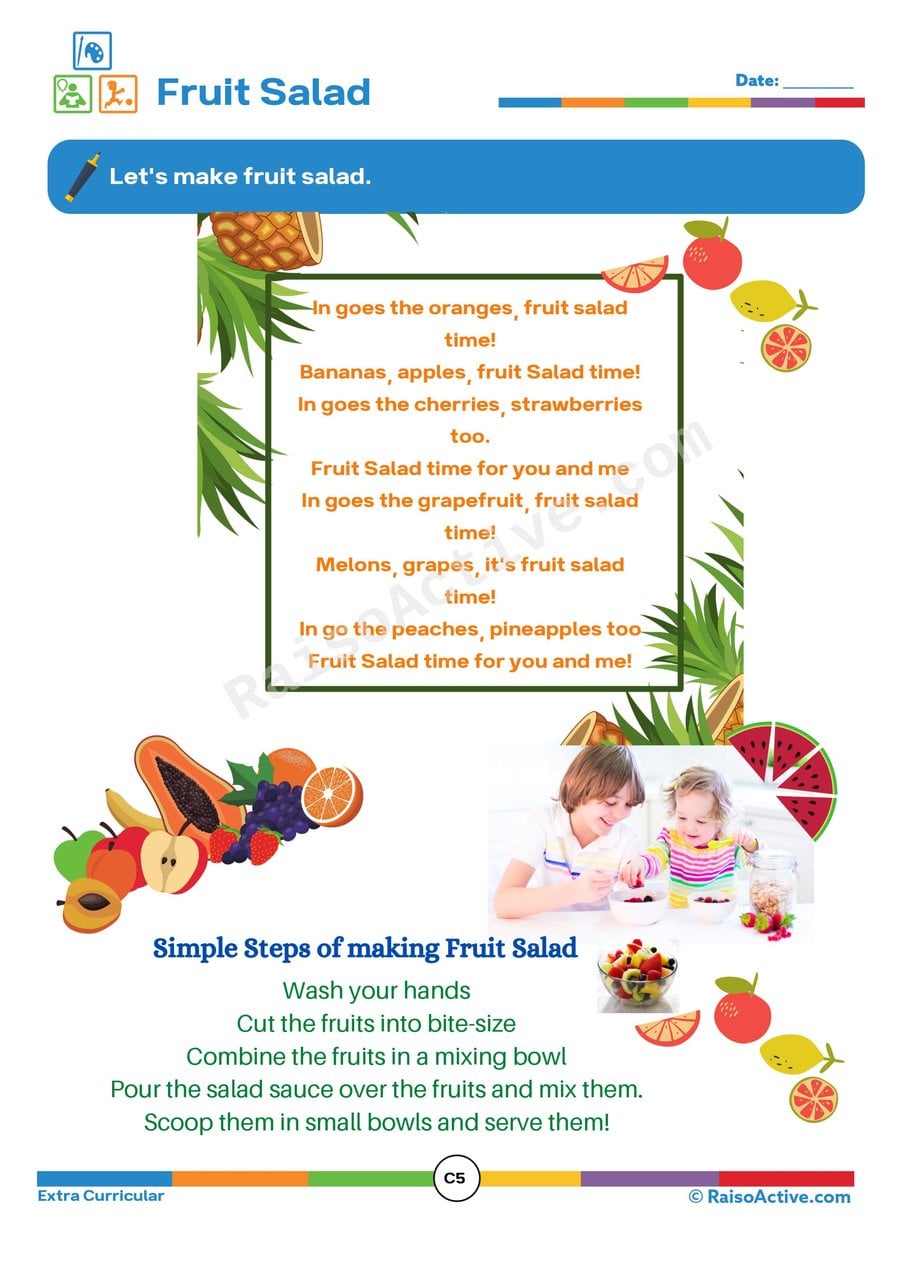
Fruit Salad Fun: A Recipe Worksheet for Kids
Ages 3-5 · Preschool–Pre-KAges 3-5 · Nursery–ReceptionAges 3-5 · Nursery–LKGAges 3-5
This worksheet uses a simple fruit salad recipe to teach children ages 3-5 how to follow a sequence of steps in order, a skill that underlies both reading comprehension and later procedural thinking in math and science. It also introduces healthy eating concepts as children name and draw the fruits that go into their salad.
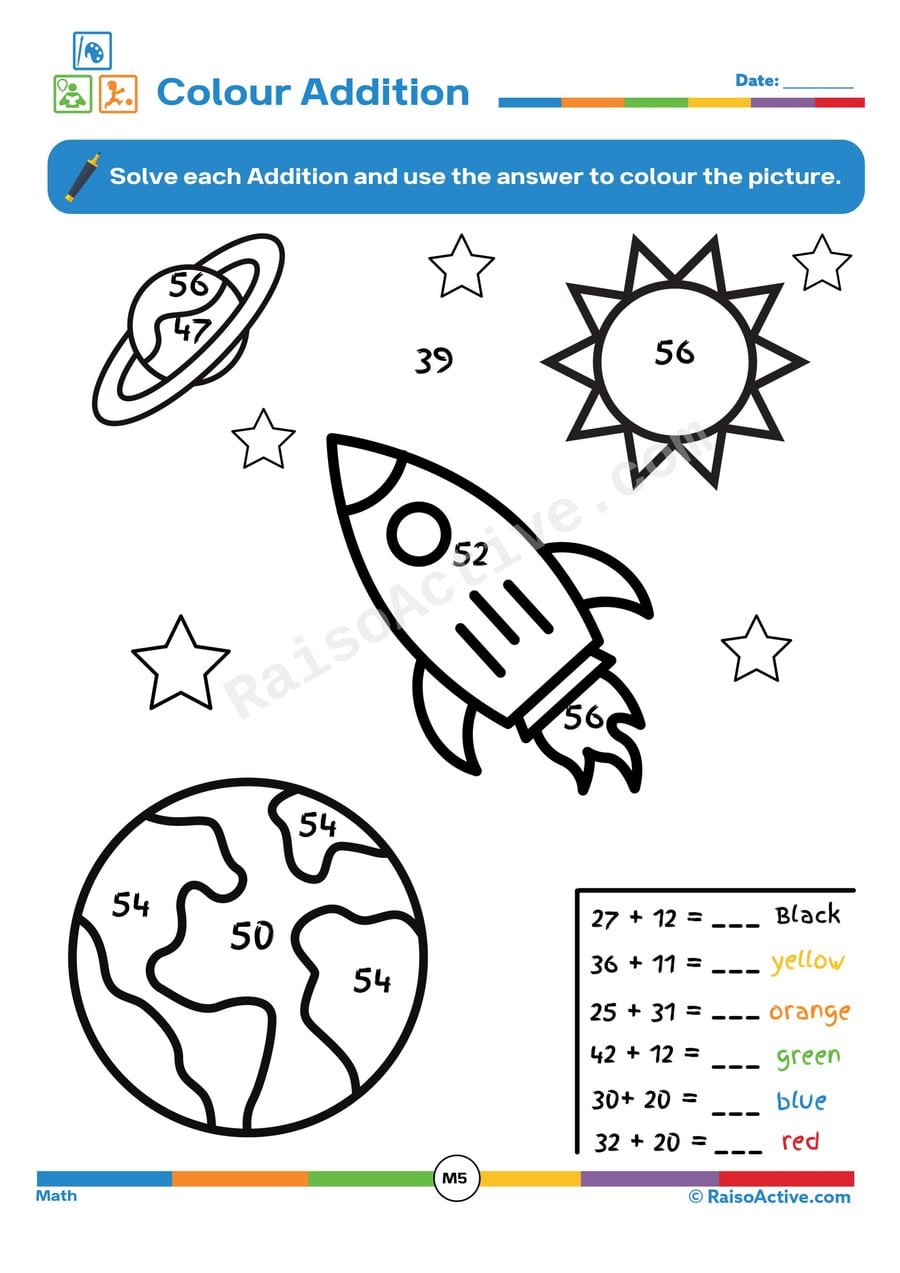
Color Addition Worksheet: Space Adventure!
Ages 5-7 · Kindergarten–Grade 1Ages 5-7 · Year 1–Year 2Ages 5-7 · UKG–Class 1Ages 5-7
This worksheet builds addition fluency by having children solve simple equations and then use each answer to determine which color to use in a corresponding section of a space-themed picture. For five- to seven-year-olds, this color-by-number format adds motivation to solve each problem accurately, since a wrong answer means the wrong color goes in the wrong spot and the final picture won't come together correctly.

Punctuation Adventure: End Punctuation Worksheet for Kids
Ages 5-7 · Kindergarten–Grade 1Ages 5-7 · Year 1–Year 2Ages 5-7 · UKG–Class 1Ages 5-7
Children ages 5-7 practice choosing between periods, question marks, and exclamation points based on the meaning and tone of a sentence, a skill that connects punctuation directly to how a sentence should sound when read aloud. This builds the foundation for expressive, correctly punctuated writing later in school.
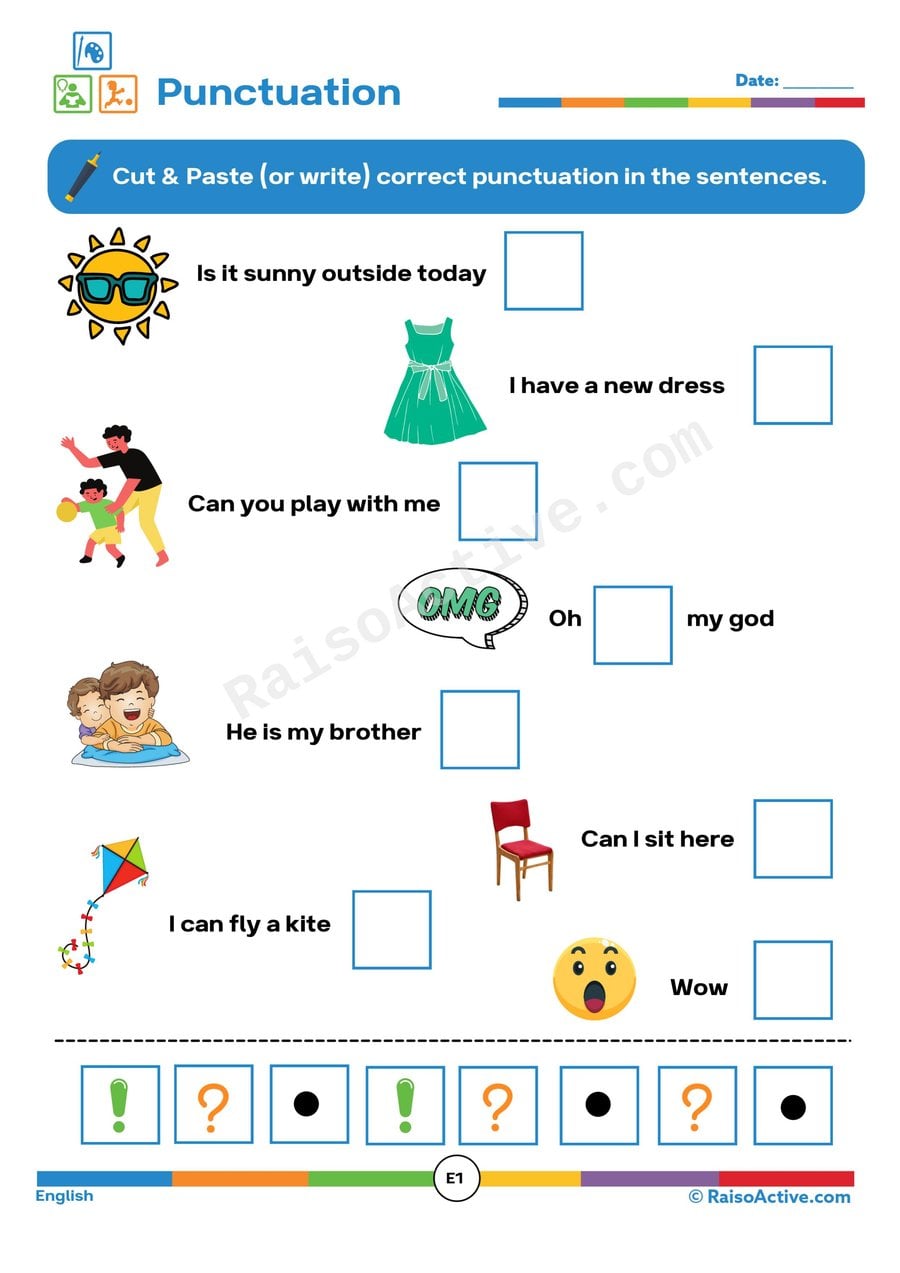
Punctuation Fun: Cut & Paste Punctuation Worksheet
Ages 4-6 · Pre-K–KindergartenAges 4-6 · Reception–Year 1Ages 4-6 · LKG–UKGAges 4-6
This worksheet teaches children to recognize and apply correct end punctuation — periods, question marks, and exclamation points — by reading simple sentences and choosing the punctuation mark that fits each one's tone. For four- to six-year-olds, connecting a sentence's meaning (a statement, a question, an exclamation) to its correct punctuation mark is an early step toward understanding that punctuation changes how a sentence should be read and understood.

Color by Number Mystery Picture Worksheet: Discover a Hidden Image!
Ages 3-5 · Preschool–Pre-KAges 3-5 · Nursery–ReceptionAges 3-5 · Nursery–LKGAges 3-5
This worksheet helps children ages 3-5 practice numeral recognition and careful instruction-following as they match numbers in a grid to a color key and reveal a hidden picture underneath. Because the picture only appears correctly if every number is matched to its right color, the activity naturally builds accuracy and attention to detail alongside number skills.
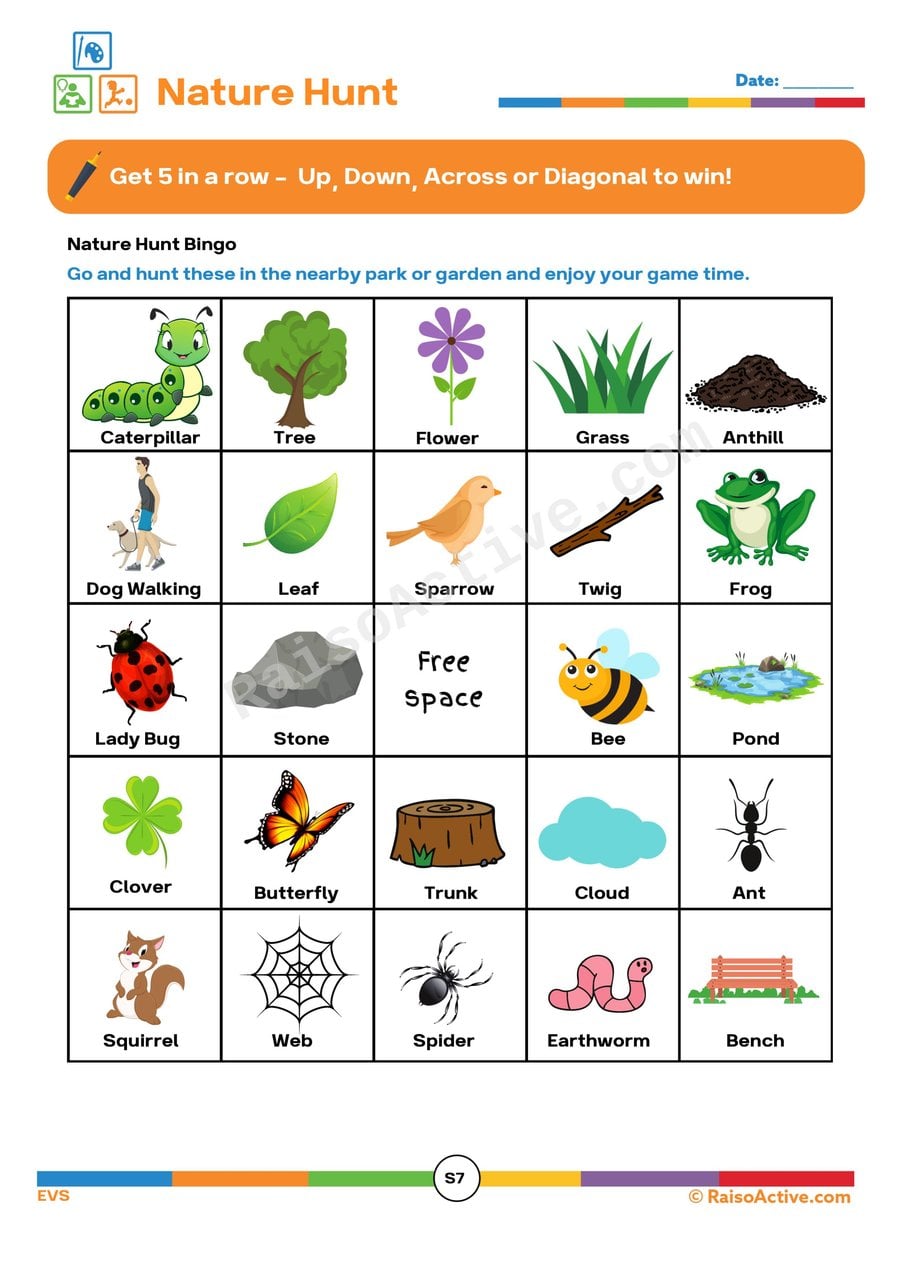
Nature Hunt Bingo Worksheet for Kids
Ages 3-5 · Preschool–Pre-KAges 3-5 · Nursery–ReceptionAges 3-5 · Nursery–LKGAges 3-5
This worksheet helps children ages 3-5 practice identifying and recognizing common items found in nature, like leaves, rocks, or flowers, by searching for them in a real outdoor space and marking them off a bingo card. Turning a nature walk into a bingo game builds observational focus, since children must actively scan their surroundings rather than passively walk through them.
Related worksheets

Addition Fun: Counting and Adding Worksheet for Kids
Ages 4-6 · Pre-K–KindergartenAges 4-6 · Reception–Year 1Ages 4-6 · LKG–UKGAges 4-6
This worksheet builds foundational addition skills by having children count two separate groups of objects and then combine those counts to find a total sum. For ages 4-6, grounding addition in physical counting of pictured objects, rather than abstract numbers alone, helps children understand that addition means putting two groups together to make a bigger group.
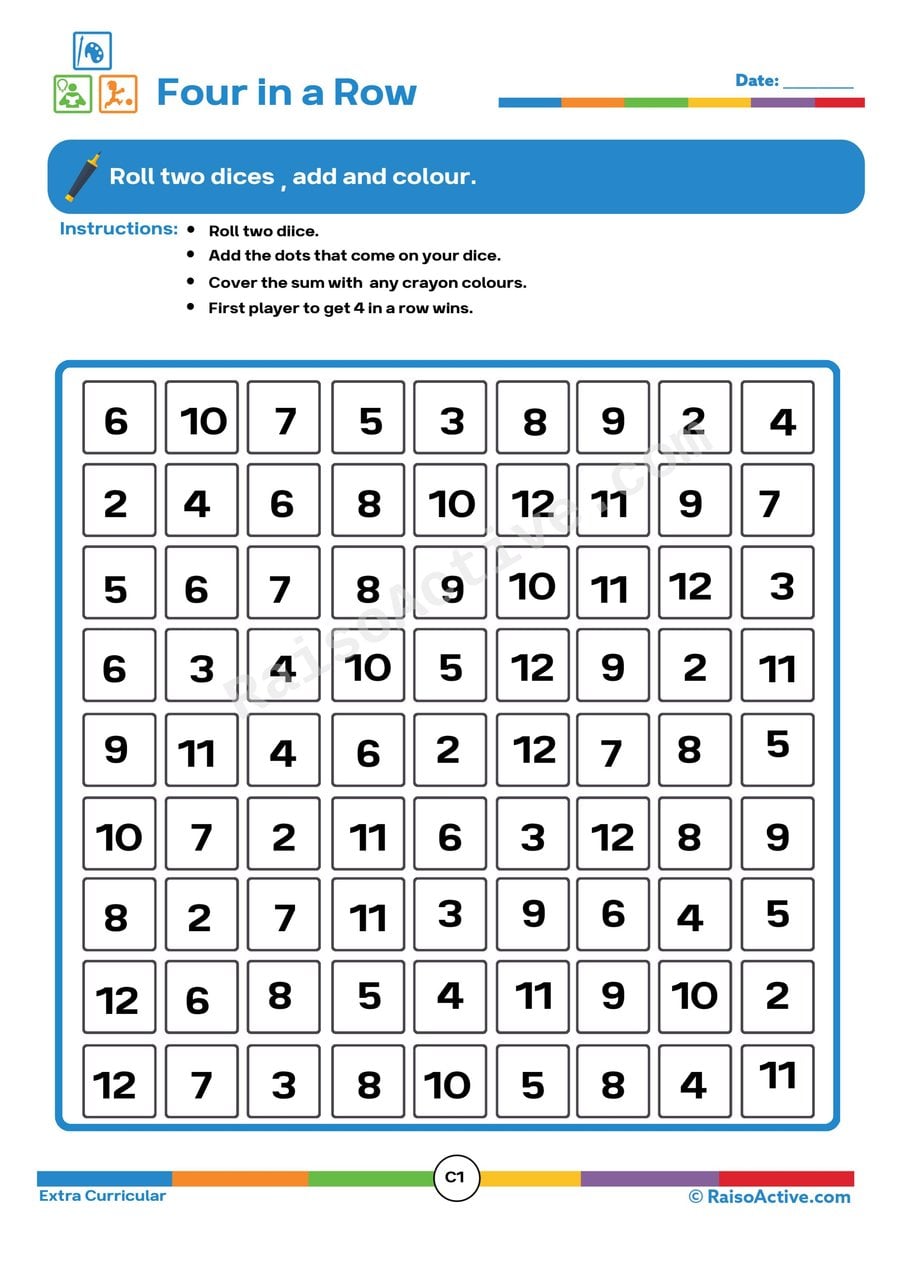
Four in a Row: Dice Game Worksheet for Kids
Ages 4-6 · Pre-K–KindergartenAges 4-6 · Reception–Year 1Ages 4-6 · LKG–UKGAges 4-6
Rolling two dice and adding the results together gives children ages 4-6 repeated, low-pressure practice with basic addition facts, since each turn presents a new combination to solve. Coloring the matching sum on a game grid turns arithmetic into an active, motivating game rather than a worksheet of isolated problems, and working toward four squares in a row adds a strategic element as children start to notice which sums appear more often. This game format also builds number recognition, since children must locate their calculated sum among many printed numbers on the grid.

Addition Worksheet: Adding Numbers with Fun Pictures!
Ages 4-6 · Pre-K–KindergartenAges 4-6 · Reception–Year 1Ages 4-6 · LKG–UKGAges 4-6
This worksheet gives children ages 4-6 practice with simple addition by having them combine two groups of pictured objects and write the resulting total, reinforcing the core idea that addition means putting groups together to find 'how many in all.' Working from pictures rather than numbers alone helps bridge concrete counting to the more abstract number sentences children will encounter as their math skills progress.
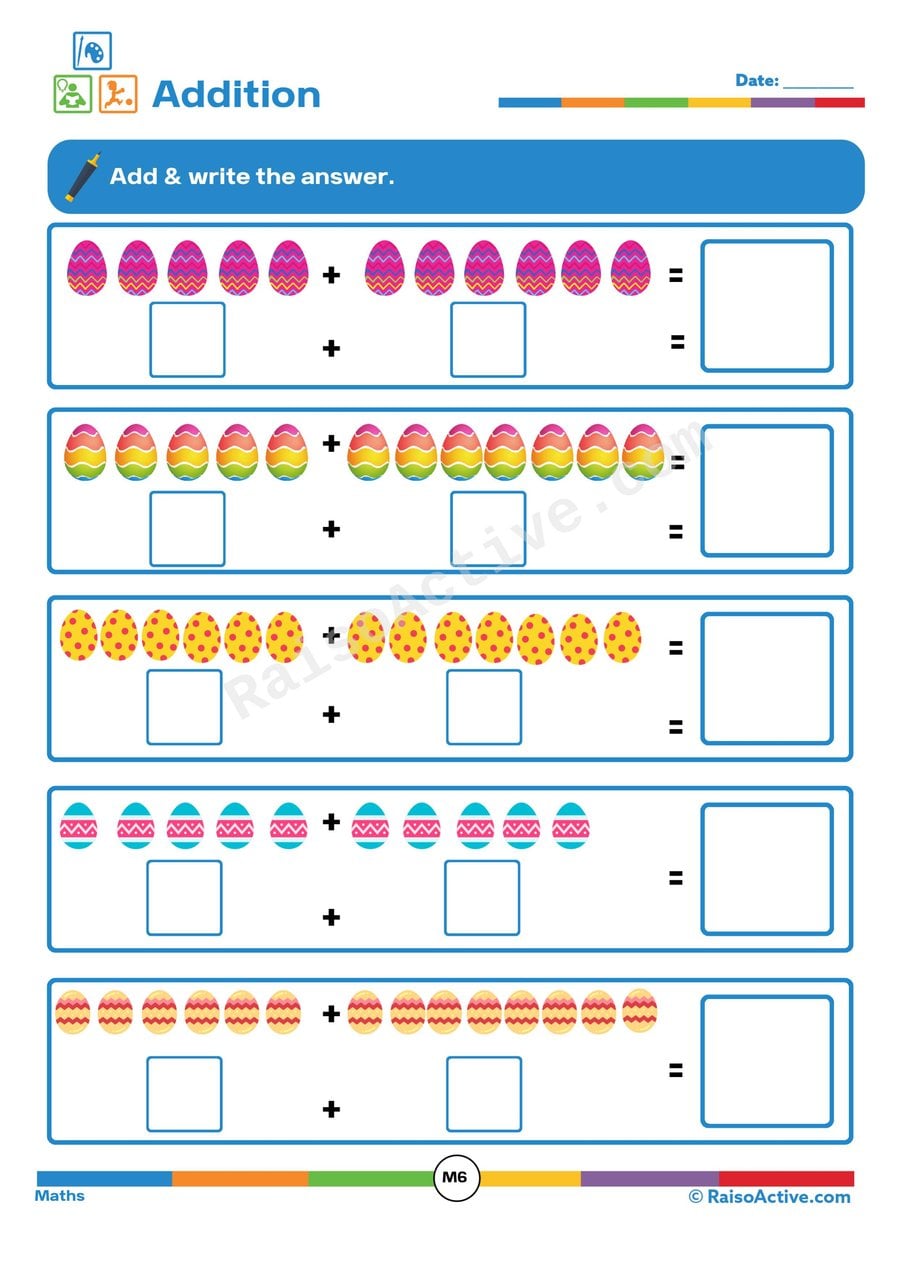
Easter Egg Addition Worksheet for Preschoolers
Ages 4-5 · Pre-KAges 4-5 · ReceptionAges 4-5 · LKGAges 4-5
Counting groups of Easter eggs and combining them builds early addition sense for children ages 4-5, showing that putting two smaller groups together creates one larger total. Because the eggs are grouped visually rather than shown as bare numerals, children practice one-to-one counting alongside the abstract addition symbol, connecting the concrete and written forms of the same idea.
Addition Coloring Worksheet: Color by Sum!
Ages 4-6 · Pre-K–KindergartenAges 4-6 · Reception–Year 1Ages 4-6 · LKG–UKGAges 4-6
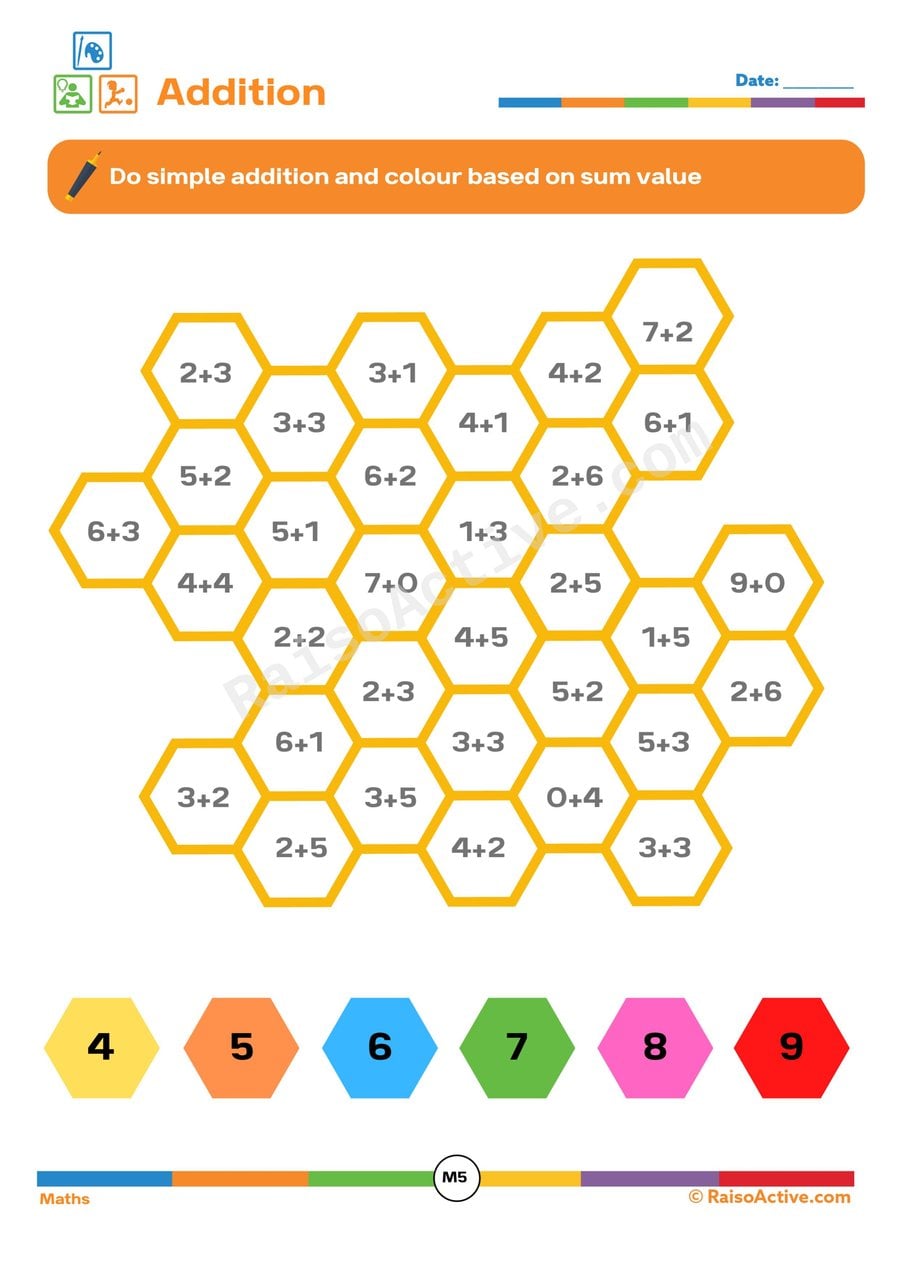
This worksheet combines addition practice with a color-by-number format, giving children ages 4-6 motivation to solve simple addition problems in each hexagon since the correct sum determines which color to use. Repeated, low-pressure practice adding small numbers builds fluency and speed, while the reveal of a colorful picture at the end rewards accurate calculation.
Dice Addition Worksheet: Add the Spots and Match!
Ages 4-6 · Pre-K–KindergartenAges 4-6 · Reception–Year 1Ages 4-6 · LKG–UKGAges 4-6
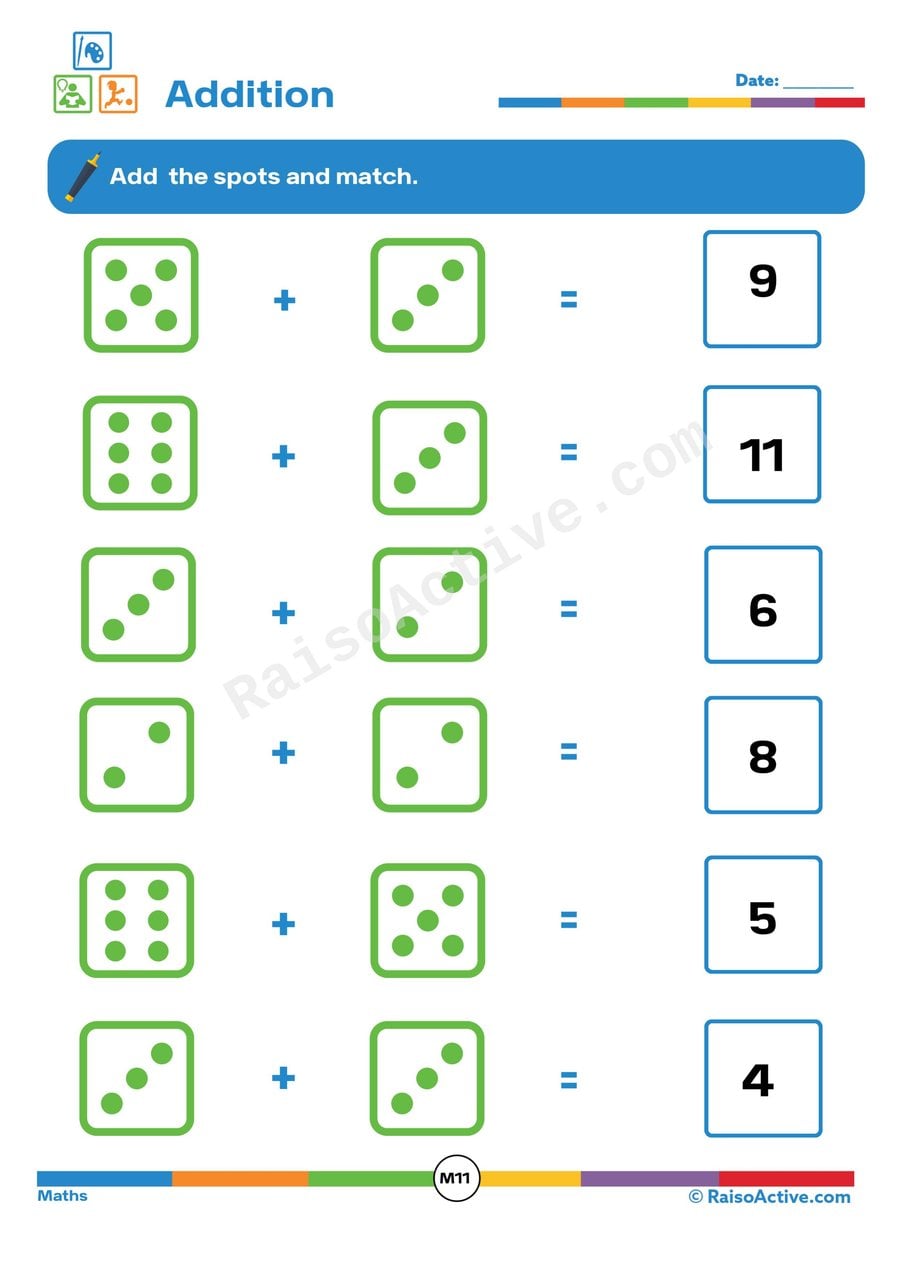
This worksheet builds basic addition fluency by having children count the dots on two dice, add the totals together, and match the resulting sum to the correct number. For four- to six-year-olds, using dice as the counting tool adds a layer of subitizing practice — the ability to recognize a small quantity of dots at a glance without counting one by one — which speeds up addition over time.

Apples to Basket: Sorting Math Worksheet for Preschoolers
Ages 4-6 · Pre-K–KindergartenAges 4-6 · Reception–Year 1Ages 4-6 · LKG–UKGAges 4-6
This worksheet combines basic addition and subtraction practice with sorting skills as children ages 4-6 solve a math problem written on each apple, then decide which basket it belongs in based on whether the answer is more or less than a target number. Categorizing numbers by size after calculating them adds a layer of number-sense reasoning beyond simply finding the right answer.

Mental Addition Worksheet for Kids: Practice Adding Numbers!
Ages 4-6 · Pre-K–KindergartenAges 4-6 · Reception–Year 1Ages 4-6 · LKG–UKGAges 4-6
This worksheet builds mental math fluency by asking children to solve simple addition problems in their heads rather than relying on counters or drawings, strengthening the internal number sense that supports faster, more confident arithmetic. For ages 4-6, moving from concrete counting toward mental calculation is a significant milestone that sets the foundation for later multi-digit addition.
Guides for this topic

Number Formation Rhymes 0–9 and How to Fix Reversals
Original number formation rhymes for 0–9, the correct stroke order for each digit, why 3, 5 and 7 get reversed most often, and multisensory fixes that work.

Christmas and Winter Activities That Combine Fun and Learning: Creating Magical Educational Experiences
Discover Christmas and winter activities that combine festive fun with real learning. Crafts, counting, literacy, and printable worksheets for ages 2 to 8 — perfect for home and school.
Age-Appropriate Halloween Learning Activities: Balancing Spooks and Skills for Young Learners
Discover fun, age-appropriate Halloween learning activities for young children. Spooky crafts, counting games, literacy ideas, and printable worksheets for ages 2 to 8.
Reviews
Every worksheet for ages 4–6, no watermark
Members download the full library of 1,000+ worksheets and every activity pack without watermarks or daily limits. One year costs ₹999 in India or $20 elsewhere.
See membership plansOr download any worksheet free with a watermark (5 a day).