Wh, Sh, Th, Ch Sounds Worksheet for Preschoolers
Filling in missing letters to complete words with the digraphs wh, sh, th, and ch teaches children ages 4-5 to recognize these blended consonant sounds, which behave differently from single letter sounds and require dedicated practice to master. Coloring the picture that matches the correct sound afterward reinforces the connection between the blended sound and its spelling.
Part of the pack
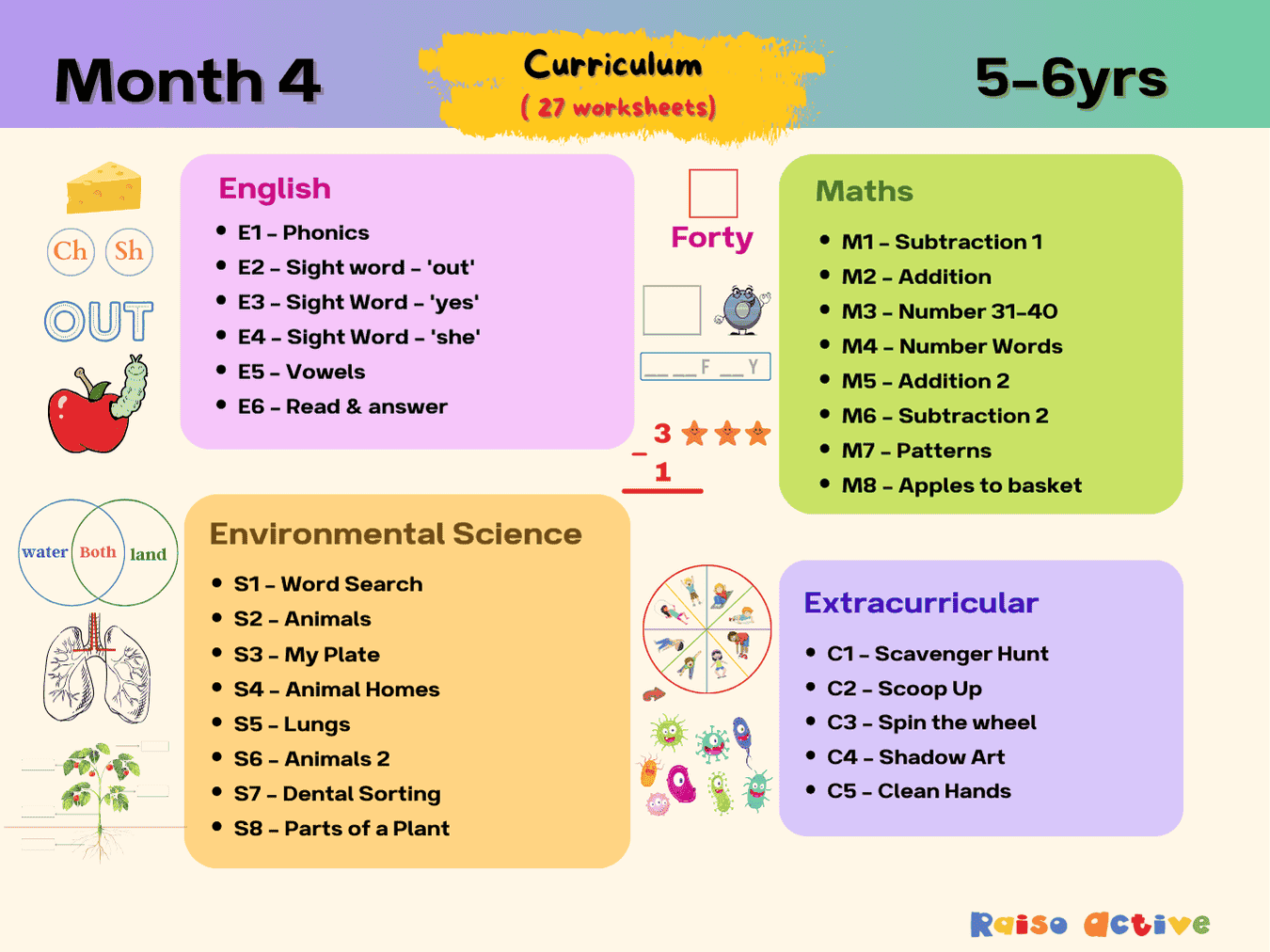
Month 4: Learning & Development | Ages 5-6
This is page 4 of the pack. Ages 5-6 · KindergartenAges 5-6 · Year 1Ages 5-6 · UKGAges 5-6
Made for your child
A whole activity pack made with their name
60 pages to spot, build, trace and write their own name, plus pages about their favourites, feelings and family. See a free preview with their name.
Make an All About Me packFree preview · free for members
Or start free: a name tracing sheet with their nameCurriculum
- Phonics - Digraphs > Digraphs
How to use this worksheet
Look at the first picture together and say the word slowly, listening closely for the beginning or ending digraph sound. Have your child fill in the missing letters to complete the word correctly. Once the words are filled in, ask them to color the picture that matches each digraph sound they identified.
Materials needed
- Pencil
- Crayons
Extension activities
- 1Play a digraph sound sorting game, grouping objects by whether they start with wh, sh, th, or ch.
- 2Search the house for objects whose names include one of these four digraph sounds.
- 3Make matching flashcards pairing digraph pictures with their written sound.
- 4Create silly sentences using several digraph words together.
- 5Practice saying each digraph sound in front of a mirror, watching mouth shape change.

Written by
Hemsweta Jain · Teacher Cheena
MBA and Early Childhood Educator, teaching since 2014 · Founder of RaisoActive, Mumbai
Every RaisoActive worksheet is designed and checked by the founder before publishing.
Published · Last reviewed
More from Month 4: Learning & Development | Ages 5-6

Subtraction Fun: Counting and Subtracting Worksheet for Kids
Ages 4-6 · Pre-K–KindergartenAges 4-6 · Reception–Year 1Ages 4-6 · LKG–UKGAges 4-6
This worksheet teaches children ages 4-6 the concept of subtraction by having them count a group of stars, cross out a specified number, and write how many remain — making the abstract idea of 'taking away' visible and countable rather than purely symbolic. Physically crossing out objects before writing the answer helps children understand subtraction as an action, which is more intuitive at this age than memorizing subtraction facts.
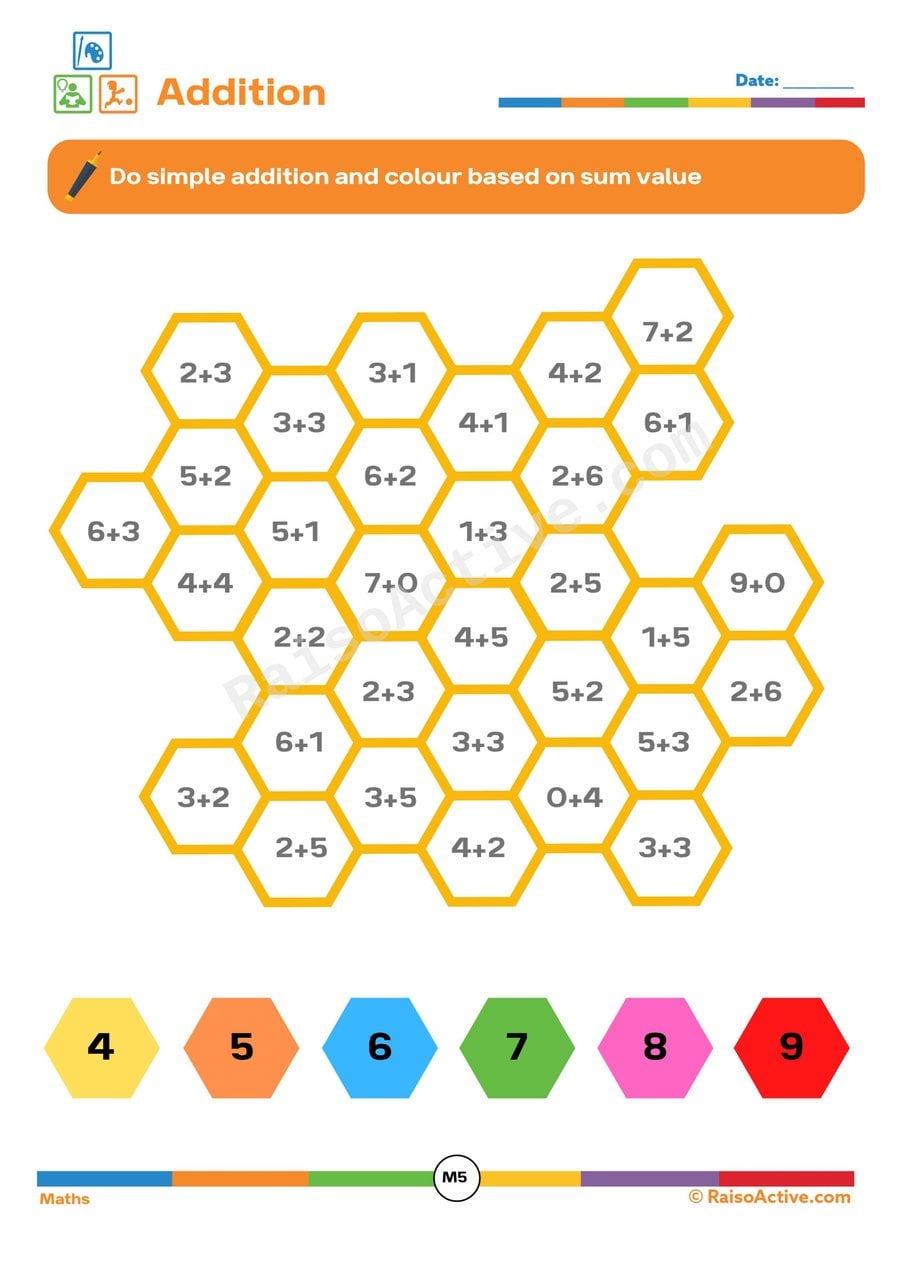
Addition Coloring Worksheet: Color by Sum!
Ages 4-6 · Pre-K–KindergartenAges 4-6 · Reception–Year 1Ages 4-6 · LKG–UKGAges 4-6
This worksheet combines addition practice with a color-by-number format, giving children ages 4-6 motivation to solve simple addition problems in each hexagon since the correct sum determines which color to use. Repeated, low-pressure practice adding small numbers builds fluency and speed, while the reveal of a colorful picture at the end rewards accurate calculation.

Animal Homes Worksheet: Cut and Paste Activity for Kids
Ages 3-5 · Preschool–Pre-KAges 3-5 · Nursery–ReceptionAges 3-5 · Nursery–LKGAges 3-5
This cut-and-paste worksheet teaches children ages 3-5 to match specific animals to their correct habitats — like a fish to water or a bird to a tree — building early understanding of how animals are suited to where they live. Sorting by habitat rather than by animal type (like farm versus wild) adds a layer of reasoning about why an environment fits a particular animal.

Parent's Guide: Sight Words, Vowels, and Early Math Activities
Ages 3-5 · Preschool–Pre-KAges 3-5 · Nursery–ReceptionAges 3-5 · Nursery–LKGAges 3-5
This parent's guide combines sight word recognition, vowel puppet play, simple subtraction with blocks, and living-versus-non-living observation, giving children ages 3-5 broad exposure to early literacy, number sense, and basic science reasoning through varied hands-on activities. Because each section targets a different skill, the guide offers something to match whatever your child feels drawn to that day.

Parts of a Plant Cut and Paste Worksheet for Kids
Ages 3-5 · Preschool–Pre-KAges 3-5 · Nursery–ReceptionAges 3-5 · Nursery–LKGAges 3-5
This cut-and-paste worksheet teaches children ages 3-5 the names and locations of the main parts of a plant — roots, stem, leaves, flower, and fruit — by having them match labels to the correct spot on a plant diagram. Learning to label a diagram, rather than just naming parts verbally, is an early step toward the kind of labeled-illustration work children will do throughout their science education.
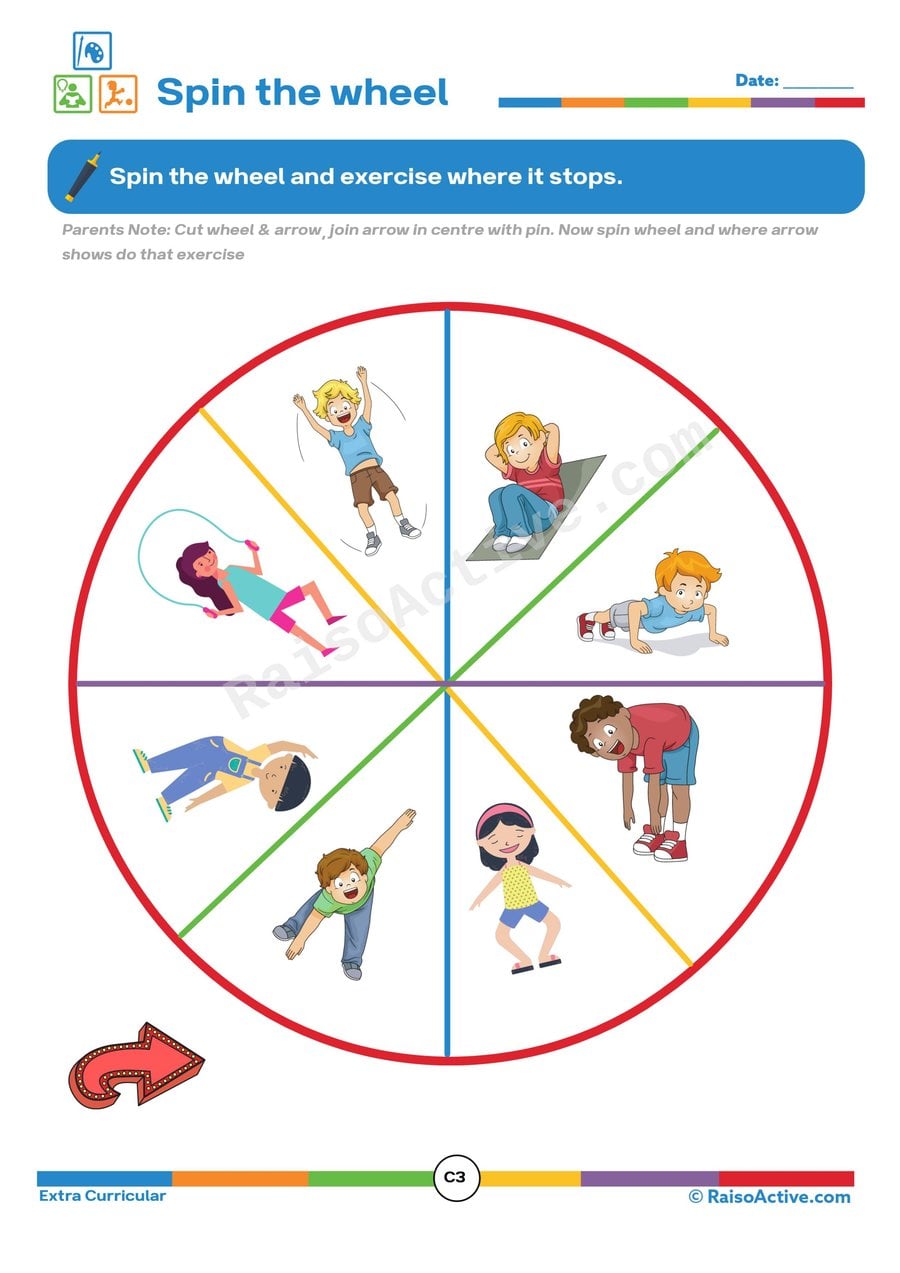
Spin the Wheel Exercise Worksheet for Kids
Ages 3-5 · Preschool–Pre-KAges 3-5 · Nursery–ReceptionAges 3-5 · Nursery–LKGAges 3-5
This spinner-based worksheet gets children ages 3-5 moving by having them build a simple spinning wheel, then perform whichever exercise the arrow lands on, combining following-directions practice with gross motor skill development like jumping, stretching, or hopping. Turning physical activity into a game with an element of chance also keeps young children more engaged than a straightforward list of exercises would.
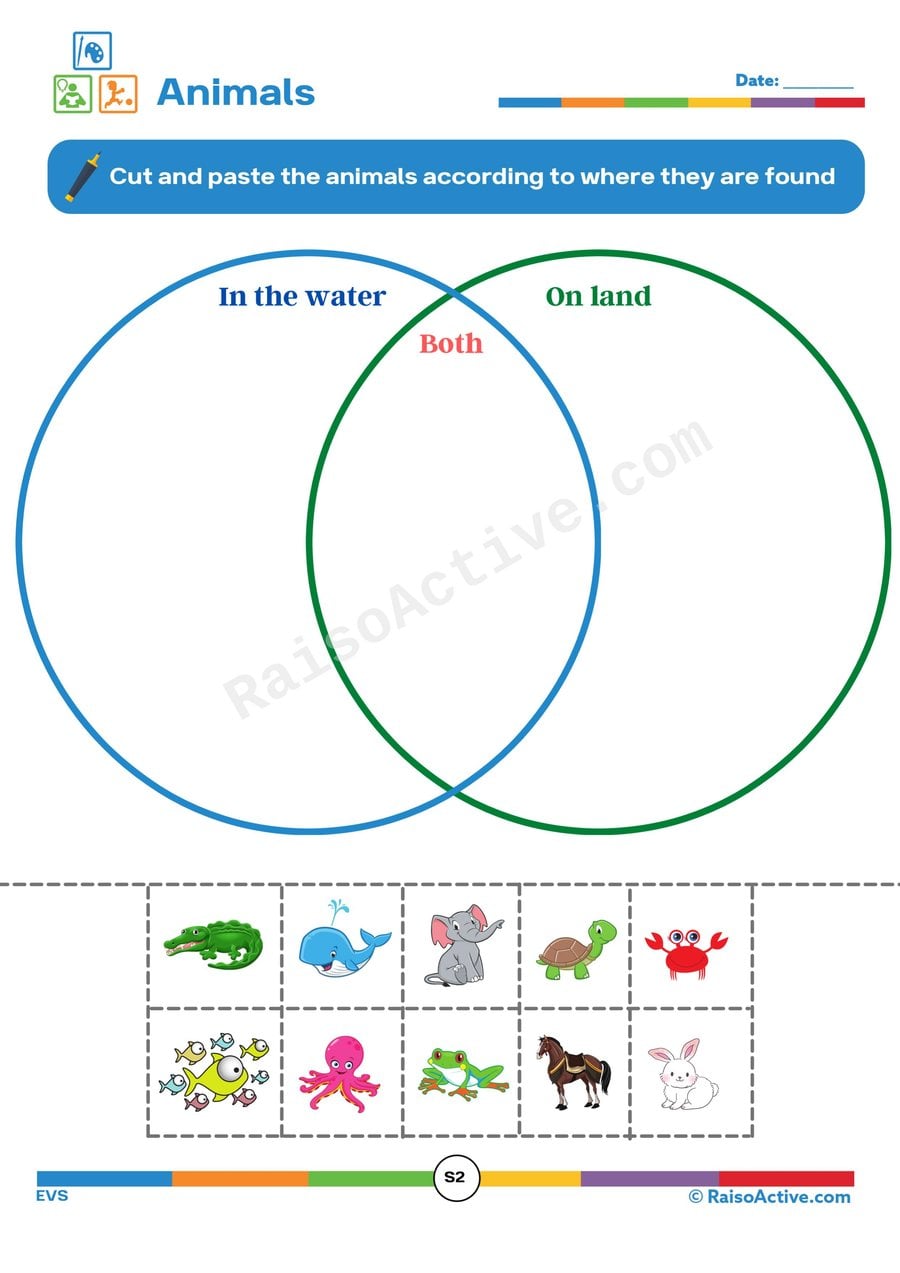
Animals: Sorting Worksheet for Preschoolers
Ages 3-5 · Preschool–Pre-KAges 3-5 · Nursery–ReceptionAges 3-5 · Nursery–LKGAges 3-5
This sorting worksheet has children ages 3-5 cut out animal pictures and paste each one into either a water or land habitat circle, building an early classification skill around where different animals naturally live. Sorting animals by habitat, rather than by type or size, introduces the idea that an animal's environment is a meaningful category on its own.

Living and Non-Living Things Word Search Worksheet for Kids
Ages 4-6 · Pre-K–KindergartenAges 4-6 · Reception–Year 1Ages 4-6 · LKG–UKGAges 4-6
This word search worksheet has children ages 4-6 hunt for and identify living and non-living things, then sort them by color-coding — living things in red and non-living things in blue — building both spelling recognition and an early science classification skill. Distinguishing living from non-living is one of the foundational categories in early science education, underlying later lessons about biology and the natural world.
Related worksheets
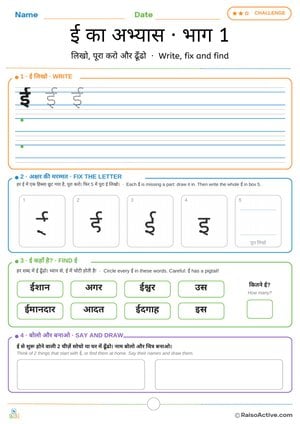
Hindi Letter ई Practice Part 1: Write, Fix and Find | ई का अभ्यास · भाग 1
Ages 3-7 · Preschool–Grade 1Ages 3-7 · Nursery–Year 2Ages 3-7 · Nursery–Class 1Ages 3-7
Children write ई on guide lines, complete four partly drawn letters, circle ई in eight words (while avoiding its look-alike इ), count how many they found, then think of two more words at home that start with ई and draw them.
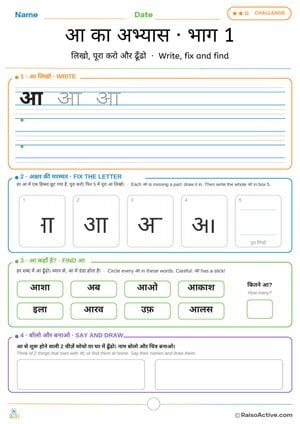
Hindi Letter आ Practice Part 1: Write, Fix and Find | आ का अभ्यास · भाग 1
Ages 3-7 · Preschool–Grade 1Ages 3-7 · Nursery–Year 2Ages 3-7 · Nursery–Class 1Ages 3-7
Children write आ on guide lines, complete four partly drawn letters, circle आ in eight words (while avoiding its look-alike अ), count how many they found, then think of two more words at home that start with आ and draw them.
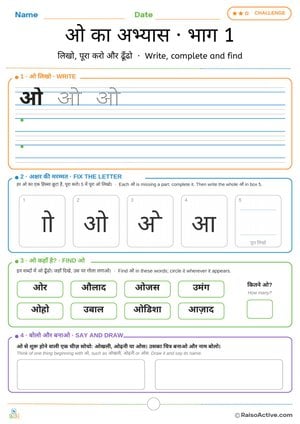
Hindi Letter ओ (o) Practice 1: Write, Fix the Letter and Find | ओ का अभ्यास · भाग 1
Ages 4-7 · Pre-K–Grade 1Ages 4-7 · Reception–Year 2Ages 4-7 · LKG–Class 1Ages 4-7
A challenge page: write ओ between the lines, complete four letters that are each missing a part and then write the whole ओ in box 5, find ओ in words such as ओर, ओजस, ओहो and ओडिशा, and draw a picture. ओ and औ are different vowels; औ has two marks on top and ओ has one.

Phonics Level 3 Long Vowels Certificate of Achievement
Ages 5-7 · Kindergarten–Grade 1Ages 5-7 · Year 1–Year 2Ages 5-7 · UKG–Class 1Ages 5-7
Children celebrate finishing Phonics Level 3 and look back at the five long vowel sounds they can now read: long a, e, i, o and u.
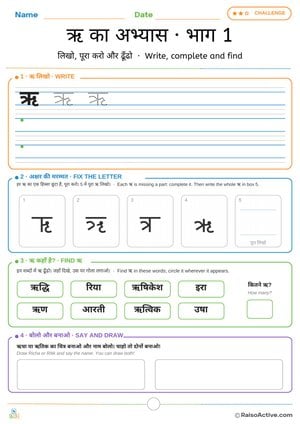
Hindi Letter ऋ (ri) Practice 1: Write, Fix the Letter and Find | ऋ का अभ्यास · भाग 1
Ages 4-7 · Pre-K–Grade 1Ages 4-7 · Reception–Year 2Ages 4-7 · LKG–Class 1Ages 4-7
A challenge page: write ऋ between the lines, complete four letters that are each missing a part and then write the whole ऋ in box 5, find ऋ in words such as ऋद्धि, ऋषिकेश, ऋण and ऋत्विक, and draw a picture. Because ऋ is a special vowel, this page helps adults say it as 'ri' and keep it apart from इ and र.
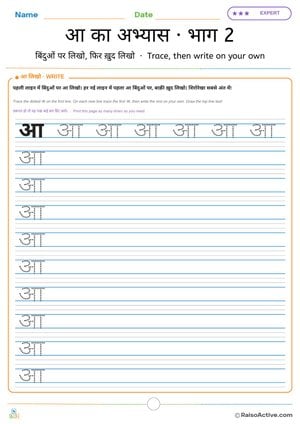
Hindi Letter आ Practice Part 2: Trace and Write on Your Own | आ का अभ्यास · भाग 2
Ages 3-7 · Preschool–Grade 1Ages 3-7 · Nursery–Year 2Ages 3-7 · Nursery–Class 1Ages 3-7
Children build writing fluency by tracing the dotted line आ on the first line and then writing the letter on their own, line after line, as the dotted help fades. The headline (शिरोरेखा) is drawn last, as in Hindi handwriting.
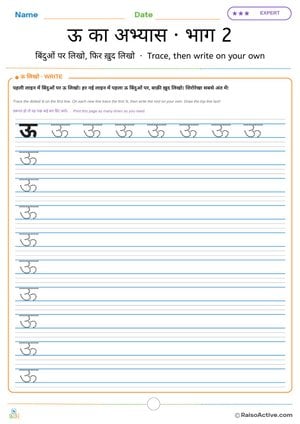
Hindi Letter ऊ Practice Part 2: Trace and Write on Your Own | ऊ का अभ्यास · भाग 2
Ages 3-7 · Preschool–Grade 1Ages 3-7 · Nursery–Year 2Ages 3-7 · Nursery–Class 1Ages 3-7
Children build writing fluency by tracing the dotted line ऊ on the first line and then writing the letter on their own, line after line, as the dotted help fades. The headline (शिरोरेखा) is drawn last, as in Hindi handwriting.

Phonics Level 3 Long Vowels Answer Key for Grown-ups
Ages 5-7 · Kindergarten–Grade 1Ages 5-7 · Year 1–Year 2Ages 5-7 · UKG–Class 1Ages 5-7
Grown-ups get every answer for the long a, e, i, o and u pages and the long-or-short sorting pages, including word search positions by row and column.
Guides for this topic

How to Teach CVC Blending: A Step-by-Step Method That Works in Two Weeks
A step-by-step method for teaching CVC blending, covering continuous sounds, word families, common errors, and a 14-day plan that most children finish reading CVC words.
Phase 2 Phonics at Home: Sound Order, Blending Games, Worksheets
Phase 2 phonics at home: the five sound sets in order, oral blending, tricky words, a two-week routine, common mistakes, and free worksheets.

Reception Year Explained: EYFS Learning and How to Help at Home
A teacher's plain-English guide to the Reception Year: the seven areas of learning, Early Learning Goals, Phase 2/3 phonics, the RBA and home routines.
Reviews
Every worksheet for ages 4–5, no watermark
Members download the full library of 1,000+ worksheets and every activity pack without watermarks or daily limits. One year costs ₹999 in India or $20 elsewhere.
See membership plansOr download any worksheet free with a watermark (5 a day).