Spin the Wheel Exercise Worksheet for Kids
This spinner-based worksheet gets children ages 3-5 moving by having them build a simple spinning wheel, then perform whichever exercise the arrow lands on, combining following-directions practice with gross motor skill development like jumping, stretching, or hopping. Turning physical activity into a game with an element of chance also keeps young children more engaged than a straightforward list of exercises would.
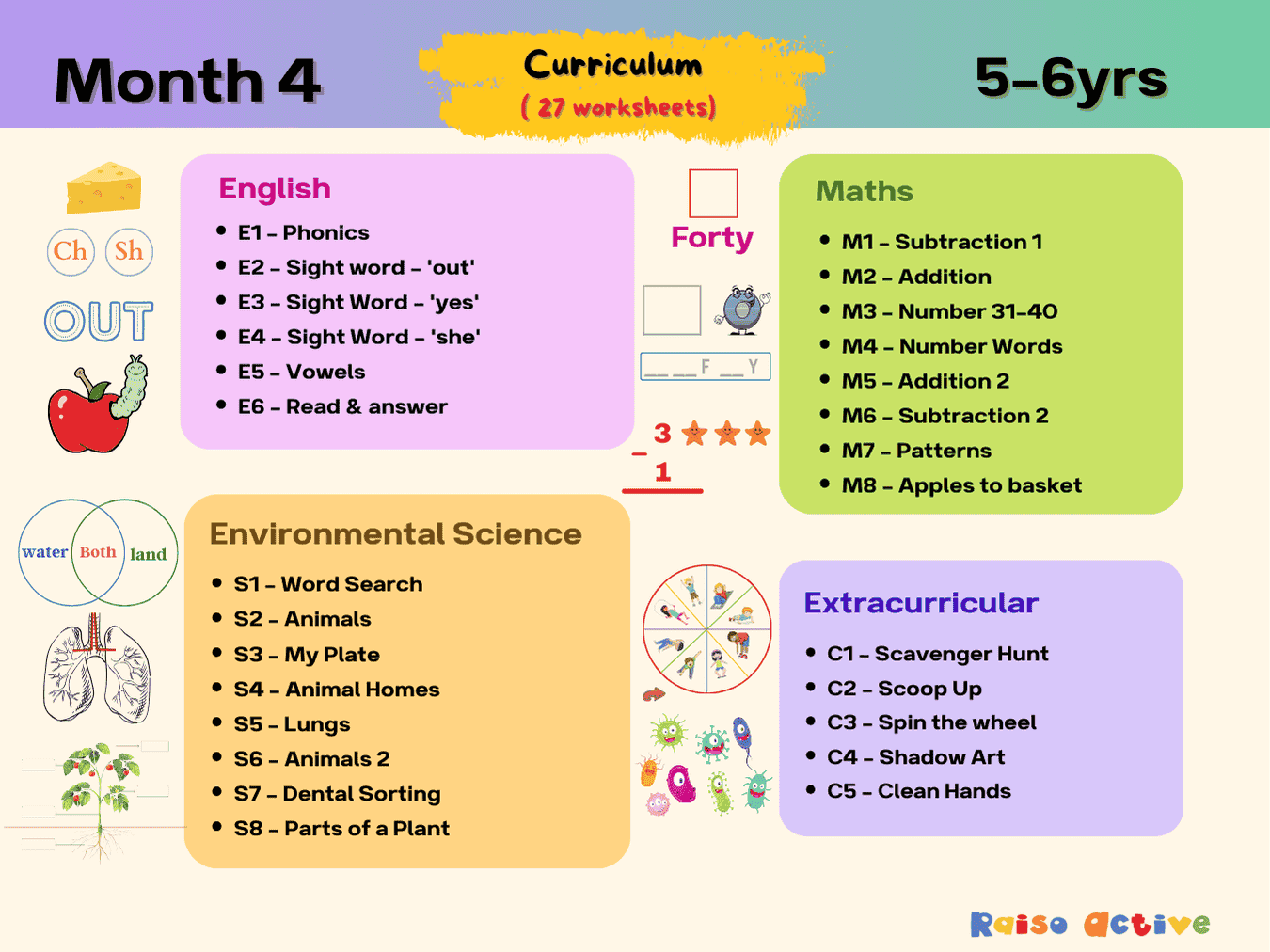
Part of the pack
Month 4: Learning & Development | Ages 5-6
This is page 28 of the pack. Ages 5-6 · KindergartenAges 5-6 · Year 1Ages 5-6 · UKGAges 5-6
Curriculum
- Physical Education > Physical Exercise
How to use this worksheet
Help your child cut out the wheel and the arrow pointer. Attach the arrow to the center of the wheel using a pin, brad, or similar fastener so it can spin freely. Take turns spinning the arrow and reading aloud whichever exercise it lands on. Perform that exercise together for the stated amount of time or repetitions before spinning again.
Materials needed
- Scissors
- Pin
Extension activities
- 1Design a second spinner wheel with new exercises your child invents.
- 2Turn the spins into a mini obstacle course, doing each landed exercise at a different station around the room.
- 3Set a timer and see how many total spins and exercises you can complete in five minutes.
- 4Draw a picture of your favorite exercise from the wheel after playing.
- 5Play music and spin the wheel between songs as a fun movement break during the day.

Written by
Hemsweta Jain · Teacher Cheena
MBA and Early Childhood Educator, teaching since 2014 · Founder of RaisoActive, Mumbai
Every RaisoActive worksheet is designed and checked by the founder before publishing.
Published · Last reviewed
More from Month 4: Learning & Development | Ages 5-6
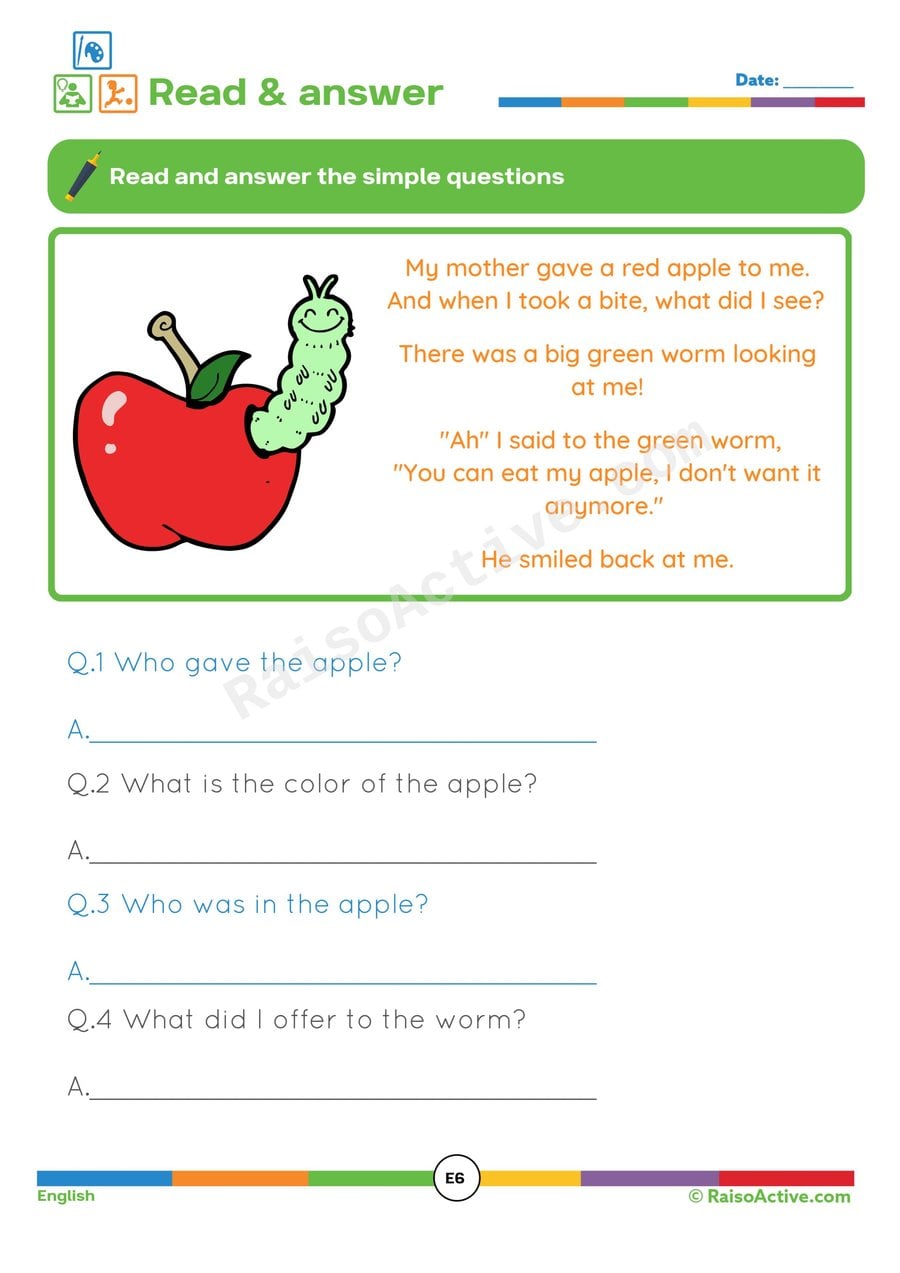
Read and Answer: The Red Apple Worksheet
Ages 3-5 · Preschool–Pre-KAges 3-5 · Nursery–ReceptionAges 3-5 · Nursery–LKGAges 3-5
Reading the short Red Apple story and answering questions afterward helps children ages 3-5 practice basic reading comprehension, recalling simple details from a story and expressing their understanding in writing. This early comprehension practice builds the habit of checking back with a text to support an answer, a skill that grows more important throughout school.

Cut and Paste Number Matching Worksheet: Numbers 31-40
Ages 4-6 · Pre-K–KindergartenAges 4-6 · Reception–Year 1Ages 4-6 · LKG–UKGAges 4-6
Matching number words like thirty-one through forty to their correct numerals teaches children ages 4-6 to recognize larger two-digit numbers by both their written word form and their numeral form, extending number recognition well beyond the more familiar numbers under twenty. Cutting and pasting the matching numeral also reinforces careful visual comparison, since numbers in this range can look similar to one another.
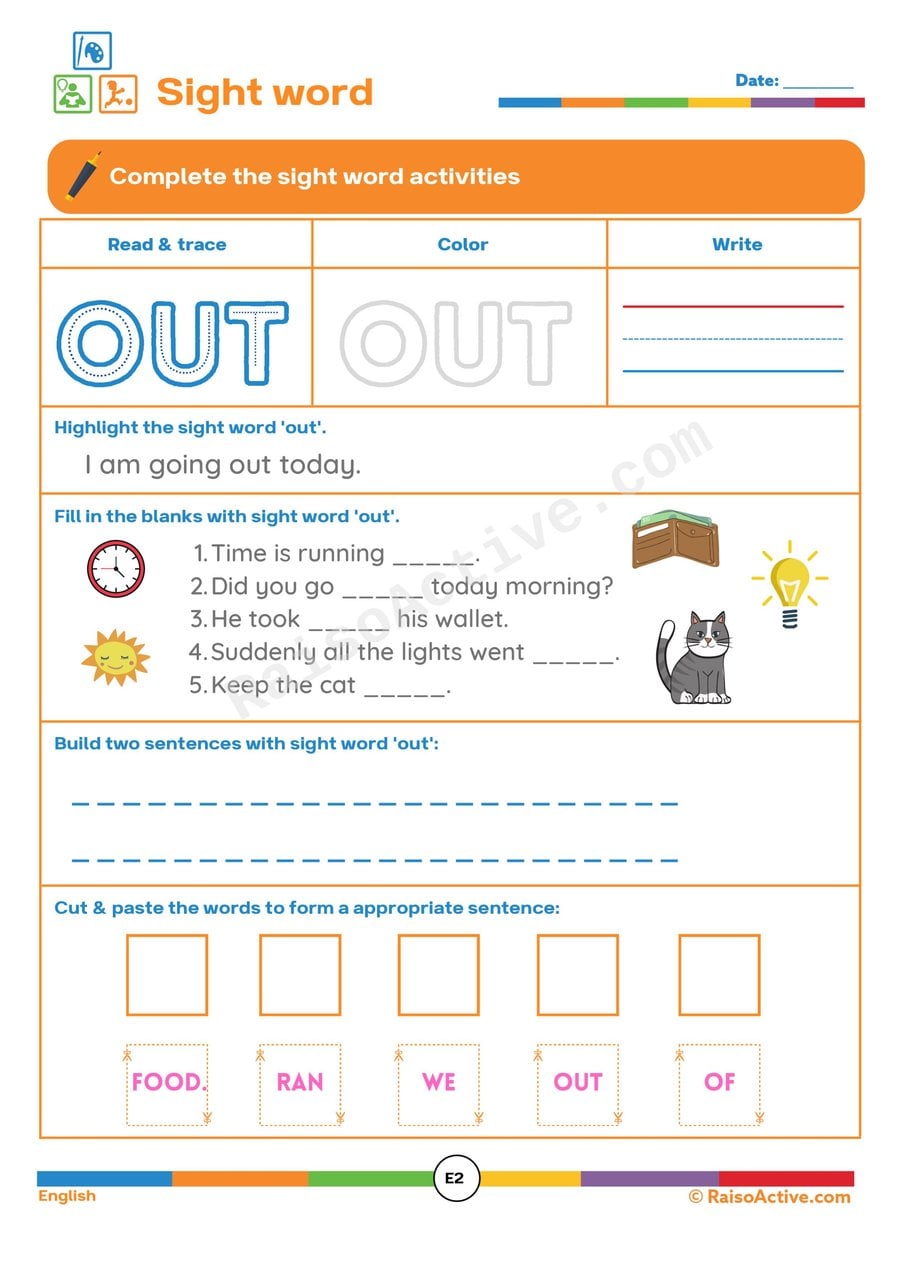
Sight Word 'Out' Worksheet: Read, Trace, and Write!
Ages 3-5 · Preschool–Pre-KAges 3-5 · Nursery–ReceptionAges 3-5 · Nursery–LKGAges 3-5
Reading fluency for young children depends on instantly recognizing common sight words that don't sound out easily, and this worksheet gives children ages 3-5 focused, repeated exposure to the word 'out' through tracing, coloring, and sentence practice. Seeing the word in context within simple sentences also helps children start connecting sight-word recognition to real reading comprehension.

Living and Non-Living Things Word Search Worksheet for Kids
Ages 4-6 · Pre-K–KindergartenAges 4-6 · Reception–Year 1Ages 4-6 · LKG–UKGAges 4-6
This word search worksheet has children ages 4-6 hunt for and identify living and non-living things, then sort them by color-coding — living things in red and non-living things in blue — building both spelling recognition and an early science classification skill. Distinguishing living from non-living is one of the foundational categories in early science education, underlying later lessons about biology and the natural world.
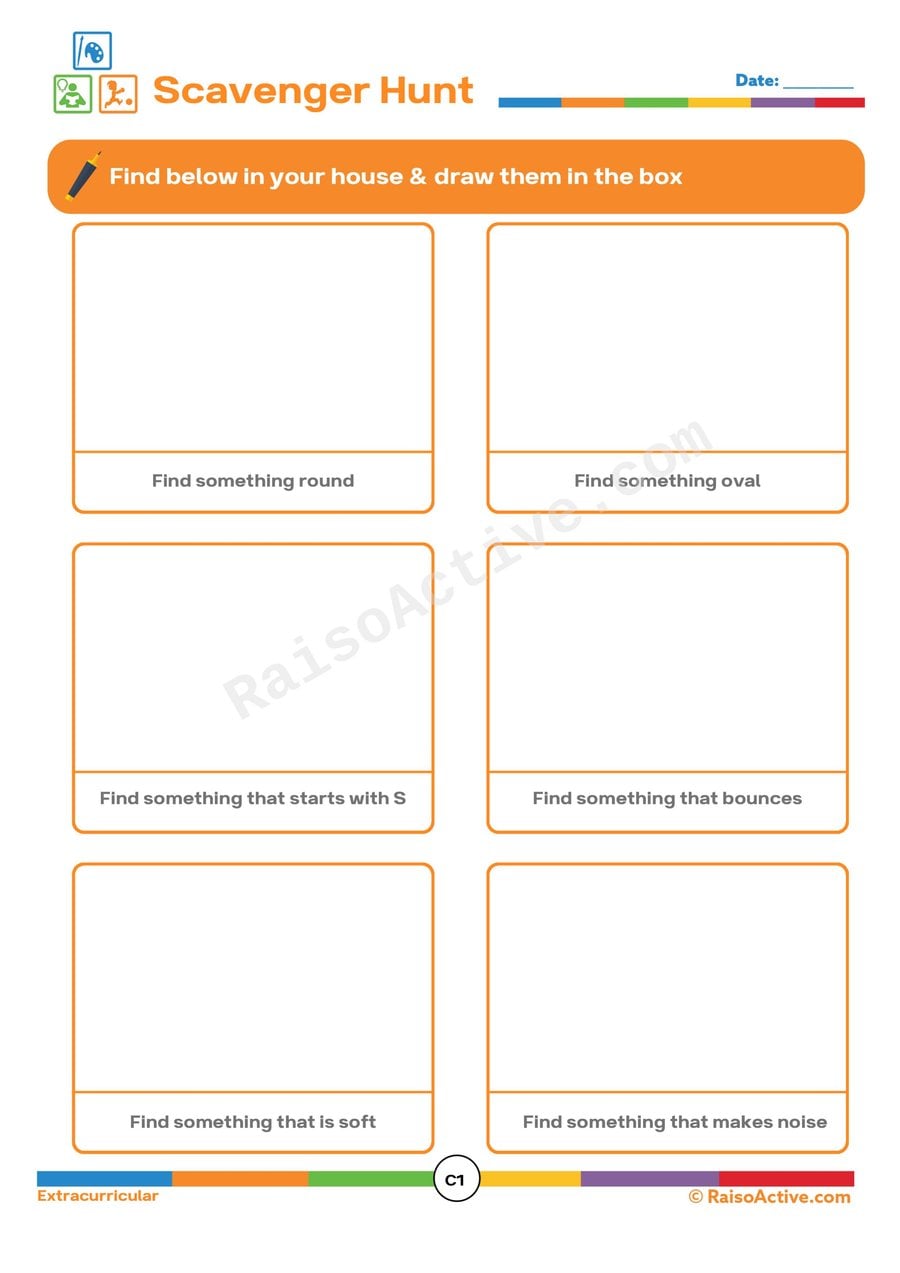
Scavenger Hunt Worksheet: Find & Draw!
Ages 3-5 · Preschool–Pre-KAges 3-5 · Nursery–ReceptionAges 3-5 · Nursery–LKGAges 3-5
This scavenger hunt worksheet asks children ages 3-5 to search their home for objects matching specific descriptions and draw what they find, building observation skills and the ability to translate a spoken or written clue into a real-world search. Drawing the found object afterward adds a fine motor and representational drawing component on top of the search itself.

Subtraction Fun: Counting and Subtracting Worksheet for Kids
Ages 4-6 · Pre-K–KindergartenAges 4-6 · Reception–Year 1Ages 4-6 · LKG–UKGAges 4-6
This worksheet teaches children ages 4-6 the concept of subtraction by having them count a group of stars, cross out a specified number, and write how many remain — making the abstract idea of 'taking away' visible and countable rather than purely symbolic. Physically crossing out objects before writing the answer helps children understand subtraction as an action, which is more intuitive at this age than memorizing subtraction facts.

Number Words Worksheet: Complete the Number Words!
Ages 4-6 · Pre-K–KindergartenAges 4-6 · Reception–Year 1Ages 4-6 · LKG–UKGAges 4-6
Filling in missing letters to complete number words teaches children ages 4-6 to connect a numeral with its written spelling, combining early spelling practice with number vocabulary. This kind of fill-in-the-blank format also encourages careful attention to each letter, since number words often contain tricky spelling patterns that don't follow simple phonics rules.

Clean Hands Worksheet: Germs and Handwashing Experiment
Ages 4-6 · Pre-K–KindergartenAges 4-6 · Reception–Year 1Ages 4-6 · LKG–UKGAges 4-6
This worksheet teaches children ages 4-6 the science behind why handwashing matters through a simple, visual experiment demonstrating how germs (represented by something like glitter or oil) transfer between hands and spread easily, then how washing removes them. Seeing germs 'in action' makes an invisible concept concrete, helping children understand the real reason behind a daily hygiene habit rather than just following a rule.
Related worksheets
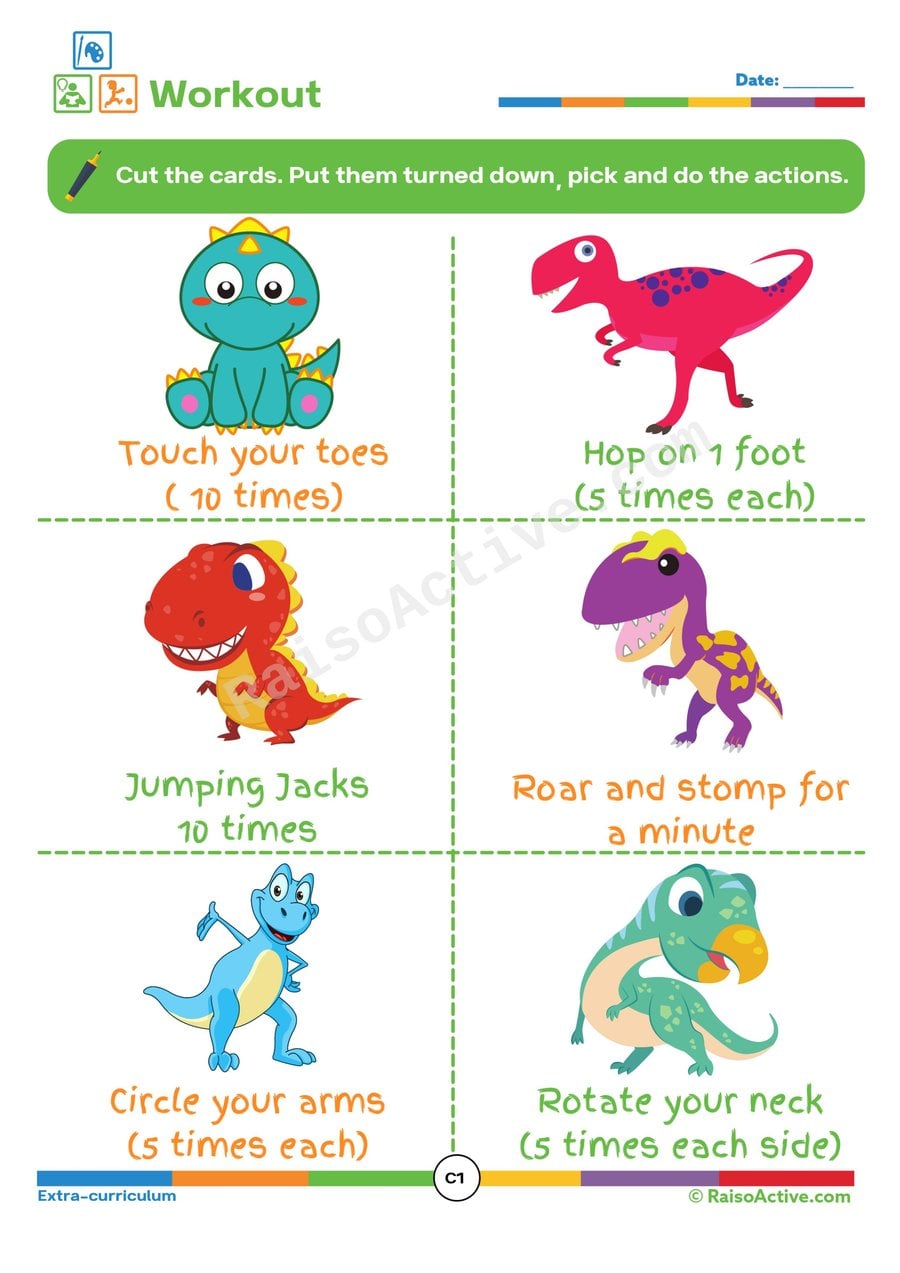
Dino Workout: Fun Exercise Worksheet for Kids!
Ages 3-5 · Preschool–Pre-KAges 3-5 · Nursery–ReceptionAges 3-5 · Nursery–LKGAges 3-5
This dinosaur-themed activity gets 3-5 year olds moving, which is exactly what this age group needs for developing gross motor skills, body awareness, and balance — abilities that don't come from sitting at a table. Following each exercise card as instructed also builds the ability to interpret a picture prompt and translate it into a physical action, a form of following directions that's harder than it sounds for young children still developing self-regulation.
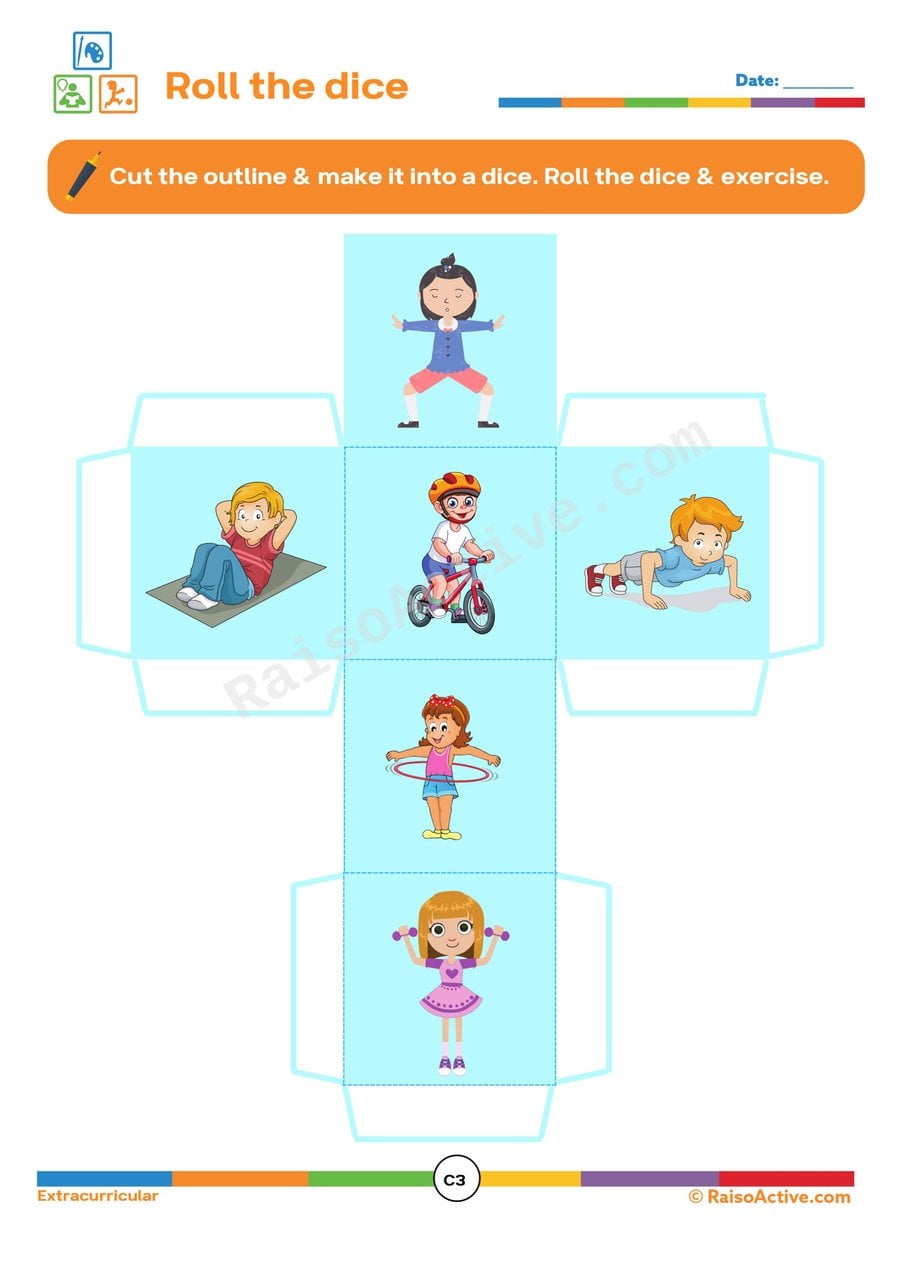
Roll the Dice Exercise Worksheet for Kids
Ages 3-5 · Preschool–Pre-KAges 3-5 · Nursery–ReceptionAges 3-5 · Nursery–LKGAges 3-5
This worksheet gets children ages 3-5 moving as they assemble a paper dice, roll it, and perform whichever physical exercise lands face-up, combining gross motor development with basic probability and turn-taking. Following a picture-based instruction and translating it into a physical action also builds the same instruction-following skill children need for classroom directions.
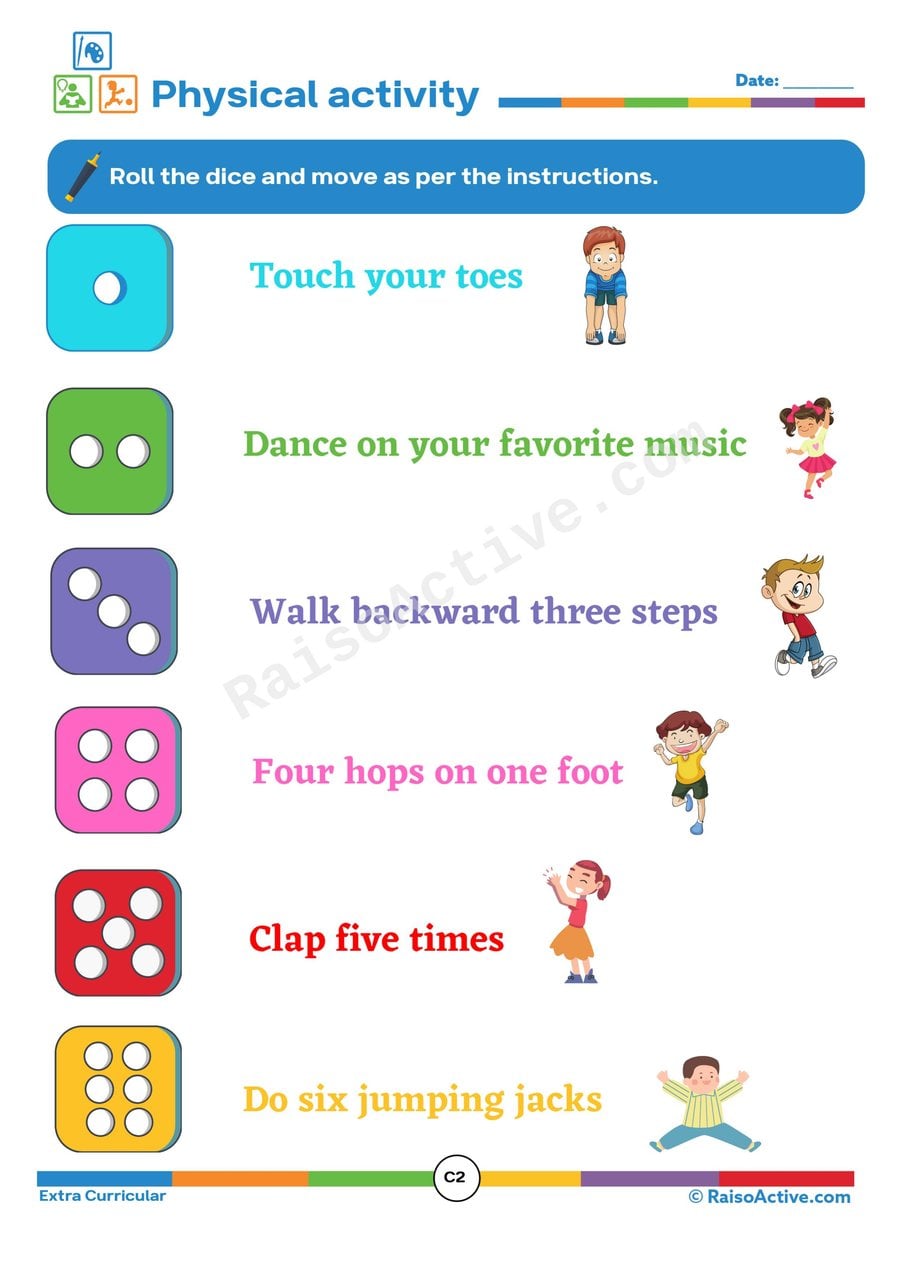
Physical Activity Dice Game Worksheet for Kids
Ages 3-5 · Preschool–Pre-KAges 3-5 · Nursery–ReceptionAges 3-5 · Nursery–LKGAges 3-5
Rolling a die and performing the matching action builds gross motor skills and number recognition together for children ages 3-5, since they must first read the number rolled before they can act on it. Following the sequence of steps also strengthens listening comprehension and the ability to carry out multi-step instructions.
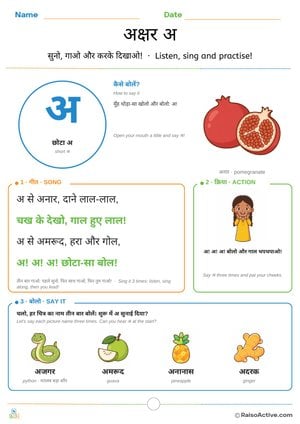
Hindi Letter अ (a) Song, Action and Say It | अक्षर अ
Ages 3-7 · Preschool–Grade 1Ages 3-7 · Nursery–Year 2Ages 3-7 · Nursery–Class 1Ages 3-7
Children hear and say the short vowel अ, learn a short rhyme with an action, and say the names of the picture words अनार (pomegranate), अमरूद (guava), अजगर (python), अनानास (pineapple), अदरक (ginger) to practise hearing अ at the start.

Animal Dice: Fun Movement Activity Worksheet for Kids
Ages 3-5 · Preschool–Pre-KAges 3-5 · Nursery–ReceptionAges 3-5 · Nursery–LKGAges 3-5
This hands-on activity combines craft-making with imaginative movement for children ages 3-5, having them build a paper dice and then act out the animal that lands face-up on each roll. Assembling the cube itself builds fine motor and spatial skills, since folding a flat template into a three-dimensional shape requires understanding how the sides connect. The movement portion that follows then builds gross motor skills, body awareness, and imaginative play as children physically embody different animals' distinctive movements, like hopping like a frog or slithering like a snake.
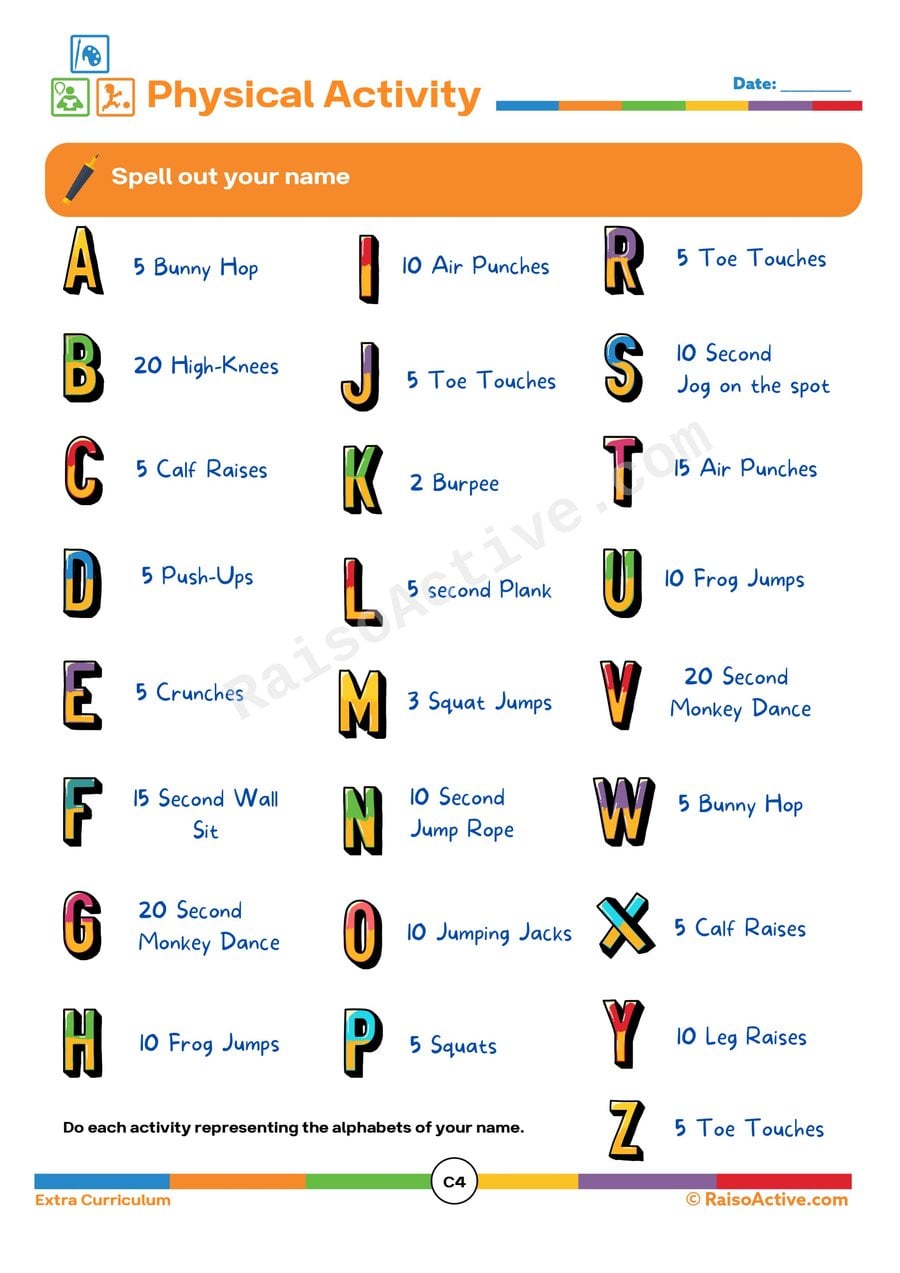
Physical Activity Worksheet: Spell Your Name!
Ages 3-5 · Preschool–Pre-KAges 3-5 · Nursery–ReceptionAges 3-5 · Nursery–LKGAges 3-5
This worksheet turns spelling practice into a physical activity by pairing each letter of the alphabet with a specific exercise, so children spell their name while getting active movement in between. For ages 3-5, connecting letter recognition to gross motor movement supports both early literacy and physical development at once, appealing especially to kinesthetic learners.

Caterpillar Activity Worksheet: Follow Instructions and Move!
Ages 3-5 · Preschool–Pre-KAges 3-5 · Nursery–ReceptionAges 3-5 · Nursery–LKGAges 3-5
This worksheet helps children ages 3-5 practice following multi-step instructions while getting active, as they move along a caterpillar's body and perform a different physical action in each circle, such as jumping or spinning. Combining movement with sequential instructions builds gross motor skills, listening comprehension, and the ability to hold a sequence of directions in mind.
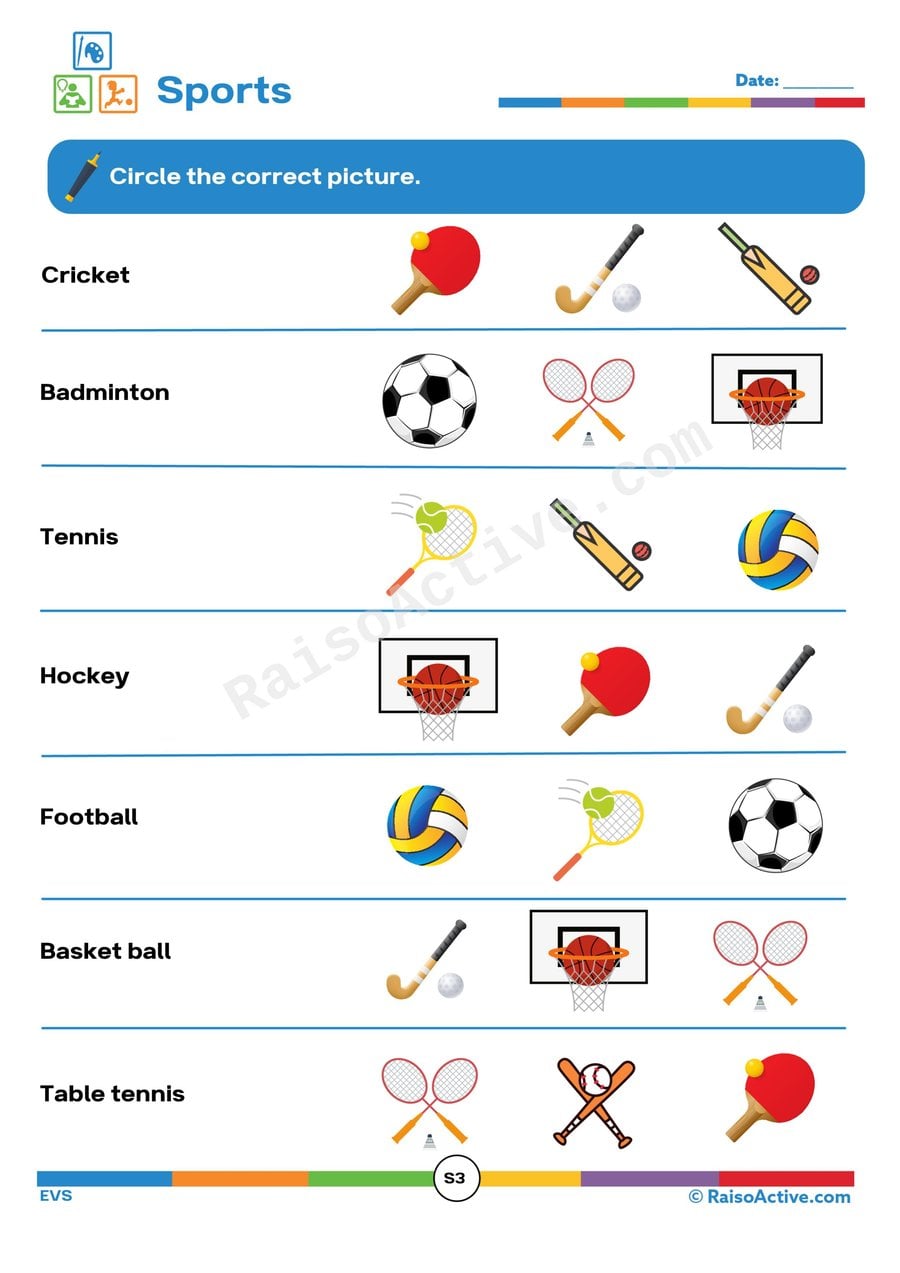
Sports Matching Worksheet for Preschoolers
Ages 3-5 · Preschool–Pre-KAges 3-5 · Nursery–ReceptionAges 3-5 · Nursery–LKGAges 3-5
Matching a sport's written name to its picture builds vocabulary and early reading recognition for children ages 3-5, connecting specific words like 'soccer' or 'swimming' to real, familiar activities. Because sports involve distinct equipment and movements, this task also sharpens visual discrimination, since children must notice small differences between similar-looking pictures to find the correct match.
Guides for this topic

Learning Activities That Work: A Comprehensive Guide for Children with ADHD
Discover hands-on, movement-based learning activities that genuinely work for children with ADHD. Practical tips for Indian parents and educators, ages 1-8.
Creating a Learning Schedule for Your Preschooler: A Complete Guide to Structured Yet Flexible Routines
Learn how to create a balanced learning schedule for your preschooler that combines structured activities with free play — with sample daily timetables and practical tips.
Beyond Worksheets: Engaging Alternatives for Your 5-Year-Old Who Refuses Paper-and-Pencil Activities
Discover practical, research-backed alternatives when your 5-year-old refuses worksheets. Hands-on activities, sensory play, and movement-based learning that build the same skills.
Reviews
Every worksheet for ages 3–5, no watermark
Members download the full library of 1,000+ worksheets and every activity pack without watermarks or daily limits. One year costs ₹999 in India or $20 elsewhere.
See membership plansOr download any worksheet free with a watermark (5 a day).