Navratri Festival Quest Certificate of Achievement
Ages 7-11 · Grade 2–Grade 3Ages 7-11 · Year 3–Year 4Ages 7-11 · Class 2–Class 3Ages 7-11
Children celebrate finishing the Navratri Festival Quest pack and record which levels they completed.
Free printable worksheets
Download free educational worksheets for children ages 2–8. Perfect for preschool, kindergarten, and early elementary learning activities.
Subscribe to get unlimited access to all worksheets without watermarks
View Subscription Plans289 topics match
23 worksheetsof 1,994
Ages 7-11 · Grade 2–Grade 3Ages 7-11 · Year 3–Year 4Ages 7-11 · Class 2–Class 3Ages 7-11
Children celebrate finishing the Navratri Festival Quest pack and record which levels they completed.
Ages 4-6 · Pre-K–KindergartenAges 4-6 · Reception–Year 1Ages 4-6 · LKG–UKGAges 4-6
Children celebrate finishing the Navratri Fun Time pages and see which levels they completed.
Ages 4-5 · Pre-KAges 4-5 · ReceptionAges 4-5 · LKGAges 4-5
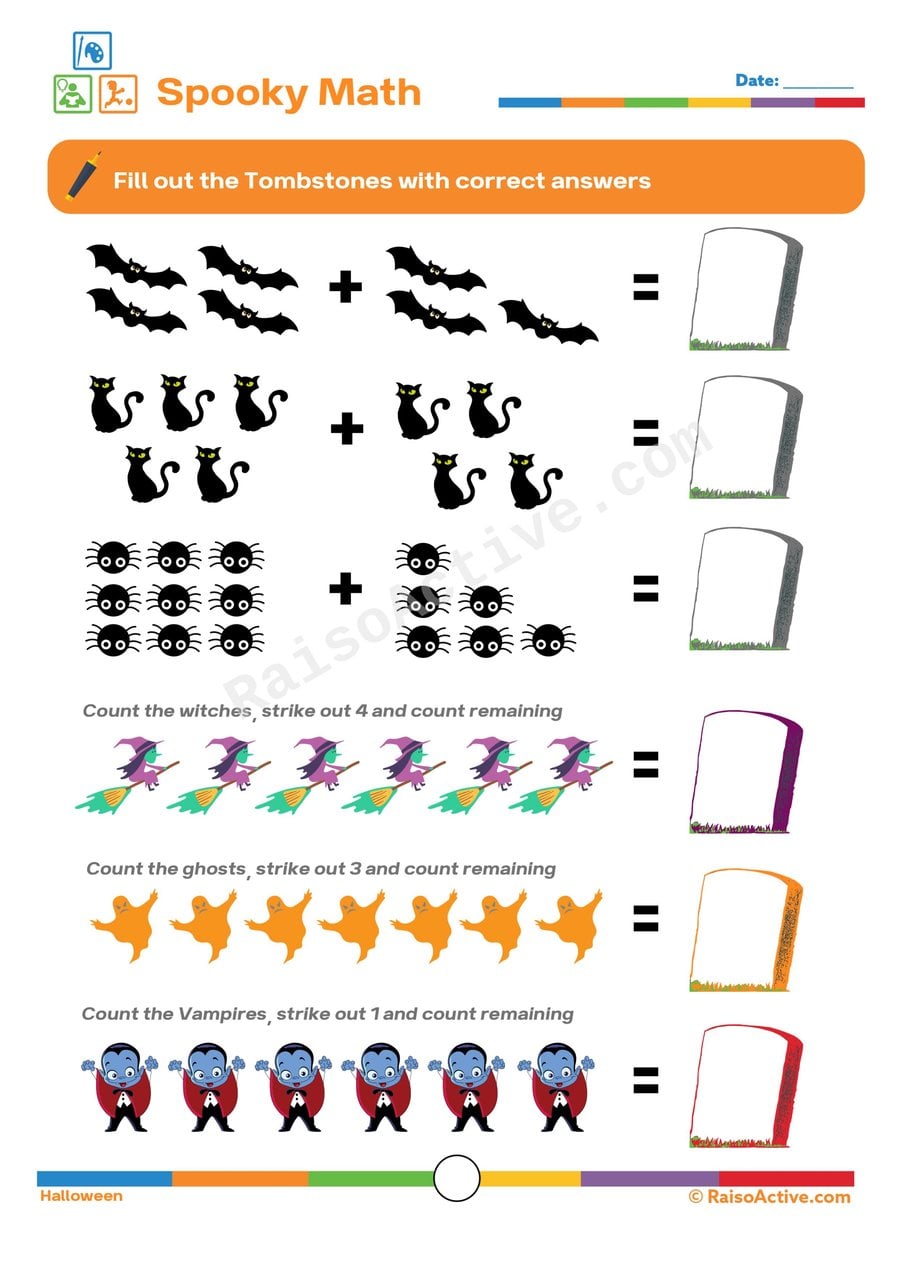
This Halloween math worksheet has children ages 4-5 count grouped pictures and then solve simple addition and subtraction problems, moving from concrete counting toward the more abstract skill of combining or taking away quantities. Writing each answer inside a tombstone shape keeps the seasonal theme playful while practicing genuine early arithmetic.
Ages 4-6 · Pre-K–KindergartenAges 4-6 · Reception–Year 1Ages 4-6 · LKG–UKGAges 4-6
This worksheet combines number-word recognition with a color-by-key coloring task for children ages 4-6, asking them to match number names written on planets to their corresponding numerals before coloring each planet according to a color code. Matching written number words in a space-themed context adds novelty that keeps repeated number-word practice fresh, while the color-key step reinforces careful, sequential following of visual instructions. Together, these two tasks combine literacy and numeracy practice in one engaging page.
Ages 3-5 · Preschool–Pre-KAges 3-5 · Nursery–ReceptionAges 3-5 · Nursery–LKGAges 3-5
This matching worksheet builds early number-word literacy for children ages 3-5 by asking them to connect each numeral with its written name. Learning that '5' and 'five' refer to the same quantity strengthens number sense and lays groundwork for reading math vocabulary later in school. The side-by-side layout also sharpens visual scanning and one-to-one matching skills.
Ages 3-5 · Preschool–Pre-KAges 3-5 · Nursery–ReceptionAges 3-5 · Nursery–LKGAges 3-5
Matching numerals to their written number-word form, like connecting '5' to the word 'five,' teaches children ages 3-5 that numbers can be represented two different ways: as a symbol and as a spelled-out word. Searching for the correct number name within a word search grid also builds visual scanning and early sight-word recognition, since number words like 'one' or 'seven' don't always follow predictable spelling patterns. This dual practice strengthens both numeracy and literacy at the same time.
Ages 4-6 · Pre-K–KindergartenAges 4-6 · Reception–Year 1Ages 4-6 · LKG–UKGAges 4-6
This worksheet asks children ages 4-6 to arrange the numbers on a row of balloons from largest to smallest, practicing descending order as a companion skill to the more commonly taught ascending order. Comparing several numbers at once and deciding their relative size builds a flexible sense of number magnitude that supports later skills like rounding and estimation.
Ages 4-6 · Pre-K–KindergartenAges 4-6 · Reception–Year 1Ages 4-6 · LKG–UKGAges 4-6
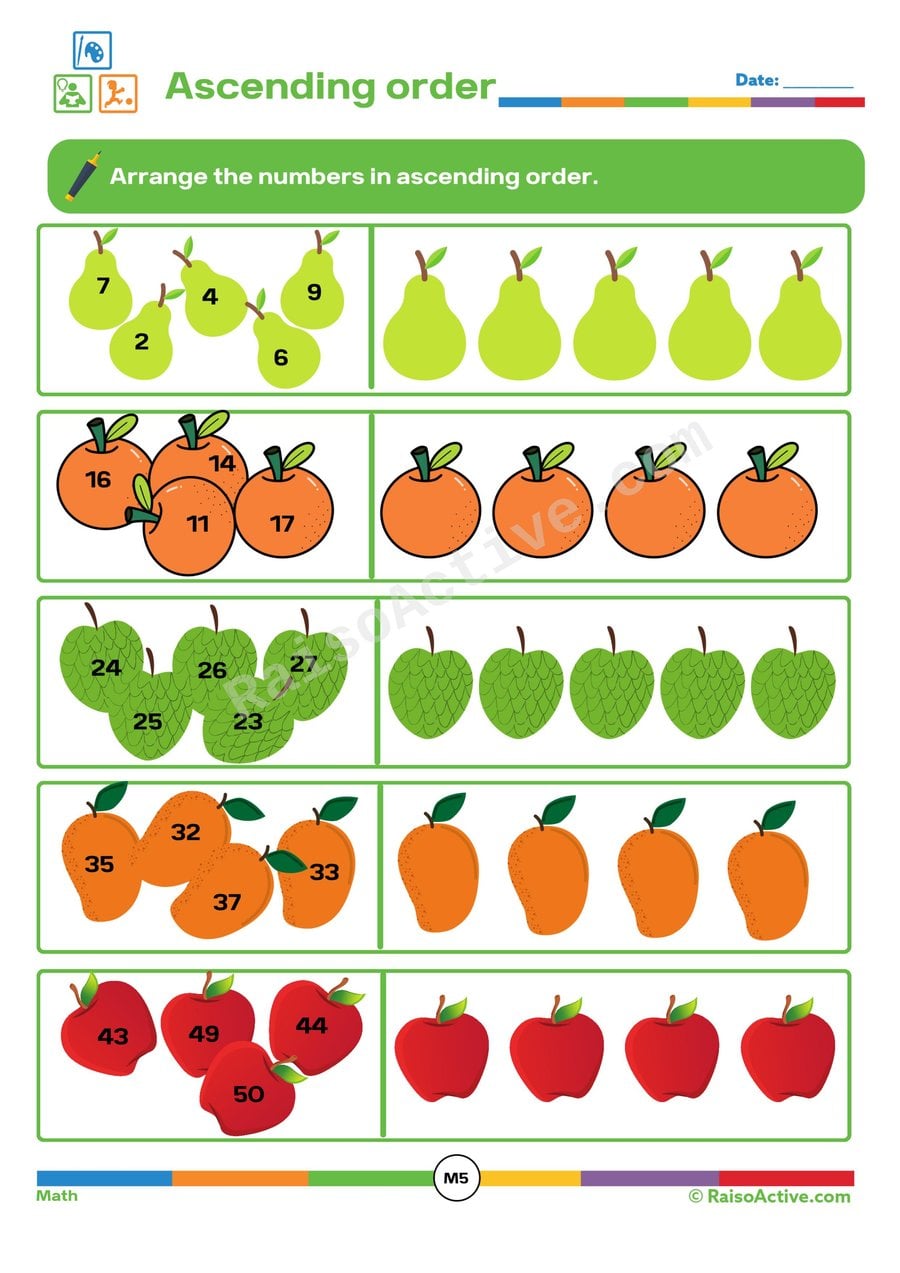
Arranging numbers on groups of fruit from smallest to largest teaches children ages 4-6 to compare quantities and understand ascending order, a core numeracy skill that supports later work with number lines and place value.
Ages 3-5 · Preschool–Pre-KAges 3-5 · Nursery–ReceptionAges 3-5 · Nursery–LKGAges 3-5
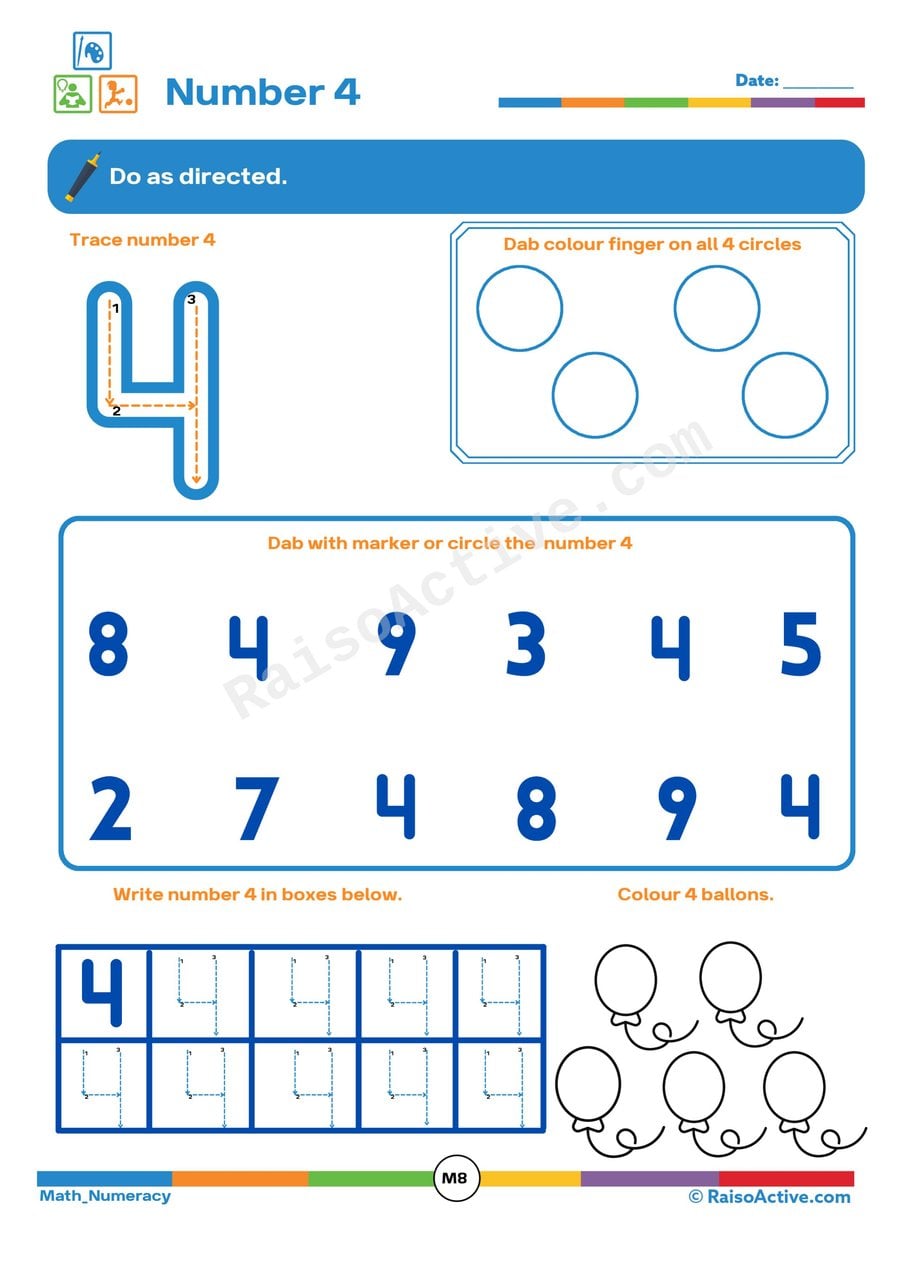
This worksheet helps children ages 3-5 learn to recognize, trace, and write the number 4 while practicing counting and matching the number to a quantity across several different activities, including dabbing circles, circling number 4 in a set, and coloring the correct number of balloons. Repeating the same number across so many formats helps solidify both the symbol and the quantity it represents.
Ages 3-5 · Preschool–Pre-KAges 3-5 · Nursery–ReceptionAges 3-5 · Nursery–LKGAges 3-5
This worksheet introduces the more abstract concept of zero by having children trace the numeral and then identify pictures showing an empty or 'zero' quantity, like a basket with no fruit or a jar with no candies. For three- to five-year-olds, zero is often trickier to grasp than other numbers since it represents an absence rather than a countable group, so tracing it alongside visual examples of 'nothing there' helps make the idea concrete.
Ages 3-5 · Preschool–Pre-KAges 3-5 · Nursery–ReceptionAges 3-5 · Nursery–LKGAges 3-5
This worksheet helps children recognize, trace, and count the number 1 through a combination of tracing practice, coloring watermelon slices and number blocks, and identifying the numeral within a sequence. For three- to five-year-olds, this multi-activity approach reinforces the same number from several angles — written form, spoken word, and counted quantity — so the concept of '1' is reinforced from more than one direction.
Ages 4-5 · Pre-KAges 4-5 · ReceptionAges 4-5 · LKGAges 4-5
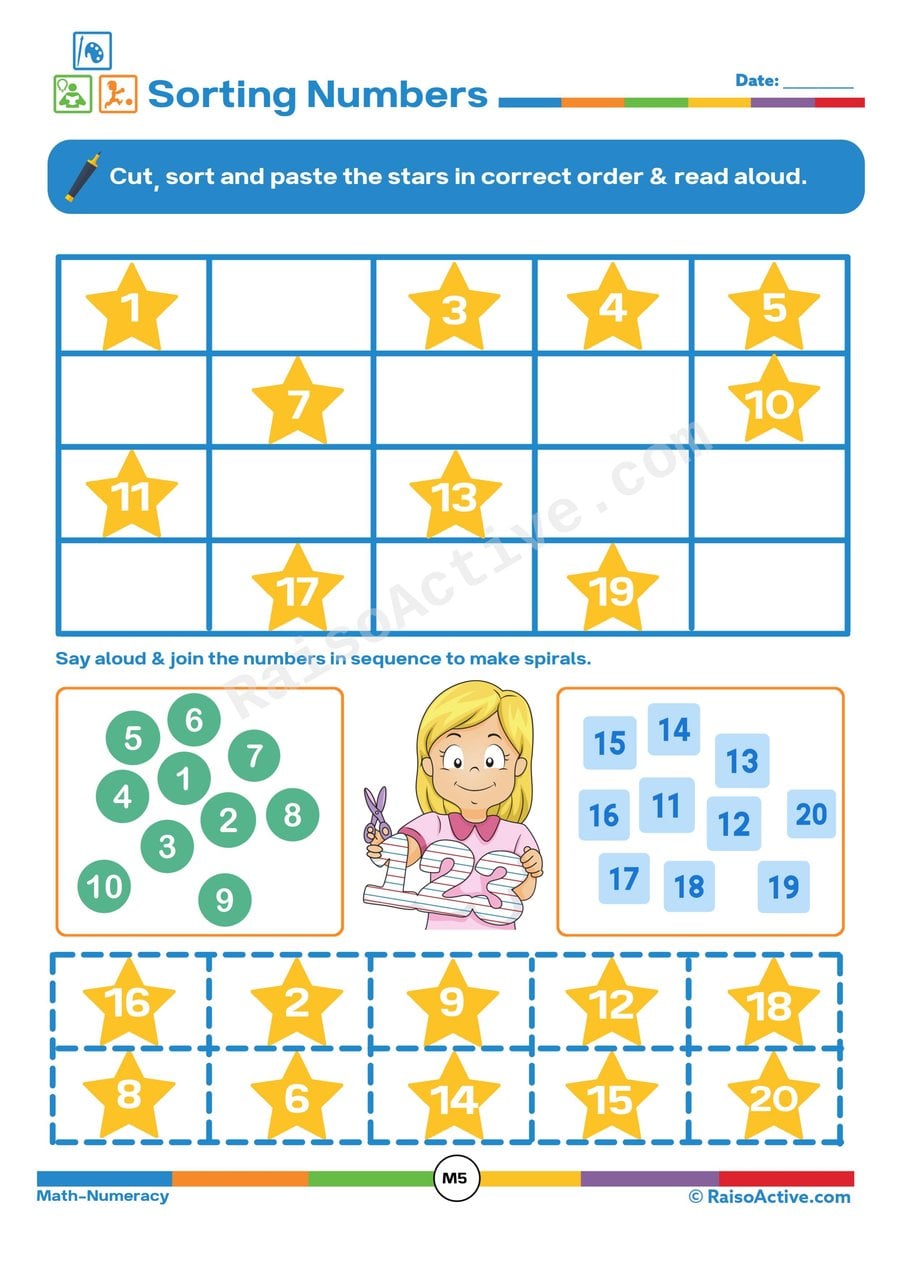
This worksheet reinforces number recognition and ascending-order sequencing by having children cut out star-shaped number pieces and paste them into a grid in the correct counting order. For four- and five-year-olds, physically manipulating loose number pieces — rather than just writing numbers in place — makes the abstract idea of 'order' something they can touch, rearrange, and correct before committing to a final answer.