Life Cycle Match: Frog, Snake, Ladybug, Butterfly, and Fish Worksheet
This matching worksheet helps children ages 4-6 compare life cycle stages across five very different animals: frogs, snakes, ladybugs, butterflies, and fish. By matching each animal to its correct stage picture, children start to notice that not all animals grow the same way — some hatch from eggs looking like miniature adults, while others go through dramatic transformations like metamorphosis. This comparative thinking builds a deeper foundation in life science than studying just one animal alone.
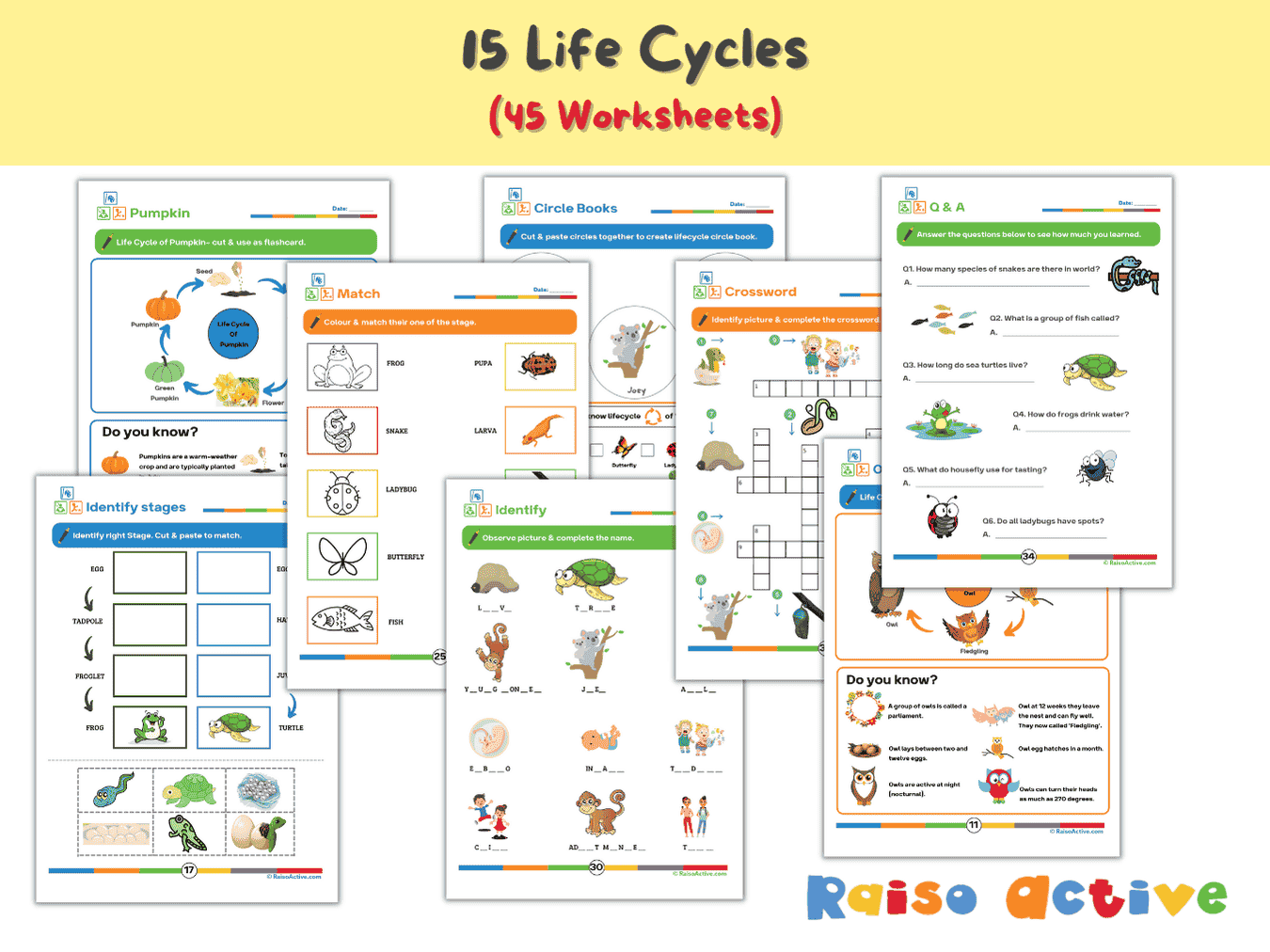
Part of the pack
Lifecycles Activity Book & Flashcards for Preschool & Early Elementary
This is page 26 of the pack. Ages 3-8 · Preschool–Grade 2Ages 3-8 · Nursery–Year 3Ages 3-8 · Nursery–Class 2Ages 3-8
Made for your child
Numbers to 20, made for your child
A maths pack with your child's name in it: pictures that explain, practice at three levels, puzzles and story sums about them. Print a new set whenever they finish.
Make a maths packFree preview · free for members
Curriculum
- Living Things - Animals > Animal Life Cycles
How to use this worksheet
Have your child color each animal picture first so the details are easier to tell apart. Next, look at the life cycle stage pictures scattered around the page and identify which animal each one belongs to. Draw a line connecting each animal to its matching stage, then read the label together to confirm the match makes sense. Finish by asking your child to point to which animals hatch from eggs and which change shape as they grow.
Materials needed
- Pencil
- Crayons
Extension activities
- 1Watch a video of a caterpillar becoming a butterfly and a tadpole becoming a frog, then compare which change is more dramatic.
- 2Sort toy animals or picture cards into 'hatches from an egg' and 'born live' groups.
- 3Visit a pond, garden, or aquarium to look for real frogs, fish, or ladybugs.
- 4Create a simple chart comparing how many stages each animal on the worksheet goes through.
- 5Act out being an egg, then a young animal, then an adult for each creature on the page.

Written by
Hemsweta Jain · Teacher Cheena
MBA and Early Childhood Educator, teaching since 2014 · Founder of RaisoActive, Mumbai
Every RaisoActive worksheet is designed and checked by the founder before publishing.
Published · Last reviewed
More from Lifecycles Activity Book & Flashcards for Preschool & Early Elementary

Frog Life Cycle Cut and Paste Worksheet for Preschoolers
Ages 3-5 · Preschool–Pre-KAges 3-5 · Nursery–ReceptionAges 3-5 · Nursery–LKGAges 3-5
Children ages 3-5 learn the four stages of a frog's life cycle — egg, tadpole, froglet, and adult frog — while practicing sequencing and precise pasting skills. This worksheet is especially useful for illustrating dramatic physical change, since a tadpole looks almost nothing like an adult frog, which helps children grasp that growth can transform an animal significantly.

Turtle Life Cycle Flashcard Worksheet for Preschoolers
Ages 3-5 · Preschool–Pre-KAges 3-5 · Nursery–ReceptionAges 3-5 · Nursery–LKGAges 3-5
This flashcard set introduces children ages 3-5 to the stages of a turtle's life, egg, hatchling, and adult, helping them understand that turtles start life very small and vulnerable before growing into their familiar shelled adult form. Discussing where turtles lay their eggs and how hatchlings behave also builds early awareness of animal habitats and instincts.

Complete the Words: Identify the Animals Worksheet for Preschoolers
Ages 3-5 · Preschool–Pre-KAges 3-5 · Nursery–ReceptionAges 3-5 · Nursery–LKGAges 3-5
This worksheet helps children ages 3-5 practice early letter recognition and spelling by filling in missing letters to complete animal names using picture clues. Working from a picture to a partially completed word builds phonics skills gradually, since children only need to identify one or two missing sounds rather than spelling an entire word from scratch.

Sunflower Life Cycle Flashcard Worksheet for Kids
Ages 3-5 · Preschool–Pre-KAges 3-5 · Nursery–ReceptionAges 3-5 · Nursery–LKGAges 3-5
Seeing a sunflower's life cycle laid out as stages — seed, sprout, growing stem, full bloom — introduces a 3-5 year old to the idea of sequence and change over time, a concept that shows up again in stories, science, and even daily routines. It's also many children's first encounter with the idea that a plant is alive and changing, not just a static thing.

Fish Life Cycle Worksheet for Kids: Learn and Color!
Ages 3-5 · Preschool–Pre-KAges 3-5 · Nursery–ReceptionAges 3-5 · Nursery–LKGAges 3-5
Children ages 3-5 build early science vocabulary and sequencing skills as they learn the four stages of a fish's life — egg, hatchling, fry, and adult fish. Working with flashcards strengthens visual memory and the ability to place events in the correct order, a skill that supports later reading comprehension and storytelling.

Chicken Lifecycle Cut and Paste Worksheet for Preschoolers
Ages 3-5 · Preschool–Pre-KAges 3-5 · Nursery–ReceptionAges 3-5 · Nursery–LKGAges 3-5
This worksheet has children ages 3-5 cut out circular images representing a chicken's life stages, egg, chick, and adult hen or rooster, and glue them in the correct growing order, building sequencing skills alongside scissor and gluing practice. Working with round shapes specifically also gives children extra scissor practice on curves, which are trickier to cut than straight lines.

Dog Life Cycle Flashcards Worksheet for Preschoolers
Ages 3-5 · Preschool–Pre-KAges 3-5 · Nursery–ReceptionAges 3-5 · Nursery–LKGAges 3-5
This flashcard worksheet introduces children ages 3-5 to the stages of a dog's life, from newborn puppy to grown adult dog, using an animal that many children already know and love from home or from pets in their community. Comparing puppy and adult features, like size and behavior, builds early observational and comparative thinking skills.

Identify and Complete the Names Worksheet for Preschoolers
Ages 4-5 · Pre-KAges 4-5 · ReceptionAges 4-5 · LKGAges 4-5
Children ages 4-5 build on early spelling skills by identifying pictures and completing their names using provided letter hints, strengthening both vocabulary and phonics awareness. Using hints rather than a fully blank space offers just enough support to keep the task achievable while still requiring active problem-solving.
Related worksheets
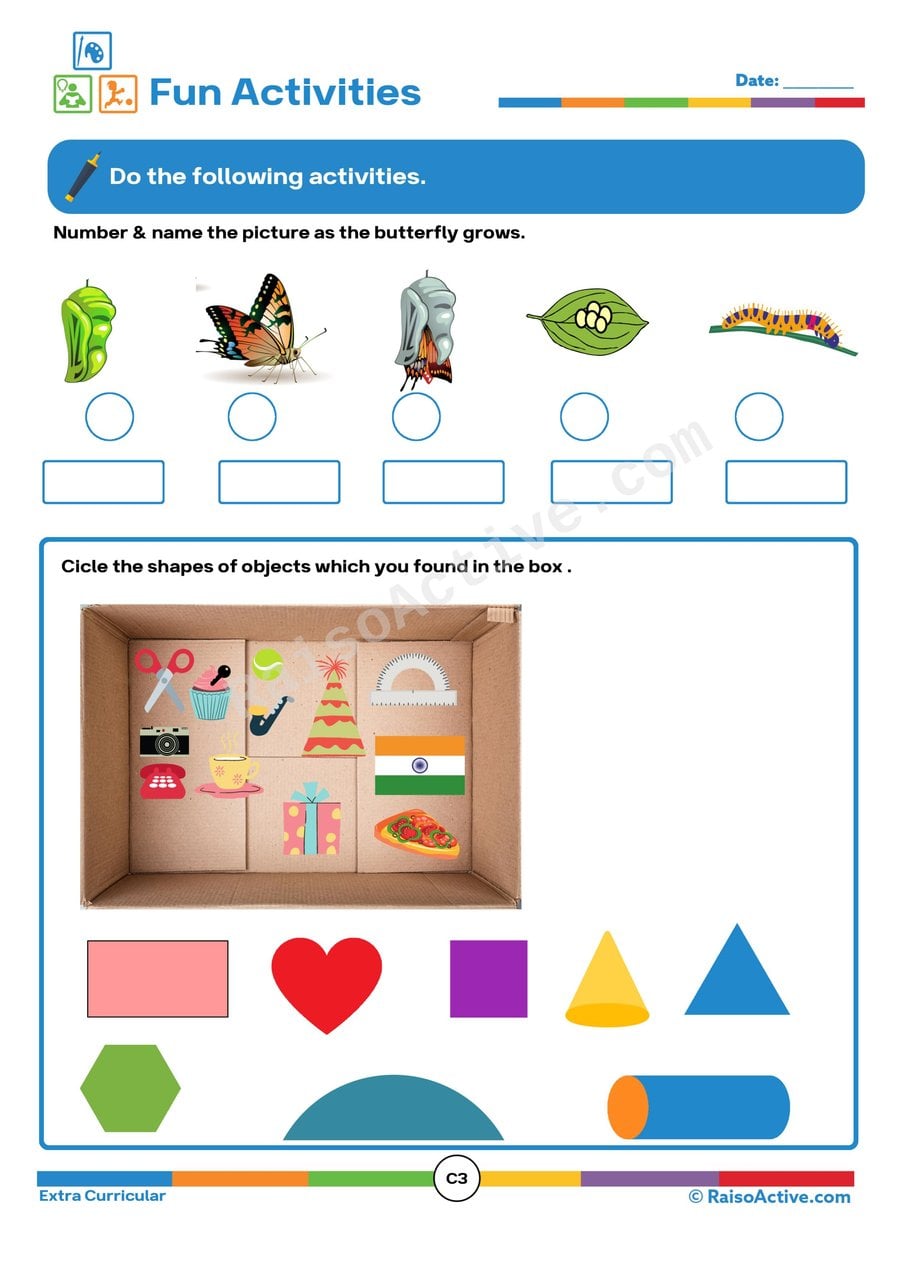
Butterfly Life Cycle Worksheet for Kids
Ages 3-5 · Preschool–Pre-KAges 3-5 · Nursery–ReceptionAges 3-5 · Nursery–LKGAges 3-5
This worksheet introduces children ages 3-5 to the four stages of a butterfly's life cycle — egg, caterpillar, chrysalis, and butterfly — by having them number the pictures in the correct sequence. Understanding a life cycle as an ordered sequence of changes is an early but genuine science skill, building the sequencing and cause-and-effect thinking children need for later scientific reasoning.

Easter Pattern Match Worksheet: Bunny, Basket, and Egg Fun!
Ages 3-5 · Preschool–Pre-KAges 3-5 · Nursery–ReceptionAges 3-5 · Nursery–LKGAges 3-5
This worksheet has children ages 3-5 study a repeating pattern shown across a set of bunny, basket, and egg images, then identify which item on the right continues or matches that same pattern. Recognizing a pattern by its color or design sequence builds early algebraic thinking, since spotting what comes next is a skill children will rely on throughout math.

Match the Flags! A Fun Coloring Worksheet for Kids
Ages 3-5 · Preschool–Pre-KAges 3-5 · Nursery–ReceptionAges 3-5 · Nursery–LKGAges 3-5
This worksheet combines coloring with flag recognition, helping children ages 3-5 practice fine motor control while learning to match a colored flag to its correct blank outline. Coloring the flags first, then matching them, adds an extra layer of visual processing as children must recall the colors they just used to complete the matching step.
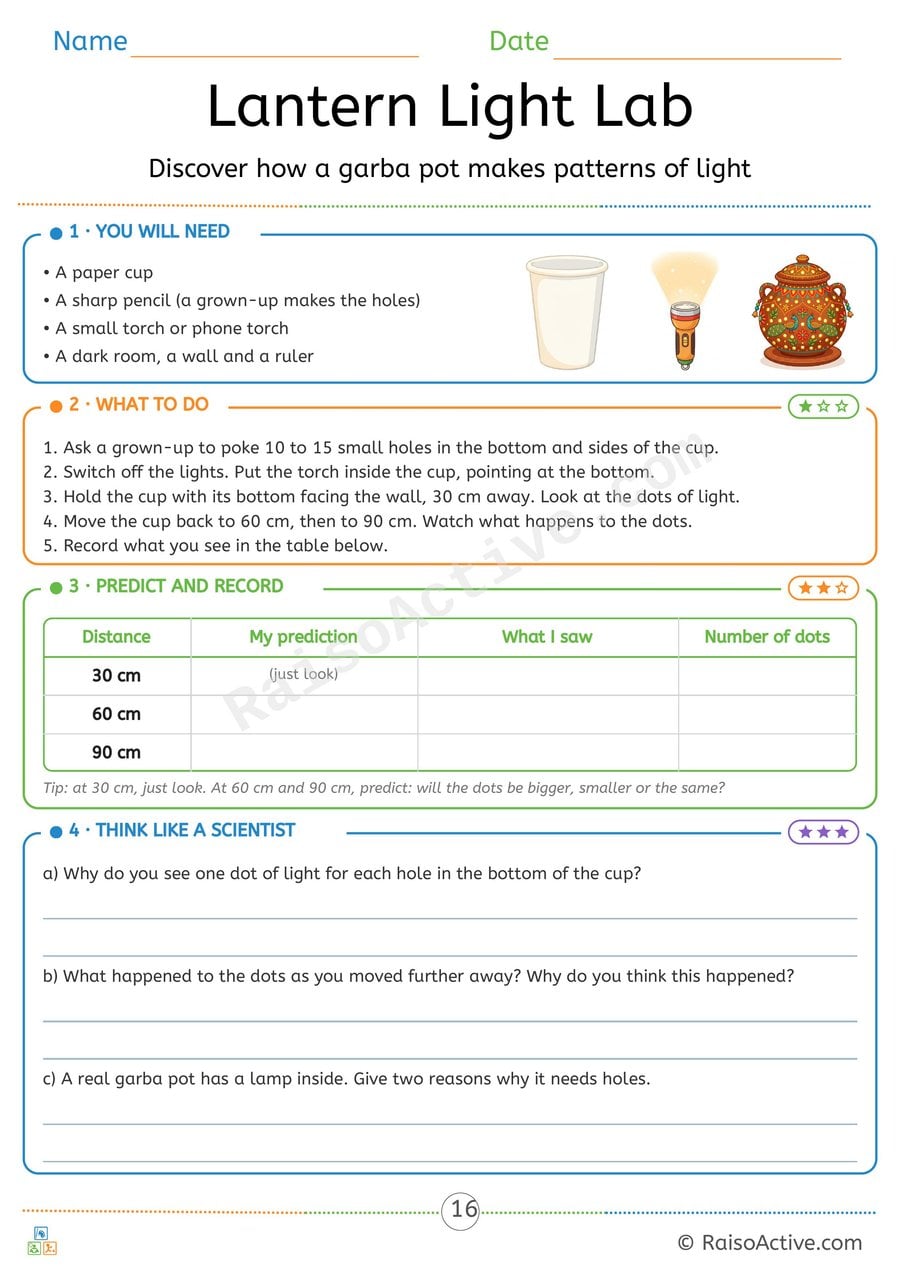
Lantern Light Lab: Navratri Garba Pot Light Experiment
Ages 7-11 · Grade 2–Grade 3Ages 7-11 · Year 3–Year 4Ages 7-11 · Class 2–Class 3Ages 7-11
Children make holes in a paper cup, shine a torch through it and see one spot of light for each hole. They predict and record what happens as they move further from the wall, and explain the results and why a real garba pot needs holes.

Identify Flags Worksheet: Cut and Paste Matching Activity
Ages 4-6 · Pre-K–KindergartenAges 4-6 · Reception–Year 1Ages 4-6 · LKG–UKGAges 4-6
This worksheet helps children ages 4-6 practice matching a country's flag to its written name, building both visual discrimination and early geography vocabulary. Pairing a flag's specific colors and pattern with a country name strengthens the same visual-matching skill children later use for letter and word recognition.

States of Matter Worksheet: Exploring Solids, Liquids, and Gases!
Ages 4-6 · Pre-K–KindergartenAges 4-6 · Reception–Year 1Ages 4-6 · LKG–UKGAges 4-6
This worksheet introduces children ages 4-6 to the three states of matter — solid, liquid, and gas — by having them examine images and sort each one into its correct category. Learning to classify familiar objects (like ice, water, and steam) by their physical state builds early scientific reasoning, since children must look past an object's identity and focus on its underlying properties.
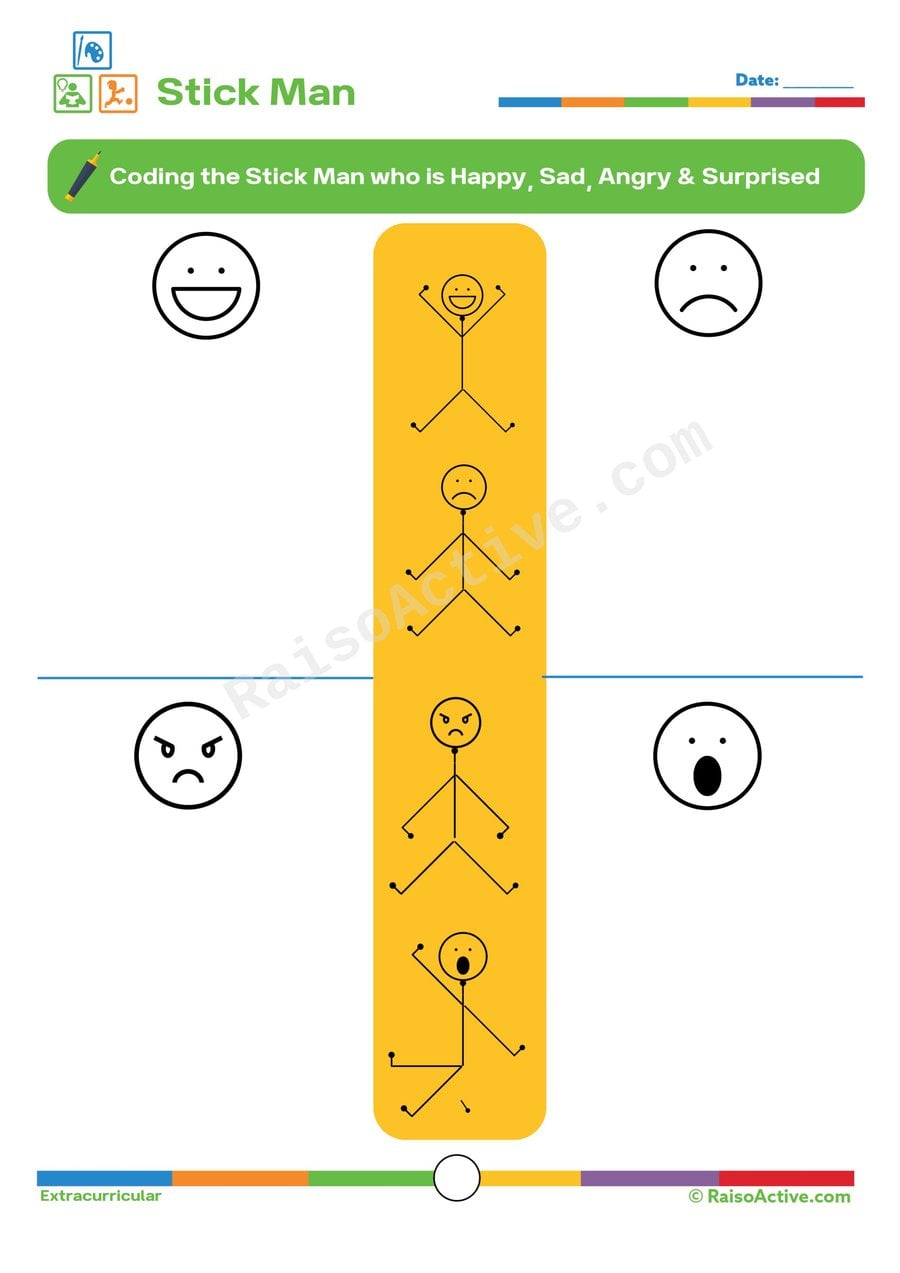
Stick Man Emotions Worksheet: Happy, Sad, Angry & Surprised!
Ages 3-5 · Preschool–Pre-KAges 3-5 · Nursery–ReceptionAges 3-5 · Nursery–LKGAges 3-5
Matching simple stick-figure faces to emotion words helps children ages 3-5 build an early emotional vocabulary, connecting facial cues like a curved mouth or raised eyebrows to specific feeling words. This kind of emotion recognition is a foundational social-emotional skill, helping children name what they and others are feeling instead of just reacting.

Easter Egg Color Match Worksheet for Preschoolers
Ages 3-5 · Preschool–Pre-KAges 3-5 · Nursery–ReceptionAges 3-5 · Nursery–LKGAges 3-5
This worksheet builds on color recognition by asking children ages 3-5 to color a full row of eggs so they all match one another, reinforcing visual discrimination alongside color vocabulary. Rather than following a printed key, children must compare their own work egg to egg, which adds a self-checking element to the coloring task.
Guides for this topic

Best Worksheets for 3-Year-Olds: What Works and What to Avoid
What works on worksheets for 3-year-olds: short sessions, crayons, tracing lines, matching, cutting, a free weekly plan, and signs one is too advanced.

Discovering Wonder: Nature-Based Learning Activities That Captivate Young Children
Explore nature-based learning activities for children ages 2–7 — leaf rubbings, bug hunts, nature journals, and seasonal Indian outdoor ideas that spark wonder.

Creating Engaging Themed Learning Units for Young Children: A Complete Guide to Integrated Learning
Discover how to create engaging themed learning units for young children that integrate literacy, maths, science, and art — with practical examples and free worksheets.
Reviews
Every worksheet for ages 4–6, no watermark
Members download the full library of 1,000+ worksheets and every activity pack without watermarks or daily limits. One year costs ₹999 in India or $20 elsewhere.
See membership plansOr download any worksheet free with a watermark (5 a day).