Parent's Guide: Learning Letters, Numbers, and More!
This parent guide brings together three foundational early-learning concepts for children ages 3-5 — capital and lowercase letter identification, basic counting, and the spatial concepts of open and close — into one set of simple, no-prep activities. Rather than a traditional fill-in worksheet, it gives parents a structured way to practice these skills through conversation and hands-on play, which suits the attention span and learning style of preschool-age children particularly well. Covering letters, numbers, and spatial vocabulary together in one sitting also shows children how different areas of early learning connect to everyday objects around them.
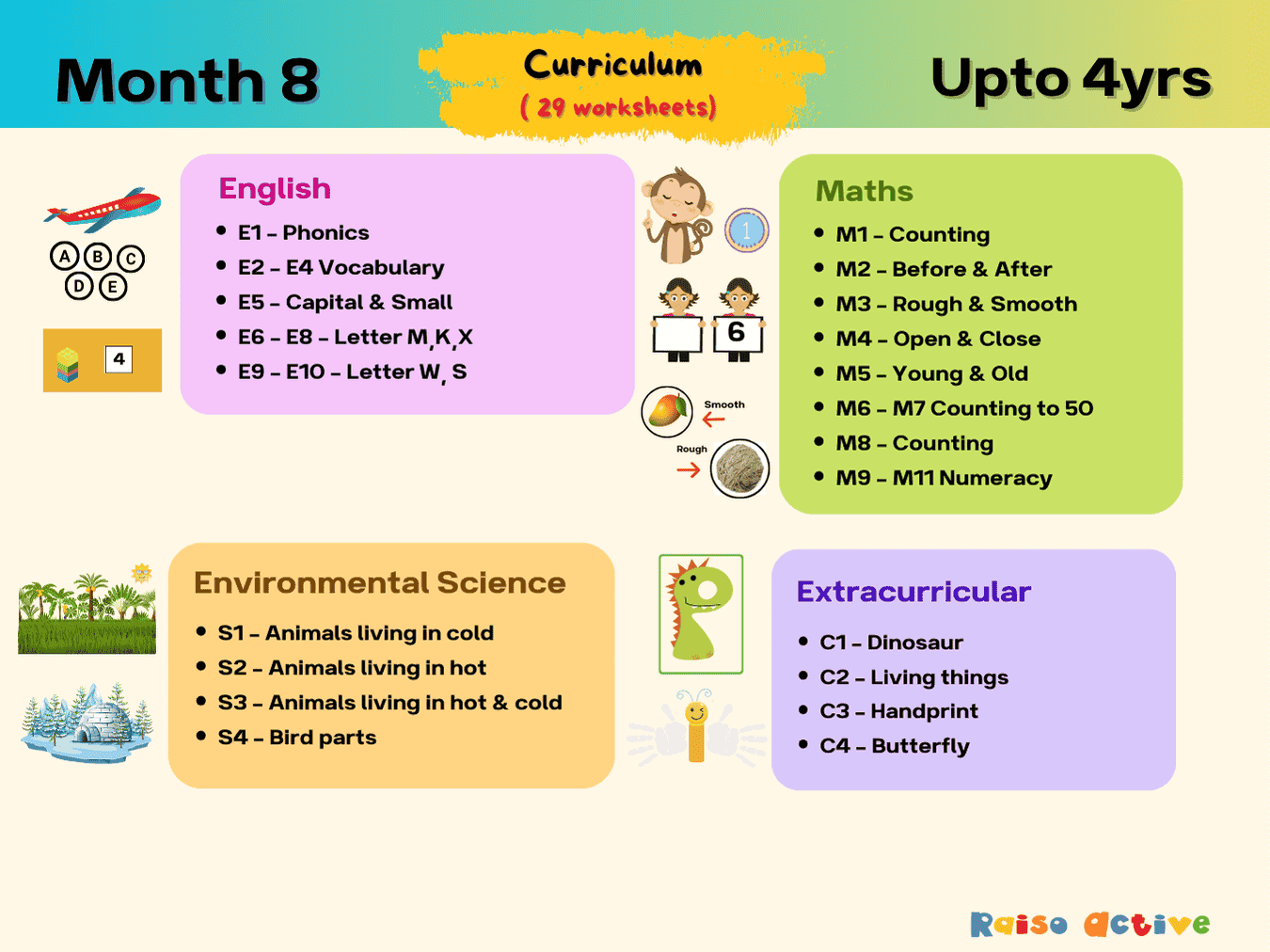
Part of the pack
Month 8: Phonics, Math, Science, Creativity | Ages Up to 4
This is page 3 of the pack. Ages 3-5 · Preschool–Pre-KAges 3-5 · Nursery–ReceptionAges 3-5 · Nursery–LKGAges 3-5
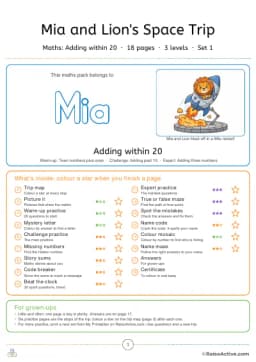
Made for your child
Counting to 10, made for your child
A maths pack with your child's name in it: pictures that explain, practice at three levels, puzzles and story sums about them. Print a new set whenever they finish.
Make a maths packFree preview · free for members
Curriculum
- Writing > Letter Tracing A-Z
How to use this worksheet
Start with the letter identification activity, showing your child a capital letter and asking them to find or name its matching lowercase partner. Move on to the counting activity, laying out a small group of blocks and asking your child to count them aloud one at a time. Finish with the open and close game, using your hands or a real object like a box to demonstrate and then ask your child to show you 'open' and 'close.' Work through the three activities in one sitting or spread across a few short sessions, whichever keeps your child engaged.
Materials needed
- Flashcards
- Blocks
- Hands
Extension activities
- 1Create flashcards for other letters not covered in the guide and practice matching capitals to lowercase.
- 2Count other everyday objects around the house, like fruit in a bowl or stairs on the way up to bed.
- 3Practice open and close with other objects, like a book, a jar, or a door, naming the action each time.
- 4Combine all three skills in one game: count blocks, sort them by an open/closed container, then label them with a letter.

Written by
Hemsweta Jain · Teacher Cheena
MBA and Early Childhood Educator, teaching since 2014 · Founder of RaisoActive, Mumbai
Every RaisoActive worksheet is designed and checked by the founder before publishing.
Published · Last reviewed
More from Month 8: Phonics, Math, Science, Creativity | Ages Up to 4

Cut and Paste Vocabulary Worksheet: Matching Words to Pictures
Ages 3-5 · Preschool–Pre-KAges 3-5 · Nursery–ReceptionAges 3-5 · Nursery–LKGAges 3-5
Matching printed words to their pictures asks emerging readers to connect an abstract string of letters with a real object, an essential step on the path from picture recognition to true word reading. The cutting and pasting adds a tactile, deliberate pace to the matching process, giving children extra time to look closely at each word before committing to an answer.

Capital and Small Letter Matching Worksheet for Preschoolers
Ages 3-5 · Preschool–Pre-KAges 3-5 · Nursery–ReceptionAges 3-5 · Nursery–LKGAges 3-5
Children ages 3-5 build letter recognition fluency by matching each uppercase letter to its corresponding lowercase form, a skill essential for reading since text uses both cases interchangeably. Recognizing that 'B' and 'b' represent the same letter sound despite looking different is a genuinely tricky early literacy milestone. Circling words that begin with a capital letter adds an extra layer of practice noticing capitalization in real context.

Counting Fun: Match the Numbers Worksheet for Preschoolers!
Ages 3-5 · Preschool–Pre-KAges 3-5 · Nursery–ReceptionAges 3-5 · Nursery–LKGAges 3-5
This worksheet layers three related counting skills, counting a group of objects, matching that group to its printed numeral, and matching the numeral to a set of fingers, so children see the same quantity represented three different ways. Seeing one number expressed as objects, digits, and fingers helps cement true number sense rather than just memorized counting words.

Animals in Cold Climates Cut and Paste Worksheet for Kids
Ages 3-5 · Preschool–Pre-KAges 3-5 · Nursery–ReceptionAges 3-5 · Nursery–LKGAges 3-5
Sorting animals into the cold-climate habitats where they actually live introduces preschoolers to the idea that different animals are adapted to survive in different environments, an early building block for later lessons in ecosystems and animal science. The cutting and pasting also reinforces fine motor control while giving children a reason to look closely at each animal picture and recall what they know about it.

Bird Parts Cut and Paste Worksheet for Preschoolers
Ages 3-5 · Preschool–Pre-KAges 3-5 · Nursery–ReceptionAges 3-5 · Nursery–LKGAges 3-5
Children ages 3-5 learn the names of specific bird body parts — such as wings, beak, tail, and feathers — by cutting out labels and pasting them next to the correct part of a bird illustration. This activity builds early scientific vocabulary and observational skills, teaching children to notice distinct features rather than viewing an animal as one shape. The cutting and pasting also develops the scissor control and hand-eye coordination needed for fine motor growth.
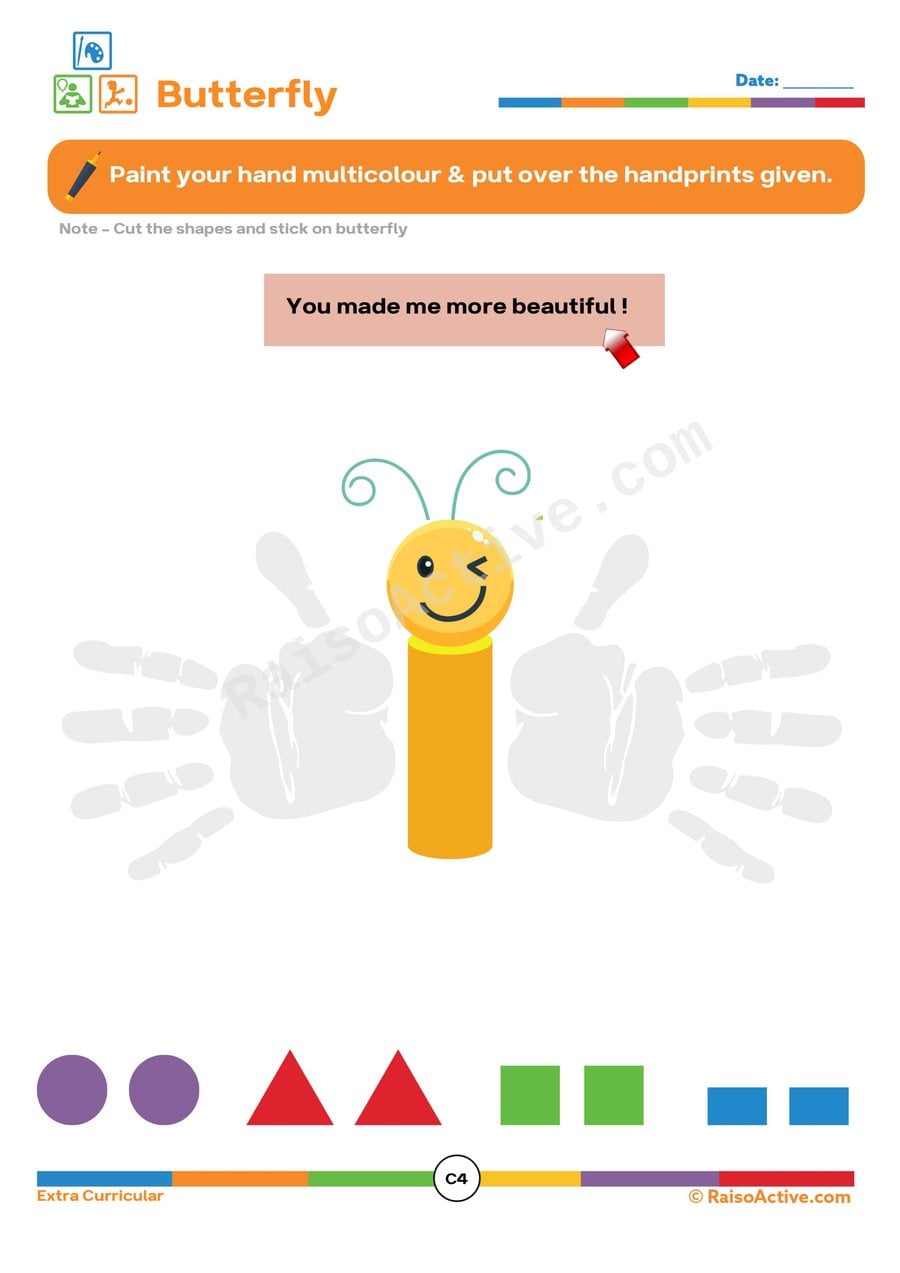
Butterfly Handprint Craft Worksheet for Kids
Ages 3-5 · Preschool–Pre-KAges 3-5 · Nursery–ReceptionAges 3-5 · Nursery–LKGAges 3-5
Painting a handprint to form butterfly wings and then adding cut-out details turns this craft into practice for both fine motor control and symmetry, since a butterfly's wings mirror each other, children begin to notice matching patterns on either side of a center line. The multi-step process of painting, waiting, cutting, and pasting also builds patience and sequencing skills appropriate for ages three to five.
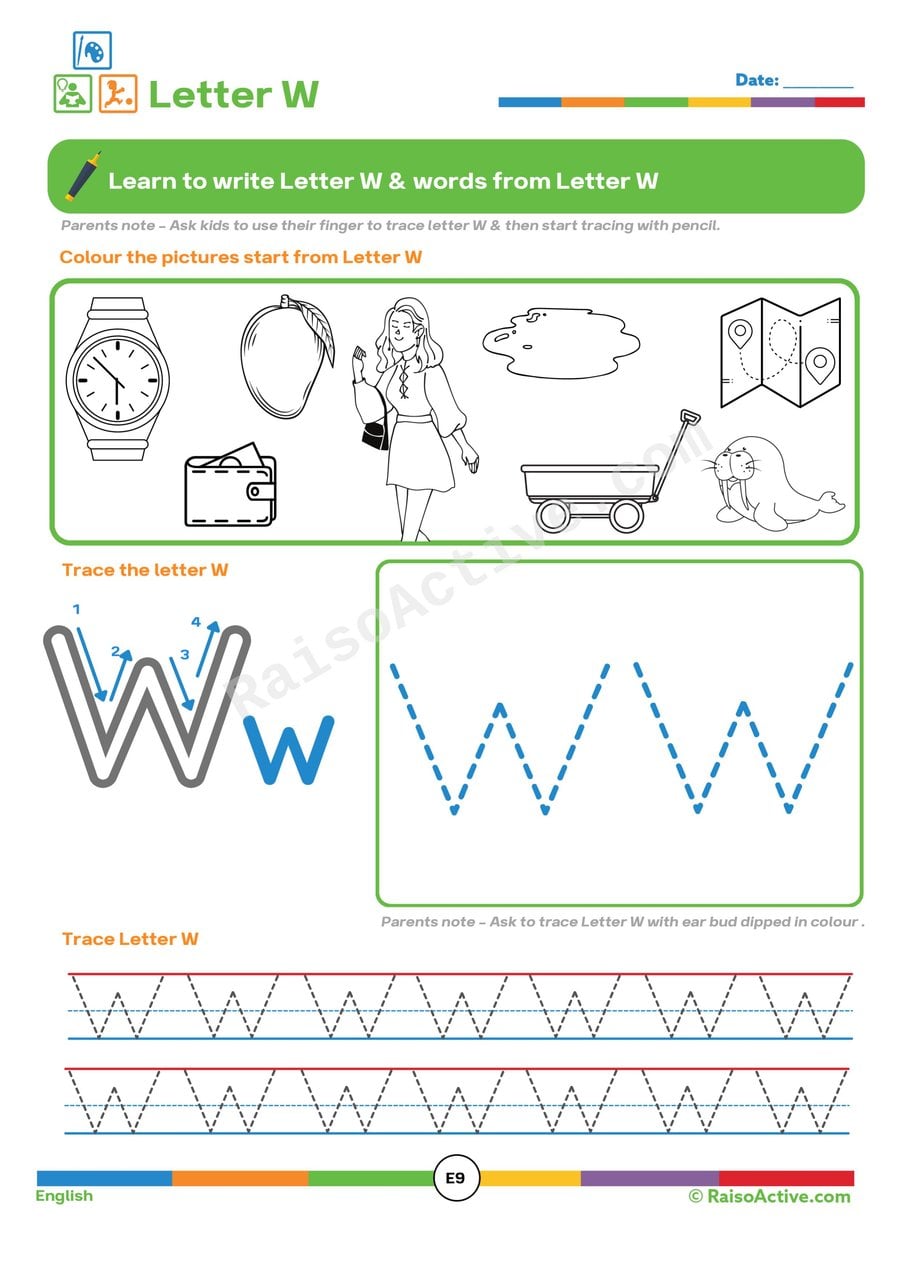
Letter W Worksheet: Trace, Color, and Learn!
Ages 3-5 · Preschool–Pre-KAges 3-5 · Nursery–ReceptionAges 3-5 · Nursery–LKGAges 3-5
Children ages 3-5 practice tracing both the uppercase and lowercase forms of the letter W, learning to distinguish the sharper zigzag of the capital from the rounded double-curve of the lowercase. This dual-case tracing builds the visual discrimination and fine motor precision needed to eventually read and write both forms correctly. Coloring W-word pictures ties the letter's shape to its beginning sound for early phonics development.
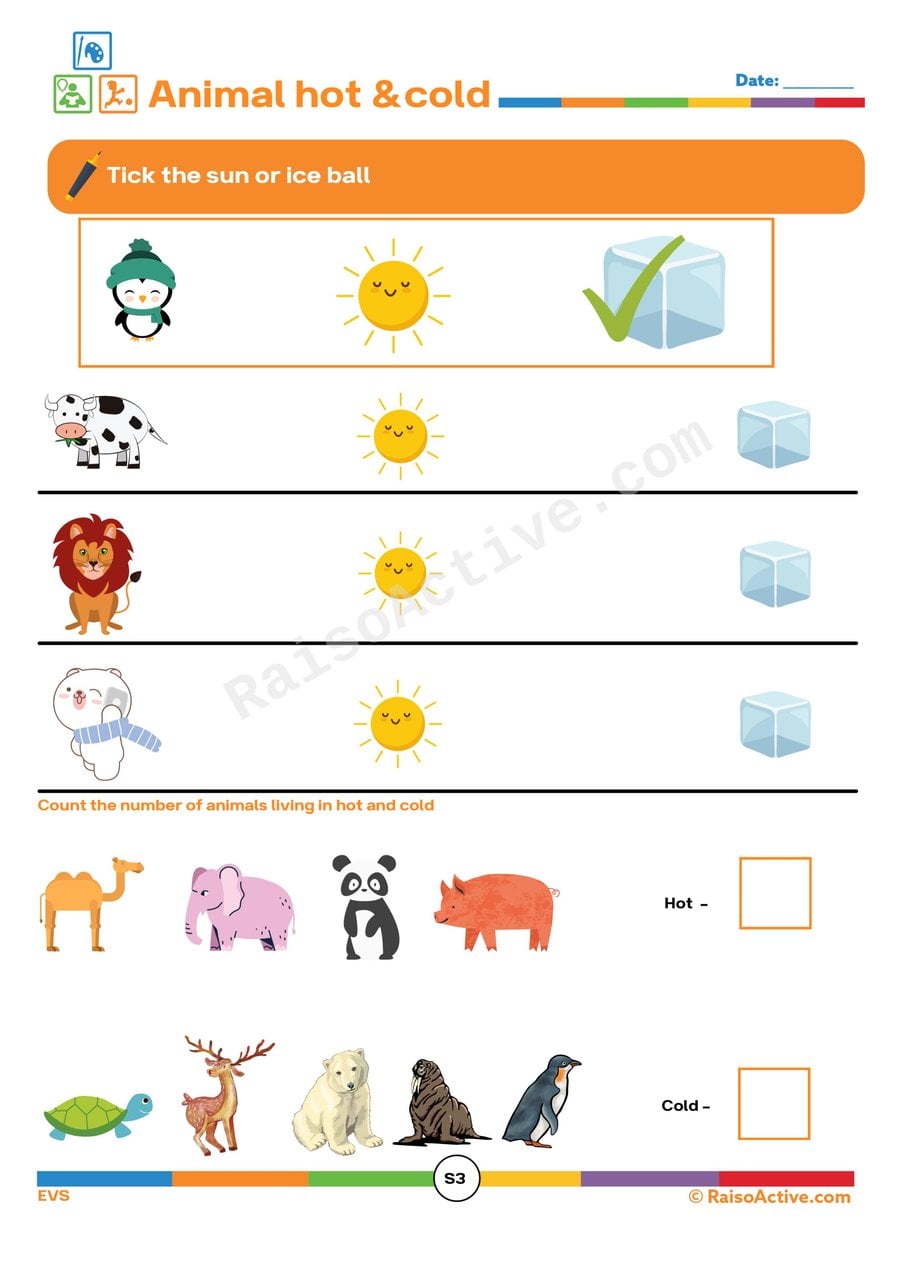
Animal Hot and Cold Worksheet for Preschoolers
Ages 3-5 · Preschool–Pre-KAges 3-5 · Nursery–ReceptionAges 3-5 · Nursery–LKGAges 3-5
This worksheet asks children to reason about which environment, hot or cold, best suits a given animal, then apply a counting task on top of that sorting decision. Combining habitat reasoning with counting practice keeps two important skill areas, science classification and numeracy, active in the same activity, which helps preschoolers see connections across subjects rather than treating them separately.
Related worksheets

Parent's Guide: Fun Activities for Early Learning!
Ages 3-5 · Preschool–Pre-KAges 3-5 · Nursery–ReceptionAges 3-5 · Nursery–LKGAges 3-5
This parent's guide gathers a set of adaptable, no-worksheet activities that build early reading, science exploration, and creative thinking for children ages 3-5. Because the activities span different domains — from a family memory book to sink-or-float experiments — this guide supports well-rounded early learning that goes beyond pencil-and-paper practice into hands-on discovery.

Fun Activities for Kids: Blend Words, Reading, and Science Experiments!
Ages 3-5 · Preschool–Pre-KAges 3-5 · Nursery–ReceptionAges 3-5 · Nursery–LKGAges 3-5
This multi-activity guide introduces children ages 3-5 to blend words, simple story reading, and hands-on science experiments like making a chocolate shake and testing dissolving, all in one session. Moving between literacy and science tasks builds flexible thinking and shows children that reading and hands-on exploration are connected, reinforcing that new vocabulary can describe real, observable experiments.

Parent's Guide: Sentence Framing and Early Literacy Activities
Ages 3-5 · Preschool–Pre-KAges 3-5 · Nursery–ReceptionAges 3-5 · Nursery–LKGAges 3-5
This parent's guide equips families of children ages 3-5 with a toolkit of hands-on activities — sentence framing, letter games, number and money recognition, and before/after sequencing with blocks — that build early literacy and numeracy together rather than in isolation. Framing simple sentences specifically helps children move from single words to connected speech, a critical bridge toward writing their own sentences later.

Parent's Guide: Fun Activities for Early Learning!
Ages 3-5 · Preschool–Pre-KAges 3-5 · Nursery–ReceptionAges 3-5 · Nursery–LKGAges 3-5
This parent's guide compiles a set of short activities spanning early literacy, spatial reasoning, and problem-solving, giving caregivers ready-made ways to build foundational skills through everyday play. For ages 3-5, mixing activity types across one guide, like word games and puzzles, keeps a young child's attention while covering multiple developmental areas in a single session or across a week.

Fun Parent's Guide: Vocabulary, Phonics, and Animal Activities!
Ages 3-5 · Preschool–Pre-KAges 3-5 · Nursery–ReceptionAges 3-5 · Nursery–LKGAges 3-5
This parent's guide bundles together activities for vocabulary building, phonics practice, and animal-themed learning, giving children ages 3-5 varied exposure to language concepts like left and right, letter-object matching, and number sorting through hands-on play. Because the activities span several skill areas, the guide offers flexibility to match whatever your child is most interested in on a given day.

Parent's Guide: Sight Words and CVC Words Activities
Ages 3-5 · Preschool–Pre-KAges 3-5 · Nursery–ReceptionAges 3-5 · Nursery–LKGAges 3-5
This parent's guide offers a set of hands-on activities for children ages 3-5 that build early reading skills through sight word and CVC (consonant-vowel-consonant) word practice, using letter blocks, storytelling, and even a color-mixing experiment to keep learning varied and engaging. Practicing sight words and simple three-letter words together builds the foundation for sounding out and recognizing whole words while reading.

Parent's Guide: Vocabulary Building and Emotional Development Worksheet
Ages 3-5 · Preschool–Pre-KAges 3-5 · Nursery–ReceptionAges 3-5 · Nursery–LKGAges 3-5
This multi-part parent guide walks children ages 3-5 through vocabulary sorting, making emotion faces, discussing seasons, and identifying good habits, covering both language development and emotional awareness in a single guided session. Naming emotions accurately and building vocabulary side by side helps children develop the words they need to express their feelings clearly, a skill that supports both communication and self-regulation.
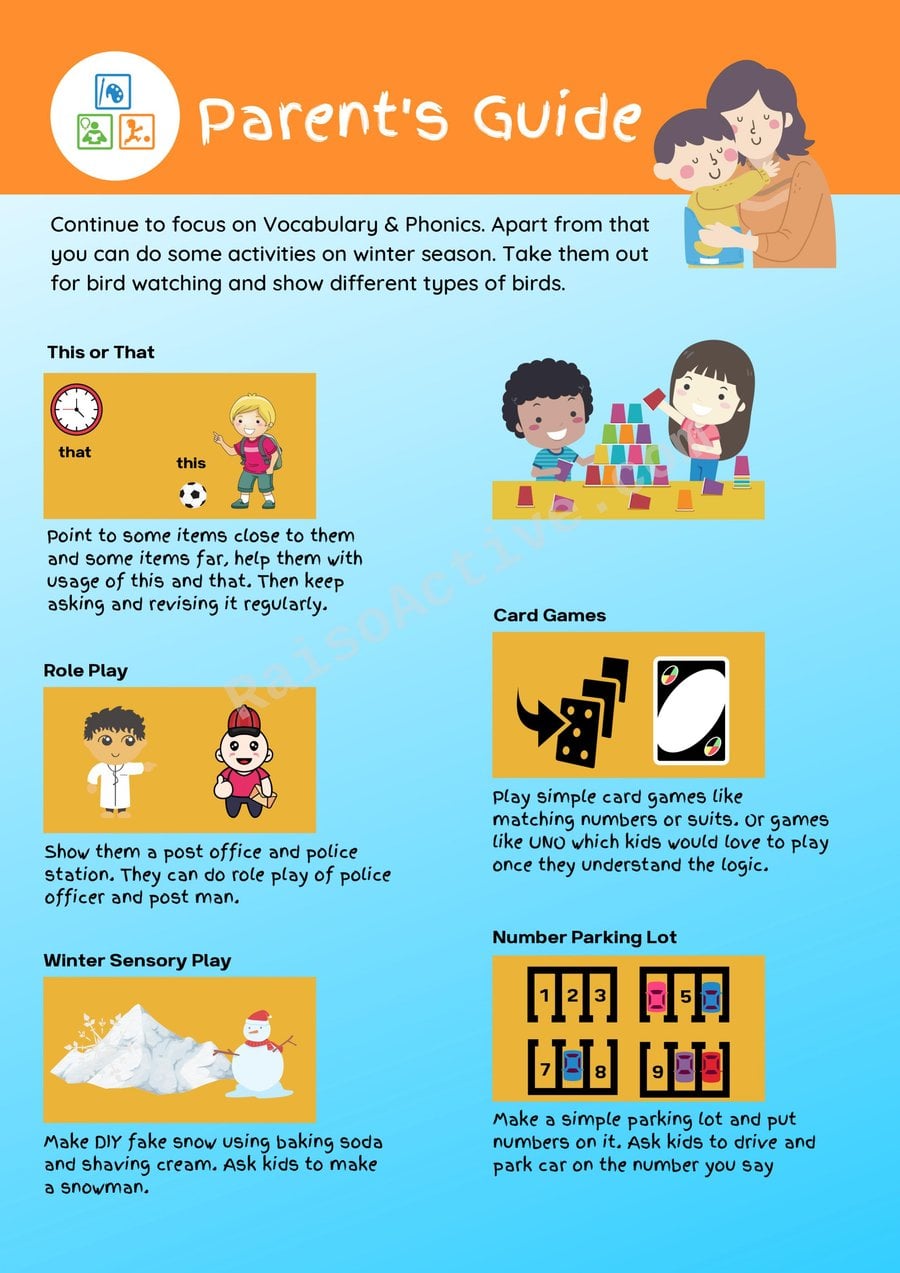
Winter Fun Activities for Kids: Parent's Guide
Ages 3-5 · Preschool–Pre-KAges 3-5 · Nursery–ReceptionAges 3-5 · Nursery–LKGAges 3-5
This parent's guide bundles several short winter-themed activities, from vocabulary games to sensory play, that build language skills, matching ability, and role-play confidence in one seasonal package. For ages 3-5, mixing modalities like talking, sorting, and hands-on sensory exploration keeps engagement high while reinforcing skills across different learning styles.
Guides for this topic

Number Formation Rhymes 0–9 and How to Fix Reversals
Original number formation rhymes for 0–9, the correct stroke order for each digit, why 3, 5 and 7 get reversed most often, and multisensory fixes that work.

Documenting Learning Without Drowning in Data: A Practical Guide for Parents and Teachers
Learn practical ways to document your child's learning without overwhelm. Simple portfolios, observation tips, and printable trackers for ages 1-8.
What's the Best Alternative to ABCmouse? A Complete Parent's Guide to Free and Affordable Educational Apps
ABCmouse runs ~Rs 4,000-5,000/year with US spellings and curriculum. Compare free & affordable Indian-friendly apps like Khan Academy Kids and DIKSHA.
Reviews
Every worksheet for ages 3–5, no watermark
Members download the full library of 1,000+ worksheets and every activity pack without watermarks or daily limits. One year costs ₹999 in India or $20 elsewhere.
See membership plansOr download any worksheet free with a watermark (5 a day).