Practice the Letter P! Uppercase and Lowercase Tracing Worksheet
P combines a straight vertical line with a small curve at the top, similar in structure to letters like R and B, giving children ages 3-5 practice with letters that have a 'stick and loop' pattern. Tracing both uppercase P and lowercase p also introduces the idea that lowercase p has a tail that dips below the line, unlike its capital form.
Part of the pack
Alphabet Tracing Activity Book | Uppercase & Lowercase A-Z for Preschool & Kindergarten
This is page 17 of the pack. Ages 3-6 · Preschool–KindergartenAges 3-6 · Nursery–Year 1Ages 3-6 · Nursery–UKGAges 3-6
Made for your child
A whole activity pack made with their name
60 pages to spot, build, trace and write their own name, plus pages about their favourites, feelings and family. See a free preview with their name.
Make an All About Me packFree preview · free for members
Or start free: a name tracing sheet with their nameCurriculum
- Writing > Letter Tracing A-Z
- Phonics - Letter Sounds > Letter P
How to use this worksheet
Point out the dotted uppercase P and lowercase p and trace each with a finger, noticing that the lowercase version has a tail hanging below the line. Have your child trace the dotted letters on the page slowly. Move to the practice lines and let them write the letters on their own, checking the lowercase tail extends below the line. Finish with a sand or playdough version of the letter P if they'd like extra practice.
Materials needed
- Pencil
- Eraser
Extension activities
- 1Find P objects around the house, like a pencil, a pillow, or a toy pig.
- 2Draw a pig or a pumpkin and write a big letter P next to it.
- 3Practice writing lowercase p in sand or with playdough, paying attention to the dipping tail.
- 4Play a simple game popping bubble wrap every time you say a word starting with P.
- 5Color the pictures on the worksheet and name each P word aloud.

Written by
Hemsweta Jain · Teacher Cheena
MBA and Early Childhood Educator, teaching since 2014 · Founder of RaisoActive, Mumbai
Every RaisoActive worksheet is designed and checked by the founder before publishing.
Published · Last reviewed
More from Alphabet Tracing Activity Book | Uppercase & Lowercase A-Z for Preschool & Kindergarten
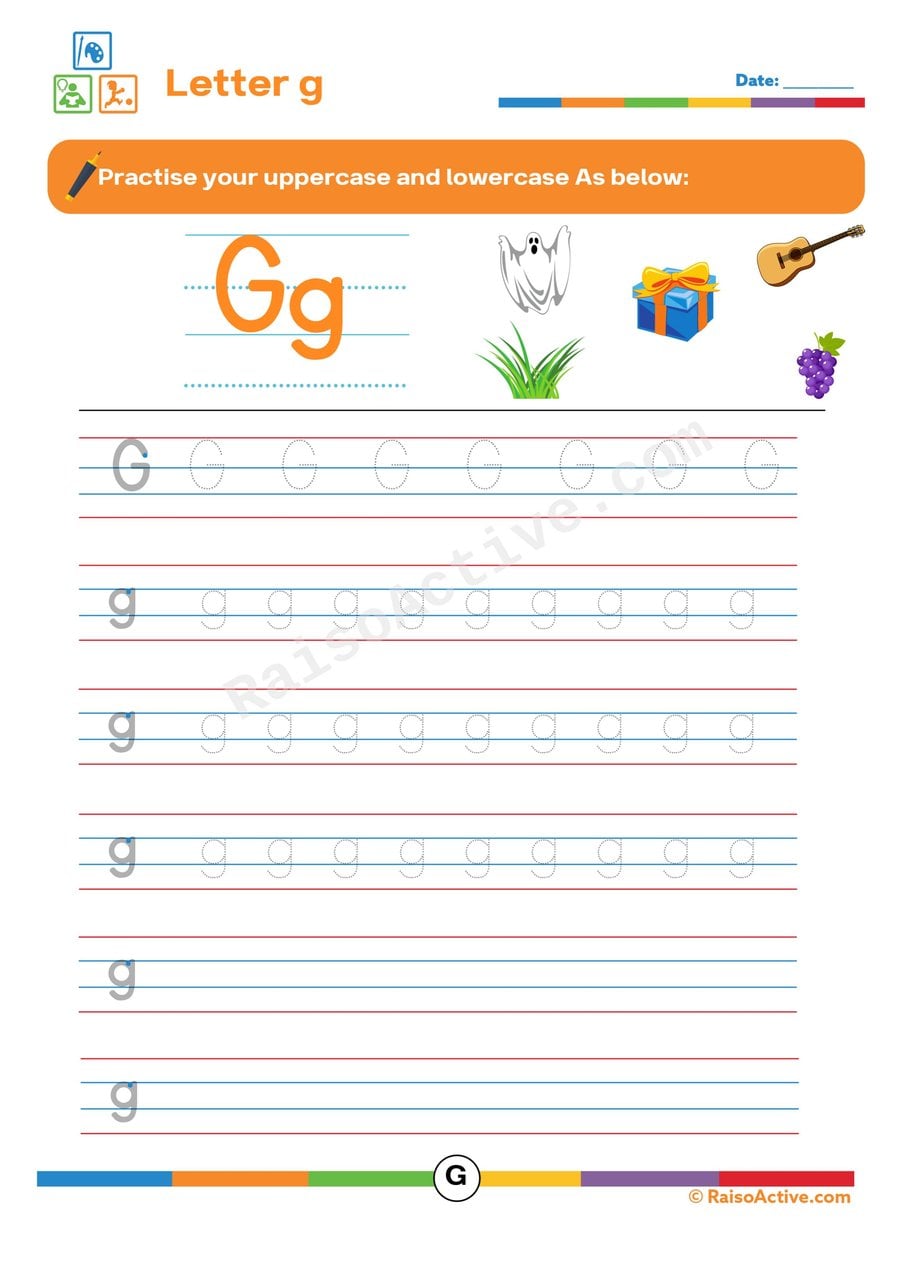
Trace the Letter G Worksheet for Preschoolers
Ages 3-5 · Preschool–Pre-KAges 3-5 · Nursery–ReceptionAges 3-5 · Nursery–LKGAges 3-5
Lowercase g is one of the more complex letters preschoolers encounter, combining a curved top with a descending tail that dips below the writing line — tracing it at ages 3-5 introduces the idea that some letters extend both above and below the main line, a concept that will matter for letters like j, p, and y too. Practicing the simpler capital G alongside it builds confidence before tackling the trickier lowercase form.

Z is for Zebra! Letter Z Tracing Worksheet for Preschoolers
Ages 3-5 · Preschool–Pre-KAges 3-5 · Nursery–ReceptionAges 3-5 · Nursery–LKGAges 3-5
Z is made of three connected strokes — across, diagonal, across — that must flow into each other without lifting the pencil too many times, which challenges the same multi-stroke coordination as letters like N and M but in a horizontal rather than vertical pattern. As the final letter of the alphabet, tracing Z alongside a zebra picture also gives a satisfying, memorable close to alphabet practice.

Letter N Tracing Worksheet: Practice Uppercase and Lowercase!
Ages 4-5 · Pre-KAges 4-5 · ReceptionAges 4-5 · LKGAges 4-5
N is built from two vertical lines connected by a diagonal stroke between them, a genuinely different pattern from letters like M that have four strokes, so tracing it at ages 4-5 sharpens a child's ability to notice and reproduce a specific number and order of strokes. This precision matters increasingly at this slightly older end of the preschool range, where handwriting expectations start to rise.

Letter a-z Practice Sheet: Handwriting Worksheet for Preschoolers
Ages 3-5 · Preschool–Pre-KAges 3-5 · Nursery–ReceptionAges 3-5 · Nursery–LKGAges 3-5
Practicing all 26 lowercase letters in one sitting builds the repeated, controlled pencil strokes that handwriting depends on, and doing them in order helps a 3-5 year old start to notice how letters relate to each other in the alphabet. Lowercase letters are what children encounter most often in books and signs, so fluency here has more everyday payoff than uppercase practice alone.
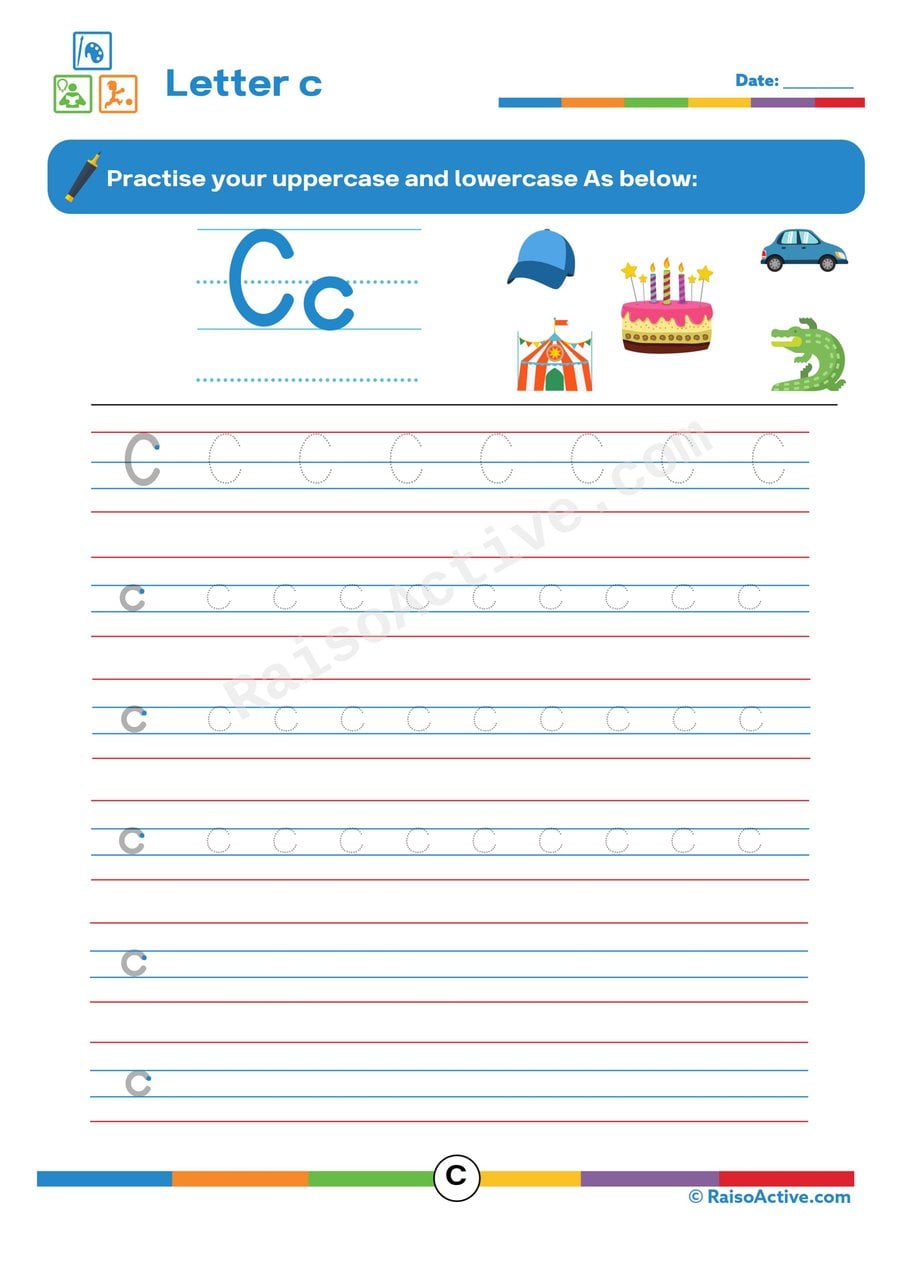
C is for Circus! Letter C Tracing Worksheet
Ages 3-5 · Preschool–Pre-KAges 3-5 · Nursery–ReceptionAges 3-5 · Nursery–LKGAges 3-5
Because C is a single open curve, tracing it gives children practice with smooth, continuous pencil movement without any straight lines or corners to lean on, similar to the challenge of letters like S and O. The circus theme on this worksheet also ties the letter to a memorable, exciting image, which helps preschoolers retain new letter-sound associations better than a plain, unthemed page.
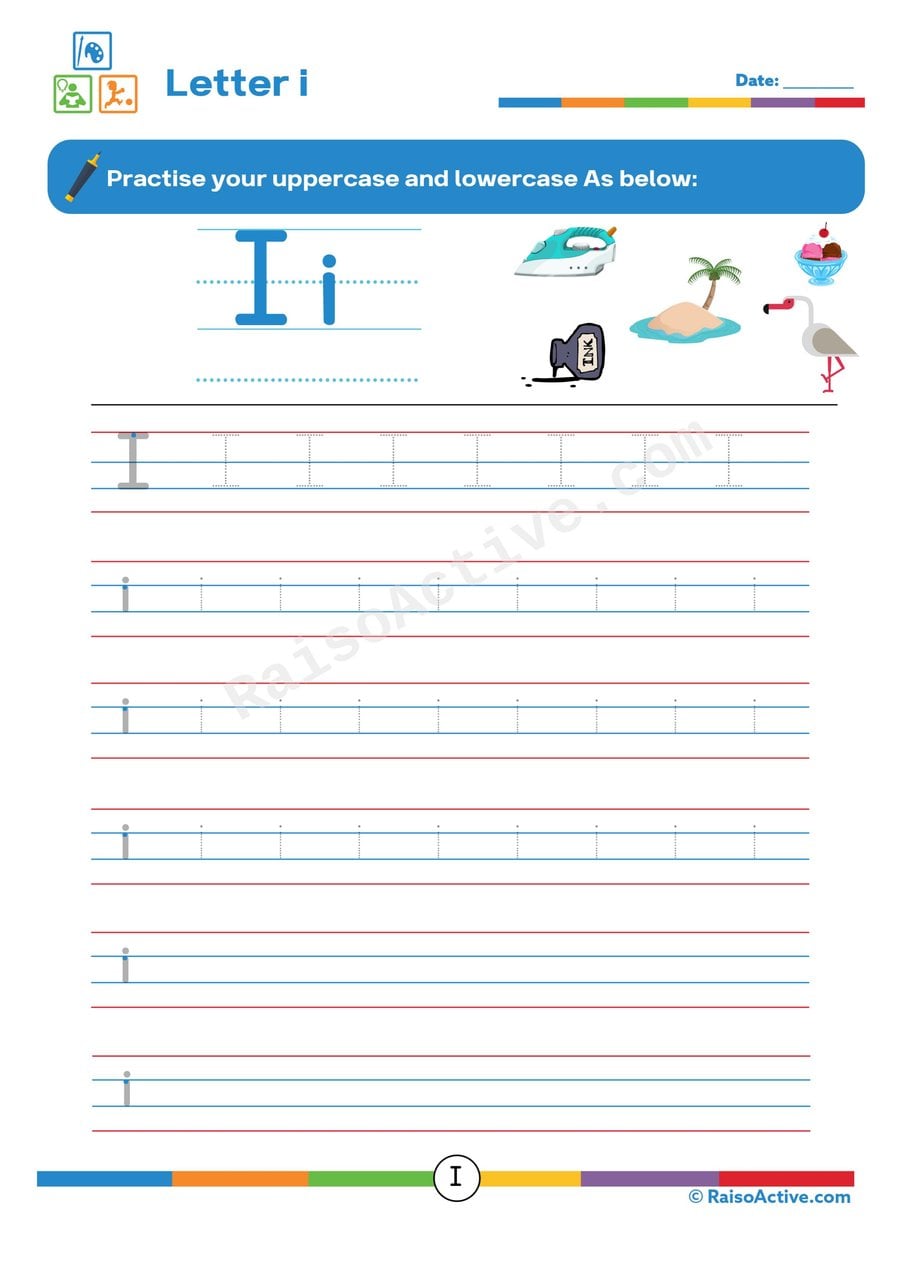
Letter I Tracing Worksheet for Preschoolers
Ages 3-5 · Preschool–Pre-KAges 3-5 · Nursery–ReceptionAges 3-5 · Nursery–LKGAges 3-5
Uppercase I is one of the simplest letters — a single straight vertical line — making it a quick, confidence-building trace, while lowercase i adds a small dot above a short line, introducing the idea that some letters have a separate mark that belongs to them. Practicing both forms at ages 3-5 teaches children that a letter's dot or detail isn't optional decoration but part of the letter itself.

Lowercase Letter Tracing Worksheet: Practice Writing the Alphabet
Ages 4-5 · Pre-KAges 4-5 · ReceptionAges 4-5 · LKGAges 4-5
This worksheet moves beyond a single letter to practice a full set of lowercase letters in sequence, asking 4-5 year olds to apply consistent size, spacing, and stroke habits across multiple different shapes rather than mastering just one. This kind of broader review is an important checkpoint skill at the older end of preschool, closer to the demands of actual kindergarten handwriting practice.

Letter L Tracing Worksheet for Preschoolers
Ages 3-5 · Preschool–Pre-KAges 3-5 · Nursery–ReceptionAges 3-5 · Nursery–LKGAges 3-5
L is a simple two-stroke letter — one line straight down, one line straight across — making it one of the easier letters for 3-5 year olds to master and a good letter for reinforcing that strokes should meet cleanly at a corner rather than overlap or leave a gap. Practicing uppercase L alongside lowercase l also shows children that this particular letter looks almost identical in both cases, just shorter.
Related worksheets
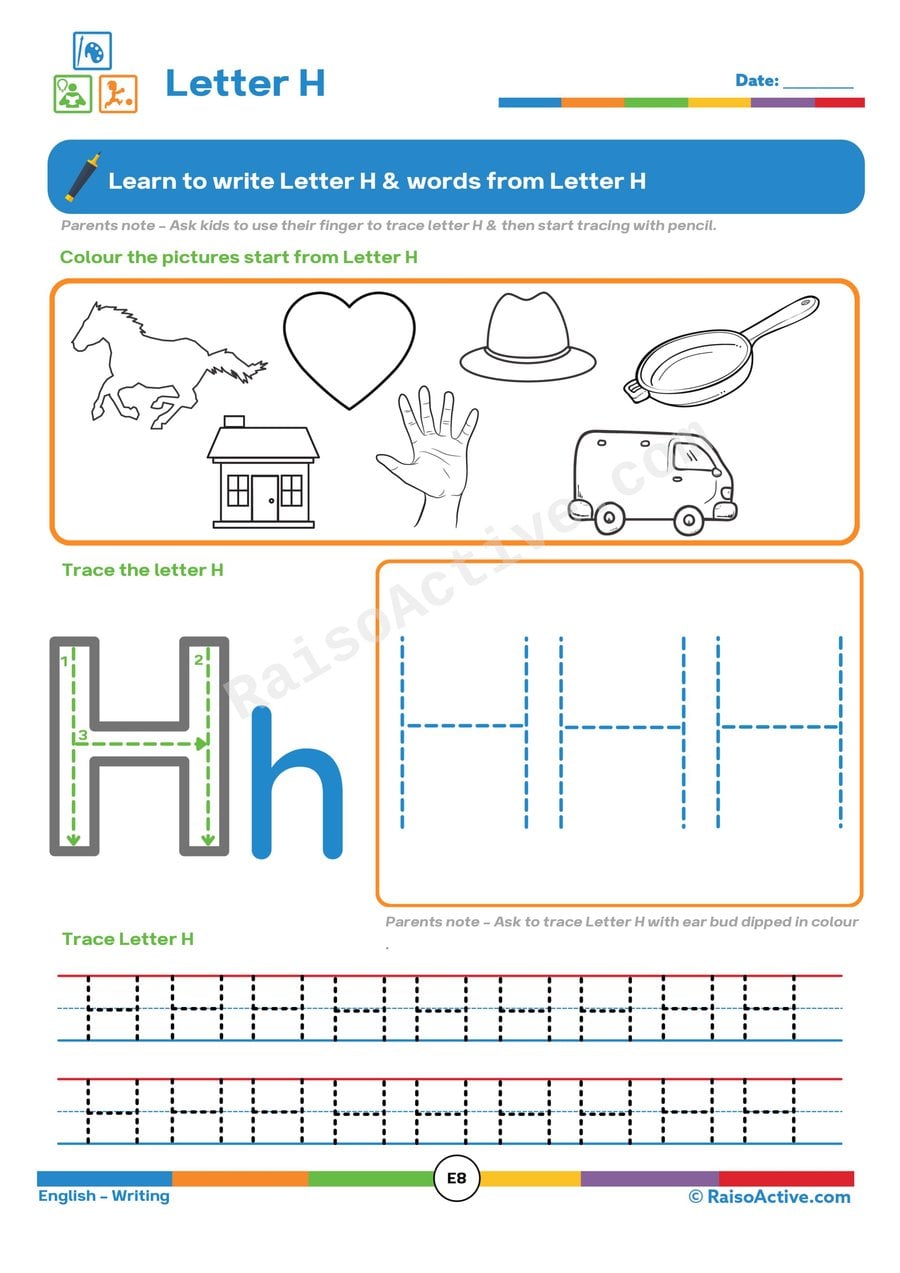
Trace the Letter H Worksheet for Preschoolers
Ages 3-5 · Preschool–Pre-KAges 3-5 · Nursery–ReceptionAges 3-5 · Nursery–LKGAges 3-5
Tracing the capital letter H gives children ages 3-5 focused practice in pencil control, directional tracking (top to bottom, left to right), and the specific line-and-line motion that forms H's two verticals and one horizontal bar. Pairing the tracing with pictures that start with H also strengthens letter-sound association, an essential early step toward decoding words later on.
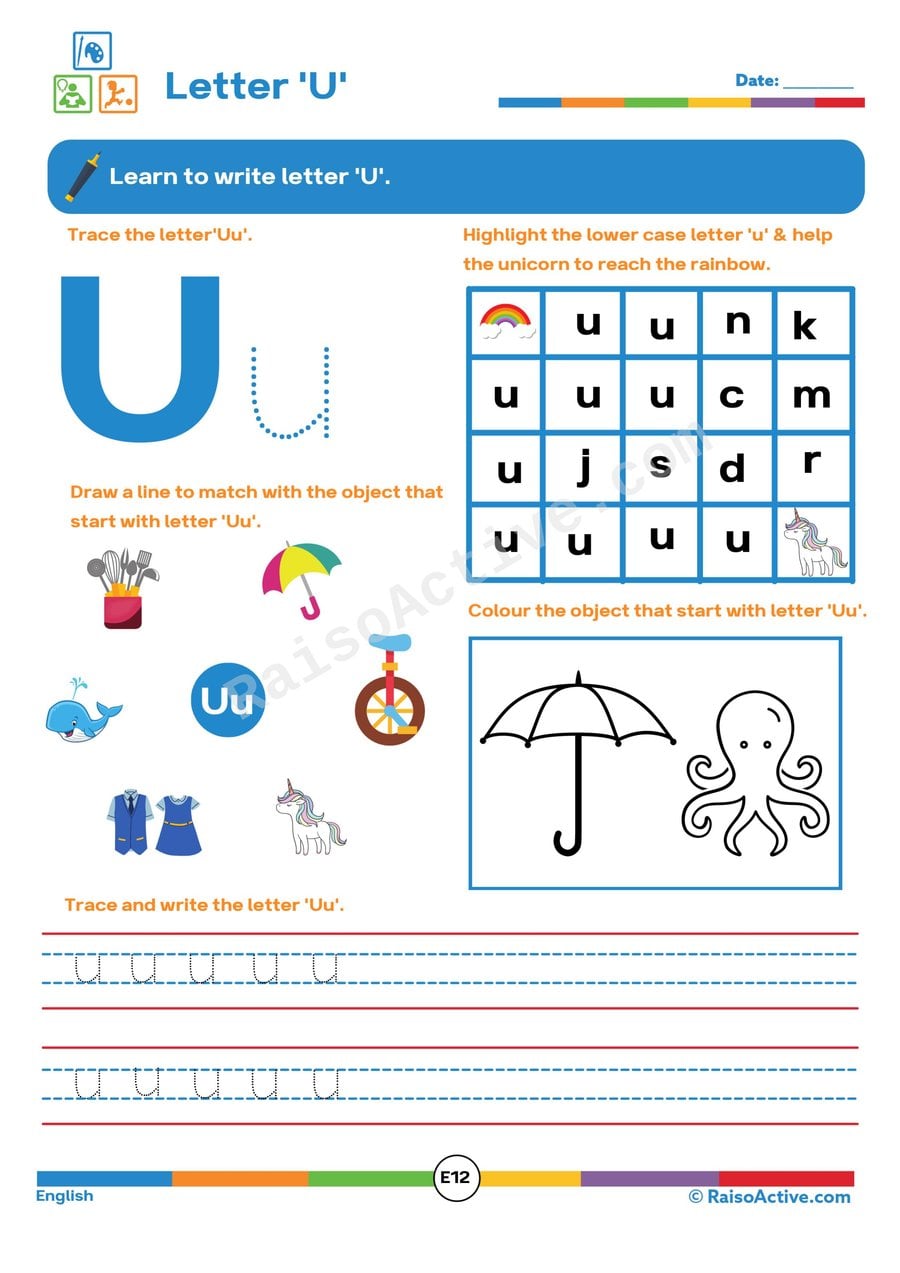
Letter 'U' Worksheet: Trace, Match, and Color!
Ages 3-5 · Preschool–Pre-KAges 3-5 · Nursery–ReceptionAges 3-5 · Nursery–LKGAges 3-5
Tracing, matching, and coloring the letter 'U' gives children ages 3-5 focused repetition on a rounded letter shape while building the sound-symbol connection for its short /u/ sound, as in 'umbrella' or 'up.' Matching pictures that start with 'U' to the letter reinforces recognition beyond the written form, tying it to real, familiar objects. Combining tracing, matching, and coloring in a single page suits a preschooler's need for varied, short activities rather than one long repetitive drill.

Letter V Tracing and Coloring Worksheet for Preschoolers
Ages 3-5 · Preschool–Pre-KAges 3-5 · Nursery–ReceptionAges 3-5 · Nursery–LKGAges 3-5
This worksheet builds recognition and formation of the letter V, both uppercase and lowercase, while practicing fine motor skills through tracing and coloring pictures of V words like 'van' or 'volcano.' For three- to five-year-olds, practicing both letter cases together helps children see that uppercase and lowercase V share the same basic shape, which isn't true of every letter and makes V a good confidence-builder.

Letter Dd Tracing and Matching Worksheet for Preschoolers
Ages 3-5 · Preschool–Pre-KAges 3-5 · Nursery–ReceptionAges 3-5 · Nursery–LKGAges 3-5
Children ages 3-5 practice writing the letter Dd through guided tracing, then apply that recognition by finding Dd hidden in a letter grid and identifying pictures that start with the sound. Moving from writing the letter to spotting it among other letters, and then to hearing it at the start of real words, builds a well-rounded, multi-sense understanding of the letter D.

Learn the Letter N! Tracing and Coloring Worksheet for Preschoolers
Ages 3-5 · Preschool–Pre-KAges 3-5 · Nursery–ReceptionAges 3-5 · Nursery–LKGAges 3-5
This worksheet helps children ages 3-5 build the specific hand movements needed to form the letter N, tracing both its uppercase and lowercase shapes while also linking the letter to its sound through picture coloring. Repeated tracing strengthens the pencil grip and directional control that later support fluent handwriting.

Learn the Letter 'n' Worksheet: Tracing, Matching, and Coloring Fun!
Ages 3-5 · Preschool–Pre-KAges 3-5 · Nursery–ReceptionAges 3-5 · Nursery–LKGAges 3-5
This worksheet builds letter 'n' recognition for 3-5 year olds through tracing, a highlighting search, matching to pictures, and coloring — four connected tasks that ask your child to hold onto the same letter across different formats and follow multi-step instructions in sequence. The letter 'n' is frequently confused with 'm' since both involve humps, so the repeated exposure here helps children start telling the two apart by sound and shape.

Fun with Letter F: Tracing, Finding, and Coloring Worksheet
Ages 3-5 · Preschool–Pre-KAges 3-5 · Nursery–ReceptionAges 3-5 · Nursery–LKGAges 3-5
Children ages 3-5 reinforce letter recognition and pencil control as they trace the letter F, search for it among other letters, and identify a picture starting with the F sound. Working through the same letter in multiple formats — writing, spotting, and sound-matching — helps move the letter from simple recognition toward automatic recall, an important pre-reading skill.

Learn the Letter U! Tracing, Matching, and Coloring Worksheet
Ages 3-5 · Preschool–Pre-KAges 3-5 · Nursery–ReceptionAges 3-5 · Nursery–LKGAges 3-5
Children ages 3-5 practice forming the letter U in both its capital and lowercase shapes, while also learning to spot U words among other pictures, building both handwriting control and letter-sound recognition together. The matching component adds a layer of visual scanning practice, since children must compare each picture's beginning sound against the target letter.
Guides for this topic

Documenting Learning Without Drowning in Data: A Practical Guide for Parents and Teachers
Learn practical ways to document your child's learning without overwhelm. Simple portfolios, observation tips, and printable trackers for ages 1-8.
Bridging Two Worlds: A Complete Guide to Teaching Heritage Languages Alongside English
A practical guide to raising bilingual children who speak both their heritage language and English with confidence. Research-backed strategies, activities, and tips for Indian families.

How to Help Your Child with Letter Reversals: A Complete Guide for Parents and Teachers
Letter reversals are normal until age 7-8. Learn the best multisensory strategies, anchor letter tricks, and activities to help children write b, d, p, and q correctly.
Reviews
Every worksheet for ages 3–5, no watermark
Members download the full library of 1,000+ worksheets and every activity pack without watermarks or daily limits. One year costs ₹999 in India or $20 elsewhere.
See membership plansOr download any worksheet free with a watermark (5 a day).