
Lowercase Letter Tracing Worksheet: Practice Writing the Alphabet
This worksheet moves beyond a single letter to practice a full set of lowercase letters in sequence, asking 4-5 year olds to apply consistent size, spacing, and stroke habits across multiple different shapes rather than mastering just one. This kind of broader review is an important checkpoint skill at the older end of preschool, closer to the demands of actual kindergarten handwriting practice.
Curriculum
How to use this worksheet
Look through the row or rows of dotted lowercase letters together before starting, naming a few to see which ones your child already recognizes confidently. Have your child trace each dotted letter in order, keeping their pencil grip and posture consistent across the page rather than rushing through. Once the traced letters are complete, have them write the same letters independently on the blank lines below. Take a short break partway through if the page covers many letters, since sustained handwriting practice is tiring at this age.
Materials needed
- Pencil
- Eraser
Extension activities
- •Pick out the three letters your child finds hardest and give them extra focused practice separately.
- •Practice writing the whole lowercase alphabet in sand or with playdough over a few short sessions.
- •Play a memory game matching lowercase letters to their uppercase partners.
- •Write a short, simple word using letters from the page and sound it out together.
- •Keep a running list of which lowercase letters feel confident versus which need more practice.
Tips for parents and teachers
At this broader review stage, it's useful to notice patterns — does your child consistently struggle with descending letters like g and y, or with curved letters like s and c — so you can target practice rather than repeating the whole alphabet evenly. Keep sessions on this kind of multi-letter page shorter than single-letter worksheets, since covering many letters is more tiring. This is a good worksheet to revisit every few weeks to track real progress over time.

Written by
Hemsweta Jain · Teacher Cheena
MBA and Early Childhood Educator, teaching since 2014 · Founder of RaisoActive, Mumbai
Every RaisoActive worksheet is designed and checked by the founder before publishing.
Published · Last reviewed
Related worksheets

Trace the Letter S Worksheet for Preschoolers
Tracing the curved strokes of the letter S helps children ages 3-5 build the specific hand movements needed for handwriting, since S requires a continuous curving motion that's different from the straight lines of letters like L or T. Repeated tracing also reinforces letter recognition, helping your child associate the shape of S with its name and sound. Because curves are harder to control than straight lines, this worksheet targets a slightly more advanced fine motor milestone than basic line tracing.

Learn the Letter U! Tracing, Matching, and Coloring Worksheet
Children ages 3-5 practice forming the letter U in both its capital and lowercase shapes, while also learning to spot U words among other pictures, building both handwriting control and letter-sound recognition together. The matching component adds a layer of visual scanning practice, since children must compare each picture's beginning sound against the target letter.
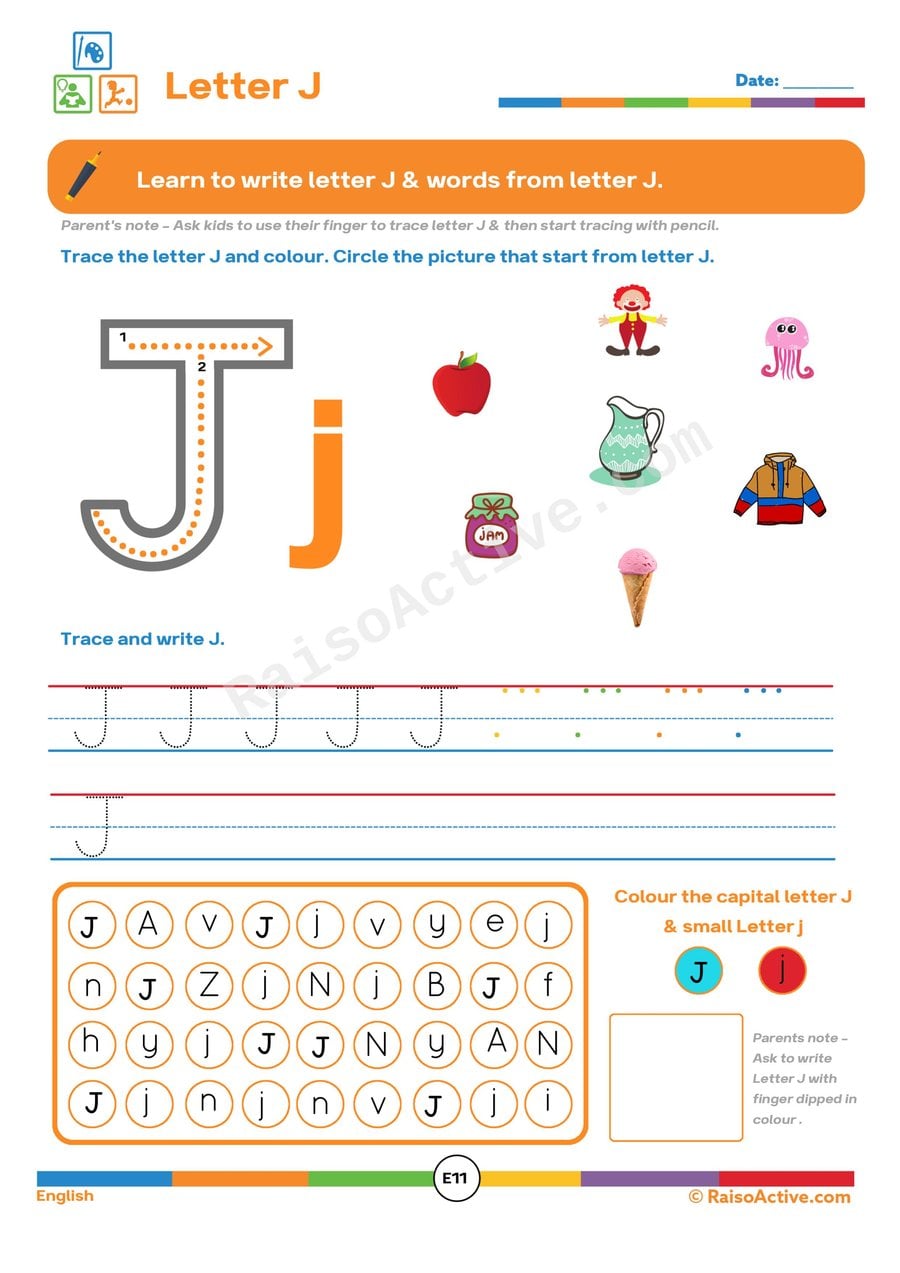
Letter J Worksheet: Trace, Write, and Color!
Children ages 3-5 practice forming the letter J, both uppercase and lowercase, through guided tracing, while also linking the letter to its sound by identifying pictures that begin with J. This combination of motor practice and phonics builds the foundation for both handwriting and early reading.

Learn the Letter N! Tracing and Coloring Worksheet for Preschoolers
This worksheet helps children ages 3-5 build the specific hand movements needed to form the letter N, tracing both its uppercase and lowercase shapes while also linking the letter to its sound through picture coloring. Repeated tracing strengthens the pencil grip and directional control that later support fluent handwriting.

Letter Y Tracing and Recognition Worksheet for Preschoolers
This worksheet builds recognition and formation of the letter Y through guided tracing practice and by identifying pictures of words that start with Y, like 'yarn' or 'yo-yo.' For three- to five-year-olds, tracing first with a finger and then with a pencil builds the motor memory needed before a child can form the letter confidently on their own.
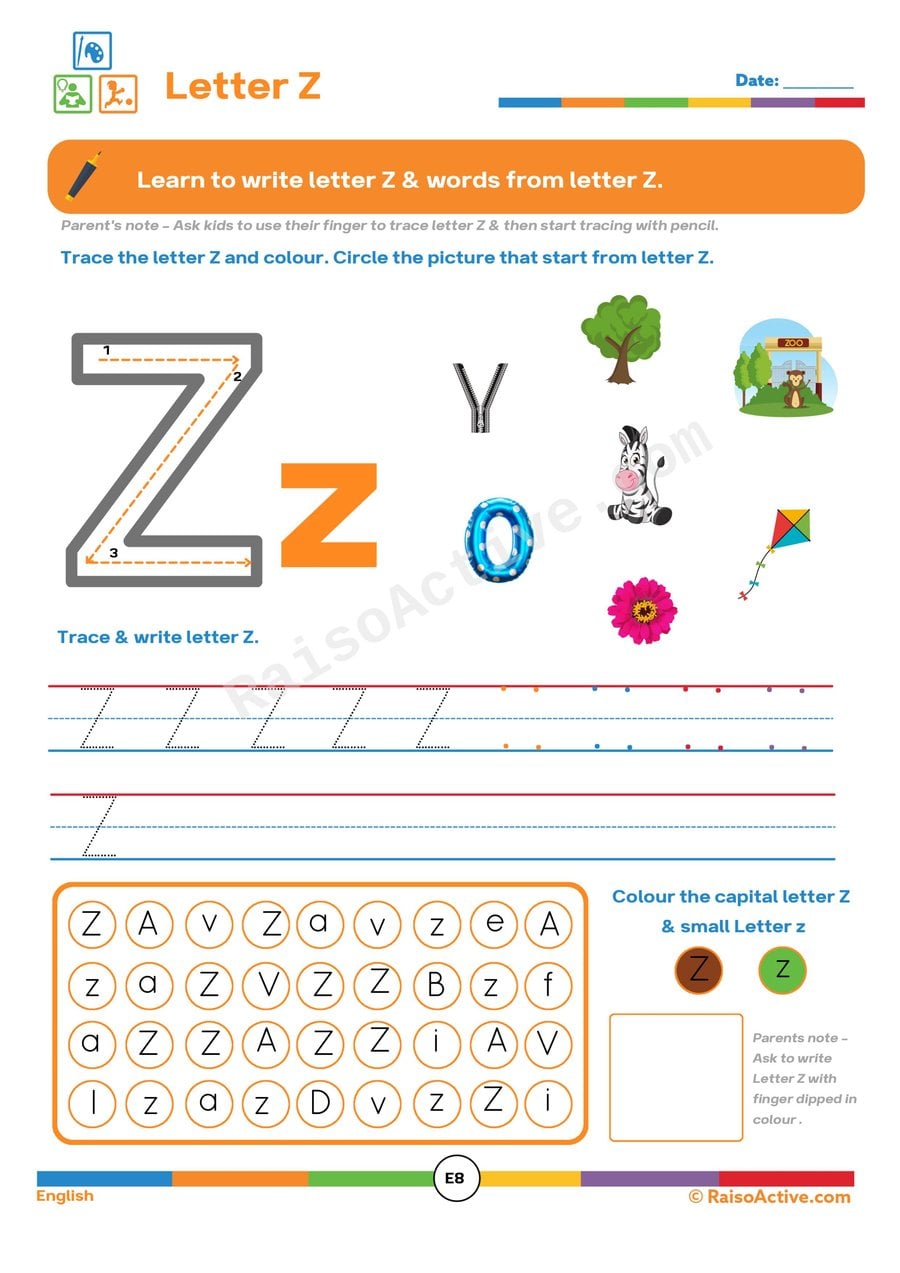
Letter Z Worksheet: Trace, Write, and Color!
This worksheet helps children ages 3-5 learn to recognize and write the letter Z, both uppercase and lowercase, completing their practice of the full alphabet with one of its most visually distinct letters. Tracing Z's sharp diagonal stroke also gives practice with a different kind of pencil movement than the curves and loops used in many other letters.

Letter V Tracing and Coloring Worksheet for Preschoolers
This worksheet builds recognition and formation of the letter V, both uppercase and lowercase, while practicing fine motor skills through tracing and coloring pictures of V words like 'van' or 'volcano.' For three- to five-year-olds, practicing both letter cases together helps children see that uppercase and lowercase V share the same basic shape, which isn't true of every letter and makes V a good confidence-builder.

Letter A Tracing and Coloring Worksheet for Preschoolers
Preschoolers ages 3-5 practice the specific pencil strokes needed to form the letter A, both uppercase and lowercase, while also connecting the letter to its sound through picture recognition. Tracing before free writing builds the fine motor muscle memory that makes independent letter formation possible.
Guides for this topic
Documenting Learning Without Drowning in Data: A Practical Guide for Parents and Teachers
Learn practical ways to document your child's learning without overwhelm. Simple portfolios, observation tips, and printable trackers for ages 1-8.
Bridging Two Worlds: A Complete Guide to Teaching Heritage Languages Alongside English
A practical guide to raising bilingual children who speak both their heritage language and English with confidence. Research-backed strategies, activities, and tips for Indian families.
How to Help Your Child with Letter Reversals: A Complete Guide for Parents and Teachers
Letter reversals are normal until age 7-8. Learn the best multisensory strategies, anchor letter tricks, and activities to help children write b, d, p, and q correctly.
Reviews
Every worksheet for ages 4–5, no watermark
Members download the full library of 1,000+ worksheets and every activity pack without watermarks or daily limits. One year costs ₹1,000 in India or $20 elsewhere.
See membership plansOr download any worksheet free with a watermark (5 a day).