3D Hippo Cut & Paste Worksheet for Preschoolers
Like other 3D paper crafts, building this hippo from flat cut pieces that fold and glue into a standing shape helps 3-5 year olds grasp that paper can be transformed from flat to solid, while the multi-step process — cut, fold, glue — builds sequencing skills beyond a single-action worksheet. The hippo theme also gives an easy hook for a fun animal fact conversation.
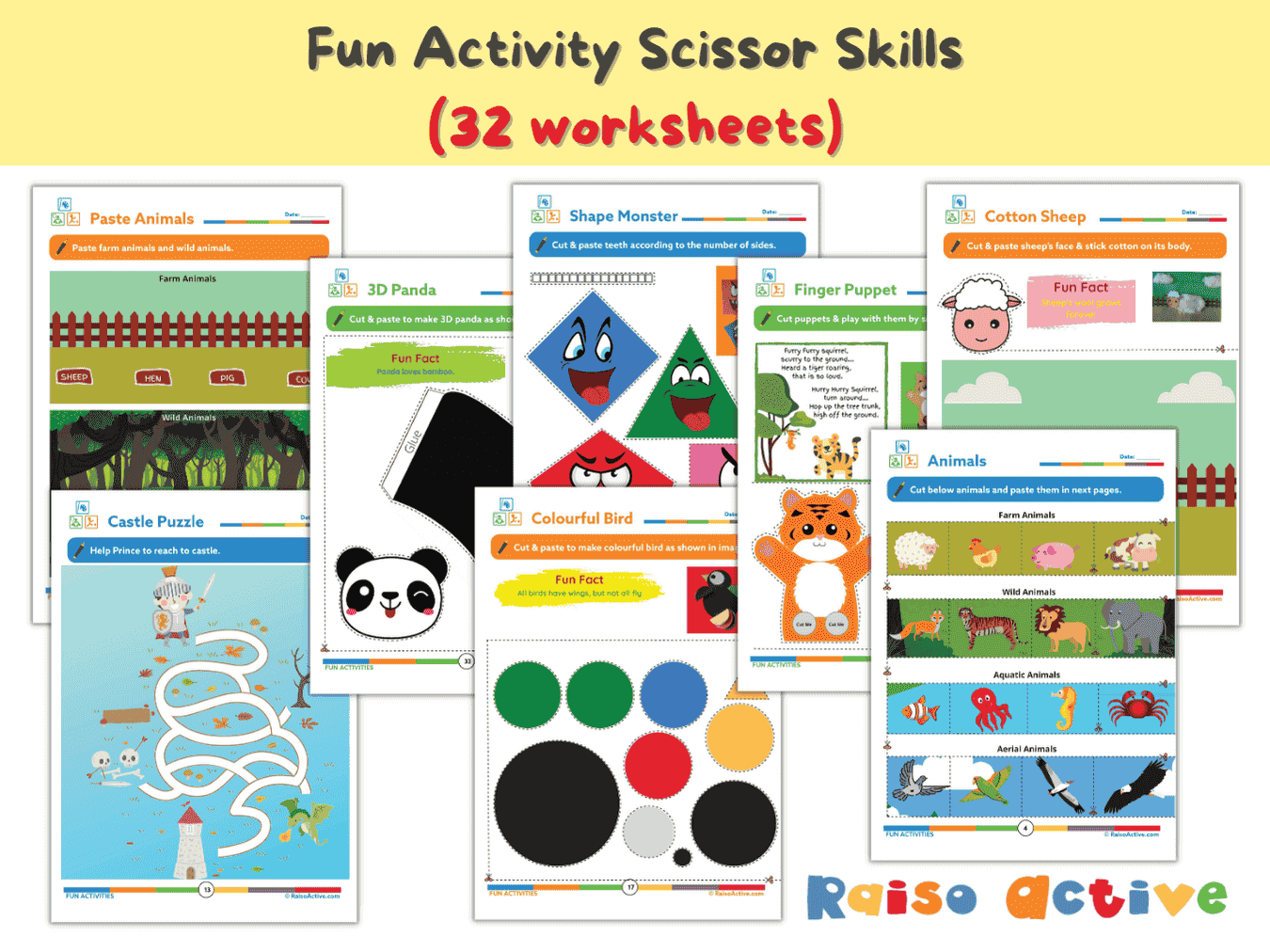
Part of the pack
Preschool Scissor Skills Activity Book: Fine Motor & Craft Fun for Ages 3-6
This is page 34 of the pack. Ages 3-6 · Preschool–KindergartenAges 3-6 · Nursery–Year 1Ages 3-6 · Nursery–UKGAges 3-6
Curriculum
- Art & Craft > 3D Paper Crafts
How to use this worksheet
Cut out the hippo pieces along the dotted lines. Fold the marked sections as shown in the picture instructions. Glue the folded pieces together to assemble the 3D hippo, following the order shown in the example. Once assembled and dry, your child can color the hippo if they like.
Materials needed
- Scissors
- Glue
- Pencil (optional)
Extension activities
- 1Talk about how hippos spend much of their day in water and why that keeps them cool.
- 2Build a simple 'river' scene out of blue paper or fabric for the hippo to sit beside.
- 3Compare the size of a hippo to other animals your child knows using pictures or a book.
- 4Try folding a second animal from the same technique using scrap paper for extra practice.
- 5Count how many separate pieces it took to build the finished hippo.

Written by
Hemsweta Jain · Teacher Cheena
MBA and Early Childhood Educator, teaching since 2014 · Founder of RaisoActive, Mumbai
Every RaisoActive worksheet is designed and checked by the founder before publishing.
Published · Last reviewed
More from Preschool Scissor Skills Activity Book: Fine Motor & Craft Fun for Ages 3-6

Community Helpers Transport Match Worksheet for Preschoolers
Ages 3-5 · Preschool–Pre-KAges 3-5 · Nursery–ReceptionAges 3-5 · Nursery–LKGAges 3-5
Cutting out vehicles and matching them to the correct community helper builds scissor control in children ages 3-5 while reinforcing social studies knowledge about which vehicle goes with which job, like a fire truck for a firefighter or a mail truck for a mail carrier. This pairing task asks children to reason about real-world associations rather than simply matching identical pictures, a small step up in thinking from basic matching.
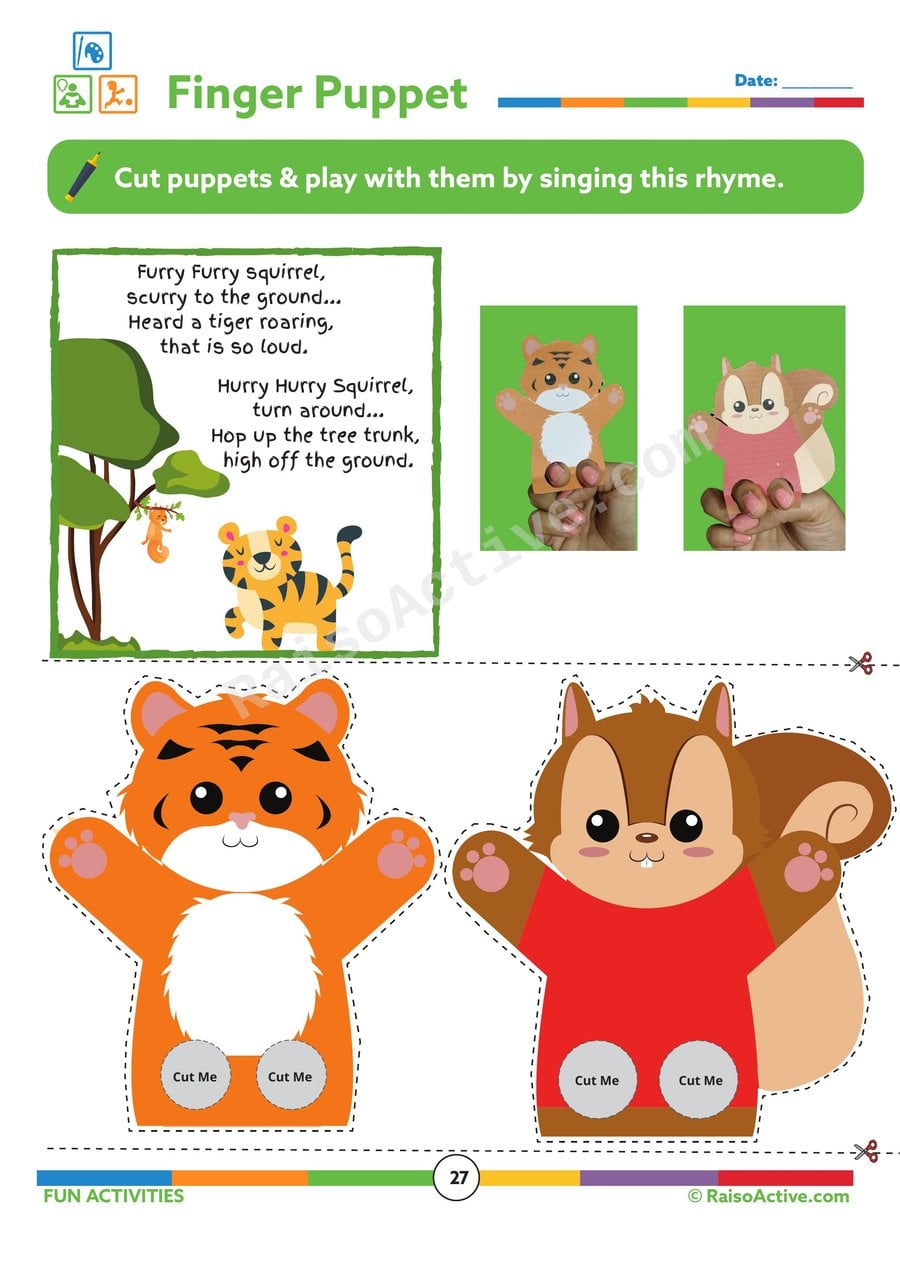
Finger Puppet Fun: Cut and Play with a Rhyme!
Ages 3-5 · Preschool–Pre-KAges 3-5 · Nursery–ReceptionAges 3-5 · Nursery–LKGAges 3-5
Cutting out the tiger and squirrel puppets and then using them to act out an accompanying rhyme builds scissor precision on animal shapes while also developing oral language and memory, since repeating a short rhyme with props helps children internalize its rhythm and words. This blend of fine motor and language practice at ages 3-5 supports both handwriting readiness and early literacy at once.

Funny Clown Craft: Cut and Paste Worksheet for Kids
Ages 3-5 · Preschool–Pre-KAges 3-5 · Nursery–ReceptionAges 3-5 · Nursery–LKGAges 3-5
Curling colorful paper strips into loops and gluing the ends together builds a different kind of fine motor control than straight cutting — bending, holding, and pinching paper into a curved shape while applying glue — which strengthens hand coordination in a new way. Assembling the finished clown from these loops also reinforces color recognition and the idea of building something bigger from repeated smaller pieces.

3D Pig Craft: Cut and Paste Worksheet for Preschoolers
Ages 3-5 · Preschool–Pre-KAges 3-5 · Nursery–ReceptionAges 3-5 · Nursery–LKGAges 3-5
Assembling this 3D pig involves cutting, folding the main body, gluing tabs, and attaching a separate head and tail — a longer instruction sequence than most flat crafts — which builds children's ability to hold and execute several steps in order. At ages 3-5, successfully following this kind of multi-step build is an early form of the executive function skills needed for more complex tasks later in school.

Cut and Paste a Fun Fish Worksheet for Preschoolers
Ages 3-5 · Preschool–Pre-KAges 3-5 · Nursery–ReceptionAges 3-5 · Nursery–LKGAges 3-5
Building a fish from separate cut-out shapes glued onto a large circle base gives children practice constructing a picture within a defined boundary, teaching them to fit and arrange pieces inside a fixed space rather than a blank page. This kind of bounded assembly at ages 3-5 builds spatial planning alongside the usual scissor and gluing practice.

Finger Puppet Fun: Make & Play with the Three Little Pigs!
Ages 3-5 · Preschool–Pre-KAges 3-5 · Nursery–ReceptionAges 3-5 · Nursery–LKGAges 3-5
Cutting out the pig and fox puppets gives 3-5 year olds focused scissor practice on small, curved shapes, while fitting the finished puppets onto their fingers and using them to sing the accompanying rhyme builds oral language, sequencing, and the confidence to perform in front of others. Acting out a familiar story also helps children practice retelling events in order, a skill that supports later reading comprehension.

Fun Activities Book for Kids: Develop Fine Motor Skills!
Ages 3-5 · Preschool–Pre-KAges 3-5 · Nursery–ReceptionAges 3-5 · Nursery–LKGAges 3-5
Because this book strings together cutting, tracing mazes, and simple puzzles in one place, children ages 3-5 get repeated practice across several fine motor skills in a single sitting rather than just one — which mirrors how occupational therapists structure real fine-motor sessions. Moving between different task types (snip, trace, solve) also builds attention and task-switching stamina appropriate for this age.

Shape Monster Cut & Paste Worksheet for Preschoolers
Ages 3-5 · Preschool–Pre-KAges 3-5 · Nursery–ReceptionAges 3-5 · Nursery–LKGAges 3-5
Counting the sides of each shape monster and pasting on the matching number of paper teeth turns shape recognition into a hands-on counting task, linking geometry (how many sides a triangle, square, or pentagon has) directly to number sense. This combination is exactly the kind of cross-skill practice that helps 3-5 year olds move from just naming shapes to understanding what actually defines them.
Related worksheets
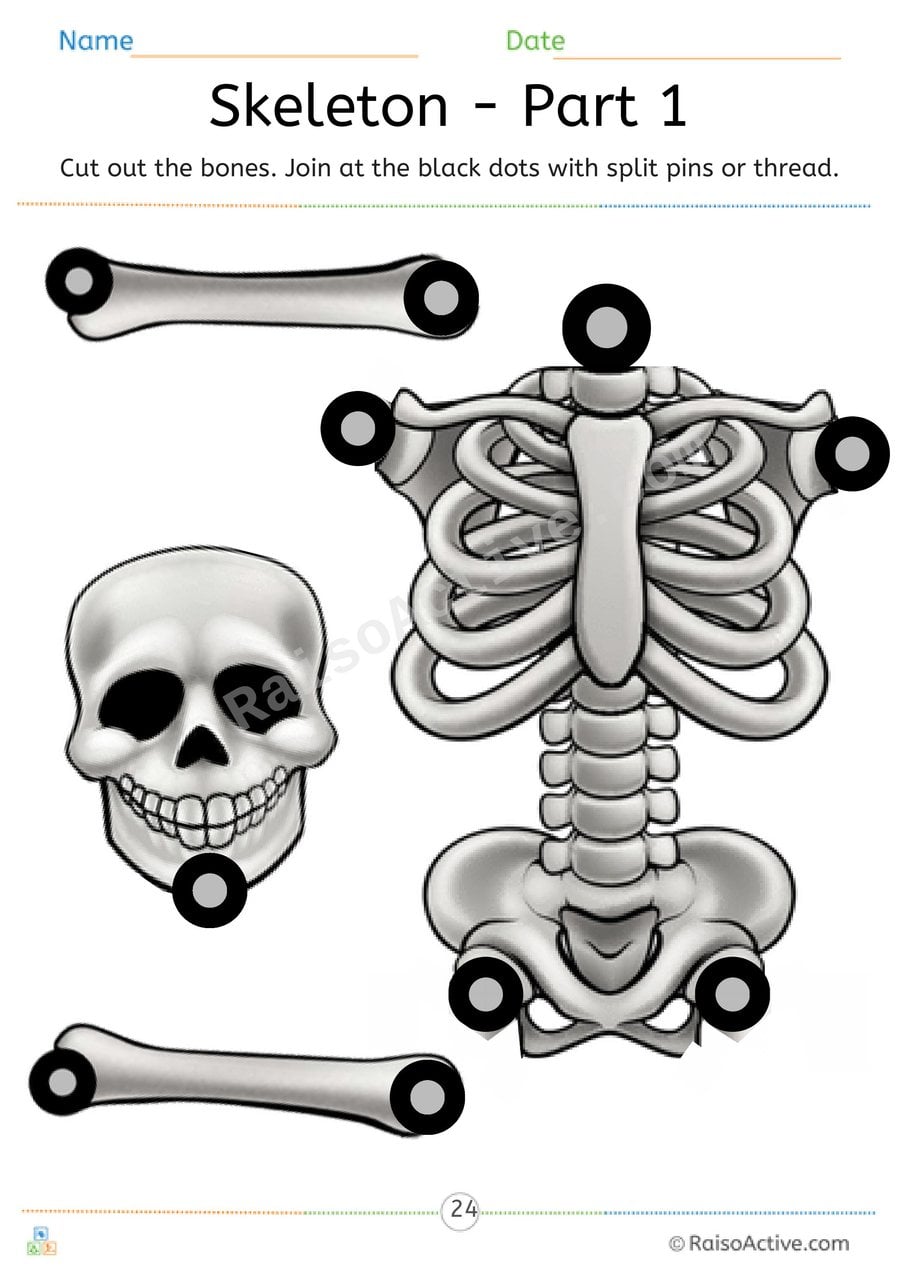
Skeleton Cut and Join Worksheet for Kids
Ages 3-5 · Preschool–Pre-KAges 3-5 · Nursery–ReceptionAges 3-5 · Nursery–LKGAges 3-5
This worksheet has children ages 3-5 cut out individual bone shapes and piece them together to assemble a skeleton, building scissor control and spatial reasoning as they figure out where each bone belongs relative to the others. Gluing the assembled bones onto a backing sheet also gives the activity a lasting, displayable result.
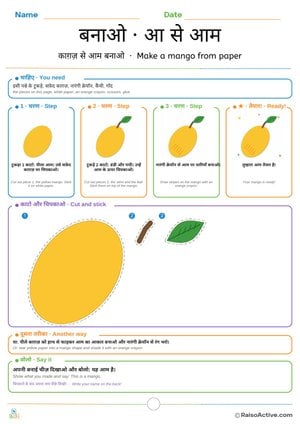
Make a Paper Mango: Hindi Letter आ Craft | बनाओ · आ से आम
Ages 3-7 · Preschool–Grade 1Ages 3-7 · Nursery–Year 2Ages 3-7 · Nursery–Class 1Ages 3-7
Children cut out the pieces, put them together following three step pictures and make a paper mango. Saying the word आम as they make it links the sound आ to something they built themselves.

Akash Kandil Craft: Make a Paper Lantern for Diwali
Ages 4-8 · Pre-K–Grade 2Ages 4-8 · Reception–Year 3Ages 4-8 · LKG–Class 2Ages 4-8
Children learn that families in Maharashtra and Goa hang an akash kandil sky lantern at Diwali, and that many festivals have their own special light.

Reindeer Craft: Follow Instructions and Create a Festive Decoration!
Ages 3-5 · Preschool–Pre-KAges 3-5 · Nursery–ReceptionAges 3-5 · Nursery–LKGAges 3-5
This multi-step reindeer craft has children ages 3-5 follow a sequence of folding and assembly instructions to build a three-dimensional decoration, strengthening both listening comprehension and the fine motor skills needed to position and attach small pieces accurately. Because each step depends on the one before it, children also practice patience and sequencing, skills that carry over into following any multi-step task.

Spider Web Connect-the-Dots Worksheet for Preschoolers
Ages 3-5 · Preschool–Pre-KAges 3-5 · Nursery–ReceptionAges 3-5 · Nursery–LKGAges 3-5
This connect-the-dots worksheet has children ages 3-5 count in sequence from one number to the next while drawing curved lines, building both number-order recognition and the pencil control needed for pre-writing curves and loops. Revealing a spider web at the end gives the counting practice a satisfying, visual payoff that keeps young children motivated through the whole sequence.

Identify Flags Worksheet: Cut and Paste Matching Activity
Ages 4-6 · Pre-K–KindergartenAges 4-6 · Reception–Year 1Ages 4-6 · LKG–UKGAges 4-6
This worksheet gives children ages 4-6 further practice matching country flags to their names, reinforcing visual discrimination and geography vocabulary through repetition with a new set of flags. Repeated matching practice across different worksheets helps move flag recognition from short-term recall into more durable, lasting memory.
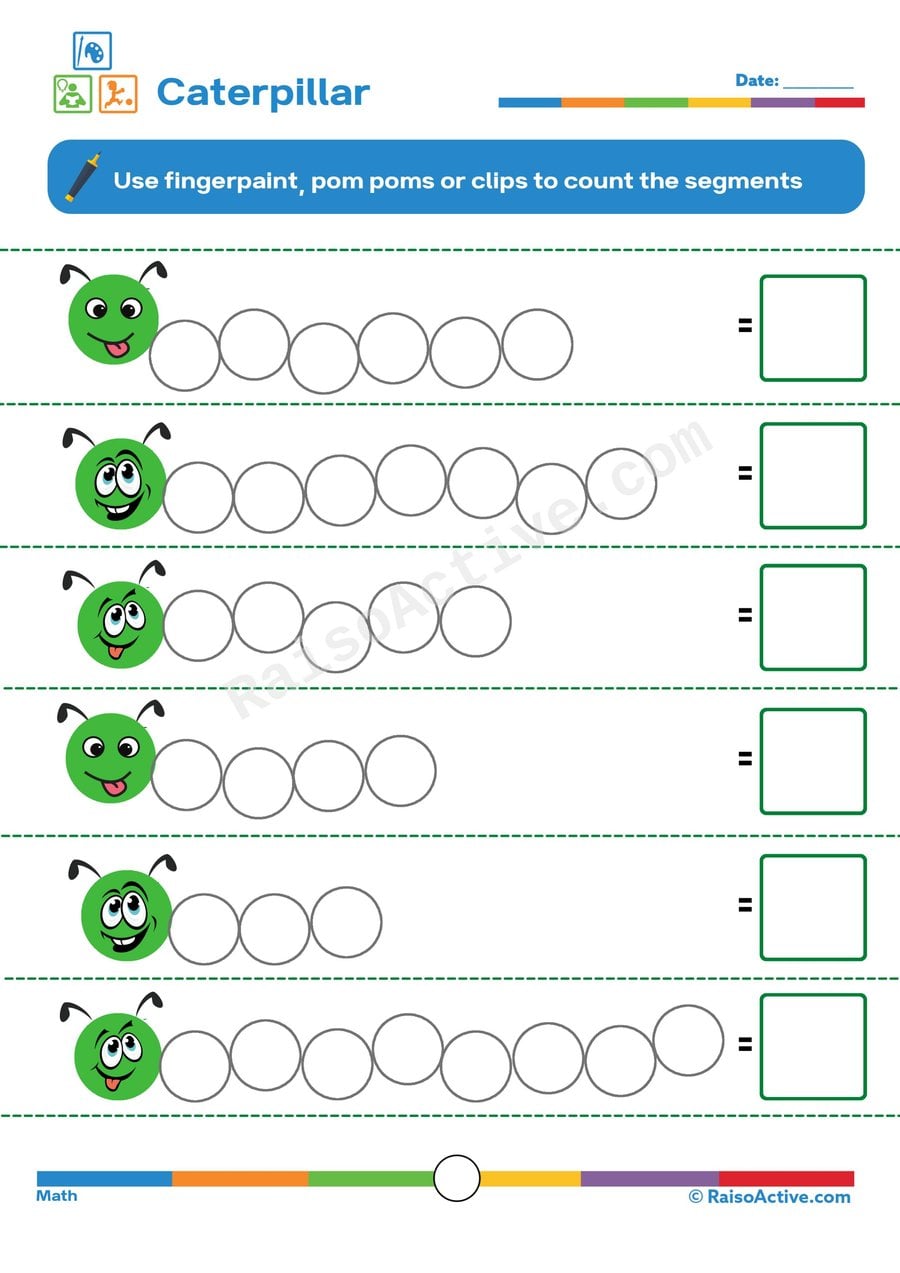
Caterpillar Counting Worksheet for Preschoolers
Ages 3-5 · Preschool–Pre-KAges 3-5 · Nursery–ReceptionAges 3-5 · Nursery–LKGAges 3-5
Counting the segments of each caterpillar teaches children ages 3-5 one-to-one correspondence — touching or marking each segment exactly once while saying a number — which is the core skill underlying accurate counting. Writing the final total in a box also connects the physical act of counting to its written numeral, reinforcing early number-writing practice.

Identify Flags Worksheet: Cut and Paste Matching Activity
Ages 4-6 · Pre-K–KindergartenAges 4-6 · Reception–Year 1Ages 4-6 · LKG–UKGAges 4-6
Children ages 4-6 practice identifying country flags and matching them to their correct names, continuing to build geography vocabulary and visual discrimination through this repeated worksheet format. Working through several similar flag-matching worksheets over time helps children build a broader mental library of recognizable flags rather than memorizing just one set.
Guides for this topic

Celebrating Diversity: How to Incorporate Cultural Awareness in Learning Activities for Young Children
Practical cultural awareness activities for young children aged 2-8. Explore Indian festivals, world cultures, food, music, and crafts to teach diversity and inclusion.
How to Teach Cutting Skills to Your Preschooler: A Complete Guide for Parents and Teachers
Help your child master scissor skills safely. Expert guide covering readiness signs, scissor types, progression steps, pre-cutting exercises, and fun practice ideas for ages 2-6.
What Supplies Do You Need for Preschool Learning at Home: The Complete Essential Guide
Discover the essential supplies for preschool learning at home — from crayons and counting blocks to sensory bins. Affordable options available in India for ages 2–6.
Reviews
Every worksheet for ages 3–5, no watermark
Members download the full library of 1,000+ worksheets and every activity pack without watermarks or daily limits. One year costs ₹999 in India or $20 elsewhere.
See membership plansOr download any worksheet free with a watermark (5 a day).