Butterfly Life Cycle Matching Worksheet for Preschoolers
This matching worksheet introduces children ages 3-5 to the four stages of metamorphosis — egg, caterpillar, chrysalis, and butterfly — while building visual matching skills essential for early science literacy. Pairing each picture to its correct stage strengthens observation and categorization, skills children will later apply across all science topics.
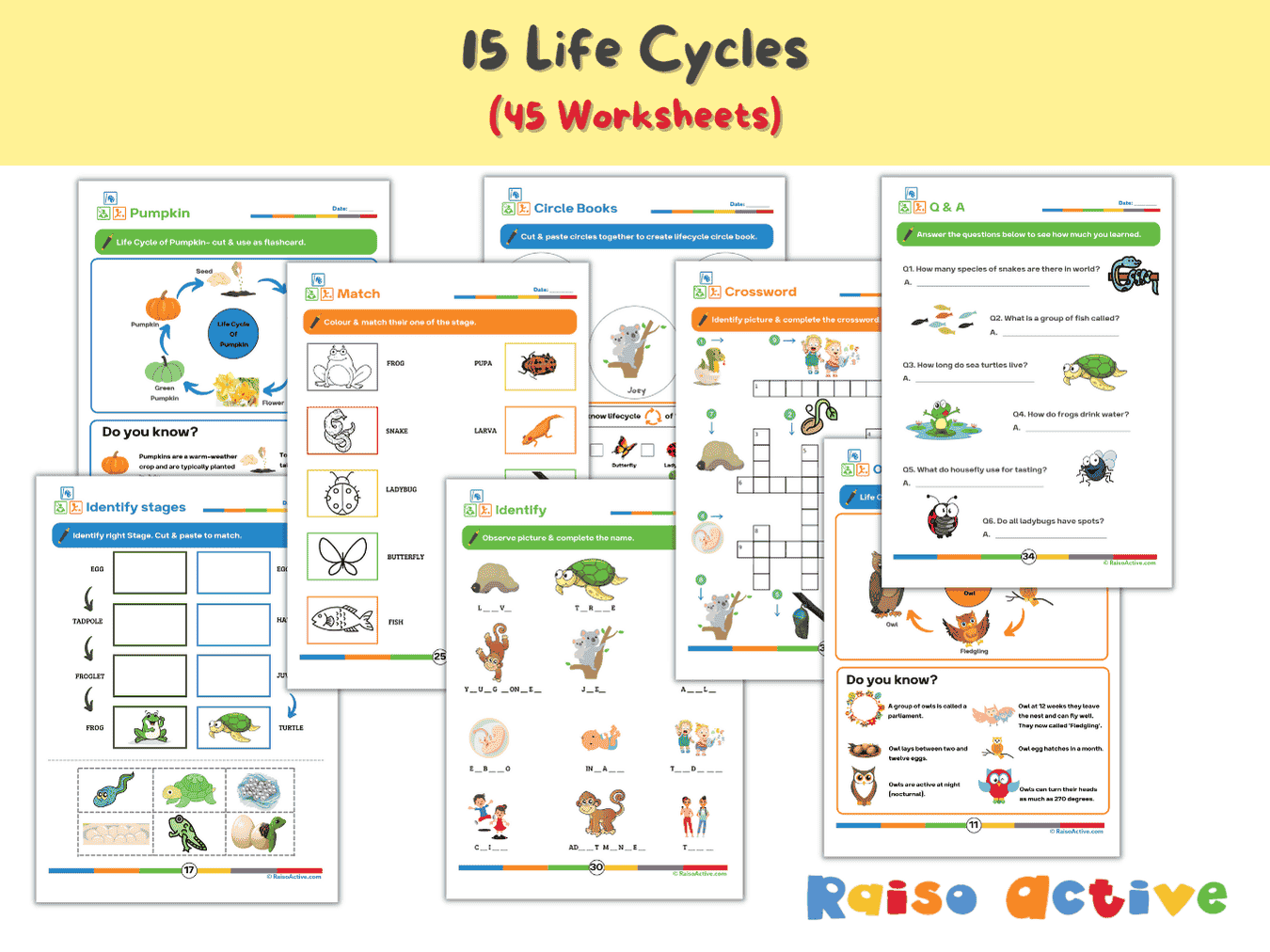
Part of the pack
Lifecycles Activity Book & Flashcards for Preschool & Early Elementary
This is page 17 of the pack. Ages 3-8 · Preschool–Grade 2Ages 3-8 · Nursery–Year 3Ages 3-8 · Nursery–Class 2Ages 3-8

Made for your child
Counting to 10, made for your child
A maths pack with your child's name in it: pictures that explain, practice at three levels, puzzles and story sums about them. Print a new set whenever they finish.
Make a maths packFree preview · free for members
Curriculum
- Living Things - Insects > Insect Life Cycles
How to use this worksheet
Look at the images together first and name each butterfly stage out loud. Have your child cut out the picture pieces at the bottom of the page, then hold each one up and decide which stage it matches before gluing it into place. Encourage them to check their work by explaining why a caterpillar picture goes with the caterpillar stage rather than gluing at random. Finish by tracing a finger along the completed sequence from egg to butterfly.
Materials needed
- Scissors
- Glue
- Pencil
Extension activities
- 1Find or draw a caterpillar outside and observe how it moves compared to a butterfly.
- 2Make an edible caterpillar snack using grapes or berries on a skewer, then talk about what it will become.
- 3Read 'The Very Hungry Caterpillar' and pause to match the book's stages to the worksheet.
- 4Create a chrysalis by wrapping a toy caterpillar in tissue paper and 'hatching' it as a butterfly.
- 5Act out the four stages as a movement game — curl up small as an egg, wriggle as a caterpillar, freeze as a chrysalis, then flutter arms as a butterfly.

Written by
Hemsweta Jain · Teacher Cheena
MBA and Early Childhood Educator, teaching since 2014 · Founder of RaisoActive, Mumbai
Every RaisoActive worksheet is designed and checked by the founder before publishing.
Published · Last reviewed
More from Lifecycles Activity Book & Flashcards for Preschool & Early Elementary
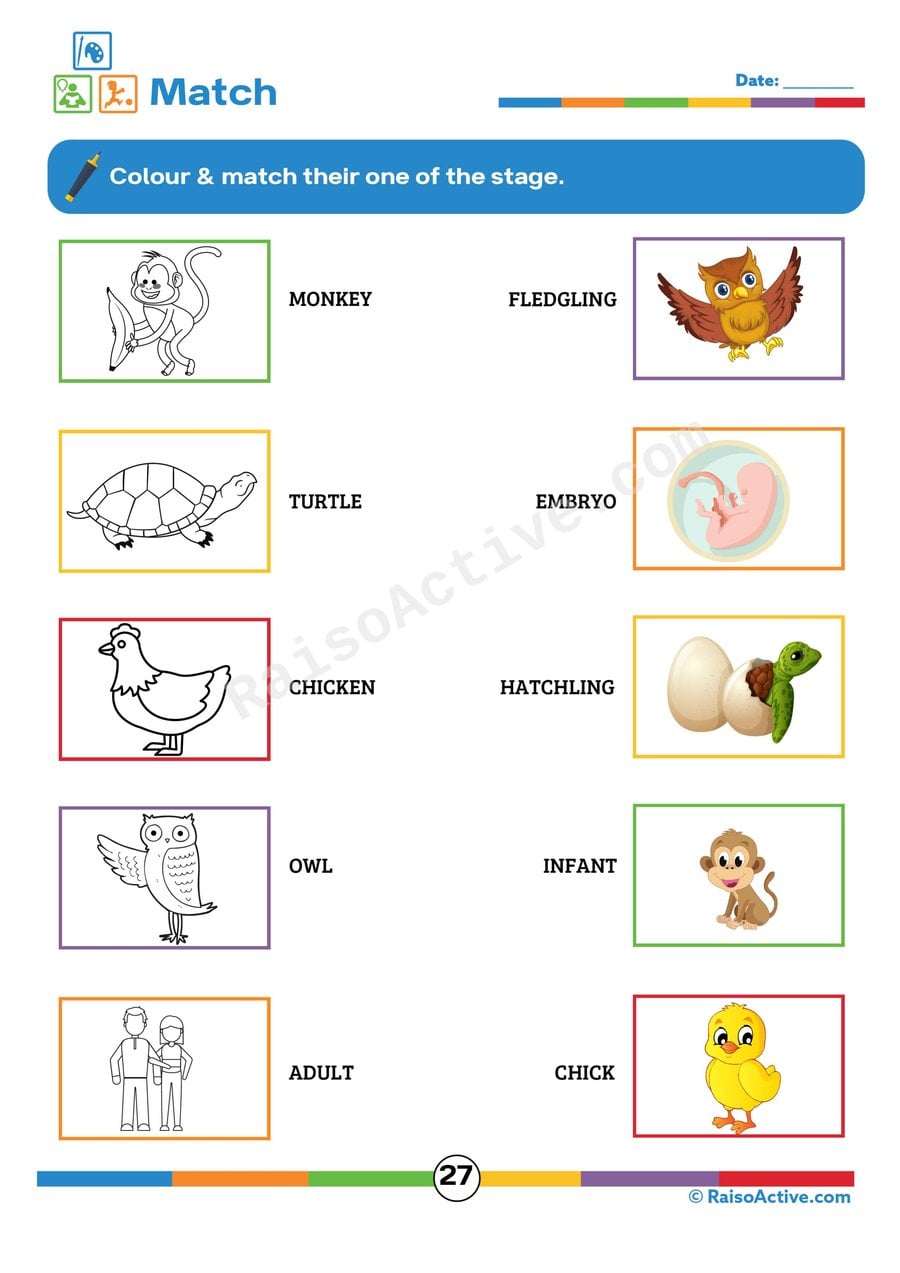
Match the Life Stages: A Fun Worksheet for Kids!
Ages 3-5 · Preschool–Pre-KAges 3-5 · Nursery–ReceptionAges 3-5 · Nursery–LKGAges 3-5
This worksheet has children ages 3-5 match a picture of an animal to the correct life stage shown on the opposite side of the page, reinforcing that living things look different depending on how old they are. Coloring the pictures after matching adds a fine motor component and gives children a reason to look closely at each image a second time.

Housefly Life Cycle Flashcards Worksheet for Kids
Ages 3-5 · Preschool–Pre-KAges 3-5 · Nursery–ReceptionAges 3-5 · Nursery–LKGAges 3-5
These flashcards teach children ages 3-5 the four stages of a housefly's life cycle, egg, larva, pupa, and adult fly, giving them a concrete, sequential science concept using an insect they likely encounter often in daily life. Learning that a familiar insect goes through such distinct changes also builds curiosity and reduces the instinct to simply dismiss it.

Frog Life Cycle Cut and Paste Worksheet for Preschoolers
Ages 3-5 · Preschool–Pre-KAges 3-5 · Nursery–ReceptionAges 3-5 · Nursery–LKGAges 3-5
Children ages 3-5 learn the four stages of a frog's life cycle — egg, tadpole, froglet, and adult frog — while practicing sequencing and precise pasting skills. This worksheet is especially useful for illustrating dramatic physical change, since a tadpole looks almost nothing like an adult frog, which helps children grasp that growth can transform an animal significantly.
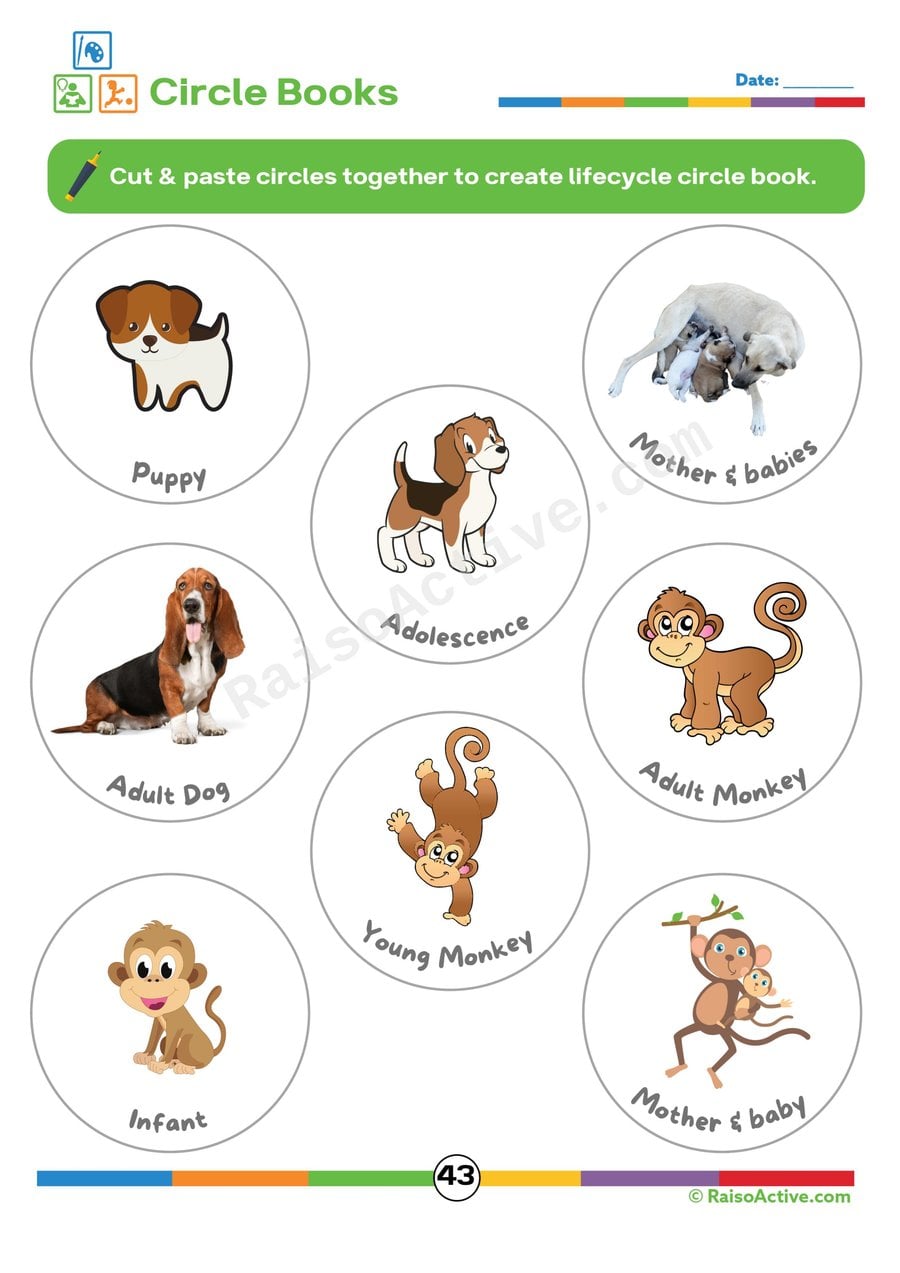
Lifecycle Circle Book: Cut and Paste Fun!
Ages 3-5 · Preschool–Pre-KAges 3-5 · Nursery–ReceptionAges 3-5 · Nursery–LKGAges 3-5
This worksheet gives children ages 3-5 more practice assembling a rotating lifecycle circle book, reinforcing the skills of sequencing, cutting, and gluing built in earlier lifecycle activities. Repeating this hands-on format with new content helps the process itself — cut, sequence, glue, review — become a familiar and confident routine.

Identify and Complete the Names Worksheet for Preschoolers
Ages 4-5 · Pre-KAges 4-5 · ReceptionAges 4-5 · LKGAges 4-5
Children ages 4-5 build on early spelling skills by identifying pictures and completing their names using provided letter hints, strengthening both vocabulary and phonics awareness. Using hints rather than a fully blank space offers just enough support to keep the task achievable while still requiring active problem-solving.

Butterfly Life Cycle Cut and Paste Worksheet for Preschoolers
Ages 4-6 · Pre-K–KindergartenAges 4-6 · Reception–Year 1Ages 4-6 · LKG–UKGAges 4-6
Children ages 4-6 build on earlier metamorphosis learning by assembling a butterfly life cycle circle book, practicing sequencing and fine motor precision as they cut and glue circular pieces. The rotating circle book format reinforces that metamorphosis is a repeating cycle, helping children move beyond a simple straight-line understanding of egg to butterfly.

Animal Q&A Worksheet for Kids: Learn About Snakes, Fish, and More!
Ages 3-5 · Preschool–Pre-KAges 3-5 · Nursery–ReceptionAges 3-5 · Nursery–LKGAges 3-5
This worksheet builds early reading comprehension and animal knowledge in children ages 3-5 as they answer simple questions about snakes, fish, and other animals using picture clues. Answering varied questions about multiple animals, rather than one, helps children practice applying the same comprehension skill flexibly across different content.

Identify Bird Life Cycle Stages Worksheet for Preschoolers
Ages 4-6 · Pre-K–KindergartenAges 4-6 · Reception–Year 1Ages 4-6 · LKG–UKGAges 4-6
Children ages 4-6 practice identifying and sequencing the stages of a bird's life — egg, hatchling, chick, and adult bird — while strengthening the scissor control and precision placement needed for cut-and-paste tasks. This worksheet also reinforces one-to-one matching between an image and its labeled box, an early classification skill.
Related worksheets

Match the Flags Worksheet: Fun Flag Matching Activity for Kids!
Ages 3-5 · Preschool–Pre-KAges 3-5 · Nursery–ReceptionAges 3-5 · Nursery–LKGAges 3-5
This flag-matching worksheet strengthens visual scanning and word recognition as children ages 3-5 compare printed country names on one side of the page to flag images on the other and connect the correct pairs. Because they must scan back and forth between two columns, it also builds the left-to-right tracking skills that support early reading.

Thought Switch: Turn Unhelpful Thoughts into Helpful Thoughts
Ages 7-10 · Grade 2–Grade 3Ages 7-10 · Year 3–Year 4Ages 7-10 · Class 2–Class 3Ages 7-10
Children compare unhelpful and helpful thoughts (such as 'I can't do it yet, I'll keep trying'), match each unhelpful thought to a helpful one and write their own switches.
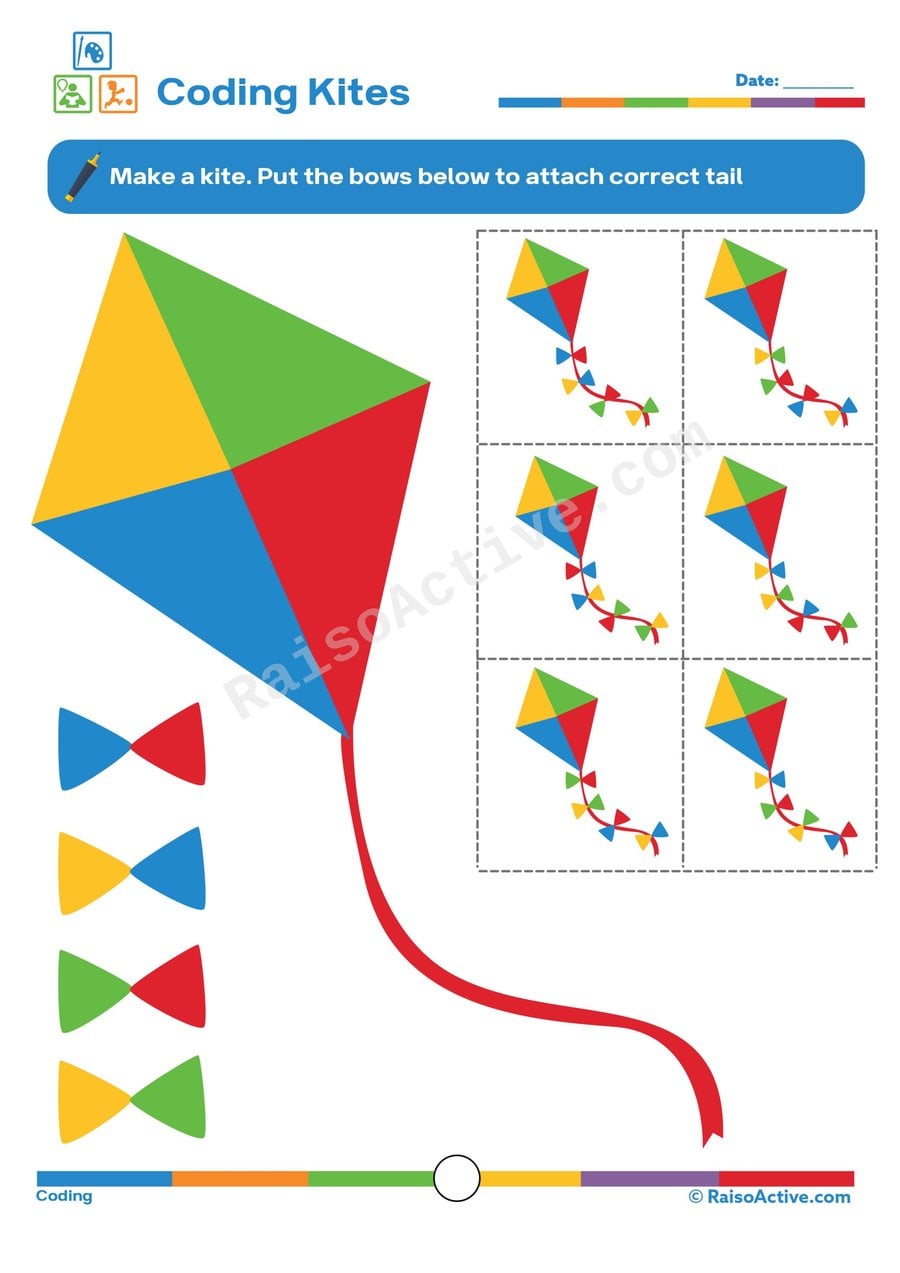
Coding Kites Worksheet: Match the Bows!
Ages 3-5 · Preschool–Pre-KAges 3-5 · Nursery–ReceptionAges 3-5 · Nursery–LKGAges 3-5
This activity sharpens visual observation in children ages 3-5 as they compare color sequences on each kite to a set of loose bows and find the exact match. Careful, systematic comparison — checking each color in order rather than glancing quickly — builds an attention-to-detail habit that transfers directly to early reading and number work.
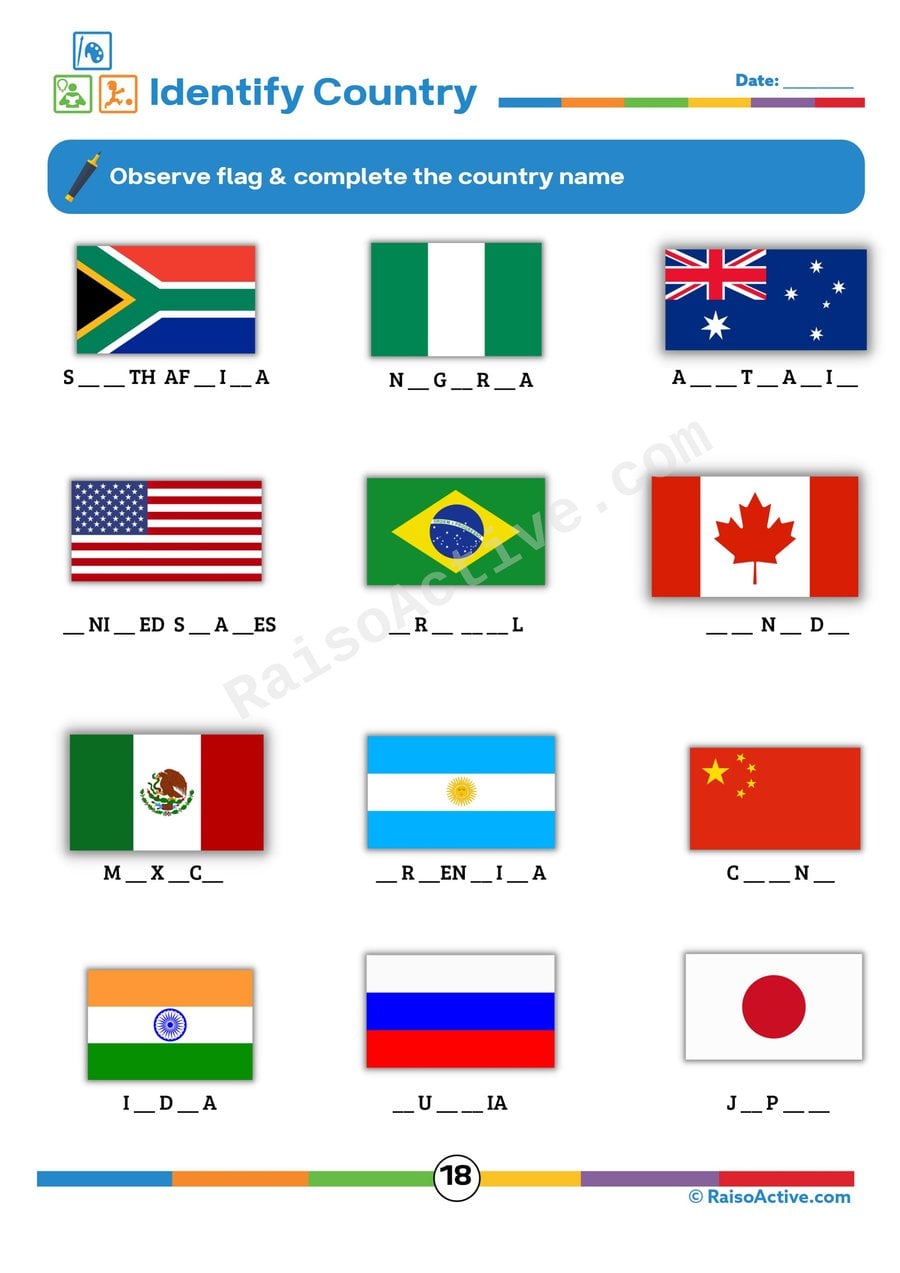
Identify the Country: Flag Matching Worksheet
Ages 4-7 · Pre-K–Grade 1Ages 4-7 · Reception–Year 2Ages 4-7 · LKG–Class 1Ages 4-7
Filling in the missing letters of each country's name while studying its flag gives children ages 4-7 practice with letter-sound correspondence and spelling patterns, since they must sound out the word and recall which letters are already provided as clues. It also builds early geography knowledge, helping children connect a visual symbol (the flag) to a country's name for the first time. This dual practice of decoding and world knowledge lays groundwork for both literacy and social studies skills.

Clothing Pattern Match Worksheet for Preschoolers
Ages 3-5 · Preschool–Pre-KAges 3-5 · Nursery–ReceptionAges 3-5 · Nursery–LKGAges 3-5
This worksheet has children ages 3-5 study repeating patterns on clothing items — stripes, polka dots, or checks — and match each item to its identical twin, building visual discrimination and early pattern-sequencing skills. Distinguishing between similar-looking patterns also sharpens attention to detail, a skill that later supports letter and word recognition.
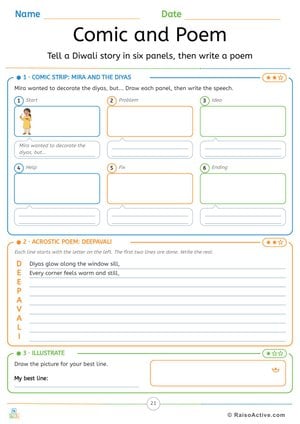
Diwali Comic Strip and Acrostic Poem Writing Activity
Ages 7-10 · Grade 2–Grade 3Ages 7-10 · Year 3–Year 4Ages 7-10 · Class 2–Class 3Ages 7-10
Children plan a six-panel comic, from start to ending, about Mira and her diyas, write the rest of a DEEPAVALI acrostic poem and draw the picture for their best line.

Match the Flags! A Fun Coloring Worksheet for Kids
Ages 3-5 · Preschool–Pre-KAges 3-5 · Nursery–ReceptionAges 3-5 · Nursery–LKGAges 3-5
This worksheet combines coloring with flag recognition, helping children ages 3-5 practice fine motor control while learning to match a colored flag to its correct blank outline. Coloring the flags first, then matching them, adds an extra layer of visual processing as children must recall the colors they just used to complete the matching step.

Clothing Pattern Matching Worksheet for Preschoolers
Ages 3-5 · Preschool–Pre-KAges 3-5 · Nursery–ReceptionAges 3-5 · Nursery–LKGAges 3-5
By comparing clothing items and connecting each one to its pattern match, children ages 3-5 build visual discrimination skills, learning to notice fine differences in stripes, dots, or repeated shapes. This close-looking practice supports the same attention-to-detail children will later need to tell similar-looking letters and numbers apart.
Guides for this topic

Best Worksheets for 3-Year-Olds: What Works and What to Avoid
What works on worksheets for 3-year-olds: short sessions, crayons, tracing lines, matching, cutting, a free weekly plan, and signs one is too advanced.

Coding Activities for Preschoolers: Building Tomorrow's Thinkers Today
Discover 15+ unplugged and screen-based coding activities for preschoolers that build sequencing, logic, and problem-solving skills through play. NEP 2020 aligned.

Creating Engaging Themed Learning Units for Young Children: A Complete Guide to Integrated Learning
Discover how to create engaging themed learning units for young children that integrate literacy, maths, science, and art — with practical examples and free worksheets.
Reviews
Every worksheet for ages 3–5, no watermark
Members download the full library of 1,000+ worksheets and every activity pack without watermarks or daily limits. One year costs ₹999 in India or $20 elsewhere.
See membership plansOr download any worksheet free with a watermark (5 a day).