Find the Names: Transportation Word Search Worksheet for Kids
Searching a letter grid for vehicle names teaches children ages 3-5 to scan systematically left to right and top to bottom, a visual tracking skill that later supports smooth left-to-right reading. Matching each found word back to its picture also reinforces that a string of letters represents a specific spoken word and real object, strengthening early sight vocabulary.
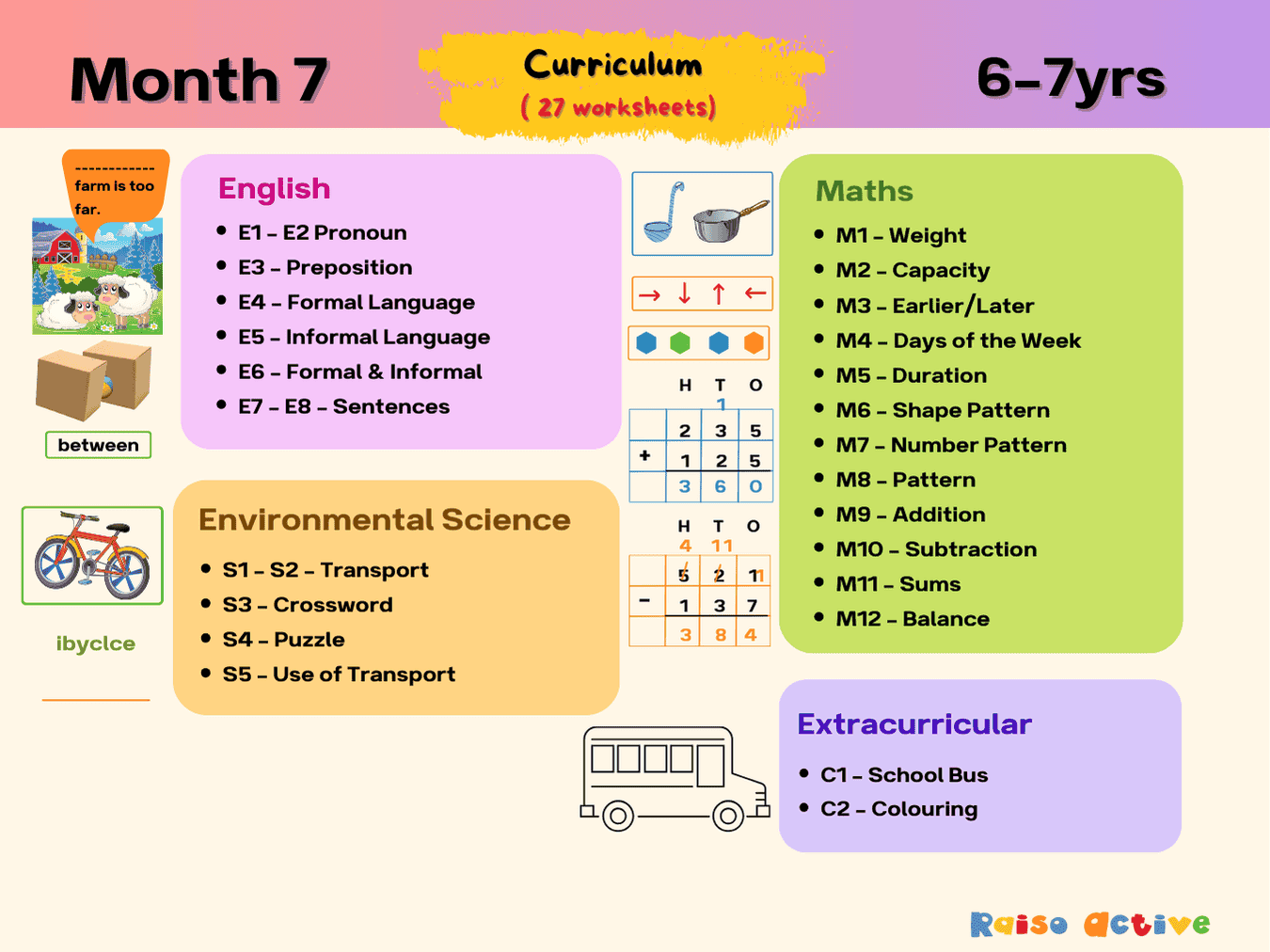
Part of the pack
Month 7: Foundational English Math Science | Ages 6-7
This is page 27 of the pack. Ages 6-7 · Grade 1Ages 6-7 · Year 2Ages 6-7 · Class 1Ages 6-7
Made for your child
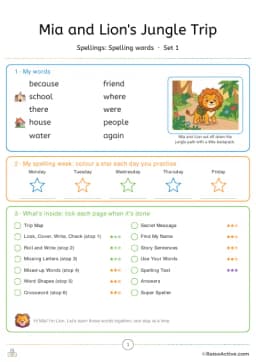
Spelling practice, made for your child
Their own spelling words turned into a pack: trace or look-cover-write-check, roll and write, a secret picture code, a word search, a crossword and a test, with their name in it.
Make a spelling packFree preview · free for members
Or start free: a word search with sight wordsCurriculum
- Transportation > Transportation
How to use this worksheet
Start by looking at the pictures of vehicles around the grid and naming each one together so your child knows exactly which words to hunt for. Point out one word from the word list and have your child say it slowly, sound by sound, before scanning the grid. Guide their finger row by row until they spot the matching sequence of letters, then have them circle it. Repeat for each remaining vehicle word, celebrating every successful find.
Materials needed
- Pencil
- Crayons
Extension activities
- 1Make a mini word search of your own with just three or four vehicle names for extra practice.
- 2Go for a walk and count how many different vehicles you can spot, saying each name aloud.
- 3Create a short story together about a journey that uses at least three of the vehicle words from the search.
- 4Cut out vehicle pictures from a magazine or flyer to make a transportation collage.
- 5Play 'I spy a word' by choosing one grid word and having your child hunt for its first letter only.

Written by
Hemsweta Jain · Teacher Cheena
MBA and Early Childhood Educator, teaching since 2014 · Founder of RaisoActive, Mumbai
Every RaisoActive worksheet is designed and checked by the founder before publishing.
Published · Last reviewed
More from Month 7: Foundational English Math Science | Ages 6-7

Parent's Guide: Complex Sentences and Observation Activities Worksheet
Ages 3-5 · Preschool–Pre-KAges 3-5 · Nursery–ReceptionAges 3-5 · Nursery–LKGAges 3-5
This parent guide bundles activities around complex sentence structure, weight and capacity comparison, measuring duration, and demonstrative pronouns ('this,' 'that,' 'these,' 'those'), giving children exposure to several distinct language and science-reasoning skills through short, hands-on games rather than one worksheet. For ages three to five, rotating between grammar and observation-based tasks like this keeps engagement high while covering meaningfully different areas of development.

Which is Faster? Duration Worksheet for Preschoolers
Ages 4-6 · Pre-K–KindergartenAges 4-6 · Reception–Year 1Ages 4-6 · LKG–UKGAges 4-6
Comparing which of two vehicles or activities would take less time introduces children to the concept of duration, how long something takes, without requiring them to read a clock yet, making it an accessible first step toward understanding time as a measurable quantity. For ages four to six, reasoning about speed and duration together also builds early scientific thinking about cause and effect.

Sentence Detective: Simple, Compound, or Complex Sentences Worksheet for Kids
Ages 4-6 · Pre-K–KindergartenAges 4-6 · Reception–Year 1Ages 4-6 · LKG–UKGAges 4-6
This worksheet introduces children to three different sentence structures, simple, compound, and complex, teaching them to notice how conjunctions and clause combinations change a sentence's complexity, a more advanced grammar concept appropriate for ages four to six who are already reading independently. Recognizing these structures also improves reading fluency, since children start to anticipate pauses and connections within longer sentences.
3-Digit Subtraction Worksheet for Kids
Ages 5-7 · Kindergarten–Grade 1Ages 5-7 · Year 1–Year 2Ages 5-7 · UKG–Class 1Ages 5-7
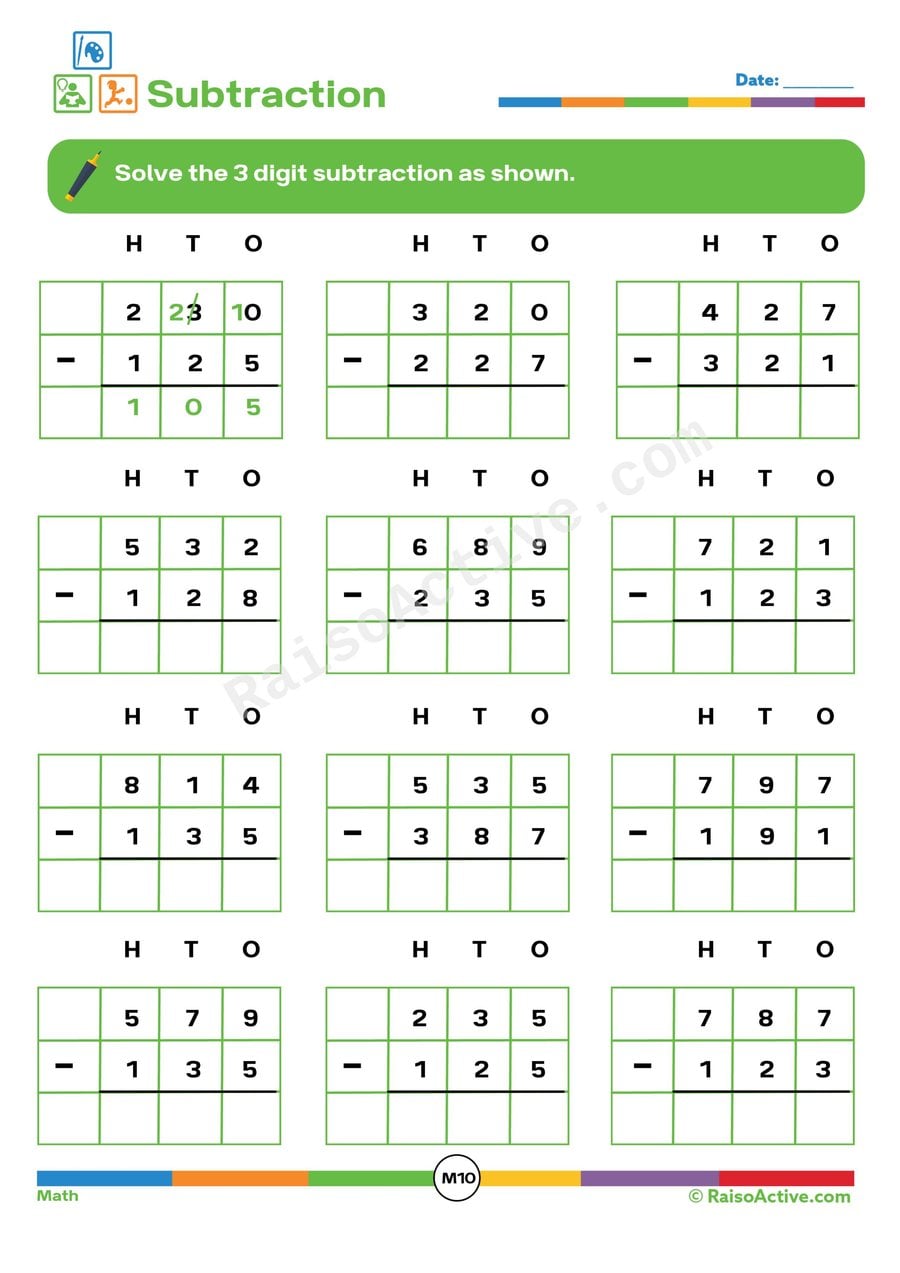
Subtracting three-digit numbers introduces children to borrowing, or regrouping, across place value columns, a more demanding skill than simple subtraction since it requires understanding that a ten can be 'broken' into ones when a column doesn't have enough to subtract from. For ages five to seven, this worksheet builds the procedural foundation for confident multi-digit subtraction going forward.

Transportation Match-Up Worksheet for Preschoolers
Ages 4-6 · Pre-K–KindergartenAges 4-6 · Reception–Year 1Ages 4-6 · LKG–UKGAges 4-6
Matching a written description to the correct vehicle picture builds reading comprehension for children ages 4-6, requiring them to connect specific details, like where a vehicle travels or what it carries, to a visual image. This strengthens both transportation vocabulary and the broader skill of using descriptive clues to identify something, which supports comprehension in future reading tasks.

School Bus Coloring and Cutting Worksheet for Preschoolers
Ages 3-5 · Preschool–Pre-KAges 3-5 · Nursery–ReceptionAges 3-5 · Nursery–LKGAges 3-5
Coloring, cutting, and assembling a school bus gives children ages 3-5 practice with precise scissor control, since cutting small shapes like windows and wheels demands more accuracy than cutting along a straight edge. The activity also introduces a familiar, comforting topic — the school bus — which can help ease transportation-related anxieties for children starting or continuing school.

Number Pattern Worksheet for Kids: Identify and Fill in the Blanks!
Ages 4-6 · Pre-K–KindergartenAges 4-6 · Reception–Year 1Ages 4-6 · LKG–UKGAges 4-6
Identifying and continuing number patterns builds early algebraic thinking for children ages 4-6, teaching them to notice a repeated rule, like adding one or adding five, rather than treating each number as unrelated. This kind of pattern recognition strengthens number sense and lays groundwork for later skip-counting, multiplication, and even sequencing in non-math contexts.

Transport Worksheet: Cut and Paste the Correct Mode of Transport!
Ages 4-6 · Pre-K–KindergartenAges 4-6 · Reception–Year 1Ages 4-6 · LKG–UKGAges 4-6
Reading a sentence and choosing the correct vehicle to complete it teaches children ages 4-6 to use context clues from text to guide a decision, an early reading comprehension skill that goes beyond simple word recognition. The cutting and pasting also reinforces vocabulary for different modes of transportation as children physically match each picture to its described purpose.
Related worksheets

Transport Vehicles Cut and Paste Worksheet for Preschoolers
Ages 3-5 · Preschool–Pre-KAges 3-5 · Nursery–ReceptionAges 3-5 · Nursery–LKGAges 3-5
This worksheet has children ages 3-5 sort transport vehicles by cutting them out and pasting each one onto the correct scene — road, water, or sky — building early classification skills alongside vocabulary about how different vehicles travel. Sorting by category, rather than just naming objects, is an important thinking skill that helps children organize new knowledge as they learn about the world.

Land Transport Vehicles Worksheet for Preschoolers
Ages 3-5 · Preschool–Pre-KAges 3-5 · Nursery–ReceptionAges 3-5 · Nursery–LKGAges 3-5
This worksheet asks children ages 3-5 to look at a busy scene and identify land transport vehicles — cars, trucks, buses, bicycles — by circling them, building visual discrimination skills alongside transportation vocabulary. Picking specific vehicles out of a larger picture also trains children's ability to filter relevant details from a busy visual field, a useful skill well beyond this worksheet's topic.
Odd One Out: Transportation Worksheet for Kids
Ages 3-5 · Preschool–Pre-KAges 3-5 · Nursery–ReceptionAges 3-5 · Nursery–LKGAges 3-5
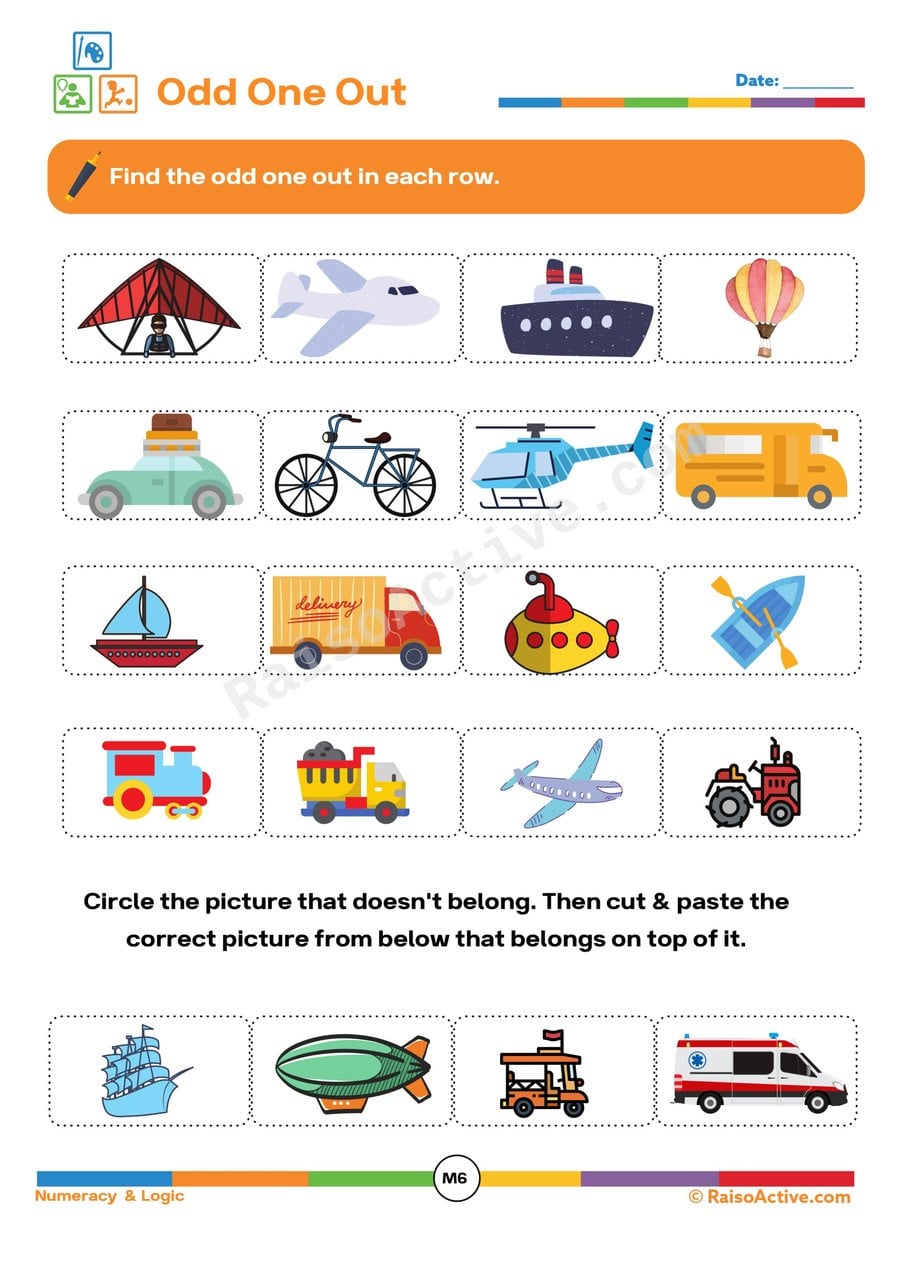
This worksheet sharpens visual discrimination and categorization skills as children ages 3-5 study a row of transportation pictures and identify the one that doesn't belong with the others, then replace it with a correct match cut from the bottom of the page. Explaining why an item is the 'odd one out' builds early critical-thinking and reasoning skills that go beyond simple picture recognition.

Transportation Worksheet: Match the Vehicles! (Ages 3-5)
Ages 3-5 · Preschool–Pre-KAges 3-5 · Nursery–ReceptionAges 3-5 · Nursery–LKGAges 3-5
This worksheet asks children ages 3-5 to sort vehicles into four transportation categories — road, track, air, and water — which builds classification skills beyond simple pairs. Because kids must decide which of four groups a vehicle belongs to instead of just two, it stretches their reasoning a level further than basic matching. It also grows vocabulary around trains and tracks, a category many transportation worksheets skip.

Transportation Fun: Identify Land, Water, and Air Vehicles!
Ages 3-5 · Preschool–Pre-KAges 3-5 · Nursery–ReceptionAges 3-5 · Nursery–LKGAges 3-5
This worksheet helps children ages 3-5 classify different vehicles by where they travel — land, water, or air — building early categorization skills alongside transportation vocabulary. Writing the correct letter (L, W, or A) for each picture requires children to think about a vehicle's purpose and environment, not just recognize what it is, adding a layer of reasoning beyond simple naming.

Transport Worksheet: Circle and Count the Transport Items!
Ages 3-5 · Preschool–Pre-KAges 3-5 · Nursery–ReceptionAges 3-5 · Nursery–LKGAges 3-5
This worksheet combines two skills for children ages 3-5: visually identifying which pictures represent transportation versus other objects, and then counting a separate group of transport items and recording the total as a number. Circling only the correct category first requires categorization and attention to detail, while the counting section that follows builds one-to-one correspondence with a real-world, kid-friendly theme that most children find naturally engaging. Vehicles are also a great vocabulary-building topic, since children often already know many transport names from daily life.

Train Engine Craft: Cut and Paste Worksheet for Preschoolers
Ages 3-5 · Preschool–Pre-KAges 3-5 · Nursery–ReceptionAges 3-5 · Nursery–LKGAges 3-5
Children ages 3-5 practice following a multi-step visual sequence and build fine motor precision as they cut out individual shapes and assemble them into a complete train engine picture. Beyond cutting and gluing practice, this craft introduces basic engineering thinking — understanding how separate parts combine to form one recognizable whole.

Transport Cut and Paste Worksheet for Preschoolers
Ages 3-5 · Preschool–Pre-KAges 3-5 · Nursery–ReceptionAges 3-5 · Nursery–LKGAges 3-5
This cut-and-paste worksheet asks children ages 3-5 to sort vehicle pictures into air, water, and land categories, building classification skills alongside scissor control and glue placement. Sorting by transport type is an early exercise in the broader thinking skill of grouping objects by a shared property, which underlies later science and math reasoning.
Guides for this topic

Sight Words by Age: The First 50 Words and How to Teach Them Without Flashcard Fatigue
Which sight words to teach first and why, the heart-word method, a read-trace-write-find routine, games, and a by-age table of typical sight-word progress.
How to Teach CVC Blending: A Step-by-Step Method That Works in Two Weeks
A step-by-step method for teaching CVC blending, covering continuous sounds, word families, common errors, and a 14-day plan that most children finish reading CVC words.

Documenting Learning Without Drowning in Data: A Practical Guide for Parents and Teachers
Learn practical ways to document your child's learning without overwhelm. Simple portfolios, observation tips, and printable trackers for ages 1-8.
Reviews
Every worksheet for ages 3–5, no watermark
Members download the full library of 1,000+ worksheets and every activity pack without watermarks or daily limits. One year costs ₹999 in India or $20 elsewhere.
See membership plansOr download any worksheet free with a watermark (5 a day).