Find the Similar Objects Worksheet for Preschoolers
Comparing a row of objects to find the ones that match and identify the one that's different builds visual discrimination skills for children ages 3-5, an early foundation for noticing the subtle differences between similar-looking letters later in reading.
Part of the pack
Month 12: Learning & Development | Ages 4-5
This is page 15 of the pack. Ages 4-5 · Pre-KAges 4-5 · ReceptionAges 4-5 · LKGAges 4-5
Made for your child
Counting to 10, made for your child
A maths pack with your child's name in it: pictures that explain, practice at three levels, puzzles and story sums about them. Print a new set whenever they finish.
Make a maths packFree preview · free for members
Curriculum
- Cognitive - Attention > Observation Skills
How to use this worksheet
Look at the first row of objects together and examine them closely one by one. Have your child color all the objects that look the same and cross out the one that is different from the rest. Continue through each remaining row, encouraging your child to explain what makes the odd one out different each time.
Materials needed
- Pencil
- Crayons
Extension activities
- 1Go on a scavenger hunt and find similar objects around the house.
- 2Draw your own sets of similar objects with one that doesn't belong.
- 3Play a matching card game, sorting cards into pairs and singles.
- 4Set out a few real objects and ask your child to spot the one that's different.

Written by
Hemsweta Jain · Teacher Cheena
MBA and Early Childhood Educator, teaching since 2014 · Founder of RaisoActive, Mumbai
Every RaisoActive worksheet is designed and checked by the founder before publishing.
Published · Last reviewed
More from Month 12: Learning & Development | Ages 4-5
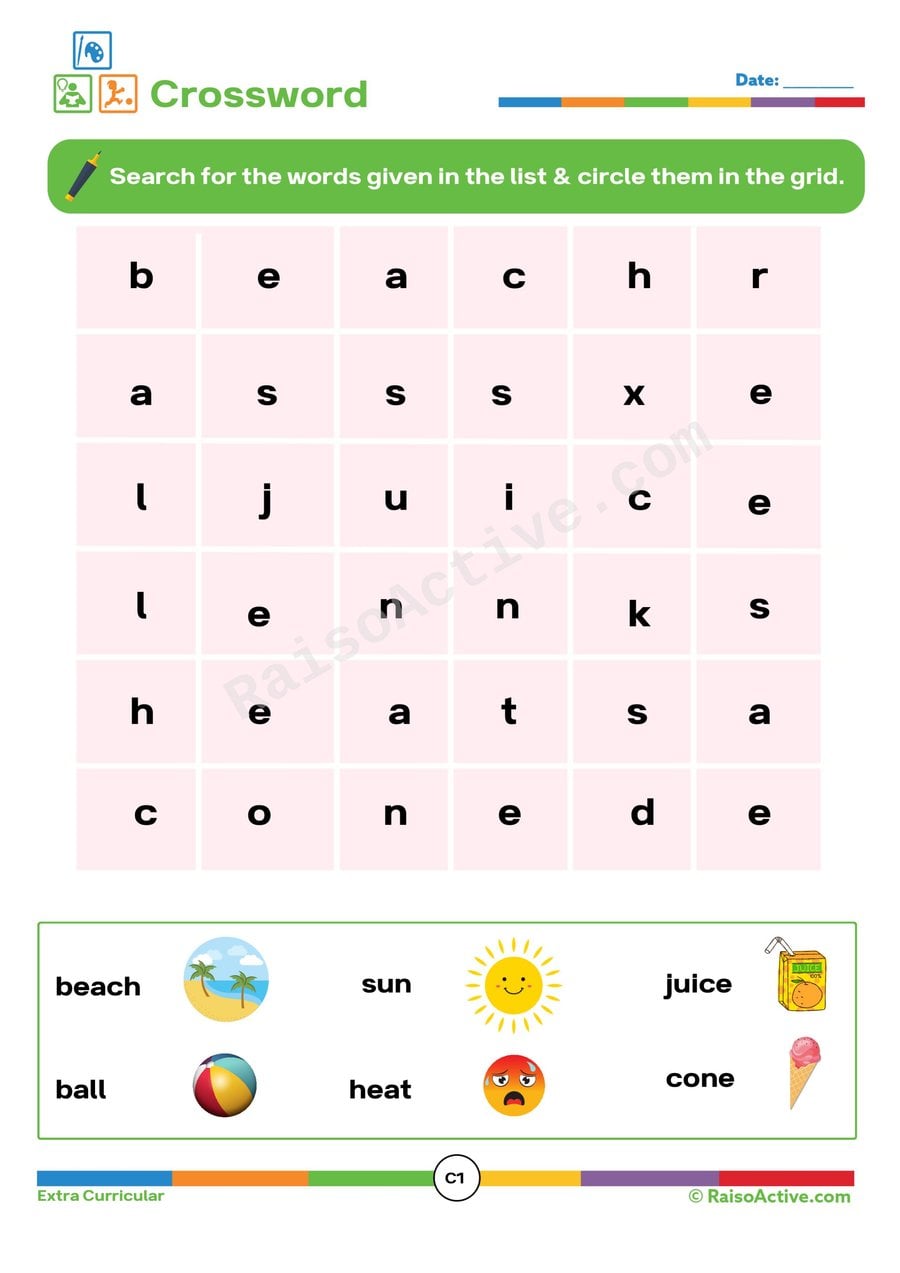
Summer Fun Crossword Puzzle Worksheet for Kids
Ages 3-5 · Preschool–Pre-KAges 3-5 · Nursery–ReceptionAges 3-5 · Nursery–LKGAges 3-5
Children ages 3-5 practice recognizing and reading summer-themed vocabulary words, like sun, pool, or ice cream, by finding them hidden within a grid, building early word-recognition and visual scanning skills. Searching for a whole word letter by letter also reinforces left-to-right reading direction, an important pre-reading habit.
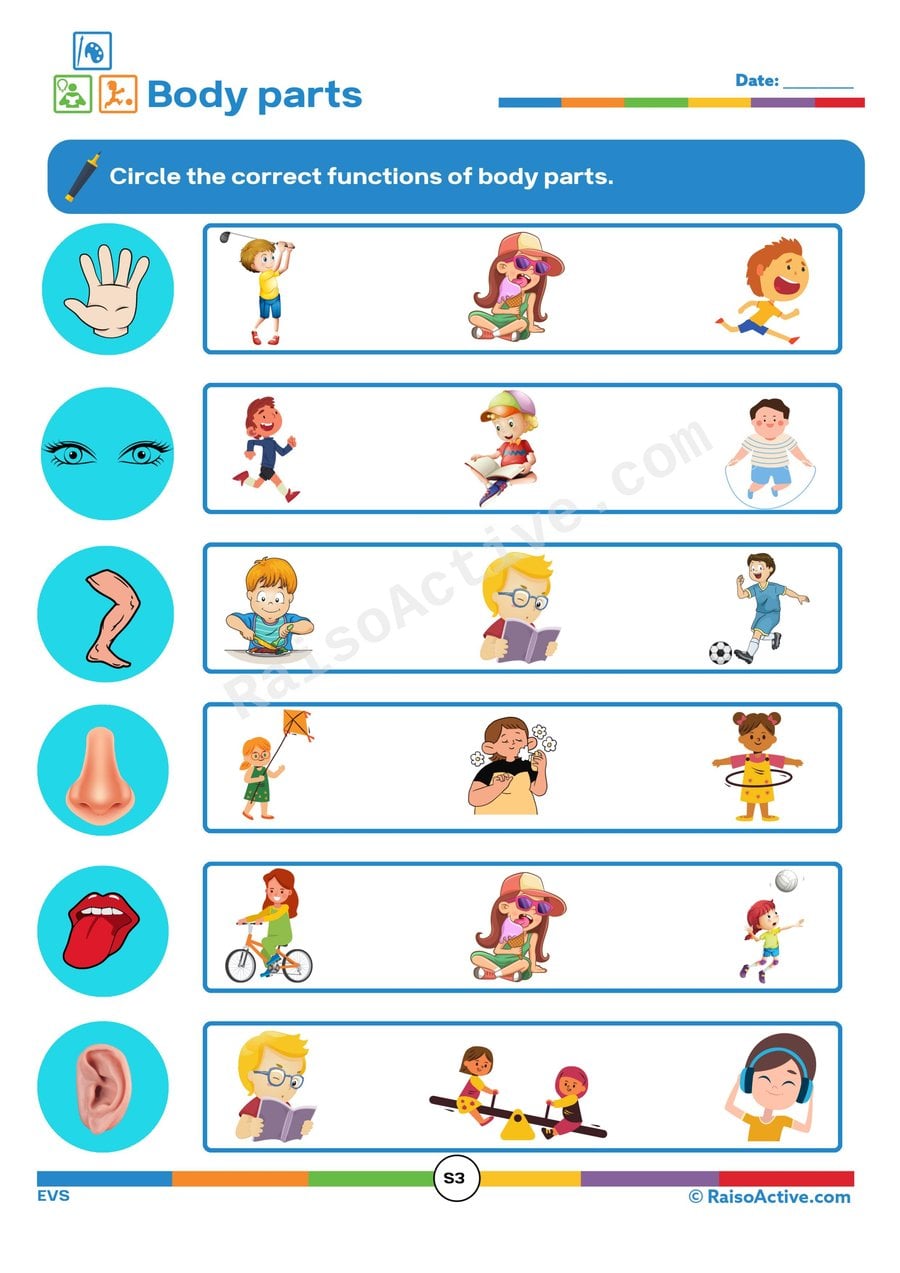
Body Parts Functions Worksheet for Kids
Ages 3-5 · Preschool–Pre-KAges 3-5 · Nursery–ReceptionAges 3-5 · Nursery–LKGAges 3-5
Children ages 3-5 practice connecting specific body parts to their real-world function, like eyes for seeing or ears for hearing, by circling the picture that shows what each body part is used for. This reinforces body awareness and vocabulary while building the reasoning skill of linking a body part to its purpose.

Days of the Week Sequencing Worksheet for Preschoolers
Ages 3-5 · Preschool–Pre-KAges 3-5 · Nursery–ReceptionAges 3-5 · Nursery–LKGAges 3-5
This worksheet builds sequencing skills for children ages 3-5 as they work with the days of the week in order, first filling in a missing day and then cutting and gluing days into the correct sequence. Understanding that days follow a fixed, repeating order is an early step toward time concepts like yesterday, today, and tomorrow, and this hands-on repetition helps cement a sequence that isn't visually obvious the way counting objects is.

Traffic Rules Worksheet: Cut and Glue the Traffic Signs!
Ages 3-5 · Preschool–Pre-KAges 3-5 · Nursery–ReceptionAges 3-5 · Nursery–LKGAges 3-5
Cutting out traffic sign pictures and matching them to their correct labels builds early sign recognition and vocabulary for children ages 3-5, connecting a familiar shape and color to its real-world safety meaning.

Subtraction Fun: Candy and Treats Worksheet for Kids!
Ages 4-6 · Pre-K–KindergartenAges 4-6 · Reception–Year 1Ages 4-6 · LKG–UKGAges 4-6
This worksheet gives children ages 4-6 concrete practice with subtraction by counting pictured candies and treats, then taking away a stated amount to find the difference. Using a visually appealing, countable context like candy makes the abstract idea of 'taking away' easier to grasp than numbers alone, helping children build the one-to-one counting and comparison skills that subtraction depends on.
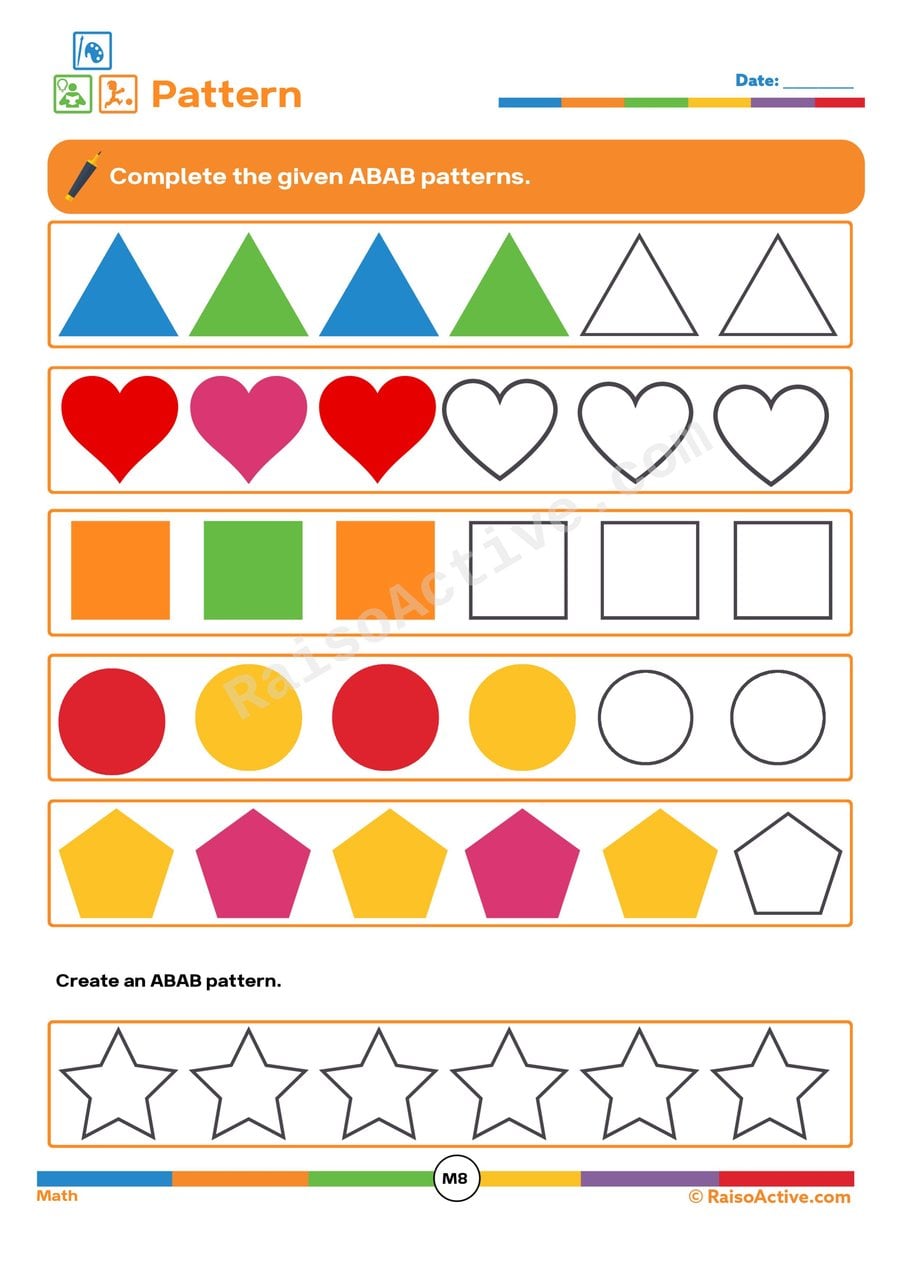
ABAB Pattern Fun: Complete the Shapes Worksheet!
Ages 3-5 · Preschool–Pre-KAges 3-5 · Nursery–ReceptionAges 3-5 · Nursery–LKGAges 3-5
This worksheet builds early algebraic thinking as children ages 3-5 identify and continue ABAB patterns using shapes and colors, then create a pattern of their own using stars. Recognizing that a pattern repeats in a predictable unit is a foundational math skill that later supports understanding sequences, multiplication, and logical prediction, making this simple shape activity more mathematically important than it might first appear.

Number Sequence Worksheet: What Comes Before, After, and In Between!
Ages 4-5 · Pre-KAges 4-5 · ReceptionAges 4-5 · LKGAges 4-5
Identifying numbers that come before, after, or in between a given number builds flexible number sequencing skills for children ages 4-5, going beyond simple forward counting to strengthen their overall sense of number order.

Parent's Guide: Sight Words and CVC Words Activities
Ages 3-5 · Preschool–Pre-KAges 3-5 · Nursery–ReceptionAges 3-5 · Nursery–LKGAges 3-5
This parent's guide offers a set of hands-on activities for children ages 3-5 that build early reading skills through sight word and CVC (consonant-vowel-consonant) word practice, using letter blocks, storytelling, and even a color-mixing experiment to keep learning varied and engaging. Practicing sight words and simple three-letter words together builds the foundation for sounding out and recognizing whole words while reading.
Related worksheets
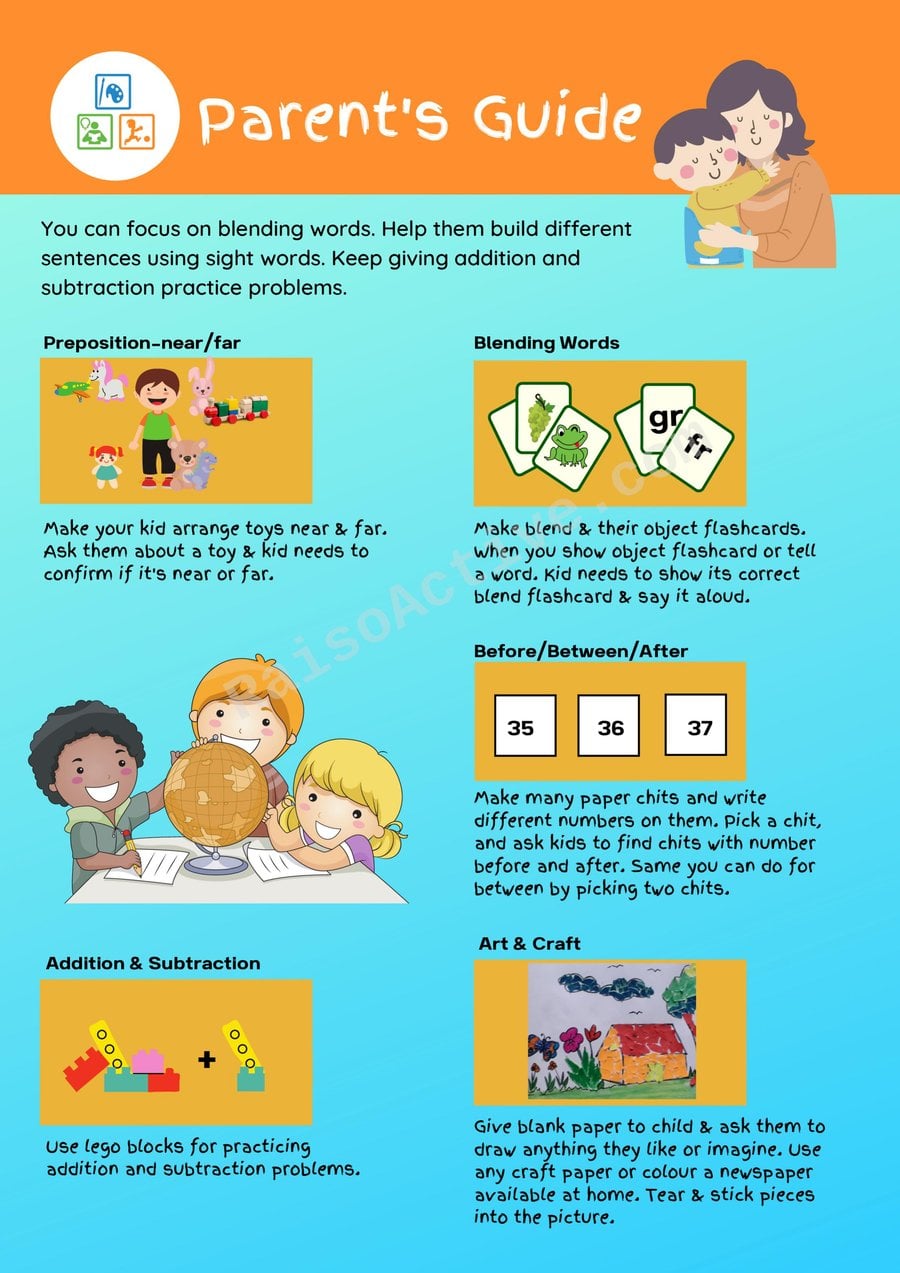
Parent's Guide: Fun Activities for Early Learning
Ages 3-5 · Preschool–Pre-KAges 3-5 · Nursery–ReceptionAges 3-5 · Nursery–LKGAges 3-5
This parent guide bundles three separate early-learning activities, blending sounds into words, understanding prepositions like 'near' and 'far,' and practicing basic math, into one set of hands-on games rather than a single printed page. Combining these skills in short, varied activities matches how preschoolers actually learn best: through play, repetition, and movement rather than sitting through one long task.

Parts of a Leaf Worksheet for Preschoolers: Learn and Play!
Ages 3-5 · Preschool–Pre-KAges 3-5 · Nursery–ReceptionAges 3-5 · Nursery–LKGAges 3-5
This hands-on activity teaches children ages 3-5 the parts of a leaf — tip, blade, veins, midrib, petiole, and stem — by having them shape a leaf from playdough while comparing it to a real leaf. Building a physical model alongside a real specimen helps children connect abstract vocabulary to tangible features they can see and touch, which is especially effective for this age group.

Transportation Coloring Worksheet for Preschoolers
Ages 3-5 · Preschool–Pre-KAges 3-5 · Nursery–ReceptionAges 3-5 · Nursery–LKGAges 3-5
This worksheet helps children ages 3-5 practice categorizing vehicles by where they travel — air, water, or land — while strengthening fine motor control through a color-coded coloring task. Following a color key adds a layer of symbolic thinking, since children must hold three rules in mind and apply the correct one to each vehicle. It's a natural bridge between science classification and hands-on art.
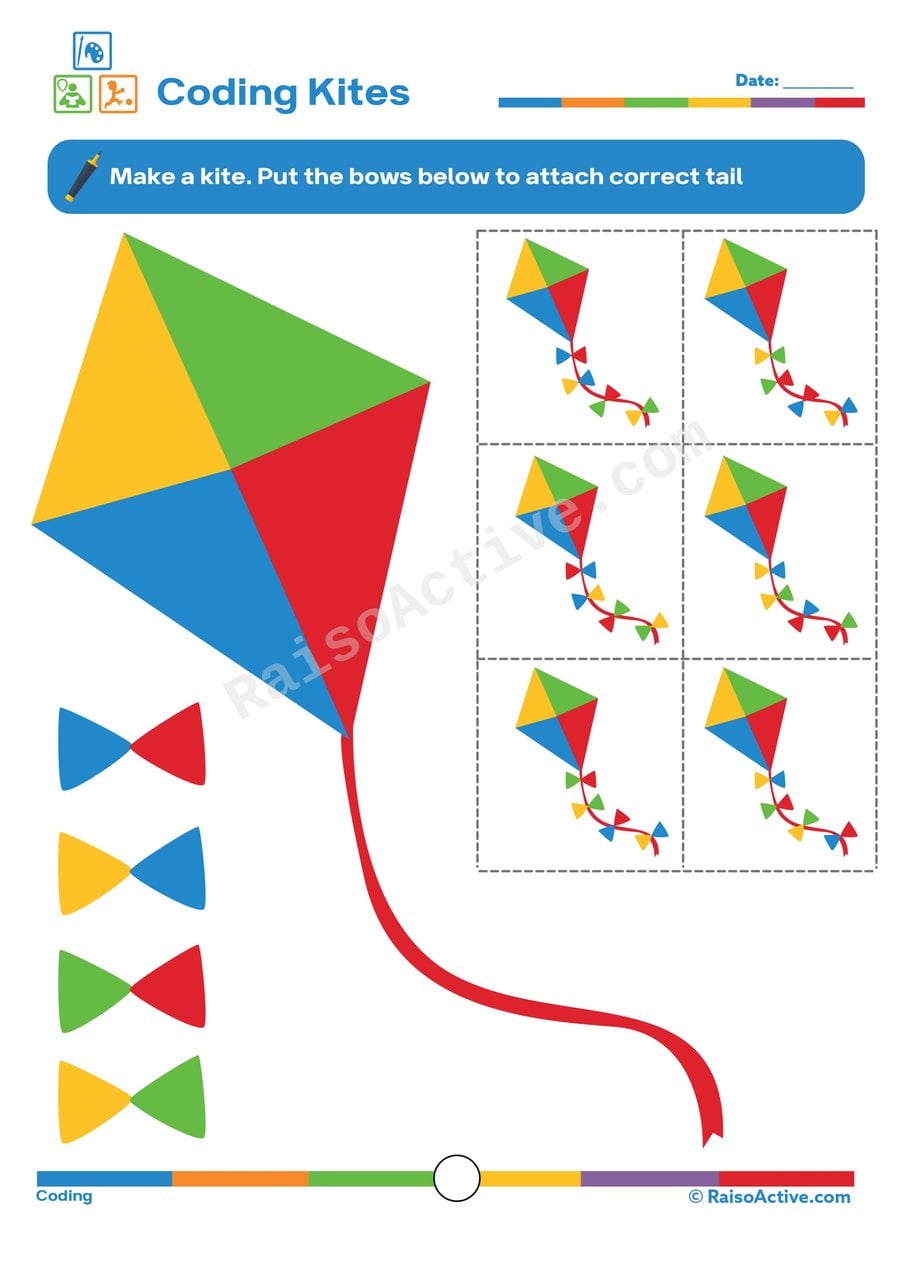
Coding Kites Worksheet: Match the Bows!
Ages 3-5 · Preschool–Pre-KAges 3-5 · Nursery–ReceptionAges 3-5 · Nursery–LKGAges 3-5
This activity sharpens visual observation in children ages 3-5 as they compare color sequences on each kite to a set of loose bows and find the exact match. Careful, systematic comparison — checking each color in order rather than glancing quickly — builds an attention-to-detail habit that transfers directly to early reading and number work.

Light Energy Worksheet: Connect the Sun to Light Sources!
Ages 3-5 · Preschool–Pre-KAges 3-5 · Nursery–ReceptionAges 3-5 · Nursery–LKGAges 3-5
Connecting the sun to other objects that produce light builds early science reasoning for children ages 3-5, introducing the concept that light comes from specific sources rather than simply existing everywhere.
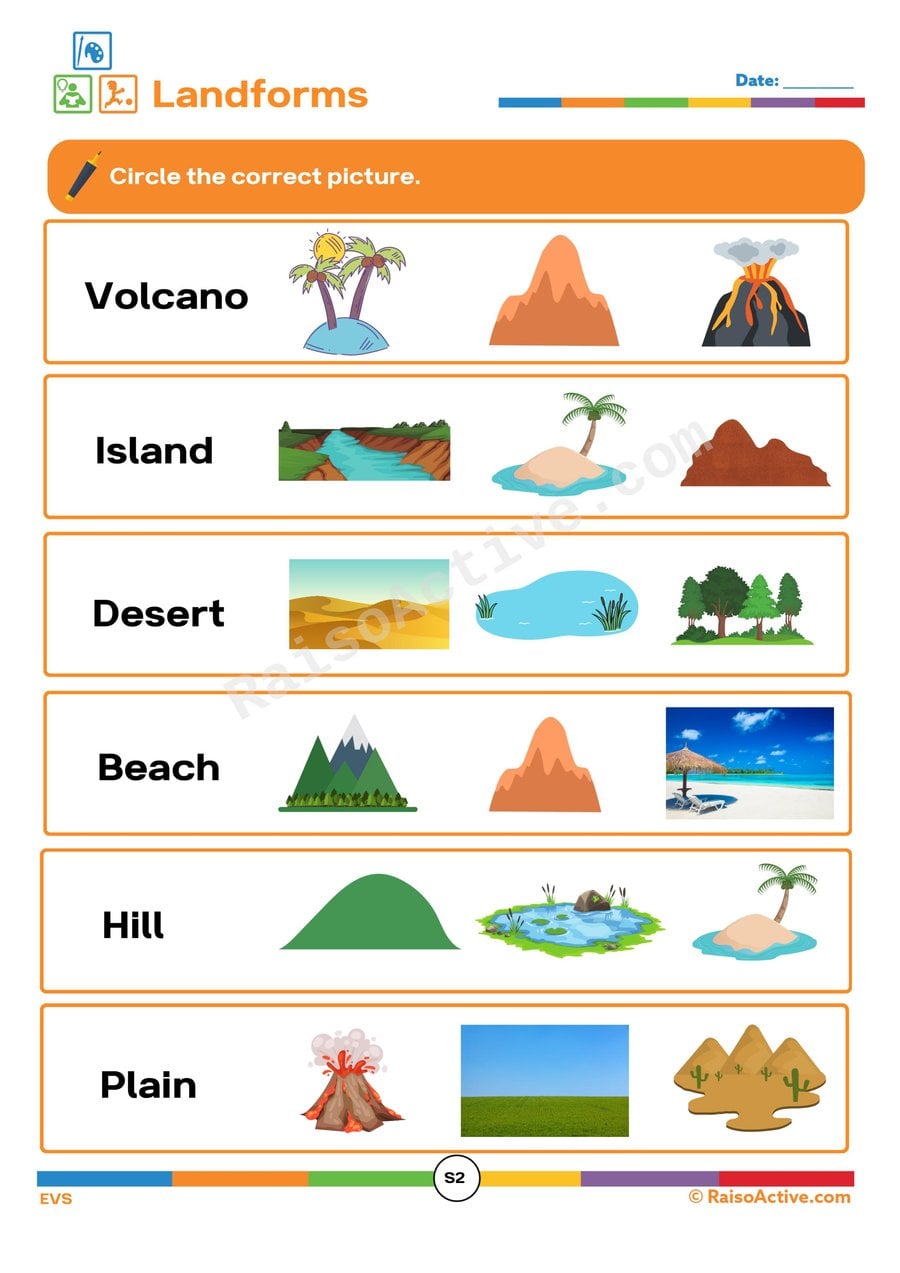
Landforms Worksheet: Circle the Correct Picture!
Ages 4-6 · Pre-K–KindergartenAges 4-6 · Reception–Year 1Ages 4-6 · LKG–UKGAges 4-6
This worksheet introduces children ages 4-6 to basic landform vocabulary — words like mountain, valley, island, or river — by asking them to read or hear a landform's name and circle the picture that matches it. Connecting a geography term to its correct visual representation builds early science and social studies vocabulary well before children can read complex nonfiction text on their own. This kind of word-to-picture matching also reinforces observational skills, since children must notice the distinguishing visual features that make one landform different from another.

Sound Energy Worksheet: Identifying Sound Producers!
Ages 4-6 · Pre-K–KindergartenAges 4-6 · Reception–Year 1Ages 4-6 · LKG–UKGAges 4-6
This worksheet asks children to identify which objects produce sound and to think about how the ear allows us to hear those sounds, introducing basic science vocabulary around sound energy at an age when they're ready to start reasoning about cause and effect. Circling and matching sound-producing objects also sharpens observation, since children must consider whether an object truly makes noise or is simply pictured near something that does.

Odd One Out Worksheet: Find the Different Animal or Object!
Ages 3-5 · Preschool–Pre-KAges 3-5 · Nursery–ReceptionAges 3-5 · Nursery–LKGAges 3-5
Children ages 3-5 sharpen visual discrimination and categorical reasoning as they scan each row of pictures and decide which single image doesn't share a feature with the rest. This kind of comparison task builds the same 'same versus different' thinking that underlies early science observation and later logical reasoning. It also trains sustained visual attention, since children must examine every image in a row before deciding.
Guides for this topic

Best Worksheets for 3-Year-Olds: What Works and What to Avoid
What works on worksheets for 3-year-olds: short sessions, crayons, tracing lines, matching, cutting, a free weekly plan, and signs one is too advanced.

Age-Appropriate Problem-Solving Activities: Building Critical Thinkers from the Ground Up
Discover fun, age-appropriate problem-solving activities for children ages 1-8. Build critical thinking, logic, and reasoning skills through play-based learning.
Critical Thinking Activities That Actually Work for Young Children: Building Tomorrow's Thinkers Today
Discover proven critical thinking activities for young children. Age-wise logic games, questioning techniques, and hands-on ideas to build thinking skills at home.
Reviews
Every worksheet for ages 3–5, no watermark
Members download the full library of 1,000+ worksheets and every activity pack without watermarks or daily limits. One year costs ₹999 in India or $20 elsewhere.
See membership plansOr download any worksheet free with a watermark (5 a day).