Short and Long Vowel Sounds Worksheet for Preschoolers
This worksheet builds phonemic awareness by having children listen for whether a picture's name contains a short vowel sound (like the 'a' in 'cat') or a long vowel sound (like the 'a' in 'cake') and sort accordingly. For four- to six-year-olds, distinguishing short and long vowels is one of the more subtle early phonics skills, since it requires listening closely to a sound rather than just recognizing a letter shape.
Part of the pack
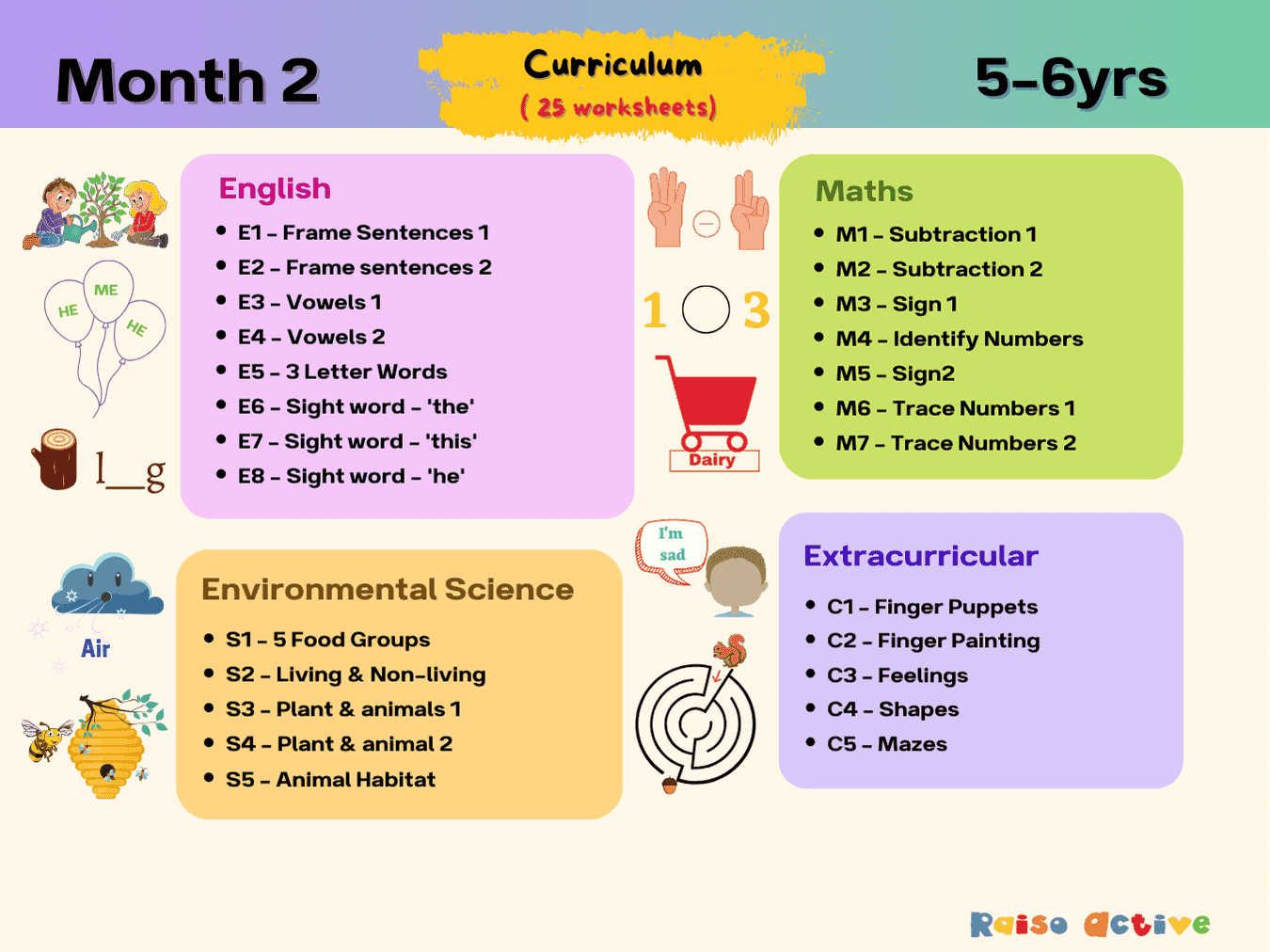
Month 2: Learning & Development | Ages 5-6
This is page 7 of the pack. Ages 5-6 · KindergartenAges 5-6 · Year 1Ages 5-6 · UKGAges 5-6
Made for your child
A whole activity pack made with their name
60 pages to spot, build, trace and write their own name, plus pages about their favourites, feelings and family. See a free preview with their name.
Make an All About Me packFree preview · free for members
Or start free: a name tracing sheet with their nameCurriculum
- Phonics - Letter Sounds > Vowel Sounds
How to use this worksheet
Cut out the pictures at the bottom of the page together. Hold up the first picture and say its name slowly, stretching out the vowel sound so your child can hear whether it's short or long. Ask them to decide which category the word belongs in, then glue the picture into the correct column — 'short vowel' or 'long vowel.' Continue through each picture, saying the word aloud before sorting it every time.
Materials needed
- Scissors
- Glue
- Pencil
Extension activities
- 1Have your child write the word underneath each glued picture to connect the sound to its spelling.
- 2Have your child draw their own pictures representing a short vowel word and a long vowel word.
- 3Play a listening game where you say pairs of words, like 'cap' and 'cape,' and ask which has the long sound.
- 4Sort household objects by their short or long vowel sound in their names.
- 5Read a short book together and pause to identify a few long and short vowel words as you go.

Written by
Hemsweta Jain · Teacher Cheena
MBA and Early Childhood Educator, teaching since 2014 · Founder of RaisoActive, Mumbai
Every RaisoActive worksheet is designed and checked by the founder before publishing.
Published · Last reviewed
More from Month 2: Learning & Development | Ages 5-6
Plants and Animals Needs Worksheet for Kids
Ages 3-5 · Preschool–Pre-KAges 3-5 · Nursery–ReceptionAges 3-5 · Nursery–LKGAges 3-5
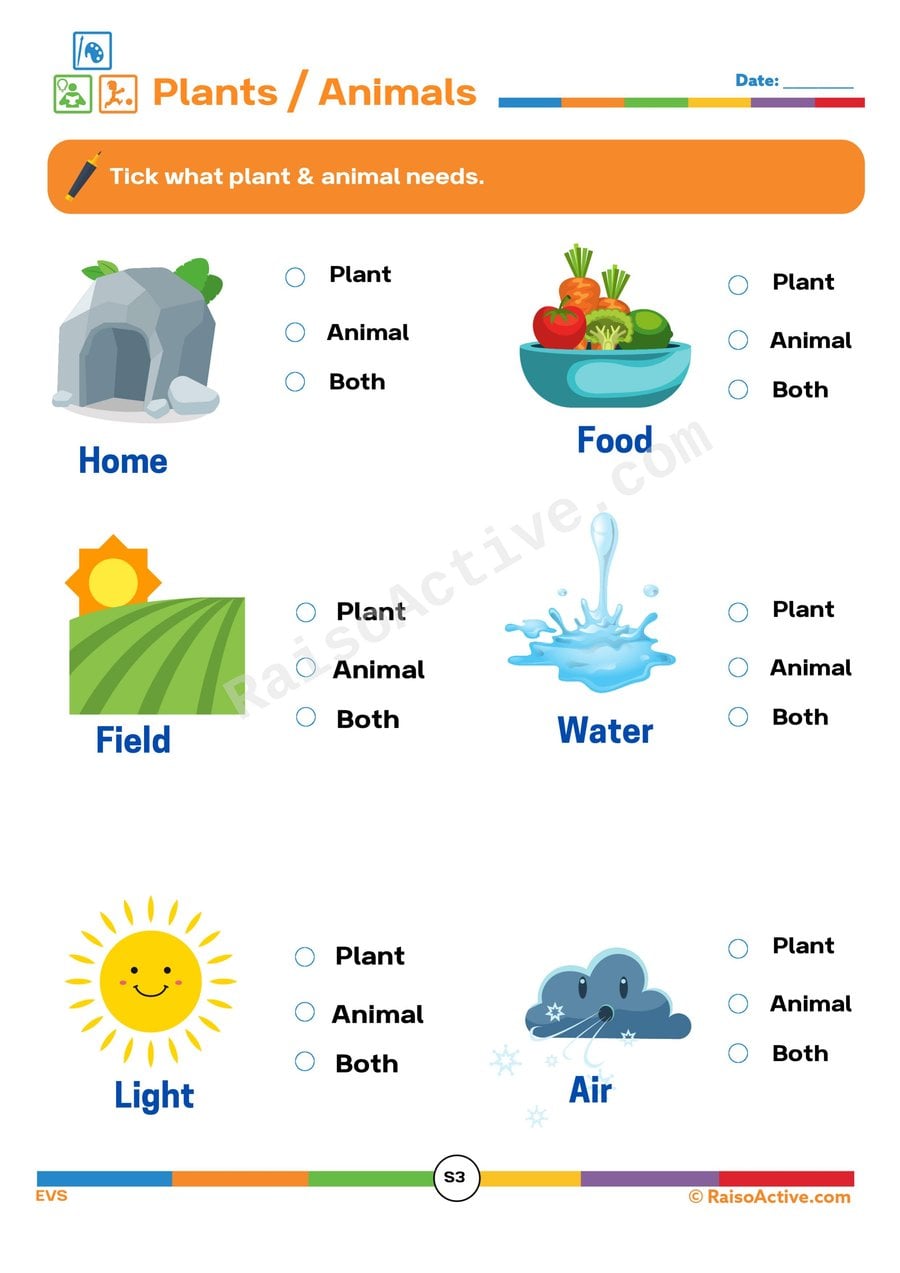
This worksheet introduces the basic science concept that living things — both plants and animals — share fundamental needs like food, water, air, and shelter to survive and grow. For three- to five-year-olds, sorting pictures by which need they represent builds early categorization skills while planting the foundation for later biology lessons about what makes something alive.

Frame Sentences Worksheet: Read and Tick the Correct Sentence!
Ages 4-6 · Pre-K–KindergartenAges 4-6 · Reception–Year 1Ages 4-6 · LKG–UKGAges 4-6
This worksheet strengthens early grammar awareness in children ages 4-6 by having them compare two or more versions of a sentence and judge which one is written correctly. Spotting the difference between a correct and incorrect sentence builds the same skimming and comparing skills that support later spelling and editing work.

Subtraction Fun: Count and Subtract with Hands and Objects!
Ages 4-6 · Pre-K–KindergartenAges 4-6 · Reception–Year 1Ages 4-6 · LKG–UKGAges 4-6
This worksheet introduces basic subtraction by having children count a starting group of objects and then 'take away' a smaller amount indicated by the minus sign, connecting the abstract concept of subtraction to something they can see and count. For four- to six-year-olds, visualizing subtraction as physically removing objects from a group — rather than just manipulating numbers — makes the concept concrete before they move to solving subtraction problems with numbers alone.

Vowel Fun! Find, Color, and Fill-in the Missing Vowels Worksheet
Ages 3-5 · Preschool–Pre-KAges 3-5 · Nursery–ReceptionAges 3-5 · Nursery–LKGAges 3-5
This worksheet gives children ages 3-5 focused practice identifying the five vowels, A, E, I, O, U, and recognizing which vowel sound completes a familiar picture word. Because vowels appear in nearly every word, this early, targeted practice builds a phonics foundation that supports reading many more words later.

Animal Maze Adventure: Help the Animals Find Their Food!
Ages 3-5 · Preschool–Pre-KAges 3-5 · Nursery–ReceptionAges 3-5 · Nursery–LKGAges 3-5
This worksheet helps children ages 3-5 develop problem-solving skills and visual discrimination by guiding different animals through mazes to reach their favorite food, requiring them to scan ahead and choose the correct path before committing to a route. Matching each animal to a food that makes sense for it also builds early general knowledge about what different animals eat.
Living and Non-Living Things Worksheet for Kids
Ages 3-5 · Preschool–Pre-KAges 3-5 · Nursery–ReceptionAges 3-5 · Nursery–LKGAges 3-5
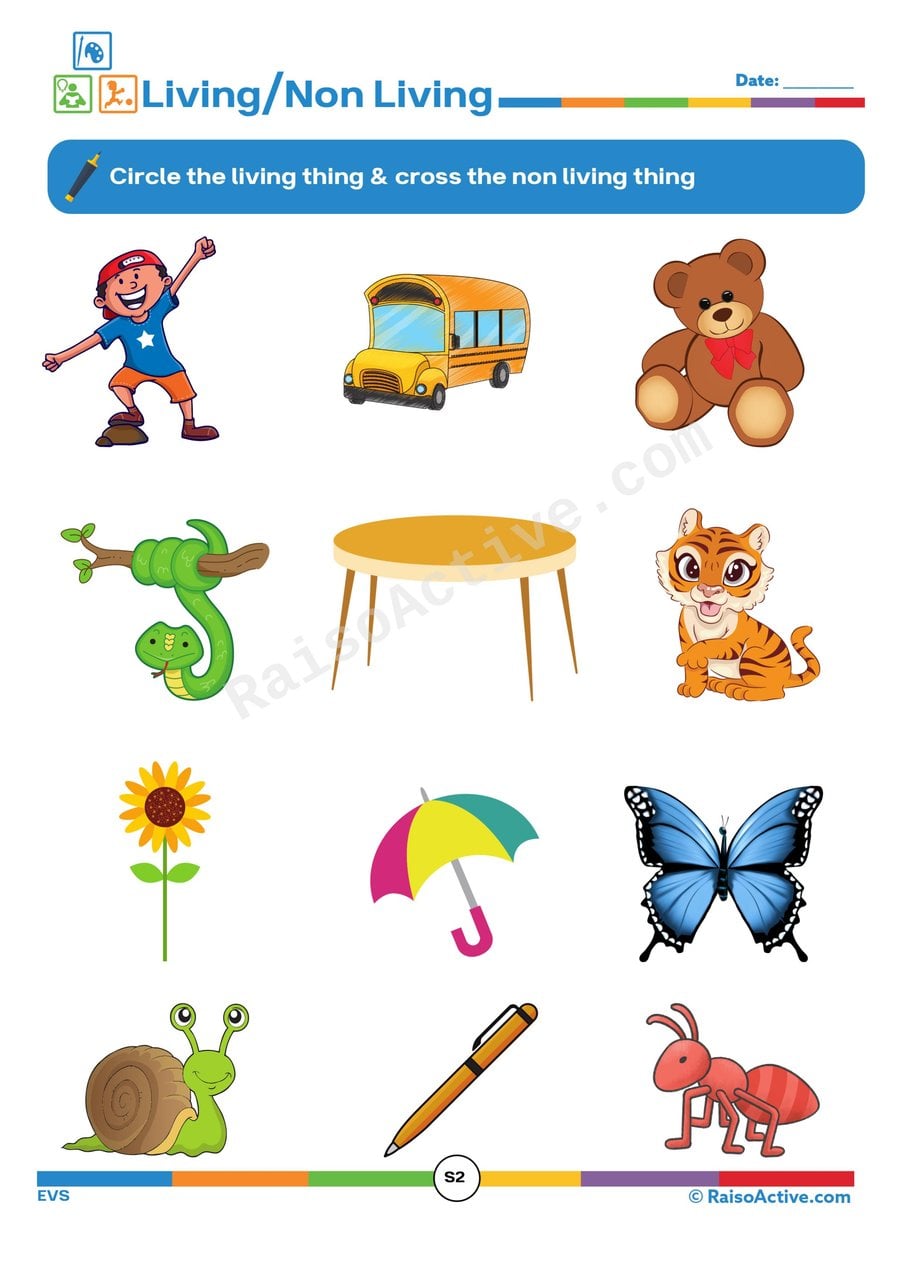
Children ages 3-5 practice an early scientific classification skill by deciding whether each pictured object grows, breathes, and moves on its own, versus things like rocks or toys that don't. Sorting living from non-living things builds the observational reasoning that underpins all later science learning.

Plant or Animal? A Fun Sorting Worksheet for Kids!
Ages 3-5 · Preschool–Pre-KAges 3-5 · Nursery–ReceptionAges 3-5 · Nursery–LKGAges 3-5
Children ages 3-5 practice distinguishing plants from animals by identifying key characteristics like movement and growth, an early biology classification skill that builds their ability to organize the natural world into categories. Labeling each picture with 'A' or 'P' also reinforces letter recognition alongside the science content.

Animal Habitat Matching Worksheet for Preschoolers
Ages 3-5 · Preschool–Pre-KAges 3-5 · Nursery–ReceptionAges 3-5 · Nursery–LKGAges 3-5
This worksheet builds science vocabulary by having children match each animal to its natural habitat, such as a fish to the ocean or a lion to the savanna. For three- to five-year-olds, connecting an animal to where it lives introduces the idea that living things are suited to specific environments, an early step toward understanding ecosystems.
Related worksheets

Identify Vowels Worksheet: Circle the Correct Vowel!
Ages 4-6 · Pre-K–KindergartenAges 4-6 · Reception–Year 1Ages 4-6 · LKG–UKGAges 4-6
This worksheet sharpens phonemic awareness in children ages 4-6 by having them say a picture's name aloud and isolate which vowel sound — a, e, i, o, or u — appears in the middle. Vowels are the trickiest sounds for early readers to hear clearly since they blend into surrounding consonants, so focused practice like this builds a skill that pays off directly in future decoding and spelling.

Vowel Sounds Worksheet: Identify and Circle the Correct Vowel!
Ages 4-6 · Pre-K–KindergartenAges 4-6 · Reception–Year 1Ages 4-6 · LKG–UKGAges 4-6
Children ages 4-6 practice identifying vowel sounds within words by looking at a picture, saying its name aloud, and figuring out which vowel they hear, a specific phonics skill that builds toward independent reading and spelling. Isolating the vowel sound in a word is often trickier for children than identifying beginning consonant sounds, making this a meaningful next step in phonics.
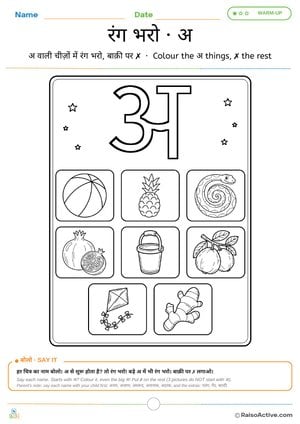
Colour the अ Things: Hindi Letter अ Colouring Page | रंग भरो · अ
Ages 3-7 · Preschool–Grade 1Ages 3-7 · Nursery–Year 2Ages 3-7 · Nursery–Class 1Ages 3-7
Children listen for the first sound of each picture name and decide whether it starts with अ. They colour the अ pictures, cross out the others and colour the big letter.
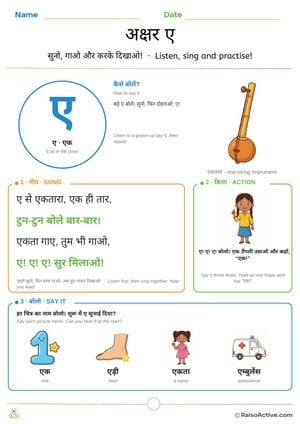
Hindi Letter ए (e) Song and Action Worksheet | अक्षर ए गीत और क्रिया
Ages 3-7 · Preschool–Grade 1Ages 3-7 · Nursery–Year 2Ages 3-7 · Nursery–Class 1Ages 3-7
Children meet the Hindi vowel ए (e) through a four-line song, a body action and picture words such as एक, एकतारा, एड़ी, एकता and एम्बुलेंस. Hearing, saying and moving together helps the sound stick before any writing begins.
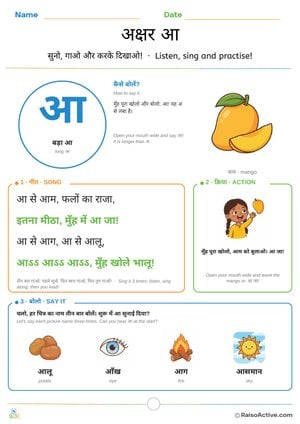
Hindi Letter आ (aa) Song, Action and Say It | अक्षर आ
Ages 3-7 · Preschool–Grade 1Ages 3-7 · Nursery–Year 2Ages 3-7 · Nursery–Class 1Ages 3-7
Children hear and say the long vowel आ, learn a short rhyme with an action, and say the names of the picture words आम (mango), आलू (potato), आँख (eye), आग (fire), आसमान (sky) to practise hearing आ at the start.
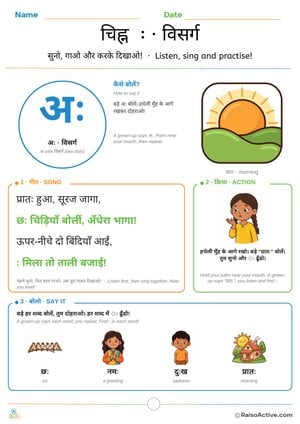
Hindi Visarga अः (ah) Song and Action Worksheet | चिह्न ः · विसर्ग गीत और क्रिया
Ages 3-7 · Preschool–Grade 1Ages 3-7 · Nursery–Year 2Ages 3-7 · Nursery–Class 1Ages 3-7
A four-line song about the morning sun, six birds and two dots, with an action and four picture words (छः, नमः, दुःख, प्रातः). Children hear अः and find the two dots ः in each word.
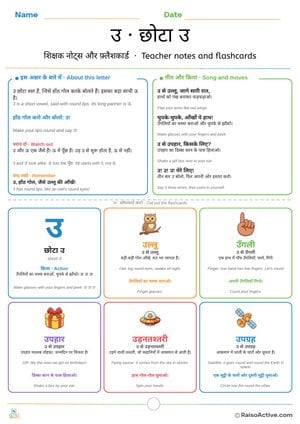
Hindi Letter उ (u) Teacher Notes and Flashcards | उ · छोटा उ
Ages 3-7 · Preschool–Grade 1Ages 3-7 · Nursery–Year 2Ages 3-7 · Nursery–Class 1Ages 3-7
Children meet the short vowel उ with a short note for adults, a song with actions and cut-out flashcards for उल्लू (owl), उँगली (finger), उपहार (gift), उड़नतश्तरी (flying saucer), उपग्रह (satellite). They hear the sound at the start of real words and link it to a hand action.
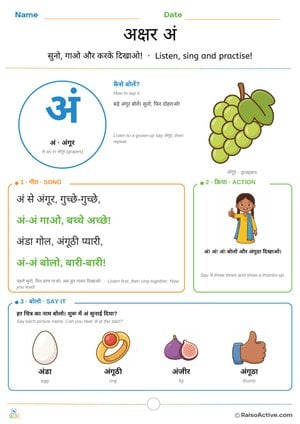
Hindi Letter अं (am) Song and Action Worksheet | अक्षर अं गीत और क्रिया
Ages 3-7 · Preschool–Grade 1Ages 3-7 · Nursery–Year 2Ages 3-7 · Nursery–Class 1Ages 3-7
Children meet the Hindi vowel अं (am) through a four-line song, a body action and picture words such as अंगूर, अंडा, अंगूठी, अंजीर, अंगूठा and अंकुर. Hearing, saying and moving together helps the sound stick before any writing begins.
Guides for this topic

How to Teach CVC Blending: A Step-by-Step Method That Works in Two Weeks
A step-by-step method for teaching CVC blending, covering continuous sounds, word families, common errors, and a 14-day plan that most children finish reading CVC words.
Phase 2 Phonics at Home: Sound Order, Blending Games, Worksheets
Phase 2 phonics at home: the five sound sets in order, oral blending, tricky words, a two-week routine, common mistakes, and free worksheets.

Reception Year Explained: EYFS Learning and How to Help at Home
A teacher's plain-English guide to the Reception Year: the seven areas of learning, Early Learning Goals, Phase 2/3 phonics, the RBA and home routines.
Reviews
Every worksheet for ages 4–6, no watermark
Members download the full library of 1,000+ worksheets and every activity pack without watermarks or daily limits. One year costs ₹999 in India or $20 elsewhere.
See membership plansOr download any worksheet free with a watermark (5 a day).