Free printable worksheets · India
Unity in Diversity Worksheets & Project Ideas (Ages 4–10)
Unity in Diversity worksheets are printable activity and project sheets built around India's states, languages, festivals and traditional costumes, the standard EVS and Social Studies school-project topic. They include matching states to their traditional dress, colouring a map of India, labelling festivals celebrated across regions, and word searches on Indian languages, building map skills, cultural knowledge and project-presentation confidence.
"Unity in Diversity" is one of the most commonly assigned school projects in Indian primary classrooms, asking children to show how one country holds together dozens of languages, dress styles, foods and festivals. Most classes want a chart or a labelled map rather than a single colouring sheet, so this page collects the pieces that project needs: state-to-costume matching, a blank India map to colour and label, festival worksheets grouped by region, and a language word search. A parent or teacher can print two or three sheets, mount them on a chart, and have a presentation-ready project without designing anything from scratch.
16 worksheets · free PDF download · print on A4 or Letter
Unity in Diversity Worksheets & Project Ideas to print
Browse all worksheets for ages 4–10
Skip Counting Adventure: Help Community Helpers! A Fun Math Worksheet
Filling in missing numbers while skip counting by 5s and 10s builds a foundation for multiplication and faster counting for children ages 4-6, using a community helpers theme to make the abstract number pattern feel purposeful.

Ordinal Numbers Worksheet: Cut and Paste the Community Helpers!
This worksheet introduces children ages 4-6 to ordinal numbers — first through tenth — by having them observe a line of community helpers and paste the correct ordinal label matching each one's position. Understanding position words like 'third' or 'seventh,' distinct from counting quantities, is an important early math and language skill used constantly in daily instructions and turn-taking.
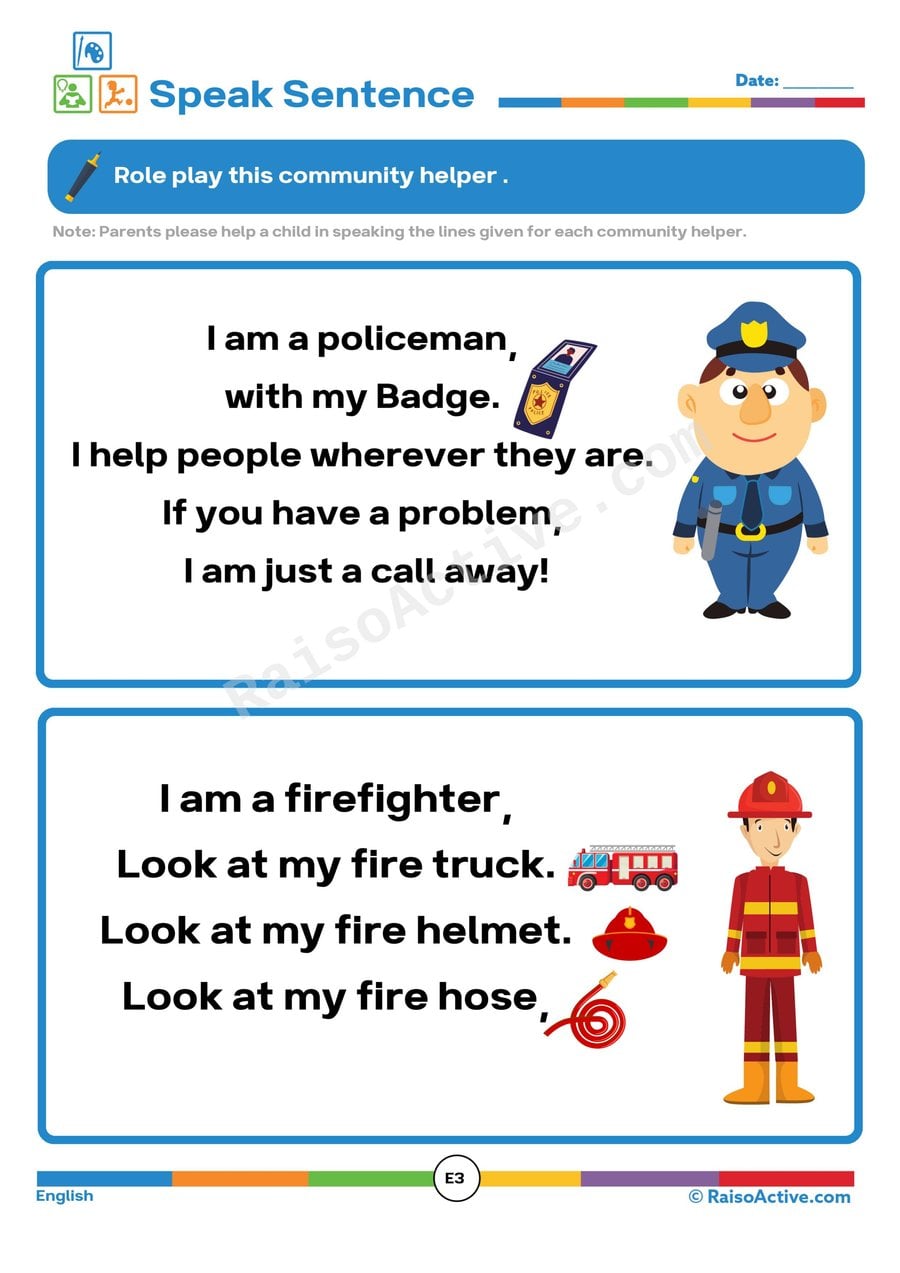
Community Helpers Role Play Worksheet for Kids
This worksheet helps children ages 3-5 learn about community helpers while practicing spoken sentence structure through guided role play. Reading a short scripted sentence aloud and then acting out the role of that helper builds oral language and expressive confidence alongside social studies knowledge, giving children a chance to practice full sentences in a low-pressure, playful context.

Community Helpers Cut and Paste Worksheet for Preschoolers
This cut-and-paste worksheet focuses specifically on firefighters for children ages 3-5, teaching them to recognize firefighting equipment like a hose, helmet, or ladder and connect each item to a firefighter's job. Learning about a single community helper in depth, rather than several at once, lets young children build a richer, more detailed understanding of what that job actually involves. The cutting, gluing, and circling tasks also build the fine motor coordination needed for more complex craft and writing activities later.

Firefighter Fun: Circle the Equipment & Maze Worksheet
Circling firefighter equipment builds vocabulary and visual discrimination for children ages 3-5, since they must identify which pictured items — a hose, helmet, or ladder — actually belong to a firefighter's tools versus unrelated objects. Guiding the fire truck through a maze to reach the station afterward adds a hands-on problem-solving and fine motor challenge, requiring children to plan and trace a path with a pencil. Combining a community-helper theme with a maze keeps the page varied while introducing real vocabulary about an occupation many young children find exciting.

Community Helpers Transport Match Worksheet for Preschoolers
Cutting out vehicles and matching them to the correct community helper builds scissor control in children ages 3-5 while reinforcing social studies knowledge about which vehicle goes with which job, like a fire truck for a firefighter or a mail truck for a mail carrier. This pairing task asks children to reason about real-world associations rather than simply matching identical pictures, a small step up in thinking from basic matching.
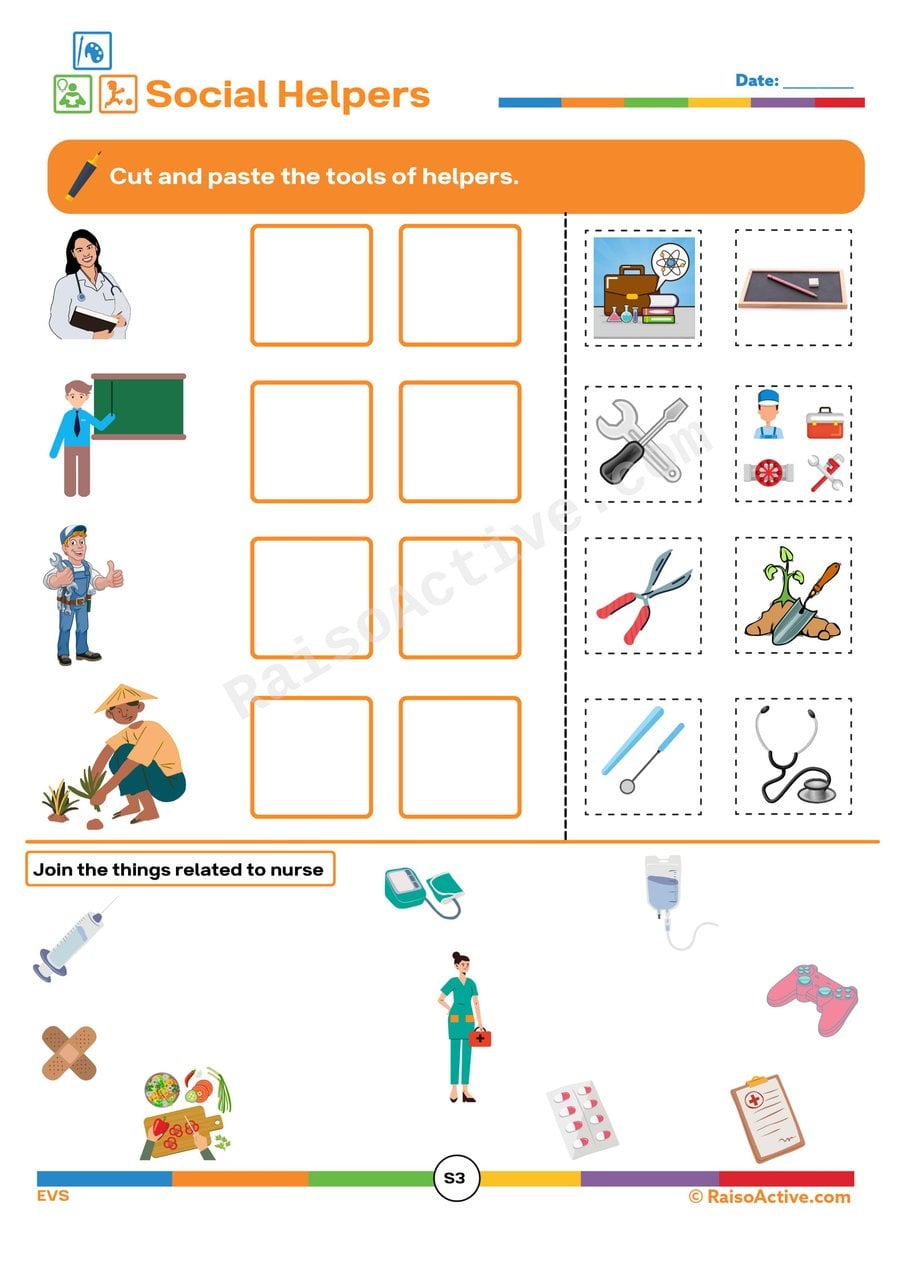
Social Helpers Tools Worksheet for Kids
This worksheet teaches children ages 3-5 to connect community helpers with the tools and equipment they use in their jobs, building early social studies knowledge alongside visual matching skills. Recognizing that a stethoscope belongs to a doctor or a hose belongs to a firefighter helps children understand how tools relate to specific roles and responsibilities in their community. The cut-and-paste and joining activities also reinforce fine motor control and visual discrimination as children sort similar-looking small pictures.

Community Helpers & Early Learning Activities Worksheet
This worksheet bundles several community-helper-themed activities, coloring, role-play, and object identification, to build vocabulary and social understanding around the different people who help in a community, like police officers or firefighters. For ages 3-5, learning about community helpers builds both social awareness and early classification skills as children learn to associate specific tools or uniforms with specific jobs.

Doctor's Tools: Circle the Items! - Worksheet for Kids
This worksheet builds visual discrimination and category knowledge by asking children to identify which pictured items belong to a doctor's toolkit, like a stethoscope or thermometer, versus items that don't. For ages 3-5, sorting objects by their real-world function is an early classification skill, and the community-helper theme also builds vocabulary around health and care.
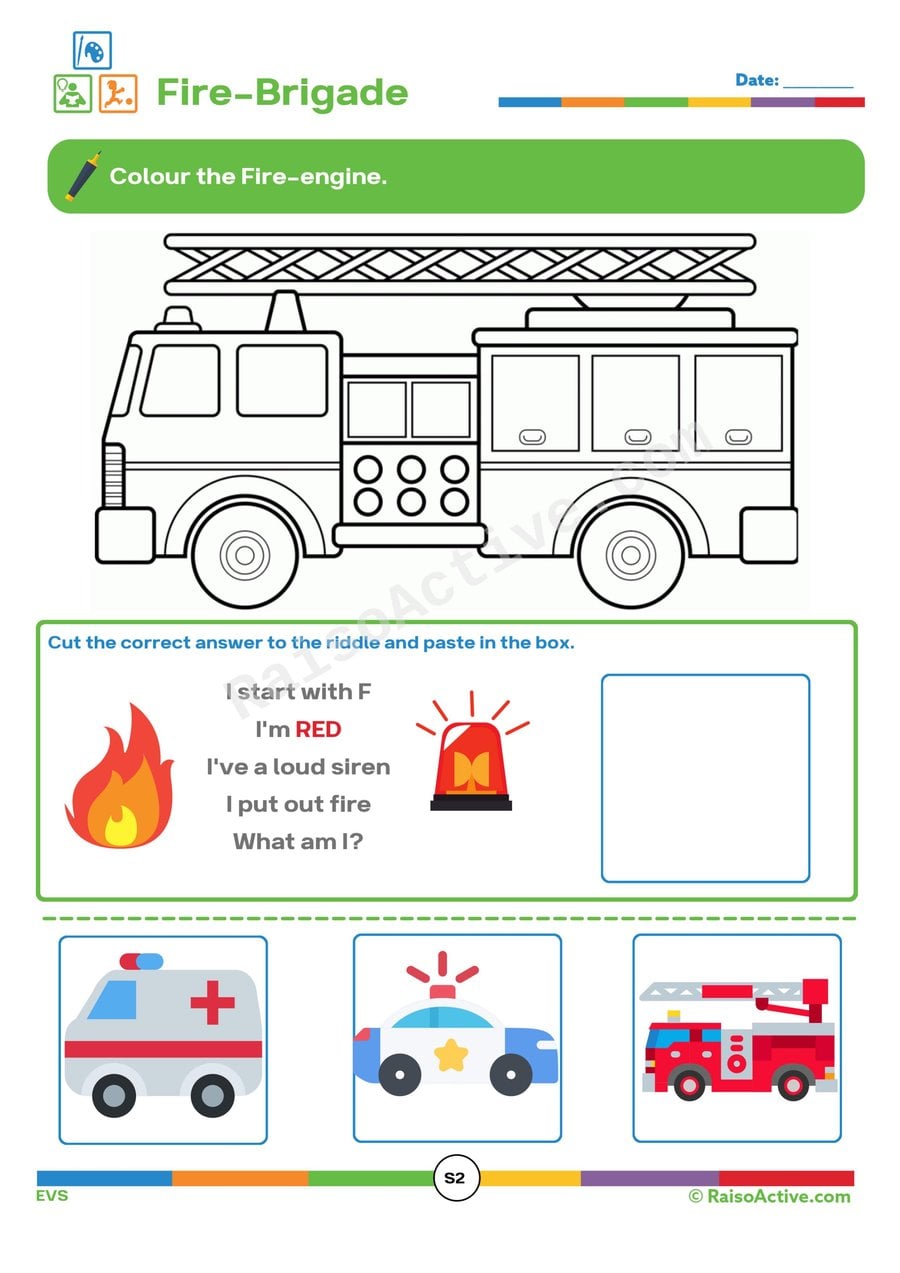
Fire Engine Fun: Color and Solve the Riddle!
This worksheet pairs creative coloring with a light dose of deductive reasoning — after coloring the fire engine, children have to solve a simple riddle and pick out the correct picture answer to paste in place. That riddle-solving step goes beyond coloring practice into comprehension and logical thinking, since your child has to listen to clues, consider a few possible answers, and choose the one that actually fits, all while learning about firefighters as community helpers.

Community Helpers Cut and Paste Worksheet for Kids
This cut-and-paste worksheet helps children ages 3-5 connect community helpers, such as a firefighter or doctor, to the tools and equipment each one uses in their job. Handling scissors to cut out small pictures and precisely placing them in the correct box builds fine motor control and hand-eye coordination, while the matching task itself deepens understanding of community roles and how people help one another.

Role Play: Color, Cut, and Create Your Neighborhood!
This hands-on activity turns community-helper knowledge into a 3D building project: children color buildings and helper figures, cut them out along the dotted lines, and assemble a small neighborhood on cardboard. That construction step is what makes this different from a typical coloring page — folding tabs and sticking pieces upright requires spatial reasoning about how a flat cutout becomes a standing structure, on top of the fine motor demands of careful cutting. It also reinforces community-helper roles by having your child literally place each helper into the neighborhood they belong in.

Community Helpers Matching Worksheet for Preschoolers
By tracing a line from each community helper to the tool or vehicle they use, children ages 3-5 practice pencil control while learning the beginnings of social studies: that people in their community have different jobs and different equipment to do them. Pairing a firefighter with a fire truck or a doctor with a stethoscope also builds cause-and-effect thinking about why each helper needs that particular item.

Police Officer Worksheet: Learn About Community Helpers!
Beyond coloring practice, this worksheet builds early community-helper knowledge by asking children to identify which specific items — a badge, a hat, handcuffs, a whistle — actually belong to a police officer's job. Circling the correct items requires visual discrimination and recall of a real-world role, which is the beginning of understanding that different jobs come with different tools and responsibilities. Drawing the officer's face afterward adds a layer of personal expression to a lesson that's otherwise about categorization.

Doctor Role Play Worksheet: Patient Emergency Form
Through pretend-play as a doctor filling out a patient form, children practice early functional writing and decision-making, selecting a 'patient,' identifying what hurts, and choosing a treatment. This kind of role play also builds empathy and emotional vocabulary around illness and care, helping ages 3-5 process what happens during real doctor visits in a low-stakes, imaginative context.
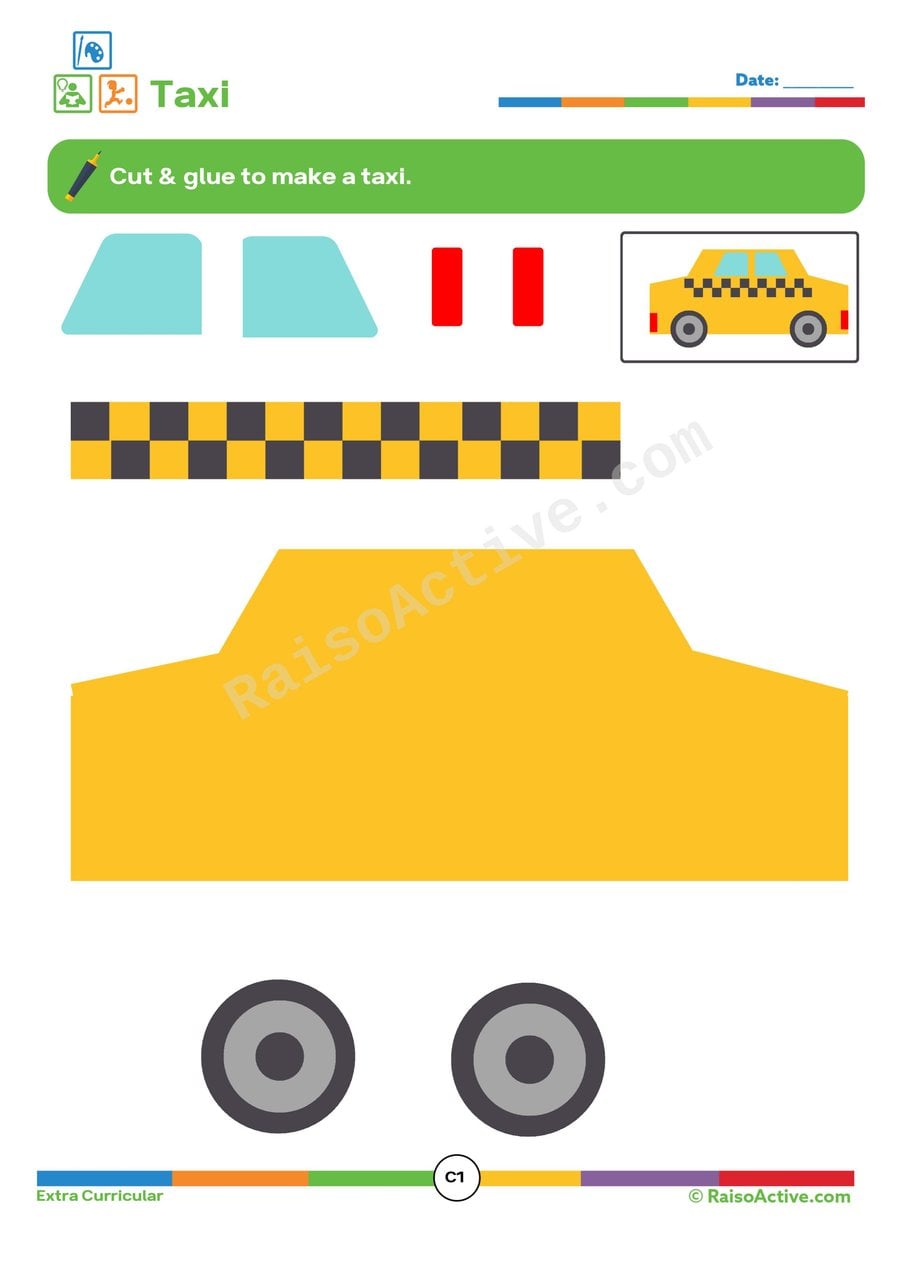
Taxi Cut and Paste Worksheet for Preschoolers
This craft-style worksheet gives children ages 3-5 focused practice with cutting along both straight and curved lines and assembling several separate pieces into one recognizable picture — a taxi. Building an image from multiple cut-out parts requires spatial planning, since children must figure out where each piece belongs relative to the others before gluing. The community-helper theme also introduces vocabulary around transportation and the people who drive it.
What a Unity in Diversity project usually needs
Teachers typically ask for a labelled map of India, a small table matching a handful of states to a traditional costume or dance, and one or two festival pictures to show regional variety. Worksheets on this page cover each piece separately, states-and-costumes matching, a printable outline map, and festival colouring and labelling sheets, so a child assembles the finished chart from parts that are already correctly sized and labelled.
- Matching Indian states to their traditional costume or dance
- Printable outline map of India to colour and label
- Festival worksheets grouped by region (Diwali, Onam, Bihu, Pongal)
- Word search and matching sheets on Indian languages and scripts
Turning the worksheets into a class project
Print the map sheet first and let a child colour and label four or five states before adding the matching costume pictures around the border. Younger children, ages 4 to 6, do best sticking to one region and its festival; children aged 7 to 10 can cover all four zones, north, south, east and west, for a fuller class chart. Keep the festival and language sheets as a short caption card under the main map.
- Start with the map sheet, then add costume matches around the border
- Ages 4–6: focus on one region; ages 7–10: cover all four zones
- Use festival sheets as short caption cards, not the whole project
- Finish two days early so the chart has time to dry and be checked
Frequently asked questions
What age group is the Unity in Diversity topic taught to?
Unity in Diversity is usually introduced in the EVS syllabus around UKG to Class 2 as simple festival and costume recognition, then returns as a full Social Studies chart or map project in Classes 3 to 5, roughly ages 8 to 10, when children are expected to name states, capitals and regional festivals correctly.
What should a Unity in Diversity school chart include?
A typical chart includes a labelled outline map of India, four to six states each paired with a traditional costume, dance or food, and one or two festivals shown per region. Teachers generally mark a project down for missing labels or an unlabelled map more than for artistic quality, so the worksheets on this page keep every label printed and correctly spelled.
How is this different from the Independence Day or Republic Day worksheets?
Independence Day and Republic Day worksheets on this site focus on the tricolour flag, the Ashoka Chakra and the freedom story around 15 August and 26 January. Unity in Diversity worksheets instead cover the everyday variety of states, languages, costumes and festivals, the syllabus topic behind most EVS and Social Studies class projects rather than a single national day.
How long does a Unity in Diversity project take to complete?
Most children finish the worksheet pieces, map colouring, state-costume matching and one festival sheet, in a single 45-minute session, then need a second short session to arrange and paste them onto a chart. Starting two to three days before the submission date leaves time for the chart to dry and for labels to be checked for spelling.
Are the Unity in Diversity worksheets free to download?
Yes. Every worksheet on this page can be downloaded free as a watermarked PDF after creating an account, with five downloads a day. An annual subscription removes the watermark and the daily limit across these sheets, the India and festival printable packs, and the rest of the 1,000+ worksheet library.

Written by
Hemsweta Jain · Teacher Cheena
MBA and Early Childhood Educator, teaching since 2014 · Founder of RaisoActive, Mumbai
Written and reviewed by Hemsweta Jain (Teacher Cheena), who designs every RaisoActive worksheet.
Last reviewed
Printable packs for ages 4–10
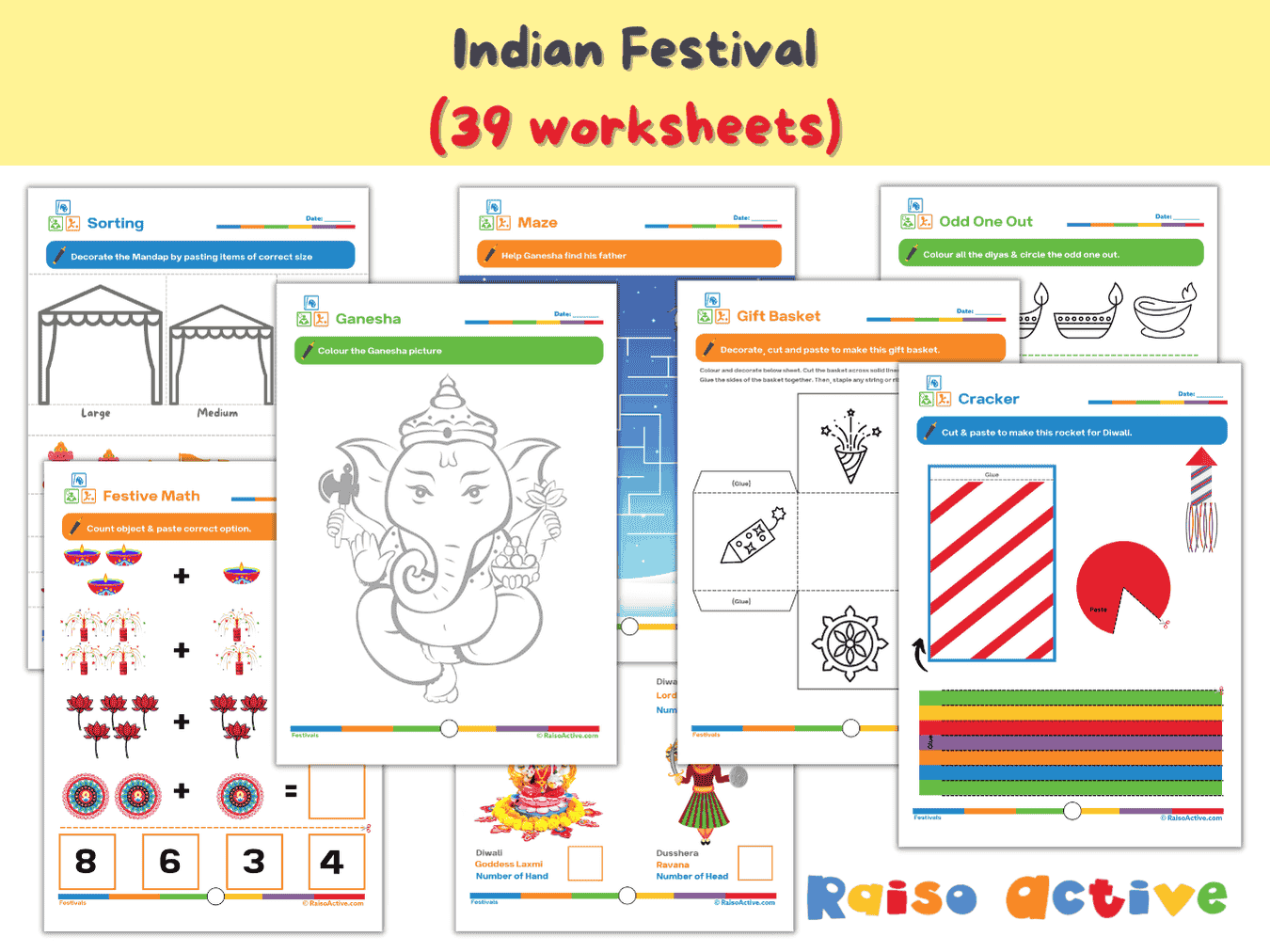
Festivals & Cultural Diversity Activity Book for Kids (Ages 4-8)
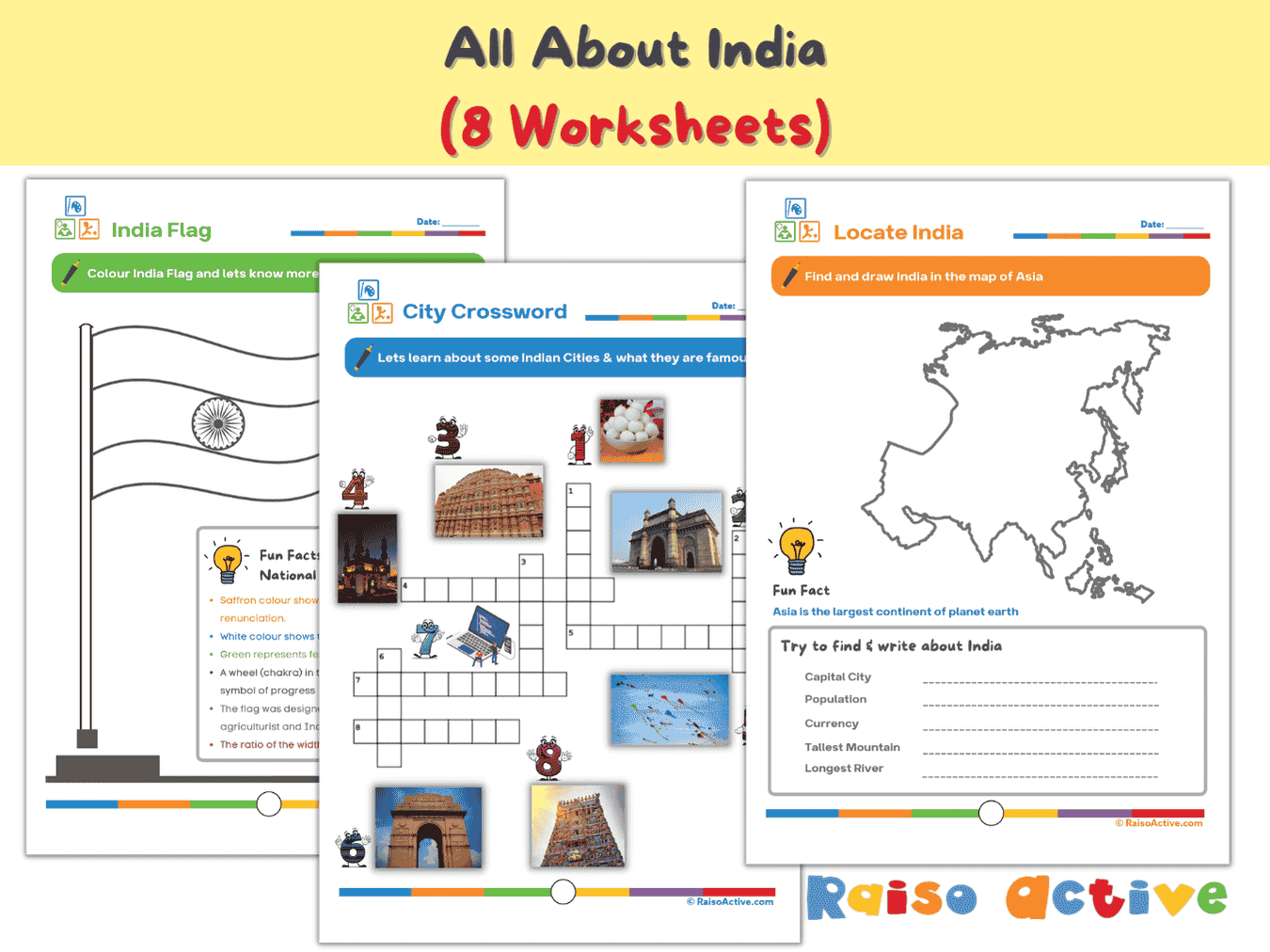
India Activity Book for Kids: Explore Geography, Culture & Symbols (Ages 5-8)
Guides for parents and teachers
See all guides →Portfolio Assessment with Young Children: A Comprehensive Guide to Meaningful Documentation
Learn how portfolio assessment captures your child's growth through meaningful documentation. Practical tips, templates, and age-appropriate strategies for ages 1-8.
Fostering Creativity in Structured Learning: The Perfect Balance for Young Minds
Learn how to blend creativity with structured learning for children ages 1-8. Practical strategies, activities, and printable worksheets for parents and teachers.
Preparing Your Child for a Rapidly Changing World: Essential Skills for Future Success
Discover the essential 21st century skills your child needs for future success. Practical tips on creativity, critical thinking, digital literacy & emotional intelligence for ages 1-8.
Celebrating Diversity: How to Incorporate Cultural Awareness in Learning Activities for Young Children
Practical cultural awareness activities for young children aged 2-8. Explore Indian festivals, world cultures, food, music, and crafts to teach diversity and inclusion.
How to Balance Structured Learning with Free Play: A Complete Guide for Parents and Educators
Learn how much free play vs structured learning young children need by age, signs of over-scheduling, and practical tips for Indian parents to design a balanced day.
Spring and Summer Learning Activities: Harnessing Nature's Classroom for Year-Round Growth
Discover heat-safe outdoor activities, monsoon science experiments, and summer holiday learning plans for young children in India. Prevent summer slide with fun ideas for ages 1-8.
Canonical: https://raisoactive.com/worksheets/unity-in-diversity-worksheets