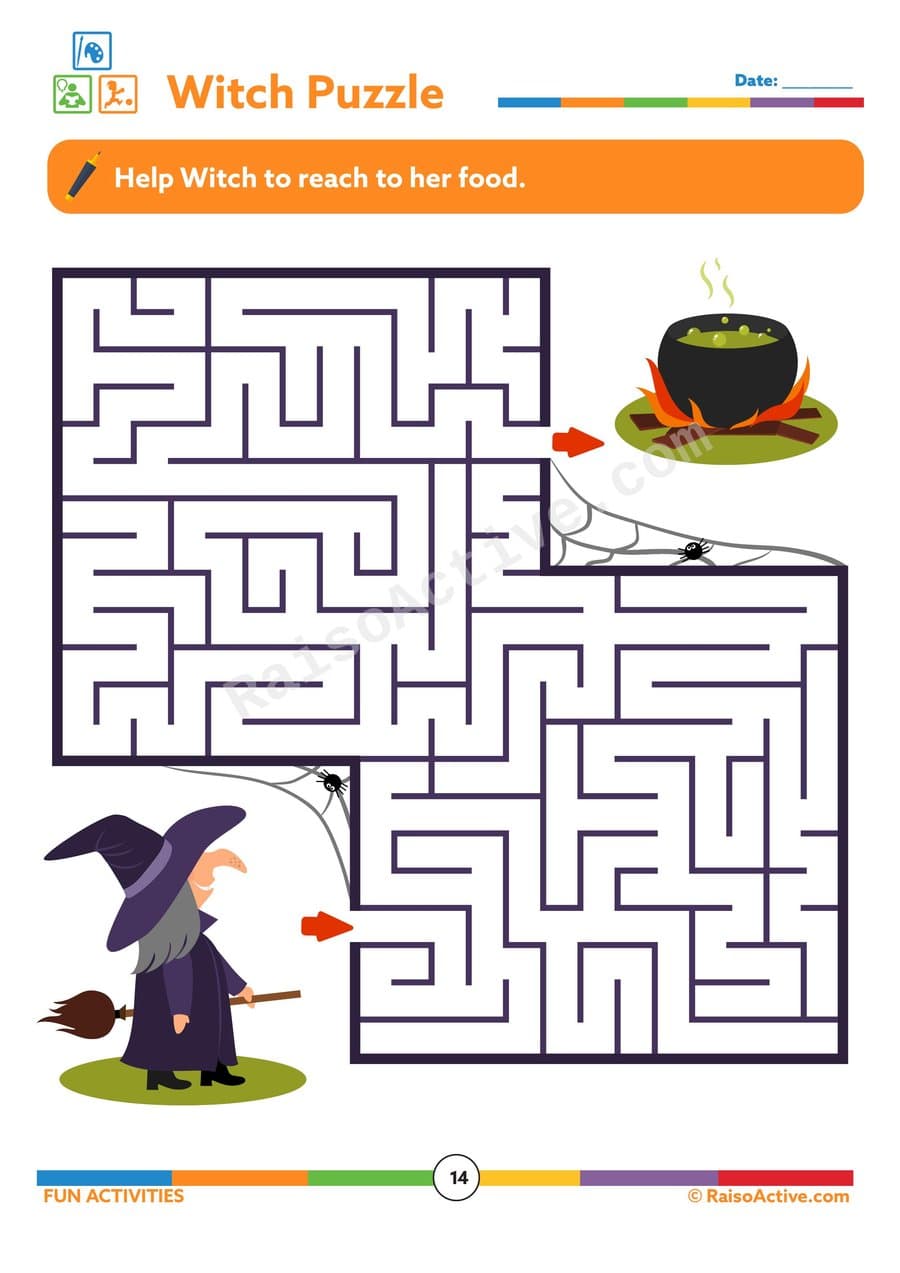
Witch's Maze: Help the Witch Find Her Food!
Guiding the witch through the maze to her food asks children to visually scan several possible paths, mentally rule out the dead ends, and commit to a single route — an early form of planning and problem-solving that lays groundwork for later logical thinking. The seasonal Halloween theme also makes this a fun, low-pressure way to build maze-solving skills without it feeling like schoolwork.
Curriculum
How to use this worksheet
Point out the witch at the start of the maze and her food at the end, and let your child study the paths with their eyes before picking up a pencil. Have them use a finger to trace a possible route first, backtracking if they hit a dead end. Once they've found a path that works, hand them a pencil or crayon to trace the correct route from start to finish. Let them color the witch and her food once the maze is solved.
Materials needed
- Pencil
- Crayons
Extension activities
- •Create a simple maze on paper using two markers and see if your child can trace a path through it.
- •Build a mini maze out of blocks, cushions, or cardboard for your child to physically walk through.
- •Talk about other Halloween characters and imagine what kind of maze they might need to solve.
- •Time how long it takes to solve the maze, then try again to see if speed improves.
- •Draw a second, trickier maze with more dead ends for extra practice.
Tips for parents and teachers
Let your child explore a few dead ends before offering help — backtracking and trying again is exactly the problem-solving skill this activity is meant to build. If frustration builds quickly, point out just the next correct turn rather than the whole solution, so they still finish the maze mostly on their own. Praise the persistence of trying multiple paths as much as the successful solve.

Written by
Hemsweta Jain · Teacher Cheena
MBA and Early Childhood Educator, teaching since 2014 · Founder of RaisoActive, Mumbai
Every RaisoActive worksheet is designed and checked by the founder before publishing.
Published · Last reviewed
Related worksheets
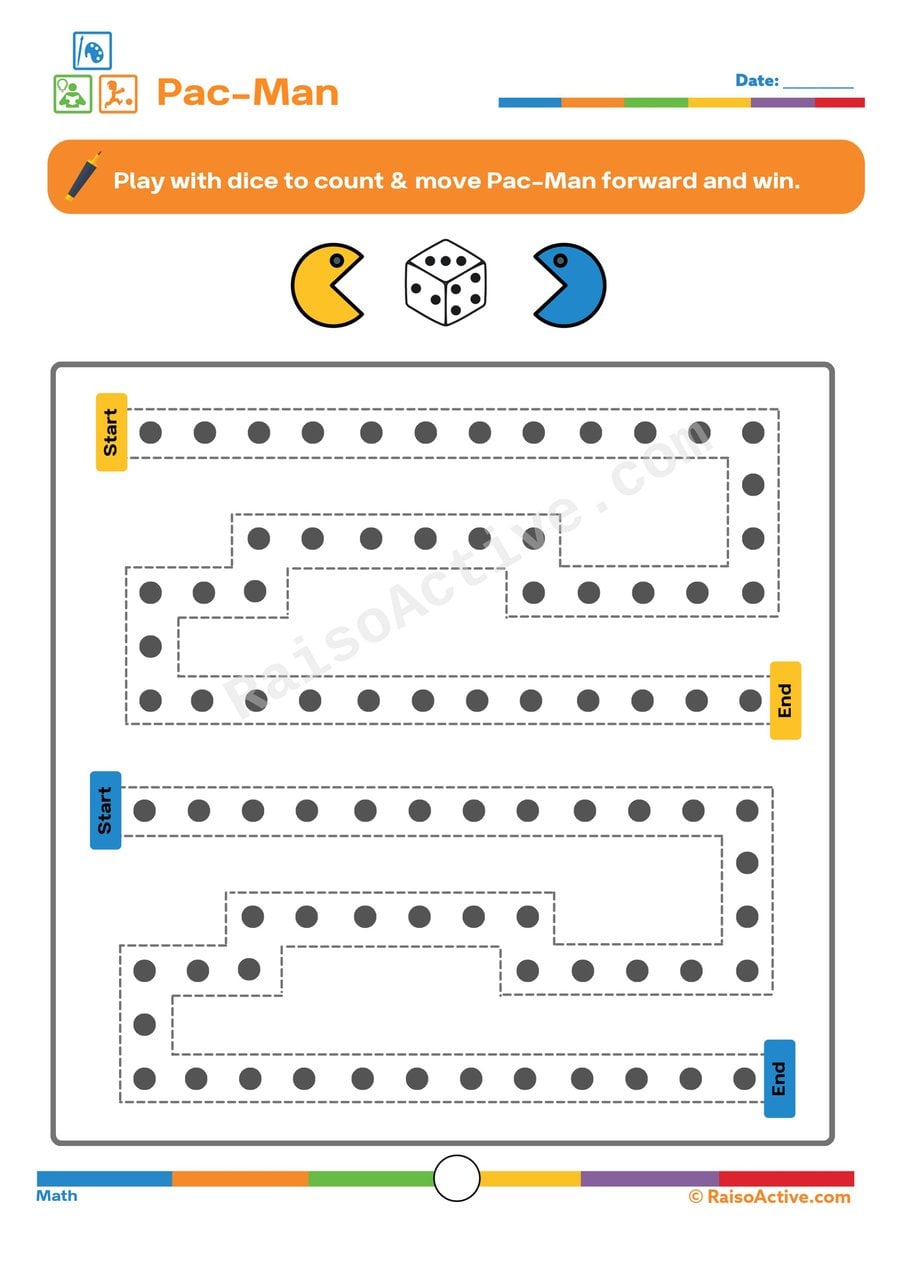
Pac-Man Maze Worksheet: Count and Move!
This dice-counting maze gives children ages 3-5 repeated practice matching a rolled number to the correct number of moves, reinforcing accurate counting under a bit of playful pressure. Tracking Pac-Man's current position after each roll also builds short-term spatial memory, since children must remember where they left off before moving again.

Help the Girl Find Her Way in the Rainy Weather Maze Worksheet
This maze worksheet builds fine motor control and visual planning in children ages 3-5 as they trace a path for a girl through a rainy-weather scene, collecting items she needs along the way. Because the maze is themed around gathering specific rain gear, it adds a light problem-solving layer on top of standard maze navigation, encouraging children to think about which path leads to the items that actually make sense for the weather.

Special Delivery Maze: Help the Postman Find the Houses!
This postman-themed maze strengthens fine motor control through pencil tracing while building visual tracking skills as children follow a winding path to the correct houses. Because the activity also involves reading numbers on a delivery note and matching them to numbered houses, it reinforces number recognition alongside the spatial problem-solving that mazes provide.

Help the Kid Reach the Doctor! A Fun Maze Worksheet
This maze worksheet builds fine motor control and pencil precision as children trace a winding path from a sick child to the doctor, while scanning for the correct route develops early planning and visual-spatial problem-solving. For ages 3-5, mazes are also a gentle way to introduce the idea that some situations, like feeling unwell, call for finding help from a trusted adult.

Clothing Pattern Match Worksheet for Preschoolers
This worksheet has children ages 3-5 study repeating patterns on clothing items — stripes, polka dots, or checks — and match each item to its identical twin, building visual discrimination and early pattern-sequencing skills. Distinguishing between similar-looking patterns also sharpens attention to detail, a skill that later supports letter and word recognition.

Trace the Numbers 1-9 Worksheet for Preschoolers
Tracing the numerals 1 through 9 gives children ages 3-5 repeated, guided practice with the specific pencil strokes each number requires, building the fine motor control and muscle memory needed for independent number writing. Because tracing follows a fixed, correct path, it also reinforces accurate numeral recognition, helping children tell visually similar digits apart.
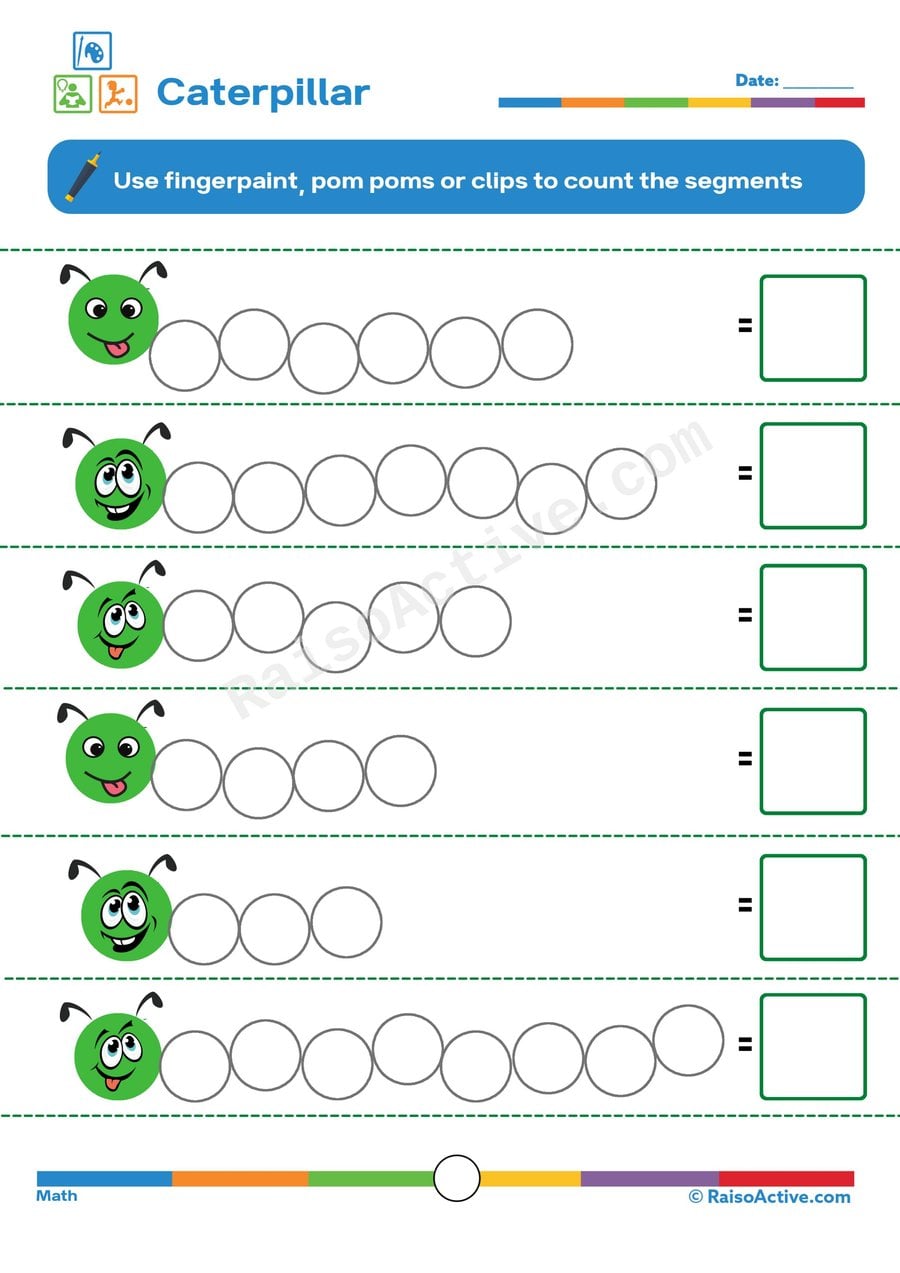
Caterpillar Counting Worksheet for Preschoolers
Counting the segments of each caterpillar teaches children ages 3-5 one-to-one correspondence — touching or marking each segment exactly once while saying a number — which is the core skill underlying accurate counting. Writing the final total in a box also connects the physical act of counting to its written numeral, reinforcing early number-writing practice.

Elephant Shapes: Fun Sorting Worksheet for Preschoolers!
This playful sorting worksheet has children ages 3-5 use an elephant's 'trunk' (their own hand reaching through a cut circle) to pick and sort shapes, building both shape recognition and simple classification skills. Physically selecting and grouping shapes by type, rather than just naming them on sight, helps solidify the concept that shapes can share a category even when their size or color differs.
Guides for this topic
Pre-Writing Strokes in Order: From Standing Lines to Loops (With Printable Patterns)
The developmental order of pre-writing strokes, from vertical lines to loops, and why practicing them in sequence makes letter formation much easier to learn.
Age-Appropriate Problem-Solving Activities: Building Critical Thinkers from the Ground Up
Discover fun, age-appropriate problem-solving activities for children ages 1-8. Build critical thinking, logic, and reasoning skills through play-based learning.
Critical Thinking Activities That Actually Work for Young Children: Building Tomorrow's Thinkers Today
Discover proven critical thinking activities for young children. Age-wise logic games, questioning techniques, and hands-on ideas to build thinking skills at home.
Reviews
Every worksheet for ages 3–5, no watermark
Members download the full library of 1,000+ worksheets and every activity pack without watermarks or daily limits. One year costs ₹1,000 in India or $20 elsewhere.
See membership plansOr download any worksheet free with a watermark (5 a day).