Kite Flying Tracing Worksheet for Preschoolers
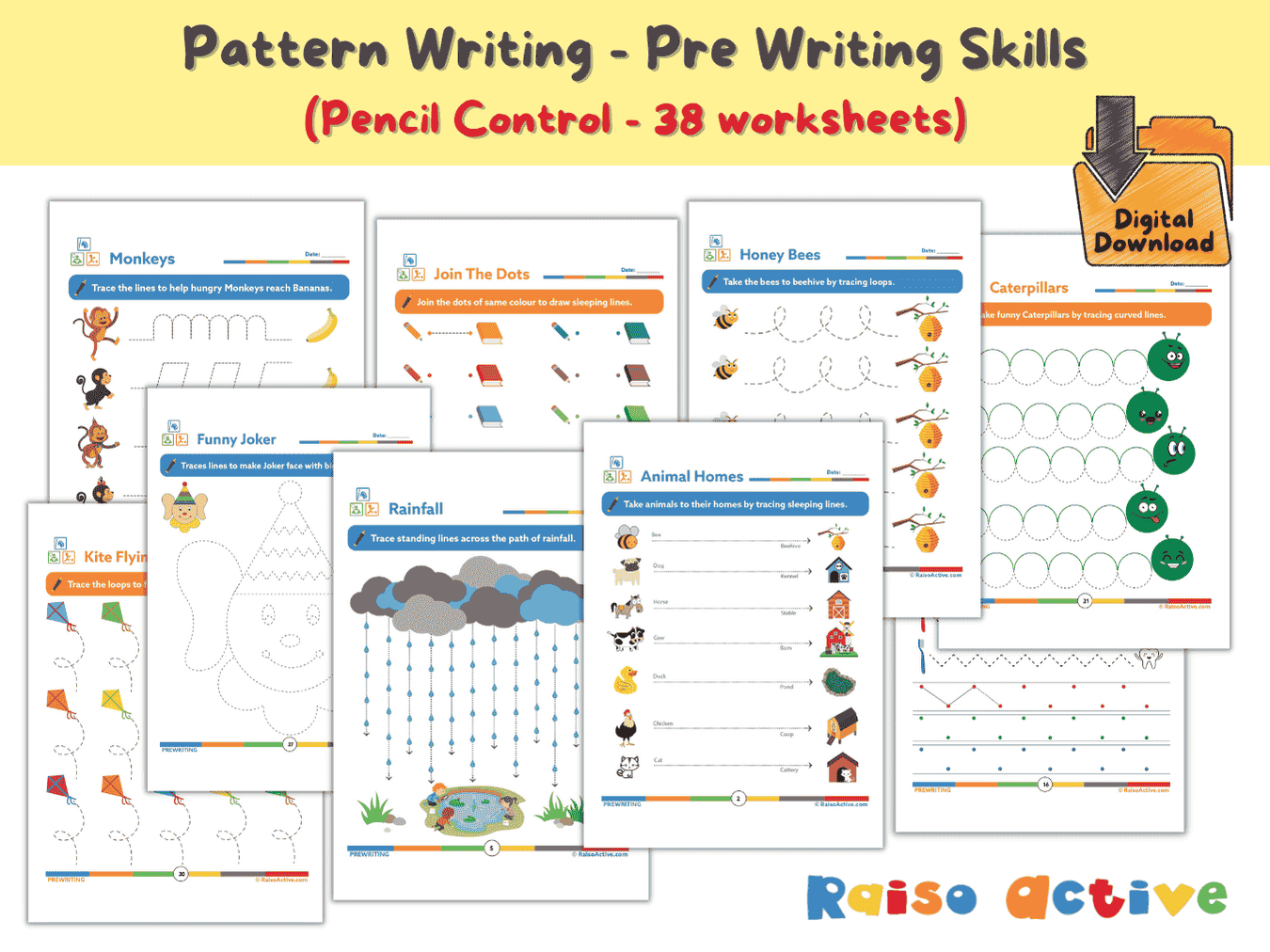
Tracing a kite's string line gives children ages 3-5 practice with a long, often gently curving or diagonal stroke, while the theme introduces simple vocabulary about wind and flying. Because a kite string is usually drawn as one long, continuous line rather than a short repeated shape, this worksheet builds a child's ability to sustain a single controlled pencil motion over a longer distance.
Part of the pack
Pattern Writing Pre-writing Skills Activity Book for 3-4 Year Olds
This is page 34 of the pack. Ages 3-4 · PreschoolAges 3-4 · NurseryAges 3-4
Made for your child
A whole activity pack made with their name
60 pages to spot, build, trace and write their own name, plus pages about their favourites, feelings and family. See a free preview with their name.
Make an All About Me packFree preview · free for members
Or start free: a name tracing sheet with their nameCurriculum
- Pre-Writing > Themed Tracing
How to use this worksheet
Point out the kite at the top of the page and the child or hand holding the string at the bottom, explaining that the line shows the string connecting them. Guide your child's pencil along the dotted line in one continuous motion from the kite down to the ground, rather than stopping partway. If the line breaks into several short strokes, encourage them to try once more in a single smooth motion. Color the kite and sky scene once the string is fully traced.
Materials needed
- Pencil
- Crayons
Extension activities
- 1Fly a real kite outside on a windy day, letting your child hold the string and feel the pull.
- 2Make a simple kite craft from paper and a string, then hang it up or fly it gently indoors.
- 3Create a windsock from a paper tube and streamers and watch how it moves outside.
- 4Hold colorful ribbons and run outside on a windy day to observe how wind moves them.
- 5Recall the diamond shape from a shape worksheet and talk about why kites are often diamond shaped.

Written by
Hemsweta Jain · Teacher Cheena
MBA and Early Childhood Educator, teaching since 2014 · Founder of RaisoActive, Mumbai
Every RaisoActive worksheet is designed and checked by the founder before publishing.
Published · Last reviewed
More from Pattern Writing Pre-writing Skills Activity Book for 3-4 Year Olds

Join the Dots: Standing Lines Worksheet for Preschoolers
Ages 3-5 · Preschool–Pre-KAges 3-5 · Nursery–ReceptionAges 3-5 · Nursery–LKGAges 3-5
This dot-to-dot worksheet asks children ages 3-5 to connect dots forming vertical lines, sometimes called 'standing lines' because they stand upright, building the bottom-to-top or top-to-bottom pencil control needed for letters like l, t, and i. Connecting dots precisely, rather than simply tracing a continuous line, adds an extra layer of accuracy practice on top of the basic straight-line motion.
Fish Hook Tracing Worksheet for Preschoolers
Ages 3-5 · Preschool–Pre-KAges 3-5 · Nursery–ReceptionAges 3-5 · Nursery–LKGAges 3-5
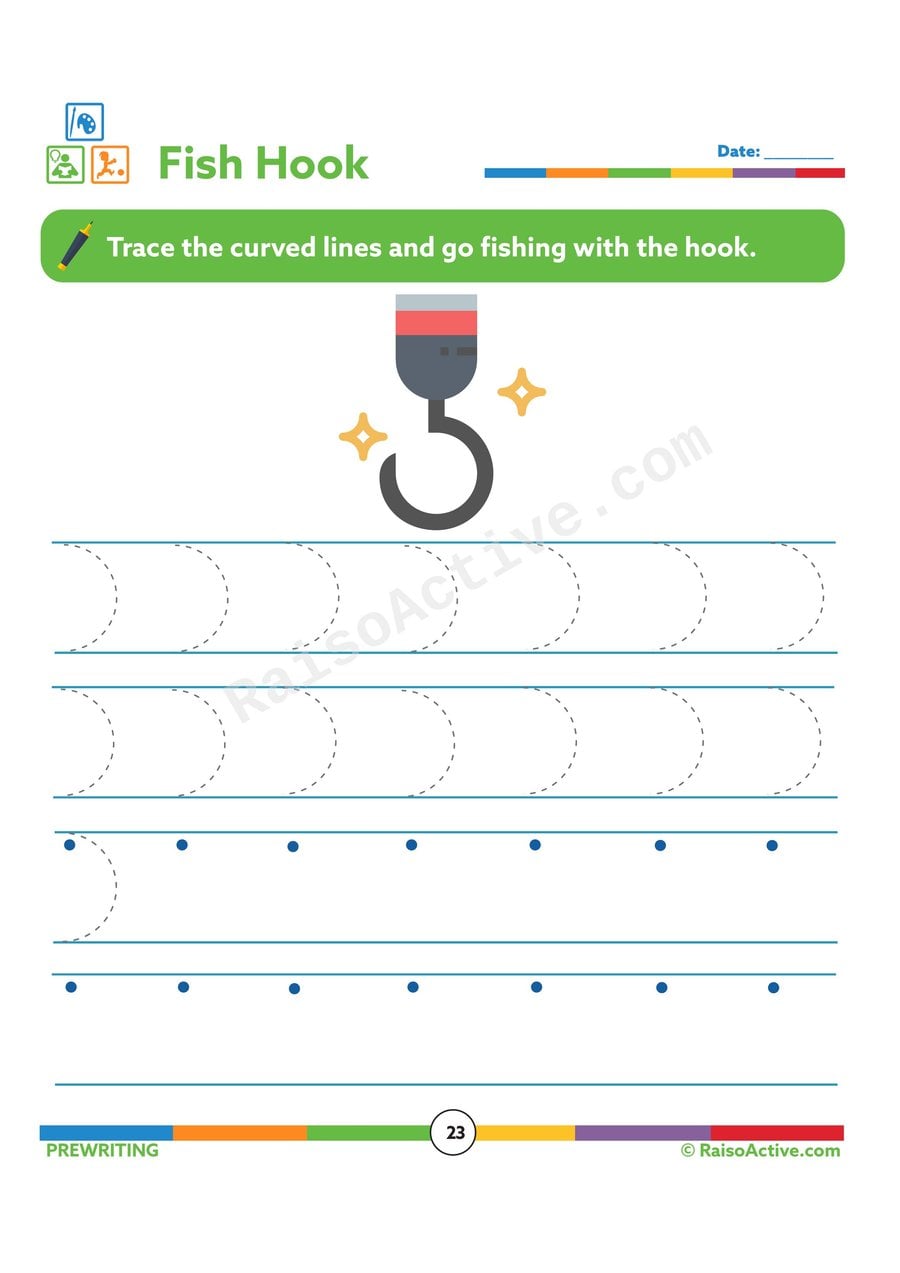
Tracing a hook-shaped fishing line curve gives children ages 3-5 practice with a tight, small curved stroke, different from the wide, sweeping curves used in other worksheets, which builds fine control over shorter pencil motions. This particular curve shape is also an early building block for letters like j, which end in a small hook, making this good preparatory practice.

Trace the Curved Lines: Give Balloons to the Girls! Worksheet
Ages 3-5 · Preschool–Pre-KAges 3-5 · Nursery–ReceptionAges 3-5 · Nursery–LKGAges 3-5
This worksheet has children ages 3-5 trace curved balloon strings, practicing the rounded, flowing pencil motion needed later for letters like c, o, and s. Curved lines demand a different wrist and finger movement than straight lines, since the hand has to continuously adjust direction rather than pushing in one line, which makes this an important complement to straight-line tracing practice.

Trace and Color the Funny Joker Face Worksheet for Preschoolers
Ages 3-5 · Preschool–Pre-KAges 3-5 · Nursery–ReceptionAges 3-5 · Nursery–LKGAges 3-5
Tracing the curved and circular shapes that make up a funny, exaggerated face gives children ages 3-5 practice with rounded strokes while the silly theme, a joker or clown face, adds humor that tends to boost engagement on what could otherwise feel like a repetitive shape-tracing task. Placing and tracing multiple facial features also reinforces facial feature vocabulary and proportion, similar to other face-based worksheets but with a playful, exaggerated twist.

Butterfly Tracing Worksheet: Connect the Butterflies to the Flowers!
Ages 3-5 · Preschool–Pre-KAges 3-5 · Nursery–ReceptionAges 3-5 · Nursery–LKGAges 3-5
Tracing a line from each butterfly to its matching flower combines pre-writing line control with an early matching and visual-tracking task, since your child has to follow the correct path among several possible ones without crossing into a neighboring line. This dual challenge builds both the fine motor precision and the visual discrimination skills that later support reading, where the eyes must track along a single line of text without jumping to the wrong row.

Trace the Waves! A Pre-Writing Worksheet for Kids
Ages 3-5 · Preschool–Pre-KAges 3-5 · Nursery–ReceptionAges 3-5 · Nursery–LKGAges 3-5
Tracing a series of connected wave shapes gives children ages 3-5 practice with a smooth, undulating curve that rises and falls repeatedly, a stroke pattern that underlies letters like m, n, u, and w. Unlike a single curve, a wave line requires the hand to reverse direction multiple times in one continuous motion without lifting the pencil, building more sustained curve control than a shorter, single-curve worksheet.

Pattern Writing Pre-writing Skills Activity Book for 3-4 Year Olds - Page 33
Ages 3-4 · PreschoolAges 3-4 · NurseryAges 3-4
This later page in the pre-writing patterns activity book asks 3-4 year olds to track a repeating pattern visually from left to right across the row before their pencil catches up, building the same visual tracking direction used in reading English text. Because this comes further into the book, it also builds a small dose of persistence, since completing a full row of repeated strokes takes more sustained attention than a single short trace.
Trace the Rainbow Worksheet for Preschoolers
Ages 3-5 · Preschool–Pre-KAges 3-5 · Nursery–ReceptionAges 3-5 · Nursery–LKGAges 3-5
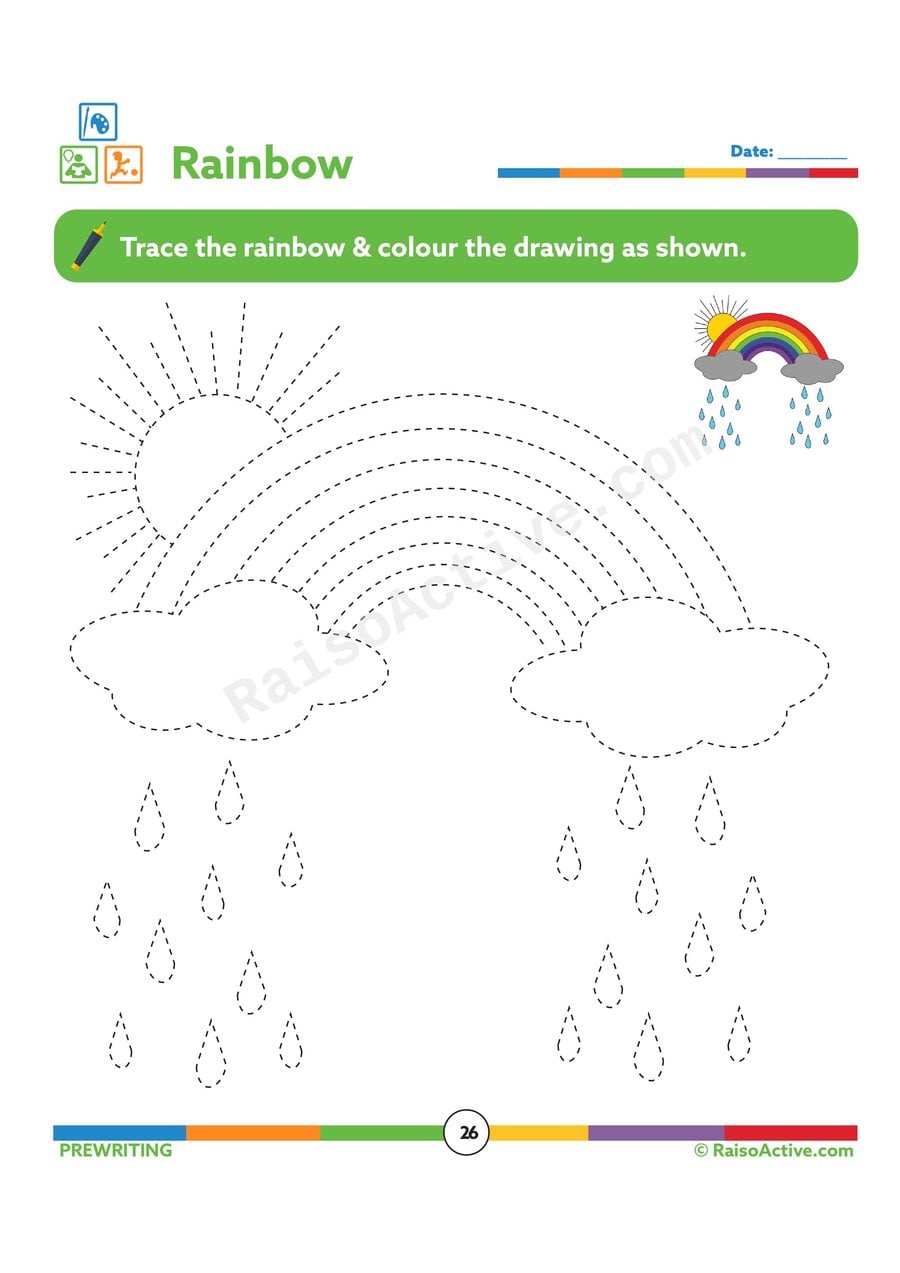
Tracing the concentric arcs of a rainbow gives children ages 3-5 practice with several nested curved lines of increasing size, a step up from tracing a single curve because each new arc has to sit a consistent distance from the one before it. Coloring the bands afterward also introduces simple color naming and sequencing, since rainbow colors typically appear in the same recognizable order.
Related worksheets

Letter F Worksheet: Trace, Write, and Color the Letter F!
Ages 3-5 · Preschool–Pre-KAges 3-5 · Nursery–ReceptionAges 3-5 · Nursery–LKGAges 3-5
This worksheet gives children ages 3-5 structured practice tracing, then independently writing, the letter F in both its uppercase and lowercase forms, building the fine motor precision needed for legible handwriting. Moving from a traced guide to writing F on plain lines is an important step up in independence for early writers. Coloring pictures of F words afterward reinforces the connection between the letter's shape and its beginning sound.
Shape Monster Craft Worksheet for Preschoolers
Ages 3-5 · Preschool–Pre-KAges 3-5 · Nursery–ReceptionAges 3-5 · Nursery–LKGAges 3-5
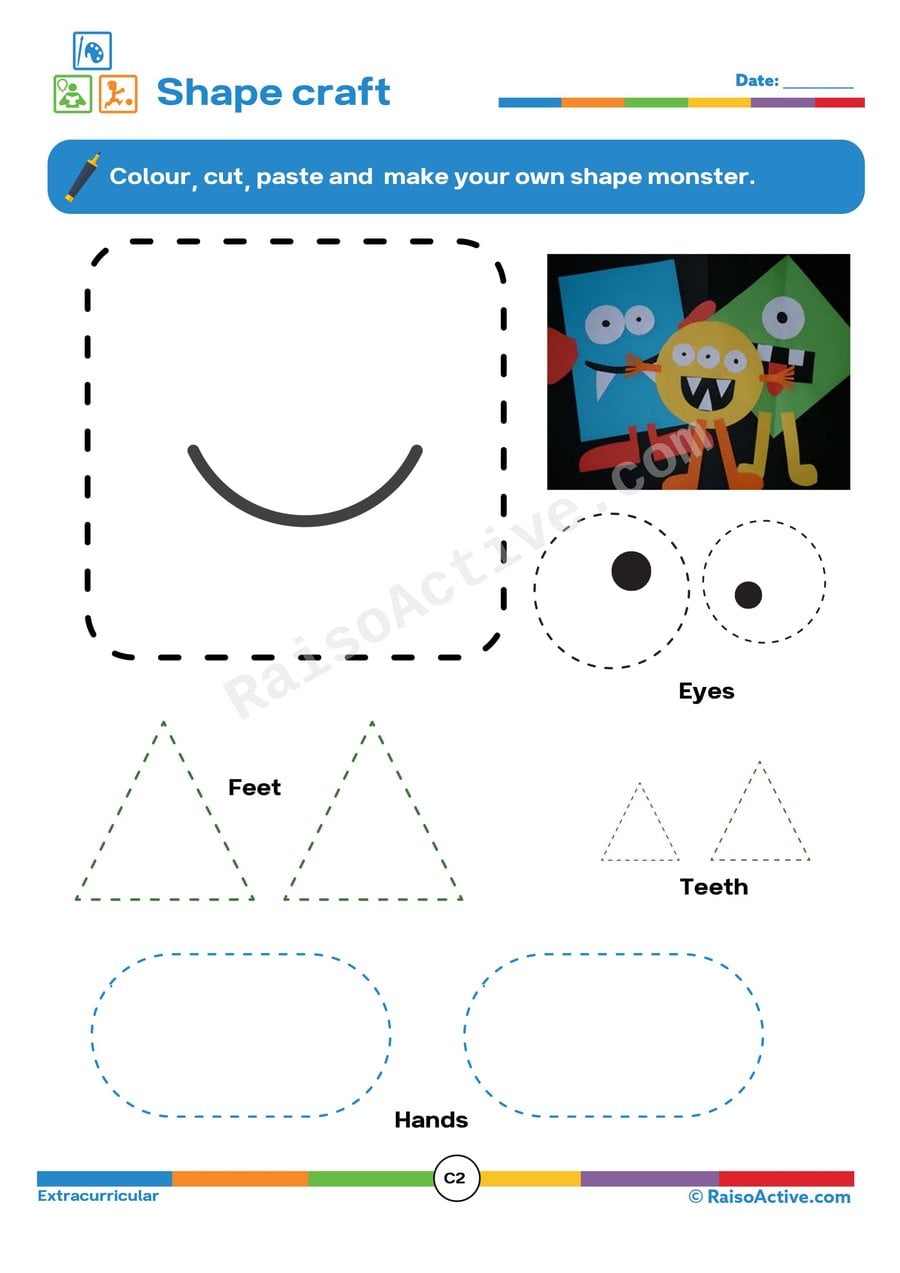
Coloring, cutting, and gluing shape pieces to build a monster teaches children ages 3-5 to recognize basic 2D shapes, like circles, triangles, and squares, while practicing scissor control along different edge types. Because the shapes need to be arranged in a specific way to form a recognizable monster face and body, this activity also builds spatial reasoning as children decide where each piece belongs. Turning geometry practice into a silly monster craft keeps repetitive shape work feeling like imaginative play rather than a math drill.

Spooky Fun Coloring Worksheet for Preschoolers
Ages 3-5 · Preschool–Pre-KAges 3-5 · Nursery–ReceptionAges 3-5 · Nursery–LKGAges 3-5
This Halloween-themed coloring page gives children ages 3-5 practice with crayon grip, color choice, and staying within outlines as they bring a collection of spooky objects to life. Naming each object as they color, like a ghost, a pumpkin, or a bat, also builds seasonal vocabulary tied directly to what they're seeing and creating.

Parent's Guide: Fun Activities for Gross Motor Development and Emotional Learning
Ages 3-5 · Preschool–Pre-KAges 3-5 · Nursery–ReceptionAges 3-5 · Nursery–LKGAges 3-5
This parent guide equips caregivers of children ages 3-5 with activities spanning gross motor skills, emotional expression, family concepts, shape recognition, and calendar awareness, using role play, finger puppets, and simple games. Combining physical movement with emotional vocabulary practice, such as making different facial expressions, helps children build body awareness and feelings vocabulary side by side. Rotating through several distinct activity types in one guide also keeps a young child's attention across a longer play session.
Dad's Beard: A Fun Shaving Activity for Kids!
Ages 3-5 · Preschool–Pre-KAges 3-5 · Nursery–ReceptionAges 3-5 · Nursery–LKGAges 3-5
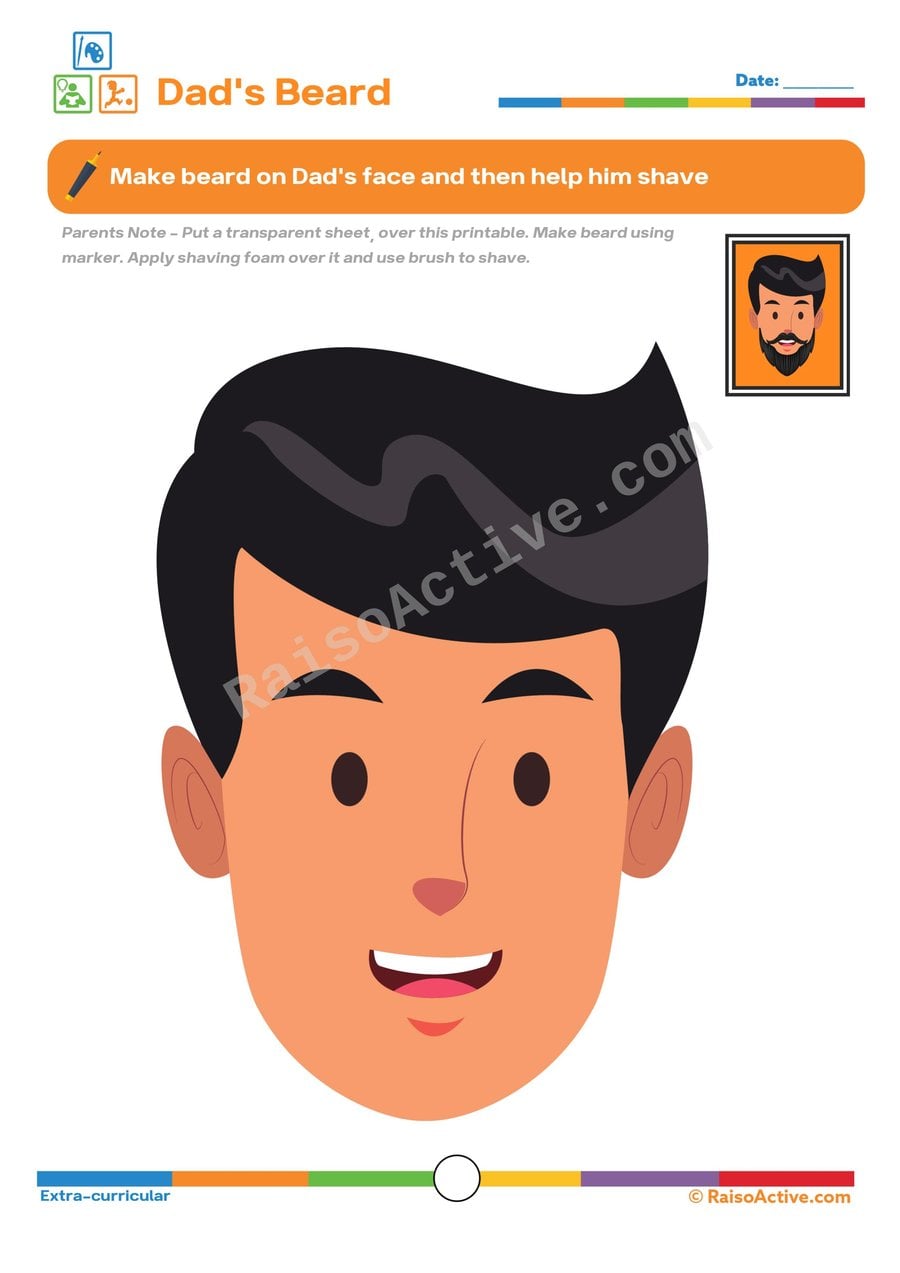
This playful pretend-shaving activity builds fine motor control and bilateral coordination in children ages 3-5, as they draw a beard with a marker and then 'shave' it away using foam and a brush in careful, controlled strokes. It also introduces a simple science idea — that shaving foam can be applied and removed in layers — while giving children a hands-on, sensory way to imitate an everyday grown-up routine.
Unicorn Friendship Bands Worksheet for Kids
Ages 3-5 · Preschool–Pre-KAges 3-5 · Nursery–ReceptionAges 3-5 · Nursery–LKGAges 3-5
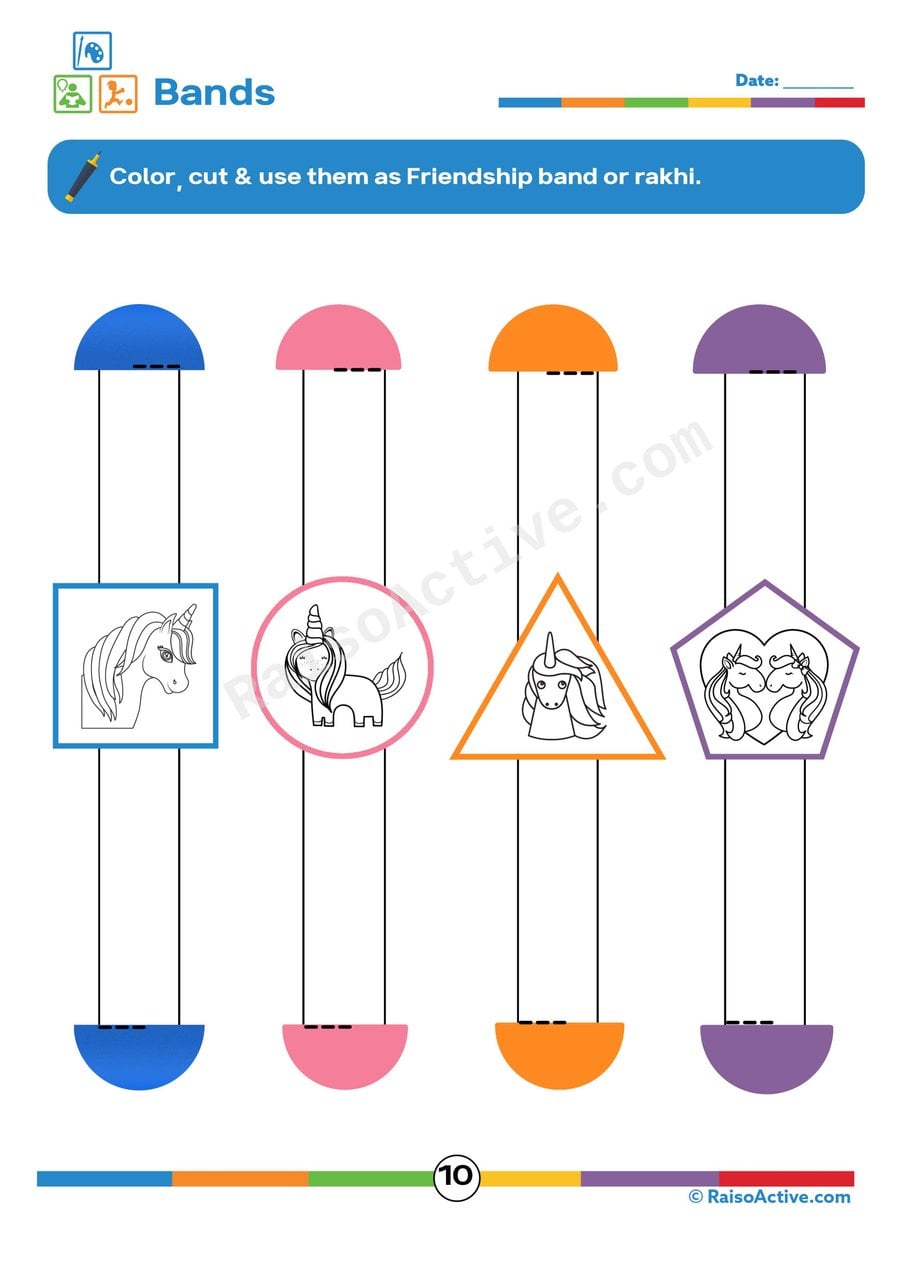
Children ages 3-5 practice coloring within defined shapes and controlled scissor cutting as they bring unicorn-themed friendship bands to life. The combination of coloring first and cutting second means they must track the same shape through two different fine motor tasks, reinforcing hand control and attention to detail.

Happy Face Cut and Paste Worksheet for Preschoolers
Ages 3-5 · Preschool–Pre-KAges 3-5 · Nursery–ReceptionAges 3-5 · Nursery–LKGAges 3-5
This worksheet helps children ages 3-5 learn the names of facial features while practicing scissor control and precise gluing. Assembling a face piece by piece — eyes, nose, mouth, ears — reinforces body part vocabulary in a hands-on way that's more memorable than simply pointing at a picture.

Rocking Santa Card Craft Worksheet for Preschoolers
Ages 3-5 · Preschool–Pre-KAges 3-5 · Nursery–ReceptionAges 3-5 · Nursery–LKGAges 3-5
This rocking Santa card craft has children ages 3-5 cut out individual shape pieces and assemble them onto a folded card base, combining scissor control with an early understanding of how folding creates movement, since the 'rocking' effect comes from the card's fold. Following the assembly steps in order also reinforces sequencing and attention to visual instructions.
Guides for this topic

Pre-Writing Strokes in Order: From Standing Lines to Loops (With Printable Patterns)
The developmental order of pre-writing strokes, from vertical lines to loops, and why practicing them in sequence makes letter formation much easier to learn.

Portfolio Assessment with Young Children: A Comprehensive Guide to Meaningful Documentation
Learn how portfolio assessment captures your child's growth through meaningful documentation. Practical tips, templates, and age-appropriate strategies for ages 1-8.
What Makes a Good Worksheet vs. a Poor One: A Parent's Guide to Quality Educational Materials
Learn what separates high-quality educational worksheets from poor busy work. Discover design principles, red flags, and how to evaluate free worksheets online for your child aged 1-8.
Reviews
Every worksheet for ages 3–5, no watermark
Members download the full library of 1,000+ worksheets and every activity pack without watermarks or daily limits. One year costs ₹999 in India or $20 elsewhere.
See membership plansOr download any worksheet free with a watermark (5 a day).