Letter I Tracing and Coloring Worksheet for Preschoolers
Tracing and writing the letter I introduces children ages 3-5 to one of the simplest letter shapes, a single vertical line, which makes it an ideal letter for building early confidence with pencil control before tackling multi-stroke letters. The coloring and recognition portions of the worksheet reinforce that this simple shape represents both a sound and, notably, a whole word on its own when capitalized as 'I.'
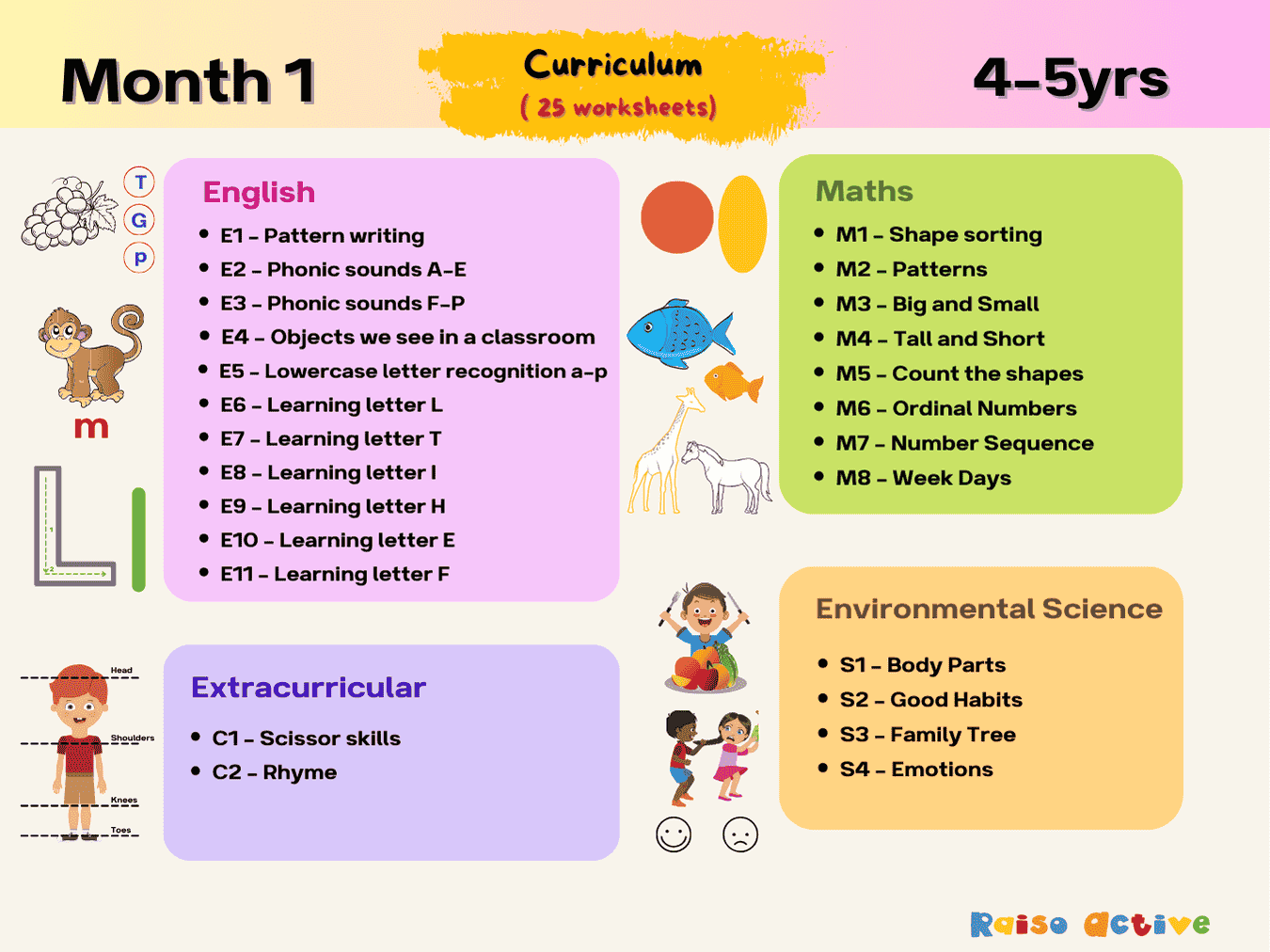
Part of the pack
Month 1: Learning & Development | Ages 4-5
This is page 11 of the pack. Ages 4-5 · Pre-KAges 4-5 · ReceptionAges 4-5 · LKGAges 4-5

Made for your child
A whole activity pack made with their name
60 pages to spot, build, trace and write their own name, plus pages about their favourites, feelings and family. See a free preview with their name.
Make an All About Me packFree preview · free for members
Or start free: a name tracing sheet with their nameCurriculum
- Writing > Letter Tracing A-Z
How to use this worksheet
Trace the large dotted letter I first, saying the short /i/ sound as your child's pencil moves down the line. Move to the practice lines and trace, then attempt writing an I without the guide. Point out that a capital I is also a word all by itself, used when talking about oneself. If there's a recognition activity, work through it together, then finish by coloring the capital and lowercase I.
Materials needed
- Pencil
- Crayons
Extension activities
- 1Search the house for objects starting with I, like ice, a spoon for ice cream, or an insect picture in a book.
- 2Trace a large I with a finger in a tray of sand or shaving cream.
- 3Practice standing tall and straight like the letter I, then bending to show how other letters curve.
- 4Cut out pictures of I words to make a small collage.
- 5Talk about how 'I' the letter is different from 'I' the word people use to talk about themselves.

Written by
Hemsweta Jain · Teacher Cheena
MBA and Early Childhood Educator, teaching since 2014 · Founder of RaisoActive, Mumbai
Every RaisoActive worksheet is designed and checked by the founder before publishing.
Published · Last reviewed
More from Month 1: Learning & Development | Ages 4-5

My Family Tree Worksheet: Learn About Family Members!
Ages 3-5 · Preschool–Pre-KAges 3-5 · Nursery–ReceptionAges 3-5 · Nursery–LKGAges 3-5
Filling in a family tree helps children ages 3-5 practice family vocabulary, like mother, father, sibling, and grandparent, while also building an early sense of belonging and identity by seeing themselves as part of a larger family structure. Talking through each relationship as it's added also supports oral language development, since children have to describe who each person is and how that person relates to them.

Classroom Connections: Circle the Classroom Items!
Ages 4-6 · Pre-K–KindergartenAges 4-6 · Reception–Year 1Ages 4-6 · LKG–UKGAges 4-6
This observation worksheet asks children ages 4-6 to scan a mixed group of pictures and circle only the ones that belong in a classroom, building categorization skill, the ability to sort items by a shared context rather than by appearance alone. This kind of visual discrimination and category-based thinking is an early form of the reasoning children will use constantly in school, from sorting objects in science to grouping words by topic in reading.

Fun with Letter F Worksheet: Tracing, Coloring, and Letter Recognition!
Ages 3-5 · Preschool–Pre-KAges 3-5 · Nursery–ReceptionAges 3-5 · Nursery–LKGAges 3-5
Tracing and writing the letter F gives children ages 3-5 practice with one vertical stroke and two horizontal strokes at different heights, building precision in starting and stopping a pencil at specific points along a line. Combined with coloring and recognition activities, this worksheet reinforces that the letter F represents a specific sound, an early step toward connecting written symbols with spoken language.
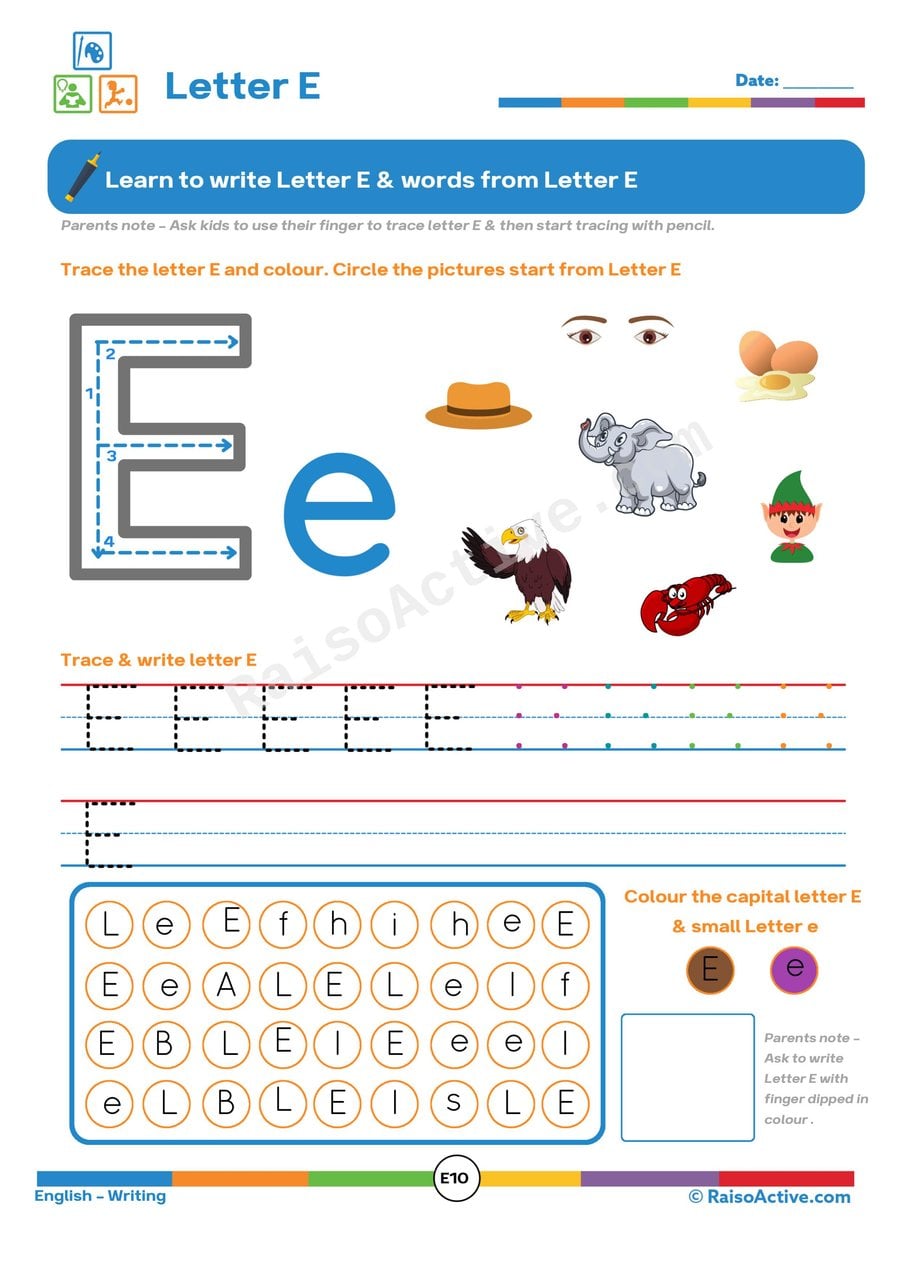
Letter E Fun: Trace, Color, and Learn!
Ages 3-5 · Preschool–Pre-KAges 3-5 · Nursery–ReceptionAges 3-5 · Nursery–LKGAges 3-5
Tracing and writing the letter E gives children ages 3-5 practice with one vertical stroke and three horizontal strokes, a slightly more complex letter shape than single-curve letters, which builds precision in stopping and starting a pencil at the right point. Alongside the physical writing practice, coloring and simple recognition activities reinforce that this shape and sound go together, an early step toward connecting letters with the words they start.
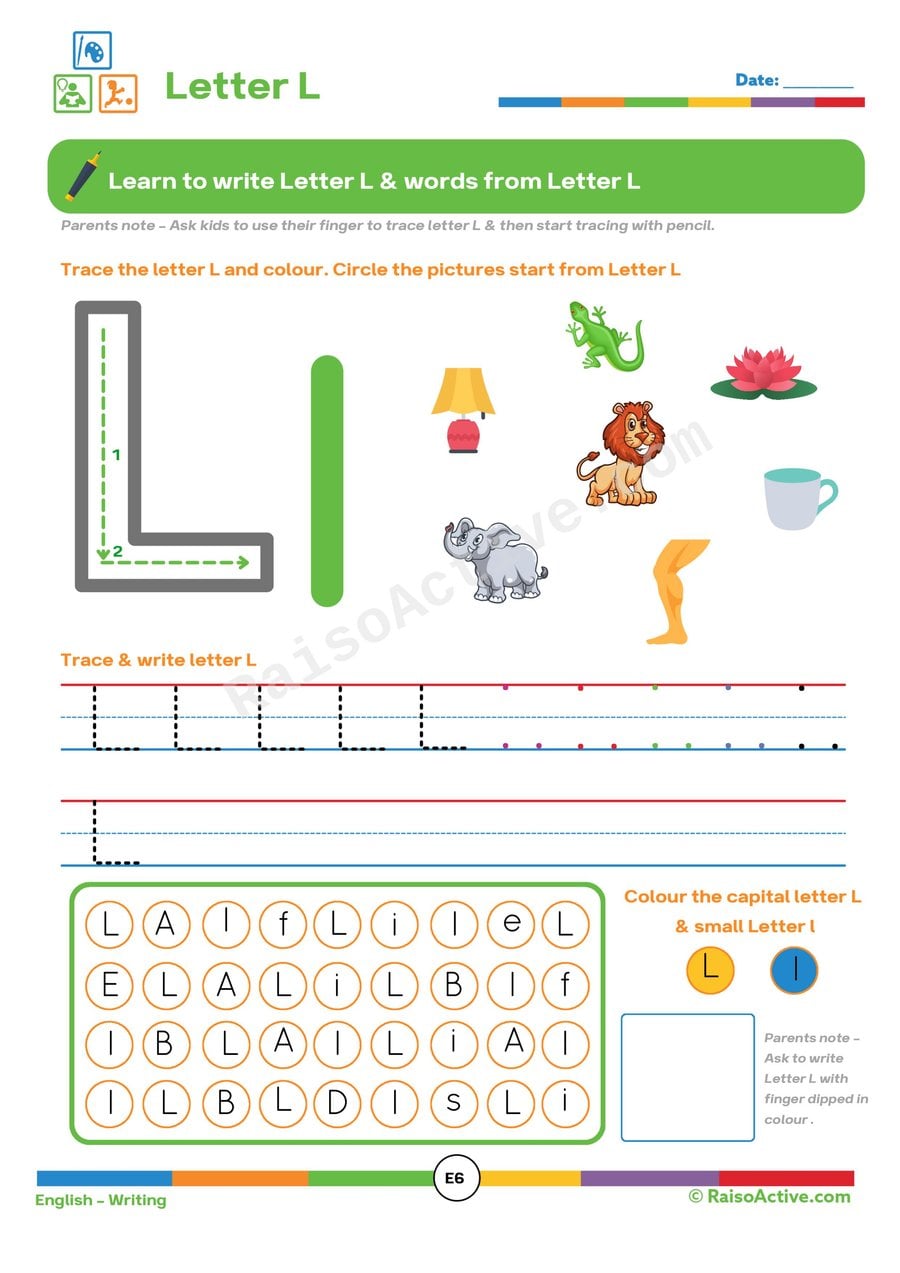
Letter L Worksheet: Trace, Color, and Learn!
Ages 3-5 · Preschool–Pre-KAges 3-5 · Nursery–ReceptionAges 3-5 · Nursery–LKGAges 3-5
Tracing the letter L builds the top-to-bottom, left-to-right pencil strokes that show up again in dozens of other letters, so this is one of the more transferable shapes a 3-5 year old can practice. Naming and coloring objects that start with L — a lion, a ladder, a leaf — ties the shape to its sound, which is exactly how early readers start linking print to speech.
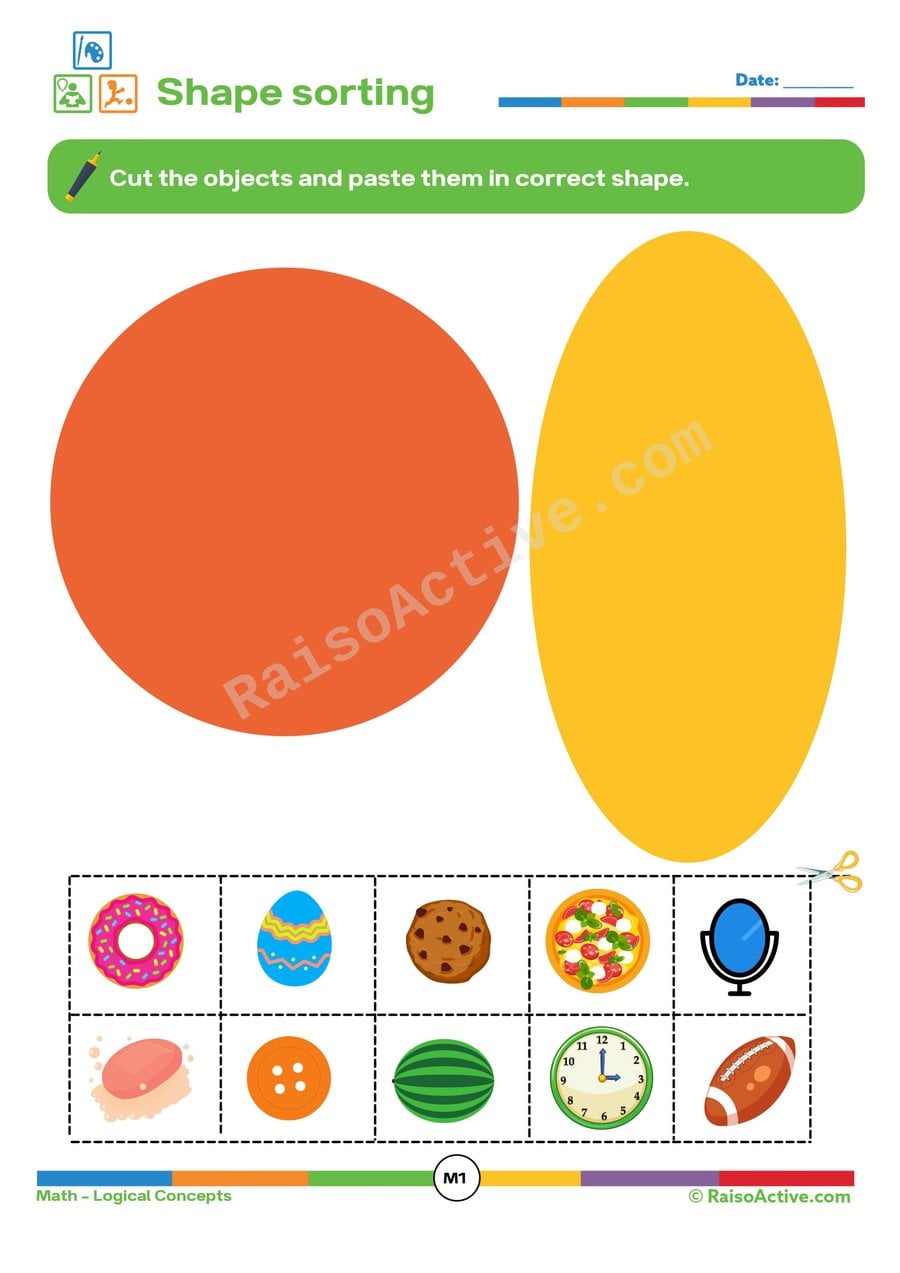
Shape Sorting Worksheet: Cut and Paste Fun!
Ages 3-5 · Preschool–Pre-KAges 3-5 · Nursery–ReceptionAges 3-5 · Nursery–LKGAges 3-5
Sorting everyday objects — a plate, an egg, a clock — into 'circle' or 'oval' bins asks a 3-5 year old to look past what an object is and notice its geometric shape instead, an early step toward abstract categorization. Cutting along the outline of each picture and gluing it into the right column also builds the scissor control and hand-eye coordination that later supports handwriting.
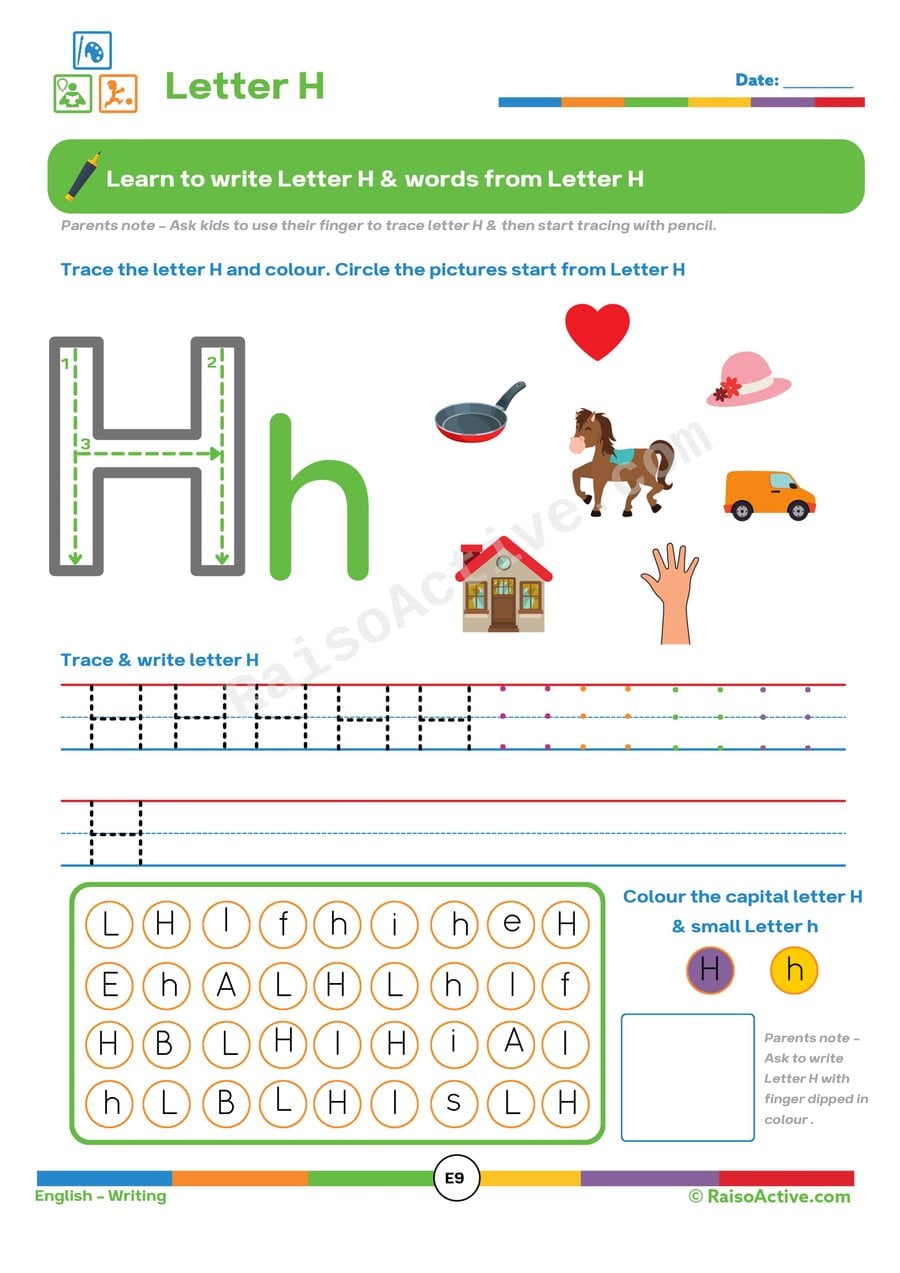
Letter H Worksheet: Trace, Write, and Color!
Ages 3-5 · Preschool–Pre-KAges 3-5 · Nursery–ReceptionAges 3-5 · Nursery–LKGAges 3-5
Tracing and writing the letter H, in both its tall uppercase and shorter lowercase form, gives children ages 3-5 repeated practice with the two straight vertical strokes and one connecting horizontal bar that make up the letter. This builds the pencil control needed before a child can write independently, while circling H's in a simple word search sharpens visual letter recognition separate from the physical act of writing.

Trace and Color the Letter T Worksheet for Preschoolers
Ages 3-5 · Preschool–Pre-KAges 3-5 · Nursery–ReceptionAges 3-5 · Nursery–LKGAges 3-5
Tracing and writing the letter T gives children ages 3-5 practice with one simple vertical stroke crossed by one horizontal stroke, making it one of the more approachable uppercase letters to master, which builds confidence before moving on to more complex shapes. Coloring the finished letters afterward reinforces recognition of the letter's form independent of the writing motion itself.
Related worksheets

Letter A Tracing Worksheet: Learn to Write and Color!
Ages 3-5 · Preschool–Pre-KAges 3-5 · Nursery–ReceptionAges 3-5 · Nursery–LKGAges 3-5
Tracing the uppercase letter A builds the fine motor control and stroke memory children ages 3-5 need for handwriting, while coloring pictures that start with A connects the written letter to its spoken sound and familiar objects. Repeating the tracing after the picture activity provides extra reinforcement of correct letter formation.

Letter B Tracing and Identification Worksheet for Preschoolers
Ages 3-5 · Preschool–Pre-KAges 3-5 · Nursery–ReceptionAges 3-5 · Nursery–LKGAges 3-5
This worksheet helps children ages 3-5 practice tracing and writing the letter B, identifying B among other letters, and recognizing objects that start with the letter B. Circling the correct letter within a small group builds the visual scanning skill children need before they can read words fluently.

Letter E Tracing Worksheet for Preschoolers: Learn to Write!
Ages 3-5 · Preschool–Pre-KAges 3-5 · Nursery–ReceptionAges 3-5 · Nursery–LKGAges 3-5
Children ages 3-5 use this worksheet to build the specific motor pattern for capital E — three horizontal strokes branching off one vertical line — while reinforcing the /e/ sound through picture recognition. Repeated tracing in a dashed-box format also trains children to keep letters a consistent size, an important pre-writing skill before they move to unlined paper.

Letter Y Tracing and Recognition Worksheet for Preschoolers
Ages 3-5 · Preschool–Pre-KAges 3-5 · Nursery–ReceptionAges 3-5 · Nursery–LKGAges 3-5
This worksheet builds recognition and formation of the letter Y through guided tracing practice and by identifying pictures of words that start with Y, like 'yarn' or 'yo-yo.' For three- to five-year-olds, tracing first with a finger and then with a pencil builds the motor memory needed before a child can form the letter confidently on their own.

Trace the Letter T Worksheet: Practice Writing & Coloring Fun!
Ages 3-5 · Preschool–Pre-KAges 3-5 · Nursery–ReceptionAges 3-5 · Nursery–LKGAges 3-5
This worksheet builds recognition and formation of the letter T through guided tracing and by identifying pictures of words that start with T, like 'tiger' or 'turtle.' For three- to five-year-olds, the letter T's simple cross-shaped stroke — one straight line down, one straight line across — makes it a good letter for practicing controlled, confident pencil strokes.

Letter K Tracing and Coloring Worksheet for Preschoolers
Ages 3-5 · Preschool–Pre-KAges 3-5 · Nursery–ReceptionAges 3-5 · Nursery–LKGAges 3-5
This worksheet builds recognition and formation of the letter K in both uppercase and lowercase forms through tracing, coloring, and identifying words that start with K, like 'kite' or 'kangaroo.' For three- to five-year-olds, working through both letter cases together, plus circling the letter among distractors, strengthens visual discrimination alongside handwriting practice.
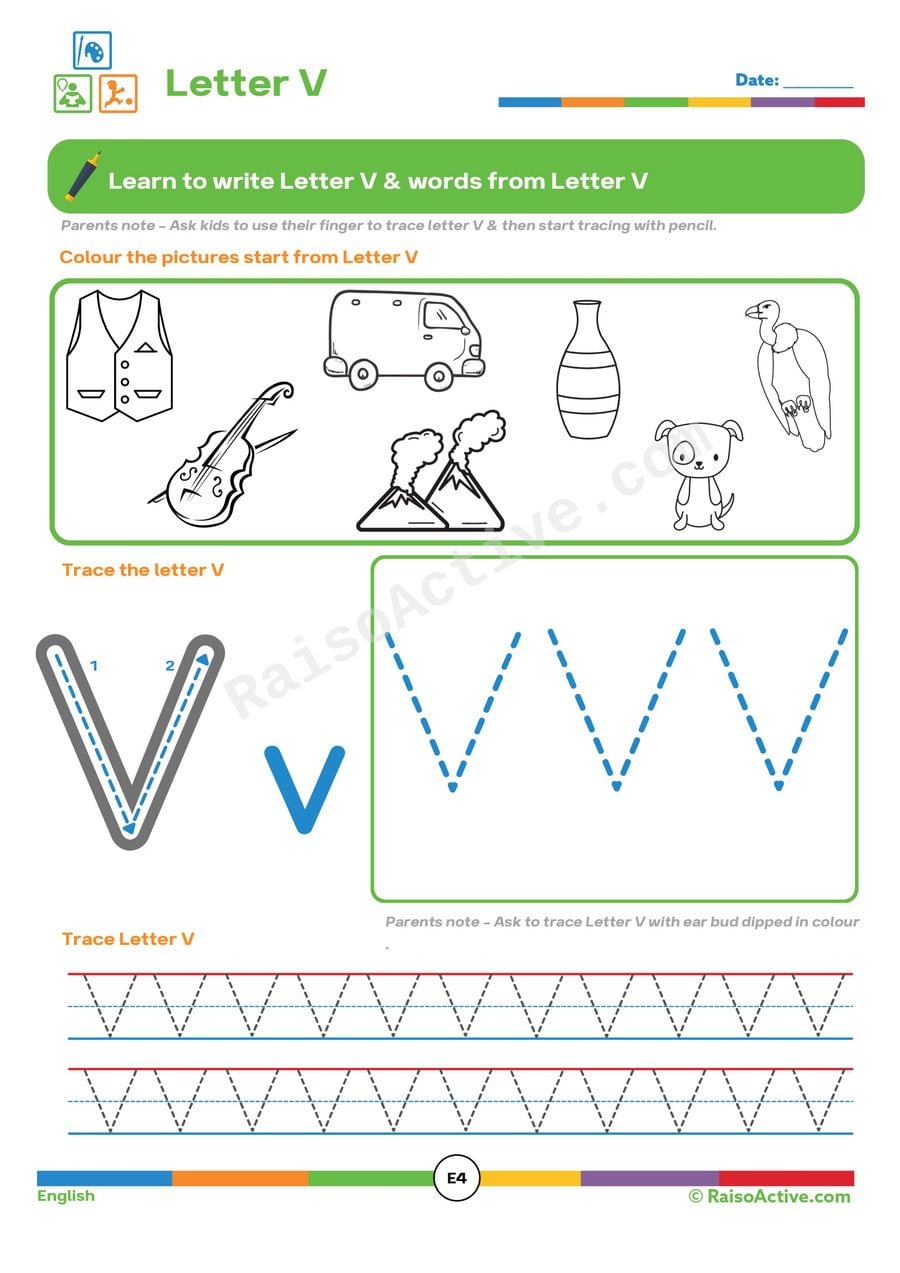
Trace the Letter V Worksheet for Preschoolers
Ages 3-5 · Preschool–Pre-KAges 3-5 · Nursery–ReceptionAges 3-5 · Nursery–LKGAges 3-5
Tracing the uppercase letter V builds the pencil control and stroke memory children ages 3-5 need for handwriting, while coloring pictures that start with V links the written letter to its spoken sound and familiar objects. Repeating the tracing after the picture activity gives extra practice forming the letter correctly.
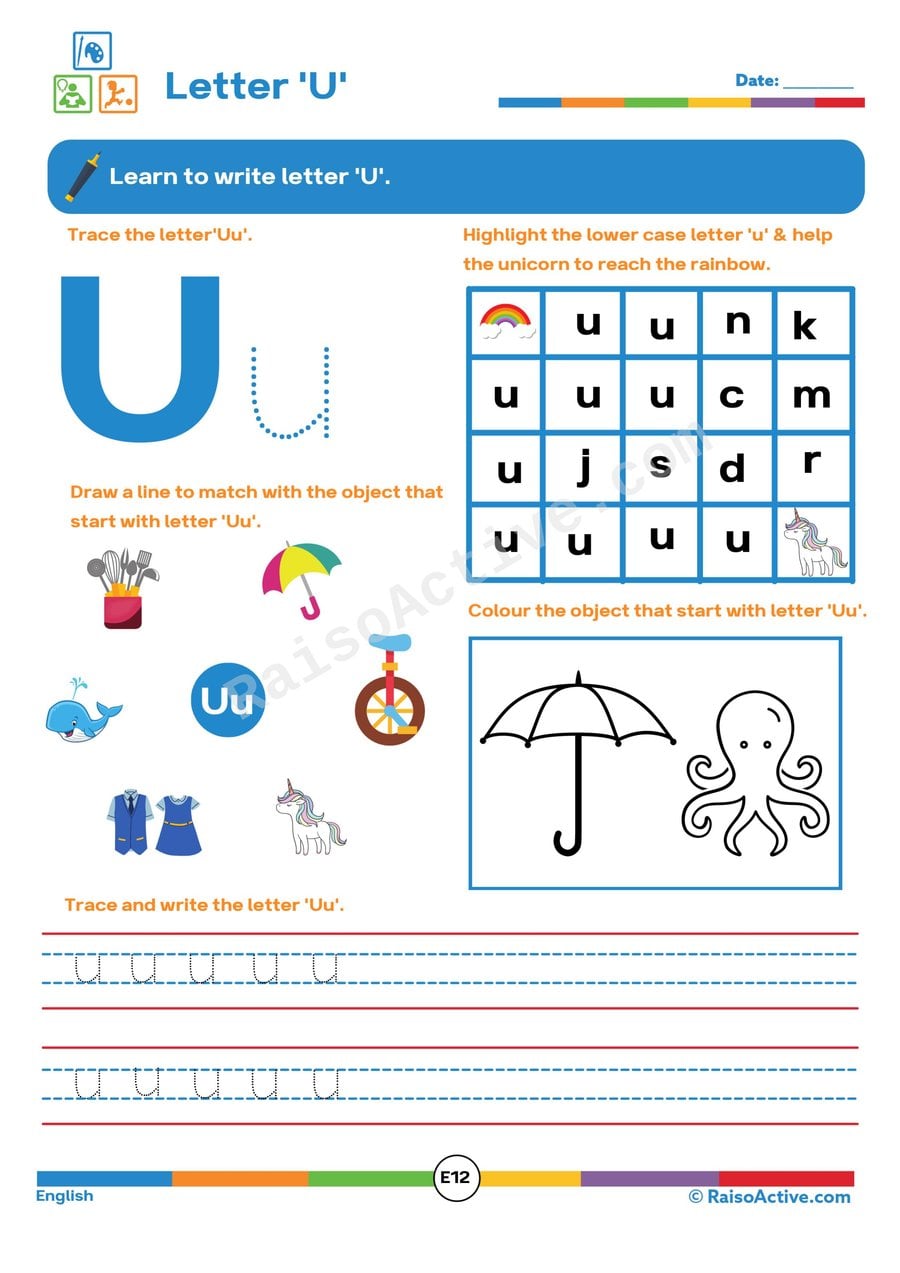
Letter 'U' Worksheet: Trace, Match, and Color!
Ages 3-5 · Preschool–Pre-KAges 3-5 · Nursery–ReceptionAges 3-5 · Nursery–LKGAges 3-5
Tracing, matching, and coloring the letter 'U' gives children ages 3-5 focused repetition on a rounded letter shape while building the sound-symbol connection for its short /u/ sound, as in 'umbrella' or 'up.' Matching pictures that start with 'U' to the letter reinforces recognition beyond the written form, tying it to real, familiar objects. Combining tracing, matching, and coloring in a single page suits a preschooler's need for varied, short activities rather than one long repetitive drill.
Guides for this topic

Best Worksheets for 3-Year-Olds: What Works and What to Avoid
What works on worksheets for 3-year-olds: short sessions, crayons, tracing lines, matching, cutting, a free weekly plan, and signs one is too advanced.
Fostering Creativity in Structured Learning: The Perfect Balance for Young Minds
Learn how to blend creativity with structured learning for children ages 1-8. Practical strategies, activities, and printable worksheets for parents and teachers.

How to Help Your Child with Letter Reversals: A Complete Guide for Parents and Teachers
Letter reversals are normal until age 7-8. Learn the best multisensory strategies, anchor letter tricks, and activities to help children write b, d, p, and q correctly.
Reviews
Every worksheet for ages 3–5, no watermark
Members download the full library of 1,000+ worksheets and every activity pack without watermarks or daily limits. One year costs ₹999 in India or $20 elsewhere.
See membership plansOr download any worksheet free with a watermark (5 a day).