Free printable worksheets · United States
1st Grade CVC Words Worksheets (Ages 6–7)
1st Grade cvc words worksheets are practice sheets for children aged 6–7 in First Grade in the US. CVC words are three-letter consonant-vowel-consonant words, such as cat or sun, practiced as the first words decoded by blending sounds. The sheets on this page cover blending three sounds into a word, short vowel sounds, segmenting a word for spelling and reading simple sentences built from CVC words.
First grade pushes reading toward fluency and math toward larger numbers: consonant digraphs, long vowels and silent e appear in decodable passages, while place value work extends to 120 and addition and subtraction move from within 10 to within 20. For a six-year-old, plain CVC words are review and should be read at a glance. Worksheets at this age extend the pattern: consonant blends at the start and end ("frog", "milk", "jump"), digraphs that make one sound from two letters ("ship", "chin", "moth"), and short passages built from these words. Spelling from dictation, including the blends, is expected. Long vowels with a silent e are usually being introduced alongside but are a separate skill.
251+ worksheets · free PDF download · print on A4 or Letter
1st Grade CVC Words Worksheets to print
Browse all worksheets for ages 6–7
Personal Pronouns Worksheet for Kids: Circle and Underline!
Circling the subject pronoun and underlining the object pronoun in each sentence teaches children ages 5-7 to recognize that pronouns play different grammatical roles depending on their position in a sentence, an important step toward more advanced grammar understanding. This careful, close-reading task also builds attention to sentence structure that supports stronger writing later on.

Punctuation Adventure: End Punctuation Worksheet for Kids
Children ages 5-7 practice choosing between periods, question marks, and exclamation points based on the meaning and tone of a sentence, a skill that connects punctuation directly to how a sentence should sound when read aloud. This builds the foundation for expressive, correctly punctuated writing later in school.
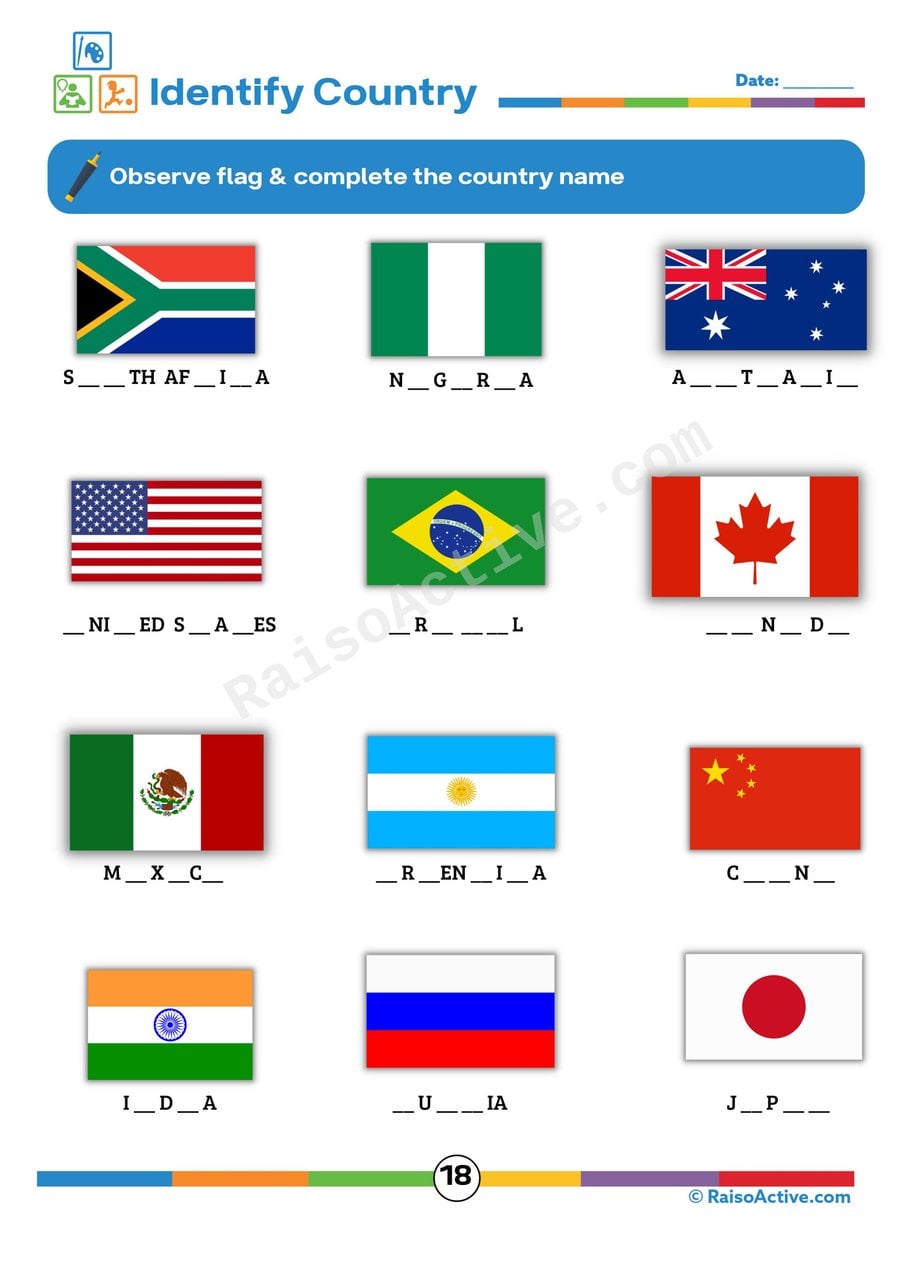
Identify the Country: Flag Matching Worksheet
Filling in the missing letters of each country's name while studying its flag gives children ages 4-7 practice with letter-sound correspondence and spelling patterns, since they must sound out the word and recall which letters are already provided as clues. It also builds early geography knowledge, helping children connect a visual symbol (the flag) to a country's name for the first time. This dual practice of decoding and world knowledge lays groundwork for both literacy and social studies skills.

Sun Safety Worksheet for Kids: Learn About Staying Safe in the Sun!
This worksheet has children ages 4-7 answer questions about sun safety, such as why sunscreen and hats matter, building early health literacy alongside writing practice as they put their understanding into their own words. Because the questions ask children to reason about why certain sun-safety habits matter rather than just label a picture, this worksheet develops early explanatory thinking, a step up from simple factual recall. Practicing writing full answers, even short ones, also builds sentence-forming skills appropriate for this age range.

J and K Consonant Sounds Matching Worksheet for Preschoolers
The letters J and K are frequently mixed up by children ages 4-6 because both are less common consonants that don't appear in as many early words as letters like S or T, so this worksheet gives them focused, repeated practice distinguishing the two sounds. Matching each letter to a picture that starts with its sound builds the letter-sound association needed before a child can spell or read J and K words confidently. This kind of targeted practice on less-frequent letters fills a gap that broader phonics worksheets often skip over.

Read and Match: Sentence Matching Worksheet for Early Readers
This worksheet moves children ages 4-6 beyond single words into reading whole simple sentences and matching each one to the picture it describes. Comprehending a full sentence — not just recognizing individual words — is a genuine leap in reading skill, since it requires holding several words in mind together and connecting their combined meaning to an image.

Unlocking 'un' Words: A Fun Worksheet for Early Readers!
Ages 4-6 practice decoding and spelling CVC words in the 'un' family, such as 'sun' and 'bun', by matching each picture to its written word. This picture-to-word matching strengthens the bridge between spoken vocabulary and printed text, a core early literacy skill. Writing the word afterward locks in correct letter sequencing and spelling memory.

Family Words Worksheet: Picture Matching and Word Recognition
Children ages 4-6 practice recognizing and reading words from the 'family' word group, like 'candle' becoming 'candle-family' patterns or similar word-family endings, by matching written words to their corresponding pictures. Word family practice builds phonics pattern recognition, helping children read new words faster by spotting familiar chunks within them.
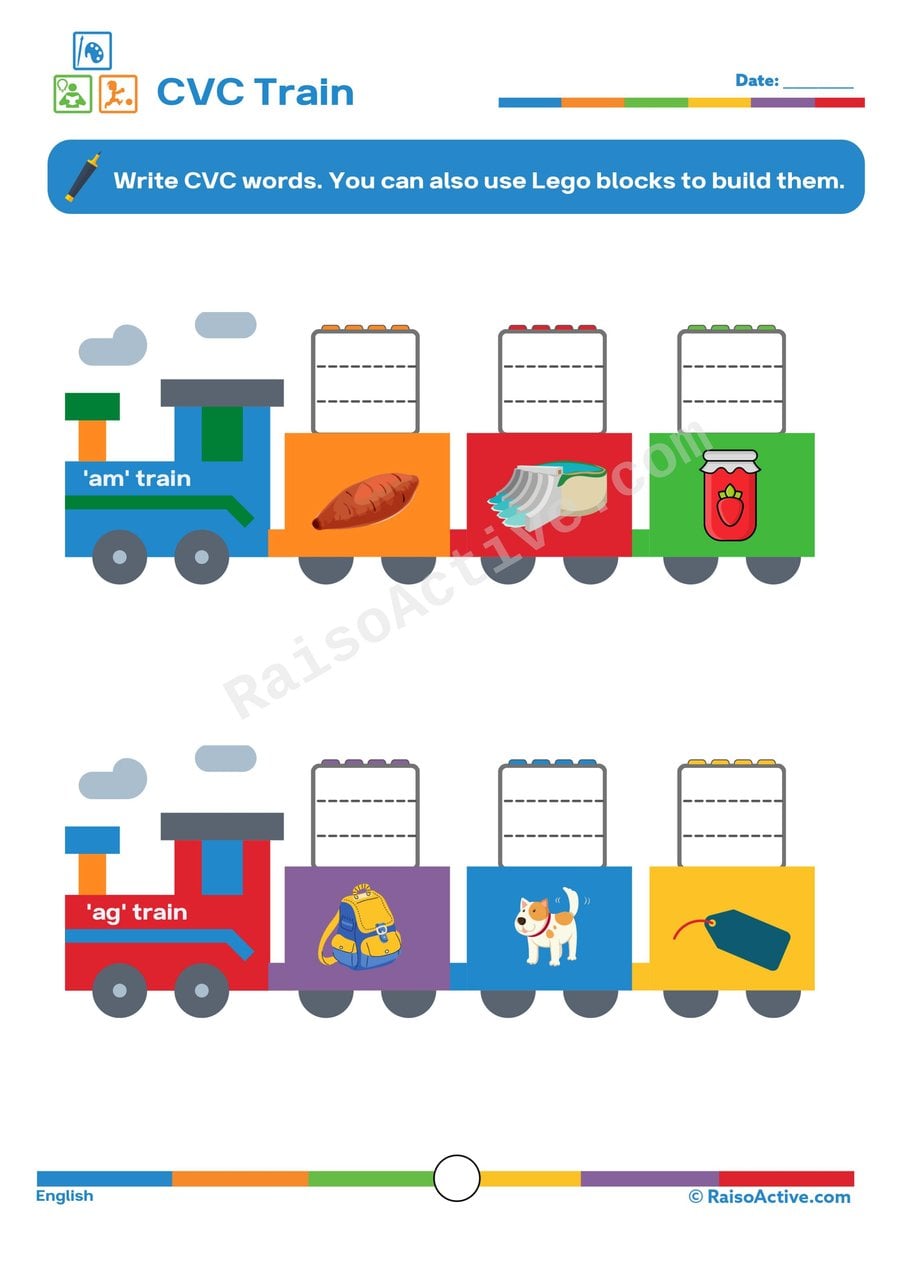
CVC Train Worksheet: Write CVC Words!
Writing consonant-vowel-consonant words like 'cat,' 'sun,' or 'pig' under matching pictures gives children ages 4-6 direct practice with letter-sound blending, a core phonics skill that underpins independent reading. Because each train car pairs a picture clue with a blank space, children also practice translating a spoken word they can sound out into its correctly spelled written form.

CCVC Word Matching Worksheet: Read and Match 'cl' and 'sl' Blends
This worksheet gives children ages 4-6 focused practice reading and matching CCVC words that begin with the 'cl' and 'sl' consonant blends, like 'clap' and 'slide'. Practicing two specific, similarly structured blends side by side sharpens a child's ability to hear the subtle difference between them, a skill that becomes increasingly important as vocabulary and reading material grow more complex.

Match the Countries with Their Symbols Worksheet
Children ages 4-6 build early social studies awareness by matching country flags to their well-known national symbols, connecting visual recognition with basic geography and cultural knowledge. This kind of matching exercise strengthens careful observation, since children must compare colors, shapes, and details across both the flag and the symbol image. It also plants the seed for understanding that different countries have distinct identities and traditions.

Punctuation Fun: Practice Using Punctuation Marks!
Choosing the correct punctuation mark to complete a sentence teaches children ages 4-6 that periods, question marks, and other marks change how a sentence should be read and understood, not just how it looks on paper. Matching sentences to their correct punctuation marks reinforces this by requiring children to recognize the tone or purpose of a sentence, whether it's a statement, a question, or an exclamation. This early grammar practice builds the foundation for reading with expression and writing complete, correctly punctuated sentences later on.

Short Vowel Fun: Complete the Words Worksheet for Kids
This worksheet has children ages 4-6 fill in missing short vowels to complete words based on pictures, then locate and color those same words within a grid, layering active spelling recall with visual word-search practice. Completing a word by choosing the correct short vowel requires your child to distinguish between five different vowel sounds — a, e, i, o, and u — which is a more demanding discrimination task than working with just one or two vowels at a time. Following that with a word search reinforces the completed spelling by having your child recognize and locate the exact same word again.
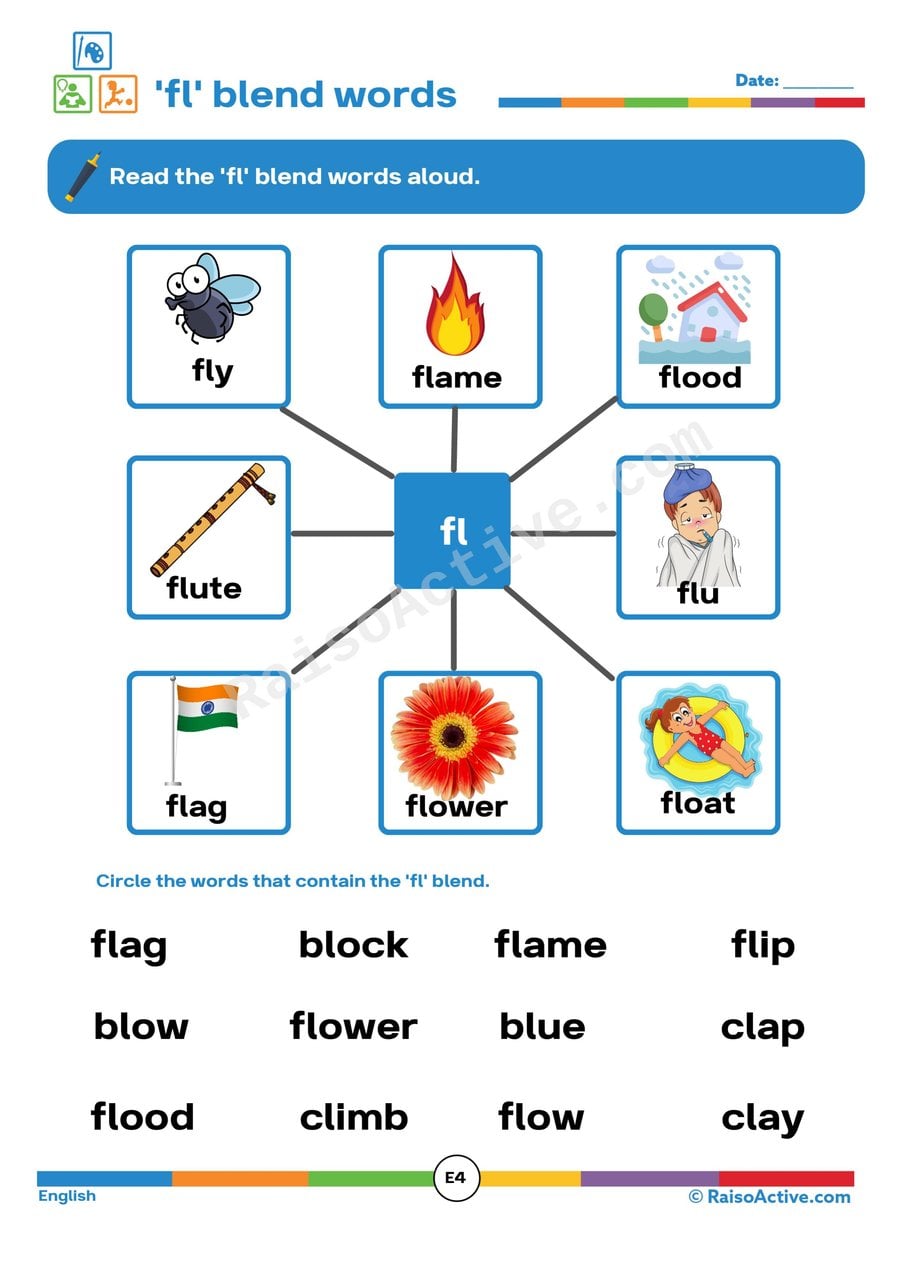
FL Blend Words Worksheet: Read, Circle, and Learn!
Reading and circling words that begin with the 'fl' consonant blend teaches children ages 4-6 that two consonants together, like f and l, can combine into one smooth sound at the start of a word, a more advanced phonics concept than single-letter sounds. This kind of targeted blend practice builds the specific decoding skill needed to read common early words like 'flag,' 'fly,' and 'flower' without stumbling. Strengthening blend recognition now supports much smoother, more confident reading as vocabulary grows in later grades.
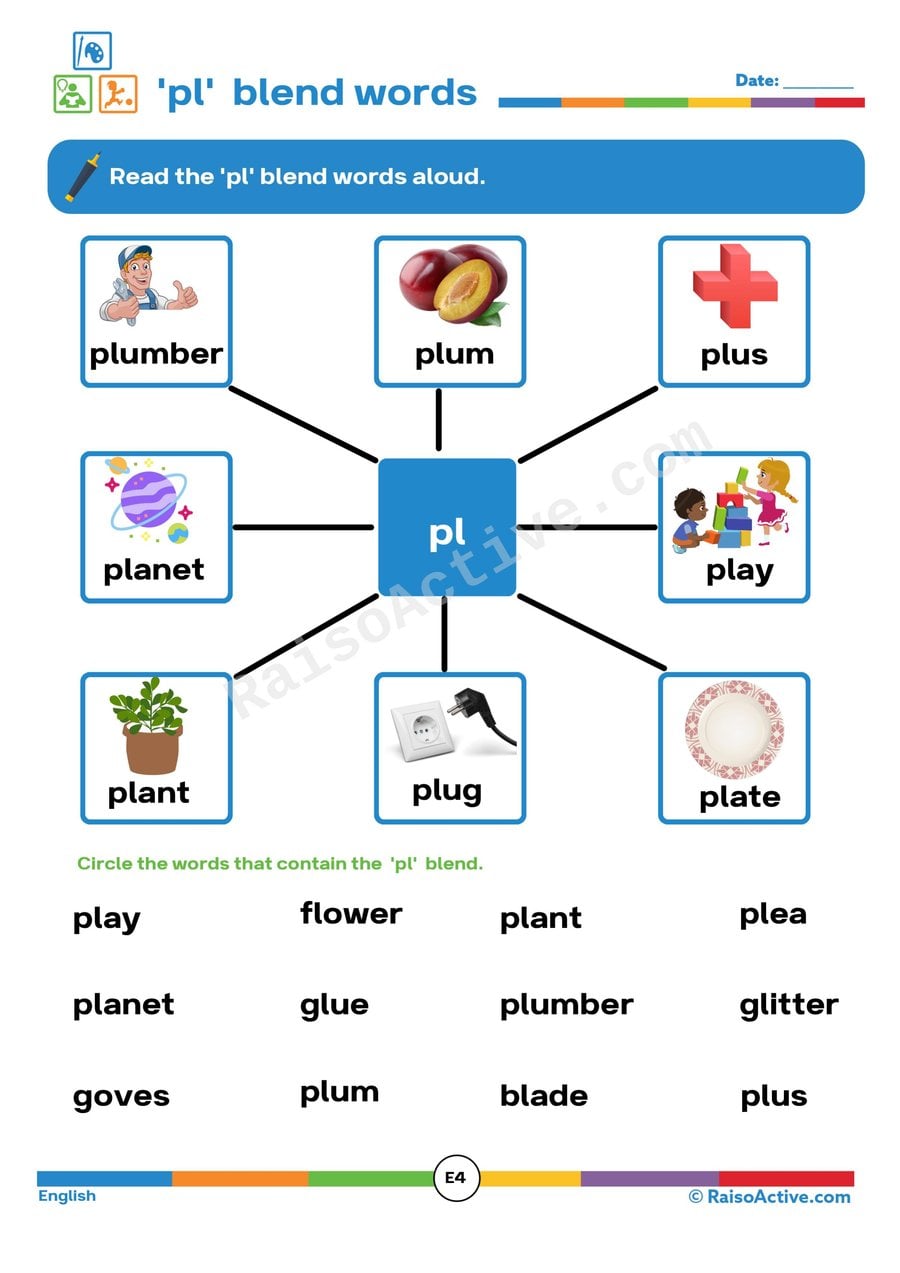
Pl Blend Words Worksheet for Preschoolers
This worksheet targets the 'pl' consonant blend, helping children recognize and read words like 'play,' 'plane,' and 'plant' where two consonant sounds combine at the start of a word. For ages 4-6, mastering blends is a key phonics milestone that comes after single letter sounds, since blending two consonants together requires more advanced sound segmentation skills.

Vowel Sounds Worksheet: Identify and Circle the Correct Vowel!
Children ages 4-6 practice identifying vowel sounds within words by looking at a picture, saying its name aloud, and figuring out which vowel they hear, a specific phonics skill that builds toward independent reading and spelling. Isolating the vowel sound in a word is often trickier for children than identifying beginning consonant sounds, making this a meaningful next step in phonics.
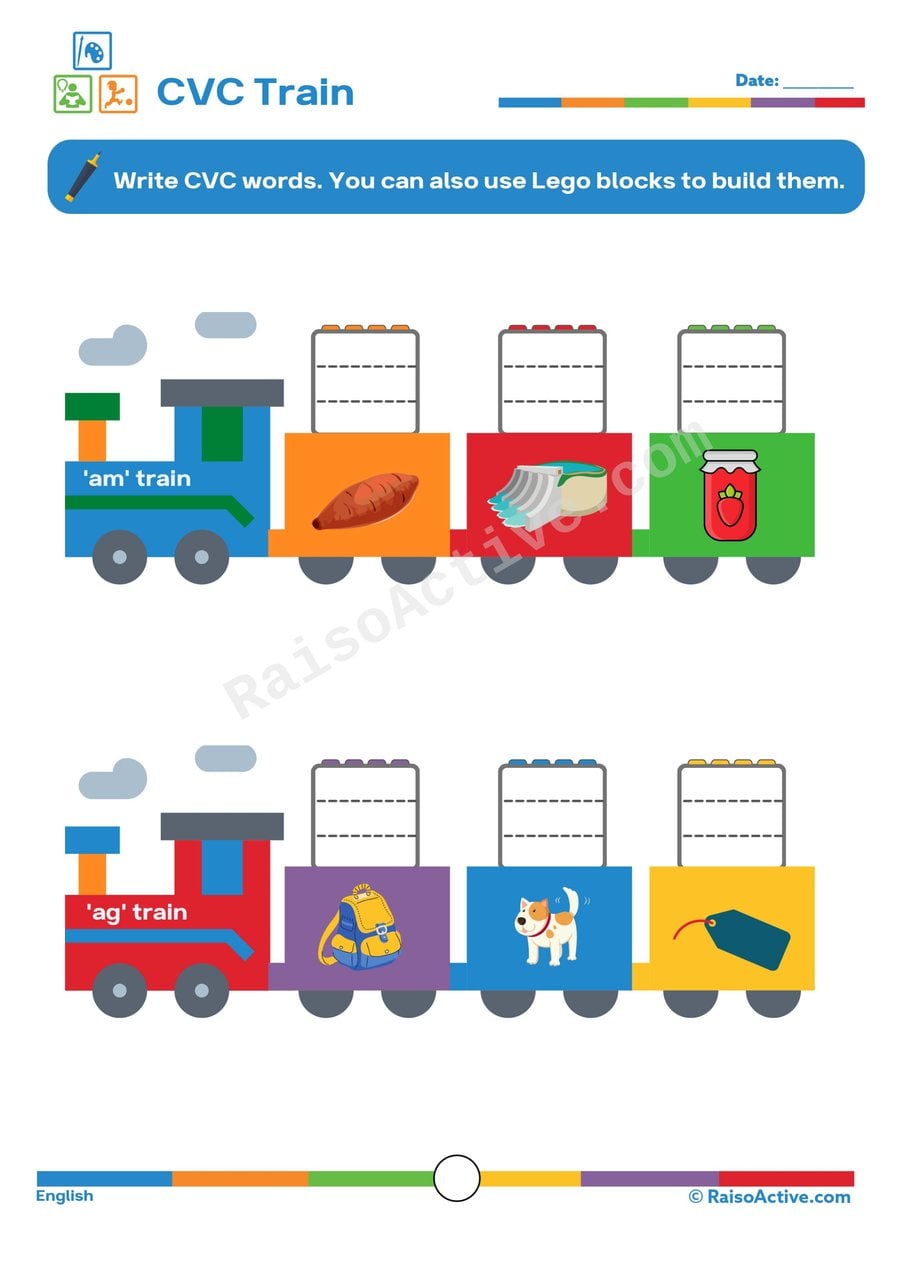
CVC Train Worksheet: Write and Build CVC Words!
This worksheet gives children ages 4-6 focused practice blending letter sounds into consonant-vowel-consonant words, using train-car pictures as clues for words like 'dog,' 'hen,' or 'cup.' Because children both write the word and can optionally build it with Lego blocks, this worksheet reinforces the same phonics skill through two different physical actions — handwriting and hands-on construction — which helps the spelling patterns stick.

Plant Adaptation Worksheet for Kids: Matching Examples
This worksheet introduces 4-6 year olds to plant adaptations — the specific features that help plants survive in their environment, like thick leaves that store water or thorns that deter animals — by having them match real plant examples to the correct type of adaptation and then write it in. This is a genuinely abstract science concept for this age group, since it requires connecting a visible feature to an invisible purpose (why does a cactus have thick, waxy skin?), making it more conceptually demanding than simple plant-part labeling.

Tenses Worksheet: Identifying Past, Present, and Future Verbs
Identifying whether an underlined verb describes something that already happened, is happening now, or will happen later introduces children ages 4-6 to verb tense, an important step toward constructing grammatically correct sentences of their own.

Short Vowel Sounds: Matching Objects to Sounds Worksheet
This worksheet helps children ages 4-6 tell apart the short 'o' sound (as in 'fox') from the short 'u' sound (as in 'sun') by matching pictured objects to their correct vowel sound. Short vowels are the building blocks of the earliest CVC words children read, so being able to hear and distinguish them accurately is essential before moving on to more complex word patterns.
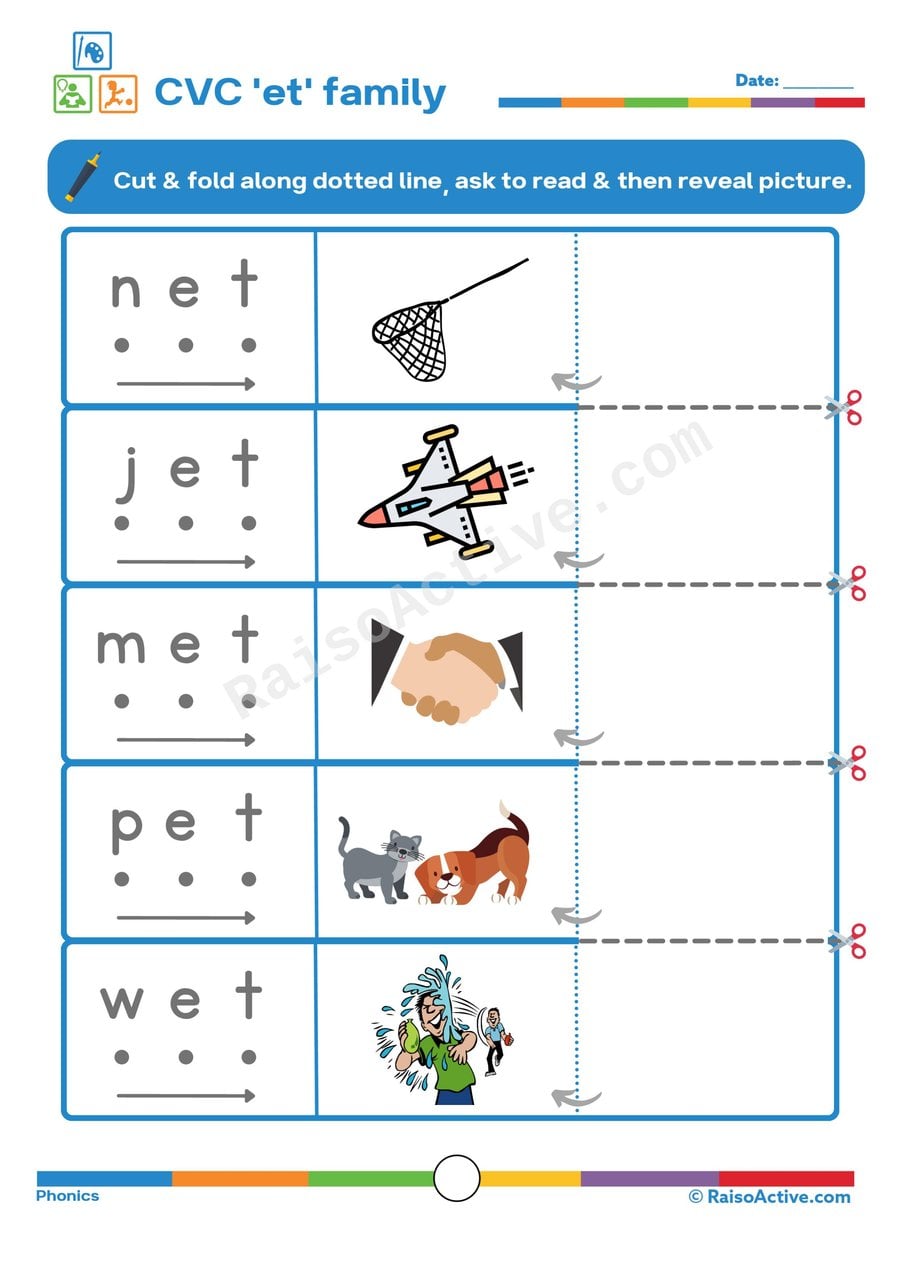
CVC 'et' Family Worksheet: Read, Cut, and Match!
This 'et' word family worksheet (like 'wet,' 'net,' 'jet') adds a fun reveal mechanic to word-family reading practice for children ages 4-6, where cutting and folding a flap hides the picture until after the word has been read and guessed. This delayed-reveal format encourages genuine decoding rather than guessing from a picture first, since your child has to sound out the word before seeing what it depicts, strengthening true reading skill instead of picture-cued guessing. The cutting and folding also builds fine motor control alongside the phonics practice.

Conjunctions Worksheet: Expanding Sentences (Ages 4-6)
This worksheet moves beyond simple conjunction identification to active sentence expansion, asking children to use conjunctions like 'but,' 'when,' 'until,' 'because,' and 'if' to add new information and build longer, more sophisticated sentences. For ages 4-6, this kind of guided sentence-combining is a key step toward more complex, connected storytelling in both spoken and written language.

Number Names Worksheet: Count, Write, and Match Numbers!
Counting, writing, and matching numbers to their written names helps children ages 4-6 connect three related but distinct number skills — quantity recognition, numeral writing, and word reading — into one integrated understanding. Building fluency across all three forms means a child can recognize '5,' 'five,' and a group of five objects as the same idea no matter how it's presented.

Tell the Time Worksheet: Clock Reading Practice for Kids
This worksheet helps children ages 4-6 practice reading an analog clock by looking at the position of the hour and minute hands and writing down the time shown. Analog clock reading is a genuinely challenging skill that combines number recognition with an understanding of two hands moving at different speeds, making repeated, varied practice like this essential before a child can read time confidently on their own.
What 1st Grade cvc words worksheets cover
For a six-year-old, plain CVC words are review and should be read at a glance. Worksheets at this age extend the pattern: consonant blends at the start and end ("frog", "milk", "jump"), digraphs that make one sound from two letters ("ship", "chin", "moth"), and short passages built from these words. Spelling from dictation, including the blends, is expected. Long vowels with a silent e are usually being introduced alongside but are a separate skill.
- Read CCVC and CVCC words such as "stop", "hand" and "jump"
- Spell "ship", "chin" and "moth" into three sound boxes, one per sound
- Read a six-sentence decodable passage and answer one question
- Sort words by whether the vowel is short or long
How to use these worksheets at home or in class
Fifteen to twenty minutes on most school days, split between a decodable passage with questions and a math page, matches what many first grade teachers assign. Keep base-ten blocks or bundled straws nearby so place value stays physical before it becomes purely written.
Start with the sheet that matches what your child can already do, then move one step up. Keep finished sheets in a folder: 1st Grade teachers often ask for evidence of practice, and children like seeing their own progress.
Is your child ready for 1st Grade cvc words work?
A child ready for this stage decodes CVC words automatically, writes a simple sentence with a capital letter and end punctuation, adds and subtracts fluently within 10, and counts and writes numerals confidently to 20.
Frequently asked questions
My six-year-old still sounds out every CVC word. Is that a problem?
It depends what "sounds out" means. Saying each sound under the breath and blending in a second or two is normal at six and fades on its own with reading practice. Sounding out slowly, letter by letter, and still getting the word wrong suggests the middle vowel sounds are not secure. Go back to one vowel at a time with pictures, then mix them, and keep sessions to five minutes of reading and five of spelling.
What should a 1st Grade child be able to do in cvc words?
For a six-year-old, plain CVC words are review and should be read at a glance. Worksheets at this age extend the pattern: consonant blends at the start and end ("frog", "milk", "jump"), digraphs that make one sound from two letters ("ship", "chin", "moth"), and short passages built from these words. Spelling from dictation, including the blends, is expected. Long vowels with a silent e are usually being introduced alongside but are a separate skill. A child ready for this stage decodes CVC words automatically, writes a simple sentence with a capital letter and end punctuation, adds and subtracts fluently within 10, and counts and writes numerals confidently to 20.
Do these worksheets follow the 1st Grade curriculum?
The sheets cover blending three sounds into a word, short vowel sounds, segmenting a word for spelling and reading simple sentences built from CVC words, which sit inside the Common Core Grade 1 (1.OA, 1.NBT, RF.1.3) outcomes for 1st Grade. Year 1 / Year 2 (UK), Class 1 (India) use the same skills at this age, so the sheets also fit families following those programmes.
Are these 1st Grade cvc words worksheets free?
Yes. Each worksheet downloads free as a watermarked PDF once you create an account, with a limit of five a day. An annual membership ($20) removes the watermark and the limit for the whole library of over 1,000 worksheets and every printable pack.

Written by
Hemsweta Jain · Teacher Cheena
MBA and Early Childhood Educator, teaching since 2014 · Founder of RaisoActive, Mumbai
Written and reviewed by Hemsweta Jain (Teacher Cheena), who designs every RaisoActive worksheet.
Last reviewed
Printable packs for ages 6–7
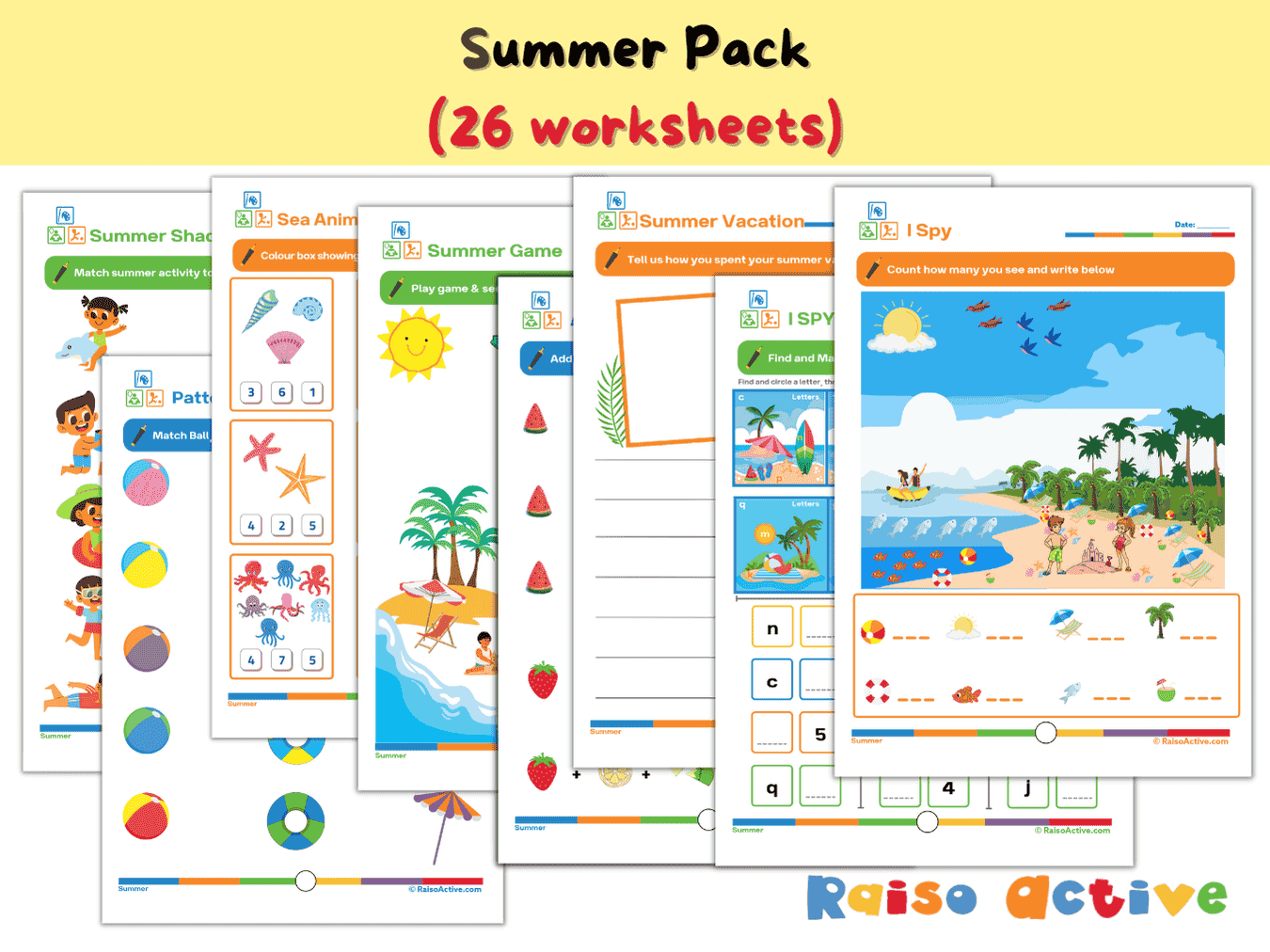
Summer Activity Pack: Math, Literacy, Puzzles & More for Preschool & Kindergarten
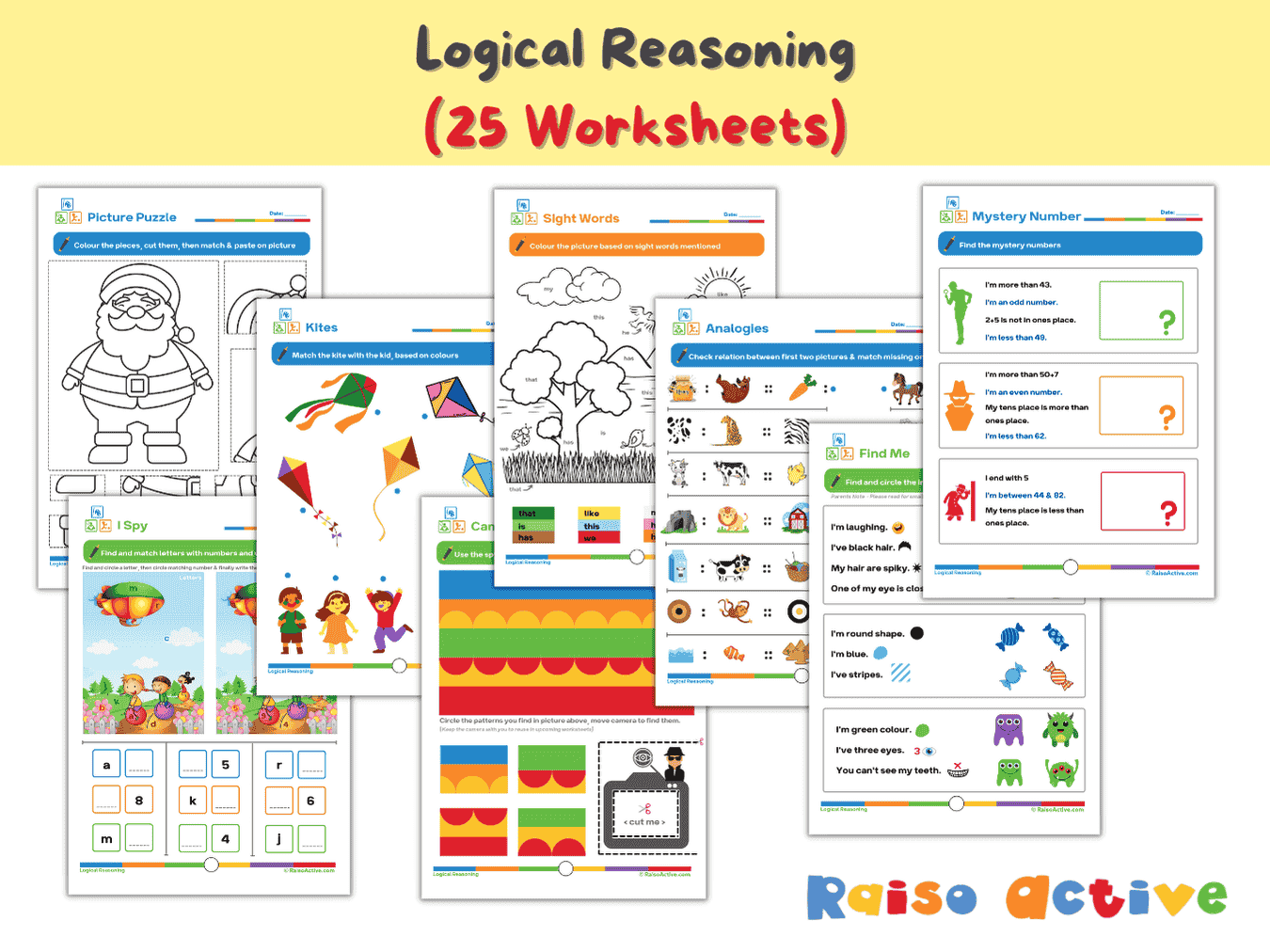
Logical Reasoning Activity Book for Preschool & Kindergarten | Patterns, Puzzles & Analogies
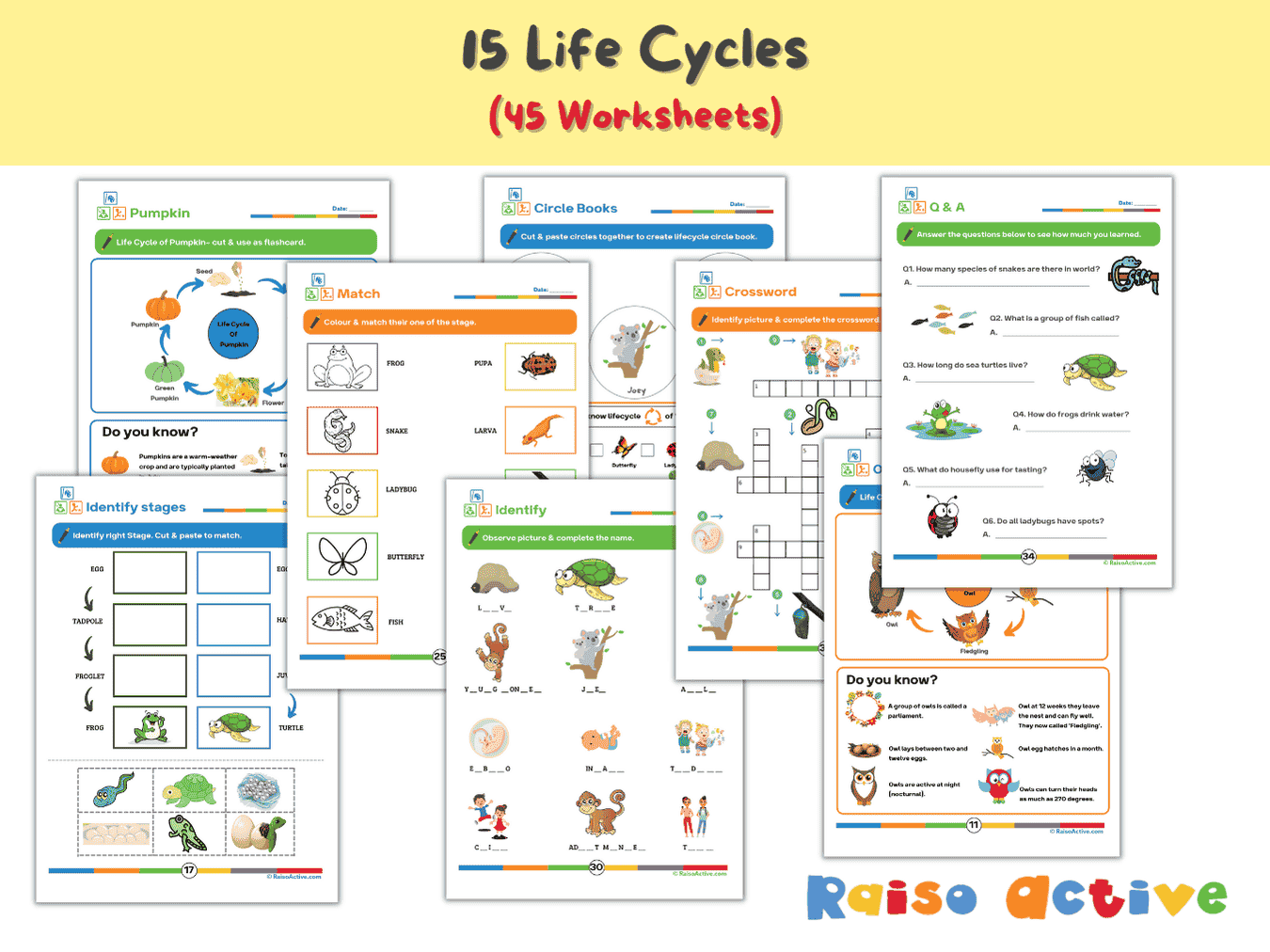
Lifecycles Activity Book & Flashcards for Preschool & Early Elementary
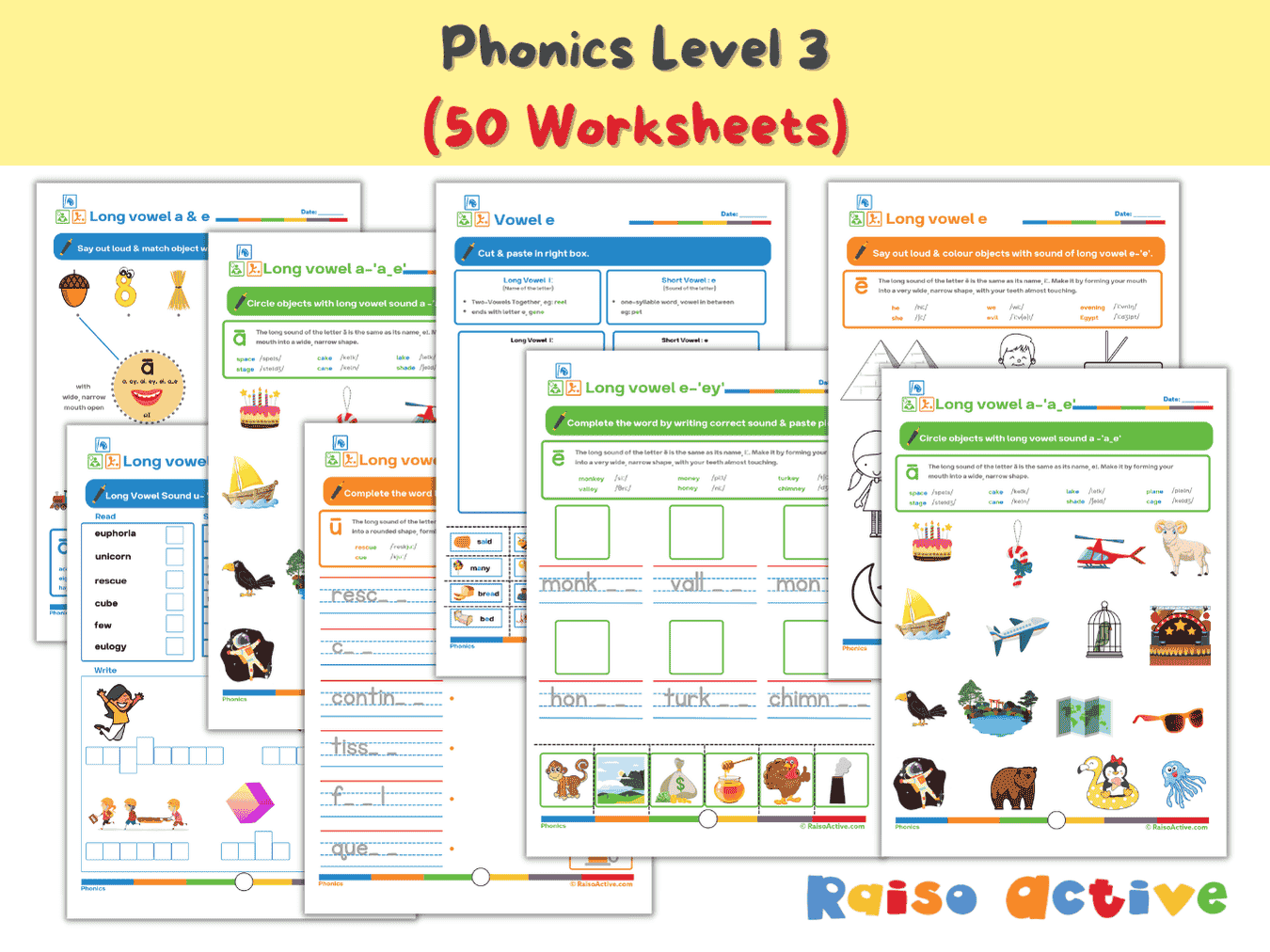
Phonics Level 3 Long Vowels Activity Book for Kindergarten & 1st Grade
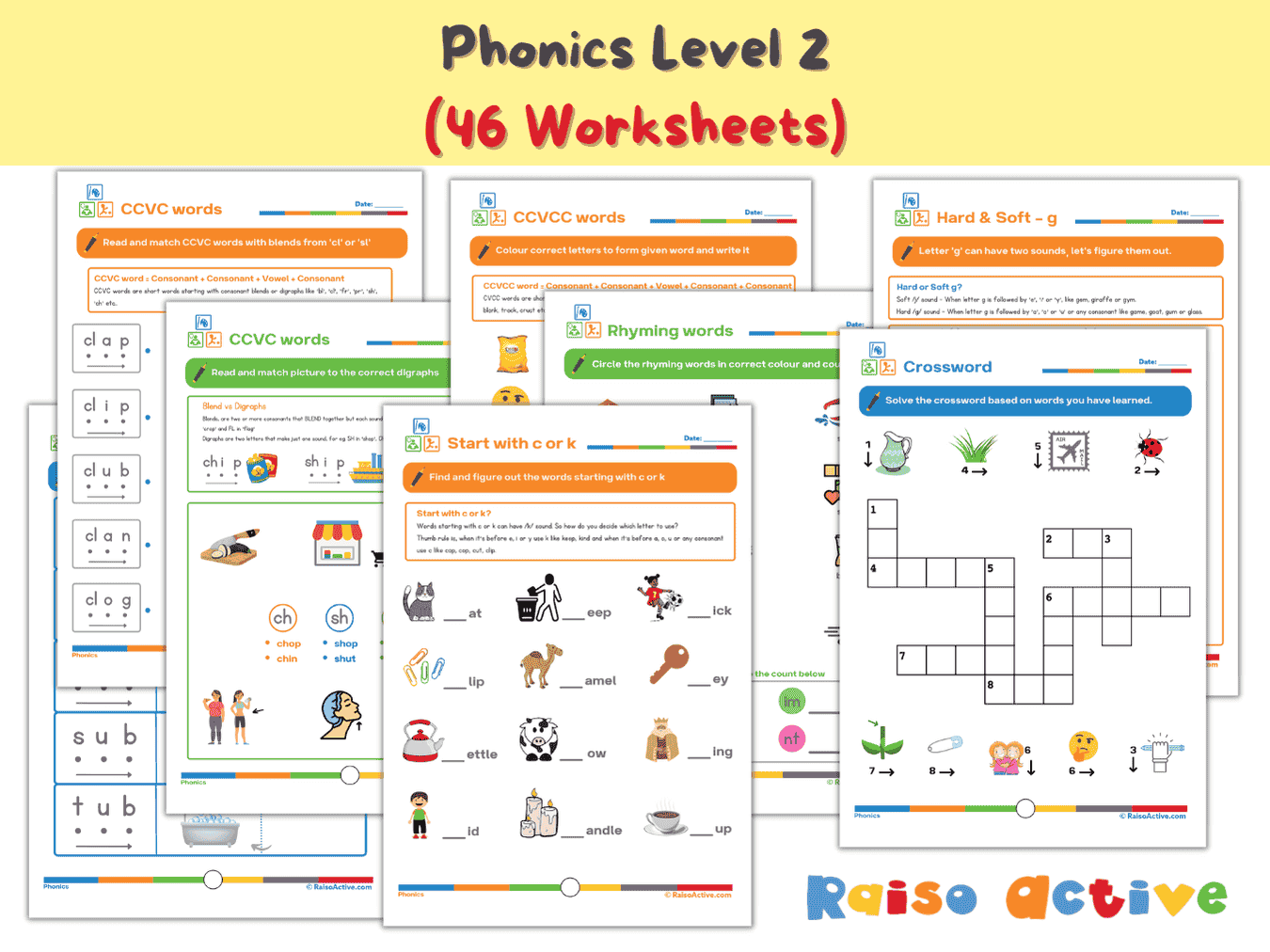
Phonics Level 2 Worksheets: CVC, CCVC, CVCC Word Families & Blends for Early Readers (Ages 4-7)
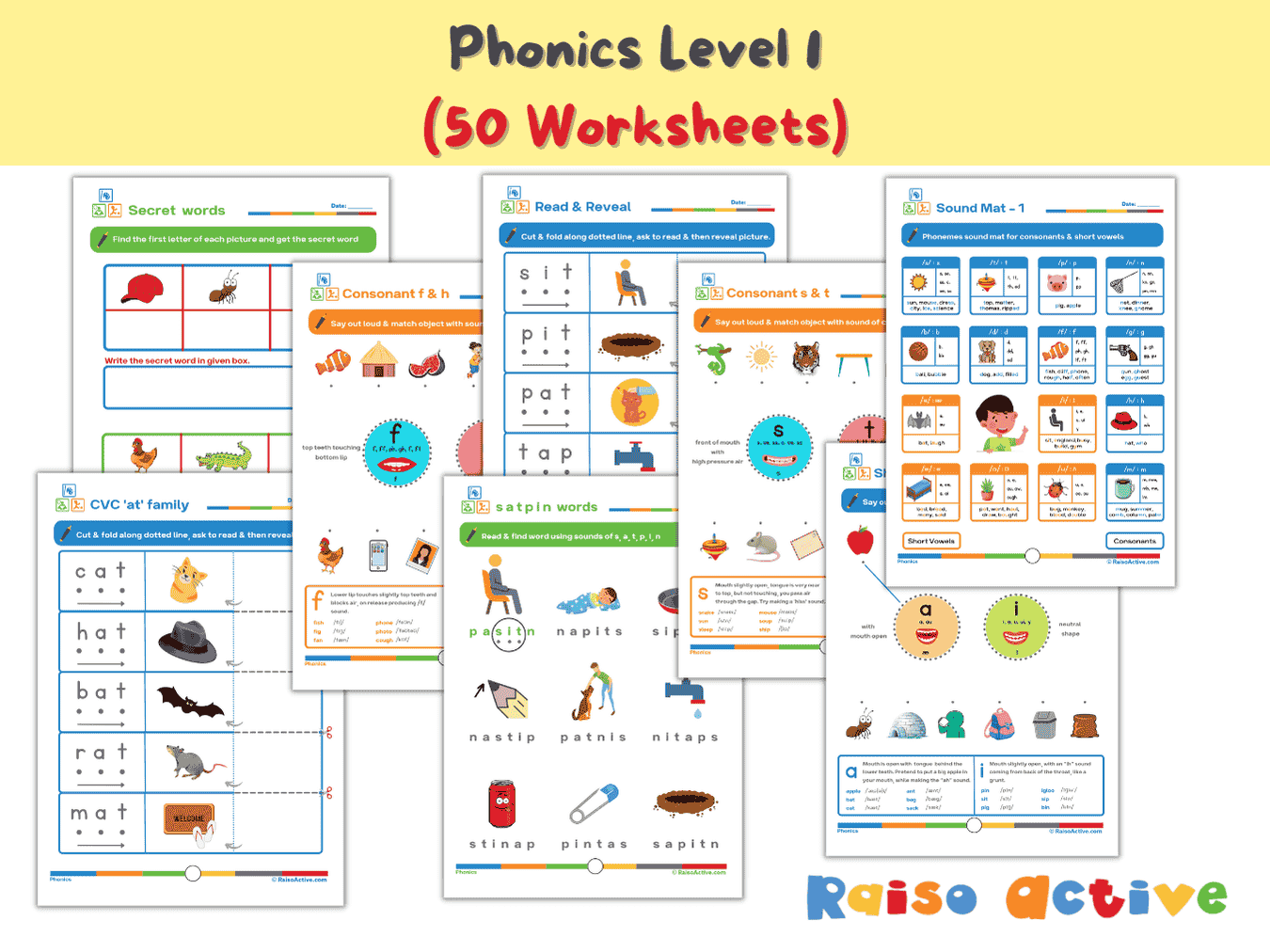
Phonics Level 1 Activity Book: Letter Sounds, Blending & CVC Words for Preschool & Kindergarten
Guides for parents and teachers
See all guides →Sight Words by Age: The First 50 Words and How to Teach Them Without Flashcard Fatigue
Which sight words to teach first and why, the heart-word method, a read-trace-write-find routine, games, and a by-age table of typical sight-word progress.
How to Teach CVC Blending: A Step-by-Step Method That Works in Two Weeks
A step-by-step method for teaching CVC blending, covering continuous sounds, word families, common errors, and a 14-day plan that most children finish reading CVC words.
Phase 2 Phonics at Home: Sound Order, Blending Games, Worksheets
Phase 2 phonics at home: the five sound sets in order, oral blending, tricky words, a two-week routine, common mistakes, and free worksheets.
Reception Year Explained: EYFS Learning and How to Help at Home
A teacher's plain-English guide to the Reception Year: the seven areas of learning, Early Learning Goals, Phase 2/3 phonics, the RBA and home routines.
UKG Syllabus Explained: English, Maths and EVS Month by Month
What UKG classes typically cover in English, maths and EVS, month by month, aligned to NEP 2020, with ways to support at home and signs your child is behind.
Bridging Two Worlds: A Complete Guide to Teaching Heritage Languages Alongside English
A practical guide to raising bilingual children who speak both their heritage language and English with confidence. Research-backed strategies, activities, and tips for Indian families.
Canonical: https://raisoactive.com/worksheets/first-grade-cvc-words