Sight Word Coloring Worksheet: Make, For, Here, Our, From, and What!
This worksheet helps children ages 3-5 build automatic recognition of six common sight words — make, for, here, our, from, and what — words that show up constantly in early reading but don't always follow predictable phonics rules. Finding and coloring matching words hidden within pencil shapes trains visual discrimination between similar-looking short words, a skill that directly supports reading fluency.
Part of the pack
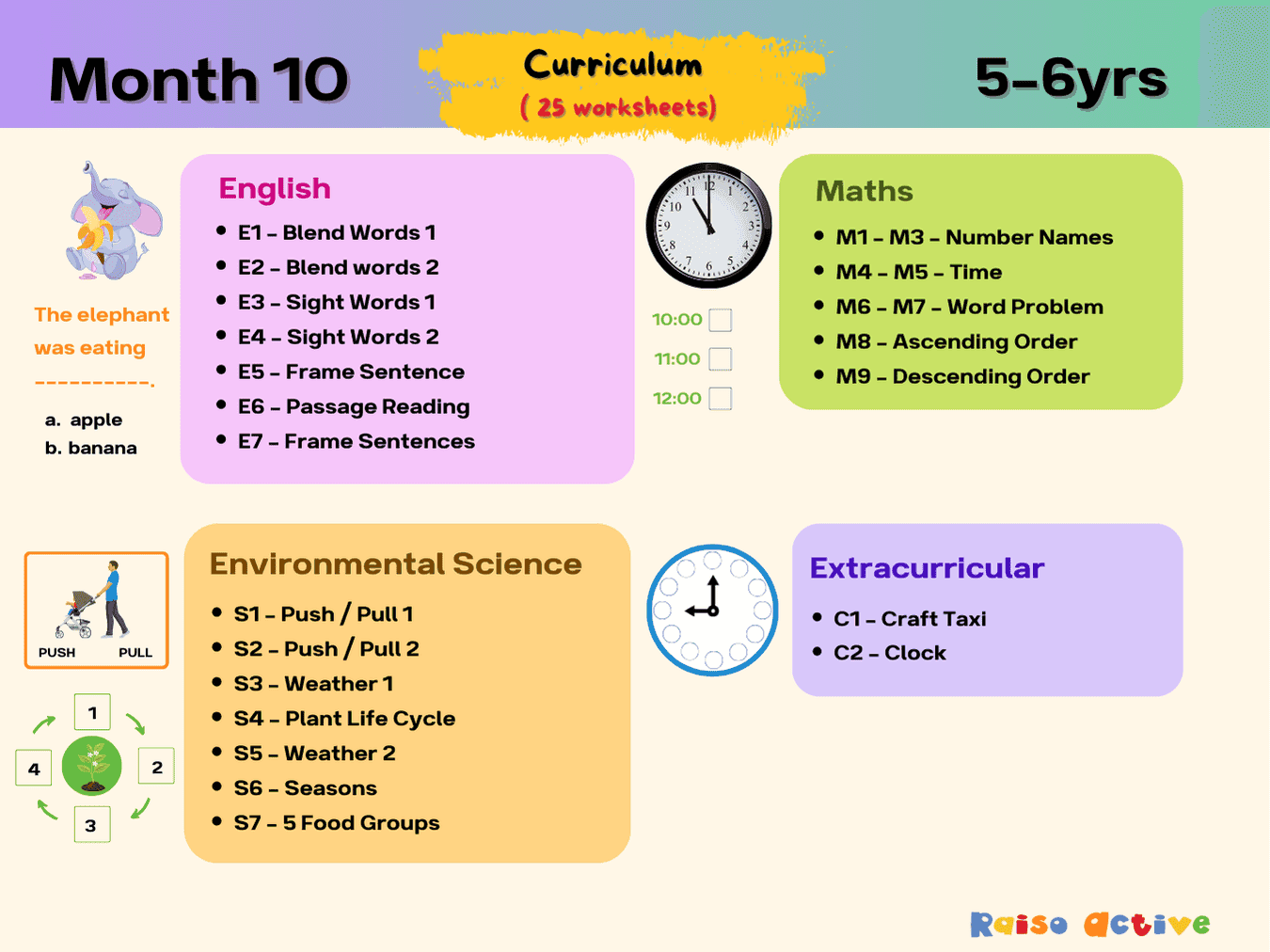
Month 10: Learning & Development | Ages 5-6
This is page 6 of the pack. Ages 5-6 · KindergartenAges 5-6 · Year 1Ages 5-6 · UKGAges 5-6
Made for your child
Spelling practice, made for your child
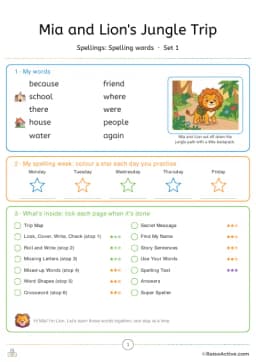
Their own spelling words turned into a pack: trace or look-cover-write-check, roll and write, a secret picture code, a word search, a crossword and a test, with their name in it.
Make a spelling packFree preview · free for members
Or start free: a word search with sight wordsCurriculum
- Fluency > Sight Words
How to use this worksheet
Look at the sight words listed at the top of the page and read each one aloud together, noting the color example shown for each. Have your child scan the pencil shapes below, reading each word carefully to find one that matches a word from the top of the page. When they find a match, have them color that pencil the same color as the example, working through the page until every sight word has been found and colored.
Materials needed
- Pencils
- Crayons or colored pencils
Extension activities
- 1Have your child write each sight word independently on a separate piece of paper.
- 2Create short, simple sentences using each of the six sight words and read them together.
- 3Use the sight words in a game of 'I Spy,' hiding word cards around the room to find and read.
- 4Make matching flashcards for a quick daily practice round before or after another activity.

Written by
Hemsweta Jain · Teacher Cheena
MBA and Early Childhood Educator, teaching since 2014 · Founder of RaisoActive, Mumbai
Every RaisoActive worksheet is designed and checked by the founder before publishing.
Published · Last reviewed
More from Month 10: Learning & Development | Ages 5-6

Push or Pull Worksheet for Kids: Circle the Correct Answer!
Ages 3-5 · Preschool–Pre-KAges 3-5 · Nursery–ReceptionAges 3-5 · Nursery–LKGAges 3-5
Children ages 3-5 build early physics vocabulary by identifying whether an action shown in a picture is a push or a pull, a foundational concept in understanding forces and motion. Learning to categorize everyday actions this way helps children start noticing cause and effect in the physical world around them, well before they encounter formal science lessons.
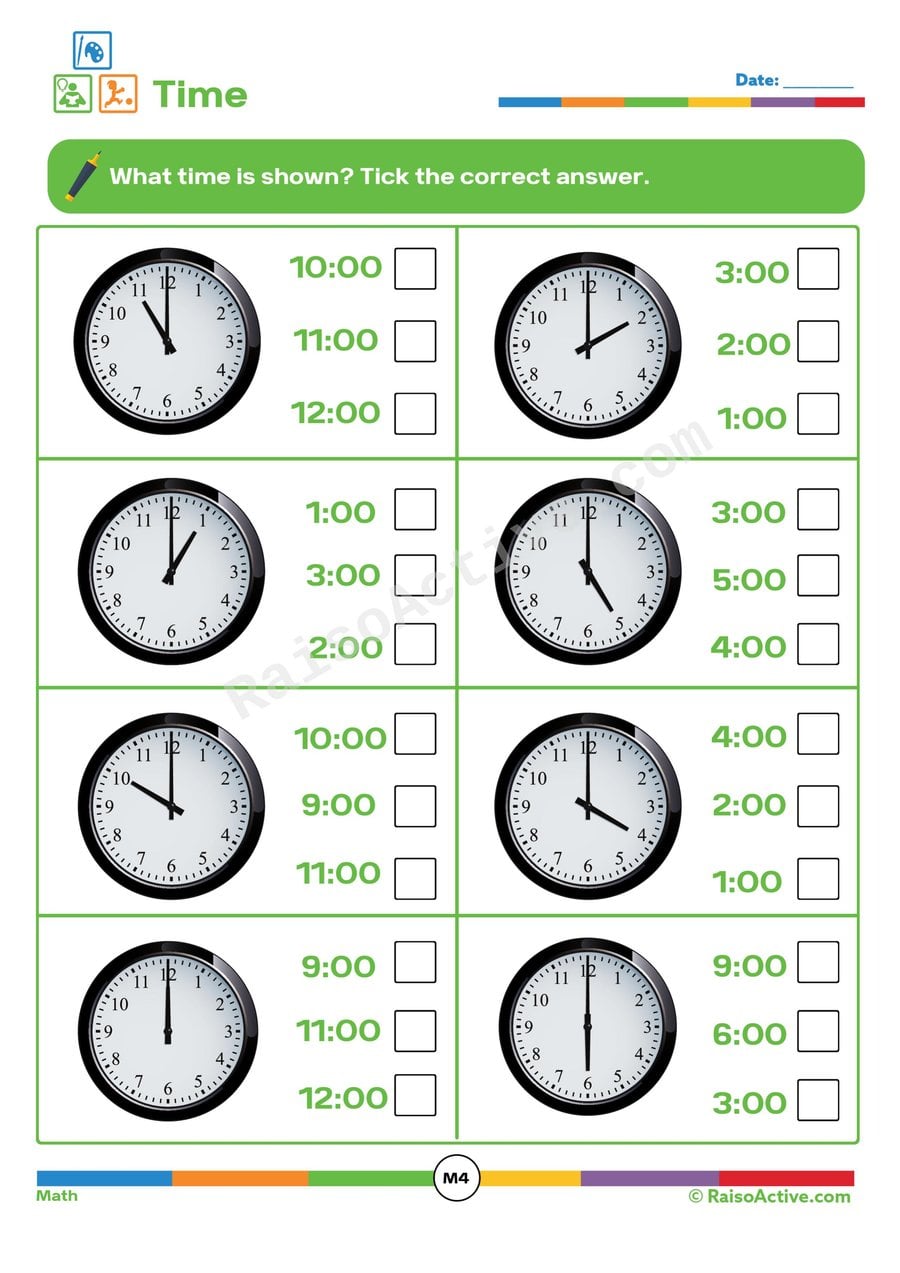
Time Telling Worksheet: What Time Is It? (3-5)
Ages 3-5 · Preschool–Pre-KAges 3-5 · Nursery–ReceptionAges 3-5 · Nursery–LKGAges 3-5
This worksheet introduces children ages 3-5 to analog clock reading at its simplest level, asking them to look at a clock face and choose the correct time from a set of answer options rather than writing it independently. Multiple-choice format lowers the barrier for this genuinely difficult skill, letting younger children build early clock familiarity before they're expected to read time unaided.
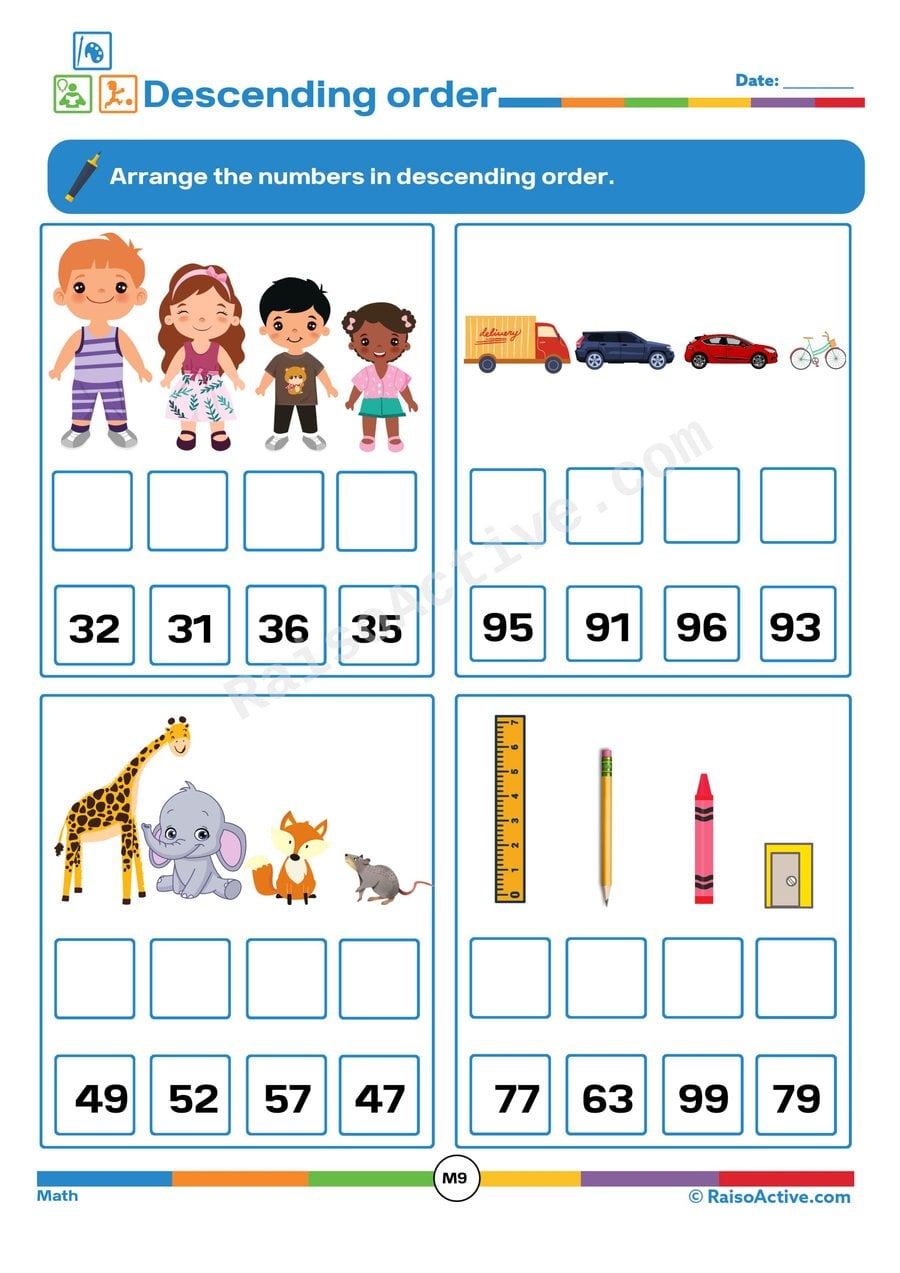
Descending Order Worksheet: Numbers 31-99
Ages 4-6 · Pre-K–KindergartenAges 4-6 · Reception–Year 1Ages 4-6 · LKG–UKGAges 4-6
This worksheet extends number-sequencing skills for children ages 4-6 into the two-digit range of 31 to 99, asking them to arrange given numbers from largest to smallest. Working with larger numbers requires understanding that the tens digit generally determines size first, an important step toward place-value thinking. Practicing descending order, which is less intuitive than counting up, also strengthens flexible number sense.

Blend Words Matching Worksheet: Read and Circle the Picture!
Ages 4-6 · Pre-K–KindergartenAges 4-6 · Reception–Year 1Ages 4-6 · LKG–UKGAges 4-6
This worksheet gives children ages 4-6 further practice reading consonant blend words and connecting them to their matching picture, this time by circling rather than cutting and pasting, which keeps the focus purely on reading and visual scanning. Repeated blend practice across different formats — matching, circling, and later independent writing — helps these two-consonant sounds become automatic rather than something a child has to sound out every time.

Number Names Worksheet: Addition Practice for Kids
Ages 4-6 · Pre-K–KindergartenAges 4-6 · Reception–Year 1Ages 4-6 · LKG–UKGAges 4-6
This worksheet combines addition practice with number-word writing for children ages 4-6, asking them to solve simple addition problems and then spell out the answer using its written name rather than a numeral. Requiring the answer in word form pushes children beyond calculation into applying number vocabulary correctly, reinforcing that 'seven' and '7' represent the same value. This dual task builds both math fluency and early spelling skills together.

Weather Worksheet: Circle the Correct Weather Word!
Ages 3-5 · Preschool–Pre-KAges 3-5 · Nursery–ReceptionAges 3-5 · Nursery–LKGAges 3-5
This worksheet strengthens children's early reading skills by having them match weather pictures — like sun, rain, or wind — to the correct written word, building sight recognition of common weather vocabulary for ages 3-5. Circling the matching word rather than just naming the picture aloud pushes children to connect spoken language with printed text, an essential pre-reading skill. Because weather words appear frequently in books and daily conversation, this practice has immediate real-world payoff.
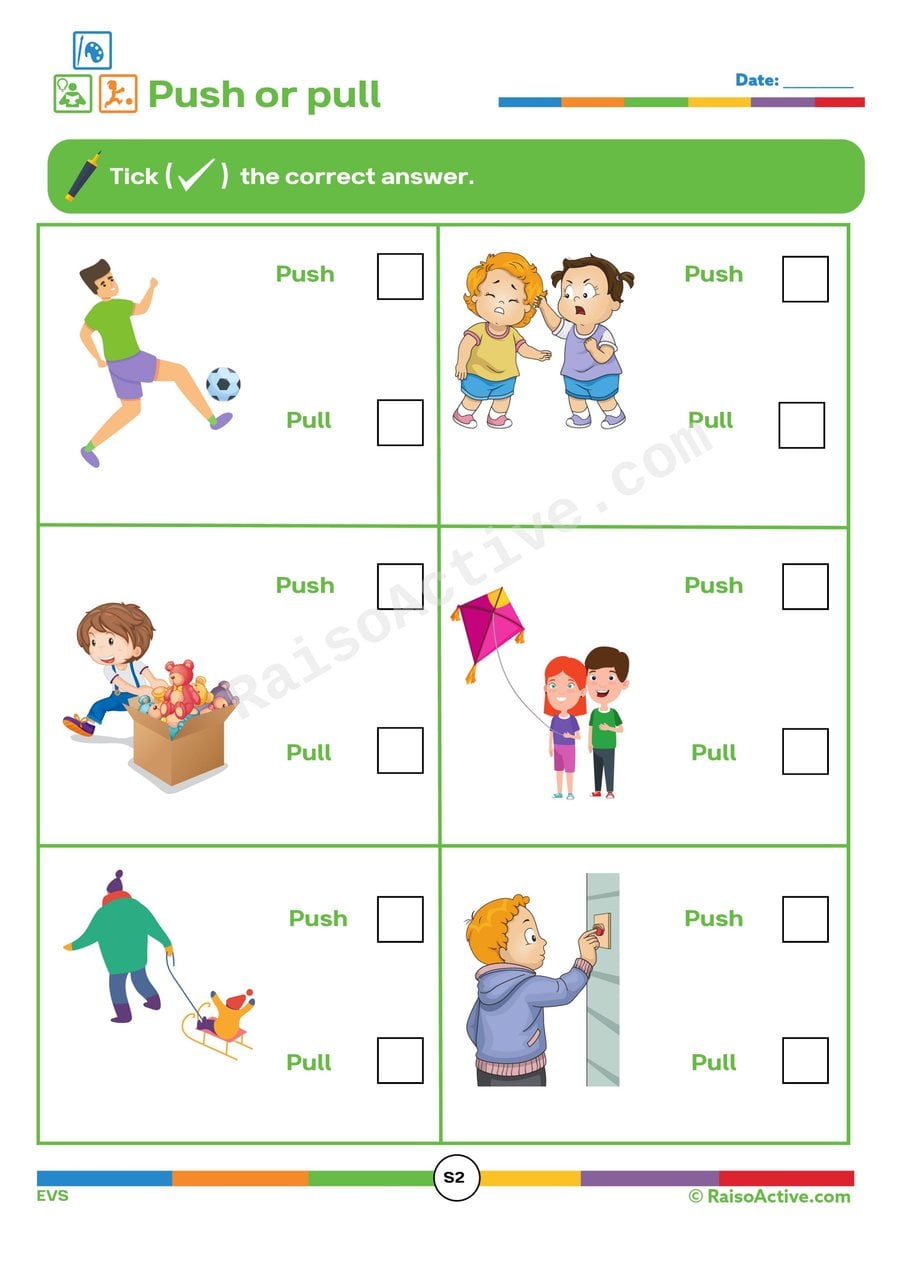
Push or Pull Worksheet: Identify Actions!
Ages 3-5 · Preschool–Pre-KAges 3-5 · Nursery–ReceptionAges 3-5 · Nursery–LKGAges 3-5
Deciding whether an action shown in a picture is a push or a pull introduces children ages 3-5 to a basic physics concept, force and motion, by having them classify everyday actions like opening a door or pulling a wagon. This early science reasoning requires children to picture the direction an object is moving relative to the person acting on it, which builds spatial thinking alongside scientific vocabulary. Learning to categorize actions this way is a first step toward understanding cause and effect in the physical world.
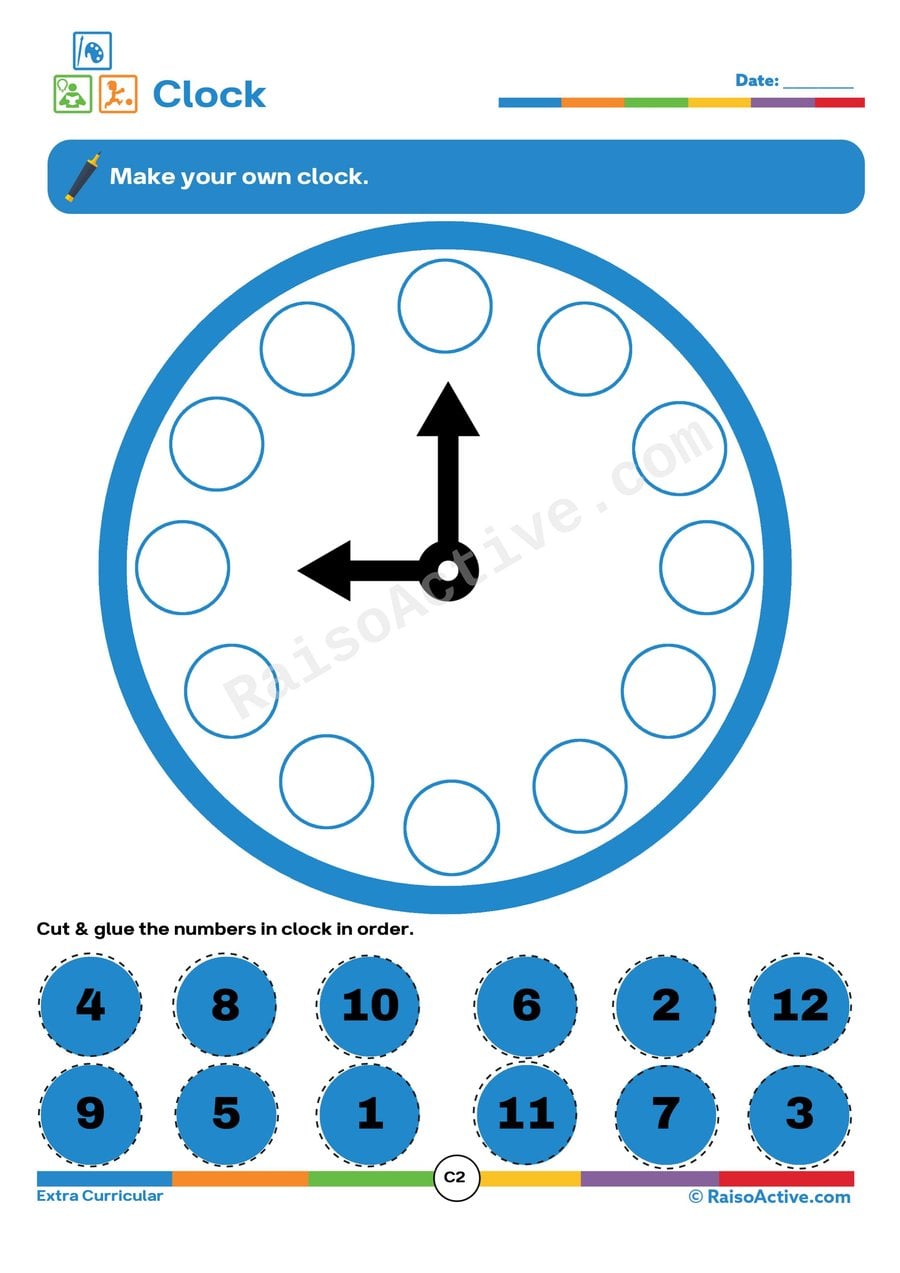
Make Your Own Clock Worksheet: Time Telling Fun!
Ages 4-6 · Pre-K–KindergartenAges 4-6 · Reception–Year 1Ages 4-6 · LKG–UKGAges 4-6
This hands-on craft has children ages 4-6 cut out and glue numbers in order around a clock face, then draw hands to show different times, combining number sequencing with an introduction to how an analog clock is structured. Physically placing each number themselves, rather than reading a pre-printed clock, helps children internalize why the numbers 1 through 12 are arranged in that specific circular order. Drawing the hands afterward extends the activity from static number placement into functional time-telling practice.
Related worksheets

Sight Words Worksheet: Practice with 'is', 'we', and 'my'
Ages 4-6 · Pre-K–KindergartenAges 4-6 · Reception–Year 1Ages 4-6 · LKG–UKGAges 4-6
This worksheet challenges children ages 4-6 to choose the correct sight word from a small word bank — 'is,' 'we,' or 'my' — to complete a sentence, rather than simply tracing or copying a single word. Selecting the right word based on sentence meaning requires a deeper level of reading comprehension than earlier single-word practice, since children must understand what each sentence is saying before choosing correctly. Writing the chosen word from memory also builds spelling recall for these common words.
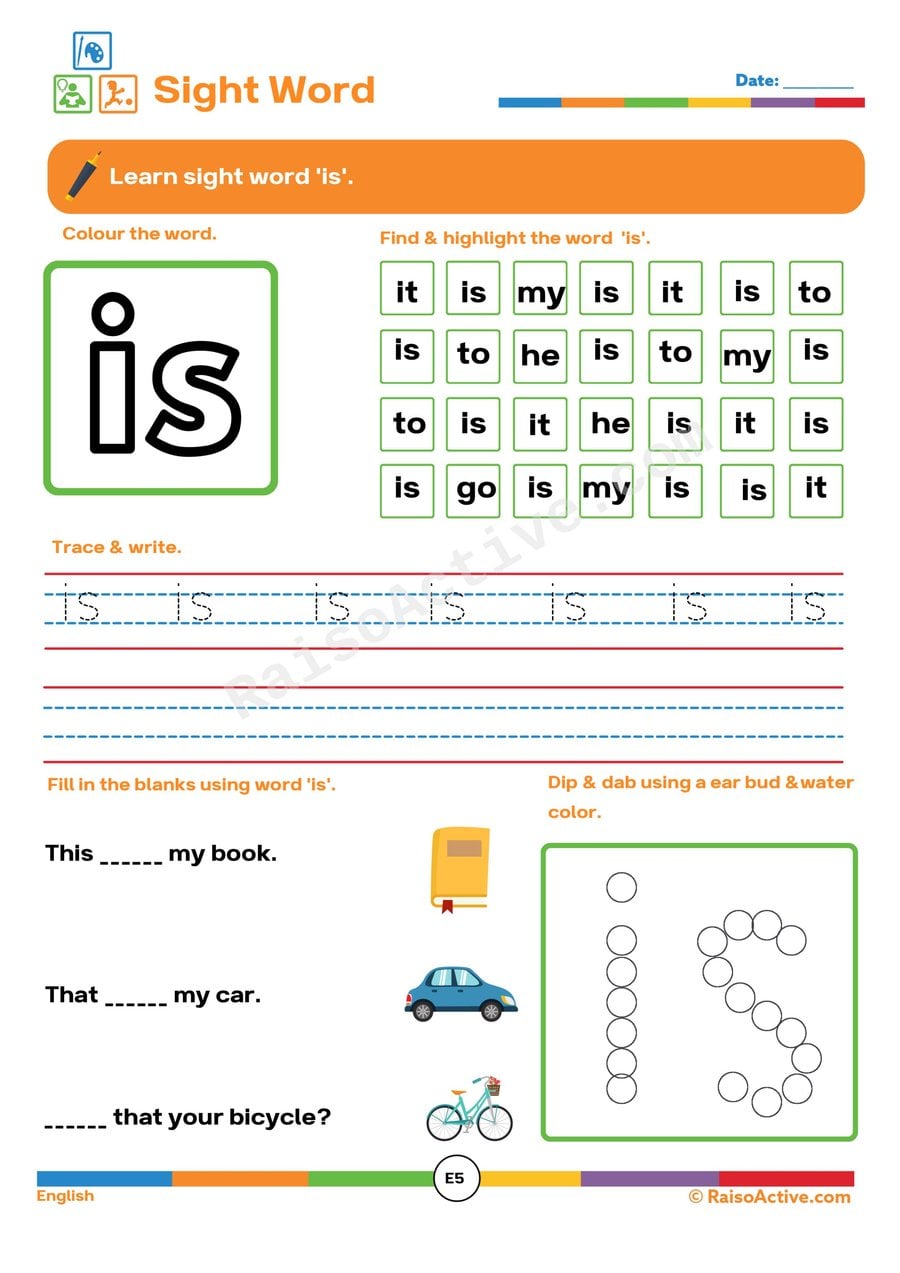
Sight Word 'is' Worksheet: Trace, Find, and Write!
Ages 3-5 · Preschool–Pre-KAges 3-5 · Nursery–ReceptionAges 3-5 · Nursery–LKGAges 3-5
Children ages 3-5 build instant recognition of the high-frequency sight word 'is', practicing it through coloring, tracing, searching, and writing for repeated exposure across multiple formats. As one of the earliest and most common words children encounter in print, quickly recognizing 'is' by sight significantly boosts early reading fluency. Completing fill-in-the-blank sentences also shows children how this small but essential word functions within everyday sentences.

Learn the Sight Word 'Are' Worksheet for Preschoolers
Ages 4-5 · Pre-KAges 4-5 · ReceptionAges 4-5 · LKGAges 4-5
Children ages 4-5 build instant recognition of the high-frequency sight word 'are', a word that doesn't sound out phonetically and must be memorized by sight to support reading fluency. This multi-step worksheet reinforces the word through five different modes — coloring, searching a grid, tracing, writing, and a watercolor technique — giving repeated exposure that strengthens memory. Practicing 'are' in context through fill-in-the-blank sentences also helps children see how the word functions within real sentences.

Sight Word Coloring Worksheet for Preschoolers
Ages 4-7 · Pre-K–Grade 1Ages 4-7 · Reception–Year 2Ages 4-7 · LKG–Class 1Ages 4-7
This worksheet helps children recognize and read common sight words while practicing their coloring skills.

Learn to Read: Sight Word 'Hear' Worksheet for Preschoolers
Ages 3-5 · Preschool–Pre-KAges 3-5 · Nursery–ReceptionAges 3-5 · Nursery–LKGAges 3-5
'Hear' is a sight word children ages 3-5 encounter often in early books, and its spelling doesn't clearly match its sound, so children need repeated exposure to recognize it instantly rather than sound it out each time. This worksheet reinforces the word through five different activities — coloring, searching, tracing, sentence completion, and cut-and-paste spelling — which research on early literacy shows builds much stronger retention than repeating a single format. Because 'hear' is often confused with the similar-sounding word 'here,' practicing it in full sentences also helps children start to notice the meaning difference between the two.

Learn the Sight Word 'Is' - Tracing and Writing Worksheet for Preschoolers
Ages 4-5 · Pre-KAges 4-5 · ReceptionAges 4-5 · LKGAges 4-5
This worksheet helps children ages 4-5 build instant recognition of the sight word 'is' through a layered sequence of tracing, independent writing, sentence fill-in, coloring, and letter-order cut-and-paste practice. Because 'is' can't easily be sounded out using typical phonics rules, repeated multi-format exposure like this is exactly what helps a sight word move into a child's automatic reading vocabulary. Using the word inside real sentence blanks also connects the isolated word to meaningful, functional reading.

Read and Match: Sight Word Sentences Worksheet for Early Readers
Ages 4-5 · Pre-KAges 4-5 · ReceptionAges 4-5 · LKGAges 4-5
Children ages 4-5 practice reading simple sight-word sentences and matching them to the picture that shows their meaning, building early reading comprehension by connecting printed words directly to what they represent. This bridges the gap between recognizing individual sight words and understanding a full sentence's meaning.

Sight Word 'Went' Worksheet for Preschoolers: Tracing, Matching, and Sentence Completion
Ages 3-5 · Preschool–Pre-KAges 3-5 · Nursery–ReceptionAges 3-5 · Nursery–LKGAges 3-5
The word 'went' doesn't sound out predictably using standard phonics rules, so children ages 3-5 need to memorize it by sight as a whole word — a key early reading strategy for common, frequently used words. This worksheet reinforces that sight-word memory through several different formats — tracing, word-hunting, letter connecting, and sentence completion — giving repeated exposure without it feeling like a single repetitive drill. Mastering high-frequency words like 'went' significantly speeds up reading fluency, since these words appear constantly in early books.
Guides for this topic

Sight Words by Age: The First 50 Words and How to Teach Them Without Flashcard Fatigue
Which sight words to teach first and why, the heart-word method, a read-trace-write-find routine, games, and a by-age table of typical sight-word progress.
How to Teach CVC Blending: A Step-by-Step Method That Works in Two Weeks
A step-by-step method for teaching CVC blending, covering continuous sounds, word families, common errors, and a 14-day plan that most children finish reading CVC words.

Best Worksheets for 3-Year-Olds: What Works and What to Avoid
What works on worksheets for 3-year-olds: short sessions, crayons, tracing lines, matching, cutting, a free weekly plan, and signs one is too advanced.
Reviews
Every worksheet for ages 3–5, no watermark
Members download the full library of 1,000+ worksheets and every activity pack without watermarks or daily limits. One year costs ₹999 in India or $20 elsewhere.
See membership plansOr download any worksheet free with a watermark (5 a day).