Puzzles, clues and codes
Critical Thinking Worksheets for Kids (Ages 5–10)
Follow the clues, crack the code and explain how you know.
- Who?
- What?
- Why?
- How do you know?
Printable activity packs
Critical thinking activity packs, by age
Two 24-page mystery activity books, one for each age group: Puzzle Detectives for ages 7 to 8 and Mastermind Academy for ages 9 to 10. Each has a certificate and an answer key, in colour and ink-saver black-and-white editions.
Puzzle Detectives (ages 7–8)
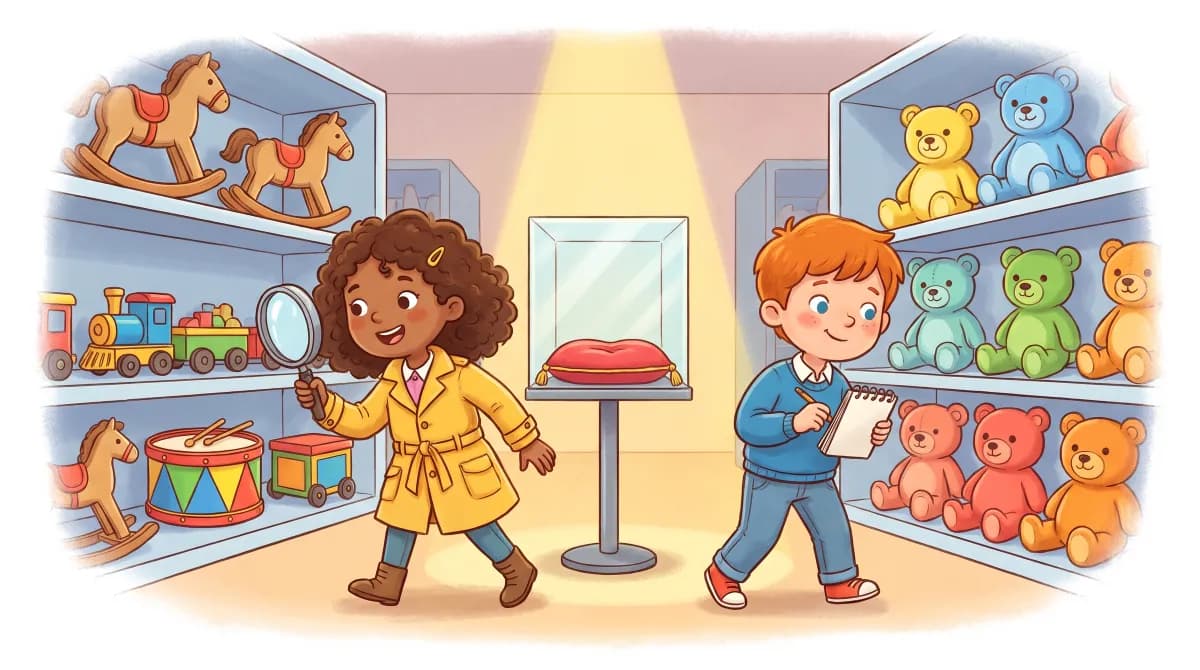
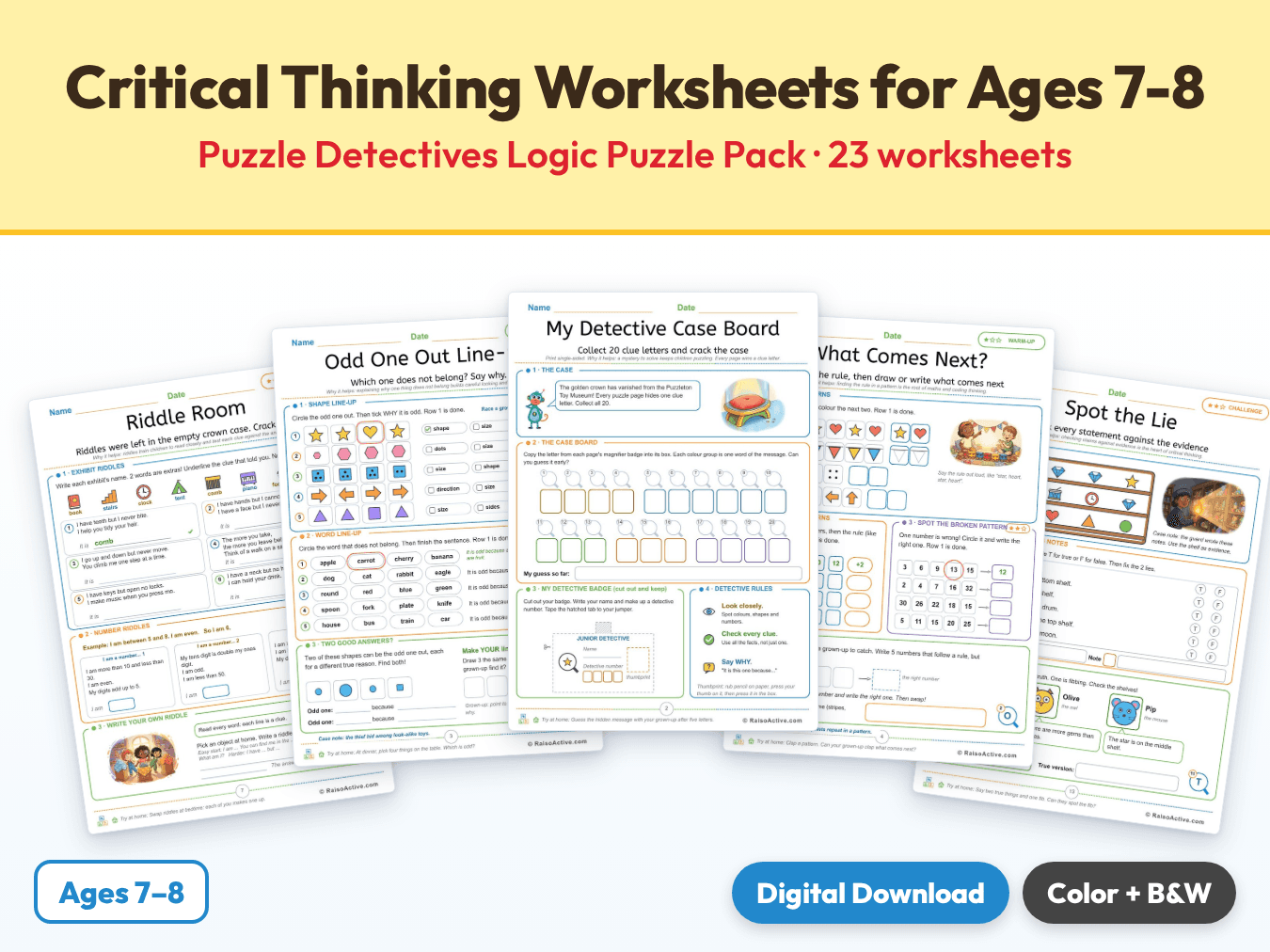
The golden crown has vanished from the Puzzleton Toy Museum. Twenty puzzle pages, each hiding one clue letter: logic grids, Sudoku, codes, riddles and a cut-out code wheel, ending with a certificate and an answer key. Colour and black-and-white editions.
Logic & codingCritical Thinking Worksheets for Ages 7-8: Puzzle Detectives Logic Puzzle Pack
Ages 7-8 · Grade 2Ages 7-8 · Year 3Ages 7-8 · Class 2Ages 7-8 · 24 pages
Ages 6-7 | Grade 1 or Full Access Free
My Detective Case Board: Clue Tracker and Junior Detective Badge
Ages 7-8 · Grade 2Ages 7-8 · Year 3Ages 7-8 · Class 2Ages 7-8
Critical ThinkingPuzzlesChildren meet the case of the vanished golden crown and see how a mystery is solved one clue at a time. They set up a case board with 20 letter boxes, make a cut-out detective badge with their own thumbprint, and learn three detective rules: look closely, check every clue, and say why.
NewDownload Free → Free
Odd One Out Worksheet: Shape and Word Line-ups for Ages 7-8
Ages 7-8 · Grade 2Ages 7-8 · Year 3Ages 7-8 · Class 2Ages 7-8
Odd One OutCritical ThinkingChildren find the one item that does not belong in rows of shapes and words, then say exactly why: a different shape, size, number of sides, dots or direction. A final section shows that some rows have two good answers, as long as each answer has a true reason.
NewDownload Free → Free
What Comes Next? Pattern and Number Sequence Worksheet for Ages 7-8
Ages 7-8 · Grade 2Ages 7-8 · Year 3Ages 7-8 · Class 2Ages 7-8
PatternsNumber SequenceChildren crack the rule behind shape patterns (repeating, growing and turning) and number sequences (adding 2, adding 5, taking away 3 and doubling), then write the rule in their own words. They also catch a deliberately broken pattern and fix the mistake.
NewDownload Free → Free
Number Path Puzzle and Robot Arrow Code Worksheet: The Laser Hall
Ages 7-8 · Grade 2Ages 7-8 · Year 3Ages 7-8 · Class 2Ages 7-8
LogicProblem SolvingChildren follow a number rule (each step is exactly 3 more) to find the only safe path through a grid of tiles, avoiding dead ends. They then trace a guard robot's arrow code to see where it stops, and write a code of their own to move it somewhere else.
NewDownload Free → Free
The Sudoku Safe: Picture Sudoku and 4x4 Number Sudoku Puzzle
Ages 7-8 · Grade 2Ages 7-8 · Year 3Ages 7-8 · Class 2Ages 7-8
SudokuLogicChildren solve a 4x4 picture Sudoku using crown, gem, key and vase tiles, then use each treasure's number to read the safe's code. A second 4x4 number Sudoku opens a second lock. Both puzzles teach 'use what you know to find what you do not know'.
NewDownload Free → Free
Riddles for Kids Worksheet: Exhibit Riddles, Number Riddles and Write Your Own
Ages 7-8 · Grade 2Ages 7-8 · Year 3Ages 7-8 · Class 2Ages 7-8
RiddlesBrain TeasersChildren read short riddles closely, test each clue against a word bank (two words are extras), and underline the clue that gave the answer away. Number riddles use clues about size, even or odd and digit sums to find one number. Finally they write a riddle about an object at home.
NewDownload Free → Free
The Suspect Line-up: Deduction Puzzle With Cut-out Suspect Cards
Ages 7-8 · Grade 2Ages 7-8 · Year 3Ages 7-8 · Class 2Ages 7-8
LogicDeductive ReasoningChildren use evidence, not guessing. Each of six animal suspects has facts on its card. Reading the clues one at a time, children turn cards face down when a clue rules a suspect out, until one is left. They then work out which clue was not needed.
NewDownload Free → Free
Pairs That Belong: Shape and Word Analogies Worksheet
Ages 7-8 · Grade 2Ages 7-8 · Year 3Ages 7-8 · Class 2Ages 7-8
AnalogiesCritical ThinkingChildren see the link inside a first pair, then pick the choice that makes the same link in a second pair. They start with shapes (size, dots, direction), move to word pairs (home, opposite, young and adult, use) and name the link in words. A cut-out card game lets them build one of their own.
NewDownload Free →
Mastermind Academy (ages 9–10)
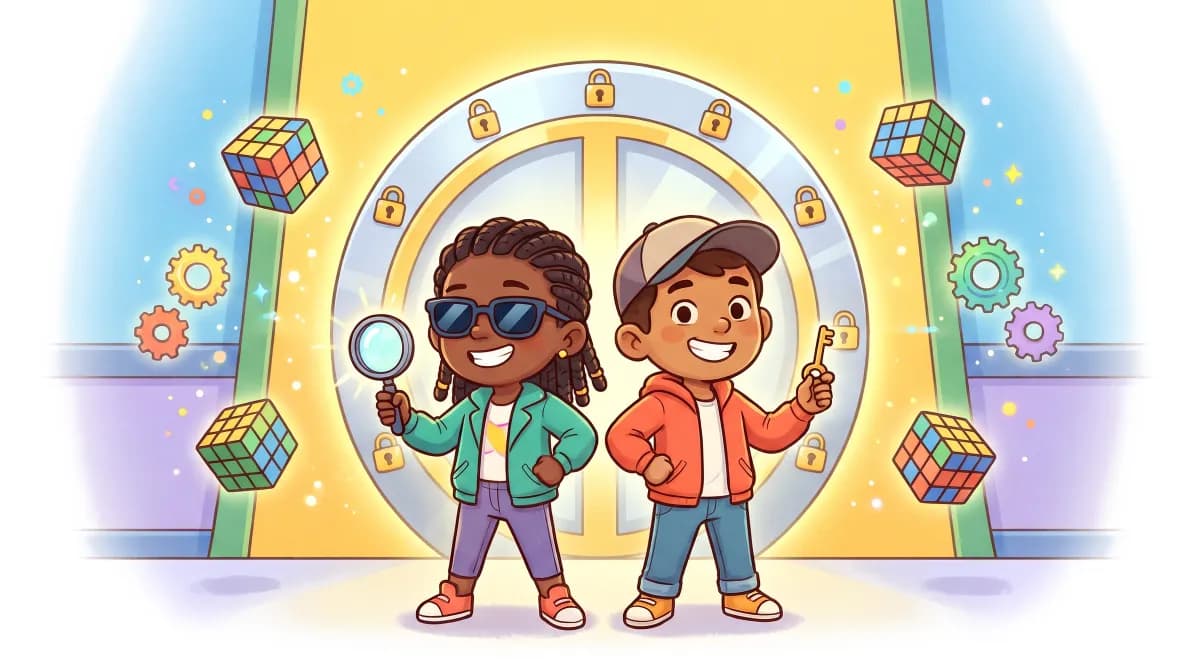
Professor Yogi's Vault has 20 locks, and each one opens with a puzzle: logic grids, code-breaking, Calcudoku, Sudoku variants, truth-teller puzzles, fair tests and a debate. A step up in difficulty, with a certificate and an answer key. Colour and black-and-white editions.
Logic & codingCritical Thinking Worksheets for Ages 9-10: Mastermind Academy Logic Puzzle Pack
Ages 9-10 · 24 pages
 Free
Agent ID and the Vault: Mastermind Academy Mission Tracker
Ages 9-10
Critical ThinkingPuzzlesChildren meet Professor Yogi and the 20-lock Vault, the goal of the whole pack. They make a fold-over Agent ID card, invent a codename with a simple two-table rule, and learn how to track their missions by colouring a padlock after each puzzle page.
NewDownload Free → Free
Odd One Out: Defend It. Reasoning Worksheet for Ages 9-10
Ages 9-10
Odd One OutCritical ThinkingChildren find an odd one out among numbers, shapes and words, then write a reason that is true for exactly one item. In two harder sets every item is odd for a different reason. A defence court asks them to judge which of two agents has the stronger argument.
NewDownload Free → Free
Sequence Lab: Number and Shape Sequences, Find the Rule and the Error
Ages 9-10
Number SequencePatternsChildren go beyond adding the same number each time. They identify square and triangular numbers, a Fibonacci-style rule and a woven sequence, draw shapes that turn and gain a dot each step, see why 1, 2, 4 can continue in two valid ways, and find the wrong term in a sequence.
NewDownload Free → Free
Code-Breaker: Printable Secret Code Logic Game for Two Players
Ages 9-10
LogicDeductive ReasoningChildren play a classic deduction game on paper. The codemaker hides four different symbols and the codebreaker guesses, using pegs that show right symbol, right place or right symbol, wrong place. Training puzzles prove only one code fits the clues, then a game board and flap let two agents play for real.
NewDownload Free → Free
The Science Fair Logic Grid: Four Inventors, Four Projects, Four Prizes
Ages 9-10
LogicLogical ReasoningChildren match four inventors to four projects and four prize places using six clues, including negative clues, an either-or clue and an ordering clue. The stair-shaped grid links all three groups, and every clue is needed to reach the single answer.
NewDownload Free → Free
Analogy Agents: Word and Number Analogies Worksheet for Ages 9-10
Ages 9-10
AnalogiesCritical ThinkingChildren name the link in an analogy: part and whole, opposite, young and grown-up, tool and job, place and worker, or cause and effect. They apply it to word pairs, then to number pairs such as 3 to 9 and 5 to 25, and finally build analogies of their own.
NewDownload Free → Free
The Pigpen Cipher: Make a Decoder Card and Read the Secret Motto
Ages 9-10
Codes and CiphersCritical ThinkingChildren learn a symbol cipher that is hundreds of years old. They make a decoder card with four grids, read the Academy motto and two other messages, then write a secret message in pigpen symbols for a grown-up to crack.
NewDownload Free → Free
Calcudoku Cages: 4x4 and 5x5 Cage Sudoku for Kids
Ages 9-10
SudokuLogicChildren combine Sudoku with arithmetic. Each cage has a target and a sign: add, take away or multiply. A worked 3x3 example introduces the rules, then a 4x4 and a 5x5 puzzle ask for logic and mental maths together. A warm-up asks which digits fit a cage.
NewDownload Free →
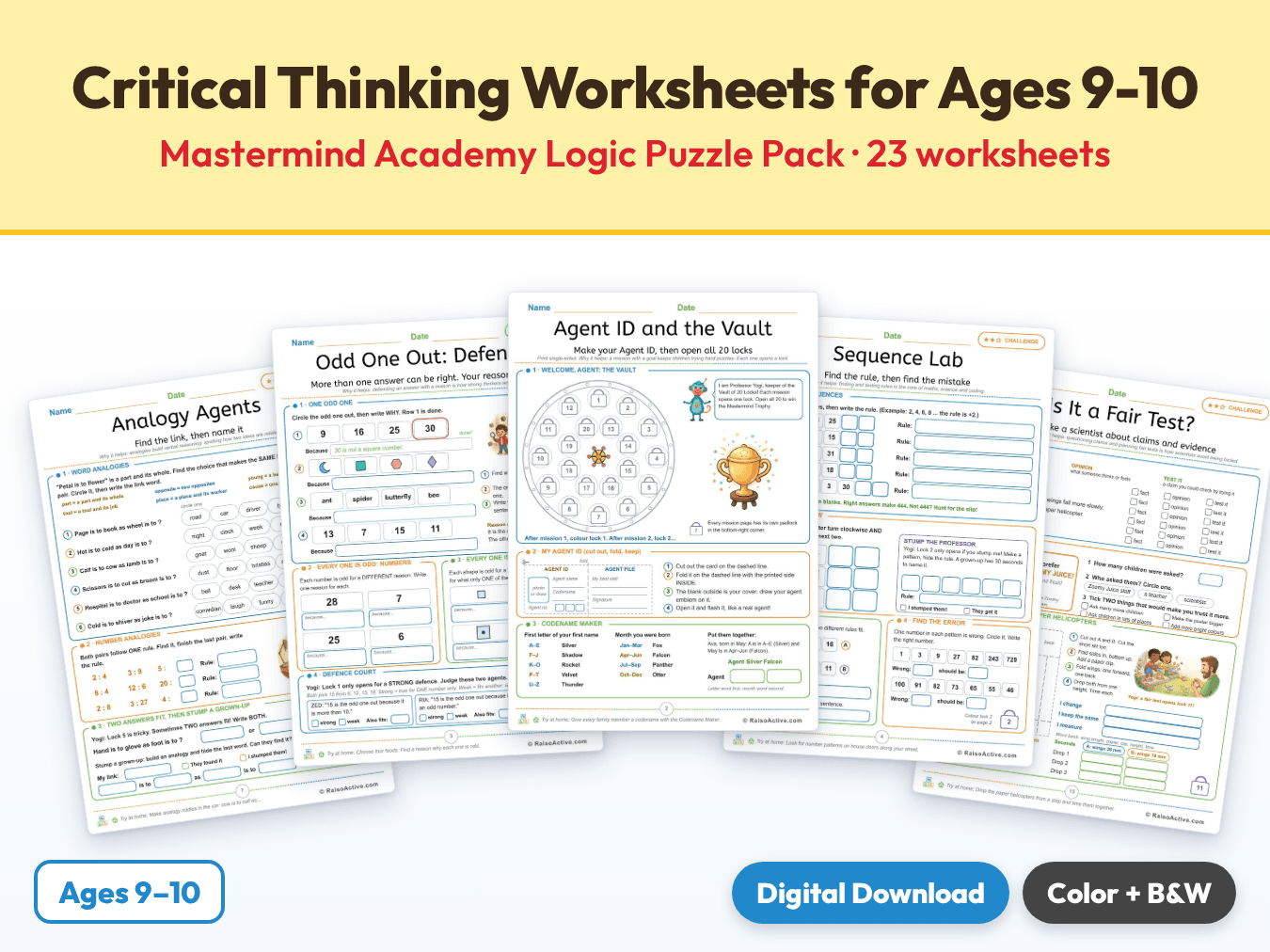
More logic and puzzle packs
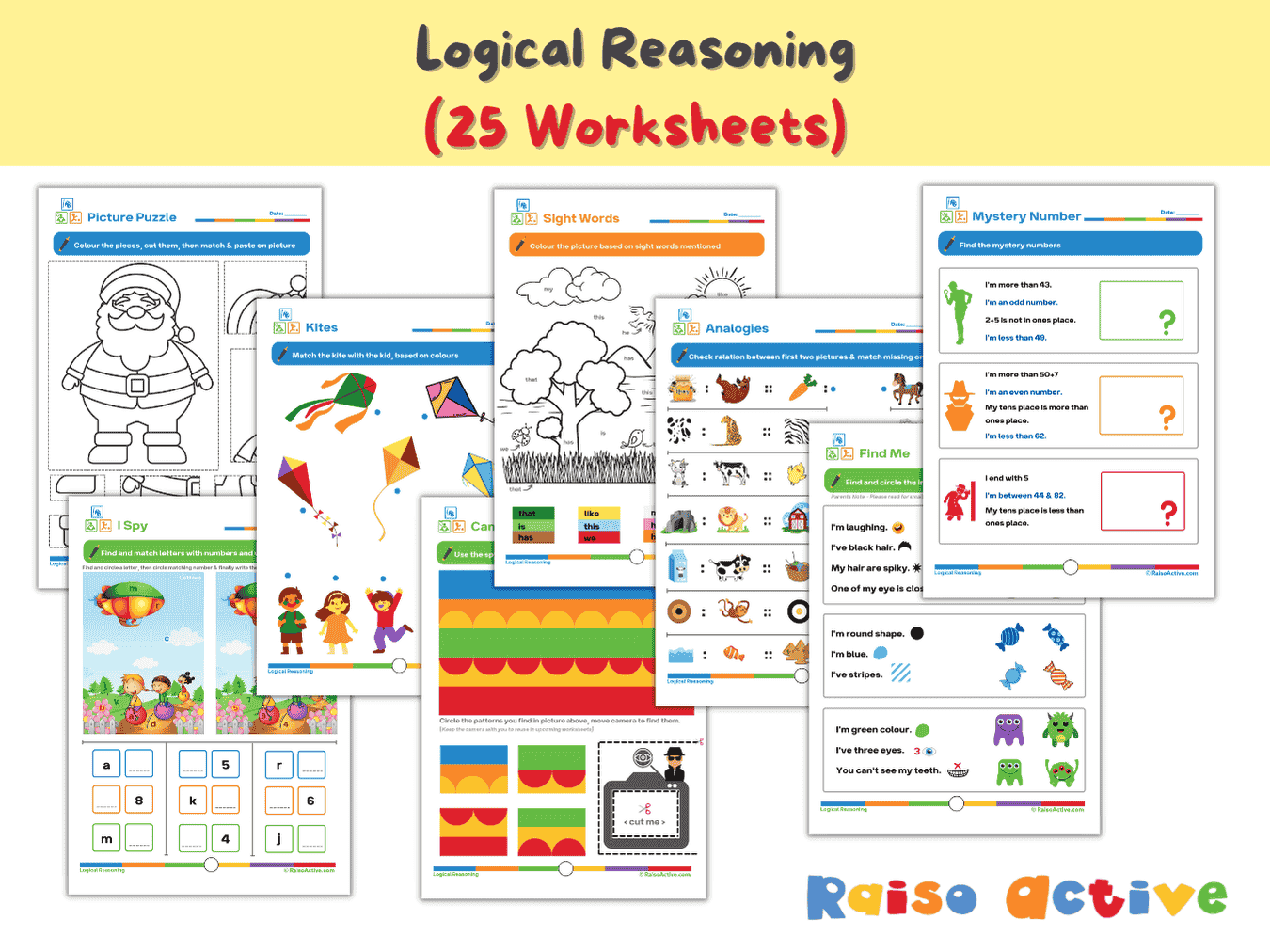
Logical Reasoning Activity Book for Preschool & Kindergarten | Patterns, Sudoku, Mazes & Coding
Ages 4-7 · Pre-K–Grade 1Ages 4-7 · Reception–Year 2Ages 4-7 · LKG–Class 1Ages 4-7 · 34 pages
Critical Thinking Worksheets for Kids to print
Browse all worksheets for ages 5–10
Problem Solvers: Stop, Think, Choose, Try and Matching the Right Calm Tool
Ages 7-10 · Grade 2–Grade 3Ages 7-10 · Year 3–Year 4Ages 7-10 · Class 2–Class 3Ages 7-10
Children use four steps, Stop, Think, Choose and Try, to help Nia after a spill. They match calm tools to places (class, bed, field, shop) and brainstorm three ideas for a friend who wants a different game.

Escape the Storm! A Feelings Escape Room Puzzle Worksheet
Ages 7-10 · Grade 2–Grade 3Ages 7-10 · Year 3–Year 4Ages 7-10 · Class 2–Class 3Ages 7-10
Children solve four mini puzzles (a picture code, ordering by size, counting calm tools and box breathing arithmetic) to get four digits, then check that the digits add up to 20.
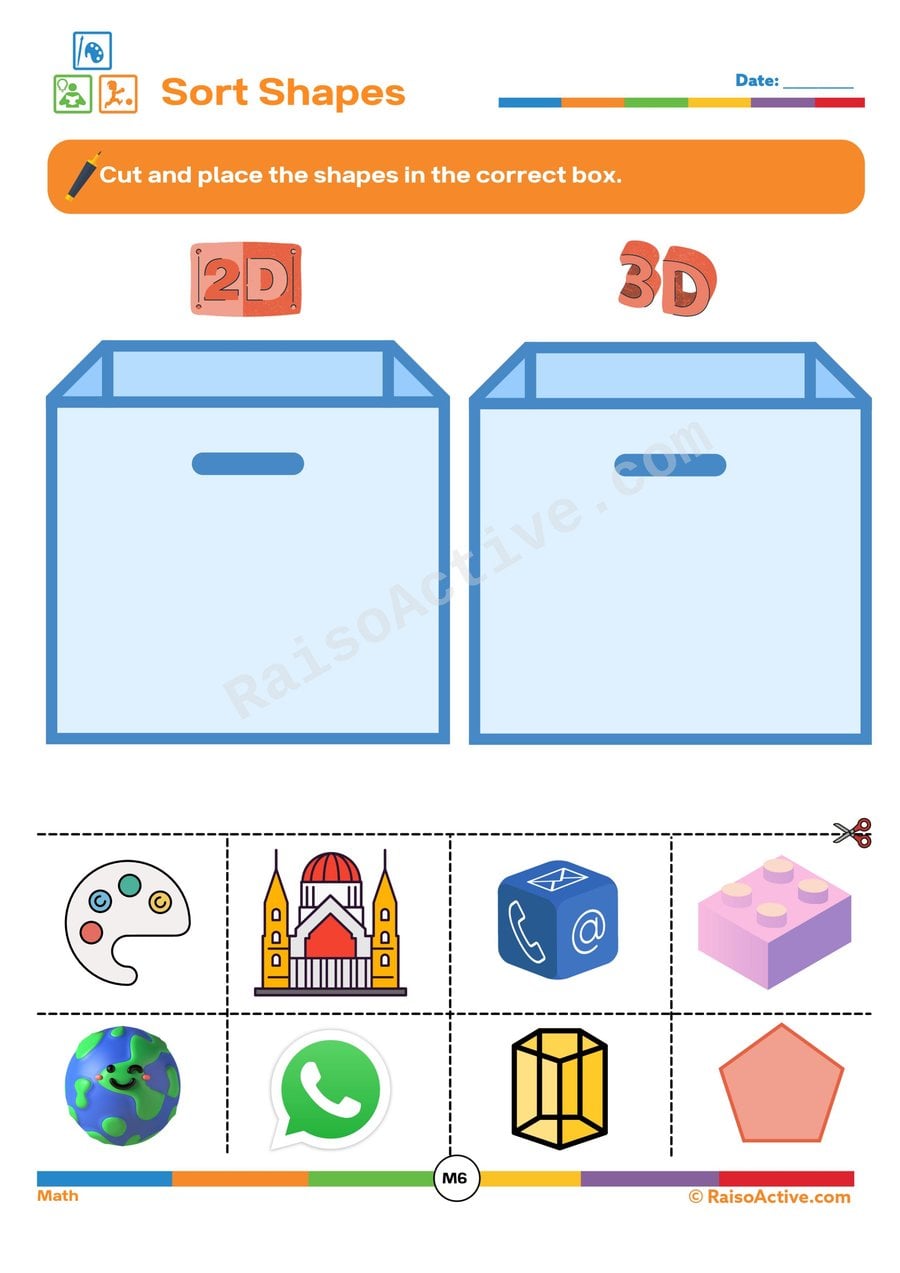
Month 3: Learning & Development | Ages 6-7 - Page 17
Ages 6-7 · Grade 1Ages 6-7 · Year 2Ages 6-7 · Class 1Ages 6-7
As part of a structured monthly learning sequence, this page gives children ages 6-7 continued practice across reading, observation, and critical thinking skills, building on the concepts introduced earlier in the Month 3 program. Working through a numbered page within a longer curriculum also helps children build the stamina and consistency needed for sustained, sequential learning.
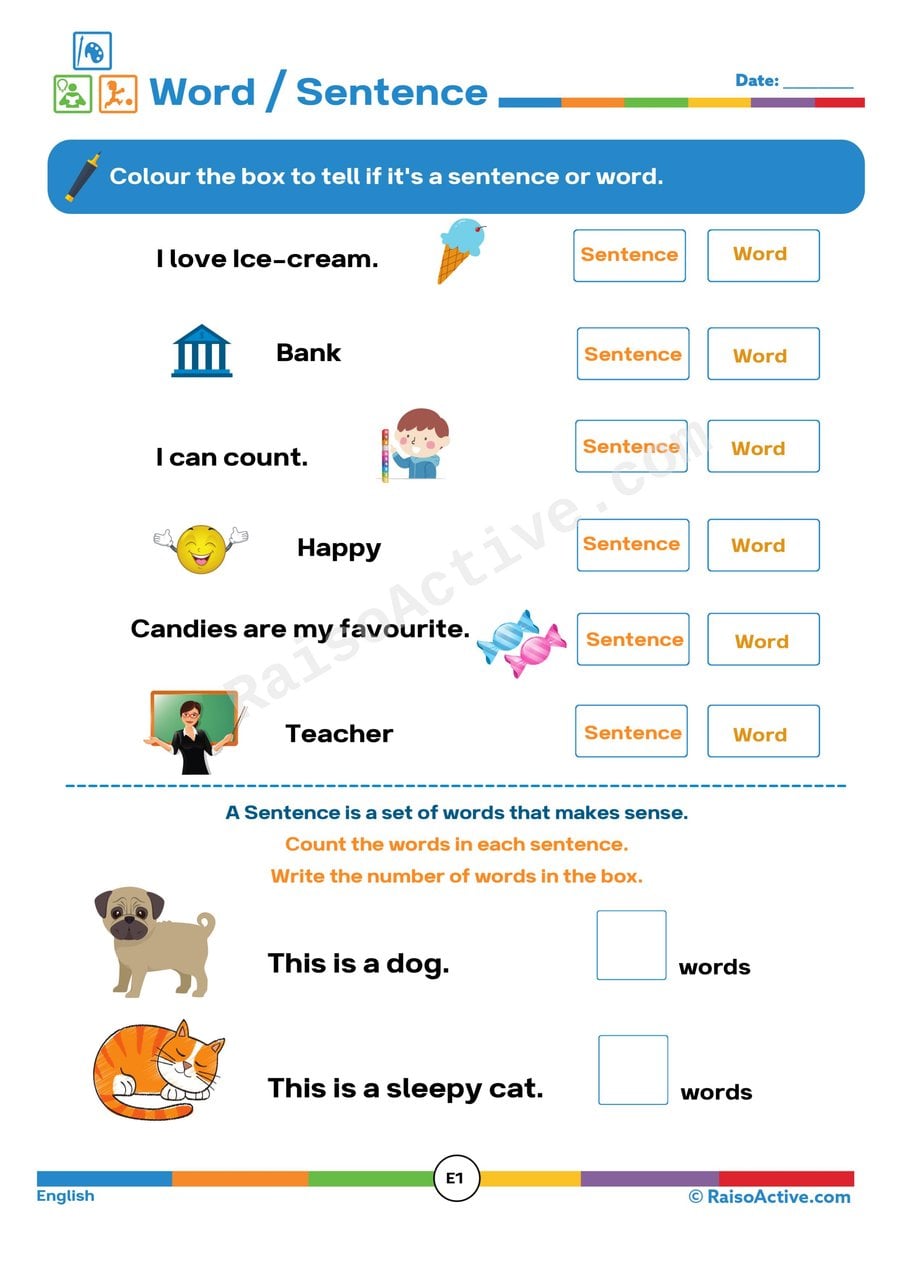
Month 1: Learning & Development | Ages 6-7 - Page 4
Ages 6-7 · Grade 1Ages 6-7 · Year 2Ages 6-7 · Class 1Ages 6-7
This overview page maps out everything covered in Month 1 of the ages 6-7 learning program, giving both children and parents a clear picture of what skills, from reading comprehension to number work to critical thinking, will be practiced across the month. Previewing a table of contents like this helps children ages 6-7 build early organizational awareness, understanding that learning happens in a structured sequence rather than as one-off, disconnected activities. Knowing what's coming also builds anticipation and motivation heading into each week's worksheets.

Feelings Detective Case Files: A Logic Clue Puzzle and Case Notes
Ages 7-10 · Grade 2–Grade 3Ages 7-10 · Year 3–Year 4Ages 7-10 · Class 2–Class 3Ages 7-10
Children use clues to cross out and work out who feels proud, nervous, disappointed or relieved, then read three case notes and decide the feeling and the best clue: face, body or what happened.

Feelings Word Search and Secret Code: Find Ten Words and Crack the Calm Code
Ages 7-10 · Grade 2–Grade 3Ages 7-10 · Year 3–Year 4Ages 7-10 · Class 2–Class 3Ages 7-10
Children find ten feeling words (across, down and diagonal) in a grid, use a symbol key to decode a calm message, and write their own message in code.
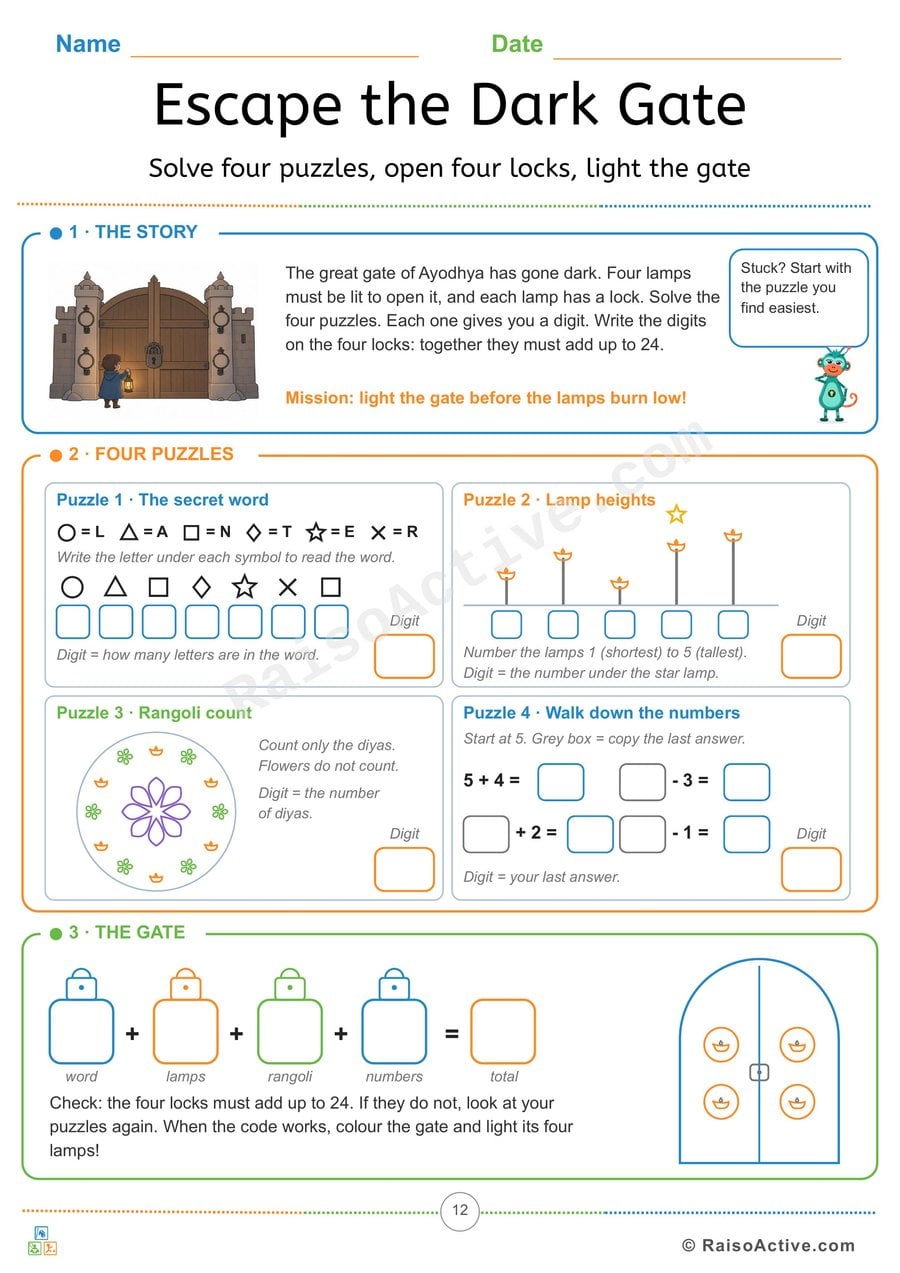
Escape the Dark Gate: Diwali Puzzle Challenge for Big Explorers
Ages 7-10 · Grade 2–Grade 3Ages 7-10 · Year 3–Year 4Ages 7-10 · Class 2–Class 3Ages 7-10
Children solve four puzzles: a secret word, lamp heights, a rangoli count and a number walk. Each gives one digit, and the four digits must add to 24 to open the gate of Ayodhya.
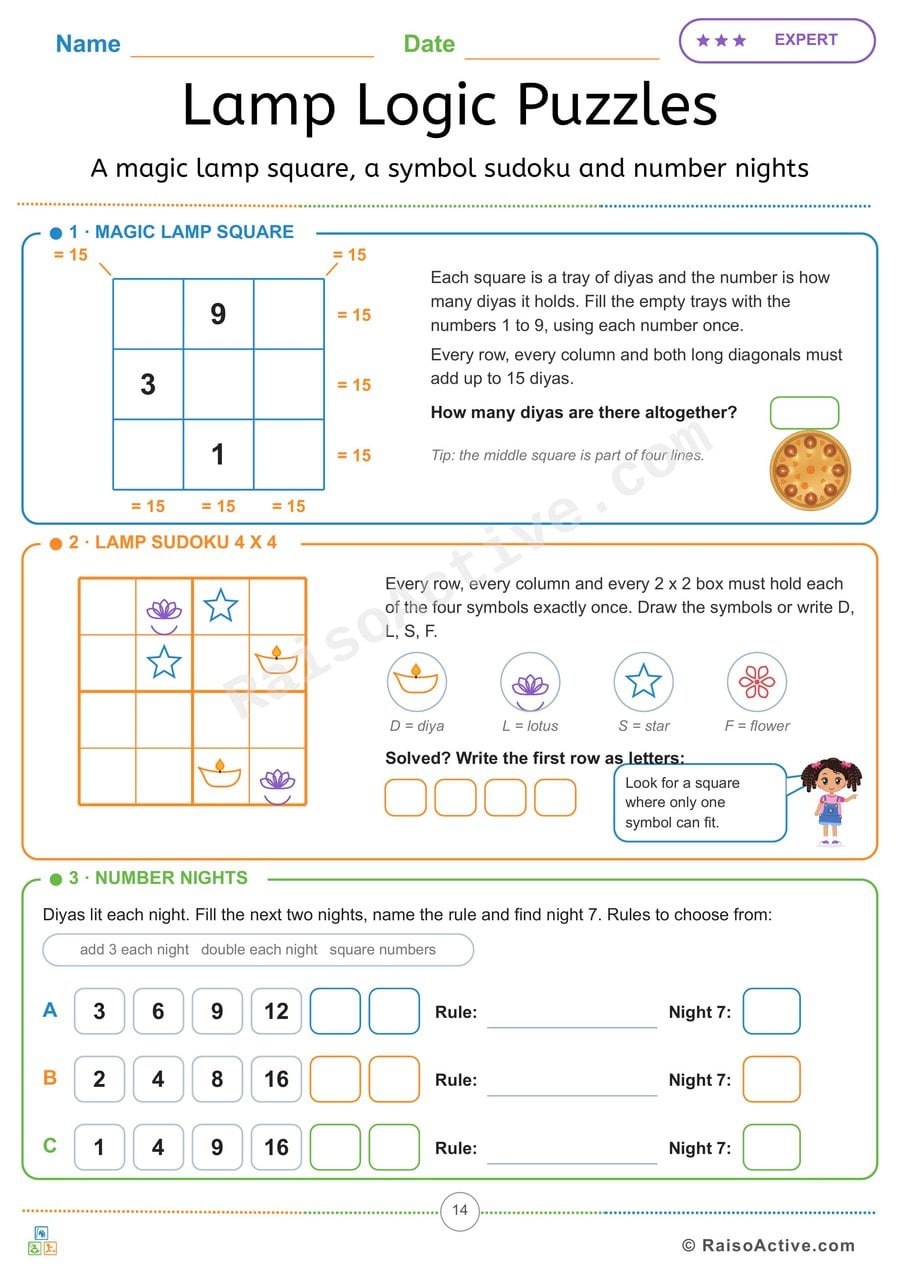
Lamp Logic Puzzles: Magic Square, Sudoku and Number Patterns
Ages 7-10 · Grade 2–Grade 3Ages 7-10 · Year 3–Year 4Ages 7-10 · Class 2–Class 3Ages 7-10
Children fill a magic square so every line adds to 15, solve a 4 by 4 symbol sudoku with diyas, lotuses, stars and flowers, and find the rule and night 7 for three number patterns.
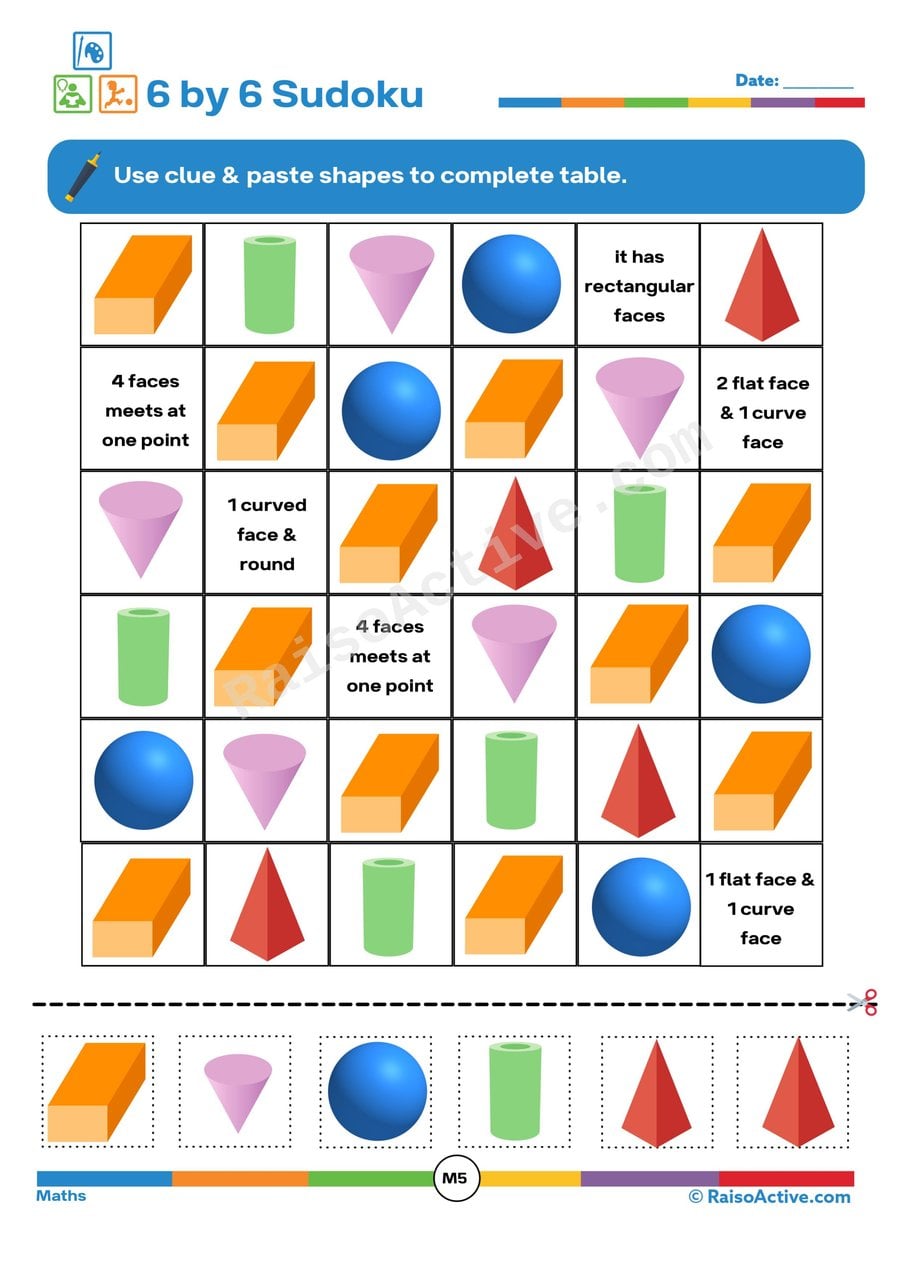
Month 11: Learning & Development | Ages 6-7 - Page 16
Ages 6-7 · Grade 1Ages 6-7 · Year 2Ages 6-7 · Class 1Ages 6-7
This page serves as the table of contents for Month 11 of the Ages 6-7 Learning & Development plan, giving parents and teachers a clear map of the skills and worksheets covered that month, from literacy and math practice to critical thinking activities. Reviewing it first sets expectations for the pacing and variety of learning a 6-7 year old will encounter across the month.
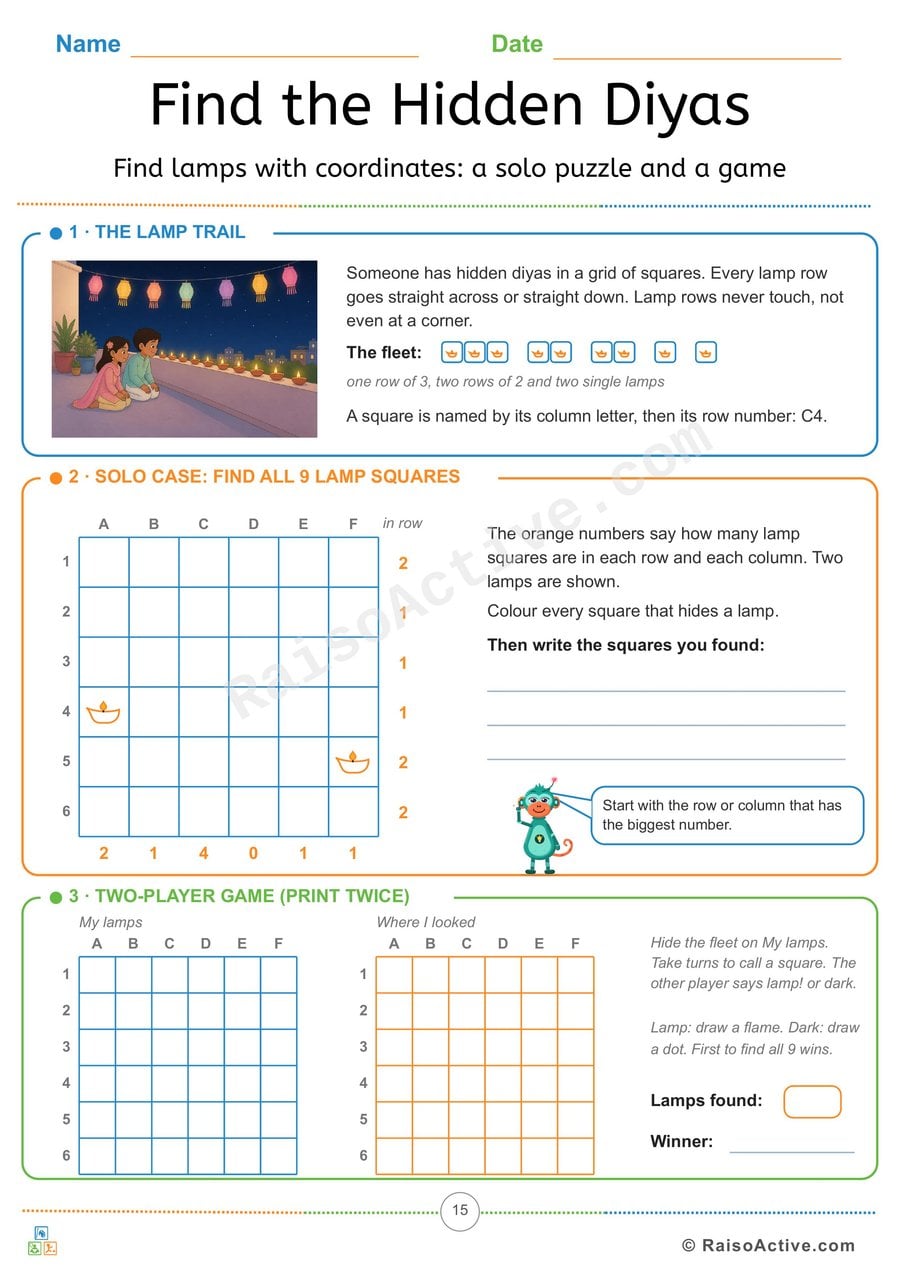
Find the Hidden Diyas: Coordinates Puzzle and Two-Player Game
Ages 7-10 · Grade 2–Grade 3Ages 7-10 · Year 3–Year 4Ages 7-10 · Class 2–Class 3Ages 7-10
Children use row and column clues to find nine hidden lamp squares in a grid, write them with coordinates such as C4, and then play a two-player game to find each other's hidden fleet.
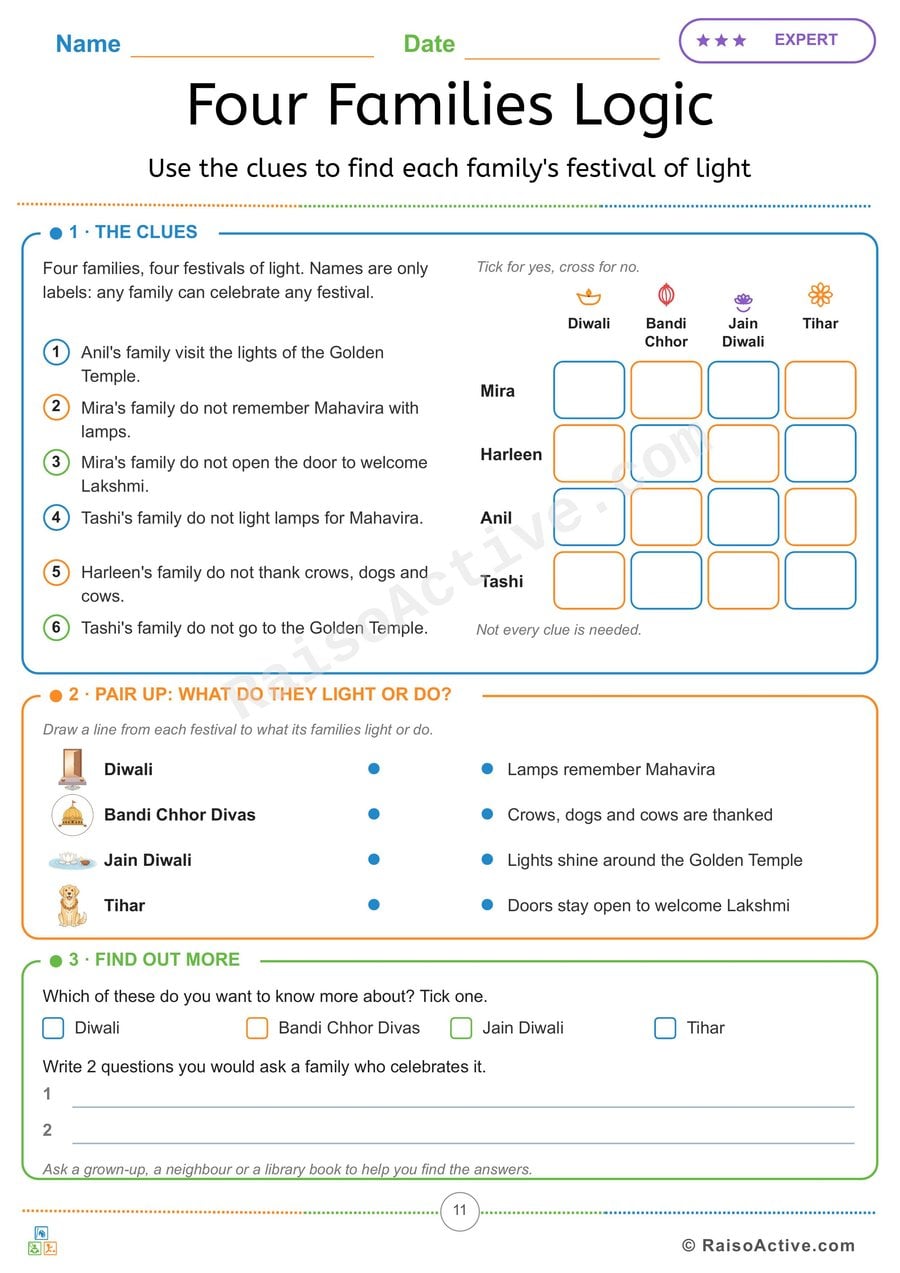
Four Families Logic: Diwali Festivals Logic Grid Puzzle
Ages 7-10 · Grade 2–Grade 3Ages 7-10 · Year 3–Year 4Ages 7-10 · Class 2–Class 3Ages 7-10
Children use six clues to solve a logic grid with four families and four festivals of light, then draw lines to match each festival to what its families light or do and write two questions to ask.
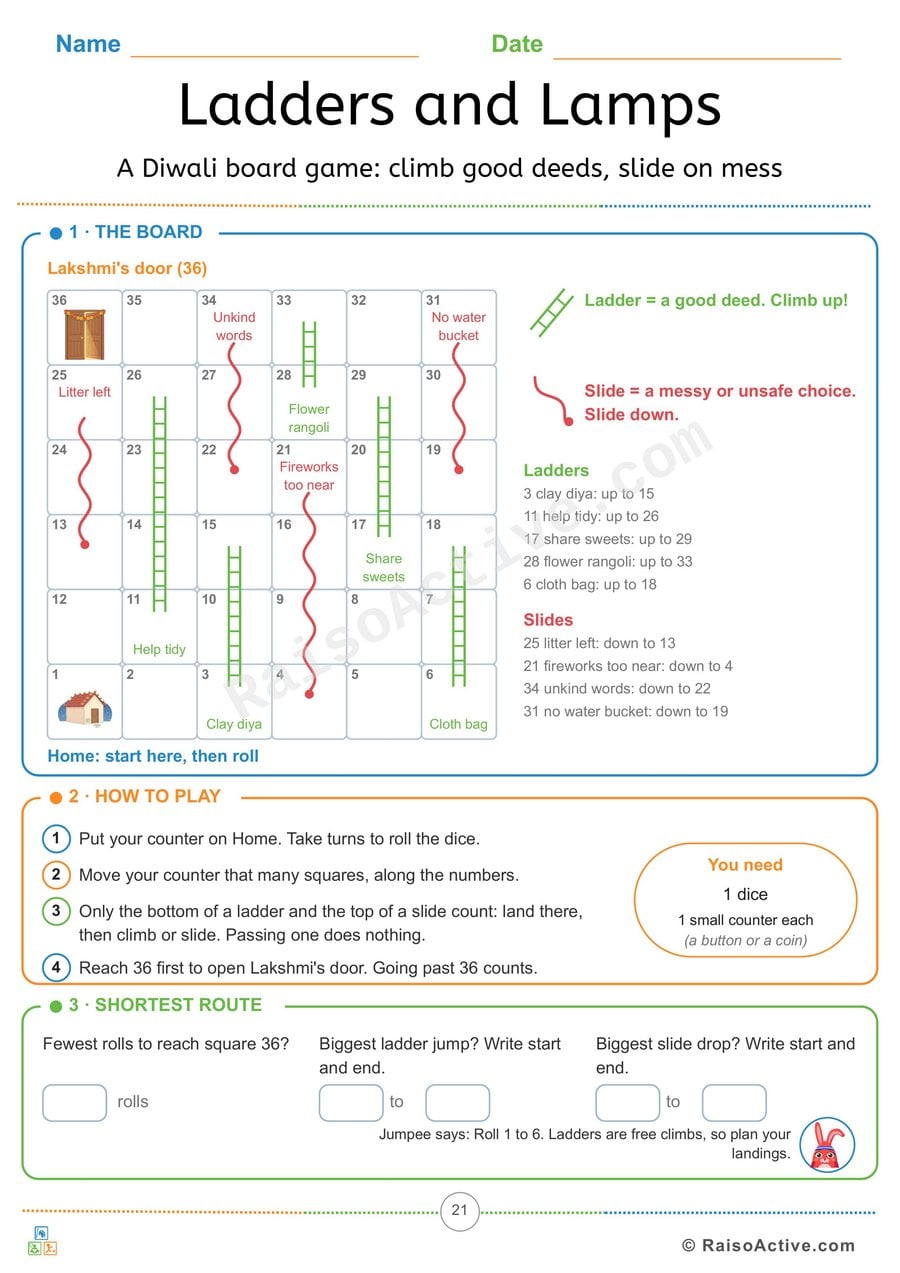
Ladders and Lamps: Diwali Board Game for Kids
Ages 7-10 · Grade 2–Grade 3Ages 7-10 · Year 3–Year 4Ages 7-10 · Class 2–Class 3Ages 7-10
Children play a ladders-and-lamps board game where good deeds like sharing sweets are ladders and messy or unsafe choices are slides, then work out the shortest route and the biggest ladder and slide.

How Big Is It? Feelings Thermometer and Matching the Size of the Reaction
Ages 7-10 · Grade 2–Grade 3Ages 7-10 · Year 3–Year 4Ages 7-10 · Class 2–Class 3Ages 7-10
Children rank five feelings from coolest to hottest, decide whether a problem is small, medium or big and match the size of the reaction, then think of a reaction that fits a small problem.

Inside My Brain: Guard Dog and Wise Owl Hand-Brain Activity
Ages 7-10 · Grade 2–Grade 3Ages 7-10 · Year 3–Year 4Ages 7-10 · Class 2–Class 3Ages 7-10
Children meet two story helpers: the guard dog, who keeps us safe fast, and the wise owl, who thinks and chooses. They make a hand model, sort eight thoughts and choose calm tools that help the owl come back.
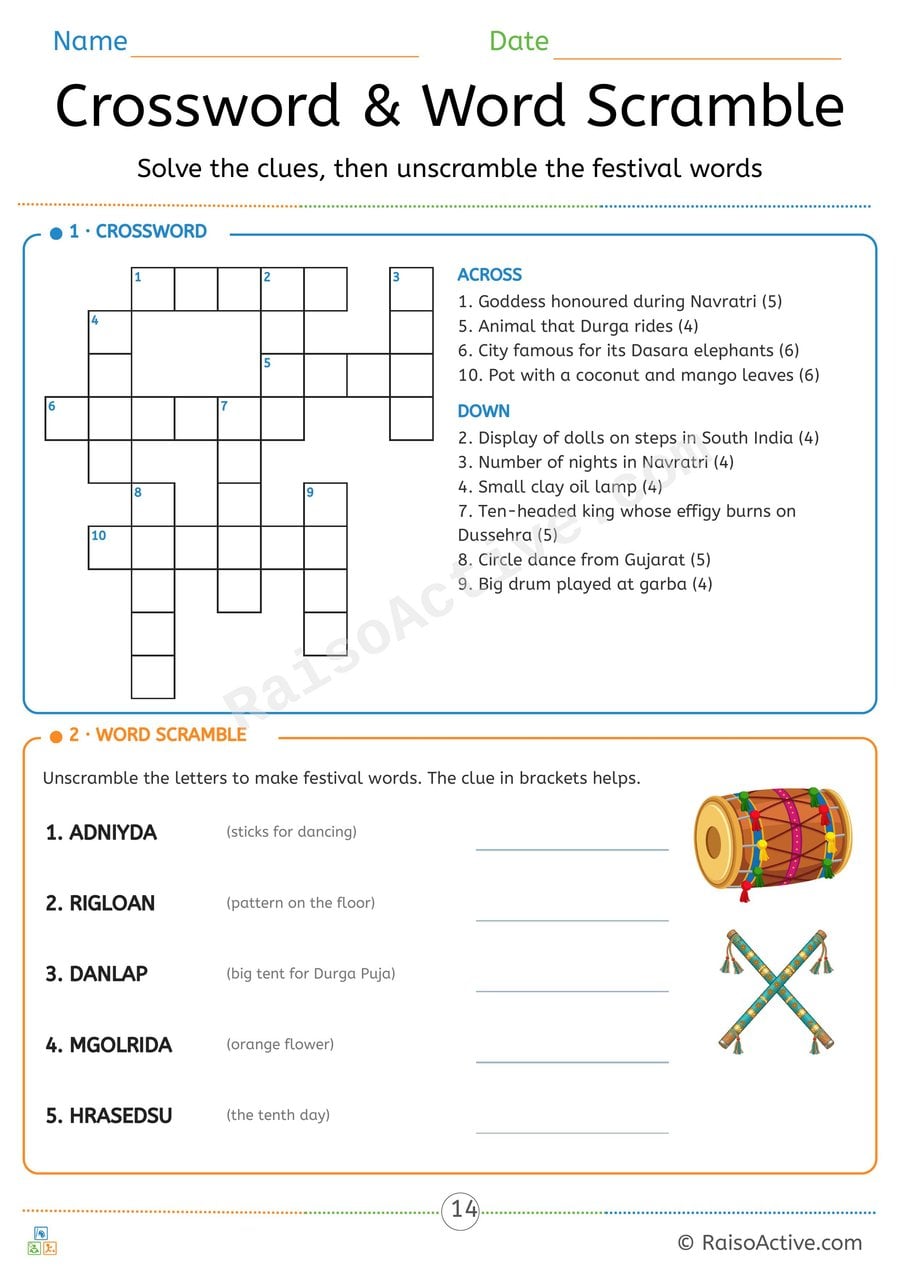
Navratri Crossword and Word Scramble
Ages 7-11 · Grade 2–Grade 3Ages 7-11 · Year 3–Year 4Ages 7-11 · Class 2–Class 3Ages 7-11
Children solve 10 crossword clues about the goddess, the lion, Mysuru, the kalash, Golu, diyas, Ravan, garba and the dhol, and unscramble five festival words with a clue for each.

Possessive Noun Worksheet: Identify and Choose the Correct Form!
Ages 5-7 · Kindergarten–Grade 1Ages 5-7 · Year 1–Year 2Ages 5-7 · UKG–Class 1Ages 5-7
This worksheet teaches the grammar rule for possessive nouns — adding an apostrophe-s to show ownership, like 'the dog's bone' — by having children choose the correctly formed possessive in each sentence. For five- to seven-year-olds who are already reading simple sentences, this is often their first formal introduction to how punctuation changes a word's meaning rather than just its sound.
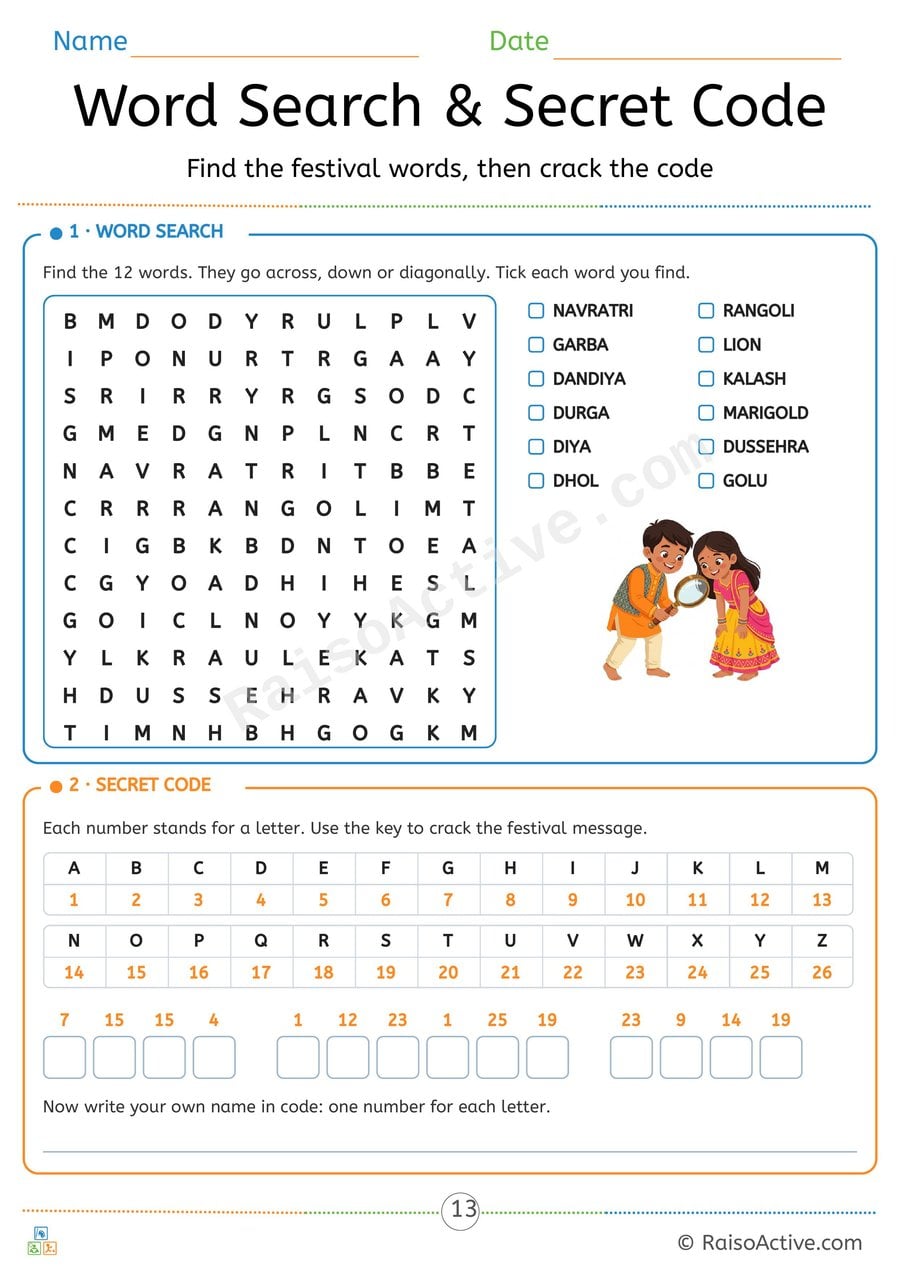
Navratri Word Search and Secret Code Puzzle
Ages 7-11 · Grade 2–Grade 3Ages 7-11 · Year 3–Year 4Ages 7-11 · Class 2–Class 3Ages 7-11
Children find 12 festival words that run across, down and diagonally, and use an A = 1 to Z = 26 key to decode a message about the festival. Then they write their own name in code.
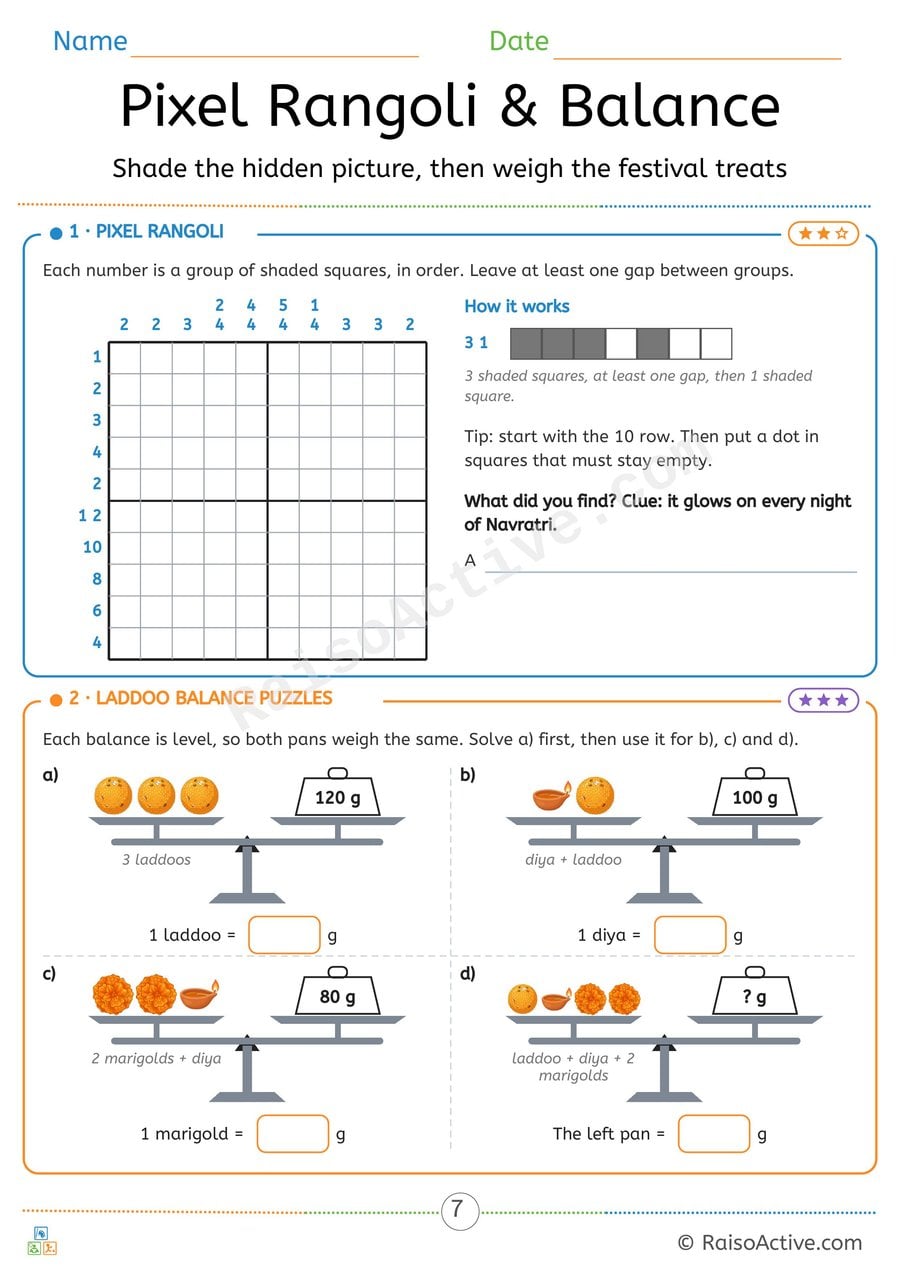
Pixel Rangoli and Laddoo Balance Puzzles for Navratri
Ages 7-11 · Grade 2–Grade 3Ages 7-11 · Year 3–Year 4Ages 7-11 · Class 2–Class 3Ages 7-11
Children use row and column clues to shade a 10 x 10 grid and reveal a hidden festival picture, then solve four balance puzzles in grams, using each answer to work out the next: a first step into algebra.
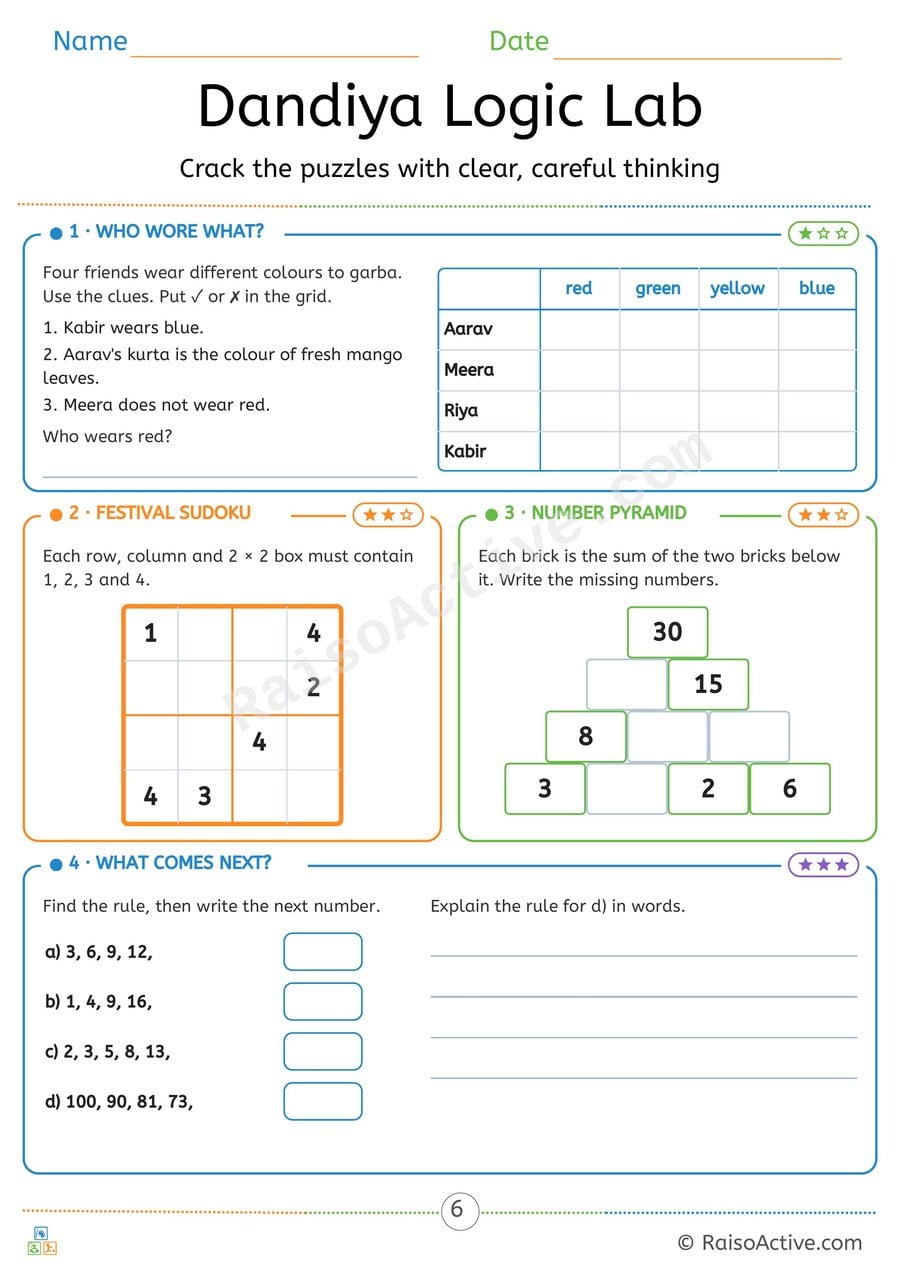
Dandiya Logic Lab: Navratri Logic Grid, Sudoku and Number Pyramid
Ages 7-11 · Grade 2–Grade 3Ages 7-11 · Year 3–Year 4Ages 7-11 · Class 2–Class 3Ages 7-11
Children use clues to fill a logic grid about four friends' garba colours, solve a 4x4 sudoku, complete a number pyramid where each brick is the sum of the two below, and find the rules for four number sequences, including square numbers and the Fibonacci pattern.
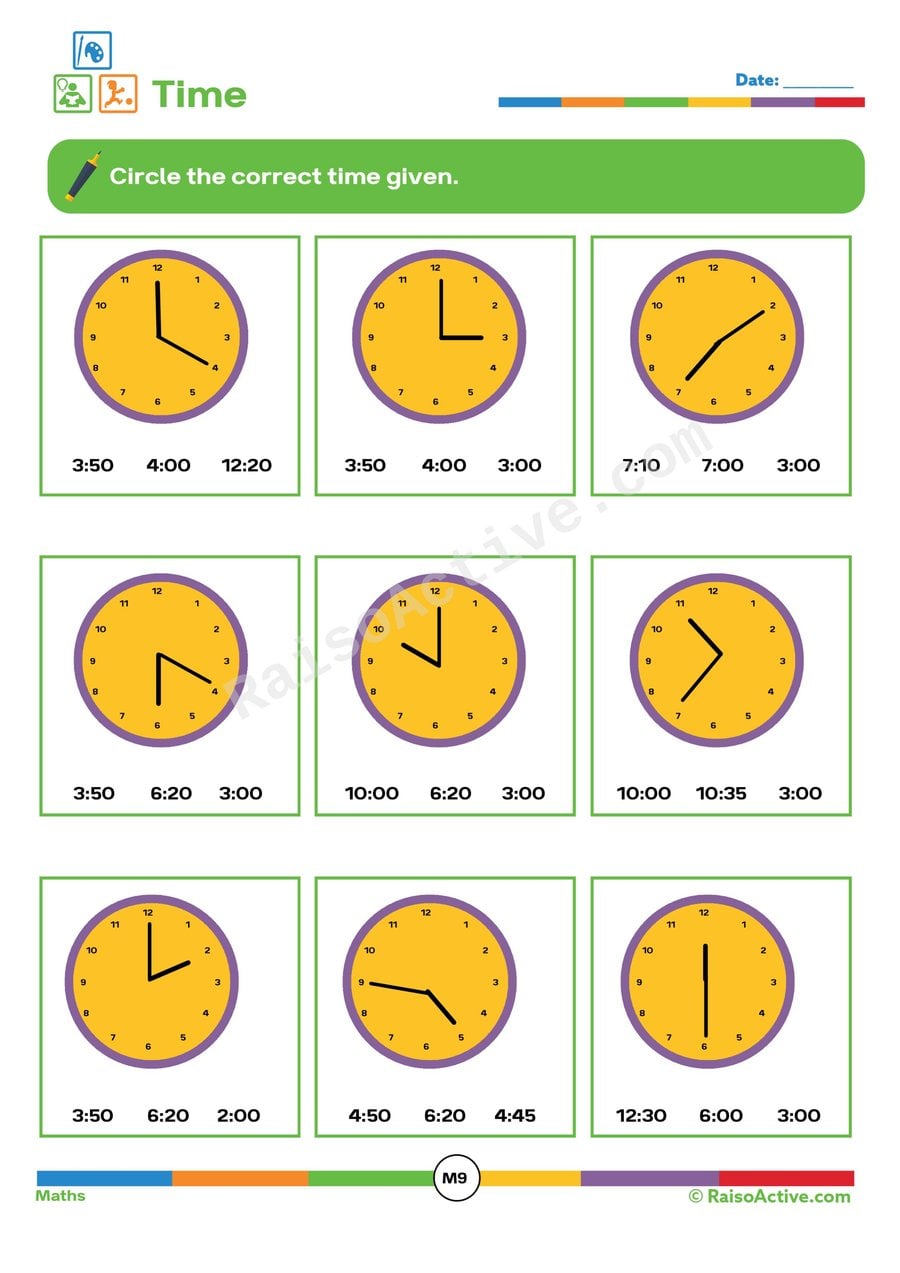
Time Telling Worksheet: Circle the Correct Time!
Ages 5-7 · Kindergarten–Grade 1Ages 5-7 · Year 1–Year 2Ages 5-7 · UKG–Class 1Ages 5-7
Reading an analog clock face and choosing the matching time from three written options builds clock-reading fluency for children ages 5-7, requiring them to interpret both the hour and minute hands together rather than guessing from a single hand.
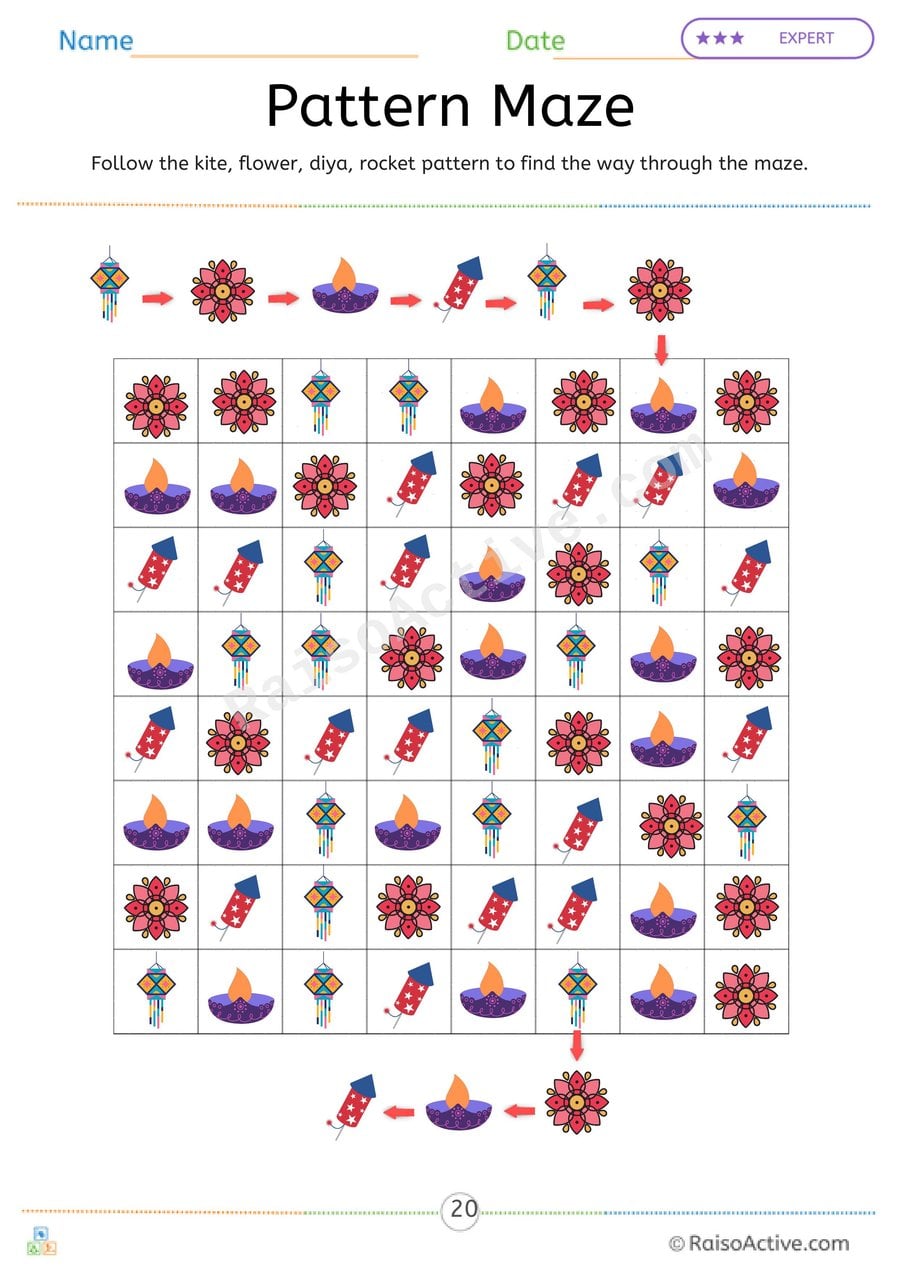
Festive Sequence Maze Worksheet for Kids
Ages 4-8 · Pre-K–Grade 2Ages 4-8 · Reception–Year 3Ages 4-8 · LKG–Class 2Ages 4-8
Children follow a repeating kite, flower, diya, rocket pattern square by square to find the only path through the maze, building logic and focus.

Golu Puzzles: Navratri Golu Step Maths and Logic Worksheet
Ages 7-11 · Grade 2–Grade 3Ages 7-11 · Year 3–Year 4Ages 7-11 · Class 2–Class 3Ages 7-11
Children read how families set up a golu on an odd number of steps. They continue a number pattern of dolls on 7 steps, add the total, spot odd step counts, divide 50 dolls into full steps with a remainder and solve a logic puzzle to place five dolls.

Tense Time! Identifying Past, Present, and Future Tense Worksheet
Ages 5-7 · Kindergarten–Grade 1Ages 5-7 · Year 1–Year 2Ages 5-7 · UKG–Class 1Ages 5-7
This worksheet asks 5-7 year olds to read a full sentence and identify which tense it's written in — past, present, or future — based on the verb form and clue words used, which is a meaningfully harder skill than simply writing verbs in different tenses since it requires recognizing the grammar pattern rather than producing it. This kind of tense-identification practice is exactly what supports stronger reading comprehension and writing later, since understanding when something happens is core to following any story.
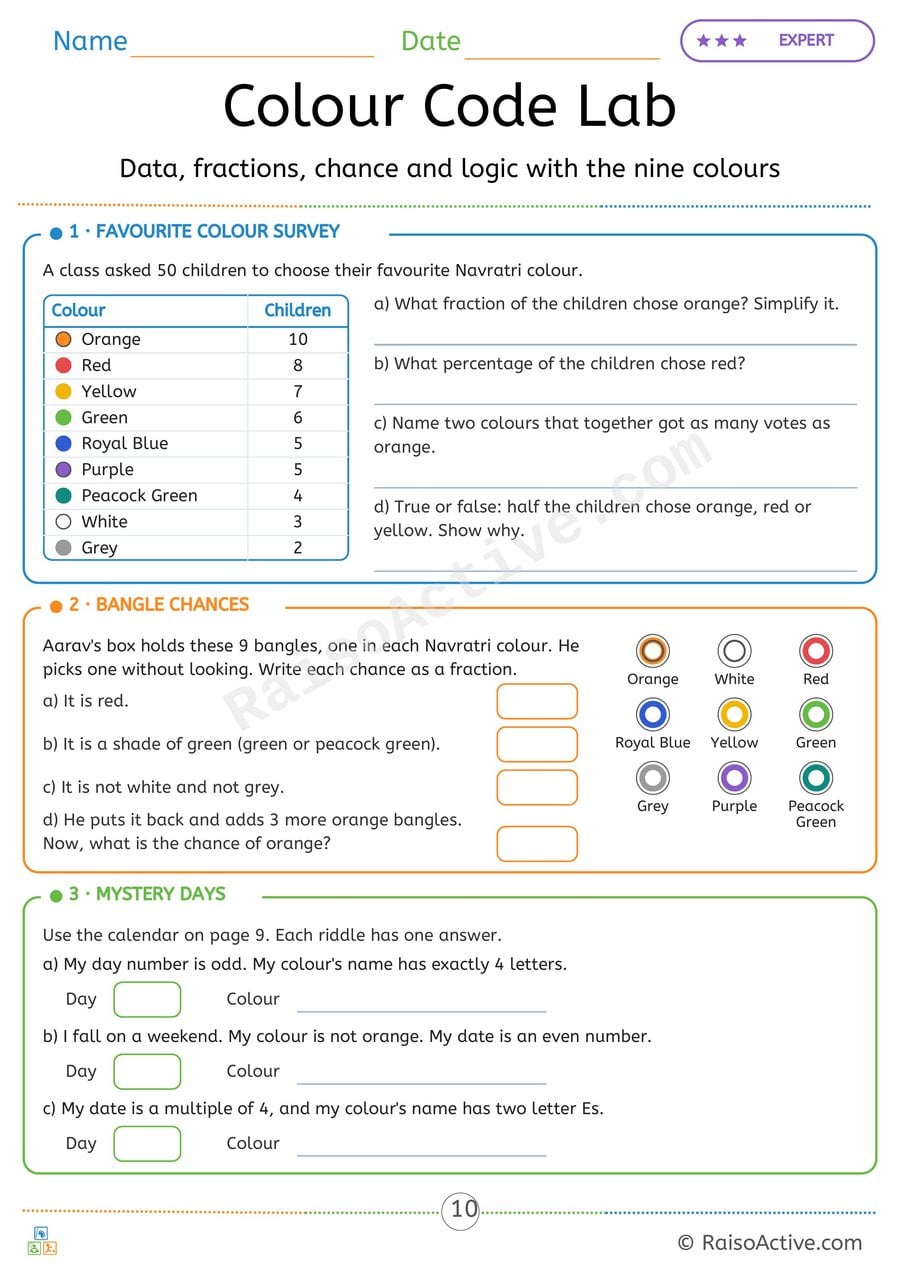
Colour Code Lab: Navratri Fractions, Percentages and Probability
Ages 7-11 · Grade 2–Grade 3Ages 7-11 · Year 3–Year 4Ages 7-11 · Class 2–Class 3Ages 7-11
Children read a survey of 50 children's favourite Navratri colours and write fractions and percentages, write the chance of picking each kind of bangle as a fraction, and solve three riddles using the colour calendar on page 9.
What the puzzles build
Six thinking skills, one puzzle at a time
Every puzzle has one answer a child can prove, so they learn to check their own thinking instead of waiting to be told.
Deduction
Use clues to rule things out until only one answer is left.
Logic grids, suspect line-ups, who-lives-where puzzles
Patterns and sequences
Spot the rule, say it out loud and use it to predict what comes next.
What comes next, number paths, analogies
Weighing evidence
Tell a fact from an opinion, check a claim and give a reason.
Spot the lie, fact or opinion, fair tests, debate
Codes and ciphers
Work step by step to crack a message and check the answer makes sense.
Code wheels, secret messages, riddles
Number logic
Balance, compare and fit numbers to rules, with exactly one right answer.
Sudoku, Calcudoku, number cages, balance scales
Spatial thinking
Turn, fit and rebuild shapes in the head, then try them with the hands.
Tangrams, nonograms, matchstick puzzles
About Critical Thinking Worksheets for Kids
Critical thinking worksheets are printable puzzle sheets for children aged 5 to 10 that teach them to look at clues, spot patterns, weigh evidence and explain their reasoning. They use logic grids, Sudoku, riddles, codes, odd-one-out and brain teasers, and every puzzle has one answer a child can prove for themselves.
Thinking well is a skill, and like any skill it grows with practice. These worksheets give children a reason to practise: a vanished crown to find, a vault with twenty locks to open, a secret message to crack. A seven-year-old sorts clues in a suspect line-up and solves a picture Sudoku, while a ten-year-old tackles Calcudoku, truth-teller puzzles and a fair-test debate. There are two 24-page activity books, Puzzle Detectives for ages 7 to 8 and Mastermind Academy for ages 9 to 10, each in a colour edition and an ink-saver black-and-white edition, alongside free single worksheets for logic, patterns and puzzles.
What children learn from critical thinking worksheets
Younger children aged 5 to 7 learn to look carefully, sort by a rule, follow a sequence and say why one thing does not belong. Children aged 7 to 10 go further: they use clues to rule out possibilities, check whether a claim is true, tell a fact from an opinion and explain a step-by-step answer in their own words.
- Deduction: using clues to rule things out until one answer is left
- Patterns and sequences: spotting the rule and predicting what comes next
- Weighing evidence: fact or opinion, true or false, and giving a reason
- Codes and ciphers: working step by step and checking the answer makes sense
- Number logic: Sudoku, balance scales and cages with exactly one answer
- Spatial thinking: tangrams, picture reveals and matchstick puzzles
How to use critical thinking puzzles at home
Short and friendly works best: one or two puzzles at a time, about fifteen minutes. Let your child struggle for a little before you help, and when they find the answer, ask how they know. Explaining a reason out loud is where the thinking really happens.
- Start with a warm-up puzzle your child can win, then move to the challenge level
- Ask "How do you know?" and "What would change your answer?" rather than giving hints
- Praise the reasoning and the effort, not only the right answer
- Use the answer key afterwards to check together, not to hurry the puzzle
- Print the black-and-white edition to save ink, or to colour in as a calm-down at the end
How the packs are built
Both packs are mysteries with a story running through them: each puzzle page wins a clue or opens a lock, so children want to get to the next page. The puzzles move through three levels (warm-up, challenge and expert), every logic puzzle has exactly one answer that was checked before printing, and each pack ends with a certificate and an answer key with short explanations. Several pages are made to be played, with cut-out code wheels, card games and a hunt to run around the house.
Frequently asked questions
What are critical thinking worksheets for kids?
They are printable puzzle and reasoning activities that help children practise thinking, not just remembering. A child might use clues to work out who did something, find the rule in a pattern, decide whether a statement is a fact or an opinion, or crack a code. Each one asks the child to explain how they know, which builds careful, independent reasoning.
What age are the critical thinking packs for?
Puzzle Detectives is for ages 7 to 8 and uses picture and number puzzles, riddles and simple logic grids. Mastermind Academy is for ages 9 to 10 and goes further, with code-breaking, Calcudoku, truth-teller puzzles and debate. Each has 24 pages. The free worksheets on this page start from age 5, so younger children can begin with those.
Are these logic puzzles and brain teasers too hard for my child?
Each pack climbs through warm-up, challenge and expert levels, so every child can start with a puzzle they can win. A stuck child can skip to another page and return later, because pages do not have to be done in order. Every puzzle has one answer, and the answer key explains the thinking so you can help without giving it away.
Are there black-and-white versions to save ink?
Yes. Each pack comes with a colour edition and an ink-saver black-and-white edition, so you can print whichever suits your printer and your child. The puzzles are identical in both. The black-and-white pages use clean line art that children can colour in after they finish solving, and both editions include the certificate and answer key.
How do critical thinking worksheets help with school?
Reasoning underpins maths word problems, reading comprehension and science investigations. Puzzles that ask a child to find a rule, check a claim or explain a step build the habits teachers look for: reading carefully, testing an idea and giving a reason. They are also a calm, screen-free way to practise concentration and perseverance at home.
Are the single worksheets on this page free?
Yes. The worksheets in the grid are free PDFs that print on A4 or Letter paper, and you can browse the whole library by age and topic. The Puzzle Detectives and Mastermind Academy activity books are low-cost printable downloads, with a free preview of selected pages on each pack page so you can try before you buy.

Written by
Hemsweta Jain · Teacher Cheena
MBA and Early Childhood Educator, teaching since 2014 · Founder of RaisoActive, Mumbai
Written and reviewed by Hemsweta Jain (Teacher Cheena), who designs every RaisoActive worksheet.
Last reviewed
Guides for parents and teachers
See all guides
Age-Appropriate Problem-Solving Activities: Building Critical Thinkers from the Ground Up
Discover fun, age-appropriate problem-solving activities for children ages 1-8. Build critical thinking, logic, and reasoning skills through play-based learning.

Fostering Creativity in Structured Learning: The Perfect Balance for Young Minds
Learn how to blend creativity with structured learning for children ages 1-8. Practical strategies, activities, and printable worksheets for parents and teachers.
Critical Thinking Activities That Actually Work for Young Children: Building Tomorrow's Thinkers Today
Discover proven critical thinking activities for young children. Age-wise logic games, questioning techniques, and hands-on ideas to build thinking skills at home.
Preparing Your Child for a Rapidly Changing World: Essential Skills for Future Success
Discover the essential 21st century skills your child needs for future success. Practical tips on creativity, critical thinking, digital literacy & emotional intelligence for ages 1-8.
Coding Activities for Preschoolers: Building Tomorrow's Thinkers Today
Discover 15+ unplugged and screen-based coding activities for preschoolers that build sequencing, logic, and problem-solving skills through play. NEP 2020 aligned.

Teaching Basic Computer Skills to Young Children: A Parent's Complete Guide
Help your child ages 3-8 build digital literacy with age-appropriate computer skills: mouse, keyboard, safe internet, and top apps for Indian families.