Free printable worksheets · United Kingdom
Reception Letter Tracing Worksheets (Ages 4–5)
Reception letter tracing worksheets are practice sheets for children aged 4–5 in Reception in the UK. Letter tracing is following the dotted outline of a printed letter with a pencil, in the correct stroke order, to learn how it is formed. The sheets on this page cover uppercase letter formation, lowercase letter formation, starting points and stroke direction and spacing between letters.
Reception is the year phonics teaching properly begins, usually with Phase 2 of Letters and Sounds or an equivalent scheme, so a child starts blending sounds such as s, a, t and p into short words within weeks. Number work stays within ten, built through subitising and comparing rather than counting alone. At four to five, letter tracing covers every uppercase letter, each shown with a starting dot and a numbered arrow for its strokes, and a child works through several letters a week rather than one. Spacing starts to matter: letters should sit close together on a row without touching. Lowercase letters, beginning with the easier round ones like o, c and a, are usually introduced in the second half of the year, traced the same way uppercase ones were.
579+ worksheets · free PDF download · print on A4 or Letter
Reception Letter Tracing Worksheets to print
Browse all worksheets for ages 4–5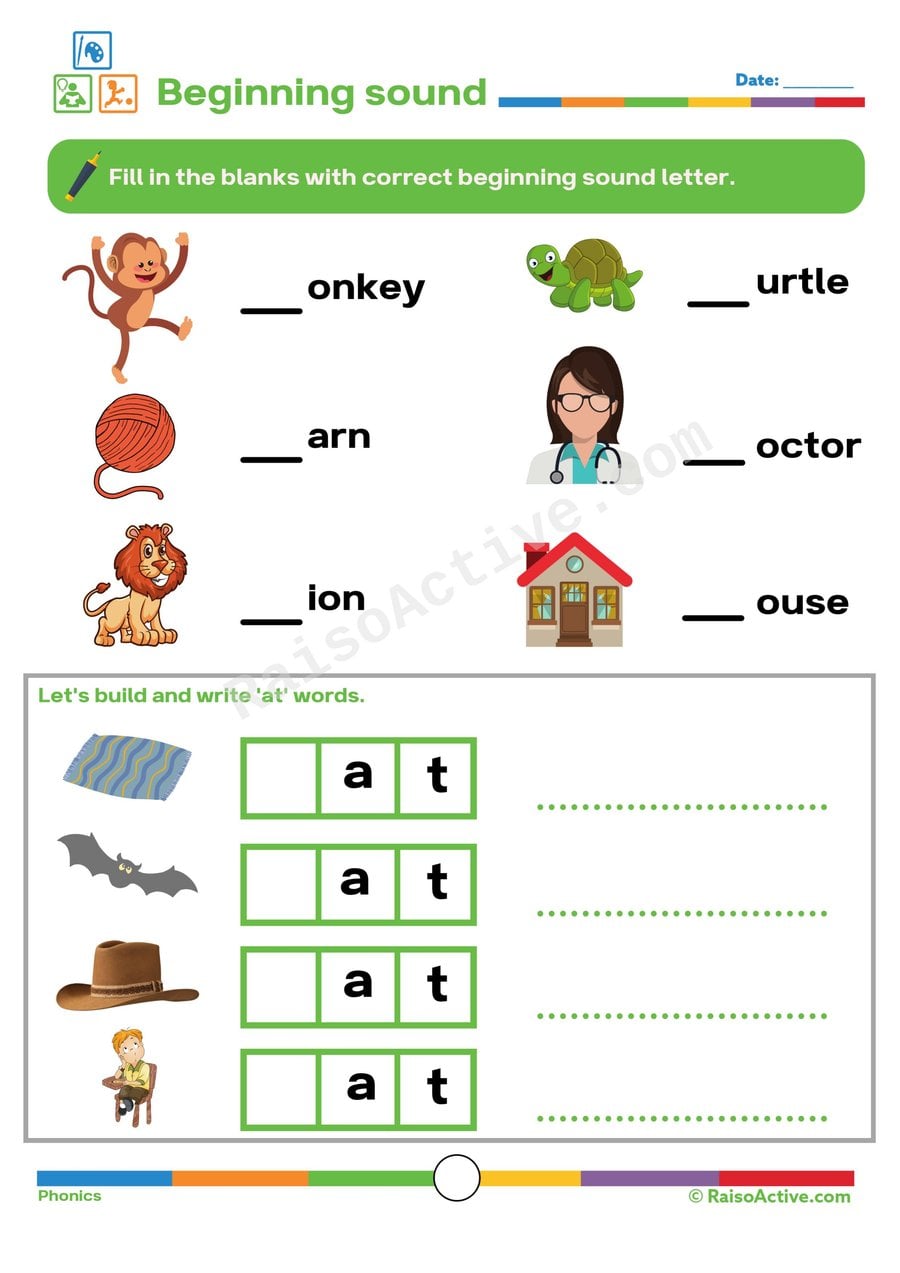
Beginning Sounds Worksheet: Fill in the Blanks!
This worksheet asks children ages 4-5 to identify the beginning sound of a pictured object and write the correct letter, then use that same skill to build new 'at' family words. Isolating and writing beginning sounds is a foundational phonics skill that bridges listening (hearing a sound) and writing (representing it with a letter) — a connection children need before they can spell independently.

Phonics Fun: Matching Letters and Words Worksheet for Preschoolers
Identifying the beginning sound of a pictured word and writing the matching letter teaches children ages 4-5 phonemic awareness, the ability to isolate individual sounds within spoken words, which is one of the strongest predictors of future reading success. Saying each word aloud after writing the letter reinforces the connection between the printed letter and its spoken sound, closing the loop between listening, writing, and speaking. This worksheet moves children from simply recognizing letters to actively applying letter-sound knowledge, a more advanced early literacy skill.
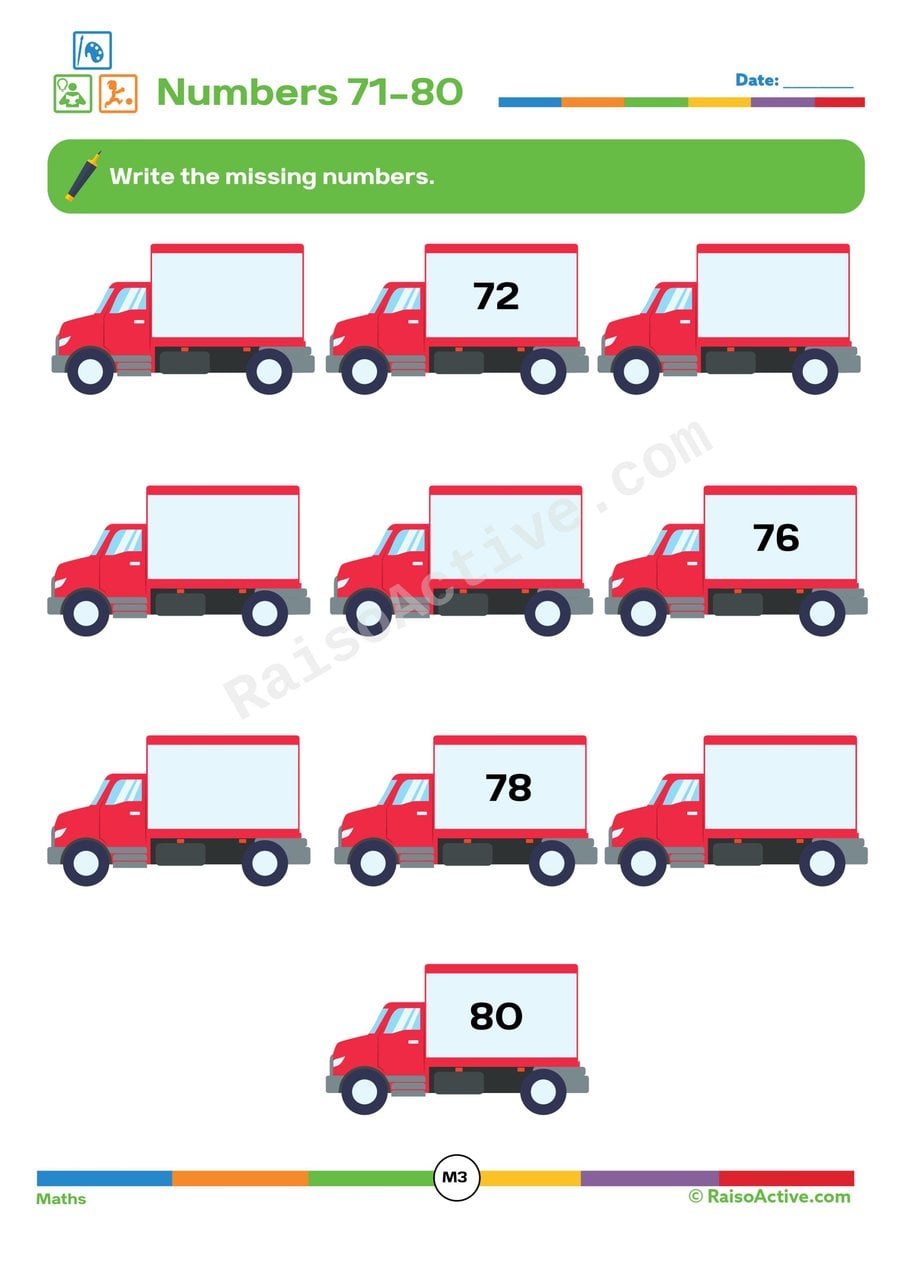
Missing Numbers: Trucks Worksheet for Kids (71-80)
Filling in missing numbers within the 71-to-80 range asks children to hold a mental number sequence steady enough to identify a gap and supply the correct value, a more demanding task than simply counting forward from one. For ages four to five, practicing in this specific decade extends their counting range beyond the more familiar numbers under 50 while the truck theme keeps the task visually engaging.

Find the 'ap' Words! A Fun Worksheet for Early Readers
Children ages 4-5 build phonics fluency by reading and writing CVC words in the 'ap' family, like 'cap', 'map', and 'nap'. Recognizing this consistent letter pattern teaches early readers to decode groups of letters as a chunk rather than sounding out every letter individually, speeding up reading over time. Writing each word after finding it also reinforces correct spelling and letter sequencing for early literacy.
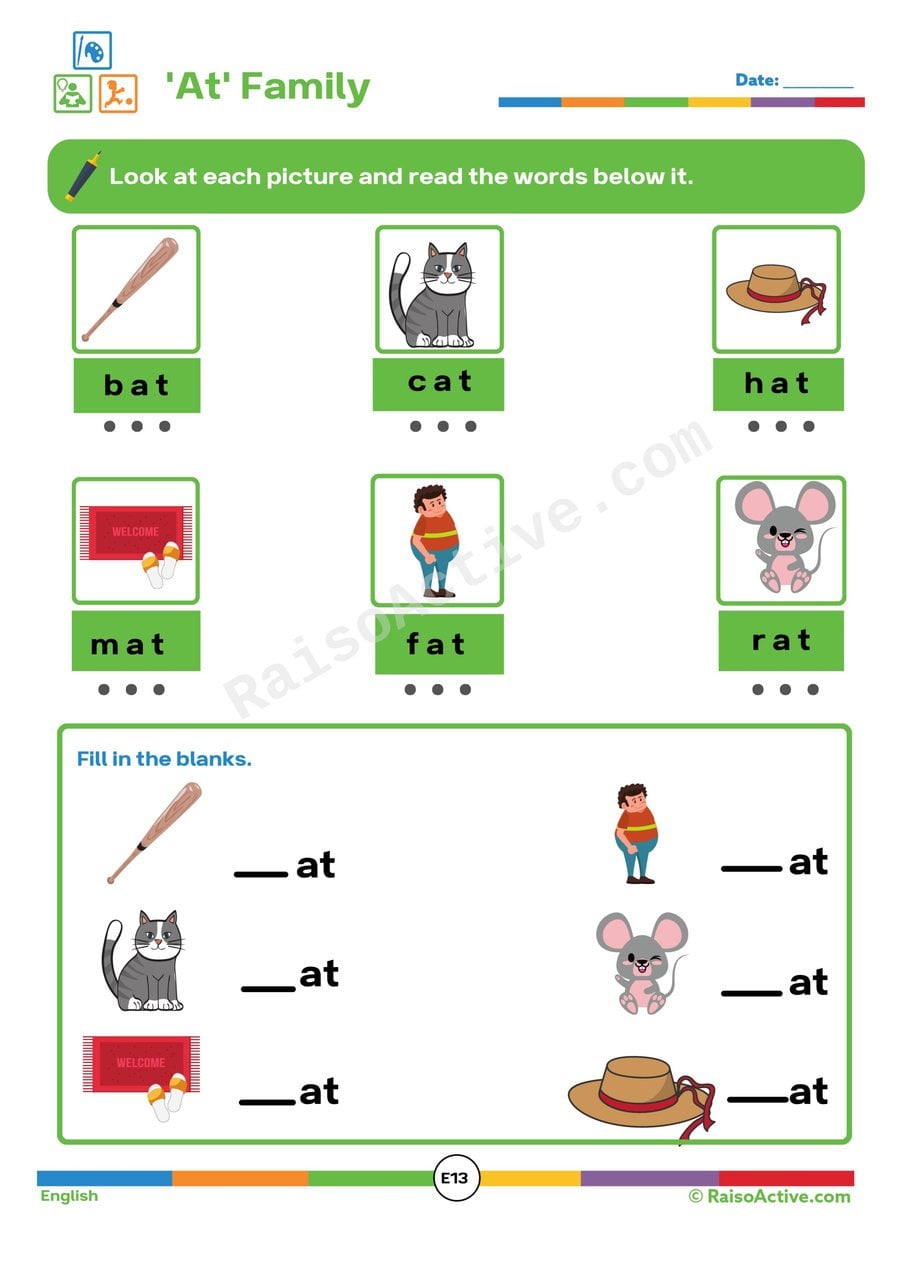
At Family Word Worksheet: Read, Match, and Write!
This worksheet introduces children ages 4-5 to the 'at' word family — words like cat, hat, and mat that share the same ending sound — helping them notice how changing just the first letter creates a new word. Recognizing word families is one of the most effective early strategies for decoding new words, since it lets children apply a pattern instead of sounding out every letter individually.
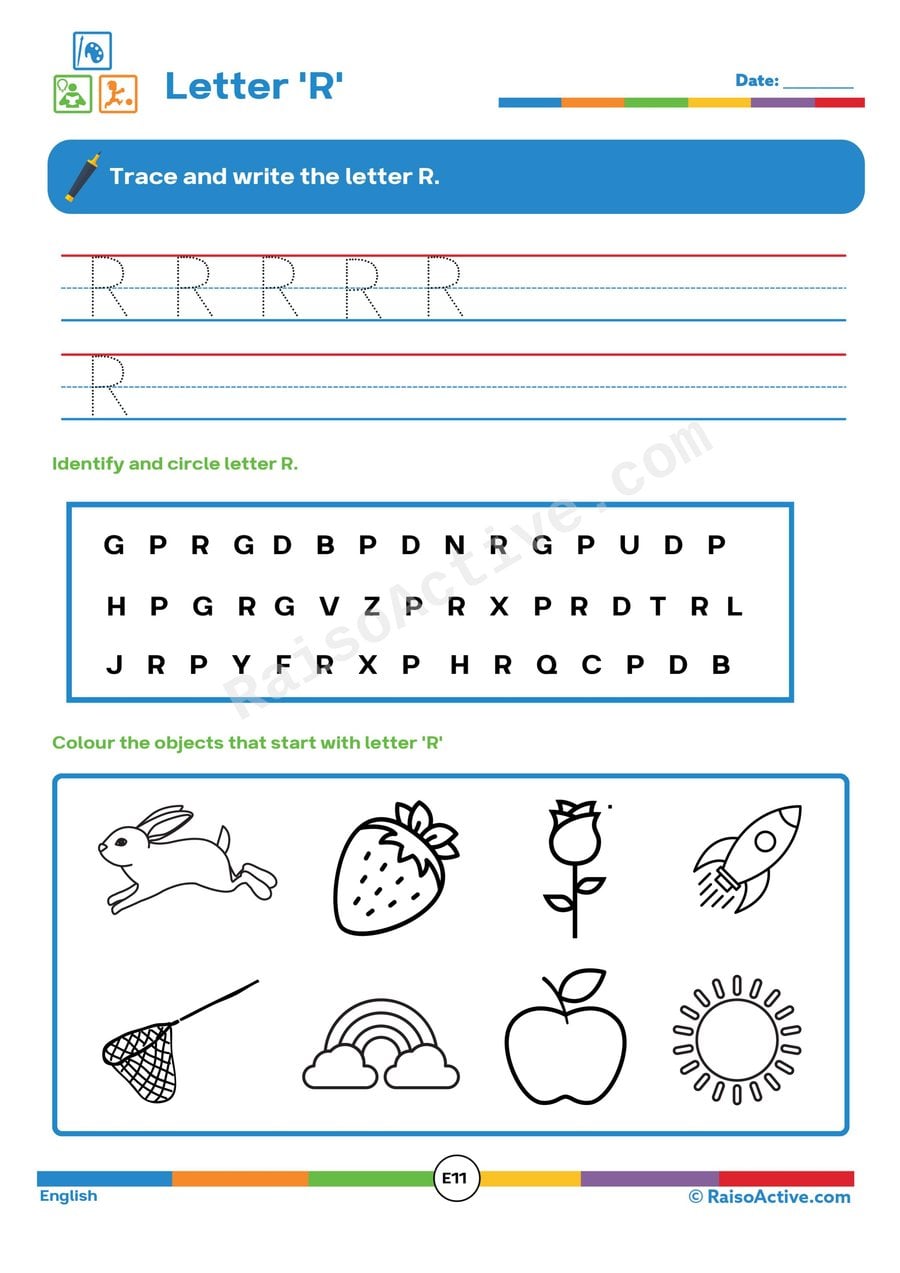
Letter R Worksheet: Trace, Identify, and Color!
This worksheet helps children ages 4-5 practice tracing and writing the letter R, spotting it among a group of other letters, and recognizing objects that begin with the R sound. Working across three related tasks for one letter, tracing, searching, and identifying pictures, gives repeated exposure that helps the letter shape and sound become automatic.

Frame Sentences Worksheet: Fill-in-the-Blanks with Pictures!
Children ages 4-5 practice connecting spoken vocabulary to written words as they use picture clues to fill in missing words within a sentence frame. This builds early sentence construction and reinforces that a sentence needs the right word in the right place to make sense, a stepping stone toward independent writing.

First Letter Sound Worksheet: Beginning Sounds Practice
This worksheet asks children ages 4-5 to identify the beginning sound of pictured objects, write the missing first letter to complete each word, and then combine those first letters to form a brand-new word. Practicing beginning sounds in this layered way — first in isolation, then combined — helps children see letters as flexible building blocks rather than fixed, memorized shapes.

Learn to Write the Number 7: A Fun Tracing and Counting Worksheet!
This worksheet helps children ages 4-5 learn the correct stroke sequence for writing the number 7, while counting fingers and mangoes reinforces that the numeral stands for a specific quantity of seven items. Practicing both writing and counting for the same number in one sitting strengthens the link between number recognition and number formation.

Sight Word 'THE' Worksheet: Trace, Write, and Identify!
This worksheet builds automatic recognition of the sight word 'the,' one of the most frequently occurring words in English text, through repeated tracing, writing, and identification practice. For four- and five-year-olds, memorizing high-frequency sight words like 'the' by sight — rather than sounding them out each time — is essential for building reading fluency, since these words appear on nearly every page a child will read.

Sequencing Numbers Train Worksheet for Preschoolers
Writing numbers 0-20 into a sequence of train cars pushes children ages 4-5 to internalize the full early counting range in fixed order, not just recite it aloud, which is a meaningfully different and more durable skill. Filling in the numbers by hand also builds numeral formation alongside sequencing, so children practice both remembering what comes next and writing it correctly. The train-car visual keeps a fairly long numeric range broken into manageable, engaging chunks rather than one intimidating list.

Lowercase Letter Tracing Worksheet: Practice Writing the Alphabet
This worksheet moves beyond a single letter to practice a full set of lowercase letters in sequence, asking 4-5 year olds to apply consistent size, spacing, and stroke habits across multiple different shapes rather than mastering just one. This kind of broader review is an important checkpoint skill at the older end of preschool, closer to the demands of actual kindergarten handwriting practice.

Number Writing Worksheet 0-10: Trace, Count, and Write!
This worksheet combines three numeracy skills in one sitting: recognizing printed numerals 0 through 10, forming them correctly through tracing, and matching a quantity of objects to its written number. For 4-5 year-olds, connecting the abstract symbol '7' to seven actual objects is the key leap between rote counting and true number sense.

Summer Words ABC Order Worksheet for Preschoolers
This worksheet has children ages 4-5 practice putting summer-themed words in alphabetical order, a key pre-reading skill that requires comparing the first letters of multiple words and understanding that the alphabet has a fixed sequence. Because children must hold several words in mind and decide their relative order rather than just recognizing a single letter, this task builds early sequencing and comparison skills alongside letter knowledge. Writing the words out afterward also reinforces spelling and handwriting practice.
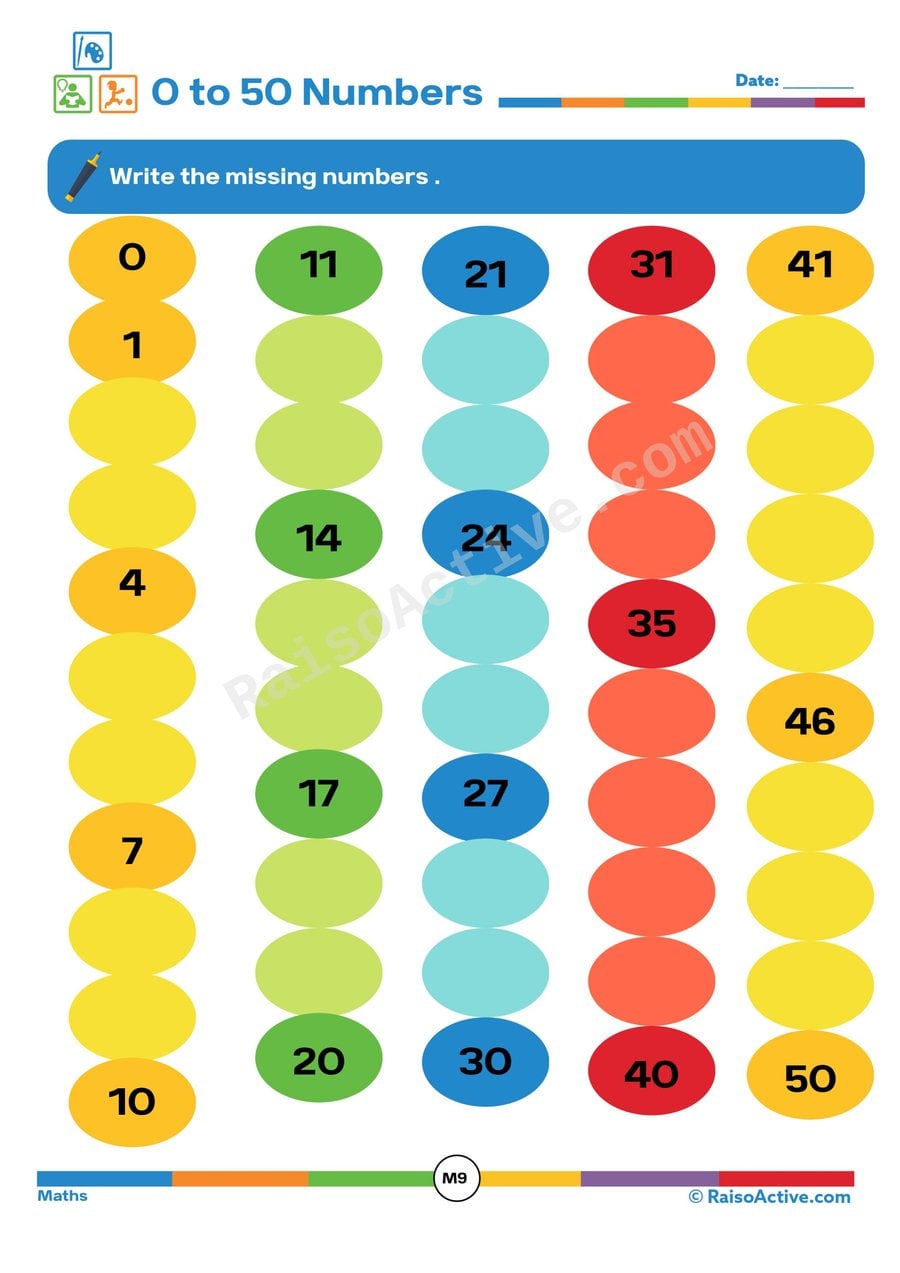
Missing Numbers Worksheet: 0 to 50
Filling in missing numbers across the 0-50 range asks children ages 4-5 to hold a much longer counting sequence in mind than typical 1-20 worksheets, strengthening both number recognition and the pattern sense needed to predict what comes next at any point in the range. This kind of extended practice also introduces children to the way numbers group into decades, like the 20s or 30s, which becomes important for later place-value understanding. Successfully completing a long sequence like this builds real counting stamina and confidence.
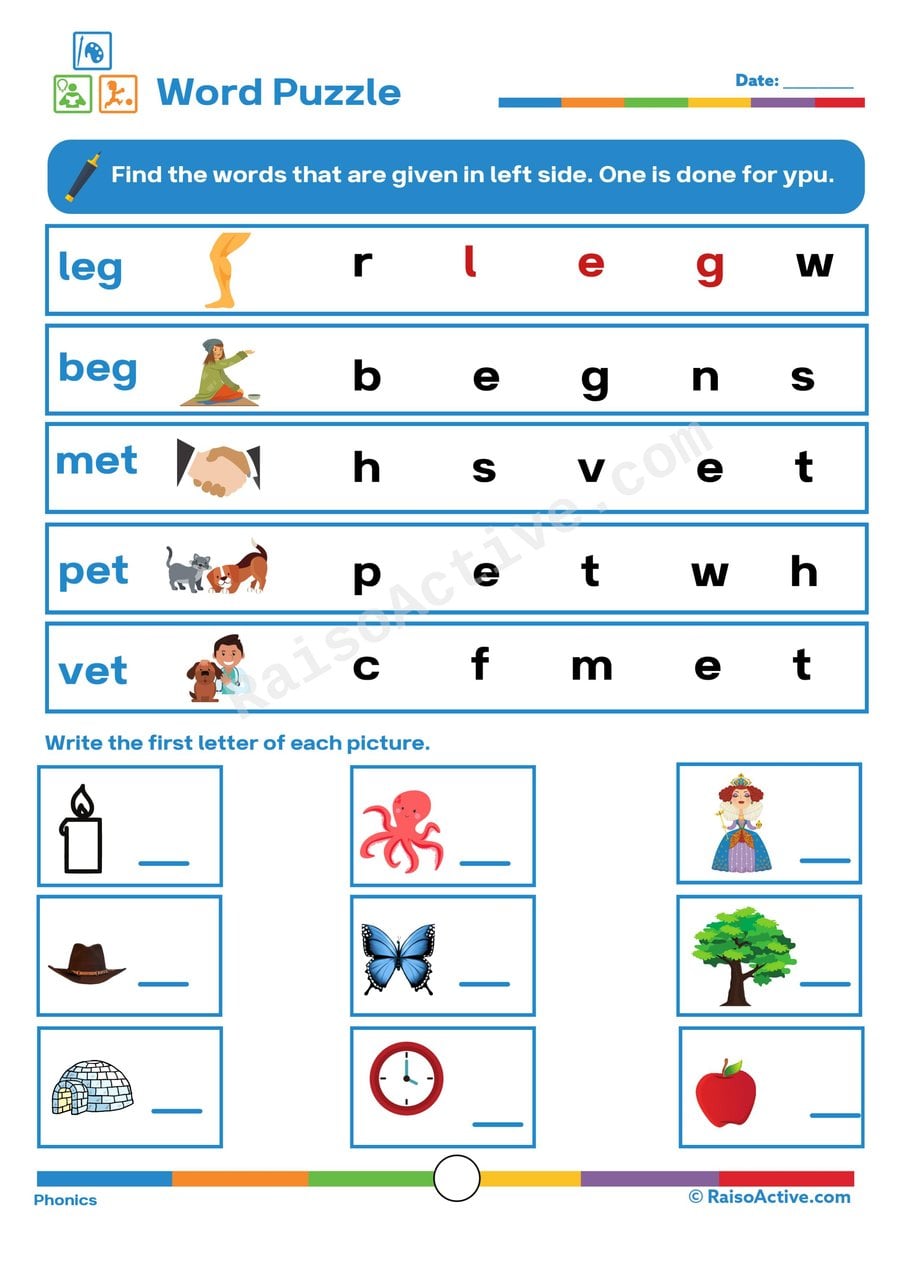
Word Puzzle Fun: Find and Write the First Letter!
This worksheet asks children ages 4-5 to locate hidden words in a picture puzzle and then identify and write the first letter of each corresponding picture, combining visual search skills with beginning-sound phonics. Searching a puzzle for target words builds visual scanning and attention, a skill that supports reading fluency later on, while writing the beginning letter reinforces the sound-to-symbol connection central to early spelling. Doing both together keeps young learners engaged while practicing two skills at once.

Counting Fun: Number Names Worksheet for Preschoolers!
This number-names worksheet pushes children from simply counting objects to connecting a quantity with its written word, a step that bridges early numeracy with beginning literacy. Ages four and five are ready to start recognizing that 'three' is both a group of three dots and a specific string of letters, which strengthens both number sense and sight-word recognition.

These or Those Worksheet: Identifying Plural Nouns
Children ages 4-5 build on singular demonstrative pronouns by learning 'these' and 'those,' the plural forms used to describe groups of objects that are near or far. Understanding this distinction strengthens both grammar and the ability to judge distance and quantity together in a single sentence.

Ending Sound Worksheet: Identify and Write the Final Sounds!
Ages 4-5 are learning to pull apart the sounds inside a word, and this worksheet zeroes in on the trickiest part: the final sound. Hearing and writing ending sounds is a phonemic awareness skill that comes after beginning sounds developmentally, since children have to hold the whole word in memory and isolate the very last phoneme. This directly prepares them for spelling, where the ending sound is often the piece kids drop or guess at.
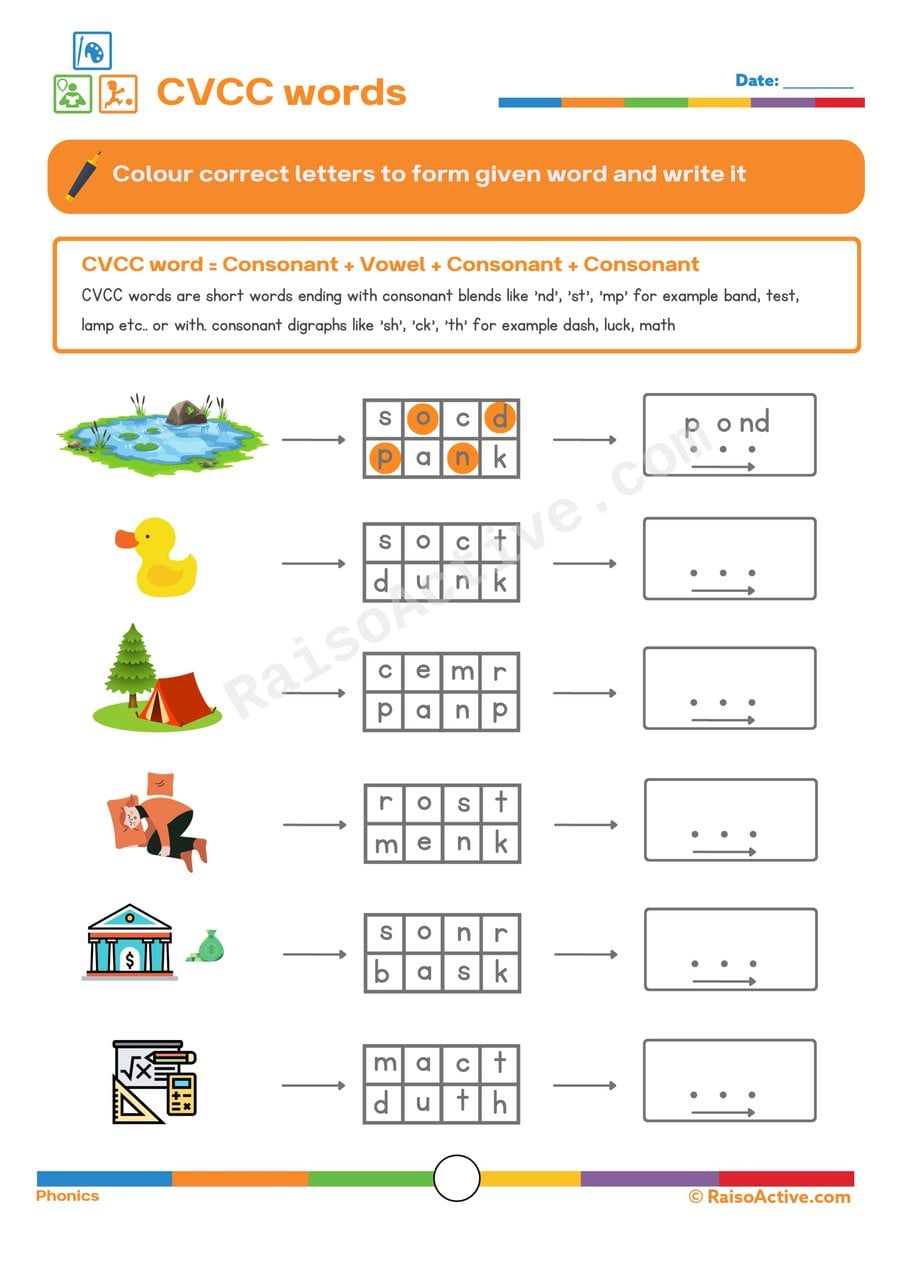
CVCC Word Fun: Color, Read, and Write!
This worksheet has children ages 4-5 identify and write CVCC words by coloring the correct letters shown in letter boxes and then writing the complete word based on a picture cue. Coloring specific letters before writing the whole word breaks decoding into a manageable first step, helping children build the word piece by piece rather than facing the whole spelling task all at once.

Trace and Write Simple Sentences Worksheet for Preschoolers
Tracing and then writing simple sentences independently helps children ages 4-5 move beyond single-word and letter practice into connected writing, learning that words are separated by spaces and sentences follow a left-to-right flow. This step is an important bridge between early handwriting skills and functional written communication.
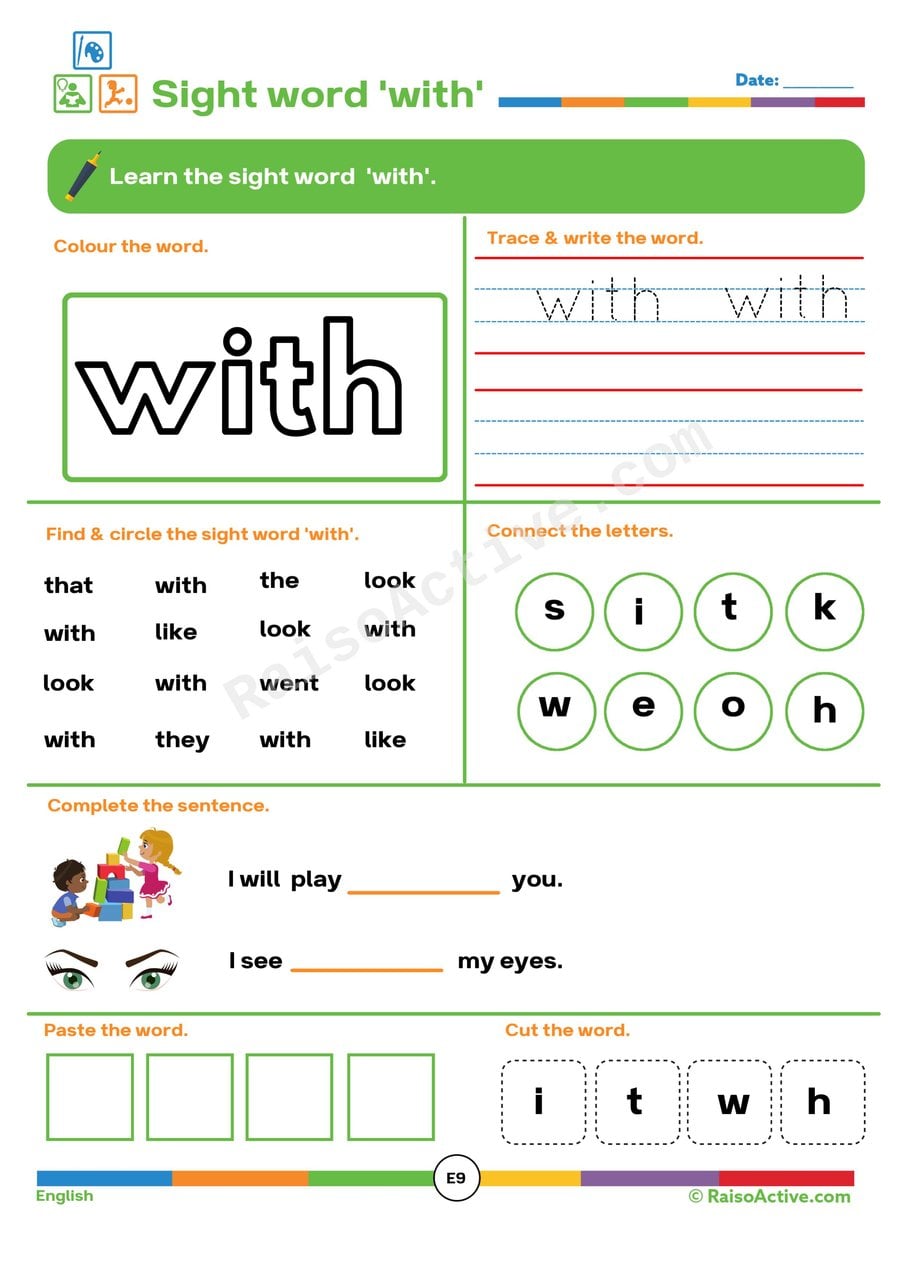
Sight Word 'With' Worksheet: Trace, Write, and Find!
This worksheet gives 4-5 year olds repeated, varied practice with the sight word 'with' — coloring it, tracing and writing it, finding it in a list, completing a sentence, and cutting and pasting it — because sight words like 'with' don't follow simple sound-out rules and need to be recognized instantly by sight rather than decoded each time. That instant recognition is what lets a young reader move smoothly through a sentence instead of stumbling on common connector words.

Trace and Count: Number 18 Worksheet for Preschoolers
This worksheet has children ages 4-5 trace the number 18 and then count and color a full set of eighteen hearts, continuing to build stamina for counting well into the teens range. Because eighteen is close to twenty, successfully counting this many objects without losing track shows real progress in sustained attention and one-to-one correspondence. Using hearts instead of a more neutral shape also adds a small, engaging visual theme to an otherwise repetitive counting task.

Number Sequencing Worksheet: Practice Counting and Ordering Numbers!
This worksheet gives children ages 4-5 focused practice writing numerals in order by filling in the missing numbers within several different counting sequences. Unlike simple counting aloud, writing each numeral by hand forces children to connect the spoken number word to its correct written symbol, reinforcing both number recognition and early handwriting control.
What Reception letter tracing worksheets cover
At four to five, letter tracing covers every uppercase letter, each shown with a starting dot and a numbered arrow for its strokes, and a child works through several letters a week rather than one. Spacing starts to matter: letters should sit close together on a row without touching. Lowercase letters, beginning with the easier round ones like o, c and a, are usually introduced in the second half of the year, traced the same way uppercase ones were.
- Trace every uppercase letter following its numbered stroke arrows
- Keep traced letters close together without letting them touch
- Trace lowercase o, c and a starting at the top
- Trace a full first name in capital letters
How to use these worksheets at home or in class
A short daily sound-matching or blending sheet paired with one number activity, around ten minutes total, mirrors the classroom rhythm. Say each sound clearly before your child traces or writes it, and keep the pace playful rather than test-like.
Start with the sheet that matches what your child can already do, then move one step up. Keep finished sheets in a folder: Reception teachers often ask for evidence of practice, and children like seeing their own progress.
Is your child ready for Reception letter tracing work?
A child moving into this stage typically holds a pencil with a developing grip, recognises several letters by sound rather than only by shape, and can count a small group of objects one at a time without skipping any.
Frequently asked questions
Should a four-year-old trace uppercase or lowercase letters first?
Uppercase first, because the strokes are mostly straight lines and large curves that a four-year-old's hand can manage, while several lowercase letters are smaller and share confusable shapes such as b, d, p and q. Most letter-tracing programs finish the uppercase alphabet before introducing lowercase, and even then start with the easiest round letters. Trying to teach both cases for every letter at once tends to slow both down rather than speed either up.
What should a Reception child be able to do in letter tracing?
At four to five, letter tracing covers every uppercase letter, each shown with a starting dot and a numbered arrow for its strokes, and a child works through several letters a week rather than one. Spacing starts to matter: letters should sit close together on a row without touching. Lowercase letters, beginning with the easier round ones like o, c and a, are usually introduced in the second half of the year, traced the same way uppercase ones were. A child moving into this stage typically holds a pencil with a developing grip, recognises several letters by sound rather than only by shape, and can count a small group of objects one at a time without skipping any.
Do these worksheets follow the Reception curriculum?
The sheets cover uppercase letter formation, lowercase letter formation, starting points and stroke direction and spacing between letters, which sit inside the EYFS Early Learning Goals; Letters and Sounds Phase 2–3 outcomes for Reception. Pre-K / Kindergarten (US), LKG (India) use the same skills at this age, so the sheets also fit families following those programmes.
Are these Reception letter tracing worksheets free?
Yes. Each worksheet downloads free as a watermarked PDF once you create an account, with a limit of five a day. An annual membership ($20) removes the watermark and the limit for the whole library of over 1,000 worksheets and every printable pack.

Written by
Hemsweta Jain · Teacher Cheena
MBA and Early Childhood Educator, teaching since 2014 · Founder of RaisoActive, Mumbai
Written and reviewed by Hemsweta Jain (Teacher Cheena), who designs every RaisoActive worksheet.
Last reviewed
Printable packs for ages 4–5
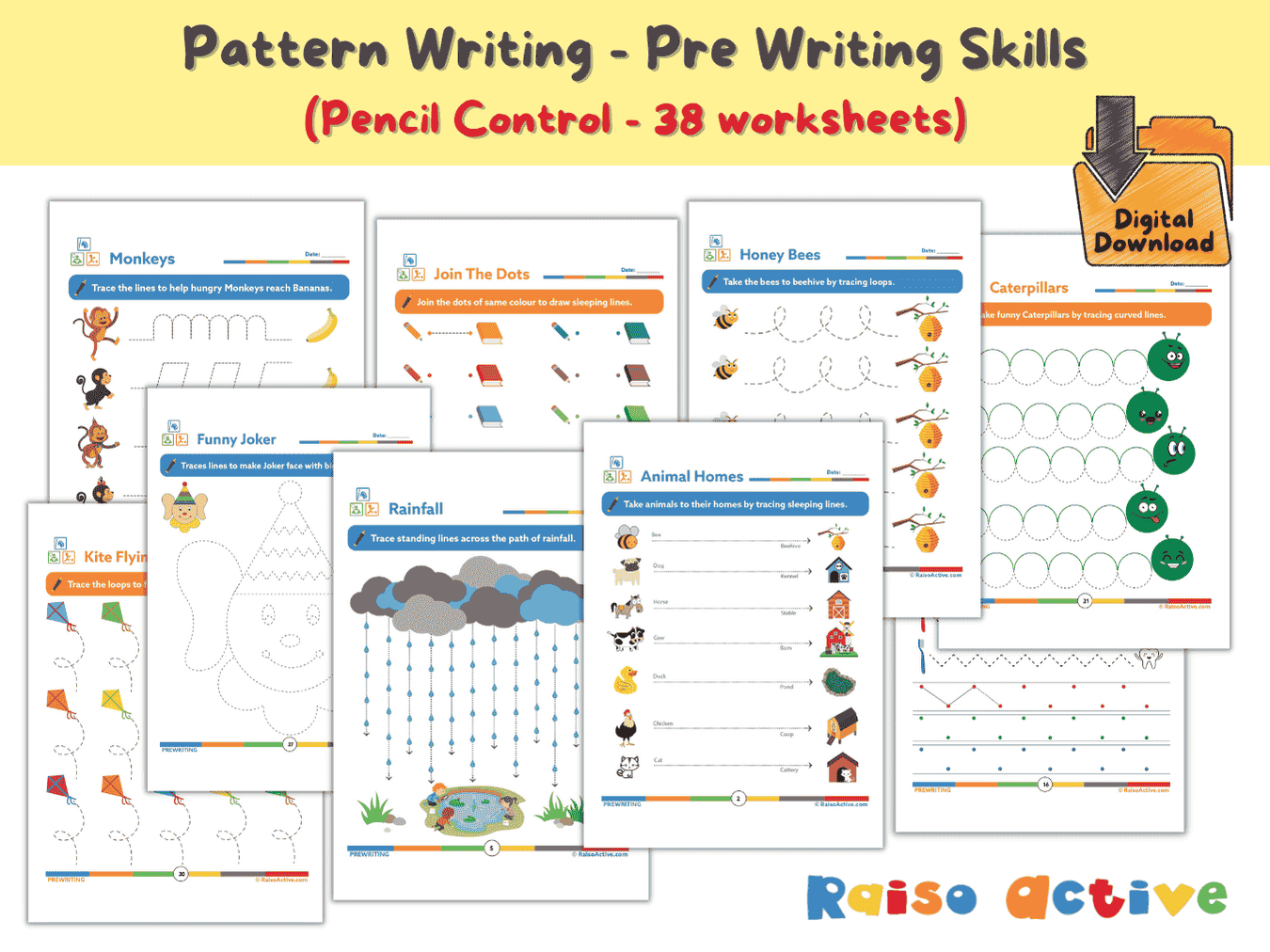
Pattern Writing Pre-writing Skills Activity Book for 3-4 Year Olds
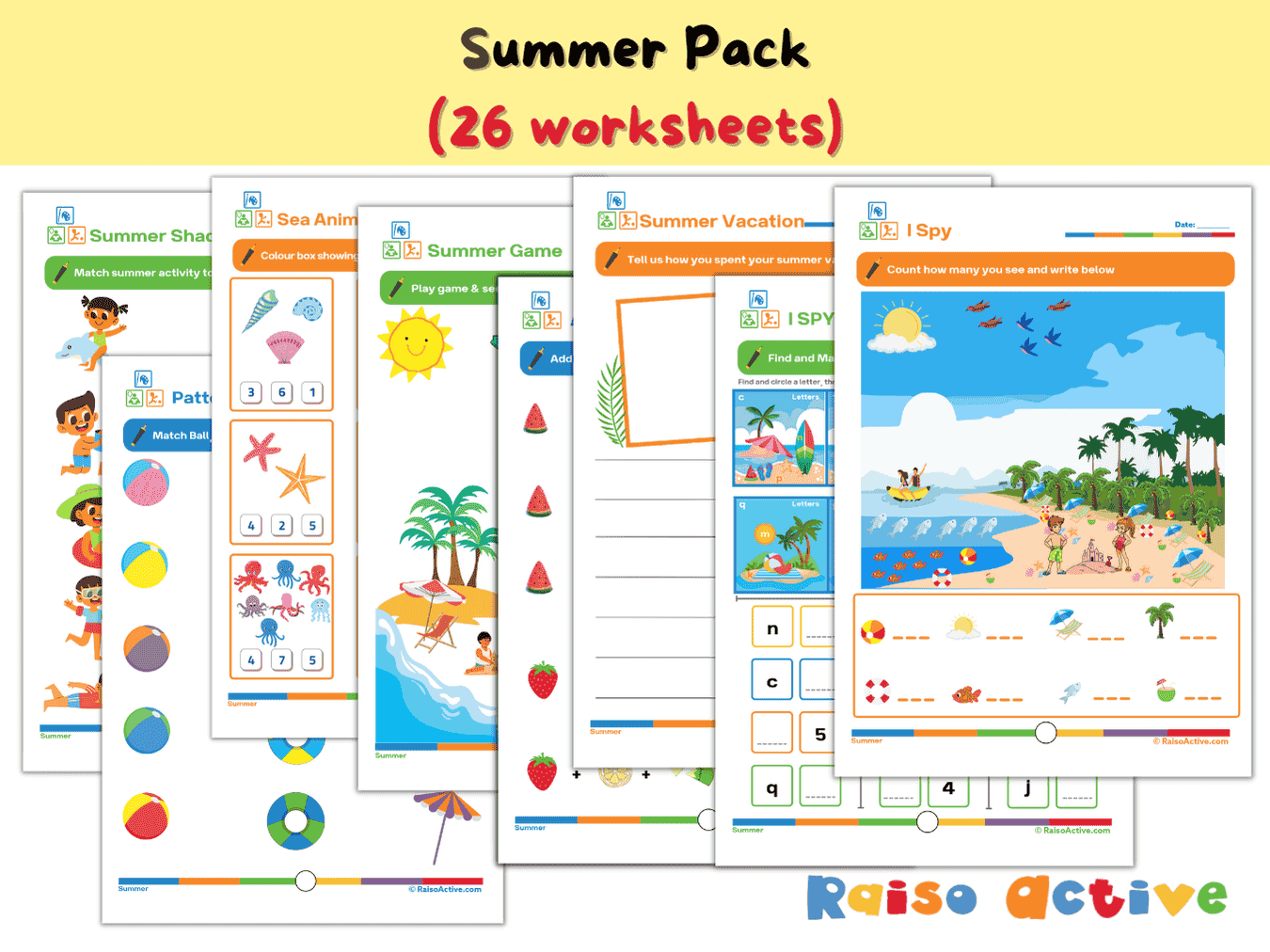
Summer Activity Pack: Math, Literacy, Puzzles & More for Preschool & Kindergarten
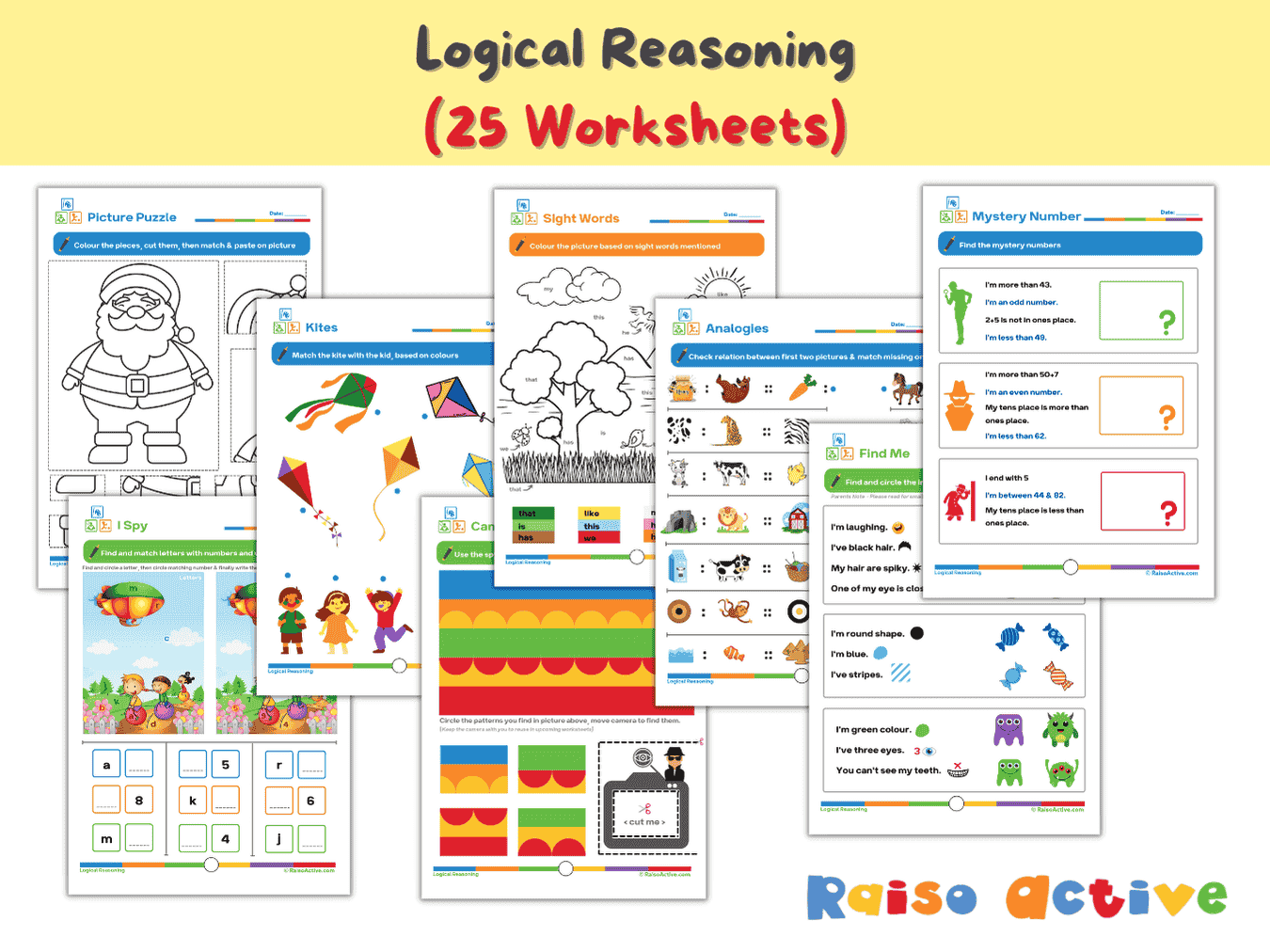
Logical Reasoning Activity Book for Preschool & Kindergarten | Patterns, Puzzles & Analogies
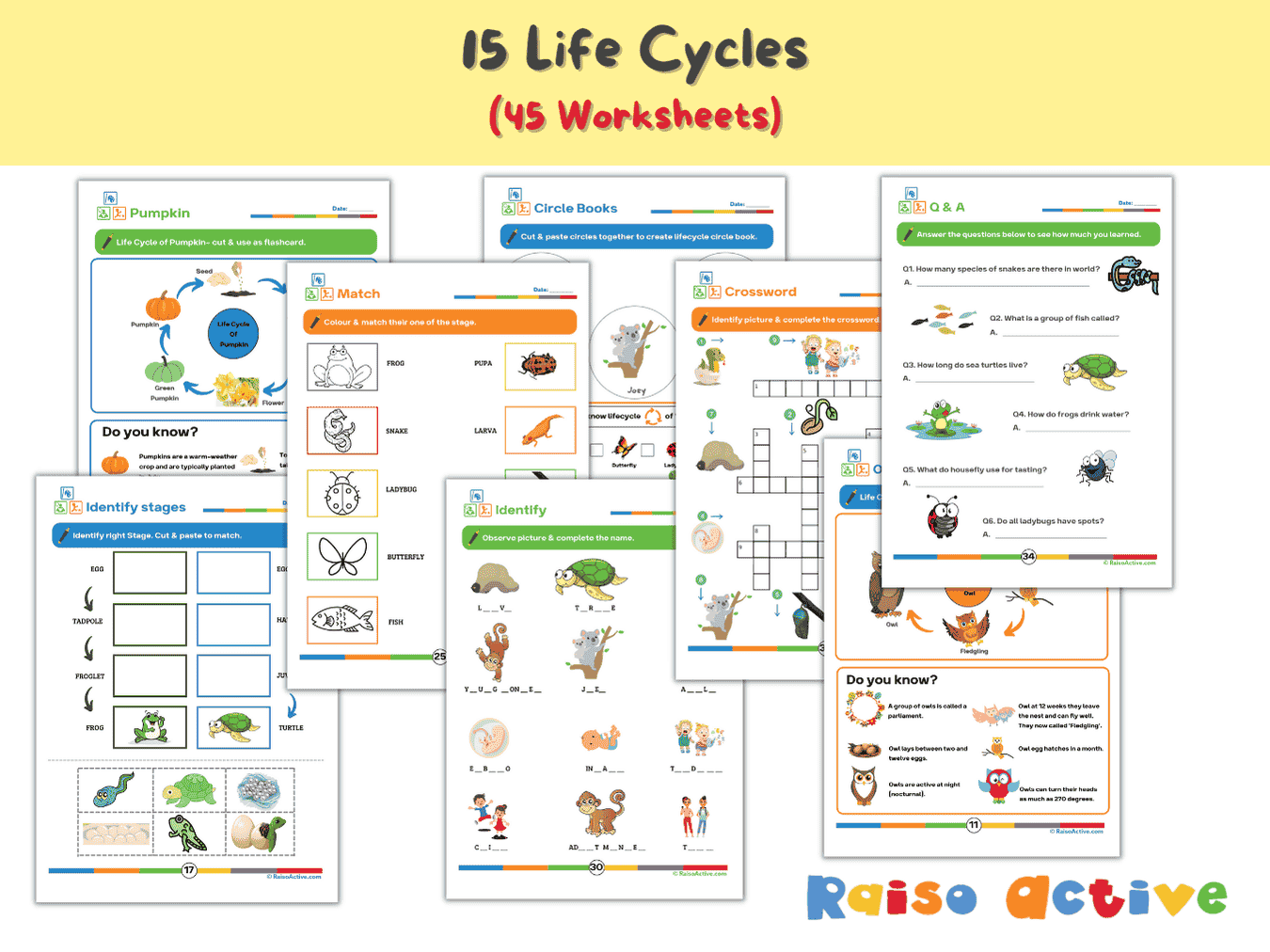
Lifecycles Activity Book & Flashcards for Preschool & Early Elementary
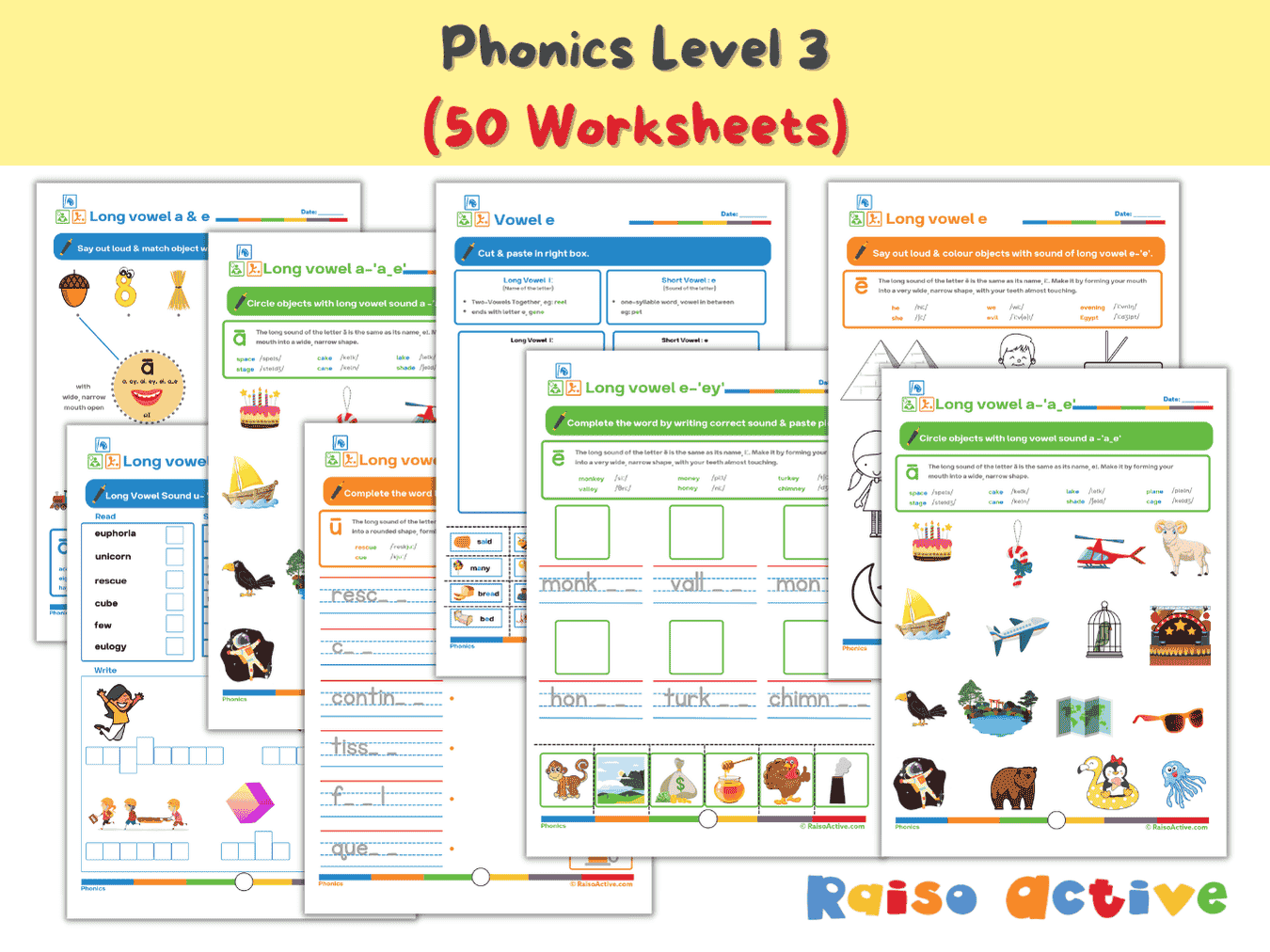
Phonics Level 3 Long Vowels Activity Book for Kindergarten & 1st Grade
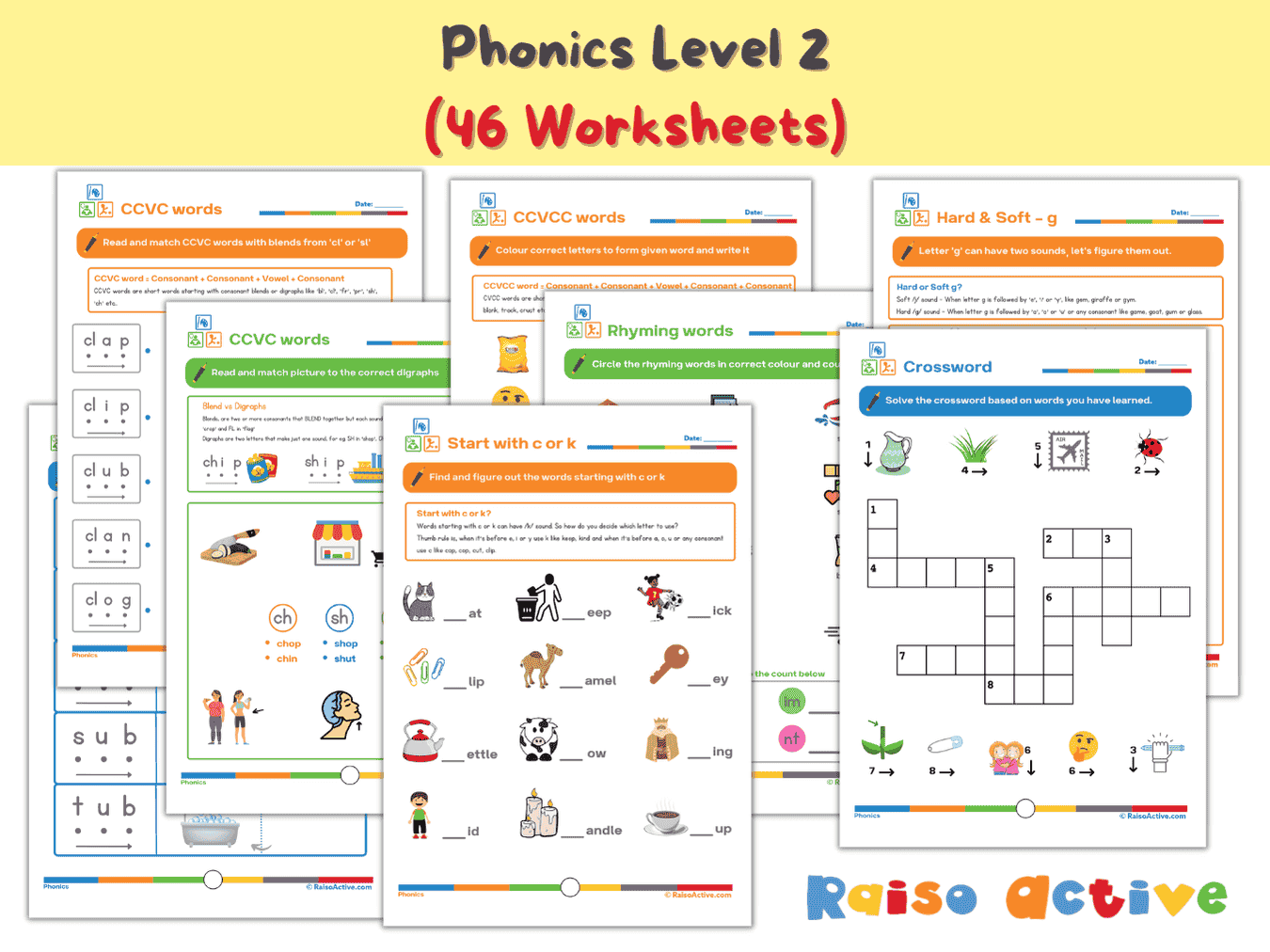
Phonics Level 2 Worksheets: CVC, CCVC, CVCC Word Families & Blends for Early Readers (Ages 4-7)
Guides for parents and teachers
See all guides →Number Formation Rhymes 0–9 and How to Fix Reversals
Original number formation rhymes for 0–9, the correct stroke order for each digit, why 3, 5 and 7 get reversed most often, and multisensory fixes that work.
Pre-Writing Strokes in Order: From Standing Lines to Loops (With Printable Patterns)
The developmental order of pre-writing strokes, from vertical lines to loops, and why practicing them in sequence makes letter formation much easier to learn.
Kindergarten Readiness Checklist: 25 Skills to Practice Before the First Day
A kindergarten readiness checklist of 25 literacy, math, motor, self-regulation and self-help skills, with an 8-week summer plan and notes on when not to worry.
Best Worksheets for 3-Year-Olds: What Works and What to Avoid
What works on worksheets for 3-year-olds: short sessions, crayons, tracing lines, matching, cutting, a free weekly plan, and signs one is too advanced.
Reception Year Explained: EYFS Learning and How to Help at Home
A teacher's plain-English guide to the Reception Year: the seven areas of learning, Early Learning Goals, Phase 2/3 phonics, the RBA and home routines.
What Should a 4-Year-Old Know Before LKG? A Readiness Checklist
A calm, teacher-written LKG readiness checklist for 4-year-olds: language, pattern writing, numbers to 10, self-help and social skills, plus a 6-week plan.
Canonical: https://raisoactive.com/worksheets/reception-letter-tracing