Free printable worksheets · United States
Preschool Counting Worksheets (Ages 3–4)
Preschool counting worksheets are practice sheets for children aged 3–4 in Preschool in the US. Counting is matching a spoken number word to each object in a group, one at a time, to find out how many there are in total. The sheets on this page cover one-to-one correspondence, counting a set of objects accurately, matching a numeral to a quantity and comparing more and less.
Preschool builds readiness rather than academics: pre-writing strokes, uppercase letter recognition, counting objects to ten, naming shapes and colors, and cutting along a line, all introduced through short table activities inside a mostly play-based day. Grip is still forming, so most activities favor a thick crayon over a standard pencil. Three-year-olds recite numbers to ten and touch-count up to five objects reliably, though counting six or more objects often breaks down or repeats a number. A worksheet should ask the child to count a small group and circle how many there are, count out loud while pointing to a row of pictures, and compare two small groups to say which has more. Counting a scattered, unordered group, and going beyond ten, are still shaky at this age.
695+ worksheets · free PDF download · print on A4 or Letter
Preschool Counting Worksheets to print
Browse all worksheets for ages 3–4
Clothing Pattern Match Worksheet for Preschoolers
This worksheet has children ages 3-5 study repeating patterns on clothing items — stripes, polka dots, or checks — and match each item to its identical twin, building visual discrimination and early pattern-sequencing skills. Distinguishing between similar-looking patterns also sharpens attention to detail, a skill that later supports letter and word recognition.

Counting Fun: Match the Numbers Worksheet for Preschoolers!
This worksheet layers three related counting skills, counting a group of objects, matching that group to its printed numeral, and matching the numeral to a set of fingers, so children see the same quantity represented three different ways. Seeing one number expressed as objects, digits, and fingers helps cement true number sense rather than just memorized counting words.

Easter Pattern Match Worksheet: Bunny, Basket, and Egg Fun!
This worksheet has children ages 3-5 study a repeating pattern shown across a set of bunny, basket, and egg images, then identify which item on the right continues or matches that same pattern. Recognizing a pattern by its color or design sequence builds early algebraic thinking, since spotting what comes next is a skill children will rely on throughout math.

Match the Words! A Fun Phonics Worksheet for Preschoolers
This phonics worksheet asks children ages 3-5 to match words to pictures and then fill in missing letters, combining whole-word recognition with letter-sound practice in one activity. Recognizing a written word and connecting it to its meaning is an early literacy milestone, while filling in missing letters pushes children to actively recall which sound belongs where rather than just reading passively. Together these two tasks build both sight recognition and phonemic spelling skills side by side.
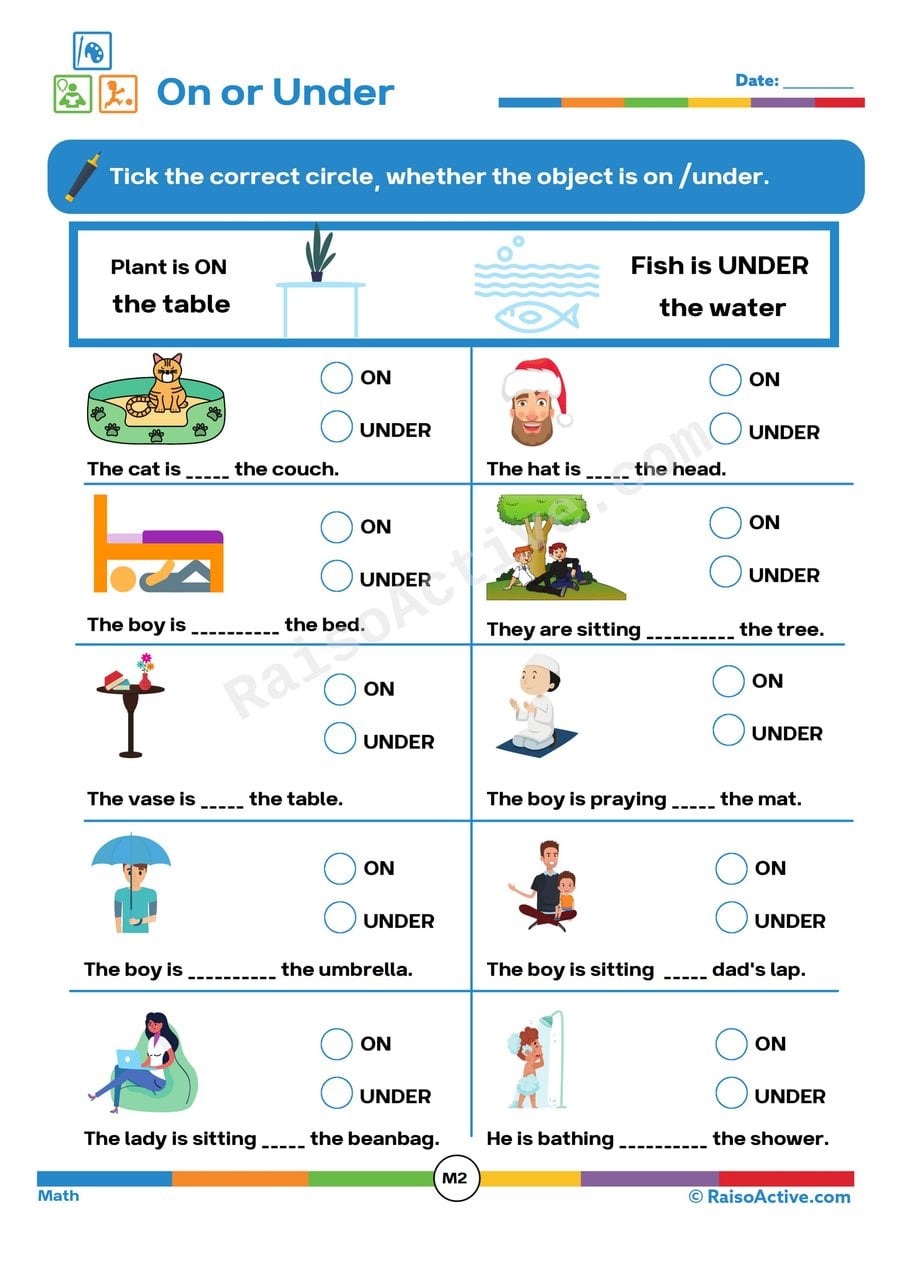
On or Under Worksheet: Where is the Object?
Reading a short sentence describing an object's location and then ticking the picture that matches teaches children ages 3-5 to connect spoken or written prepositions, 'on' and 'under,' to a visual representation, strengthening both listening comprehension and spatial vocabulary. This worksheet requires children to hold a sentence in mind and compare it against a picture, which is a slightly more advanced skill than simply naming a position they can already see. Understanding prepositions like these supports later reading comprehension, since so many simple stories depend on describing where things are.

Clothing Pattern Matching Worksheet for Preschoolers
By comparing clothing items and connecting each one to its pattern match, children ages 3-5 build visual discrimination skills, learning to notice fine differences in stripes, dots, or repeated shapes. This close-looking practice supports the same attention-to-detail children will later need to tell similar-looking letters and numbers apart.
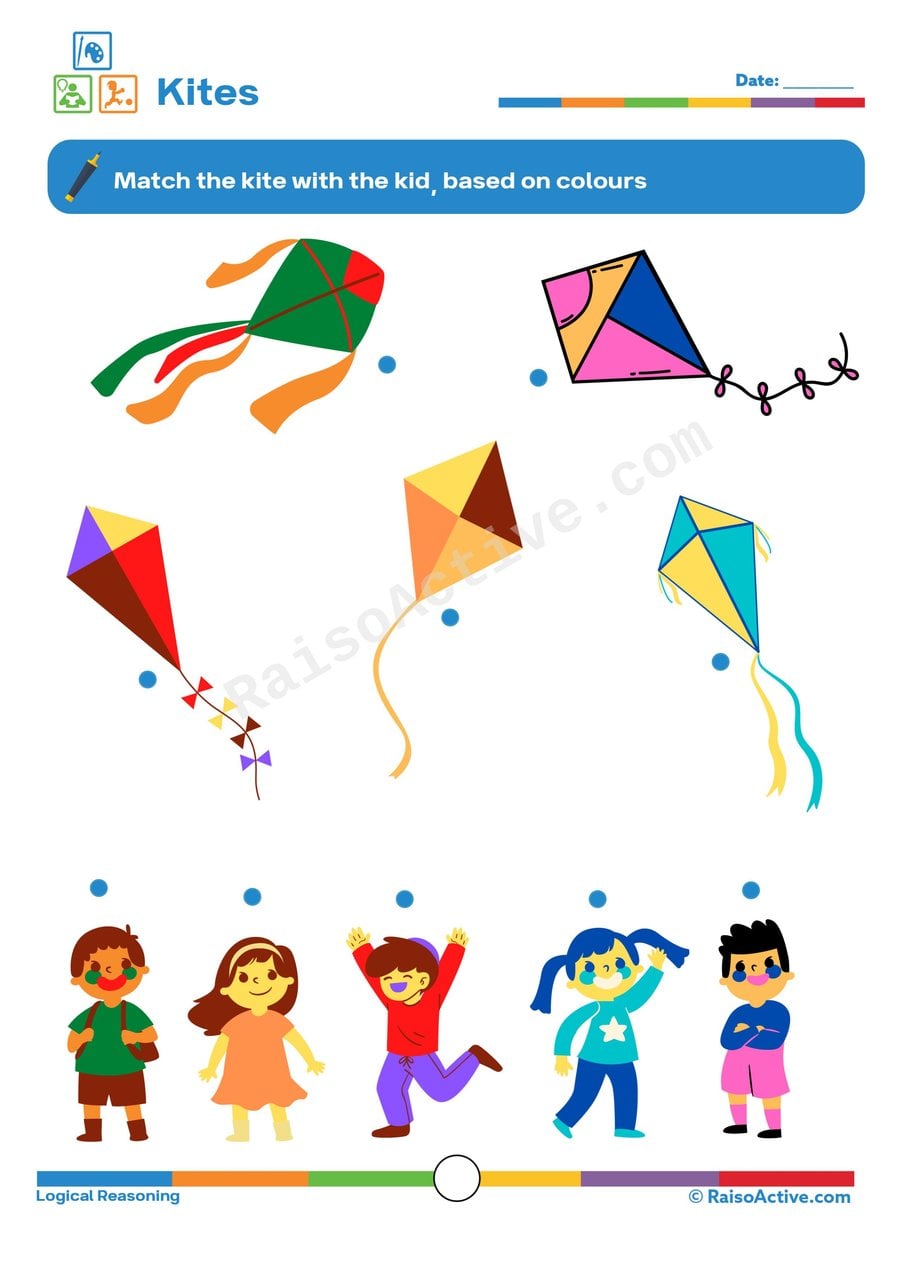
Kite Color Matching Worksheet for Preschoolers
This color-matching worksheet asks children ages 3-5 to connect each kite to the child flying a matching-colored kite, reinforcing color recognition and visual discrimination as they scan multiple color options across the page. Because children must compare several colors at once rather than matching a single pair, the task demands more sustained visual attention than a simple two-item match. Practicing color vocabulary in a playful, seasonal context also keeps repetition from feeling like rote drilling.

Consonant Sounds: Matching Objects to 'p' and 'n' Sounds Worksheet
This worksheet gives children ages 3-5 practice identifying the beginning sounds 'p' and 'n' and matching them to the correct pictures, an early step in connecting spoken sounds to written letters. At this age, distinguishing between consonant sounds that use different parts of the mouth (lips for 'p', tongue and nose for 'n') helps children build a mental map of how sounds are produced, which supports both listening and eventual spelling. Matching objects to sounds also reinforces vocabulary alongside phonics.

Fun Phonics Worksheet: Matching Uppercase and Lowercase Letters!
This matching worksheet teaches children ages 3-5 to recognize that uppercase and lowercase versions of the same letter — like S and s — represent one letter despite looking different, a concept that trips up many early readers. Drawing a line between the four matching pairs builds visual discrimination and letter-form memory, while the follow-up task of circling pictures that start with 'C' adds practice connecting a letter to its sound.
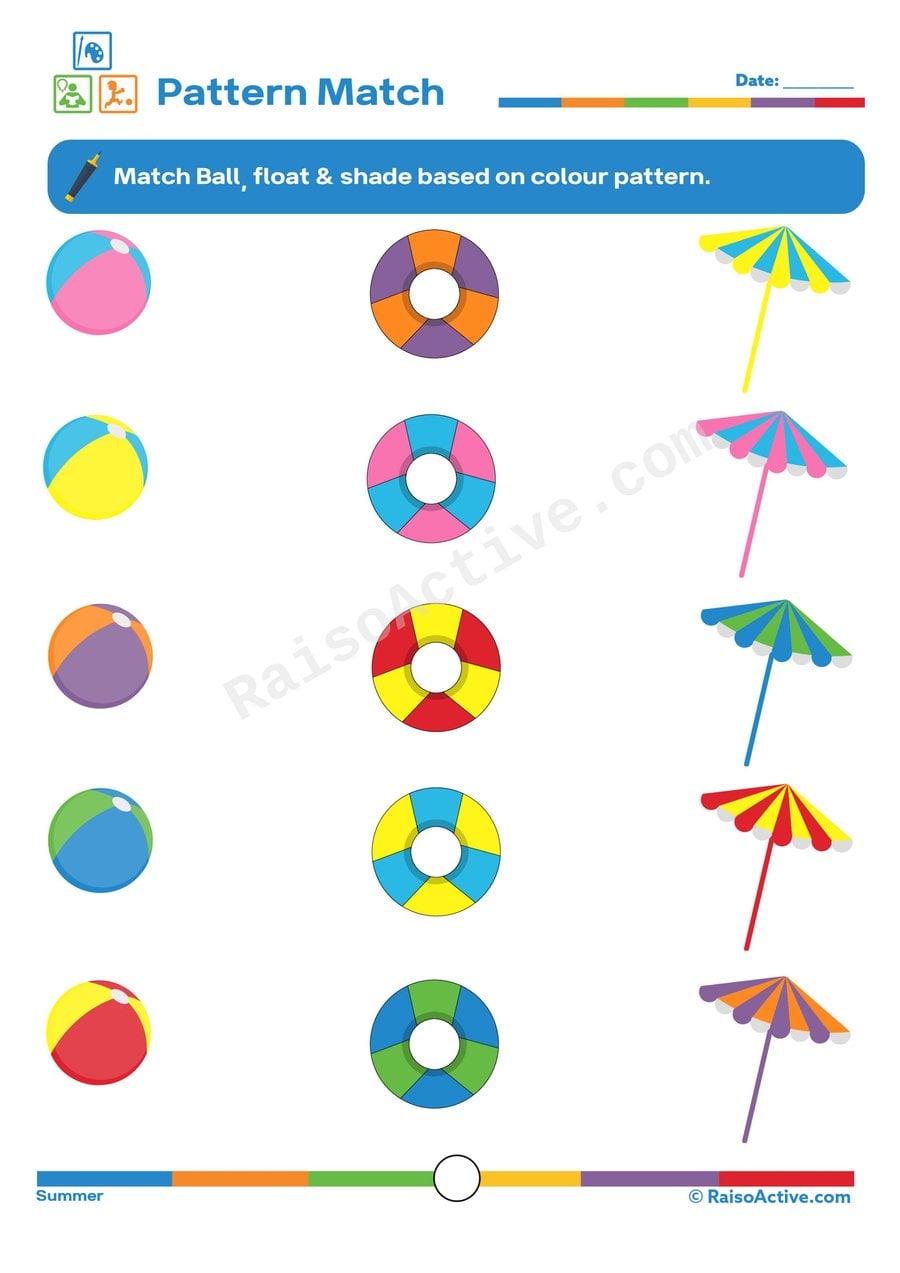
Summer Pattern Match Worksheet for Preschoolers
This worksheet asks children ages 3-5 to study the color pattern on a beach ball, pool float, and sun umbrella and match each item to its correctly patterned counterpart, building early pattern recognition, a foundational skill for later math concepts like sequencing and algebraic thinking. Because the match depends on noticing the order and repetition of colors rather than just matching a single color, children must compare details carefully rather than glance quickly. This strengthens visual attention alongside the pattern skill itself.
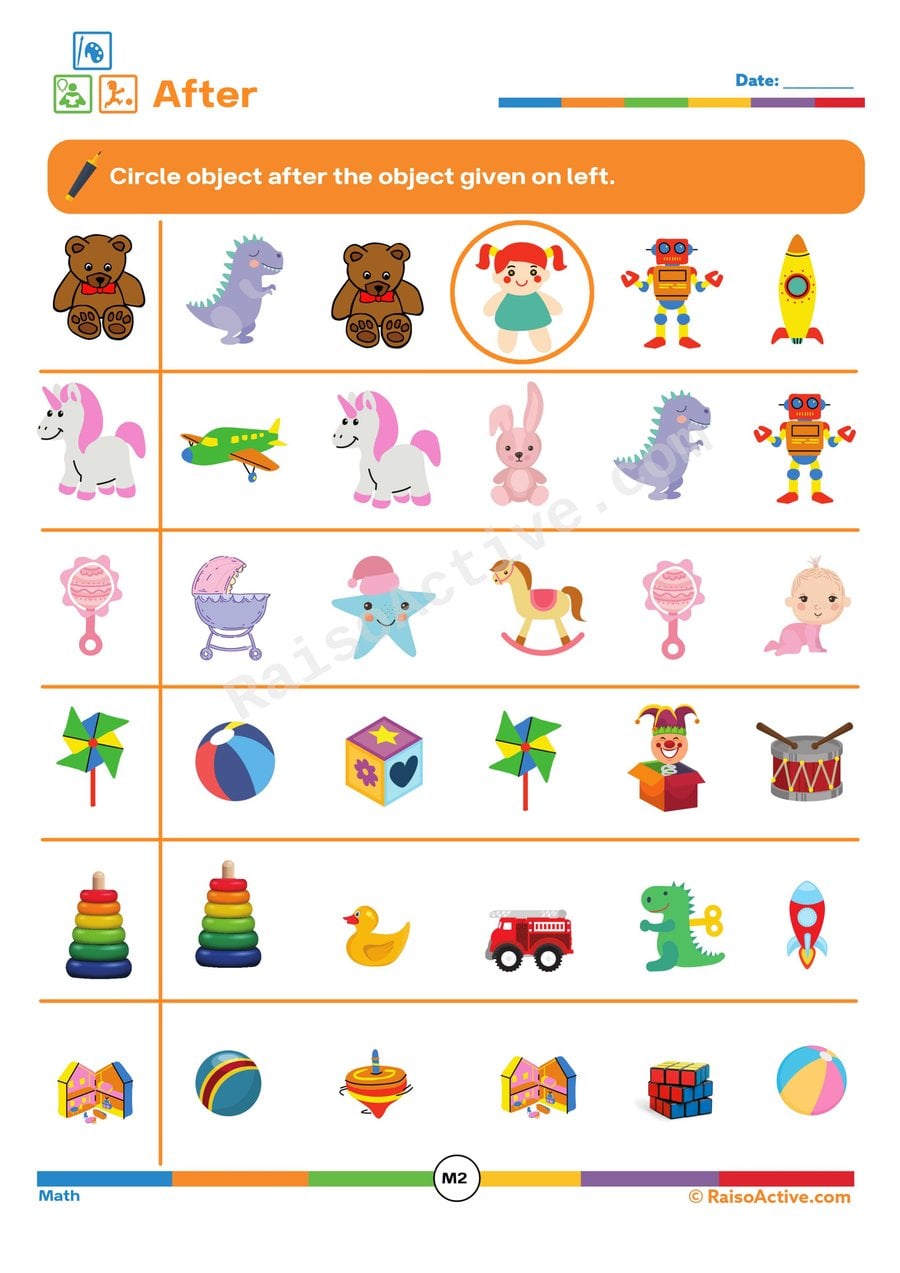
Object Sequencing Worksheet: What Comes After?
Preschoolers ages 3-5 build sequencing and pattern-recognition skills by identifying what object logically comes next after a given item. Predicting what comes next requires observing a pattern or relationship and applying that logic forward, an early form of the reasoning used in later math and science. Circling the correct answer among several options also sharpens careful visual comparison and decision-making.

Animal Food Matching Worksheet for Preschoolers
This worksheet teaches children ages 3-5 which foods different animals eat by matching each animal to its correct food, building early classification skills and expanding their vocabulary around animals and diets. Learning that a rabbit eats carrots while a bird eats worms also introduces the idea that living things have different needs, a first step toward basic life-science thinking.
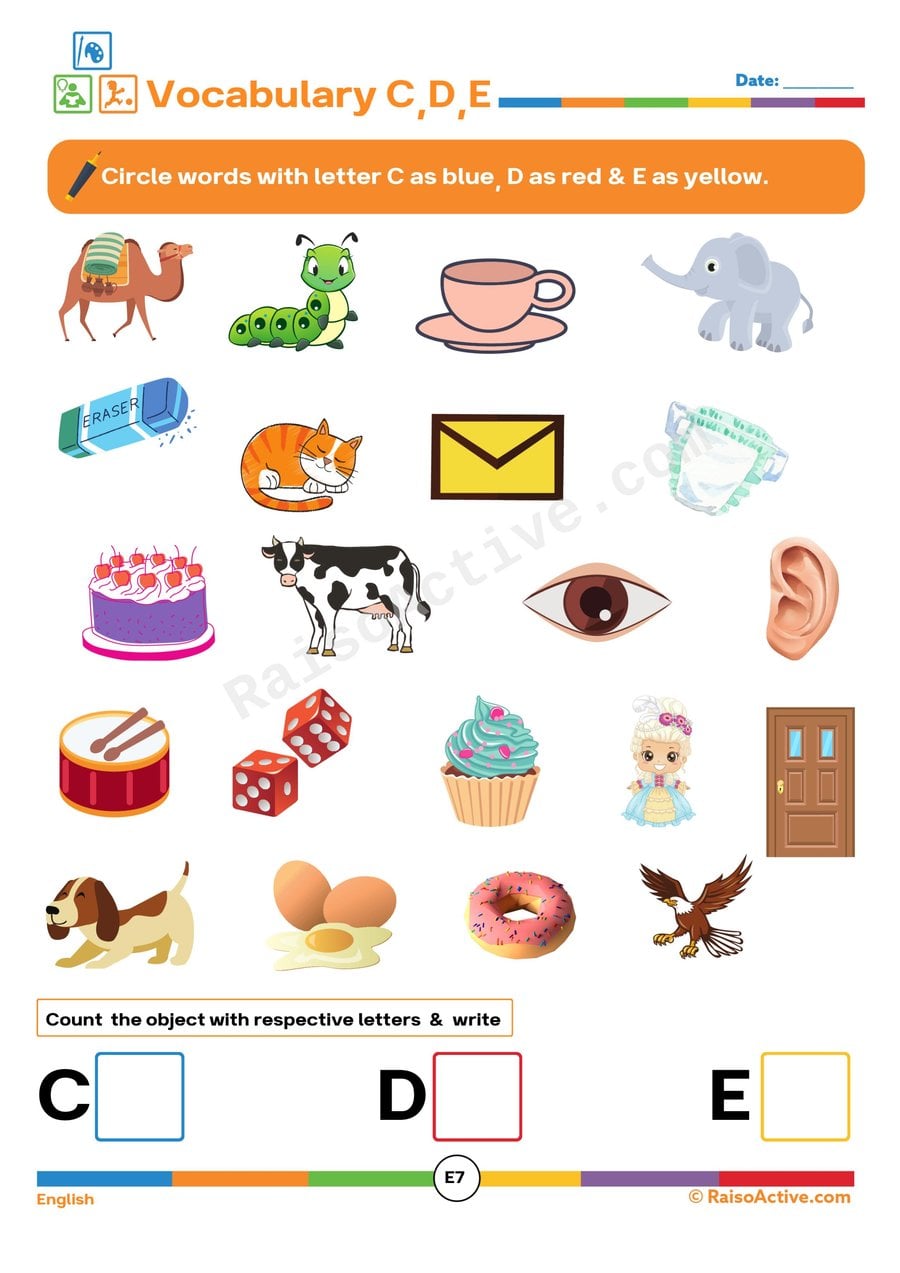
C, D, E Letter Sounds Worksheet: Circle and Count!
This activity gives children ages 3-5 focused practice recognizing the beginning sounds of the letters C, D, and E, asking them to circle matching pictures in different colors for each letter before counting the results. Combining phonics with counting means children practice two skills in one sitting: identifying initial letter sounds and recording a numeric total, both foundational for kindergarten readiness. Color-coding each letter also helps children visually organize the three sounds instead of mixing them together.

Road Safety Signs Matching Worksheet for Preschoolers
Matching road safety signs teaches 3-5 year olds to recognize specific shapes, colors, and symbols and connect them to their real-world meaning — an early form of symbol literacy that matters well beyond the worksheet, since these are signs your child will actually encounter on walks and car rides. Coloring the signs first, then matching them, reinforces visual recognition through repetition before the matching task asks them to recall each sign's identity without color cues alone.

Shape Movement Worksheet: Rolling, Stacking, and Sliding Fun!
This worksheet introduces children ages 3-5 to a physical property of 3D shapes — whether they roll, stack, or slide — by having them examine shapes like spheres, cubes, and cylinders and match each one to its correct type of movement. Understanding how a shape's form determines its behavior is an early step in geometric reasoning that goes beyond simply naming shapes.

Long, Tall, and Short: Comparing Objects Worksheet for Kids
Children ages 3-5 build comparative reasoning by identifying which of two or three objects is long, tall, or short. Understanding relative size — that an object is only 'tall' compared to something else — is an early measurement skill that lays the groundwork for later concepts like more/less and eventually numeric comparison.
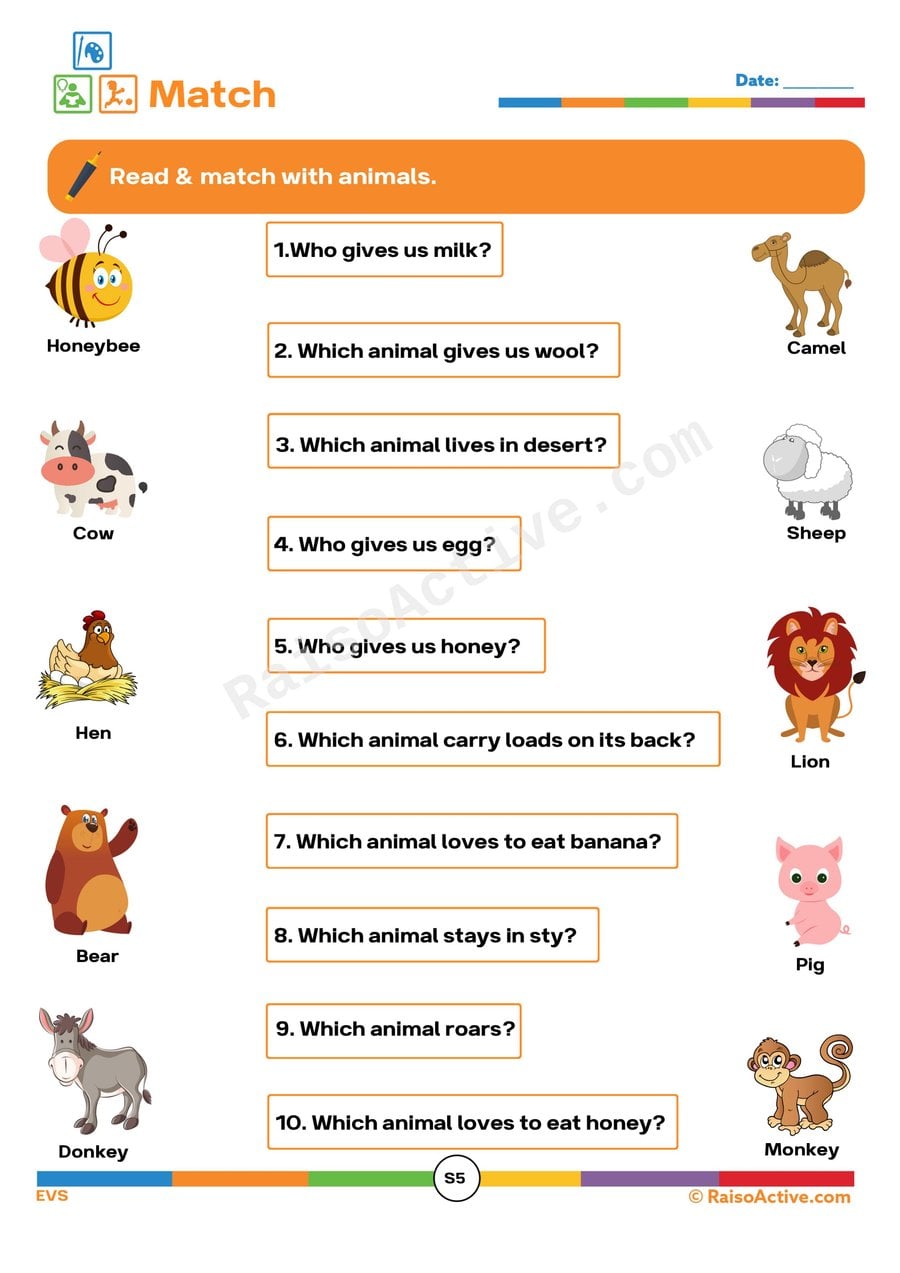
Match the Animals! A Fun Worksheet for Kids
This worksheet helps children ages 3-5 build observation and reasoning skills as they read a simple question or clue about an animal and match it to the correct picture. Rather than matching by appearance alone, children must connect descriptive language to an animal's known characteristics, which strengthens both listening comprehension and early vocabulary about animals.

Healthy Eating Worksheet: Fruit Salad and Vegetable Soup!
This matching worksheet helps children ages 3-5 build food vocabulary by identifying pictures of fruits and vegetables and sorting them into the correct category — fruit salad ingredients or vegetable soup ingredients. Learning to classify foods by type, not just by whether they're healthy, supports early categorization skills that apply across many other subjects, from animals to shapes. The cooking-themed framing also connects the sorting task to a familiar, everyday context children may have experienced at home.

Match the Verb: Action Verbs Worksheet for Preschoolers
Action verbs are some of the first 'doing words' children learn to recognize in print, and this worksheet asks children ages 3-5 to spot the verb within a simple sentence and connect it to a picture showing that action. Circling the verb first trains children to identify the part of a sentence that describes an action, an early grammar skill, while matching it to a picture reinforces comprehension of the word's meaning. This combination builds both reading and vocabulary skills using content — running, jumping, eating — that's naturally engaging to young children.
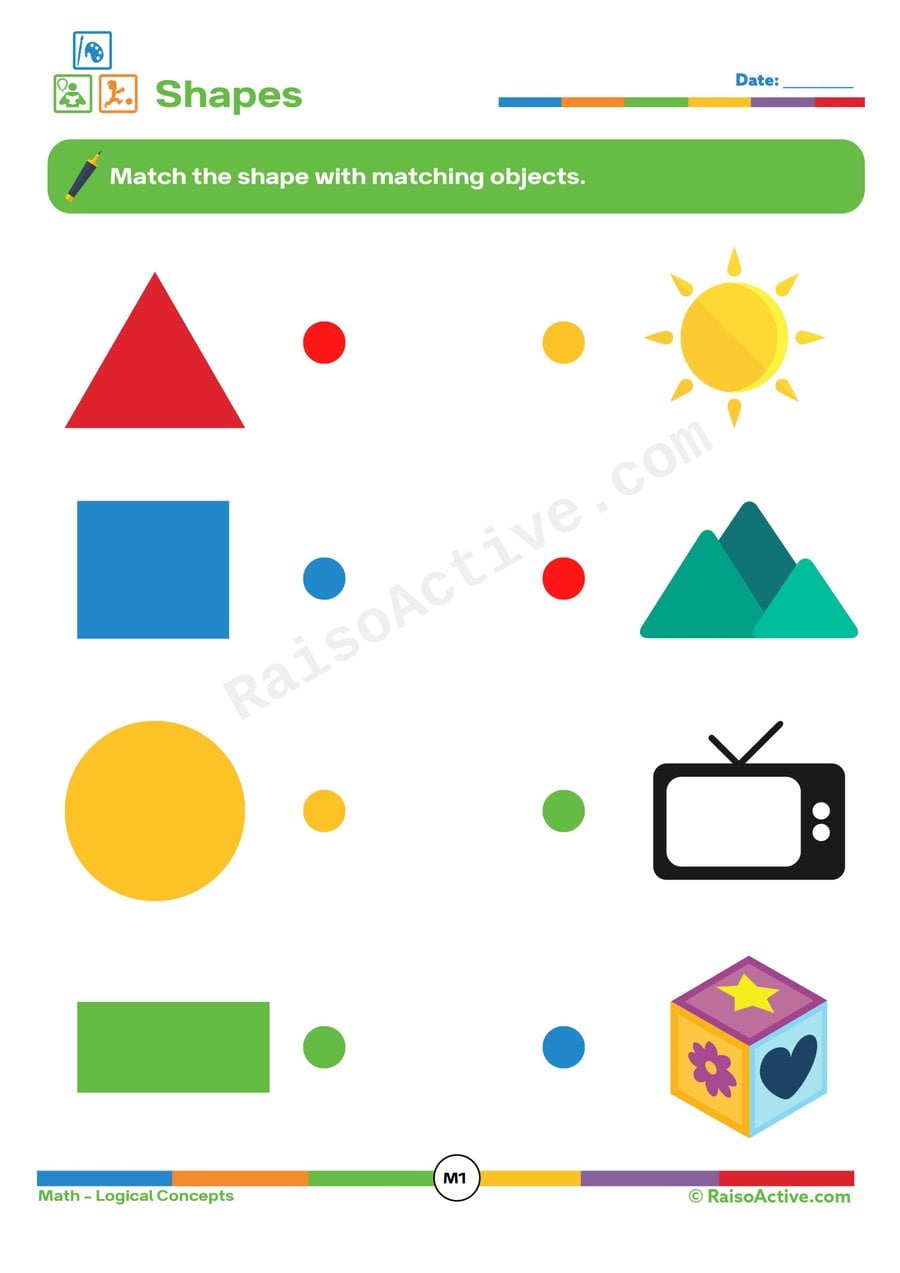
Shape Matching Worksheet for Preschoolers
This worksheet helps children ages 3-5 practice recognizing basic geometric shapes by connecting each shape outline to the everyday object it resembles. Pairing an abstract shape with a concrete object supports the transition from recognizing shapes in isolation to spotting them out in the real world. Drawing a connecting line between the matched pairs also builds hand-eye coordination and pencil control.
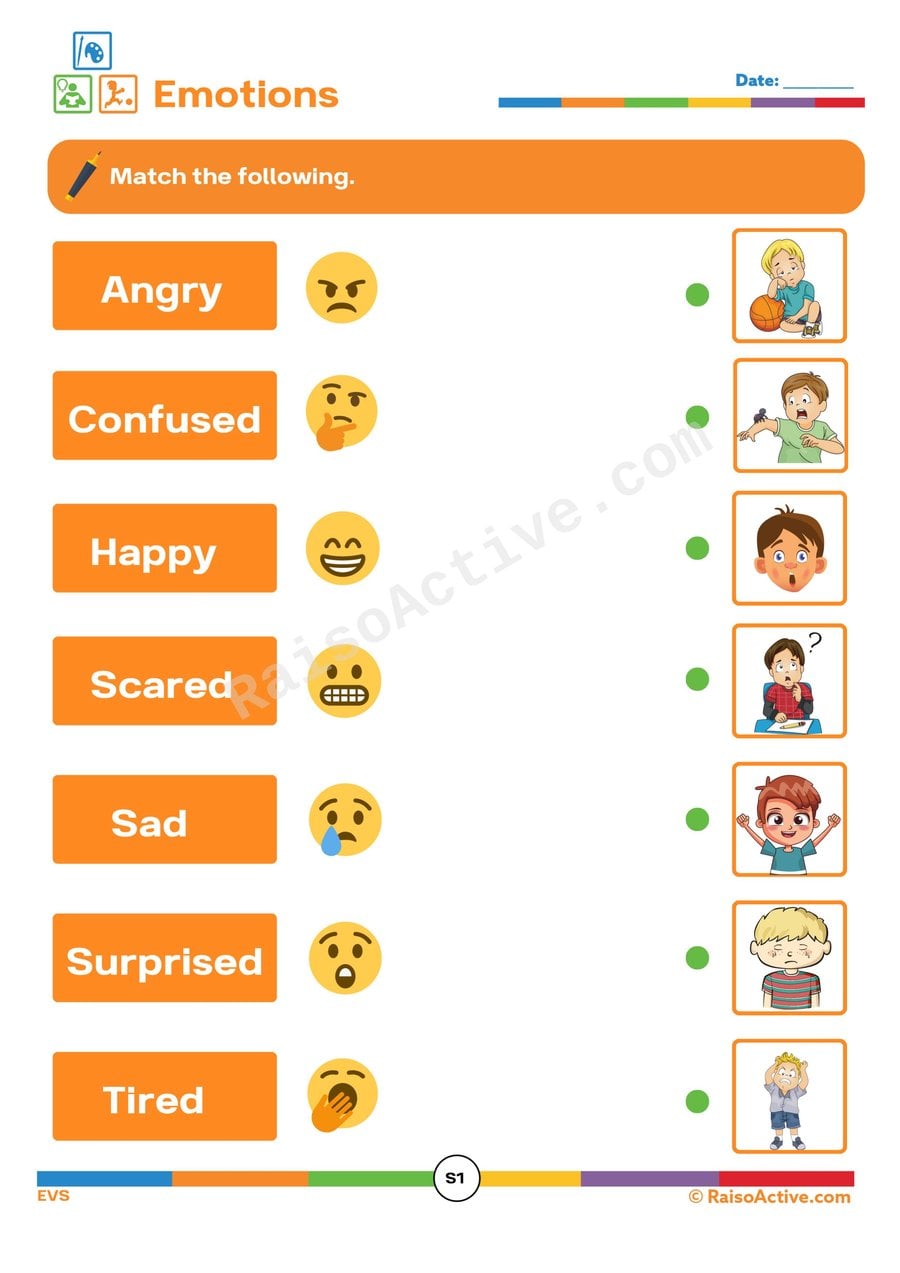
Emotions Matching Worksheet for Preschoolers
Recognizing and naming emotions is a foundational social-emotional skill for children ages 3-5, helping them build the vocabulary needed to express their own feelings and understand the feelings of others. This worksheet asks children to match emotion words to corresponding facial expressions, strengthening their ability to read facial cues — a skill that supports empathy and smoother social interactions. Building this kind of emotional vocabulary early also gives children better tools for self-regulation, since naming a feeling is often the first step toward managing it.
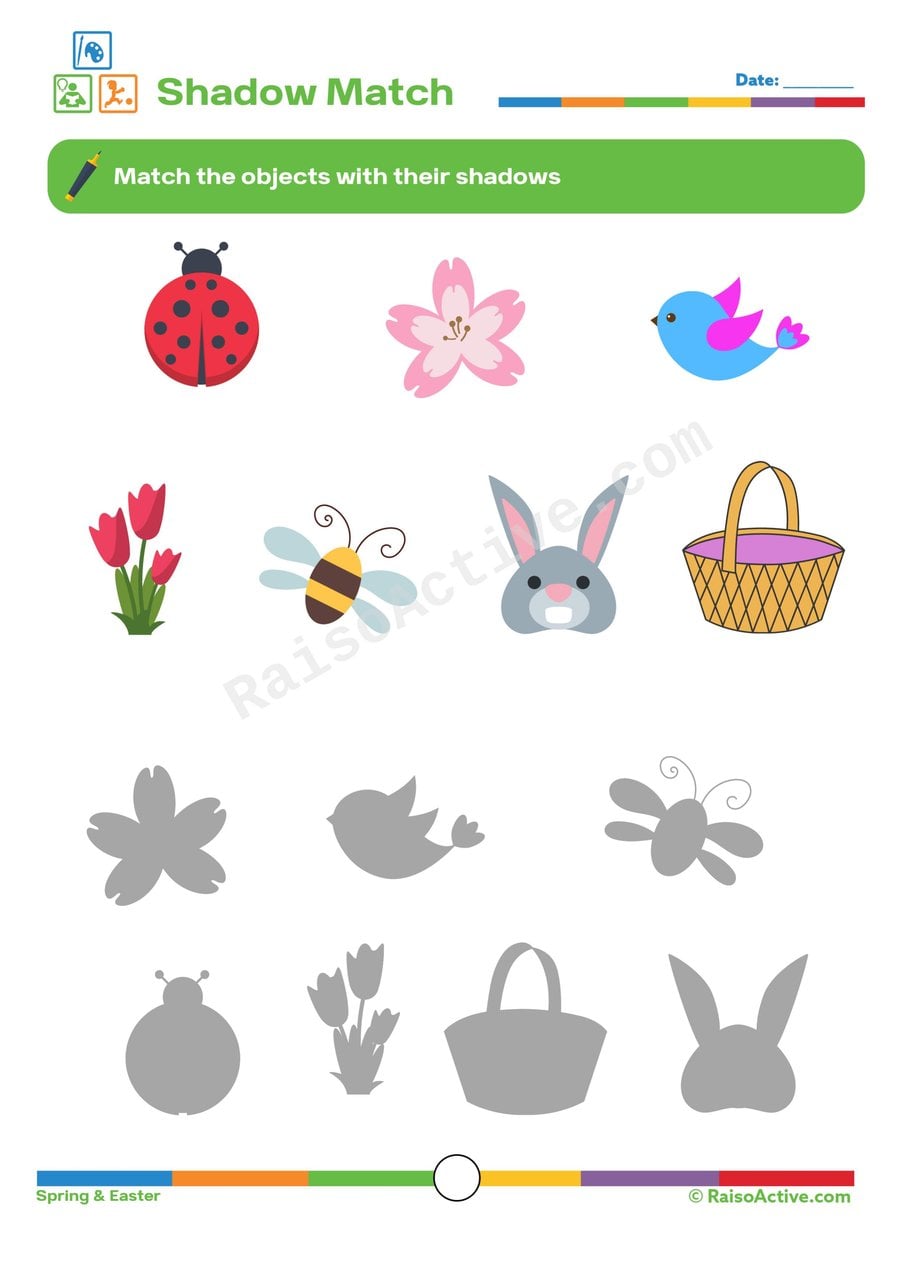
Spring Shadow Match Worksheet for Preschoolers
Children ages 3-5 practice visual discrimination by matching spring-themed objects to their correct silhouette shadows. Because shadows strip away color and detail, leaving only outline shape, this activity sharpens a child's ability to focus on form alone — a more advanced visual skill than matching by color or pattern.

Subtraction Fun: Counting and Subtracting Worksheet for Kids
This worksheet gives 3-5 year olds direct practice subtracting the smaller number from the larger one, using accompanying pictures to make each subtraction problem visible and countable rather than purely abstract. Working through picture-supported subtraction repeatedly at this age builds the number sense needed before children can subtract using numerals alone, without a picture to lean on.

Count and Match: Number Names Worksheet for Preschoolers
This worksheet helps children ages 3-5 connect a counted group of objects to its written number name, reinforcing that a quantity, a numeral, and a number word all represent the same idea. Counting a group and then finding its matching name — rather than just its matching numeral — adds an extra layer of number literacy, since your child must recognize or read the word form as well as understand the quantity.
What Preschool counting worksheets cover
Three-year-olds recite numbers to ten and touch-count up to five objects reliably, though counting six or more objects often breaks down or repeats a number. A worksheet should ask the child to count a small group and circle how many there are, count out loud while pointing to a row of pictures, and compare two small groups to say which has more. Counting a scattered, unordered group, and going beyond ten, are still shaky at this age.
- Touch-count up to five objects, saying one number per object
- Recite numbers to ten from memory, in order
- Circle the number that matches a small counted group
- Say which of two small groups has more
How to use these worksheets at home or in class
Five minutes is a solid session for a three-year-old, ten minutes the practical ceiling. Offer a thick crayon or a short fat pencil, sit beside your child, and treat the sheet as one activity among blocks, stories and outdoor play rather than as schoolwork.
Start with the sheet that matches what your child can already do, then move one step up. Keep finished sheets in a folder: Preschool teachers often ask for evidence of practice, and children like seeing their own progress.
Is your child ready for Preschool counting work?
A child ready for these activities holds a crayon and makes deliberate marks, sits at a table briefly, follows a single spoken instruction, and shows some interest in the letters of their own name or the numbers they hear counted aloud.
Frequently asked questions
My three-year-old can count to ten but loses track counting five toys. Why?
Because reciting numbers in order and touch-counting objects use different parts of counting, and the second is harder: it needs the child to keep track of which objects are already counted, especially if they can be moved. Practice sliding each object aside as it is counted, or lining objects up in a row rather than leaving them scattered, which removes the tracking problem. Reciting to ten usually comes before reliable counting of five loose objects.
What should a Preschool child be able to do in counting?
Three-year-olds recite numbers to ten and touch-count up to five objects reliably, though counting six or more objects often breaks down or repeats a number. A worksheet should ask the child to count a small group and circle how many there are, count out loud while pointing to a row of pictures, and compare two small groups to say which has more. Counting a scattered, unordered group, and going beyond ten, are still shaky at this age. A child ready for these activities holds a crayon and makes deliberate marks, sits at a table briefly, follows a single spoken instruction, and shows some interest in the letters of their own name or the numbers they hear counted aloud.
Do these worksheets follow the Preschool curriculum?
The sheets cover one-to-one correspondence, counting a set of objects accurately, matching a numeral to a quantity and comparing more and less, which sit inside the Head Start Early Learning Outcomes Framework (ELOF) outcomes for Preschool. Nursery (UK), Nursery (India) use the same skills at this age, so the sheets also fit families following those programmes.
Are these Preschool counting worksheets free?
Yes. Each worksheet downloads free as a watermarked PDF once you create an account, with a limit of five a day. An annual membership ($20) removes the watermark and the limit for the whole library of over 1,000 worksheets and every printable pack.

Written by
Hemsweta Jain · Teacher Cheena
MBA and Early Childhood Educator, teaching since 2014 · Founder of RaisoActive, Mumbai
Written and reviewed by Hemsweta Jain (Teacher Cheena), who designs every RaisoActive worksheet.
Last reviewed
Printable packs for ages 3–4
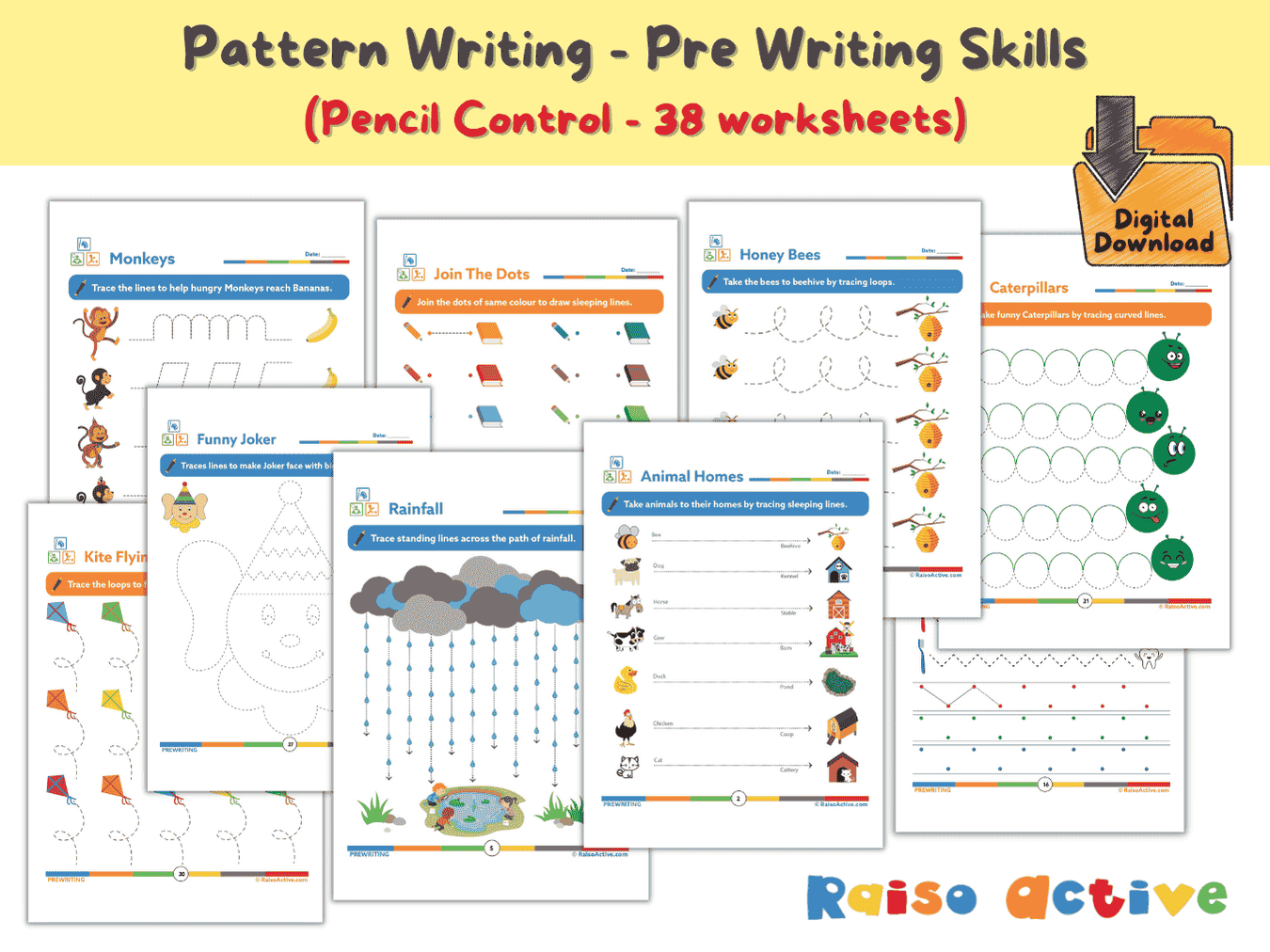
Pattern Writing Pre-writing Skills Activity Book for 3-4 Year Olds
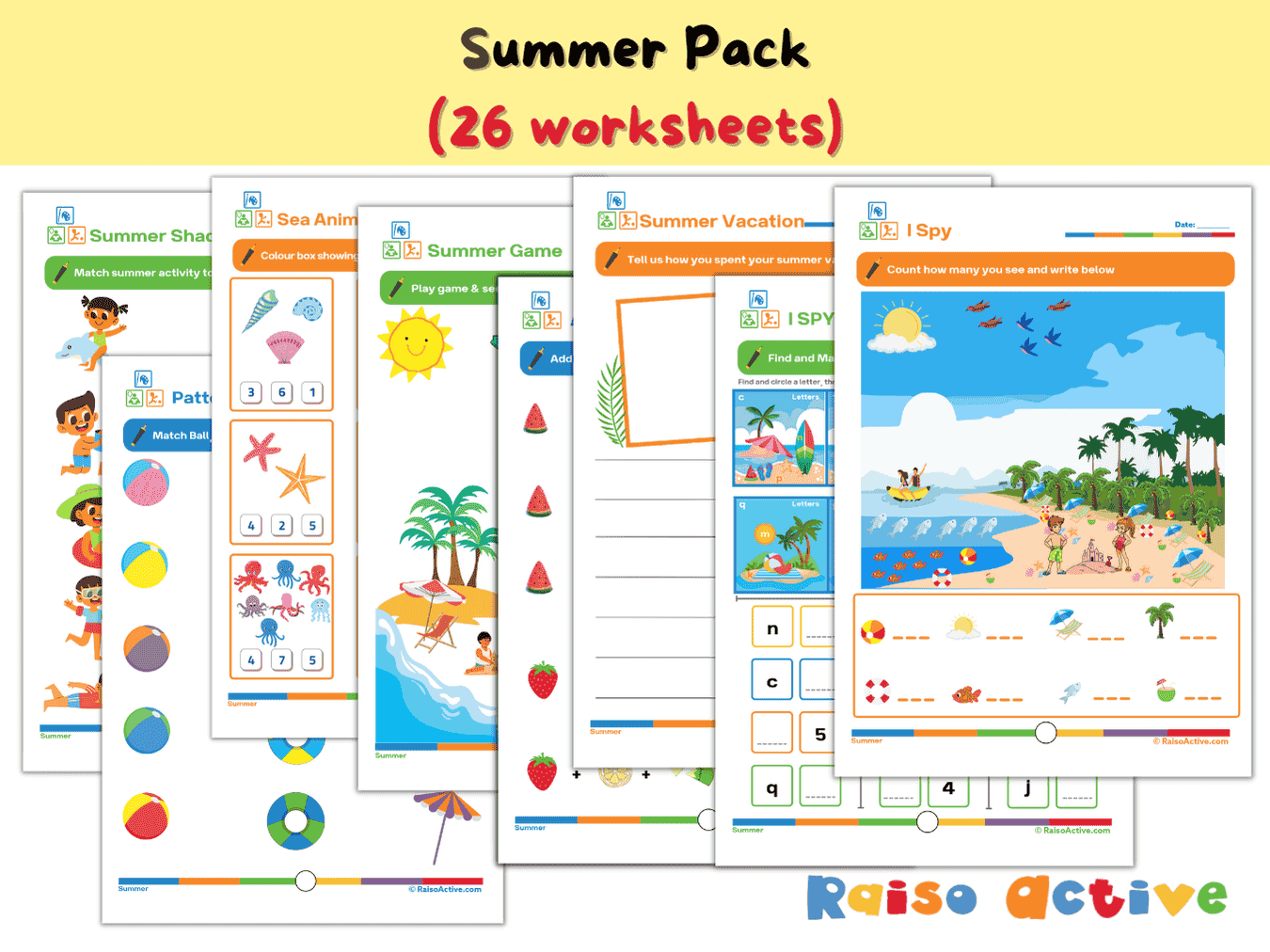
Summer Activity Pack: Math, Literacy, Puzzles & More for Preschool & Kindergarten
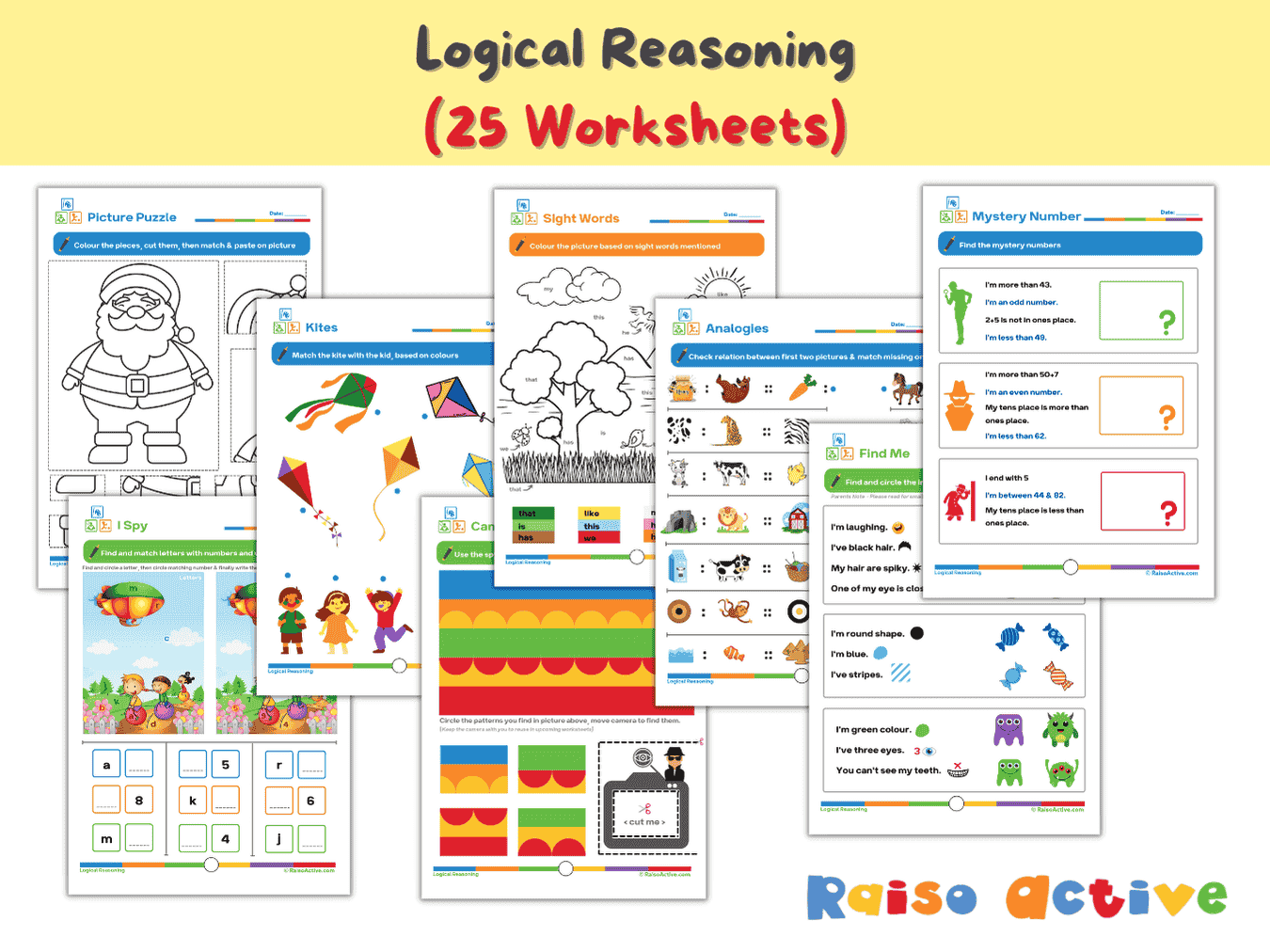
Logical Reasoning Activity Book for Preschool & Kindergarten | Patterns, Puzzles & Analogies
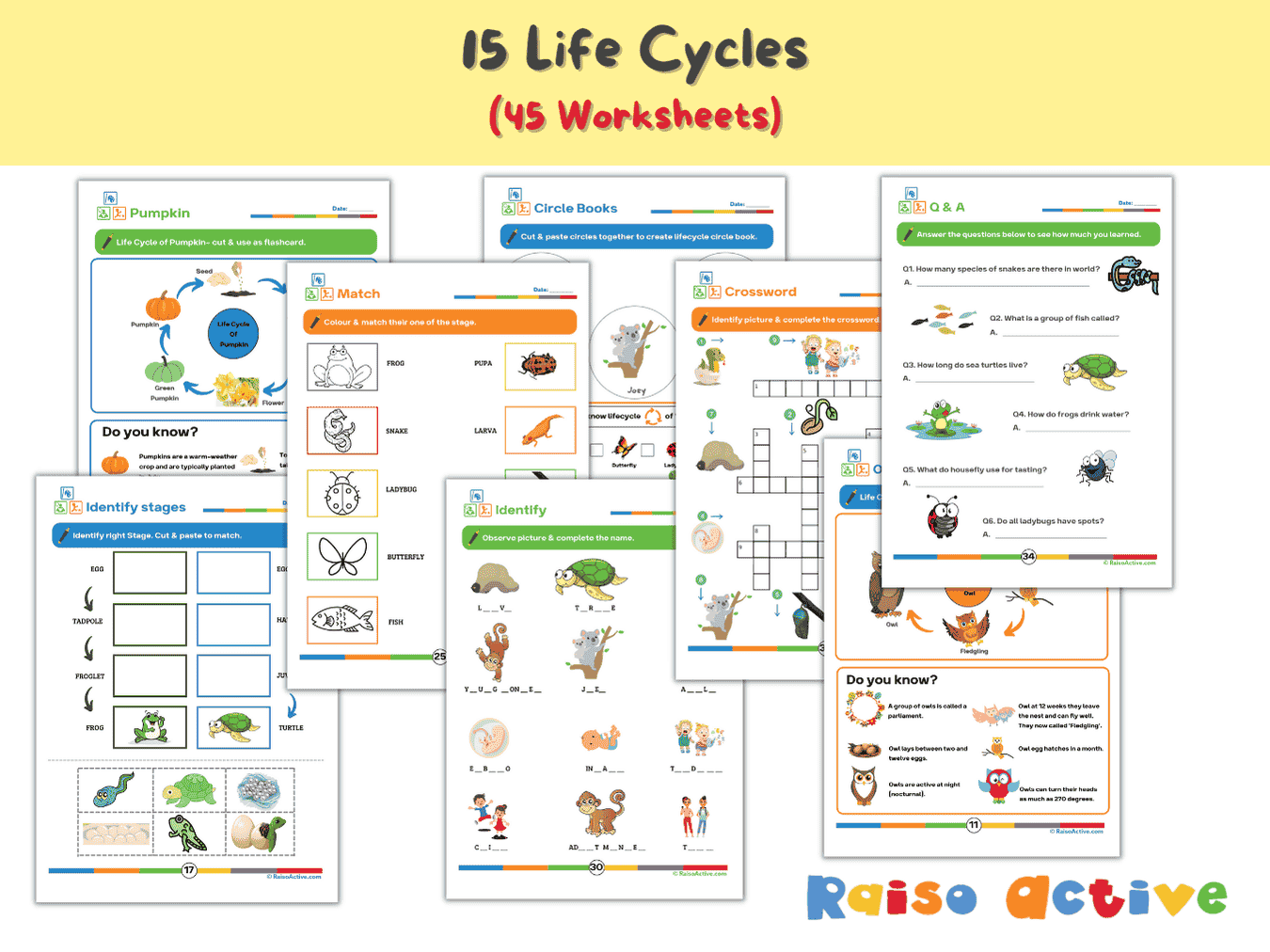
Lifecycles Activity Book & Flashcards for Preschool & Early Elementary
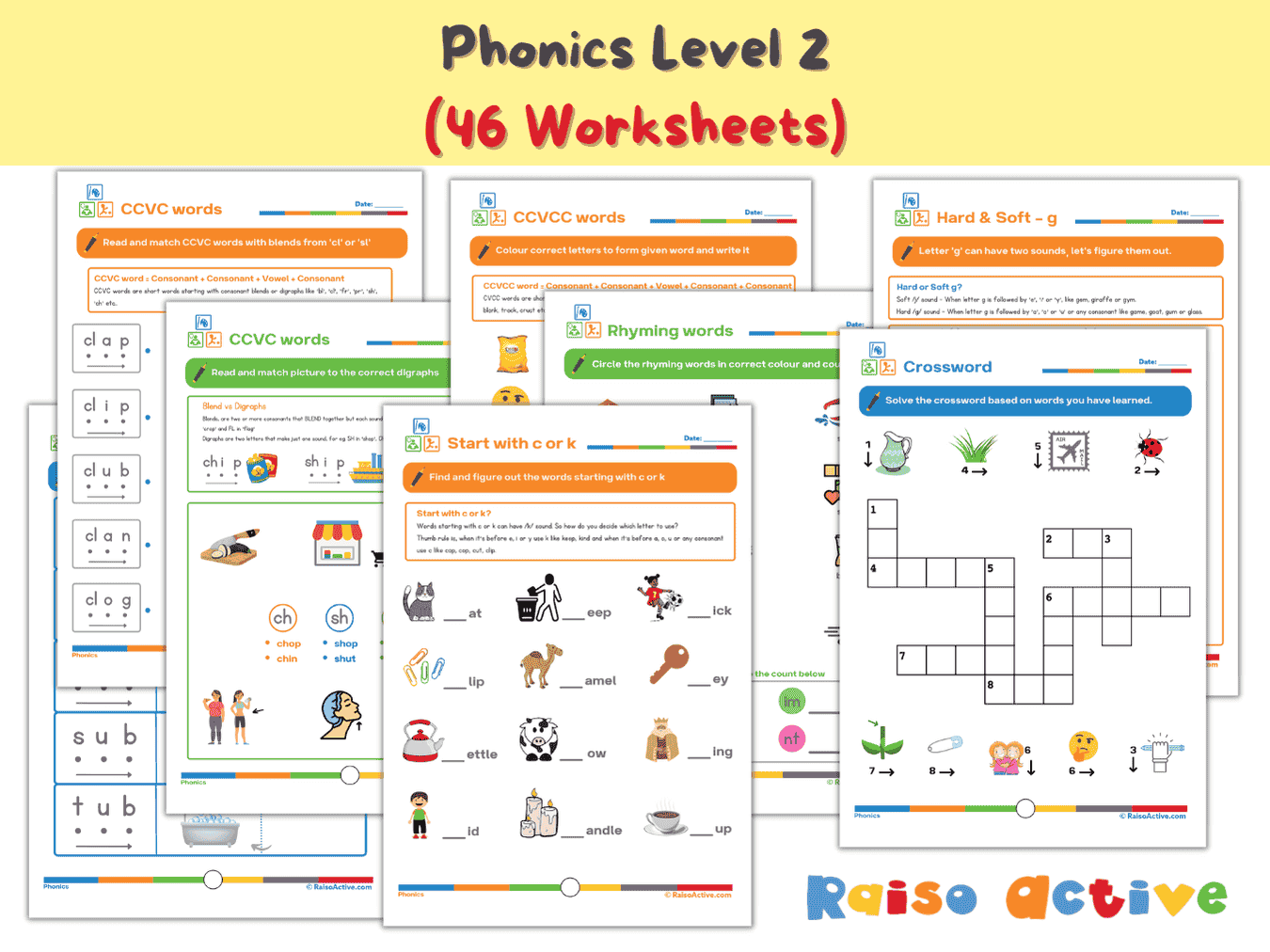
Phonics Level 2 Worksheets: CVC, CCVC, CVCC Word Families & Blends for Early Readers (Ages 4-7)
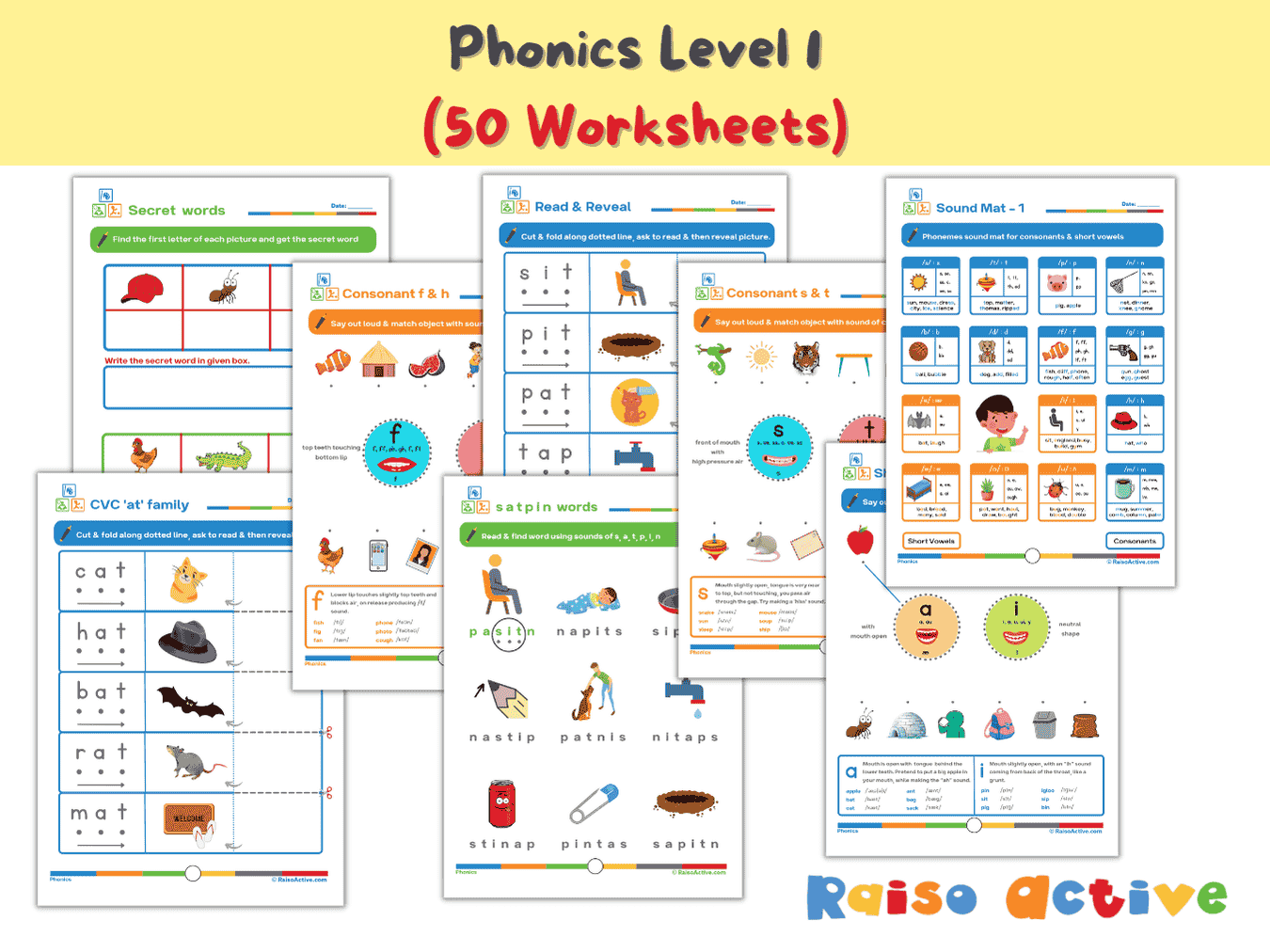
Phonics Level 1 Activity Book: Letter Sounds, Blending & CVC Words for Preschool & Kindergarten
Guides for parents and teachers
See all guides →Number Formation Rhymes 0–9 and How to Fix Reversals
Original number formation rhymes for 0–9, the correct stroke order for each digit, why 3, 5 and 7 get reversed most often, and multisensory fixes that work.
Christmas and Winter Activities That Combine Fun and Learning: Creating Magical Educational Experiences
Discover Christmas and winter activities that combine festive fun with real learning. Crafts, counting, literacy, and printable worksheets for ages 2 to 8 — perfect for home and school.
Age-Appropriate Halloween Learning Activities: Balancing Spooks and Skills for Young Learners
Discover fun, age-appropriate Halloween learning activities for young children. Spooky crafts, counting games, literacy ideas, and printable worksheets for ages 2 to 8.
The Power of Music: How Musical Activities Accelerate Learning Development in Young Children
Discover how musical activities accelerate brain development, phonics, maths, and emotional regulation in children ages 1–8. Practical tips for Indian homes and classrooms.
What's the Best Alternative to ABCmouse? A Complete Parent's Guide to Free and Affordable Educational Apps
ABCmouse runs ~Rs 4,000-5,000/year with US spellings and curriculum. Compare free & affordable Indian-friendly apps like Khan Academy Kids and DIKSHA.
Is Khan Academy Kids Really Free? A Parent's Complete Guide to Costs, Features, and Hidden Fees
Confirmed: Khan Academy Kids has zero subscription fees, ads, or paywalls. See what's included, age-by-age tips, and offline use for Indian families.
Canonical: https://raisoactive.com/worksheets/preschool-counting