Free printable worksheets · United Kingdom
Reception English Worksheets (Ages 4–5)
Reception english worksheets are practice sheets for children aged 4–5 in Reception in the UK. English covers letter and sound recognition, reading, vocabulary, grammar and writing, building from spoken language toward independent sentences. The sheets on this page cover letter recognition and phonics, reading comprehension, sentence writing and vocabulary and grammar.
Reception is the year phonics teaching properly begins, usually with Phase 2 of Letters and Sounds or an equivalent scheme, so a child starts blending sounds such as s, a, t and p into short words within weeks. Number work stays within ten, built through subitising and comparing rather than counting alone. At four to five the sound of a letter matters as much as its name. A set should pair each capital with its lowercase form, attach a sound to most letters and find pictures that start with it, practice rhyming and beginning sounds, blend three spoken sounds into a word, trace and then copy the child's name, and put pictures from a story in order. Reading words on the page is emerging, not expected.
1082+ worksheets · free PDF download · print on A4 or Letter
Reception English Worksheets to print
Browse all worksheets for ages 4–5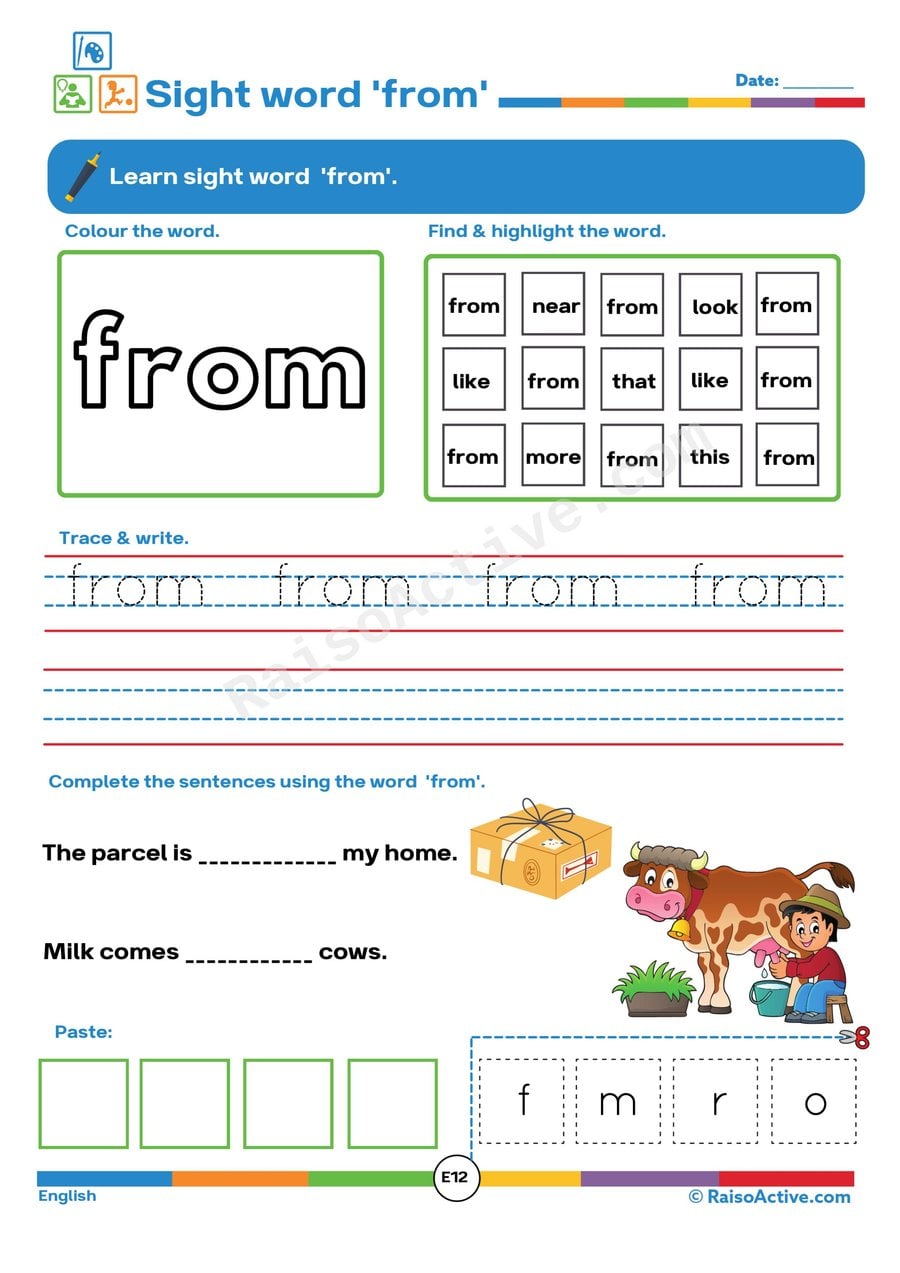
Sight Word 'From' Worksheet: Trace, Find, and Write!
This worksheet targets the sight word 'from' through a five-step sequence of coloring, searching, tracing, writing, and sentence practice, giving children ages 4-5 the repeated, varied exposure needed to recognize this common word instantly rather than sounding it out each time. Because 'from' appears constantly in early reading material, building fluency with it directly supports smoother, more confident reading of simple sentences and books.

Trace and Count the Number 16 Worksheet for Preschoolers
This worksheet has children ages 4-5 trace the two-digit number 16 and then count and color a full set of sixteen squares, continuing to build counting stamina in the teens range that many children find more challenging than counting to 10. Because 16 combines a 1 and a 6, tracing it reinforces the same two-digit writing pattern practiced with numbers like 11 through 15, helping children generalize the pattern rather than treating each teen number as entirely new. Counting squares instead of round objects also quietly introduces basic shape vocabulary.

Does Not Match: Circle the Odd Word Out Worksheet
This worksheet builds critical thinking alongside phonics for children ages 4-5 by having them examine a group of words and identify the one that doesn't belong based on its initial sound. Spotting the 'odd one out' requires more than just reading each word individually — your child has to compare all the words in a group simultaneously and reason about which shared feature the majority have in common. This kind of comparative reasoning strengthens both phonemic awareness and early logical thinking, since it's not enough to read correctly; your child also has to analyze and categorize.

CVCC Word Matching Worksheet: Read, Colour, and Match!
This worksheet builds on basic CVC reading by introducing CVCC words — words ending in two consonants, like 'lamp' or 'nest' — for children ages 4-5 to read, color, and match to pictures. Ending consonant blends require children to hold onto and pronounce two closing sounds without dropping one, refining the precision of their blending skills beyond simple three-letter words.
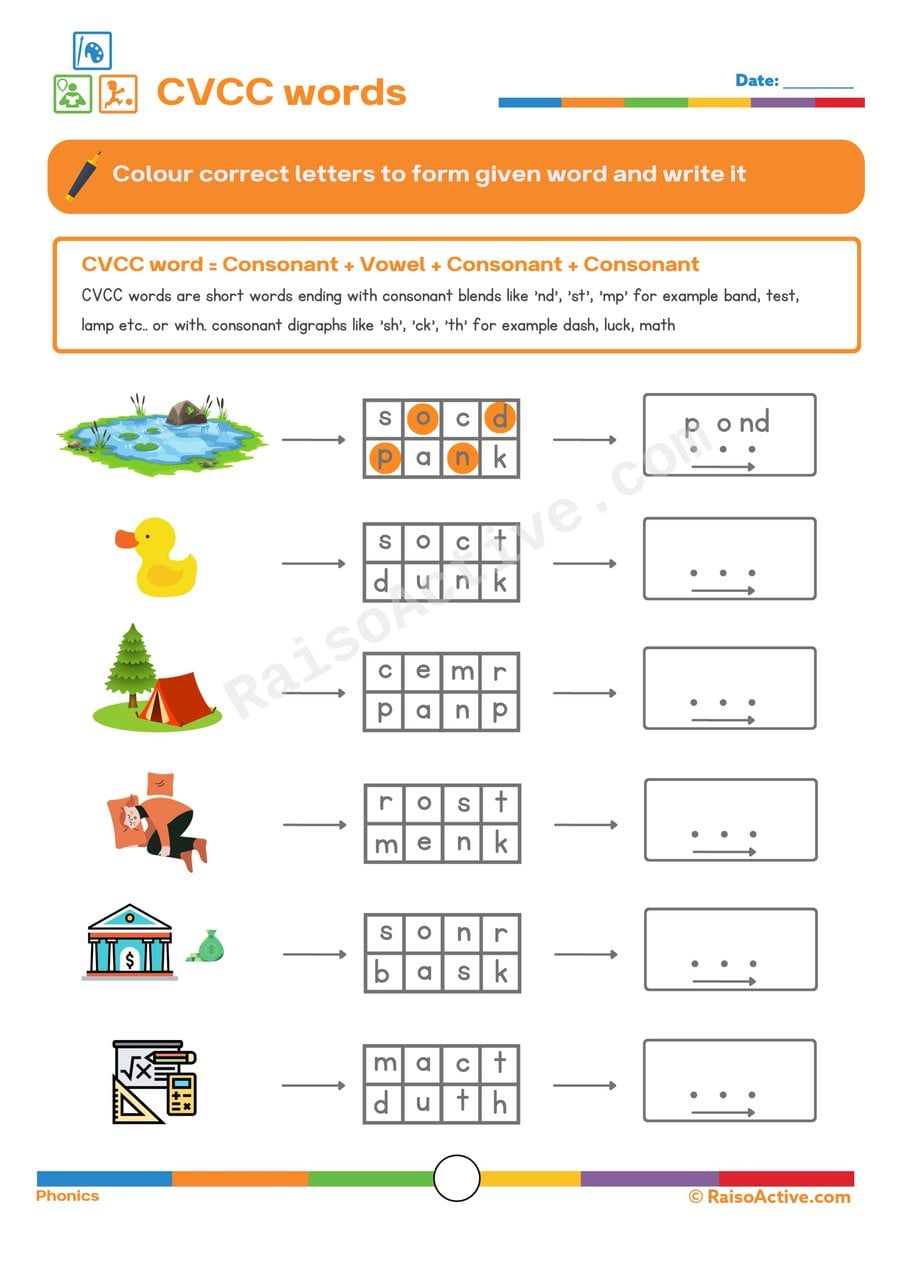
CVCC Word Fun: Color, Read, and Write!
This worksheet has children ages 4-5 identify and write CVCC words by coloring the correct letters shown in letter boxes and then writing the complete word based on a picture cue. Coloring specific letters before writing the whole word breaks decoding into a manageable first step, helping children build the word piece by piece rather than facing the whole spelling task all at once.

Match and Write: Beginning Sounds Worksheet for Preschoolers
Preschoolers ages 4-5 build the foundation of phonics by connecting a spoken sound to its written letter, and this worksheet has them do exactly that by matching beginning sounds to specific pictures before writing the full word. This two-step process — first identifying the sound, then producing the letters that spell it — bridges listening skills into early writing, a jump that's often the hardest part of learning to read. Practicing beginning sounds repeatedly also builds the mental habit of decoding words letter by letter instead of guessing from pictures alone.

Lowercase Letter Matching Worksheet for Preschoolers
This worksheet gives children ages 4-5 practice connecting uppercase letters to their lowercase form by circling the correct match from a set of answer choices, a skill that's essential since most of the reading material children encounter is printed in lowercase. Many lowercase letters look quite different from their uppercase counterpart, so this matching task genuinely tests whether the connection has been learned rather than guessed.

Circle the Correct Letter: Fun Phonics Worksheet for Kids
This phonics worksheet helps children ages 4-5 connect a picture's beginning sound to its matching letter, a key decoding skill on the path to independent reading. Circling the correct letter from a small set of choices also builds visual discrimination, since children must tell similar-looking letters apart under a bit of time pressure.
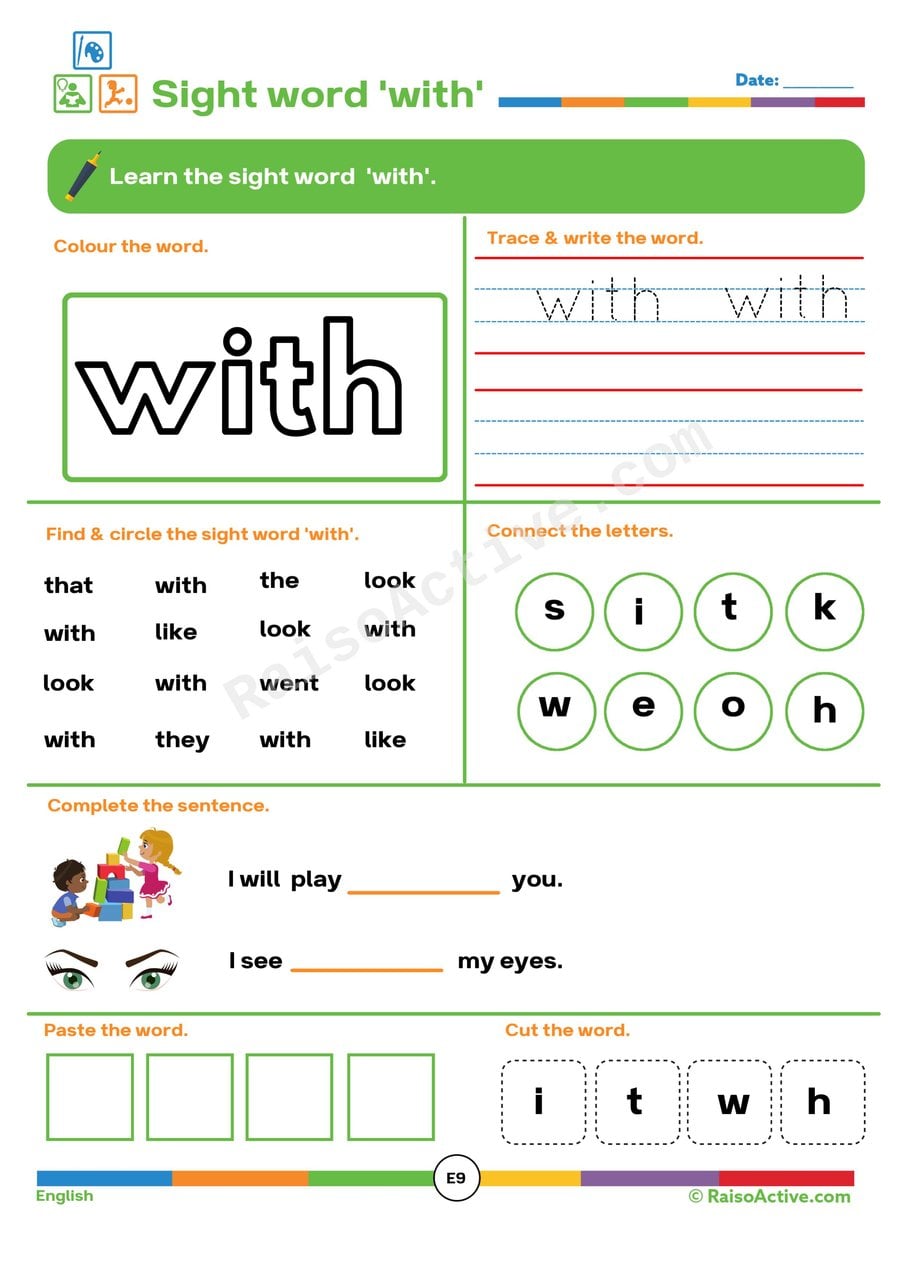
Sight Word 'With' Worksheet: Trace, Write, and Find!
This worksheet gives 4-5 year olds repeated, varied practice with the sight word 'with' — coloring it, tracing and writing it, finding it in a list, completing a sentence, and cutting and pasting it — because sight words like 'with' don't follow simple sound-out rules and need to be recognized instantly by sight rather than decoded each time. That instant recognition is what lets a young reader move smoothly through a sentence instead of stumbling on common connector words.
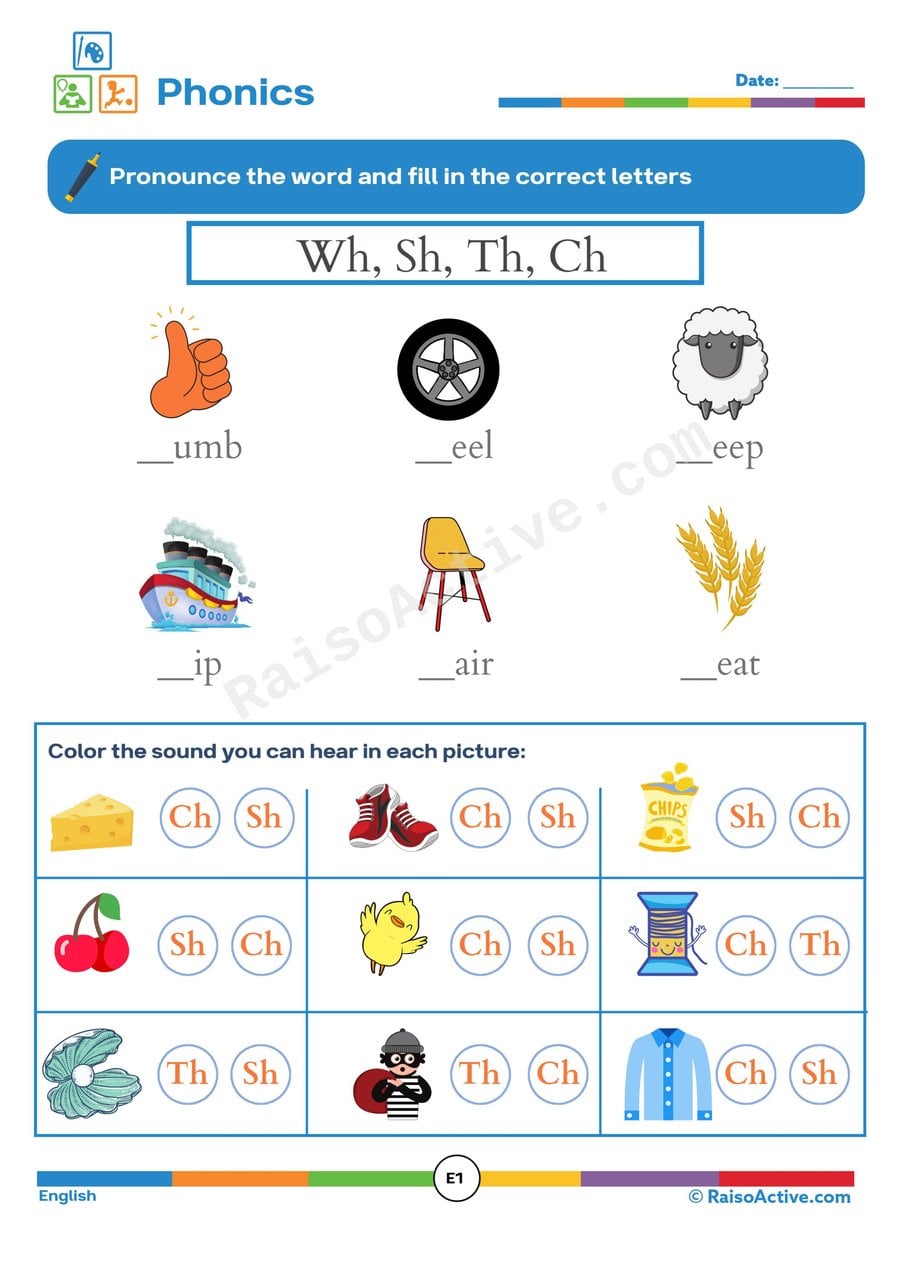
Wh, Sh, Th, Ch Sounds Worksheet for Preschoolers
Filling in missing letters to complete words with the digraphs wh, sh, th, and ch teaches children ages 4-5 to recognize these blended consonant sounds, which behave differently from single letter sounds and require dedicated practice to master. Coloring the picture that matches the correct sound afterward reinforces the connection between the blended sound and its spelling.

Tracing and Counting Fun: Number 5 Worksheet for Preschoolers
Children ages 4-5 practice tracing and writing the number 5 while reinforcing counting up to five through a picture-based matching task. Repeating the number in multiple formats — tracing, writing, and counting — helps cement both the shape of the numeral and the quantity it represents.

Learn the Letter 'x' Worksheet: Tracing, Matching, and Coloring Fun!
This worksheet builds recognition of the less common letter x through tracing both uppercase and lowercase forms, then reinforces that recognition through matching pictures and highlighting the letter within a grid. For ages 4-5, letter x is genuinely rare at the start of everyday words, so this worksheet leans on strong examples like 'x-ray' to build familiarity despite limited real-world exposure.

Sight Word 'Your' Worksheet: Tracing, Coloring, and Sentence Practice
Children ages 4-5 build sight word automaticity for 'your' — a word that can't be sounded out with basic phonics rules and must instead be recognized instantly for fluent reading. Multiple exposure formats (coloring, tracing, searching, and using it in a sentence) help move the word from short-term recognition into long-term memory, a rehearsal strategy that is especially important for high-frequency 'trick' words.

Counting Fun: Number Names Worksheet for Preschoolers!
This number-names worksheet pushes children from simply counting objects to connecting a quantity with its written word, a step that bridges early numeracy with beginning literacy. Ages four and five are ready to start recognizing that 'three' is both a group of three dots and a specific string of letters, which strengthens both number sense and sight-word recognition.
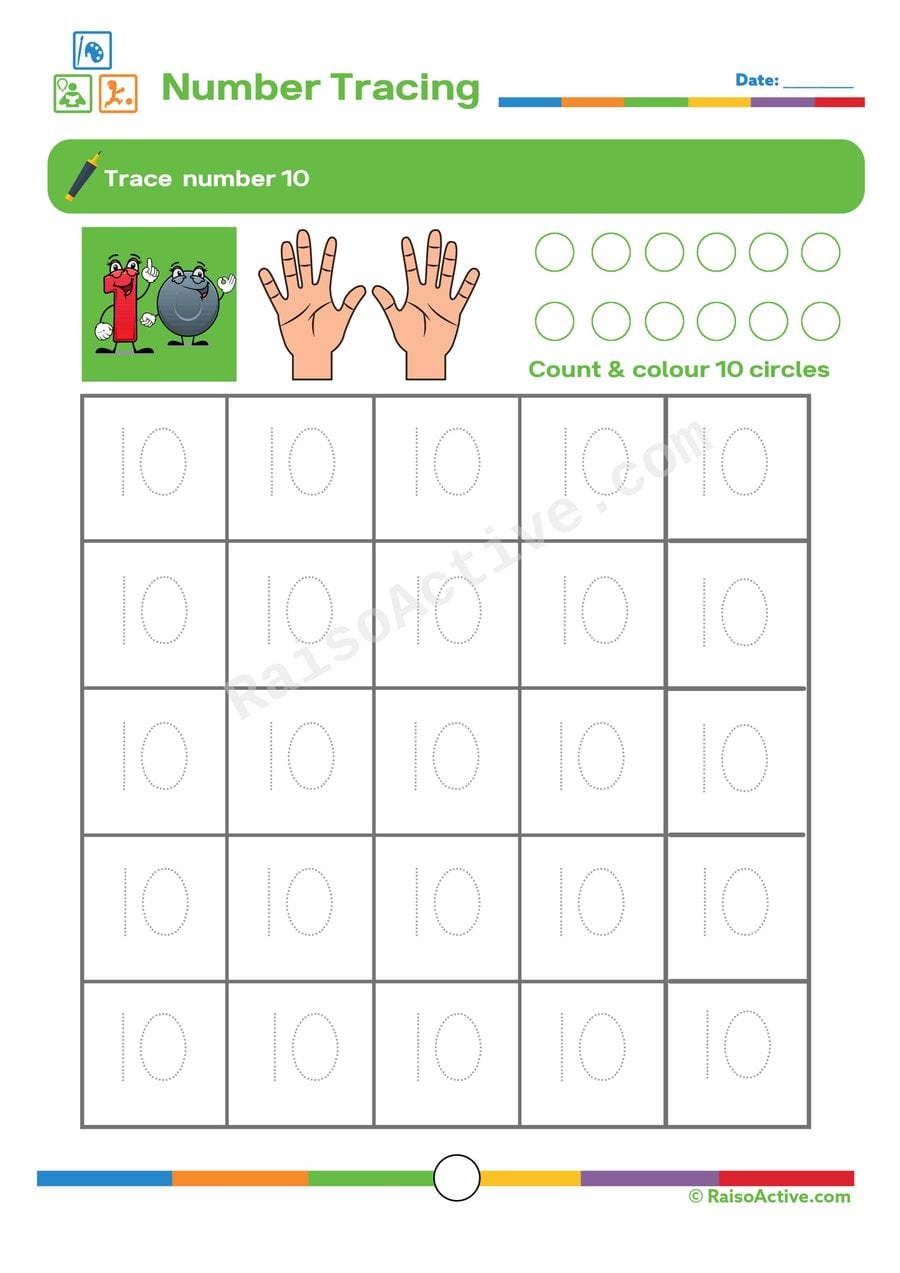
Trace and Count to 10! Number Tracing Worksheet
This worksheet has children ages 4-5 trace the number 10, their first two-digit number in a structured sequence, and then count and color a full set of ten circles, reinforcing that 10 represents a complete group of two fives or one full set of fingers on both hands. Practicing 10 also marks an important transition point, since children who can confidently count, write, and represent 10 are ready to begin extending their counting into the teens. This combination of tracing and counting to a meaningful benchmark number builds solid number sense.
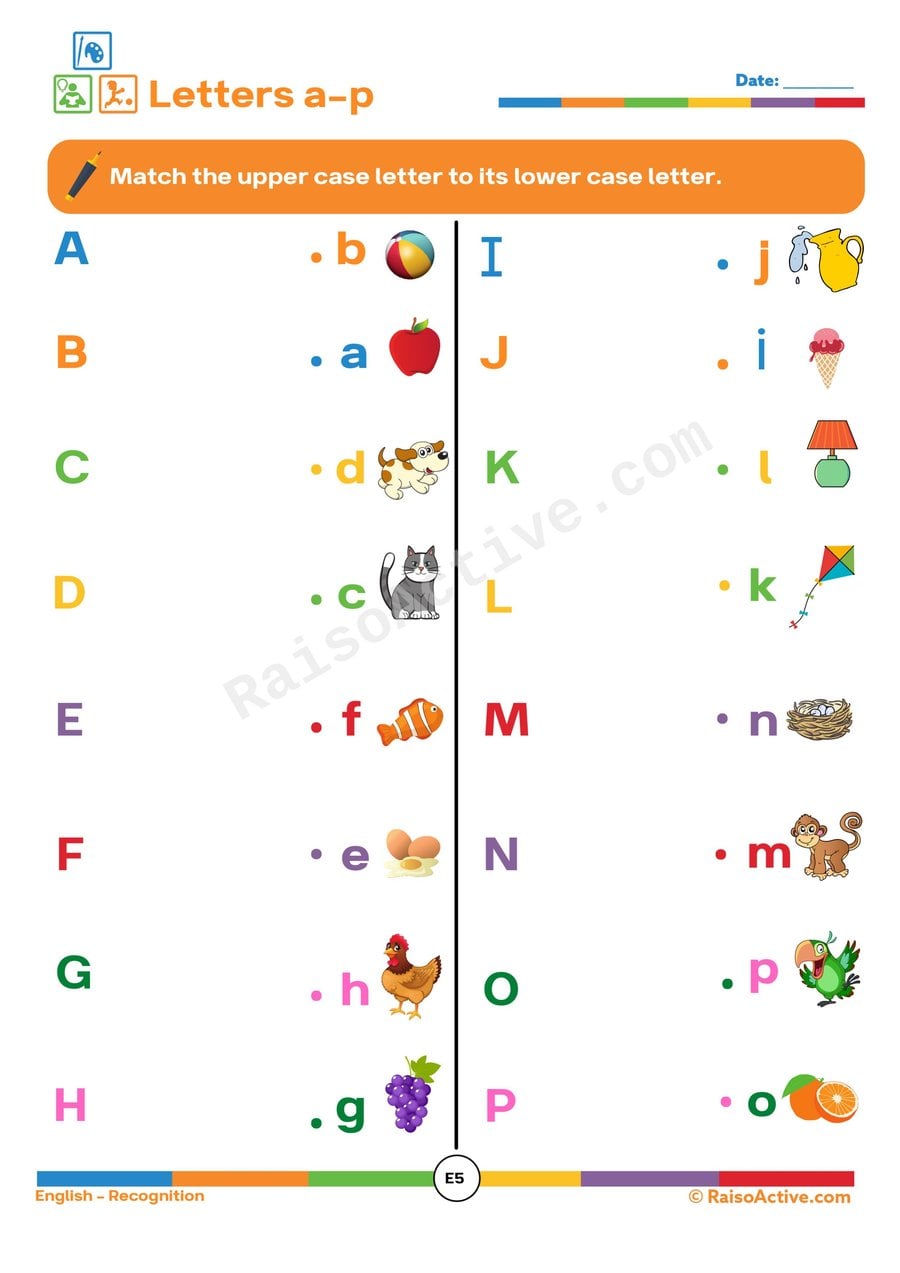
Match the Uppercase Letters: A-P Worksheet
This worksheet strengthens your child's visual discrimination skills by focusing on uppercase letters from A to P. Children aged 4-5 years develop crucial pre-reading abilities as they learn to identify and pair identical letter forms. Mastering this matching task builds a strong foundation for future letter recognition and early literacy success.
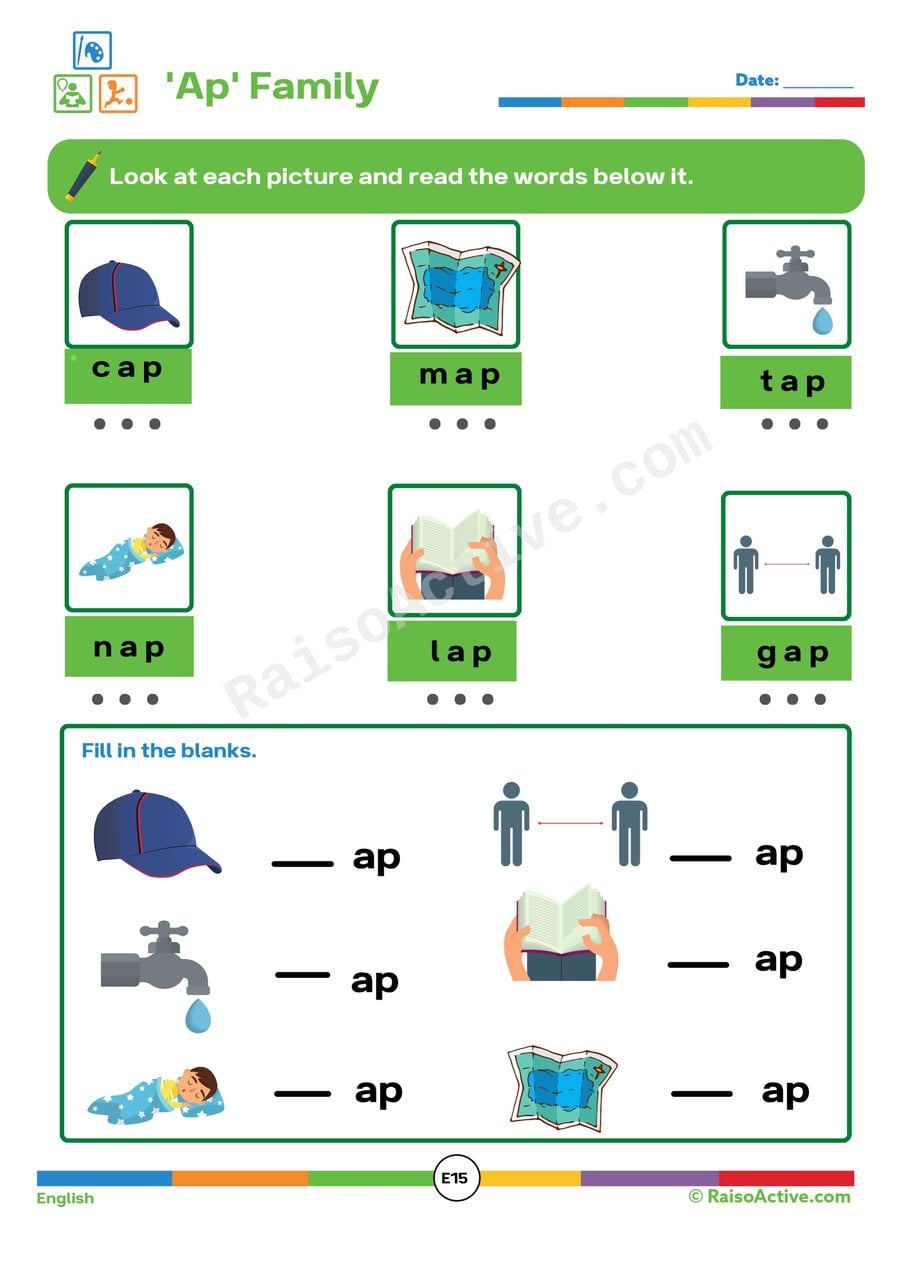
Ap Family Worksheet: Read and Fill in the Blanks!
Continuing the word-family approach, this worksheet helps children ages 4-5 read and complete 'ap' words such as cap, map, and tap by filling in a missing letter, reinforcing the pattern that a shared ending sound can appear across many different words. This kind of practice builds decoding speed and phonics confidence ahead of more independent reading.

Writing Number 6 Worksheet: Trace, Color, and Count!
This worksheet builds number 6 recognition for 4-5 year olds through tracing, coloring, and counting practice, connecting the written numeral to an actual quantity of objects your child counts aloud. Bringing formation, counting, and independent writing together in one page reinforces that '6' isn't just a shape to copy but represents a specific, countable amount, which is the real foundation of number sense.

Am Words Worksheet: Read, Match, and Fill-in the Blanks!
This worksheet builds phonics skills within the 'am' word family — words like 'ham,' 'jam,' and 'Sam' — by having children read words aloud, match them to pictures, and fill in missing letters to complete them. For four- and five-year-olds, working within a single rime family like '-am' helps children generalize a decoding pattern they can apply to many new words, rather than sounding out every word from scratch.

Learn the Sight Word 'the' - Fun Worksheet for Early Readers!
'The' is one of the most frequently occurring words in the English language, and because it doesn't follow regular phonics rules, children ages 4-5 need to learn it by sight rather than by sounding it out. This worksheet builds that instant recognition through several different modes — coloring, tracing, searching, and using it in a sentence — which research on early literacy shows helps sight words stick more firmly than a single repetition. Mastering 'the' specifically gives children a huge boost in reading fluency, since it appears in nearly every simple sentence they'll encounter.

Sight Word 'THE' Worksheet: Trace, Write, and Identify!
This worksheet builds automatic recognition of the sight word 'the,' one of the most frequently occurring words in English text, through repeated tracing, writing, and identification practice. For four- and five-year-olds, memorizing high-frequency sight words like 'the' by sight — rather than sounding them out each time — is essential for building reading fluency, since these words appear on nearly every page a child will read.

These or Those Worksheet: Identifying Plural Nouns
Children ages 4-5 build on singular demonstrative pronouns by learning 'these' and 'those,' the plural forms used to describe groups of objects that are near or far. Understanding this distinction strengthens both grammar and the ability to judge distance and quantity together in a single sentence.
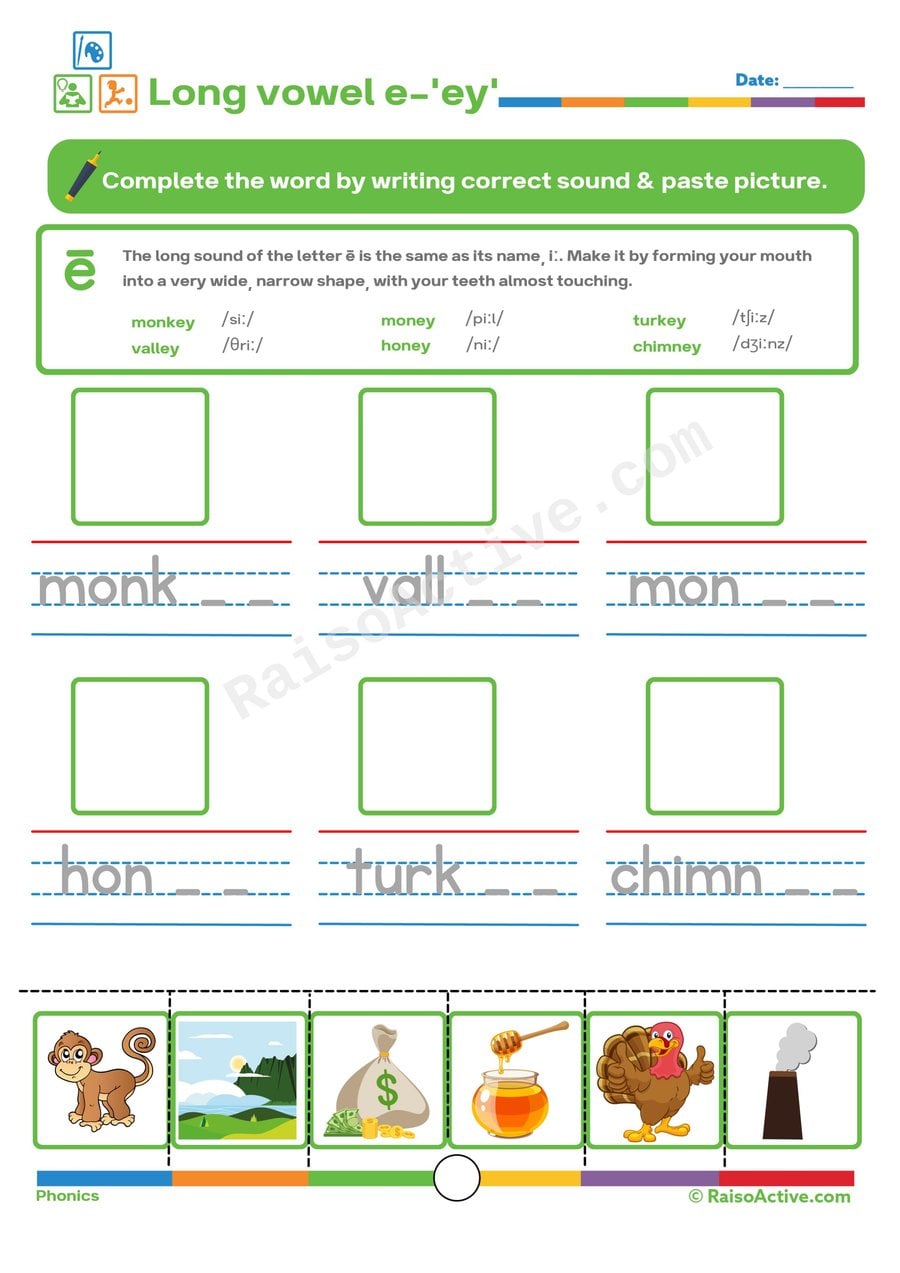
Long Vowel E Worksheet: Write, Match & Paste!
This worksheet gives children ages 4-5 practice with the long 'e' sound, as in 'bee' or 'leaf,' by having them fill in a missing letter to complete a word, match that word to its correct picture, and paste the picture into place. Combining spelling, reading, and picture matching in one activity reinforces the long 'e' sound from multiple angles, helping the sound-spelling connection stick more firmly than any single task alone.

Learn the Sight Word 'Are' Worksheet for Preschoolers
Children ages 4-5 build instant recognition of the high-frequency sight word 'are', a word that doesn't sound out phonetically and must be memorized by sight to support reading fluency. This multi-step worksheet reinforces the word through five different modes — coloring, searching a grid, tracing, writing, and a watercolor technique — giving repeated exposure that strengthens memory. Practicing 'are' in context through fill-in-the-blank sentences also helps children see how the word functions within real sentences.
What Reception english worksheets cover
At four to five the sound of a letter matters as much as its name. A set should pair each capital with its lowercase form, attach a sound to most letters and find pictures that start with it, practice rhyming and beginning sounds, blend three spoken sounds into a word, trace and then copy the child's name, and put pictures from a story in order. Reading words on the page is emerging, not expected.
- Match uppercase to lowercase for all 26 letters
- Say a letter's sound and find pictures that start with it
- Trace, then copy, the child's own name
- Blend three sounds said aloud into a word
- Put three pictures from a story in the right order
How to use these worksheets at home or in class
A short daily sound-matching or blending sheet paired with one number activity, around ten minutes total, mirrors the classroom rhythm. Say each sound clearly before your child traces or writes it, and keep the pace playful rather than test-like.
Start with the sheet that matches what your child can already do, then move one step up. Keep finished sheets in a folder: Reception teachers often ask for evidence of practice, and children like seeing their own progress.
Is your child ready for Reception english work?
A child moving into this stage typically holds a pencil with a developing grip, recognises several letters by sound rather than only by shape, and can count a small group of objects one at a time without skipping any.
Frequently asked questions
Should my four-year-old be reading yet?
Not yet, and most are not. The readiness signs are knowing the sounds of most letters, hearing the first sound in a spoken word, and blending three sounds an adult says into a word. Those three skills are what the year's worksheets should build. Decoding a written three-letter word typically starts at five. A child who begins earlier is fine; a child who does not is on schedule.
What should a Reception child be able to do in english?
At four to five the sound of a letter matters as much as its name. A set should pair each capital with its lowercase form, attach a sound to most letters and find pictures that start with it, practice rhyming and beginning sounds, blend three spoken sounds into a word, trace and then copy the child's name, and put pictures from a story in order. Reading words on the page is emerging, not expected. A child moving into this stage typically holds a pencil with a developing grip, recognises several letters by sound rather than only by shape, and can count a small group of objects one at a time without skipping any.
Do these worksheets follow the Reception curriculum?
The sheets cover letter recognition and phonics, reading comprehension, sentence writing and vocabulary and grammar, which sit inside the EYFS Early Learning Goals; Letters and Sounds Phase 2–3 outcomes for Reception. Pre-K / Kindergarten (US), LKG (India) use the same skills at this age, so the sheets also fit families following those programmes.
Are these Reception english worksheets free?
Yes. Each worksheet downloads free as a watermarked PDF once you create an account, with a limit of five a day. An annual membership ($20) removes the watermark and the limit for the whole library of over 1,000 worksheets and every printable pack.

Written by
Hemsweta Jain · Teacher Cheena
MBA and Early Childhood Educator, teaching since 2014 · Founder of RaisoActive, Mumbai
Written and reviewed by Hemsweta Jain (Teacher Cheena), who designs every RaisoActive worksheet.
Last reviewed
Printable packs for ages 4–5
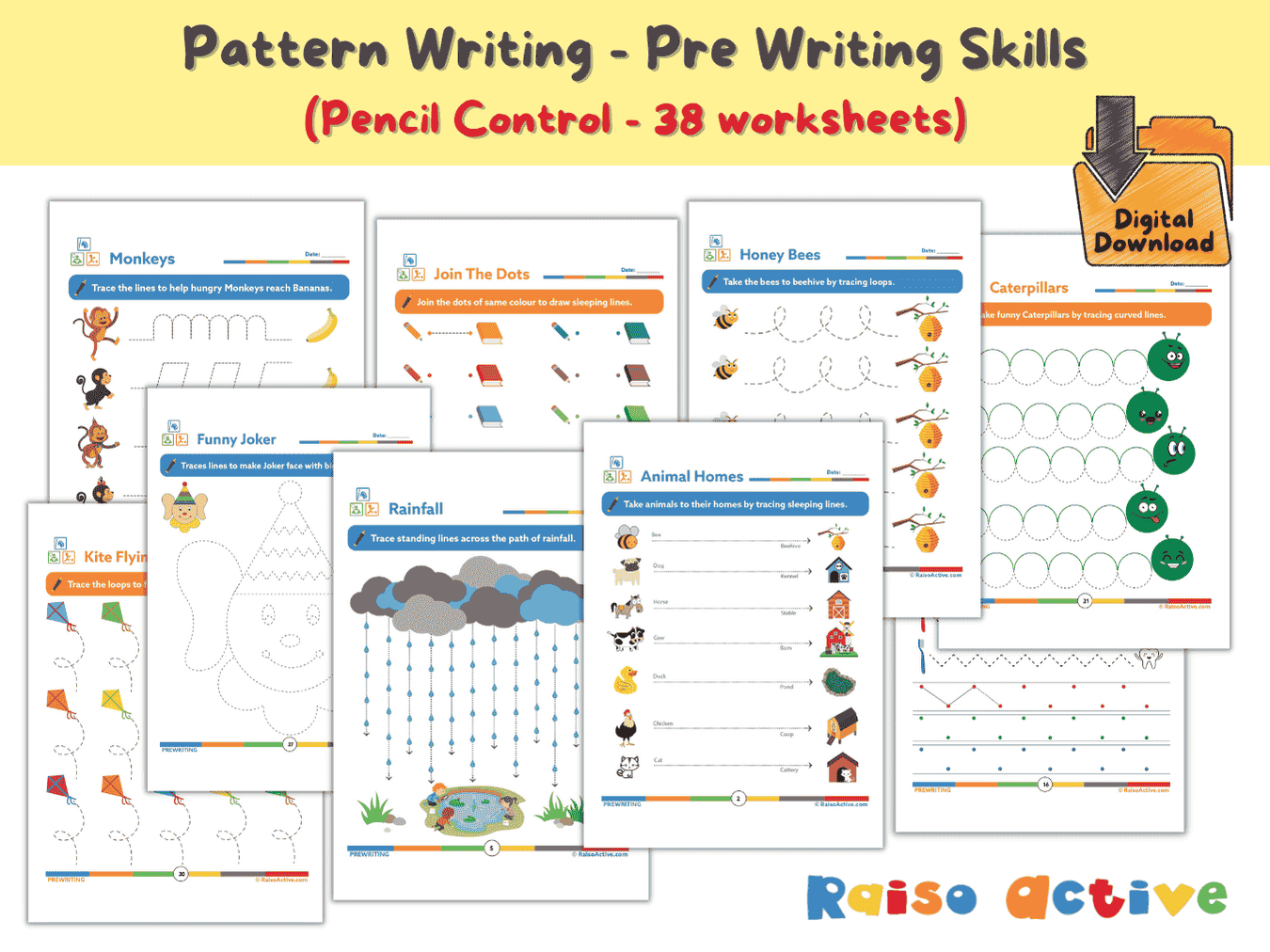
Pattern Writing Pre-writing Skills Activity Book for 3-4 Year Olds
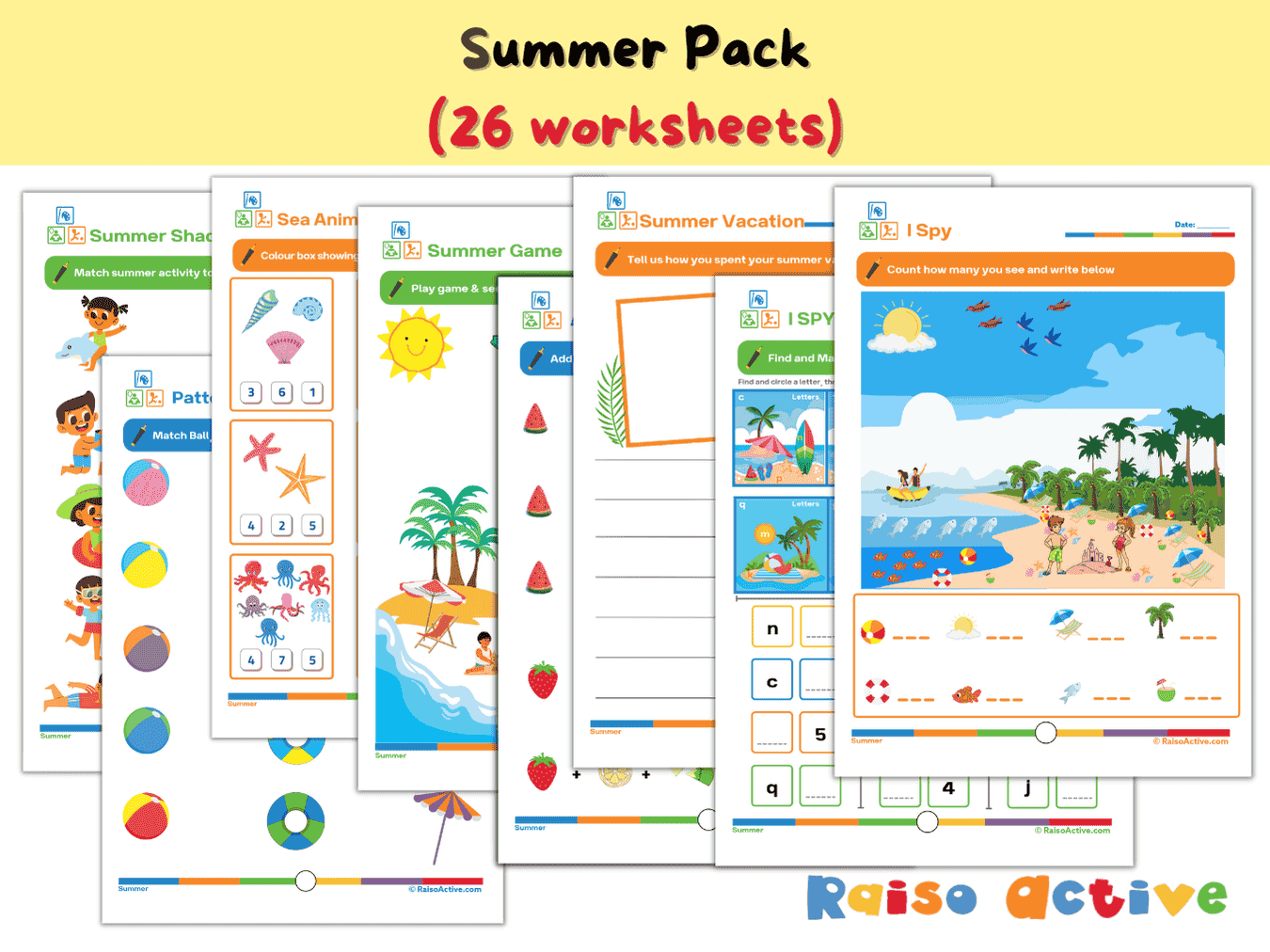
Summer Activity Pack: Math, Literacy, Puzzles & More for Preschool & Kindergarten
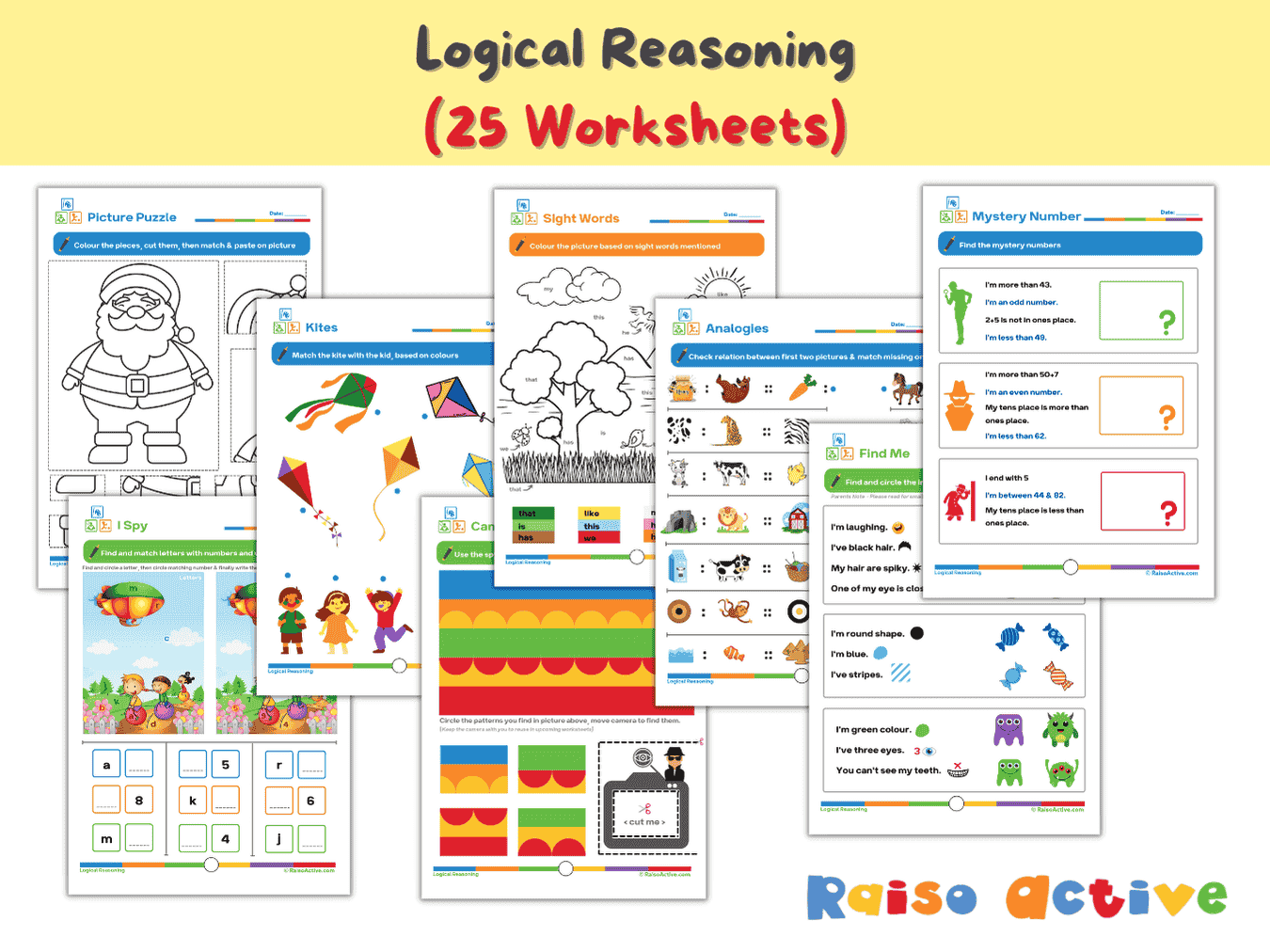
Logical Reasoning Activity Book for Preschool & Kindergarten | Patterns, Puzzles & Analogies
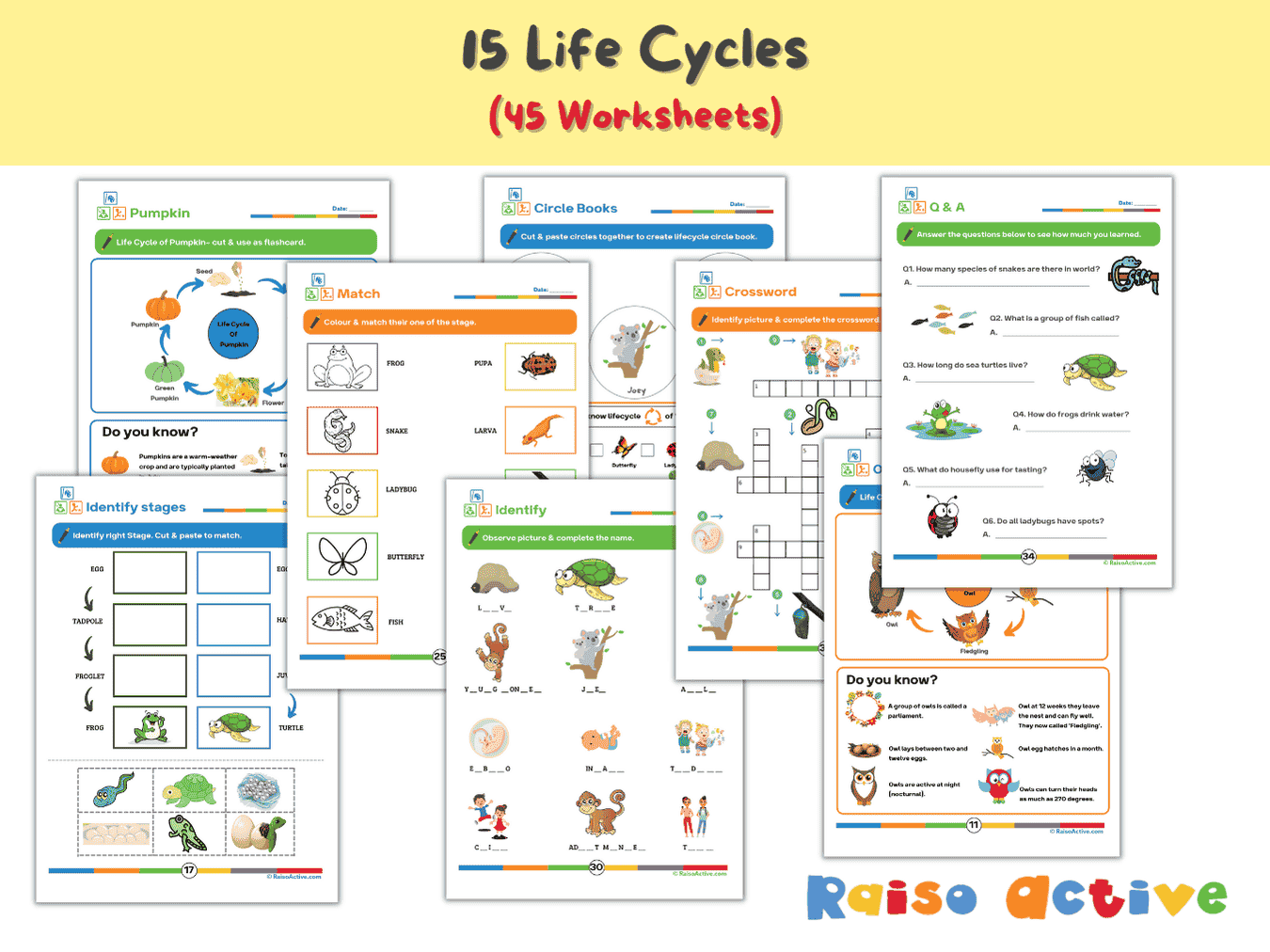
Lifecycles Activity Book & Flashcards for Preschool & Early Elementary
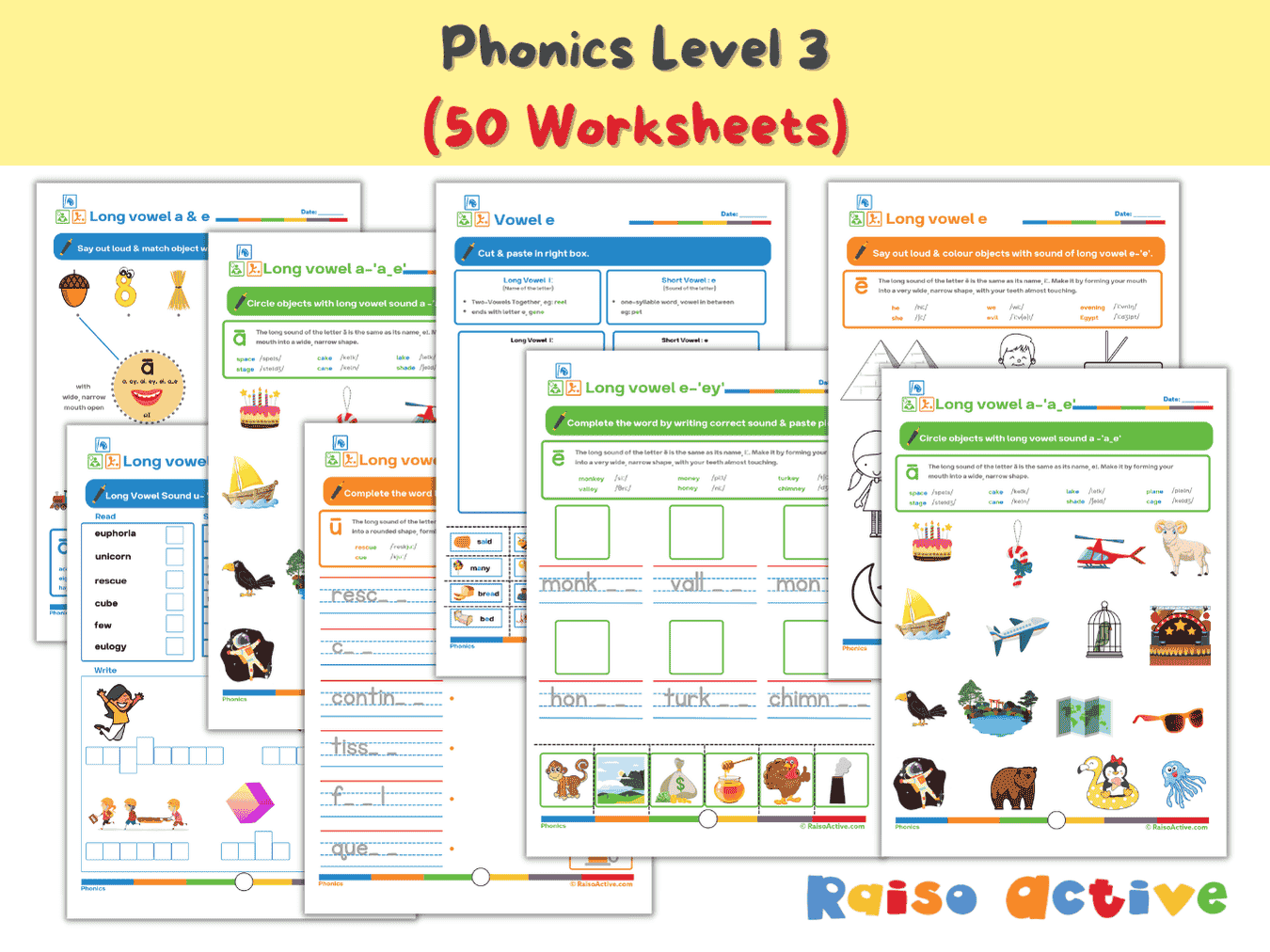
Phonics Level 3 Long Vowels Activity Book for Kindergarten & 1st Grade
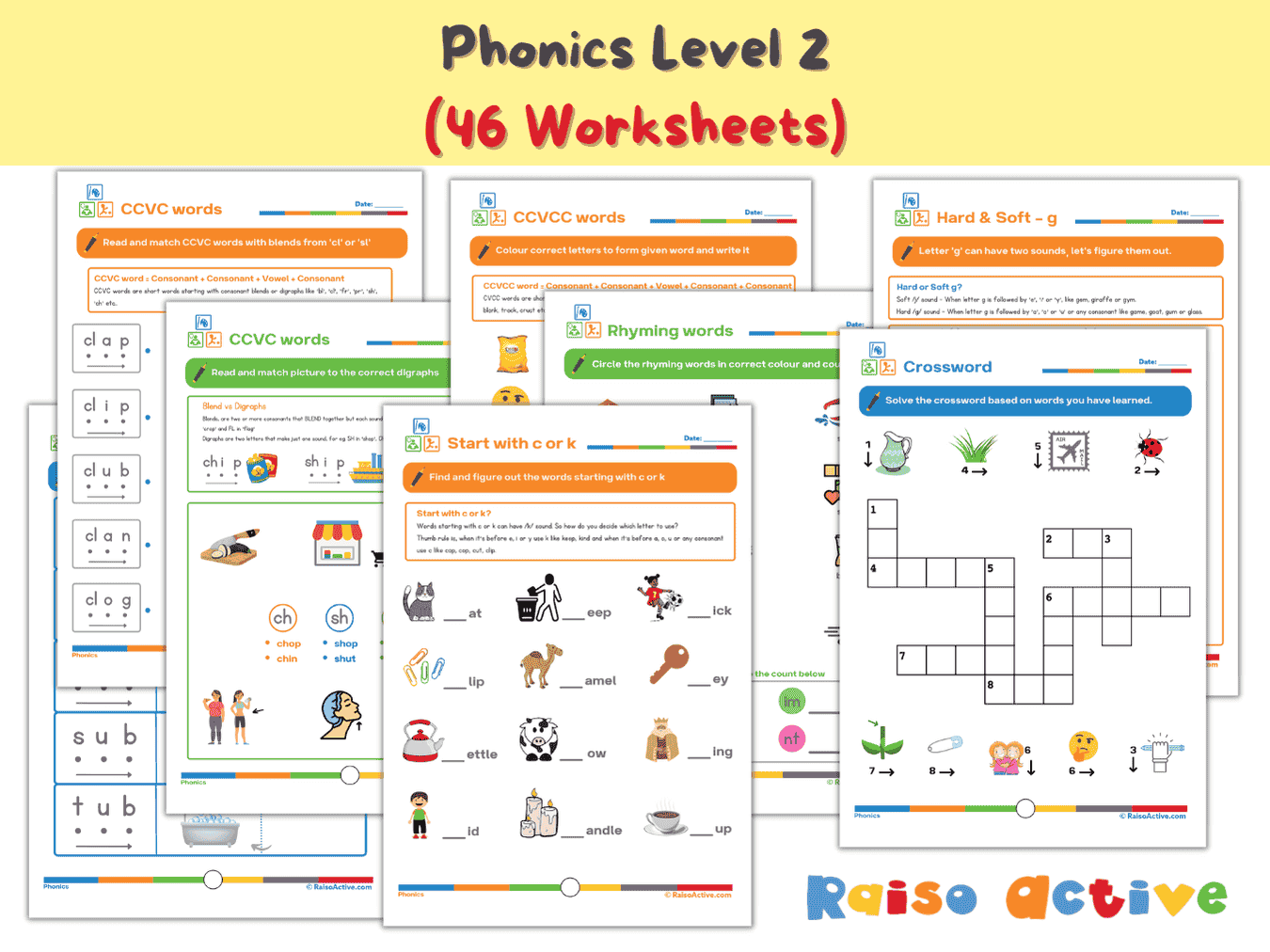
Phonics Level 2 Worksheets: CVC, CCVC, CVCC Word Families & Blends for Early Readers (Ages 4-7)
Guides for parents and teachers
See all guides →Sight Words by Age: The First 50 Words and How to Teach Them Without Flashcard Fatigue
Which sight words to teach first and why, the heart-word method, a read-trace-write-find routine, games, and a by-age table of typical sight-word progress.
How to Teach CVC Blending: A Step-by-Step Method That Works in Two Weeks
A step-by-step method for teaching CVC blending, covering continuous sounds, word families, common errors, and a 14-day plan that most children finish reading CVC words.
Phase 2 Phonics at Home: Sound Order, Blending Games, Worksheets
Phase 2 phonics at home: the five sound sets in order, oral blending, tricky words, a two-week routine, common mistakes, and free worksheets.
Reception Year Explained: EYFS Learning and How to Help at Home
A teacher's plain-English guide to the Reception Year: the seven areas of learning, Early Learning Goals, Phase 2/3 phonics, the RBA and home routines.
UKG Syllabus Explained: English, Maths and EVS Month by Month
What UKG classes typically cover in English, maths and EVS, month by month, aligned to NEP 2020, with ways to support at home and signs your child is behind.
Bridging Two Worlds: A Complete Guide to Teaching Heritage Languages Alongside English
A practical guide to raising bilingual children who speak both their heritage language and English with confidence. Research-backed strategies, activities, and tips for Indian families.
Canonical: https://raisoactive.com/worksheets/reception-english